The Steppe Worldview
Stretching thousands of miles from the Mongolian-Manchurian grassland to the Crimean Peninsula, the Eurasian steppe belt was once home to diverse communities of warrior-herdsmen whose lifestyle and economy were based on pastoralism with various forms of seasonal migrations. Eurasian pastoralists lived on the geographical peripheries of agrarian societies and powerful sedentary empires and have as a result been pushed to the conceptual fringes of most historiographies and scholarly inquires. “Visual culture”, “visual rhetoric”, and “aesthetics”, terms so commonplace in the art-historical canon, seldom appear in studies of steppe peoples in Eurasian Antiquity.Footnote 1 One often speaks of seasonal itinerants as manufacturers, traders and circulators, but rarely does one conceive of them as makers, designers and trend-setters. Eurasian steppe art is rich in visual complexity and showcases extraordinary feats of conceptual design and craftsmanship starting as early as 800 bce. Hereafter, I focus on an emblematic example of what I qualify as “portable steppe luxury”, known under the umbrella term “animal style”. This approach to portable decoration refers to the luxurious metalwork, embellished with zoomorphic designs of entwined, abbreviated or stylised animal forms, which the steppe elites would transport on their bodies and horseback in seasonal or forced migrations. Tombs and hoards along the steppe, particularly in the Ordos plateau (North China), Mongolia, South Siberia, Kazakhstan, Crimea and parts of the Balkans have yielded thousands of plaques, belt buckles, torques, headdresses, horse trappings, and other types of personal adornment once commissioned and produced by the steppe elites. Private and museum collections in Russia, China, Mongolia, Kazakhstan, Ukraine also contain steppe gold jewellery, much of which came into the possession of nineteenth and twentieth-century private collectors through the subversive trade of plunder from elite steppe tombs. So persistent was grave looting around Siberia and the Urals that its impact reached the court of Peter I (1672-1725), who later issued an edict making grave robbery a serious crime equal to treason and demanding that all exhumed grave inventories belonged to the sovereign.Footnote 2 The Tsar's own exquisite gold collection and its later additions through imperial excavations and diplomatic gifts, now housed at the State Hermitage Museum in St Petersburg, contains around two-hundred and forty precious animal-style items thought to have come from ancient Siberian burials of nomadic elites.Footnote 3 Steppe treasures are not limited to gold, although this high-value metal dominates the archaeological and museum records; we encounter the same conceptual designs and visual tools on nomadic funerary furnishings and textiles.
How do we conceptualise the complexity of steppe zoomorphic designs and tropes in the broader picture of early Eurasian Antiquity? How do we move beyond a simple acknowledgment of the value of these treasures toward a more in-depth study of their meaning within and not only on the fringes of the interconnected ancient world? The present study suggests that portable steppe artworks, originally meant to display status, political clout and access to resources “on the move” (hence, the term “portable luxury”) should be studied in the context of image-making, and specifically the making of monsters. Whimsical zoomorphic creations are admittedly not unique to the domain of steppe pastoralists, but as the following analysis will show, they do follow a different visual formula, reflective of a uniquely steppe worldview and one rooted in a pastoralist community's intensive interactions with nature. While the following sections concentrate on pastoral societies, non-pastoral and non-nomadic “fringe” groups (e.g. Thracians) living on the outskirts of sedentary empires will be brought into the conversation about the transmission of composites, due to their close interactions with steppe peoples and their continued yet problematic absence in the art-historical canon.
Design formulas rooted in entwined zoomorphic junctures, species metamorphosis and predatory confrontation are found across various modes and media, and they also managed to partially permeate the visual cultures of neighbouring sedentary empires such as Zhou-dynasty China, Achaemenid Persia and Classical Greece in Early Antiquity. Noteworthy case studies of animal style in a mortuary context come from the Iron-Age culture of Pazyryk. A saddle cover featuring a classical animal-style design was excavated from one of the five Pazyryk barrows, nested in the High Altai mountains of South Siberia and occupied by a group of equestrian nomads in the Iron Age (5th – 3rd Century bce).Footnote 4 Finished in the appliqué technique, the piece features bilateral symmetry of two entwined configurations located on opposite sides of an axis. A griffin preys on an ibex in this fantastic, colourful battle. The saddle is made of felt, which was the most commonly utilised material in the making of collapsible dwellings (yurts), clothing, and other furnishings in early steppe communities.
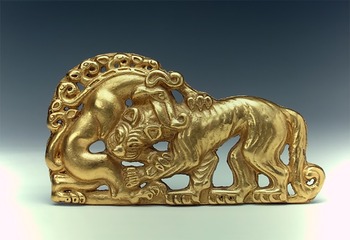
This entangled zoomorphic configuration is ubiquitous across tombs and wealth deposits throughout the Eurasian steppe and has thus contributed to the equation of animal style to “animal combat scenes”. A gold piece from the nomadic art collection of Peter the Great echoes this visual trope.
Allegedly given to the Tsar's wife Catherine as a gift to celebrate the birth of their first-born son, this gold object encompasses the main characteristics of the “animal style” visual language. Yet again, the viewer encounters a fantastic animal (an ungulate with stylised deer antlers terminating into raptor heads) biting onto the back of a regular feline. Fantastic and ordinary converge in a bizarre entanglement of anatomies and textures. This idiom, based in the interlace of animal forms resembling predation, emerges as far west as the plains of Dobrudzha in northern Bulgaria, an expanse of land inhabited by Thracian tribes around the fifth to fourth century bce.
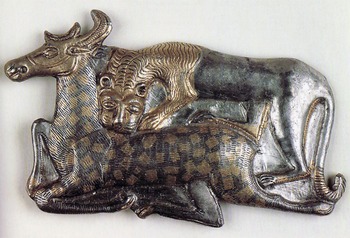
The majority of Thracian treasures found in burials in modern-day Bulgaria are contemporaneous with the discoveries from the Pazyryk archaeological culture. Thracian portable regalia, while consistent with nomadic visual tropes farther east, also reflects the cultural and economic interactions with their powerful neighbour Greece and the Achaemenid empire during that time. This silver cheekpiece from the Lukovit treasure discovered in Bulgaria depicts a lion and a recumbent deer.Footnote 5 Only the most characteristic elements of the animals’ anatomy, the seasonal spots and feline mane, are highlighted by gilding. Stylisation is the guiding principle in the rendition of the image, which, coupled with the upper silhouette of the biting lion, immediately recalls the Achaemenid approach to depictions of felines. Overall, the Thracian item echoes the portable format, metalworking techniques, already associated with steppe animal-style art, while also retaining certain stylistic features of Achaemenid art. It should be noted here that while “Thracian” in itself is a loose blanket exonym referring to various tribes, accounted for by Herodotus and other Greek thinkers, these people were a pastoral nomadic society like most of their steppe contemporaries.Footnote 6 Even so, they are vital actors in the following transmission scenario, because, much like their Scythian or Saka counterparts, they continued to be viewed as a ‘fringe’ society at the outskirts of powerful sedentary societies who occasionally subjugated by them. As such, their art, much of which was gold adornment, was acknowledged and valued only if it adhered to the pre-established prototypes of their powerful imperial neighbours Greece and Persia (e.g. Greek-style vases and plates, images of goddesses, and wall paintings found in Thracian tombs). In reality, the Dacians and Getae who inhabited the Dobrudzha grasslands and the larger Danubian plain in northern Bulgaria and Romania had more cultural affinities and shared artistic traditions with peoples from Central Asia than the canon has allowed us to recognise. The site of Lukovit which yielded the aforementioned animal-style silver item, along with other horse regalia consistent with steppe style, is nestled between the vast Danubian plain and the Balkan mountain range; this topographic configuration bears certain similarities with the forest-steppe further east. In fact, the archaeological record confirms that that animal-style idioms from the steppe flourished in certain parts of Thrace: a bronze matrix for glass decoration, featuring animal-style patterns, was found near the village of Gurchinovo in north Bulgaria, thus pointing to mass production of such imagery in the region.Footnote 7
It has so far become evident that elements or tropes of animal-style was highly transferable and reached the very far-flung corners of the steppe expanse on the Balkans. It could be beneficial to our analysis to take a step back here and look at shared features between the above-mentioned animal entanglement, in the form of confrontation or predation, and image-making in the major sedentary Eurasian empires.
Monstrosity and ‘Otherness’
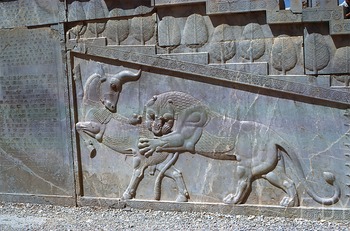
The aforementioned animal-style images are reminiscent of the monumental relief on the staircase of the Apadana palace erected in Persepolis around the 6th century bce (Fig. 4) This period was marked by the intense migrations and military activities of steppe alliances (e.g. the so-called Scythians) across various cultural zones in Eurasia. Yet, in the art-historical canon of the early 20th Century, the directionality of exchange would have been defined by an old framework: as a rule, settled societies are thought to engulf, culturally and socially, their non-sedentary neighbours. Before delving into the image from Persepolis, a brief digression is warranted to clarify the necessity for this critique. The ‘fringe’ pastoral communities and societies of Eurasia were largely absent in twentieth-century survey textbooks, and even today have yet to find their way to mainstream discourse and pedagogy. This is true even in the case of trail-blazing Central Asian survey manuscripts by pioneers in Central Asian studies like Benjamin Rowland and Mario Bussagli.Footnote 8 Monumentality was the key subject studied in such broad global surveys, and everything else was swept under the umbrella category of “minor arts”. Gandhara and Persia were the favoured candidates for departure points (prototypes) of cultural transmissions, and this is highly unsurprising considering the colonial quest for exotic monumentality in the architectural remains of Mesopotamia and South Asia in the early twentieth century. This “monumental-minor” dichotomy has been somewhat challenged in recent years, but never have pastoralists and other fringe Eurasian societies like the Thracians found their way into the limelight of art-historical and archaeological discourse, other than in attempts to study their ultimate adherence to a Persian, Greek or Chinese archetype. Thus, animal-style idioms remain in a discursive vacuum, stuck between a current trend to revisit a West-centred (or monumentality-centred) bias whilst preserving the herculean archaeological achievements of the past century.
Saddle cover. Felt in the applique technique. Pazyryk barrow no.1, 5th to 4th Century bce, South Siberia (excavated by M. P. Gryaznov, 1929), Image is used from www.hermiatagemuseum.org, courtesy of the State Hermitage Museum, St Petersburg, Russia.

Plaque. Gold. Siberian Collection of Peter I. (5th to 4th Century bce), Image is used from www.hermiatagemuseum.org, courtesy of the State Hermitage Museum, St Petersburg, Russia.

Horse trapping. Gilded silver. Lukovit treasure, Bulgaria. 4th Century bce.

Apadana palace staircase. Persepolis. 6th century bce.

So, how does this digression illuminate the scene we encounter on the Apadana staircase? Any viewer would be able to detect the striking similarity between the content of the relief and that of the portable steppe objects discussed in the previous section. The canon could easily have us believe that nomadic chieftains would have seen the monumental Persian scene and adapted the content to a smaller, more “manageable” scale. But what if it was the other way around? Such precious jewellery would have been easily carried on the bodies of tribal leaders and their treasured horses which provided the passage to new lands. It points to a portable luxury (or display of status) consistent with migrations and frequent exposures to novel environs. It should be acknowledged that the lion-bull motif might indeed have been part of an already established Persian cosmology as it appears in various forms in the Achaemenid archaeological record. Variations of the image appear on Elamite seals, Sumerian decorations and gaming boards, to name only a few.Footnote 9 Be that as it may, we know from the rest of the Apadana staircase décor that Persian elites chose to depict diverse groups of nomads and sedentary foreigners, from the Saka to Bactrians, on this monumental public structure. Registers of high reliefs of twenty-three distinct foreign processions adorn the north and east staircases. Each group is identifiable by their characteristic accessories and outfits. Persian elites were acutely aware of the “Saka” people (an exonym which Persian sources conflate with “Scythian”). The Avesta is arguably the oldest source which mentions nomadic groups inhabiting the steppe by referring to them as the “Tura with fast horses” who were in conflict with the sedentary Iranians.Footnote 10 Other Near Eastern sources use the name “Saka” to collectively refer to the enemies of the Achaemenids: for instance, a variation of the word “Saka” can be found on relief inscriptions in Behistun and Persepolis from the sixth to fifth century bce.Footnote 11 We also learn from Herodotus’ ethnographical accounts in Histories that Scythians posed a significant military threat to the Persians during the reign of Darius I.Footnote 12 Examples of similar scenes of entangled, abbreviated animals from the Tuvan site of Arzhan-2 in the Altai-Sayan area of South Siberia are C-14 dated to the seventh century bce (prior to the construction of Persepolis). A highly stylised heads of a feline and a deer are locked together in what appears to be a static scene of predation. It is reasonable to suggest that the Persepolis image borrows nomadic visual codes but was completed in a format consistent with Mesopotamia's longstanding penchant for the monumental. We would thus be better served by the term “receptivity” rather than the more ambiguous “cultural transmission”.
The lion-bull physiognomy was undeniably a local motif retained in the collective memory of Near Eastern elites. However, the central display of a scene featuring the twisted bodies of beasts caught in dynamic predation could be unequivocally associated with steppe visuality. It is possible that captured Saka or other foreign craftsmen were mandated to work on this relief, which to the Persian elite would have been a political opportunity to publicly showcase their capture of the (nomadic) Other. Persia led numerous foreign campaigns, including the conquest of the Indus Valley and Egypt. It is no coincidence that Darius commissioned an inscription on the deposition box found at the bottom of the Apadana. The text serves as a reminder of the diverse makeup of his large empire which stretches from the land of the Saka to the Kush Kingdom along the Nile, and from the Indus valley to Lydia.Footnote 13 The animal combat scene coupled with a procession of foreign envoys thus conveys a projected dominance over the “Other” whose presence is both acknowledged and carefully controlled. This is accomplished through the conscious and strategic retention of elements of nomadic (steppe) aesthetic elements, framed in a format already familiar in Persia.
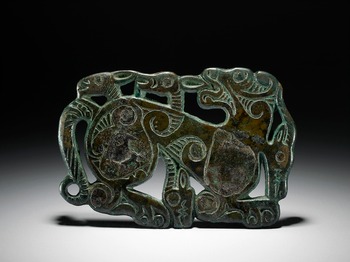
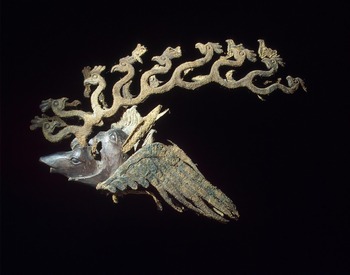
Such swift transferability is not only associated with the trope of animal predation. Other visual tropes present in steppe imagery lead to similar entanglements. Let us return to the gold item from Fig. 2. A noteworthy element is the assemblage of the predatory beast and his hybrid deer-bird antlers. The monster to the left is a “composite” creature typical of steppe imagery, where hybrid bodies frequent the surface design of precious objects: we would expect to come across such tropes anywhere from north China to southeast Europe. Steppe artisans frequently adopted a pars-pro-toto mode of expression in their image-making and design practice. Whether depicted static or entangled in vigorous interaction, animals are abbreviated, their essence and character conveyed through a visual synecdoche.Footnote 14 A deer would thus be reduced to its antlers, a raptor to its curved beak, a wild goat to its horns, and a feline to its powerful musculature and menacing jaw. These metonymically-conveyed elements could be found in a single cluster, thus constructing a counterintuitive, irregular anatomy which I would hereafter refer to as “zoomorphic juncture”. Syncretic antlers with bird terminals are particularly omnipresent along the Eurasian grasslands. They might originate in the stylised, crowded deer imagery on late Bronze-Age megaliths dispersed in Mongolia and South Siberia, known as ‘deer stones’. Such stone monuments are primarily associated with the Slab Grave culture, which likely spread out of the Late Bronze-Age Karasuk culture of South SiberiaFootnote 15, and the ‘khirigsuur’ archaeological culture in Tuva and north-western Mongolia (e.g. Uyuk culture of the late seventh century bce).Footnote 16 These Bronze-Age megaliths share certain features of conceptual design with their Iron-Age successors in Central Asia: along a limited, vertically-inclined surface, the maker inserted stylised and abbreviated images of contorted deer or deer antlers, or, occasionally, parts of other species (ibex, elks etc.). The substitutive modes which occupied the imagination of Iron-Age steppe artisans seemed to have also dominated the visual culture of their Bronze-Age predecessors. Fragmentation and replacement become the ruling principles behind the construction of deer-stone imagery: due to the limited pictorial space, one would either contort, twist or replace an otherwise anatomically-complete animal with one or some of its parts. Evidence of this mode of expression also abounds in the eastern steppe along the Chinese northern periphery. A British Museum plaque from the Ordos cultural zone of North China once occupied by the “forest hu” (Linhu) nomads from around the fifth century bce, shows a symmetrical placement of two composites: a creature made of the body of a horse, deer antlers and tails sprouting into bird terminals. Yet another bronze ornament from the British Museum collection, also said to have come from Iron-Age Ordos, exhibits a variant of the syncretic antler trope. We see a scene in which a tiger is supposedly trampling and preying on an ibex, whose body is unnaturally twisted and contorted as if engulfed in agony and pain. Yet, doe heads emerge out of the tiger's back and another one emanates from his highly-textured upper body. The configuration results in syncretic antler-like formation and a hodgepodge of incongruous anatomical elements.
Each animal is only evident through cognitive associations with its respective anatomy, but their bodies have been fragmented and conceptually re-assembled to form a new being. This particular ‘animal style’ trope could have been swiftly transferred to a new format, material and technique in the early Iron Age: as artisans developed more sophisticated tools and a competency in crafting they would have easily translated some old devices and pictorial motifs into new portable formats (e.g. gold adornment).
Such zoomorphic composites are also found in less luxurious forms in the funerary inventory of Pazyryk, the same cluster of nomadic barrows which yielded the aforementioned felt saddle. Below is a finial featuring a curious configuration of a griffin holding a stag's head in its beak. (Fig. 6) A “frame” visual narrative emerges here as we have a similar composite creature (deer head with bird-like antlers) being swallowed by a griffin-like predator. A mode of conceptual replacement dominates steppe imagery, thus resulting in a sea of counterintuitive, abbreviated fantastic fauna. Animal forms become transferrable and remain in a perpetual state of flux.
Plaque of a tiger attacking ibex. Bronze. Ordos, North China. 5th to 3rd Century bce Image courtesy of the Trustees of the British Museum.

Finial, Pazyryk Barrow no.2. Wood and leather. South Siberia, 5th to 3rd Century bce.

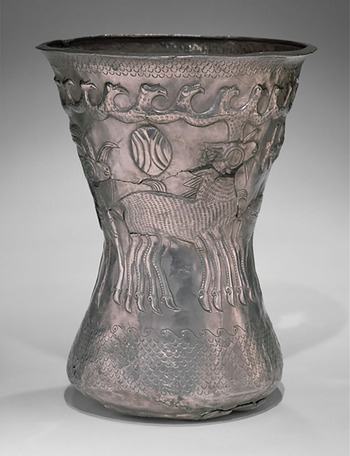
This visual concept of replacement also exists in Thracian visual culture which, as we established, was the likely by-product of intensive interactions with Greeks, Persians and Scythians. A silver beaker, now displayed at the Metropolitan Museum of Art, features a curious stag-like composite with a horn, deer antlers with bird terminals, and eight hoofed legs. (Fig. 7) This depiction was not one-of-a-kind: a closely related example, excavated in Agighiol in modern-day Romania, is likely the work of the same workshop.Footnote 17 On the bottom, a winged beast reminiscent of a griffin chews on an animal leg and grasps a small beast in its clawed feet, thus bringing us back to the repertoire of aggressive predation. The configuration, and particularly the presence of the bird-deer antler trope, is indebted to animal-style visual rhetoric and its penchant for idioms of substitution. Although the material culture of the Thracians invites associations with steppe peoples from Central Asia, their visual culture was also closely associated with Classical Greek art. Interactions with Scythians further east might have contributed to the unique conceptual entanglement present in the silver cup but Thracian workshops and craftsmanship were following the models of their sedentary neighbour Greece. In the product, we encounter a steppe visual idiom (zoomorphic juncture) framed in a Greco-Roman format. Finally, this method of local framing of imported visual repertoire occurs in the cities of yet another sedentary empire: China. During the third and second century bce, as China starts to buy more heavily into the nomadic market by manufacturing steppe gold in its own workshops for export to the north, we observe several curious implementations of gold jewellery of steppe design in tombs which are located very far from the abode of the Xiongnu nomads who occupied the northern periphery. For instance, the Xuzhou elite cemetery complex in Jiangsu province and the royal tomb of King Zhao Mo in South China have yielded exquisite gold belt plaques featuring intertwined, highly stylized and almost unrecognizable beasts, a formula consistent with that of animal-style.Footnote 18 The syncretic antler motif re-appears at yet another site of the Han period, located in Zhushan County of Hubei province in Central China; this occurrence is noteworthy and equally unexpected as the site is situated at a considerable distance from the Chinese northern periphery.Footnote 19
Beaker. Silver. Thrace (Bulgaria or Romania). MET.

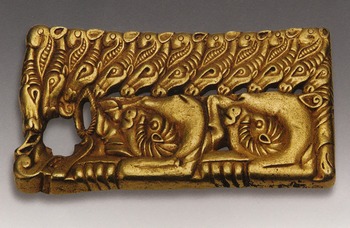
We do not know much about the original depositional context of the buckle, which was a chance find, and whether it was part of a broader mortuary context and decorative theme. Even so, we can still detect familiar tropes, which have been reinterpreted to perhaps fit a local aesthetic. The object features ten main deer-rams with horns terminating into a raptor-like being, which is highly abstracted and abbreviated, and only recognisable through the intentionally curved beaks. These beaks are then topped by doe ears, which likely serve to re-introduce the deer-ness of the beast. There are also two contorted rams in the lower part of the main image. The braided rope pattern, characteristic of steppe art, reappears toward the hoofs and at times the head textures. It is hard to make out the exact dissemination path of this approach to decoration so far south in early China. We know that by the time this plaque was supposedly made (second century bce to first century ce), the Xiongnu confederacy had established extensive interactions with Han China. This configuration seems to be more of an isolated example in South China, but it is certainly indebted to nomadic visual rhetoric from North Asia.
One would not expect to find northern steppe artefacts in Southern or Central China where local officials and nobles generally exhibited a clear preference for funerary rituals and inventories of Chinese taste and manufacture. It should be noted that these gold plaques were the odd ones out, as the rest of the tomb inventories, their overall structure and layout still seem to adhere to Chinese standards and show no borrowing of foreign concepts. Yet again, we encounter a curious entanglement of imported idioms placed in local frames and familiar formats.
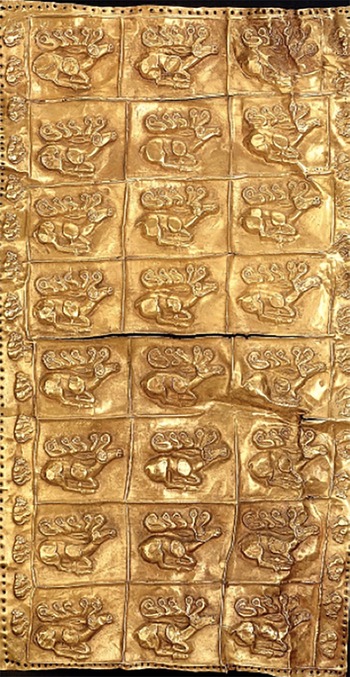
Fantastic fauna abounds in nomadic steppe art but why would the three major Eurasian sedentary empires occasionally embrace devices and tropes of a visual language invented in the nomadic cultural realm? It appears that at times of economic uncertainty, social unrest or political turmoil, associations with the ‘exotic’ steppe would have proven strategic in a diverse and largely decentralised empire. This tactical reference to governable ‘otherness’ through the entanglement of local formats and imported visual idioms is also evident in the depictions of real animal species. Recumbent deer with exaggerated, stylised antlers abounds in steppe imagery. By the fifth century bce, such peculiar deer imagery reached the Northern Black sea where Scythians, having likely migrated from the East, had become sedentary and turned to trading with the Greeks. Royal Scythian barrows, like the Kelermes and Kostromskaya in the Trans-Kuban area of South Russia, have yielded gold objects combining steppe-inspired content with Greek form and craftsmanship. In the example shown below, the overlay was nailed to the visible surface of a Hellenistic gorytos; the centre is decorated with 24 recumbent deer and the edges are embellished with 32 panthers in a bent position.Footnote 20
Similar panthers, in the form of plaques, were found in several of the Kelermes barrows, as well as in Kurgan 1 of the Uilski Aul site in the Kuban region.Footnote 21 We see similar traces of steppe visuality on the kalathos (basket-shaped headdress) unearthed from the Scythian Chertomlyk barrows in the Crimea. The kalathos was traditionally an object used by the Greeks in the worship of the goddesses Demeter and Persephone. Yet again, one observes the intricate framing of foreign motifs, infused with steppe visual rhetoric, within formats produced by settled empires.
Anatomical composites are not the preserve of steppe artisans, although the steppes have yielded some of the earliest refined concepts of hybrid anatomies. Beasts have had a long-standing presence in the Western canon, particularly at times of tumultuous power shifts in Europe. The monsters adorning the pages of cartographies in Western Antiquity, however, were almost always rooted in the classical canon of half-human, half-animal hybrids. These beasts were political tools, whether used to (mis) represent the Other, or display military prowess and the ability to control even the (un)human. Ancient geographies and scholarly treaties produced in the Greco-Roman sphere depict the “East” as a far-flung land of marvels, the habitat of whimsical flora and fauna which houses all that is bizarre, grotesque, and supernatural. Ctesisas, for one, presents a physical geography of India which can be best described as a flight of fancy: the land is traversed by gigantic mountains, and the fauna abounds in marvellous creatures unknown to the man of Antiquity, including sciapods (people with a single foot) and cynocephali (men with dog heads), the martikora beast made of a man's face, a lion's body and a scorpion's tail.Footnote 22 Griffins and unicorns are described as guardians of precious gold and diamond treasures. The post-Alexandrian legacy in Asia did not significantly change the tendency to infuse reports on the East with larger-than-life phantasmagorias. Dispatched to the Indian subcontinent by Alexander's successors after his failed campaign there, Megasthenes wrote a comparatively scientific geography of the region, in which he still listed a number of fantastic beasts and topographic curiosities.Footnote 23 Pliny's Naturalis Historia follows these early works.Footnote 24 Featuring monstrous people with anthropomorphic and zoomorphic elements, Pliny conflates the ecosystems of India and Ethiopia into an yet another whimsical invention, thus drawing a boundary between the orderly, structured and ‘human’ Greco-Roman realm and the uncontrollable, fantastic and ‘beast-like’ East. In the Middle Ages, the ‘otherness’ of monsters became the seed in mass conversions to Christianity: if Christianity could transform even an unhuman monster, then its power would have been indisputable. An epistolary tale of wonder, The Letter of Prester John, purportedly written by a descendant of the Three Magi ruling over the land of riches and marvellous creatures, India, is a representative example of the strategic fascination of Medieval Christianity with monsters. The letter mentions Nestorian Christian communities in the marvellous lands of Central Asia, thus implying that Christianity has penetrated even the supernatural territories of the ‘Other’. This reference recalls the mention of the Scythians in the Bible's New Testament. A passage from Colossians 3:11 in Letters of Paul states: “Here there is no Greek or Jew, circumcised or not, barbarian, Scythian, slave or free, but Christ is all and is in all”.Footnote 25 In the minds of premodern Western thinkers, Christianity's power lay precisely in its ability to penetrate far-flung lands of marvels, and reach even the most “barbaric” of humans, the nomadic Scythian hordes and the curious beasts of the East. There is an ironic yet tangible correlation between fantastic beasts, perceived to be unhuman and irregular, and the Other perceived to be inhuman(e), unhinged and equally irregular. Monsters, like the ‘Other’, had to be controlled and subdued, be it through religion, military prowess, or strategic appropriation of their strangeness. In their textual and visual traditions, thinkers of European Antiquity appear to have also embraced the idea of ‘governable otherness’, once so clearly communicated through the Apadana reliefs.
The Legacy of ‘Global’ Monsters
How does monstrosity, as defined by an incongruous, irregular anatomy, figure in the larger trajectory of the ancient world? I speak not of the ancient world manufactured by Western historiographers and defined by Greco-Roman sculptures and figurative, monumental expressions of Antiquity, but rather a global ancient world which was driven by interconnectivity, symbiotic dependencies and the epidemiology of representations. In our subsequent search for answers, we need to recognise that ‘monsters’ meant different things in different cultural models and social niches. Moreover, the term ‘monster’ itself is not always interchangeable with ‘composite’ and such interchangeability is also dependent on the culture that employs it. While visual tropes were indeed transmitted across cultural spheres through the Eurasian Steppe and Silk Routes, the invented meanings and adapted functions of monsters remained highly specific to each microregion. In the Greco-Roman realm, composites were always meant to represent an idiosyncrasy. Composite creatures seem to have been at the forefront of Horace's discourse. He displays little interest in linking monsters to the Exotic Other (the East), but rather bases his polemics on the alarming explosion of imagery of irregular bodies in fine art. His exasperation culminates in his pointed comments in Ars Poetica: “If a painter chose to join a human head to the neck of a horse, and to spread feathers of many a hue over limbs picked up now here now there, so that what at the top is a lovely woman ends below in a black and ugly fish, could you, my friends, if favoured with a private view, refrain from laughing?’Footnote 26 Vitruvius shares this scepticism in a commentary on architectural interiors filled with murals of grotesque monstrosities.Footnote 27
Despite the strong ridicule on the part of ancient philosophers, Roman elites were actively experimenting with systems of imagery based on composites, as exemplified by the excavation of the Domus Aurea. A chance discovery from the 16th Century, the palace of Emperor Nero (r.54-68 ce), boasts large vaults and hallways with walls covered in a multiplicity of phantasms including composites made of humans, flora and fauna. In the complex, the recently unearthed Hall of Sphinx and the House of the Griffins on the Palatine Hill are brimming with imagery of fantastic fauna. Renowned Renaissance painters such as Raphael became frequent visitors to the Golden House, studying and drawing inspiration from these fantastic depictions.Footnote 28 Raphael's work in the Cardinal Bibbiena was indebted to his meticulous studies of the interior of Domus Aurea. A shared fascination with anatomical syncretism and bodies defying biological laws seems to have been a global phenomenon not only in Pre- and Early Antiquity but also the late Middle Ages and Renaissance, as indicated by the later surge of composites and curiosities in Christian illuminated manuscripts and medieval cloisters of the Gothic and Romanesque periods.
A peculiar Western composite, marking a slight departure from the normative in beast depictions, is the so-called Chimera of Arezzo, dated to the 4th Century bce and originally created in the Etruscan domain of Italy. Monumental and free-standing, the bronze sculpture is particularly illuminating because it actually comes close to the steppe conception of zoomorphic junctures (and composites). In its construction, we encounter the rather abrupt transition between the feline body, mane and head, and two additional disparate heads, of a serpent and a bird. The snake stems from the tail, with the head functioning as a terminal. Each specific zoomorphic part stands for the presence of the complete animal, and thus recalls steppe zoomorphic junctures. Frozen in aggressive agitation, the large-scale Etruscan beast is not however a representative example of what is typically meant by ‘composites’ in scholarship on the material culture of the ancient world. Most of the well-known monsters only became monsters through associations with a normative human element.
If we look closely at the pantheon of curious composites across Antiquity, we would be struck by just how many of these beasts appear to be made of at least one human component. Anthropomorphic hybrids include the griffin, sphynx, hydra, satyr, centaur, harpy, sirena, lamia, lamassu etc. The list goes on. What unifies all these creatures is their reliance on an anthropomorphic fragment: in their final form, they are either horse-human, bird-human, fish-human, or snake-human hybrids. This is not to say that all of the major ancient empires produced only anthropomorphic composites, but human elements noticeably dominate the visual record. Anthropomorphic composites are also prevalent in the visual records of other parts of the ancient world. In early Chinese mythology alone, there are countless examples of partially human demons, like the baize白泽, chiyou 蚩尤, zhuyin 烛龙, Nüwa女娲, Fuxi 伏羲, niutou 牛頭, and others. They are labelled ‘monsters’ because they depart from a pure, fully-fledged human figure through a violation of at least some biological norms. In Chinese texts and imagery, we also have other categories of theriomorphic beings, including exaggerated birds (sanzuwu 三足烏, fenghuang 鳳凰 bifang 畢方, peng 鵬, jiufeng niao 九頭鳥), fish (鲲, the final transformation of the peng), mammals (qilin 麒麟, longma 龍馬, luduan 甪端, jiuwei hu 九尾狐) and reptilian (xiangliu 相柳, ao 鳌), all of which share a similar method of distortion or biological fallacy, as a proper monster should.Footnote 29 Alternatively, some exhibit supernatural qualities or skillsets which still render them non-human.
This leaves one wondering if and how Eurasian steppe creatures were distinguishable from the more widely-published monsters of Antiquity and the Middle Ages in Europe. At a first glance, both appear to be ‘composites’, presenting a paradoxical aberration from the normative. Some of the earliest examples of steppe hybrids appear at the Arzhan site of the Tuva republic in South Siberia and are dateable to the late 8th or early 7th centuries bce, long before the time of emerging Western commentaries on composites.Footnote 30 The composites of Central Eurasia have a distinct ‘flavour’, pointing to a very particular visual rhetoric rooted in steppe ecology and the nomadic worldview. Unlike their Greek and Persian counterparts, nomadic artisans are not negating but rather using reality as a stepping stone toward an embellished, counterfactual construction. It is exactly this emphasis on substitution, abbreviation and the organically counterintuitive that tends to unify Eurasian animal-style art into a standard visual language with regional topolects, which were later adopted in many sedentary imperial centres.
In pre-and early Antiquity, Classical Greco-Roman, Near Eastern as well as Chinese monsters are frequently based on both anthropomorphic forms and established mythologies. Greek and Near Eastern artisans made biological incongruity systematic, almost clinically accurate, and their anatomical hybrids appear controlled and structured rather than fluid and organic. Each anatomical component, particularly the human one, is clearly delineated and its specific role accentuated: for example, a viewer would have no trouble instantly identifying the lamassu as a winged human-feline. By comparison, in Eurasian steppe composites, the source of abnormality is not easily (or at all) traceable: the viewers would be gradually prompted to examine what at first looks like an organic body and slowly untangle the juncture. Steppe artisans place a much softer emphasis on the irregularity of their biology and a stronger accent on abstraction. When I first showed animal-style objects to my undergraduate students (e,g. the Zhushanxian hybrid), several of them observed that unlike their Greco-Roman counterparts, steppe beasts recall rare but real hybrids existing in our biota: the liger (tiger and lion), zonkey (zebra and donkey), cama (camel and lama), etc. They could, of course, see that there was a bizarre aberration, something misapplied in nature. Yet, it took them a while to pinpoint the source of this irregularity and list the various animal parts present. Indeed, many steppe creatures appear minimally irregular in a sense that there is subdued and organic integration of zoomorphic elements which evolve into or replace each other.Footnote 31 (Fig. 5, 5.1, and 8)
Belt buckle. Gold. Zhushanxian, Hubei province. 2nd century bce to 1st Century ce.

Gorytos. Gold. Kelermes barrows, Trans-Kuban, South Russia.

Shifting Nature (and Paradigms)
As steppe nomads moved across constructed and natural environments, they came in touch with a diverse array of flora and fauna which settled peoples remained unaware of. The steppe and forest-steppe zones of Central Eurasia spread over at least four types of terrain: open flat plains with forest-steppe natural growth, foothills, hollows or valleys, and large river deltas.Footnote 32 Once Eurasian nomads mastered horse-riding, they were able to expeditiously cross vast areas of diverse topographies. Nomadic design concepts reflect the constant changes in pastoralists’ interactions with the natural world: migrations driven by seasonal (or climate) change reflect an acute awareness of the constant fluidity, metamorphosis and cyclic shifts occurring in the biosphere. While they defy natural norms visually, steppe images of composite creatures represent the big picture of social metabolism rather accurately. By contrast, the structural rigidity of composites in Western art could be attributed to a more politically-driven intentionality. Monstrosity in Western Antiquity was not meant to visualise or re-create a natural configuration or negotiate one's own tension with nature. In Greco-Roman visual culture and discourse, a monster was a meticulously-constructed irregularity, an aberration from the touted normative, such as the idealised human body of the Classical tradition, hence the appropriateness of the term “monster” in a Greco-Roman context. From its very inception, steppe art has been almost entirely devoid of anthropomorphic imagery instead relying on counterfactual images of fantastic fauna: the regular human biology is neither the norm nor the normative in nomadic art. The whimsical beasts created by nomadic artisans were meant to signify their own fluctuating tension with the changing ecosystem(s) upon which they were greatly dependent. In the West, images of monsters do reflect tension, but not with one's biota. Hybrids in the Greco-Roman canon signal a different kind of tension: an adverse or unstable relationship with the socio-political environment or insecurity about the unknown ‘Other’ who needs to be governed and ‘inscribed’ into a familiar frame.
Finally, in light of the above-mentioned case studies, this paper calls for a reassessment of terms ‘hybridity’ and ‘hybridization’, commonly-adopted in discussions of finds which do not fit the established prototypes of the canon. Drawing from the recent work of P. Stockhammer, I am skeptical of the epistemological usefulness of these terms beyond their purely metaphorical, ‘ornamental’ functions.Footnote 33 All of the aforementioned objects and monuments can be referred to as ‘hybrid’ or ‘syncretic’ in a sense that they exhibit formal qualities attributed to the artistic traditions of two or more distinct cultural zones. For an artwork to be deemed ‘hybrid’, it has to indicate certain cultural encounters between two or more communities, states or individuals. Yet, the adoption of the term ‘hybridity’ necessitates the acknowledgement of its antonymic category, ‘purity’, as the former becomes meaningless without the latter.Footnote 34 Did any of the nomadic cultures in early Eurasian Antiquity really only ‘become’ hybrid through a process of hybridisation or creolisation? This would mandate the existence of a once ‘pure’ cultural prototype, which subsequently became diversified via interactions with external cultures. This reliance on the existence of a prime, pristine state of things is not realistic or conceptually helpful in studies of image-making and image-transfer. Was Achaemenid society any less pluralist before the construction of the Apadana palace reliefs? Was Thracian art any more purely Thracian and less ‘Hellenised’ before they came into direct contact with Greece? Can we speak of an original Scythian culture reflecting a sheer steppe or ‘pastoralist’ taste which only later became mixed with elements from Greece and Persia? It is unlikely that an affirmative answer can be given to any of these inquiries. Much like the hybrid monsters discussed above, hybridity mandates the presence of a rigid, predictable structure: a hybrid is, in a strictly biological sense, the by-product of two distinct varieties, or the addition of several distinct, incongruous elements in a rather clinical, quantifiable fashion. Receptivity and experimentation in art production does not follow the same biological processes and is thus devoid of such a measurable outcome. Instead, the entanglements described so far lead to a more practical and quantifiable paradigm or what I have referred to as “governable Otherness”. The so-called “Other” could have been Mother Nature itself, the rest of one's own collective, or one's geopolitical rival. From the lamassu to the deer-bird antler junctures, fantastic beasts took on a shared metonymic role across multiple cultural spheres in early Eurasian antiquity, sometimes indicating the ‘Other’ and sometimes substituting (or simplifying) the inexplicable in nature. Overall, the contrasting yet easily transmittable conceptions of zoomorphic anatomies in Eurasian Antiquity lead us toward new avenues for the study of animal imagery in the ancient world, and remind us of the critical importance of previously-overlooked communities and systems of imagery.
Supplementary material
To view supplementary material for this article, please visit https://doi.org/10.1017/S1356186321000808.