1. Introduction
Theoretical and empirical literature about the effects of democracy on the level of environmental quality is still inconclusive and does not provide clear and unilateral answers as to the effect of different regimes on the environment. In the 1970s, the dominant thinking was that democracy and its associated liberties of consumption and procreation would have generated ecological catastrophes (Hardin, Reference Hardin1968; Desai, Reference Desai1998); recently, on the contrary, scholars have found a positive effect of democracy on environmental quality, the main reason being the necessity for democratic governments to be elected or re-elected, which makes them more prone to respect human life, and then more responsive to life-threatening environmental degradation (Schultz and Crockett, Reference Schultz and Crockett1990; Dasgupta and Mäler, Reference Dasgupta, Mäler, Behrman and Srinivaan1995; Payne, Reference Payne1995; Gleditsh and Sverdrup, Reference Gleditsch, Sverdrup, Paper and Redclift2003).
This paper is aimed at contributing to the debate about whether democracy may be good or not for the environment. By means of a theoretical model, the question I want to answer is: are democracies more pro-environmentalist than autocracies? In order to answer this question, it is important first of all to understand the difference between those two regimes. In a (direct) democracy, decisions are made by majority voting, while in a dictatorship they are made by one or a group of a few individuals. In practice, therefore, the decisive political actor is different, and what makes them differ is often their wealth.
It is well known that wherever in the world, at any time in history, kings, queens and dictators have been the richest and most powerful people. From north to south, in developed and underdeveloped countries, in communist and non-communist regimes, the only characteristic that this variegated group of people has in common is a lofty position and vast fortune. Forbes, in an article appearing a few years ago,Footnote 1 estimated the Saudi Arabian King Abdullah Bin Abdulaziz's wealth at around 45 per cent of the country's US$340bn GDP. Brunei's Sultan Haji Hassanal Bdkiah has an estimated fortune of US$20bn in addition to benefits from petroleum and natural gas fields. The President of the United Arab Emirates (UAE), Sheikh Khalifa bin Zayed Al Nahyan, owns 90 per cent of the 2.5 million barrels a day exported from the UAE and he alone represents two-thirds of the GDP. Mutubu Sese Seko in the Democratic Republic of Congo (Zaire) during the 1970s benefited by around 15–20 per cent of Congo's operating budget and in the 1980s his fortune was estimated at US$5bn (Leslie, Reference Leslie1987). Rafael Trujillo in the Dominican Republic had a fortune which amounted to 100 per cent of the national GDP at current prices, and his family controlled almost 80 per cent of the country's industrial production (Moya Pons, Reference Moya Pons1995). These are only a few examples, but the list of very rich rulers could probably be a manuscript on its own. From this perspective, a regime change from dictatorship to democracy shifts the decisive power from the dictator to the median voter, implying an impoverishment of the decisive political actor and therefore a different willingness to pay (WTP) for environmental protection.
If the demand for environmental quality was an increasing function of income, dictatorship would be a panacea for the environment. Numerous empirical studies suggest that WTP for environmental improvement is an increasing function of wealth (Kriström and Riera, Reference Kriström and Riera1996; Hökby and Söderqvist, Reference Hökby and Söderqvist2001; Miles et al., Reference Miles, Pereyra and Rossi2002). Richer people tend to express higher WTP for environmental improvement than poorer people; that is, environmental quality is typically found to be a normal good. Because of this, an institutional shift from democracy to dictatorship should result in an improvement in a country's environmental quality. As pointed out by Boyce (Reference Boyce, Baland, Bardhan and Bowles2007), however, this beneficial effect may not necessarily bring the expected result because other factors come into play to mitigate or even nullify it.
First, an increase in the decisive political actor's income raises his ‘price’ of environmental protection. Increasing income means increasing the share the individual gets out of production, if production is kept constant. Since production requires some environmental depletion, it is easy to realize that environmental protection is more costly for the rich because a decrease in global GDP results in a greater decrease in their own income than in that of the poor, who get a lower share. Moreover, even though richer individuals may desire more environmental quality (income effect), they also desire more of the goods and services responsible for environmental degradation (price effect), so the expected environmental improvement will occur only if the negative ‘price effect’ does not outweigh the positive ‘income effect’.
Secondly, richer people have more resources and capabilities to substitute environmental quality with private consumption, giving rise to so-called environmental inequality. If indeed the WTP for environmental protection is an increasing function of income, the elasticity of such WTP may be the opposite. Martini and Tiezzi (Reference Martini and Tiezzi2010) indeed find, in a panel of Italian households from 1999 to 2006, that despite the fact that WTP for environmental protection is higher for richer people, the elasticity of WTP is less than one, and therefore decreases as income increases, suggesting a lower capability for poorer people to substitute environment with private consumption.
Substantial evidence indeed shows that the less wealthy and powerful members of societies may be the ones exposed to much heavier environmental degradation than the more well off who, being able to avoid it, simply relocate to cleaner living areas or use their political power to drive out polluting industries from their own neighbourhoods. Gray and Shadbegian (Reference Gray and Shadbegian2004), for instance, obtained some evidence from US data on the paper industry for the period 1985–1997 that polluting emissions were significantly lower in areas with more children, older people and fewer poor people than in areas with young, poor people without children. Bina Agarwal (Reference Agrawal1992) documented how the degradation of forest resources in rural India had particularly severe effects on poor women, via impacts on their time, income and nutrition. Pastor et al. (Reference Pastor, Sadd and Hipp2001) provide substantial evidence that minority residential areas have a higher likelihood of hosting various environmental hazards, and Foster (Reference Foster1998) reports that poor African American neighbourhoods in Chester, PA, often experience a clustering of waste facilities in their areas.
This paper provides a theoretical model through which the effects of democratization on the environment are analyzed, meaning by democratization a shift of the decisive power from a rich individual (dictator) to a poorer one (decisive voter). It is assumed that citizens differ only by their wealth, meaning by wealth only income (or the share they get out of production) and excluding any inherited endowment, in order to keep the model as simple as possible.
In the first instance, the result of democratization on the level of environmental quality is analyzed, assuming that there is no environmental inequality so all the citizens experience the same level of pollution.
This assumption will later be removed by introducing a class model of experienced pollution, and assuming that the society is composed of two types of individuals – employers and employees. Employers supply capital in the production process, while employees supply their physical labour and therefore cannot avoid their own exposure to pollution. Employers, on the other hand, in supplying capital, can relocate far away (at a cost) from their polluting factories, since their physical presence is not necessary in the production process.Footnote 2 To the best of the author's knowledge, the introduction of differences in exposure to pollution (i.e., environmental inequality) between the two political actors is the novelty of this paper, having found in the literature only models that took for granted that exposure to pollution was the same across all individuals irrespective of their wealth.
As it is often unexpected, income inequality per se between the two decisive political actors may not be responsible for the different environmental policies undertaken by the two different regimes, but environmental inequality is the crucial variable affecting them. Income inequality, therefore, has an indirect role as long as it induces environmental inequality. In countries where the majority of the population is represented by employees whose services require their physical presence in the firm, democratization is expected to be beneficial for the environment, and this is in line with recent empirical evidence.
The next section reviews the literature on the topic of environmental quality and regime, and section 3 introduces the model. Section 4 presents some empirical evidence and discusses some cases of regime transition, having regard to the effect on the environmental policy of democratization. Section 5 concludes.
2. Literature review
Literature on the effect of political regimes on pollution or pollution control dates back to the 1970s, and the main view of that time was that democracies and their associated liberties to consume, pollute and procreate would generate environmental catastrophes (Hardin, Reference Hardin1968; Heilbroner, Reference Heilbroner1972; Ophuls, Reference Ophuls1974; Desai, Reference Desai1998).
Desai (Reference Desai1998) has argued that ‘as democracy is dependent on economic development, and since economic growth and prosperity generally result in environmental pollution and ecological destruction, democracy would not necessarily be protective of the environment’. This argument, however, says little about the independent effects of democracy, separate and apart from income.
The same criticism can be extended to Hardin (Reference Hardin1968) as well as Heilbroner (Reference Heilbroner1972). In Hardin's article on the tragedy of the commons, he does not explicitly refer to democracy as a cause, ceteris paribus, of pollution, but he refers to it indirectly, saying that pollution is a direct cause of the increase in population, and one characteristic of democracy is its freedom to procreate.
Heilbroner (Reference Heilbroner1972) bases his arguments on the projections made by Jay Forrester and a team of scientists at MIT about population growth, and therefore an always shorter carrying capacity of the Earth. He moreover estimates a total ‘self-destruction’ of the human race by the year 2100 if the rate of growth of the economy is kept constant.
More recent and theoretically oriented papers put forward the premise that (income) equality may or may not be necessary to minimize degradation because actual results depend primarily on the intersection between the distribution of preferences across groups and institutional rules (Roemer, Reference Roemer1993; Scruggs, Reference Scruggs1998). None of these contributions introduces the concept of environmental inequality.
In more recent years, however, empirical evidence suggests that democracies tend to respect the environment more than autocracies, and the reason often provided is the necessity of governments to respect human life (and therefore to be more responsive to life-threatening environmental degradation) because they want to be re-elected (Schultz and Crockett, Reference Schultz and Crockett1990; Dasgupta and Mäler, Reference Dasgupta, Mäler, Behrman and Srinivaan1995; Payne, Reference Payne1995; Gleditsh and Sverdrup, Reference Gleditsch, Sverdrup, Paper and Redclift2003).
In support of this view, Congleton (Reference Congleton1992) develops a theoretical model showing that authoritarian regimes (i.e., dictators) often face a higher relative price for pollution abatement than a median voter does, due to the fact that the dictator has a shorter time horizon and gets a bigger fraction of income (i.e., he is richer). If indeed this is the case, autocracies will adopt less stringent environmental standards than democracies. In his model, however, Congleton deals with ‘global’ pollution problems, and assumes that the level of experienced environmental quality does not differ between the median voter and the dictator.
In the empirical literature, Bhattarai and Hamming (Reference Bhattarai and Hammig2001), for example, use a measure of institutional quality (measured by an index of political rights and civil liberties) to account for the role of different policy regimes in the causes of deforestation in 66 Latin American, African and Asian countries during the period 1972–1991. Using a fixed effect panel data model estimated by weighted least squares (thus correcting for some of the outliers and measurement errors by giving less weight to such outliers), they claim that democratic institutions significantly reduce deforestation.
Torras and Boyce (Reference Torras and Boyce1998) use a similar technique for a panel data survey of seven air and water pollution indicators. They basically test whether power equality (which is higher in democracies) may affect the level of pollution in more than 1,000 locations worldwide, and find that the inclusion of variables like the Gini index of income inequality, literacy and political rights – which are proportionally correlated to power equality and therefore democracy – all have the effect of lowering the peak of the environmental Kuznets curve (EKC), or making GDP not significant in the regression.
Gallagher and Thacker (Reference Gallagher and Thacker2008) introduce a concept of ‘stock of democracy’ to study its implications through time, and they also find a positive effect of democracy on the environment.
Barrett and Graddy, Reference Barrett and Graddy2000 find that countries that are more democratic tend to have lower levels of sulphur dioxide emissions, smoke, particulates, arsenic and lead. Harbaugh et al. (Reference Harbaugh, Levinson and Wilson2002) found that democracies significantly and constantly reduce sulphur dioxide, smoke and particulates in a panel of cities worldwide (the number of cities varies according to the availability of data for the indexes of pollution analyzed).
Neumayer (Reference Neumayer2002) tests Payne's hypothesis that democratic governments are more prone to collaborate with each other on environmental issues. He finds that democracies sign and ratify more multilateral environmental agreements, participate in more environmental intergovernmental organizations, comply better with reporting requirements under international agreements and put a greater percentage of their land area under protected status, using a multivariate regression in a cross-country setting.
Farzin and Bond (Reference Farzin and Bond2006) find democracy associated with lower levels of carbon dioxide, nitrogen oxides, volatile organic compounds and sulphur dioxide. They also find that other covariates like income inequality, age distribution, education and urbanization may mitigate or exacerbate the net effect of the political regime on pollution.
Fredriksson and Wollscheid (Reference Fredriksson and Wollscheid2007) use the method of propensity score matching with a sample of 163 countries from the late 1990s to test for the hypothesis that democracies tend to be more environmentalist than autocracies. They also observe differences in the level of stringency of environmental policies among different types of democracies. Controlling for the price of super and diesel gasoline in 1998 and 2000, age distribution, population density, urbanization, percentage of land forested and percentage of land used in agriculture, as well as GDP per capita and the ratio of exports plus imports to GDP, they consistently find that democracies (and, in particular, parliamentary democracies) tend to set more stringent environmental policies than autocracies.
They all find positive evidence that civil liberties and political rights are associated with more pro-environmental behaviour.
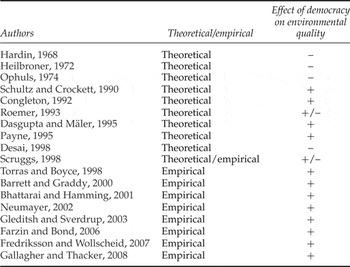
Table 1 summarizes all the contributions cited in this section. As can be observed, older (and mainly theoretical) contributions assume that liberties (characteristics typical of democratic countries) of procreation, consumption and production would damage the environment, even though the main criticism of this view is that they do not analyze the effect of the regime separately and apart from all the other characteristics of a country (level of production, population, etc.). Recent (and mainly) empirical articles instead find a positive association between democracy and environmental quality.
Summary of the literature review

3. The model
This section presents the model with the aim of analyzing the effect of a regime change (in particular, democratization) on the optimal level of environmental quality. In the first instance, I will assume that the decisive political actor in an autocracy is richer than in a democracy, so democratization results in a shift of the decisive power from a rich individual (the dictator) to a poor one (the median voter). Poorer people have a tendency to value consumption more than environmental quality, but richer people consume more of the goods responsible for pollution. The first part of the model will deal with this issue, assuming that the environment is a pure public good whose exposure cannot be avoided by anyone at any cost.
The second part will instead introduce a model of class differences in experienced environmental quality to take into account the effect of environmental inequality. Assuming that the decisive political actors in democracy and autocracy belong to different classes and, in particular, assuming that the dictator is a capitalist employer who only supplies capital in the production process and therefore is able to relocate his home far away from the polluting sources, while the median voter is an employee who supplies physical labour and therefore is exposed to emissions, I will show that democracy is beneficial to the environment – the more beneficial, the higher the difference in wealth between the dictator and the median voter.
3.1. Democratization and income inequality
As in Congleton (Reference Congleton1992), throughout this section, it is assumed that:
A.1. The decisive political actor under an autocratic regime receives a larger share of GDP than under a democratic one.
Denote then by g the level of production, or GDP, and by e the level of environmental quality, with both g and e assured to be positive. Environment is an essential factor of production, so there cannot be positive production without some environmental depletion. Equation (1) represents the relation between production and environmental quality, i.e., the transformation locus between environment and income:
 $$g = f - \displaystyle{{1} \over {2}} e^2$$
with f being a positive constant. The maximum achievable level of production is bounded above due to technological constraints and this boundary is represented by f. A level of production equal to f can be achieved only by completely depleting the environment. Conversely, the highest environmental quality requires absence of production.
Suppose then that the society is composed of N individuals, with all having an identical preference function. Each generic individual i gets a share of total production s
i
, with
 $\sum^{N}_{i=1} s^{i} = 1$
(notice that, in general, s
i
≠ s
j
for i ≠ j) as a ‘personal wage’ available for consumption and, therefore, the amount each individual can consume in each period is represented by
 $$y^i = s^i g$$
and, therefore, the ‘personal’ marginal rate of transformation between income and environmental quality is represented by
 $$\displaystyle{{\partial y^i}\over{\partial e}} = -es^i.$$
Each individual's utility is an inseparable function of income and environmental quality and is denoted by
 $$u^i = u\lpar y^i\comma \; e\rpar \quad i = 1\comma \; \ldots\comma \; N$$
with u i representing the level of utility for individual i, y i denoting income (or consumption) of the same individual, and e the level of environmental quality. Environmental quality is a public good which is experienced uniformly across the population, hence the absence of the superscript (this assumption, however, will be removed later). The utility function u i is assumed increasing and concave with respect to both arguments, and has positive cross-derivatives. In other words, u e > 0, u y > 0, u ee < 0, u yy < 0, u ey > 0 and u ye > 0, where u x is the first derivative of the utility function with respect to the generic variable x, and u xz is the first derivative of u x with respect to another variable z. These assumptions imply that the utility generated by increasing income or environmental quality is positive, but it increases at a decreasing rate, and that the higher the pleasure derived by income (cleaner environment), the higher the environmental quality (income).
Under assumption A.1., if the level of experienced environmental quality does not differ between different people, the effect of democratization (autocratization) can be read as the effect of an impoverishment (enrichment) of the decisive political actor.Footnote 3 Denote with v the decisive political actor under democracy, and with a the decisive individual under autocracy. Assumption A.1. has the only implication that s v < s a , so the problem the decisive citizen faces is
 $$\eqalign{\max_e u^i & = u\lpar y^i\comma \; e\rpar \quad i = v\comma \; a \cr \hbox{s.t.} \quad y^i & = s^i \cdot g \cr g & = f - \displaystyle{1 \over 2}e^2}$$
so they decide their optimal levels of environmental quality so as to maximize their utility subject to their wealth and the available technology.
The first-order condition for utility maximization requires
 $$\eqalign{-s^{i}e\cdot u_{y^i} & \lpar y^{i}\comma \; e\rpar =-u_e \lpar y^{i}\comma \; e\rpar \quad \hbox{or}\cr & -es^{i} = -{u_{e} \lpar y^{i}\comma \; e\rpar \over {u_{y^{i}} \lpar y^{i}\comma \; e\rpar }}} $$
where u y i represents the derivative of the utility function for individual i with respect to the level of income y i , and u e represents the derivative of the utility for individual i with respect to the environmental quality. Equation (2) simply says that a necessary condition for maximizing utility is the equality between the ‘personal’ marginal rate of transformation between income and environment and the marginal rate of substitution between income and environment. The level of environmental quality e chosen by individual i, therefore, will be
 $$e^\ast = \displaystyle{{1}\over{s^i}} \cdot \displaystyle{{u_e \lpar y^i\comma \; e\rpar }\over{u_{y^i} \lpar y^i\comma \; e\rpar }}.$$
A first question that comes to mind is whether the effect of a marginal increase in the share of income of this citizen increases the level of environmental quality or not. Taking the first derivative of e* in equation (3) with respect to s i , we get that
 $$\eqalign{{\partial e^\ast\over \partial s^i} & = {1\over{s^i}} \left[-{1\over{s^i}} \left({u_e \lpar y^{i}\comma \; e\rpar \over{u_{y^i} \lpar y^i\comma \; e\rpar }}\right)\right. \cr & \left. \quad + g\left(\displaystyle{{u_{ey^i} \lpar y^{i}\comma \; e\rpar u_{y^{i}} \lpar y^{i}\comma \; e\rpar -u_e \lpar y^{i}\comma \; e\rpar u_{y^{i}y^i} \lpar y^{i}\comma \; e\rpar } \over {\lpar u_{y^{i}} \lpar y^{i}\comma \; e\rpar \rpar^2}}\right)\right]}$$
which is positive (so the effect of an increase in s i is good for the environment) when
 $$\displaystyle{{1}\over{s^{i} g}} \lt -\displaystyle{{u_{y^iy^i} \lpar y^i\comma \; e\rpar } \over {u_{y^i} \lpar y^i\comma \; e\rpar }} + \displaystyle{{u_{ey^i} \lpar y^i\comma \; e\rpar } \over {u_e \lpar y^i\comma \; e\rpar }}.$$
Defining
 $$\eqalign {& \displaystyle{{u_e \lpar y^i\comma \; e\rpar }\over{u_{y^i} \lpar y^i\comma \; e\rpar }} = MRS_{e\comma y}^i \cr & -es^{i} = MRT_{e\comma y}^i}$$
it is easy to see that equation (4) can be rewritten asFootnote 4
 $$\displaystyle{{\partial {MRT}_{e\comma y}^i /\partial y} \over {{MRT}_{e\comma y}^i /y}} \lt \displaystyle{{\partial {MRS}_{e\comma y}^i / \partial y} \over {{MRS}_{e\comma y}^i /y}}$$
so a positive variation in the share of income is associated with a positive variation in the level of environmental quality only if the ‘price effect’ due to a higher share of income s i (which also makes the marginal rate of transformation between environment and income steeper) is lower than the ‘income effect’ due to the relative variation in the marginal rate of substitution between the two goods. In other words, becoming richer is beneficial for the environment only if the elasticity of MRT e,y i is lower than the elasticity of MRS e,y i , both with respect to income.
Denoting by e v and e a the optimal level of environmental quality chosen by the decisive citizen in democracy and by the dictator, respectively, we have that
 $$\eqalign{e^v & = \displaystyle{{u_{e^v} \lpar y^v\comma \; e^v\rpar } \over {s^v \cdot u_{y^v} \lpar y^v\comma \; e^v\rpar }} \cr e^a & = \displaystyle{{u_{e^a} \lpar y^a\comma \; e^a\rpar } \over {s^a \cdot u_{y^a} \lpar y^a\comma \; e^a\rpar }}}$$
The optimal level of environmental quality selected in democracy will be lower than the level selected in dictatorship (e v < e a ) if
 $$\displaystyle{{{MRS}_{e\comma y}^v }\over{s^vg}} \lt \displaystyle{{{MRS}_{e\comma y}^a} \over {s^ag}}$$
or, rearranging,
 $$\displaystyle{{{MRS}_{e\comma y}^v} \over {s^v}} \lt \displaystyle{{{MRS}_{e\comma y}^a -{MRS}_{e\comma y}^v } \over {s^a - s^v}}$$
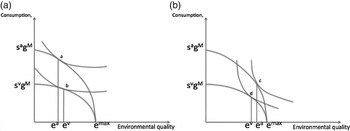
Equation (6) highlights the ambiguous effect (depicted in figure 1) of a regime shift. Since the level of environmental quality experienced by both the dictator and the decisive citizen in democracy is actually the same, what makes the difference in determining which regime is more pro-environment depends basically on the difference of ‘relative’ marginal WTP for environmental protection. An example may clarify the interpretation of equation (6): suppose the decisive political actor in democracy is willing to pay two units of income to increase environmental quality by one unit. Suppose instead that the dictator is willing to pay five because he's richer so he values the environment more. However, the difference in wealth between those two decisive citizens is huge. Suppose that the dictator gets 10 per cent of the global production, so s a = 0.1. Assume that the median voter gets only 1 per cent, so s v = 0.01. Assume that the country's GDP (g) is, for simplicity, 1,000. It follows that, in percentage terms, the decisive political actor in democracy is willing to give up 0.2 per cent of his income to protect the environment whereas the same decisive citizen under dictatorship is willing to pay 5 per cent. In this case, of course, democracy is bad for the environment. If inequality between those two citizens instead was not too high, and the marginal rate of substitution for the median voter was six against eight for the dictator, s v = 0.05, s a = 0.1, and keeping constant g at 1,000, we have that, proportionally to income, the median voter is willing to give up 12 per cent to increase environmental quality against 8 per cent for the dictator. This case, of course, implies that democracy is good for the environment.
Possible effects of a regime change on the level of environmental quality depending on the MRSe, y of the two decisive political actors

Figure 1 provides a graphical explanation of the argument above. Suppose that the decisive citizen's income increases from s v g to s a g. Whether this shift is good for the environment or not depends on the variation of the ratio between the two marginal rates of substitution between y and e for the dictator and the decisive citizen in democracy. Of course, the dictator has an MRS e, y higher than the median voter's MRS e, y , but if this increase in the WTP for environmental quality does not compensate the increase in the share of income the dictator gets, dictatorship is bad for the environment (figure 1A). Figure 1B depicts the opposite case, so when democracy is bad for the environment, the marginal utility from consumption of the decisive voter in democracy is much higher than the dictator's, so a shift from democracy to dictatorship is good for the environment.Footnote 5 Equation (6) means exactly what is depicted in figure 1.
From another point of view, equation (7) shows that we can see democratization as a bad regime for the environment if the median voter's relative marginal WTP for environmental quality does not compensate what would be the difference of the marginal WTP under the two different regimes, weighted by the difference in income between the two decisive citizens.
3.2. A model of class differences in experienced environmental quality
In order to introduce environmental inequality, i.e., the fact that environment is experienced in different ways by different people, the assumption made is that the population is divided into two classes, capitalists and workers. Capitalists supply capital in the production process and receive the rents their capital generates. Workers can only sell their labour in the firms owned by the capitalists and therefore cannot avoid their exposure to the pollution produced by the firms in which they are employed, either because during the job they are exposed to emissions or because they cannot relocate too far away from the firms since they have to show up for work every morning. Of course, this is not the case for the capitalist, who can choose the best location to live because he does not need to physically sell his own labour. Under the assumption that the decisive political actor in autocracy is a capitalist and in democracy a worker, the optimal level of environmental quality chosen by those two decisive citizens will be different from that in the previous case. The worker is assumed to have an experienced environmental quality which reflects the real status of the environment; therefore, his maximization problem remains unchanged. The capitalist, on the other hand, may decide to increase his own perceptionFootnote 6 of environmental quality, for example, by relocating to a cleaner area, but this can be done at a cost. The price may be related, for instance, to the transportation costs the capitalist must pay in order to reach the city where his firms are located, so the price may be a function of the capitalist's home distance to the industrial district.
Denote by e x a the capitalist's (or dictator's) level of experienced environmental quality. e x a is no more equal to the actual, or ‘real’ level, since it can be increased by relocating far away from the pollution source. In detail, the equation for e x a is given by
 $$e_x^a = e + hc$$
where e is the real level of environmental quality, c is the cost of relocating in a cleaner area and h is a positive constant denoting the level of ‘productivity’ of the cost of living far from the pollution sources. In this model, it will be assumed that
 $$e_x^a \ge e$$
so the level of experienced environmental quality cannot be lower than the real level. This assumption guarantees that c is an effective cost, so it cannot be negative (the employer basically cannot accept bribes in order to live close to the polluting factory).
Equation (8) can be rephrased as follows: if one defines c as the monetary expense the employer pays to experience a better environment, c can be read as
 $$c = p\lpar e_x^a - e\rpar$$
that is to say, the price for an experienced environmental improvement (p) multiplied by the difference in the experienced environmental quality chosen by the employer and the real environmental quality (e x a − e). If this is the case, it is possible to notice, by equation (8), that, taking e from the right hand side of the equation to the left, the price for an experienced environmental improvement p is defined as 1/h.
 $$p \equiv \displaystyle{{1} \over {h}}$$
Since the capitalist – or employer – pays a cost c > 0, his level of income available for consumption will be reduced by that amount, so
 $$y^a = s^ag - c$$
and technology remains identified by equation (1).
The new problem the decisive political actor in a dictatorship faces is then
 $$\max_{e\comma c} u^a = u\lpar y^a\comma \; e_x^a\rpar$$
subject to equations (8) and (9). The first-order conditions for utility maximization are:
 $$\displaystyle{{\partial u^a} \over {\partial e}} = 0 \Rightarrow e^{a\ast} = \displaystyle{{u_{e_x^a } \lpar y^a\comma \; e_x^a \rpar } \over {s^au_{y^a} \lpar y^a\comma \; e_x^a \rpar }}$$
 $$\displaystyle{{\partial u^a} \over {\partial c}} = 0 \Rightarrow \displaystyle{{1} \over {h}} = \displaystyle{{u_{e_x^a } \lpar y^a\comma \; e_x^a \rpar } \over {u_{y^a} \lpar y^a\comma \; e_x^a \rpar }}$$
Equation (11) represents the equilibrium level of expenditure, which must equate the productivity of the ‘insurance’ against pollution and the amount of the environmental quality the dictator is willing to give up to become one unit richer. Combining equations (10) and (11) I get
 $$e^{a\ast } =\displaystyle{{1} \over {s^ah}}$$
so the optimal level of environmental quality chosen by the dictator depends negatively only on the share he can get out of production and the productivity of the expenditure in increasing the perception of environmental quality.
The reason for this result is simple: a richer citizen enjoys environmental quality more than a poorer one, but his opportunity cost to pay for environmental protection is higher than for a poor citizen. If he can increase his own perception of environmental quality by an amount that is greater than the amount of environment he is willing to give up to become one unit richer, then it is worthwhile to pay.
In general, taking the equilibrium relations of the two decisive political actors, represented by equations (12) and (5), I get that the optimal level of environmental quality will be lower in autocracy if
 $$h \gt \displaystyle{{s^v} \over {s^a}} \cdot \displaystyle{{u_{y^v} \lpar y^v\comma \; e^v\rpar } \over {u_{e^v} \lpar y^v\comma \; e^v\rpar }}$$
that is to say, the level of productivity of the cost devoted to prevent exposure to pollution is greater than the amount of environmental quality the median voter is willing to give up to become a unit richer, times the ratio of the income share of production of the two decisive actors. So, income inequality between the dictator and the median voter is not a good predictor of the effect of a regime change on the environmental policy undertaken by a country; it is environmental inequality that matters as long as the expenditure for substituting environment with private consumption is productive (i.e., increases the perception of environmental quality) enough. This result is exacerbated when income inequality between the two political actors is big, making autocracy more prone to choose bad environmental policies even for lower levels of h.
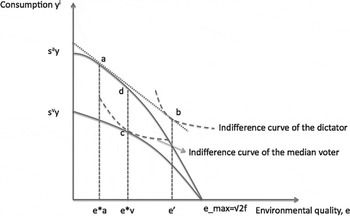
Figure 2 represents two possible equilibria a country may reach, depending on the type of regime. Assume that a dictator gets a larger share of output than a potential median voter in a democracy; if the dictator can pay to avoid his own exposure to pollution and the median voter cannot, the dictator will choose a lower optimal level of environmental quality. Denote by s v y − e max and s a y − e max the private transformation locus between the income of the potential median voter and the dictator, respectively. At point c the median voter solves his own maximization problem, equating his MRS e, y (that is to say, the amount of money he is willing to spend to improve the environment) with the amount of money he would get by producing more (this is expressed in terms of e, and is equal to −se). Denote this equilibrium level of environmental quality by e *v . The dictator optimizes his utility function with respect of two controls, the level of perceived environmental quality and the cost of insurance against exposure to pollution. The equilibrium condition is represented by equation (12).
Representation of two possible equilibria a country may reach, depending on the type of regime, and assuming that the dictator can pay to avoid his exposure to pollution

The question is: if the dictator can protect himself against pollution by paying insurance, will his optimal level of e be lower than the optimal level of the median voter? The answer is yes, provided that at point d the amount of income the dictator has to give up to increase environmental quality by one unit (−∂ y/∂ e) is greater than his WTP (in terms of income) to increase quality by one unit (MRS e, y ).
If this is so, it is in the dictator's interest to reduce his optimal level of environmental quality such that he can buy the insurance and increase his perceived level of environmental quality. In figure 2, e* a represents the ‘real’ level of environmental quality chosen by the dictator, while e′ is the ‘experienced’ level of environmental quality. If this is the case, then democracy is definitely better for the environment.
The next section presents some row statistics and a simple econometric model showing that democracies – as implied by the model of class differences (which assumes that dictators have a different exposure to pollution from the median voter in democracies) – are good for the environment.
4. Motivations: empirical evidence and some case studies
As the previous section showed, in the presence of environmental inequality between the two decisive political actors in dictatorship and democracy, democracy is likely to be beneficial for the environment – the better the effect on the environment, the bigger the income inequality between those two citizens.
Provided that this paper is mainly theoretical and this section does not pretend to be a formal test of the results implied by the theoretical model, but only a mere description of what we can observe in the data, I will show with some row statistics and a simple OLS regression that democracy is beneficial for the environment (a brief justification of the econometric model used here is provided in the online appendix available online as supplementary material).
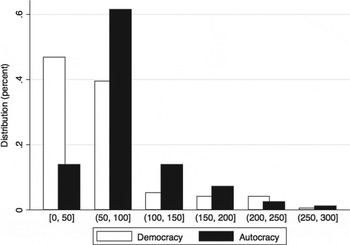
Looking at some simple raw statistics,Footnote 7 using a sample of 47 transition countries, we observe that during the period 1990–2002 the average concentration of PM10 recorded during spells of dictatorship is about 1.36 times bigger than during democratic periods, despite the average level of per capita GDP being 2.36 times bigger during democracy than during dictatorship spells.Footnote 8 Normalizing the number of democratic observations to 100 and doing the same for autocratic observations in the sample, it is possible to observe that almost 50 per cent of the democratic spells have a concentration of PM100 under 50. The same cannot be said for autocratic spells, where more than 80 per cent of them have concentrations of PM10 above 50 (see figure 3).
Distribution of periods of democracy and dictatorship by levels of PM10 concentrations

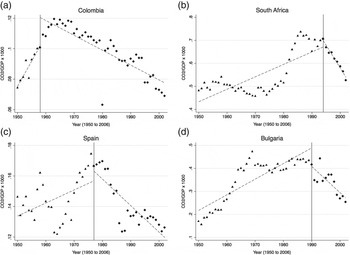
Across the period 1950–2002, the average intensity of CO2 emissions produced per unit of GDP is 1.17 times larger in periods of dictatorship than in periods of democracy.Footnote 9 Several countries clearly show a decrease in the intensity of emissions per unit of GDP in proximity to the regime shift (see figure 4).
CO2 emissions (expressed in kg of carbon) per US$ 1,000 of GDP before (triangle) and after (diamonds) democratization, represented by a vertical line, and their linear fits (dashed lines)

A simple fixed-effect regression of variations of per capita CO2 emissions over a constant, variations of per capita income and a dummy for democracy represented in equation (13), shows that per capita emissions are consistently reduced during democratic periodsFootnote 10 :
 $$\Delta \hbox{CO}2_{it} = \matrix {{8.229862} \cr {\lpar 1.89233\rpar }} + \matrix {{0.1170303} \cr {\lpar 0.0079892\rpar }} \Delta \hbox{GDP}_{it} + \matrix {{-17.3097} \cr {\lpar 3.356346\rpar }} \hbox{Dem}_{it}$$
with ΔCO2 it denoting variations in the level of per capita CO2 emissions expressed in kg of carbon that occurred between t − 1 and t for country i, ΔGDP it variations in the level of per capita income that occurred between t − 1 and t for country i, and Dem it is a dummy variable coded 1 during periods of democracy, and 0 otherwise.
The estimated coefficients of equation (13) indicate that emissions are positively correlated to income, and that one dollar increase in GDP requires 0.117 kg more carbon. However, for each year a country has been democratic, we mark an average decrease in per capita carbon utilization of 17.3 kg. Graphically, the estimated coefficient related to the dummy for democracy represents the average ‘kink’ in the two fitted lines in figure 4, before and after the regime shift, for the whole sample of countries.
Figure 4 shows, for Colombia, South Africa, Spain and Bulgaria, the actual (dotted) and fitted (line) levels of intensity of emissions (expressed in kg of carbon per unit of GDP). The vertical line in each subfigure represents the date of the regime shift. All four countries have experienced a transition to democracy after long periods of dictatorship. After the regime shift we observe a reverse pattern for emissions; whereas before democratization the tendency is to increase the intensity of CO2 emissions in production, later we observe a decline, which is persistent through time.
In early democracies, environmental policies may often be outside the public agenda. The need to protect human rights is instead one of the main reasons for democratization. The protection of human rights often manifests as the need for a job for everyone, social reforms aimed at reducing poverty and pressures for meeting the basic needs of the whole population. In this last category falls the right of everyone to have a healthy life for present and future generations, and therefore environmental management comes to be of crucial importance. How a country chooses to achieve the goal of a better environment, however, varies between different nations, and sometimes it is a direct consequence of other policies undertaken and may not be explicitly regulated. In Colombia, for example, the sharp reduction in the intensity of emissions is associated with the land reform which was aimed both at creating jobs and reducing poverty. Under President Carlos Lleras Restrepo (1966–1970), the Colombian Institute of Agrarian Reform (INCORA) promoted the redistribution of usable land to the peasants and unemployed workers in the country, issuing more than 60,000 titles in 1968 and 1969 alone. As a result of that, after few years the economy was more diversified than before, labour productivity was higher, and inequality lower. He also implemented an aggressive and broad programme of social and economic reforms, creating, among others, a national saving fund, an institute for family wellbeing, the institute to protect non-renewable resources and an agency to promote exports. His successor Misael Pastrana Borrero (1970–1974) carried on the development, increasing economic growth through encouraging housing construction and giving financial incentives to commercial agriculture. As a result, jobs increased as well as wages, and he also promoted the first national environmental legislation in Latin America.
In South Africa the picture is similar. The election of the new government in 1994 was meant to put in place new policies to promote development, directed mainly at alleviating poverty, creating jobs and meeting the basic needs of the majority of South Africans. In this last context, it was necessary to define clear policy objectives in the area of environmental quality and the use of natural resources. The Constitution provided (and provides) a powerful safeguard in shaping future economic and social development in an environmentally sustainable way: it lays down among the fundamental rights of every citizen that ‘every person shall have the right to an environment that is not detrimental to his or her health and wellbeing’ and that ‘every person shall have the right to access all information held by the state or any of its organs at any level of government insofar as such information is required for the protection or exercise of any of his or her rights’.
In Spain the decrease in the intensity of emissions coincides with an increase in the investment in environmental areas. During the 1960s and early 1970s, Spain had an uncontrolled process of industrialization (Font and Morata, Reference Font, Morata, Hanf and Jansen1998). The institutionalization of the environmental policy started in the 1970s, with the creation in 1971 of the Interministerial Commission for the Environment, but investments in the environmental areas were not significant until 1978 (De Esteban and Loṕez Loṕez Reference De Esteban, Loṕez Loṕez and Barbado1993), when the new Constitution introduced an article that established the obligation to ensure rational use of natural resources, to protect and improve the quality of life and to defend or restore the environment.
Lastly, Bulgaria, contrary to other countries, had very bad environmental conditions and democratization was the result of (mainly) environmentalist protests. Bulgaria's dramatic environmental conditions were inherited from the inefficient and obsolete technologies used during the communist era. Any regulation for environmental protection was missing, and it was estimated that two-thirds of Bulgarians suffered from health problems due to pollution. In 1988 the top three causes of death in Bulgaria were cardiovascular illnesses, cancer and respiratory illnesses.Footnote 11 The first demonstration against the communist party in Bulgaria took place in Rousse at the Romanian border in the north of the country. In February 1988 pram-pushing mothers marched through the main street of Rousse protesting that the government was doing nothing on behalf of the ‘international proletariat’ about the chemical plant in Girgiu on the other side of the border in Romania, which for decades had been belching chlorine pollution into the air in Rousse. A committee to save Rousse was founded, and its activities were directed not against the regime of Nicolae Ceausescu in Romania but against Bulgaria and Todor Zhivkov. Here, environmental problems were the driving force toward democratization.
With relevance to this work, however, the issue is not whether democracy causes an environmental improvement or whether environmental issues cause democracy. What is important here is that environmental goals can be obtained only through democratic institutions. What comes first is not crucial; it is only important that environmental policies were undertaken after the regime transition to democracy, which was necessary to achieve those objectives.
5. Conclusion
This theoretical model sheds some light on the possible mechanisms underlying the observed empirical evidence of an environmental improvement followed by democratization. In the absence of environmental inequality, a shift of the decisive power from the dictator to the median voter may lead to an environmental improvement only if the ‘relative’ (with respect to income) marginal WTP for an additional unit of environmental quality is greater for the median voter than the dictator. This result is simply due to the fact that the dictator, appropriating a larger share of global production, faces the tradeoff between taking possession of an additional fraction of income or giving up an amount of income and having a better environment. As long as the fraction of income the dictator can take possession of increases, the opportunity cost to pay for environmental protection increases as well. On the contrary, since the median voter is poorer than the dictator, his demand for environmental quality will be lower, but his opportunity cost to pay for additional environmental protection is also lower due to the fact that his own share of income is low.
The global effect of a regime change from dictatorship to democracy is then ambiguous and depends primarily on the interaction of the differences of wealth between the two decisive political actors and their marginal WTP for environmental protection. If instead one assumes that the dictator can enjoy a better environment because of his ability to pay in order to avoid exposure to pollution, the basic result of this model is that the environmental quality chosen by the dictator does not depend on utility any more, but only on the share of global production of which he can take possession, and the productivity of the expenditure made for reducing the exposure to pollution.
Basically, what is called here ‘insurance for exposure to pollution’ reduces the marginal utility from environmental quality and therefore reduces the marginal WTP for environmental protection. As long as this insurance's productivity is higher than the amount of environmental quality the dictator is willing to give up to become one unit richer, then it is worth for the dictator paying. The total amount the dictator will spend on such an insurance depends on its productivity, stopping when the amount of environmental amenities he can renounce to become marginally richer is exactly equal to the level of productivity of the insurance. The direct effect of this insurance on the level of environmental quality is detrimental: the dictator will find it worthwhile to increase production because in doing so he can maximize his own consumption (or wealth) and pay for reducing his own exposure to pollution generated by the productive activity. Global production will be greater (and, correspondingly, the global level of environmental amenities will be lower), the greater the productivity of the insurance policy because the dictator's perceived environmental quality will be higher.
In conclusion, income inequality per se is not a valid indicator to predict whether a change of the decisive power from a dictator to the median voter will result in more environmental protection or not. Wealth inequality instead plays an important role in conjunction with environmental inequalities to explain the recent evidence of the beneficial effects of democracy on the environmental quality. The explanation for this effect is simple and relies on the assumption that in authoritarian regimes the person who holds the decisive power is likely to be rich and can afford – contrary to the decisive citizen in a democracy who is supposed to be poorer – this insurance against exposure to pollution. If this is the case, as the empirical evidence on the distribution of the environmental burden suggests, we can easily explain why democratization is associated with reductions in human-induced emissions.
Some scholars may wonder, however, if this effect may be induced by the EKC, assuming that democratization occurs at the turning point. Looking at the statistics of equation (13) and the row statistics related to concentration of PM10, it can be reasonably excluded that this sharp reduction in the intensity of CO2 emissions or concentrations of PM10 was the result of generic development, like technological progress or changes in the composition of GDP or any reason that has been adducted to justify the EKC. Even assuming that an EKC exists for such kinds of pollution indicators, the average per capita income during periods of democracy is far below Selden and Song's (Reference Selden and Song1994) minimum estimate of the ‘turning point’ for CO2 emissions, which was supposed to be around US$6,241.00, and for PM10 this turning point has been estimated by Grossman and Krueger (Reference Grossman and Krueger1995) at less than US$5,000.00 (these estimates are computed using real per capita GDP at constant prices, with reference to 1985 US$. My data for GDP are expressed in 1990 US$, but having them expressed in 1985 US$ the average per capita income during democratic spells between 1990 and 2002 is US$4,162,79, and US$1,914.93 during dictatorship. Increasing the time of observation from 1950 to 2002, yields that per capita GDP in 1985 US$ during democracy is, on average, US$4,286.08 and, during dictatorship, US$2,405.68, in any case far below the estimated turning points). Moreover, as Stern (Reference Stern2004) pointed out in one of his recent surveys, any estimation of the EKC's turning point tends to be larger the greater is the number of developing and underdeveloped countries included in the sample, which makes the EKC of dubious existence. The fact that the intensity of emissions has declined simultaneously with an increase in income, therefore, is not an indicator that the turning point of the EKC has reached, since there are good reasons to believe to stay in the increasing part of the EKC (so, to the left of the turning point).
The evidence therefore supports the basics of the model. Democratization, in a society where the majority of the population is not self-employed and supplies physical labour to the production process, is likely to be beneficial for the environment – the bigger the effect, the larger the difference in the share of income of which the two decisive citizens can take possession.
So, having shown that democracies, ceteris paribus, are beneficial for the environment when environmental inequality exists between the two decisive political actors (when the dictator is less exposed to pollution because of his greater ability to substitute environment with personal consumption), one policy conclusion that can be inferred from this exercise and that may boost this result in democracy is a greater openness to trade that increases the exchange of knowledge and the level of technology. Better technologies are often implemented because they allow the increase of production with proportionally less consumption of resources (raw materials, energy, etc.) and this may reach the double goal of increasing economic growth without increasing environmental depletion.
Supplementary materials and methods
The supplementary material referred to in this paper can be found online at journals.cambridge.org/EDE/.