INTRODUCTION
Among the family Acanthuridae only one species has been recorded from the Mediterranean Sea so far, namely Acanthurus monroviae Steindachner, 1876, which was reported first from southern Spain (Crespo et al., Reference Crespo, Rey and García1987) and later from Israel's Mediterranean coast (Golani & Sonin, Reference Golani and Sonin1996). In the years 2001–2002 it was observed quite regularly along the Algerian coast (Hemida et al., Reference Hemida, Diatta, Golani, Ben Souissi, Guélorget and Capapé2004). Here we report the first occurrence of the blue tang surgeonfish Acanthurus coeruleus Bloch & Schneider, 1801 in the Mediterranean Sea and some ways the species may have been introduced are discussed.
MATERIALS AND METHODS
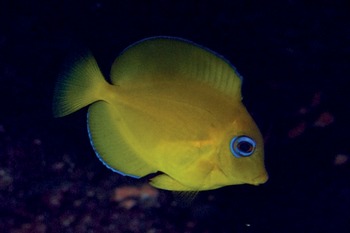
On 1 December 2011, during a SCUBA dive in the vicinity of Xilofagou (south-eastern Cyprus: 34°57′41″N 33°49′48″E), a single juvenile specimen of Acanthurus coeruleus (Figure 1) was observed, and several photographs were taken. The specimen (approximately 8 cm total length) showed up at a depth of 4–5 m over rocky bottom covered by calcareous algae among some individuals of Thalassoma pavo (Linnaeus, 1758), Sparisoma cretense (Linnaeus, 1758), Chromis chromis (Linnaeus, 1758) and Sargocentron rubrum (Forsskål, 1775). The morphological characters match those of a juvenile specimen of A. coeruleus: although many surgeonfishes have yellow juvenile phases, only A. coeruleus and Acanthurus pyroferus Kittlitz, 1834 show electric blue fin edges and a blue ring around both eyes (Lieske & Myers, Reference Lieske and Myers1995). However, the two species can be easily distinguished, as A. coeruleus shows 9 dorsal spines, whereas A. pyroferus shows only 8. As the observed specimen has 9 dorsal spines it should be clearly identified as A. coeruleus.
The specimen of Acanthurus coeruleus observed near Xilofagou (photograph by H.C. Simak).

A second observation of a conspecific specimen took place two days later on the 3 December 2011 near Ayia Napa, about 12 km from the first sighting (34°59′11″N 33°57′53″E). Although the photographs taken at this time are not so clear, the fish in the photograph appears to be A. coeruleus as well.
DISCUSSION
Acanthurus coeruleus usually lives in the western Atlantic Ocean, mainly in tropical waters; it has been recorded from islands of the Mid-Atlantic Ridge too, especially from Ascension Island (Cadenat & Marchal, Reference Cadenat and Marchal1963; Lubbock, Reference Lubbock1980). The present record reports for the first time the presence of this species in the Mediterranean Sea; it is not clear whether the specimen observed on the 3 December is the same as the one observed on the 1 December 2011. The presence of at least one juvenile specimen in the Mediterranean Sea could be explained by three processes: (i) arrival in the Mediterranean Sea through the Atlantic Ocean unrelated to human activities; (ii) introduction by shipping of eggs or larvae; and (iii) release of a captive specimen. The establishment of a tropical Atlantic fish first in the eastern Mediterranean, and its subsequent westward spreading, is already known for the fangtooth moray eel Enchelycore anatina (Lowe, 1839) (Ben Tuvia & Golani, Reference Ben-Tuvia and Golani1984; Bitar et al., Reference Bitar, Dupuy de la Grandrive and Foulquie2003; Guidetti et al., Reference Guidetti, Causio and Licchelli2012)—probably due to the warmer waters of the eastern basin; however, this possibility seems to be unlikely for Acanthurus coeruleus because of the huge distance to travel, although the larval phase of this species has a planktonic life span of 45–70 days (Rocha et al., Reference Rocha, Bass, Ross Robertson and Bowen2002) which seems to be sufficient for crossing the Atlantic Ocean and the Mediterranean Sea from west to east.
The second possibility is the introduction by shipping within ballast water containing larval and juvenile specimens. This kind of introduction of species with a distribution range very far from the Mediterranean Sea is already known (Rodrìguez & Suàrez, Reference Rodrìguez and Suàrez2001; Galil, Reference Galil, Davenport and Davenport2006) for bony fishes (Goren et al., Reference Goren, Gayer and Lazarus2009; Schembri et al., Reference Schembri, Bodilis, Evans and Francour2010); the long pelagic life of the larval stage accords with this hypothesis. The colonization via ballast water is known for western Atlantic species, for example Pinguipes brasilianus (Cuvier & Valenciennes, 1829) (Orsi Relini, Reference Orsi Relini2002) and the hermatypic coral Oculina patagonica De Angelis, 1908 (Zibrowius, Reference Zibrowius1974; Fine et al., Reference Fine, Zibrowius and Loya2001).
A likely possibility as well seems to be the escape of a young specimen from captivity, as the species is commonly traded as aquarium fish. This way of introduction in the Mediterranean has been speculated for the exotic fishes Platax teira (Forsskål, 1775) (Bilecenoglu & Kaya, Reference Bilecenoglu and Kaya2006) and Pterois miles (Bennett, 1803) (Golani & Sonin, Reference Golani and Sonin1992); the latter has been also introduced through aquarium escapees along the western Atlantic Coast, where it is currently considered as a highly invasive species (Morris et al., Reference Morris, Akins, Barse, Cerino, Freshwater, Green, Muñoz, Paris and Whitfield2009). However, as these species commonly occur in the Red Sea, an arrival through the Suez Canal cannot be excluded. For a third species, Scatophagus argus (Linnaeus, 1766), whose native range covers the Indian Ocean (excluding the Red Sea) and the Pacific Ocean, the most likely explanation of the presence in the Mediterranean Sea seems to be the aquarium escape (Zammit & Schembri, Reference Zammit and Schembri2011). Nevertheless, at present, no documented introduction of bony fishes via aquarium trade is known in the Mediterranean. Another two western Atlantic species, namely Paranthias furcifer (Valenciennes, 1828) and Holacanthus ciliaris (Linnaeus, 1758), were recently reported, on the basis of single specimens, from a little bay in the central part of the eastern Adriatic Sea (Dragičević & Dulčić, Reference Dragičević, Dulčić, Poncin, Parmentier, Paquer, Pequex and Wanson2012); these authors considered their presence related to the long rest of an oil platform coming from the Gulf of Mexico in a Croatian shipyard. Such an explanation, however, is not plausible for the present record.
Apart from the way of introduction, about which only suggestions can be made, Acanthurus coeruleus is a highly thermophilic species; its survival in late autumn in the eastern part of the Mediterranean Sea is remarkable, probably related to the trend of global warming and especially to the warming of the Mediterranean waters (Francour et al., Reference Francour, Boudouresque, Harmelin, Harmelin-Vivien and Quignard1994). This record of A. coeruleus in the Mediterranean Sea is probably an accident: the establishment of this western Atlantic species in the Mediterranean seems unlikely.
ACKNOWLEDGEMENTS
We are very grateful to B. Dragičević and J. Dulčić for providing literature and to the anonymous referees for their valuable comments and corrections.