1. Introduction
The rise of multicellularity represents a major evolutionary transition (Maynard Smith & Szathmary, Reference Maynard Smith and Szathmary1998). Multicellular eukaryotes may have evolved as early as during Palaeoproterozoic time, but their diversity remains relatively low until the Ediacaran Period (Knoll et al. Reference Knoll, Javaux, Hewitt and Cohen2006; Xiao et al. Reference Xiao, Muscente, Chen, Zhou, Schiffbauer, Wood, Polys and Yuan2014a ). The Ediacaran Period is characterized by a series of exceptionally preserved fossil Lagerstätten, including the Lantian biota (Yuan et al. Reference Yuan, Chen, Xiao, Zhou and Hua2011), Weng'an biota (Xiao et al. Reference Xiao, Muscente, Chen, Zhou, Schiffbauer, Wood, Polys and Yuan2014a ; Yuan et al. Reference Yuan, Xiao, Yin, Knoll, Zhou and Mu2002) and Miaohe biota (Ding et al. Reference Ding, Li, Hu, Xiao, Su and Huang1996; Xiao et al. Reference Xiao, Yuan, Steiner and Knoll2002), as well as the Avalon assemblage (Narbonne, Reference Narbonne2004), White Sea assemblage (Martin et al. Reference Martin, Grazhdankin, Bowring, Evans, Fedonkin and Kirschvink2000) and Nama assemblage (Grotzinger et al. Reference Grotzinger, Bowring, Saylor and Kaufman1995) of the Ediacara biota. Among these Ediacaran biotas, the Weng'an biota in the Doushantuo Formation of central Guizhou Province of South China stands out for its extraordinary fossil preservation at cellular and subcellular levels (Hagadorn et al. Reference Hagadorn, Xiao, Donoghue, Bengtson, Gostling, Pawlowska, Raff, Raff, Turner, Yin, Zhou, Yuan, McFeely, Stampanoni and Nealson2006; Xiao, Zhang & Knoll, Reference Xiao, Zhang and Knoll1998). It provides a unique window to explore the early evolution of cellularly differentiated eukaryotes, including multicellular algae and animals (Chen et al. Reference Chen, Xiao, Pang, Zhou and Yuan2014a ; Xiao et al. Reference Xiao, Muscente, Chen, Zhou, Schiffbauer, Wood, Polys and Yuan2014a ).
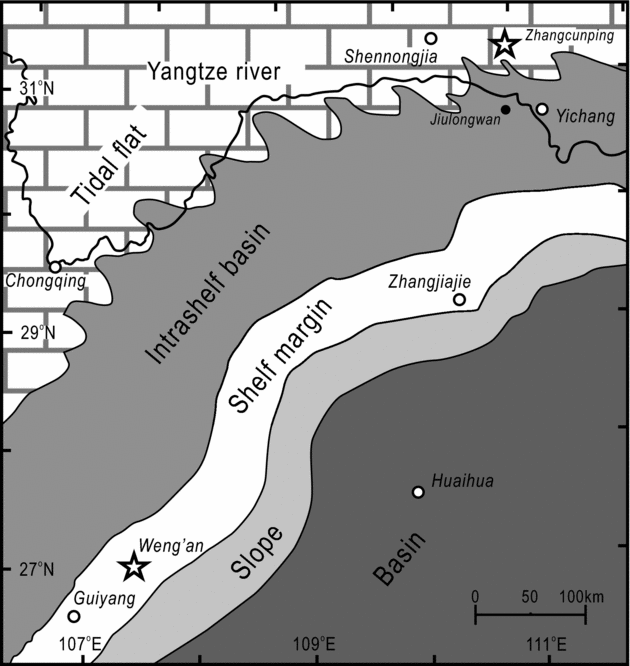
The stratigraphic background of the Weng'an biota has been published previously (Xiao et al., Reference Xiao, Muscente, Chen, Zhou, Schiffbauer, Wood, Polys and Yuan2014a) and is briefly summarized here. The Doushantuo Formation at Weng'an (Fig. 1) overlies the Cryogenian Nantuo Formation and underlies the terminal Ediacaran Dengying Formation (Fig. 2). It begins with a cap dolostone (unit 1) that is widely distributed and easily recognizable in South China. The cap carbonate is followed by unit 2 or lower phosphorite that is characterized by thin-bedded, peloidal phosphorite with interbedded dolostone. Unit 3 is a 2–4 m thick massive dolostone, also known as the mid-Doushantuo dolostone, with a prominent karstification surface on top. Further upsection, unit 4 or upper phosphorite consists of 3–10 m thick intraclastic phosphorite; this unit is further divided into the lower unit 4A (black facies) and the upper unit 4B (grey facies). Unit 5 is c. 10 m thick phosphatic dolostone, which may contain an additional exposure surface. The Weng'an biota occurs in units 4–5, but the main repository is in unit 4A (black facies) and 4B (grey facies).
Palaeogeographic reconstruction of the Ediacaran Doushantuo Formation (Jiang et al. Reference Jiang, Shi, Zhang, Wang and Xiao2011) and locations of the studied Zhangcunping and Weng'an sections (stars).

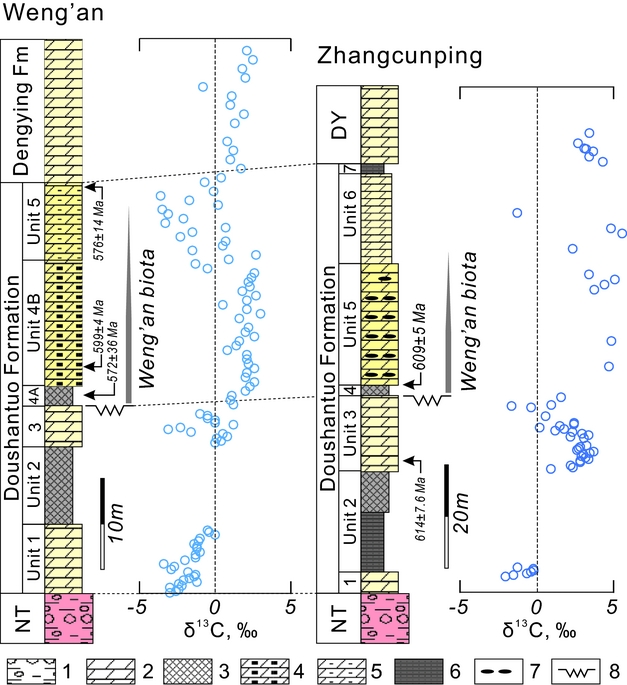
Litho-, chemo- and biostratigrasphic correlation of the Doushantuo Formation at Zhangcunping and Weng'an. Radiometric dates are from Barfod et al. (Reference Barfod, Albaréde, Knoll, Xiao, Télouk, Frei and Baker2002), Chen et al. (Reference Chen, Dong, Zhu and Chen2004), Chen et al. (Reference Chen, Jiang, Ling and Yang2009) and this study. δ13C data are from Zhou et al. (Reference Zhou, Xie, McFadden, Xiao and Yuan2007) for Weng'an section and Yuan et al. (Reference Yuan, Chen, Xiao, Zhou and Hua2011) for Zhangcunping section. 1, diamictite; 2, dolostone; 3, phosphorite; 4, dolomitic phosphorite; 5, phosphatic dolostone; 6, black shale; 7, chert/phosphatic nodules; 8, erosional surface. NT – Nantuo Formation; DY – Dengying Formation.

Despite the key role it plays in the study of Ediacaran palaeobiology, the Weng'an biota is poorly constrained by radiometric ages. Previously published radiometric dates from the Doushantuo Formation at Weng'an include whole-rock Pb–Pb isochron ages of 572 ± 36 Ma (Chen et al. Reference Chen, Jiang, Ling and Yang2009), 599 ± 4 Ma (Barfod et al. Reference Barfod, Albaréde, Knoll, Xiao, Télouk, Frei and Baker2002) and 576 ± 14 Ma (Chen et al. Reference Chen, Dong, Zhu and Chen2004) from units 4A, 4B and 5, respectively. Although these ages are consistent within errors with each other and suggest that the Weng'an biota is c. 600 Ma, they have large error bars and are considered unreliable (Condon et al. Reference Condon, Zhu, Bowring, Wang, Yang and Jin2005). Instead, Condon et al. (Reference Condon, Zhu, Bowring, Wang, Yang and Jin2005) proposed that the Weng'an biota is younger than c. 580 Ma based on the assumption that the exposure surface atop unit 3 represents a sedimentary response to the c. 582 Ma Gaskiers glaciation.
The poor age constraint on the Weng'an biota hampers our understanding of the evolutionary pattern of Ediacaran marine ecosystems. For example, it has traditionally been believed that the marine ecosystems during early Ediacaran time (635–580 Ma) is dominated by microscopic eukaryotes, including spiny acritarchs and spheroidal fossils in the Weng'an biota, with macro-organisms (e.g. those in the Lantian biota; Wan et al. Reference Wan, Yuan, Chen, Guan, Pang, Tang and Xiao2016) playing a subordinate role; the late Ediacaran (580–541 Ma) marine ecosystems are however characterized by the ecological dominance of macro-organisms including the Ediacara biota (e.g. Xiao & Laflamme, Reference Xiao and Laflamme2008). If the Weng'an biota is younger than 580 Ma as suggested by Condon et al. (Reference Condon, Zhu, Bowring, Wang, Yang and Jin2005), then it is possible for the Weng'an biota to temporally overlap with the Ediacara biota.
The Doushantuo Formation at Zhangcunping in Yichang of western Hubei Province, South China, exhibits lithostratigraphic sequence and yields phosphatic fossil assemblage similar to those at Weng'an (Chen et al. Reference Chen, Yin, Liu, Gao, Tang and Wang2010; McFadden et al. Reference McFadden, Xiao, Zhou and Kowalewski2009; Ye et al. Reference Ye, Tong, An, Tian, Zhao and Zhu2015; Zhou, Xie & Xiao, Reference Zhou, Xie and Xiao2005). The Zhangcunping section can therefore provide an independent test of the age of the Weng'an biota. In this paper, we report a SIMS zircon U–Pb age from a tuffaceous bed immediately above the upper phosphorite unit at Zhangcunping, which is correlated with unit 4 at Weng'an.
2. Geological setting and sample horizon
Facies analyses of representative sections on the Yangtze Block suggest that the basal Doushantuo Formation was deposited in an open shelf setting, which then evolved into a rimmed shelf shortly after the deposition of the Doushantuo cap dolostone (Jiang et al. Reference Jiang, Shi, Zhang, Wang and Xiao2011). The Zhangcunping section is located in the inner shelf whereas the Weng'an section in located in the outer shelf, both in shallow-water environments (Fig. 1) (Cao et al. Reference Cao, Tang, Xue, Yu, Yin and Zhao1989; Jiang et al. Reference Jiang, Shi, Zhang, Wang and Xiao2011). Facies variation is expected in both sites because of the exposure of the shallow-water carbonate platform and facies migration towards the shelf lagoon (Jiang et al. Reference Jiang, Shi, Zhang, Wang and Xiao2011).
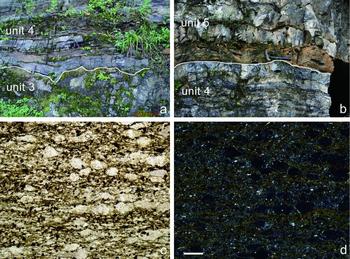
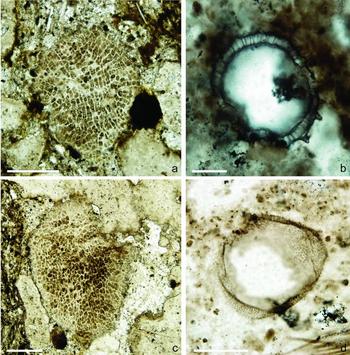
The lithostratigraphic sequence of the Doushantuo Formation at Zhangcunping resembles that at Weng'an (Fig. 2). The Doushantuo Formation (c. 90 m in thickness) generally consists of seven units, though the thickness of each unit varies in this area. Overlying the Cryogenian Nantuo Formation diamictite, the Ediacaran Doushantuo Formation begins with c. 3 m of the cap dolostone (unit 1) followed by 2–24 m of black shale with phosphorite and dolostone interbeds (unit 2). The phosphotite unit is overlain by 4–20 m of medium-bedded dolostone (unit 3), with an erosional surface at the top (Fig. 3a) and a 614.0 ± 7.6 Ma ash bed at the base (Liu et al. Reference Liu, Yin, Gao, Tang and Chen2009). Overlying the erosional surface, unit 4 is characterized by the 5–12 m of phosphorite interbedded with dolostone (Fig. 3a, b). The succeeding unit 5 begins with a 30 cm thick tuffaceous siltstone and mudstone (Figs 2, 3b), followed by c. 30 m of greyish-black thin- to medium-bedded dolostones with abundant cherty and phosphatic nodules and thin layers. Unit 6 is >20 m thick and consists of thin-bedded dolostone, which is overlain by unit 7 of 1–2 m black shale. The Doushantuo Formation is overlain by the Dengying Formation dolostone. Phosphatized multicellular algal fossils and acanthomorphic acritarchs taxonomically similar to those in the Weng'an biota have been reported from units 4 and 5 (Fig. 4; Chen et al. Reference Chen, Yin, Liu, Gao, Tang and Wang2010; Liu et al. Reference Liu, Yin, Gao, Tang and Chen2009; McFadden et al. Reference McFadden, Xiao, Zhou and Kowalewski2009; Ye et al. Reference Ye, Tong, An, Tian, Zhao and Zhu2015; Zhou, Xie & Xiao, Reference Zhou, Xie and Xiao2005).
Outcrop and thin-section photographs: (a) unit 4 phosphorite deposited on the erosional surface at the top of unit 3 dolostone; (b) brown tuffaceous bed immediately overlies the unit 4 phosphorite; (c, d), thin-section photographs taken under plane and polarized transmitted light, respectively, showing phosphatic/chert nodules within tuffaceous silty and argillaceous matrix. Hammers in (a) and (b) are c. 30 cm long, scale bar in (d) 100 µm, also applicable to (c).

Microfossils from units 4 and 5 of the Doushantuo Formation at Zhangcunping. (a, c) Wenganian globosa, 14ZCP-34; (b) Distosphaera speciosa, 14ZCP-45; (d) Knollisphaeridium triangulum, 14ZCP-46. Scale bars 100 µm in (a, c, d) and 20 µm in (b).

The tuffaceous bed occurs in unit 5 at Lizhi roadcut section (31° 19.944′ N, 111° 12.361′ E). In contrast to adjacent grey dolostone and dark grey phosphorite, it is brown in colour on weathered outcrop and contains centimetre-thick phosphorite/chert layers (Fig. 3b). Thin-section observation under microscope indicates that these layers consist of phosphorite/chert nodules within tuffaceous silty and argillaceous matrix (Fig. 3c, d).
3. SIMS zircon U–Pb analytical procedures
Zircon concentrates were separated from a c. 10 kg of tuffaceous sample (sample number 15LZash1) using standard density and magnetic separation techniques. Zircon grains, together with zircon standard Plešovice 91500 and Qinghu, were mounted in an epoxy disc, which was then polished to expose the zircon crystals for analysis. All zircons were documented with transmitted and reflected light photomicrographs and cathodoluminescence (CL) images to reveal their internal structures. The mount was cleaned and vacuum-coated with high-purity gold prior to SIMS analysis.
Measurements of U, Th and Pb isotopes were conducted using a Cameca IMS 1280HR large-radius SIMS at the Institute of Geology and Geophysics, Chinese Academy of Sciences in Beijing. Analytical procedures are the same as those described by Li et al. (Reference Li, Liu, Li, Guo and Chamberlain2009). The O2 − primary ion beam was accelerated at 13 kV, with an intensity of c. 8 nA. The aperture illumination mode (Kohler illumination) was used with a 200 μm primary beam mass filter (PBMF) aperture to produce even sputtering over the entire analysed area. The ellipsoidal spot is about 20×30 μm in size. Positive secondary ions were extracted with a 10 kV potential. The ‘oxygen flooding technique’ with a working O2 gas pressure of c. 5×10⁻⁶ Torr (Li et al. Reference Li, Li, Liu, Tang, Yang and Zhu2010) was used to enhance the secondary Pb+ sensitivity to a value of c. 38 cps (nA ppm)–1 for zircon. In the secondary ion beam optics, a 60 eV energy window was used. Mass resolving power is set at 5400 (10% peak height definition) to separate Pb+ peaks from isobaric interferences. A single electron multiplier was used in ion-counting mode to measure secondary ion beam intensities by peak jumping.
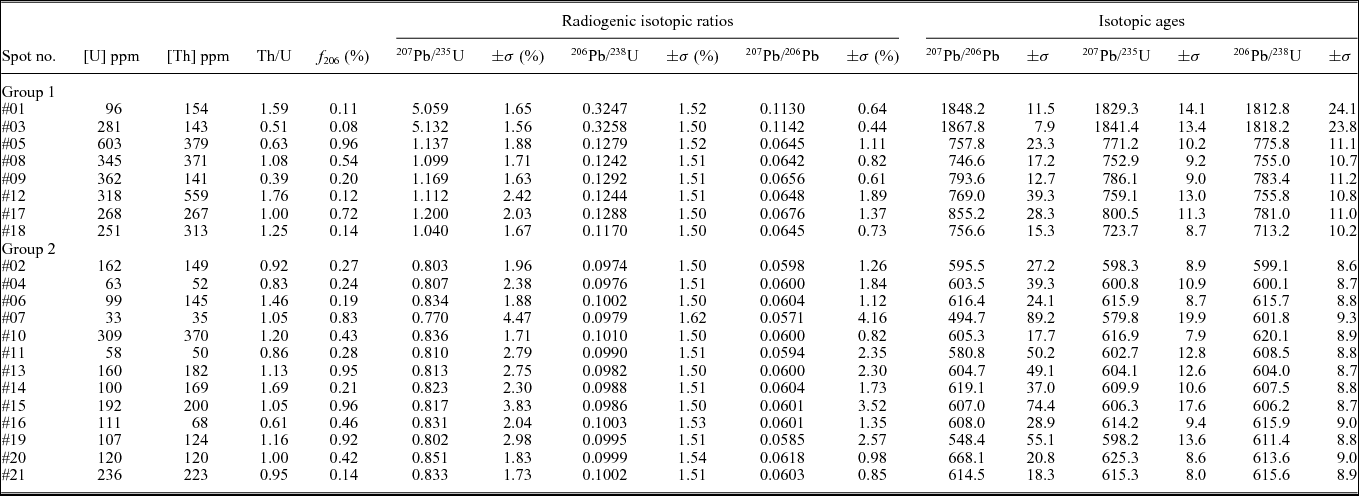
Pb/U fractionation was calibrated with the power relationship between 206Pb/238U and 238U16O2/238U against zircon standard Plešovice (Sláma et al. Reference Sláma, Košler, Condon, Crowley, Gerdes, Hanchar, Horstwood, Morris, Nasdala, Norberg, Schaltegger, Schoene, Tubrett and Whitehouse2008); calibration of U and Th abundance was performed relative to zircon standard 91500 (Wiedenbeck et al. Reference Wiedenbeck, Allé, Corfu, Griffin, Meier, Oberli, Quadt, Roddick and Spiegel1995). A long-term uncertainty of 1.5% (1 RSD) for 206Pb/238U measurements of the standard zircons (Li et al. Reference Li, Li, Liu, Tang, Yang and Zhu2010) was propagated to the unknowns, despite the fact that the measured 206Pb/238U error during the course of this work is <1%. Measured compositions were corrected for common Pb using non-radiogenic 204Pb. Corrections are sufficiently small to be insensitive to the choice of common Pb composition, and an average of present-day crustal composition (Stacey & Kramers, Reference Stacey and Kramers1975) is used for the common Pb assuming that the common Pb is largely surface contamination introduced during sample preparation. Analytical results are listed in Table 1 and uncertainties for individual isotopic data analyses are reported as 1σ. Mean ages for pooled U/Pb analyses are quoted with 95% confidence interval. Data processing was carried out using the Isoplot 3.70 program (Ludwig, Reference Ludwig2008).
Geochronological data of the tuffaceous sample 15LZash1.

207 Pb/235U, 206Pb/238U and 207Pb/206Pb are common Pb-corrected ratios; f 206 value is the proportion of common 206Pb in total measured 206Pb.
In order to ascertain the veracity of SIMS U–Pb measurements calibrated against Plešovice standard, Qinghu zircon standard was alternately analysed as an unknown together with 15LZash1 zircons. Seven measurements conducted on Qinghu yield a Concordia Age of 160.3 ± 1.8 Ma, identical within errors to the recommended value of 159.5 ± 0.2 Ma (Li et al. Reference Li, Tang, Gong, Yang, Hou, Hu, Li, Liu and Li2013).
4. Results
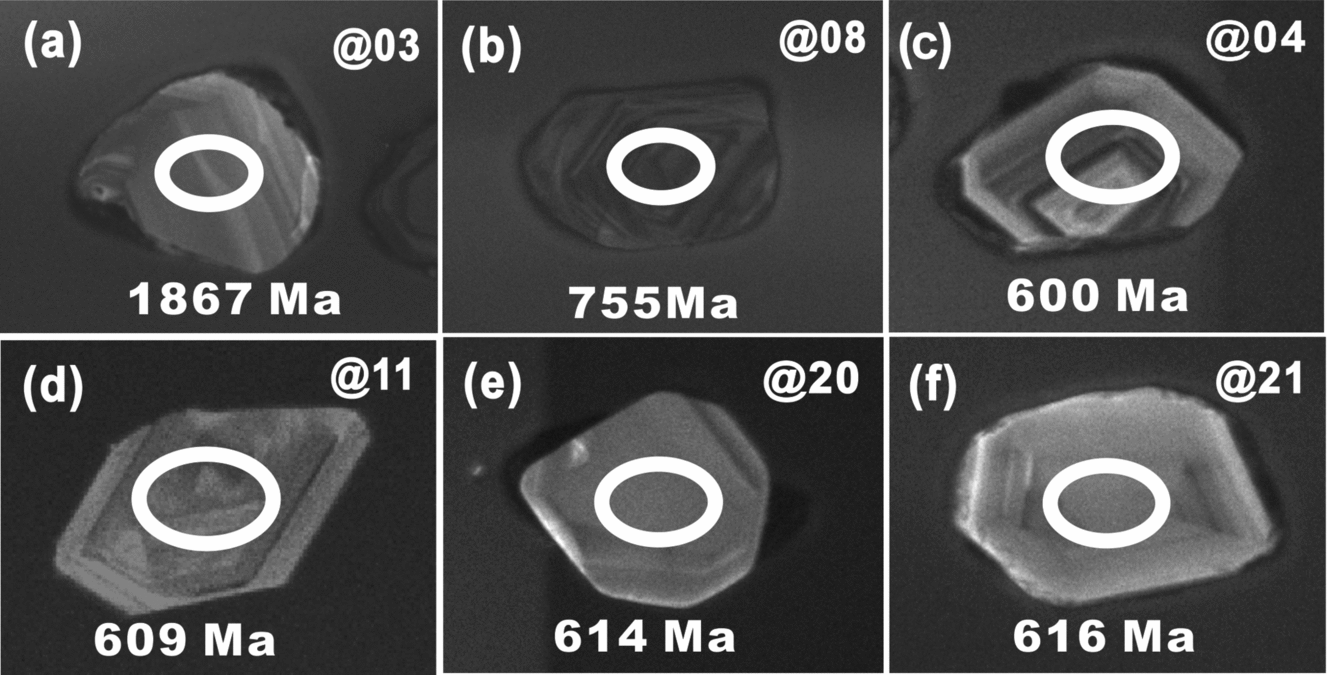
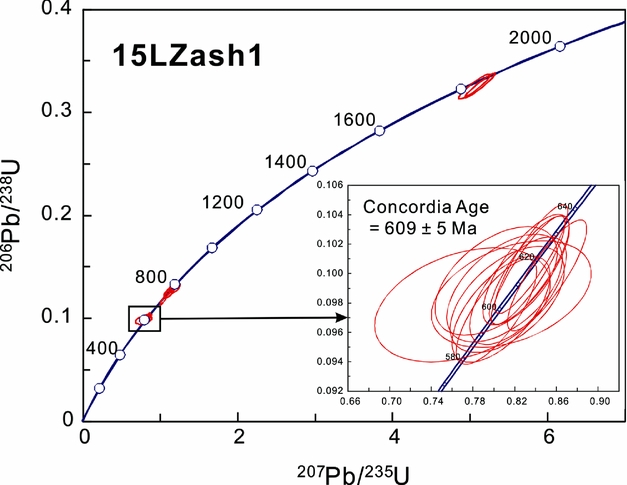
Zircon crystals from the tuff sample 15LZash1 are small in size, 50–100 μm in length and have aspect ratios of 1:1 to 2:1. They can generally be subdivided into two groups in terms of their morphology and CL image features. Group 1 zircons are mostly oval in shape (Fig. 5a, b), whereas group 2 zircons are euhedral to subhedral in shape, showing oscillatory zoning under CL (Fig. 5c–f). Twenty-one analyses were conducted on 21 zircons (Table 1), with 8 and 13 measurements for group 1 and group 2, respectively. Six of eight group 1 zircons are dated at c. 750–800 Ma, and the remaining two zircons yield a much older, Palaeoproterozoic age of c. 1.85–1.87 Ga (Table 1; Fig. 6). Considering their oval shape and scattered ages, they are most likely xenocrysts. Such Neoproterozoic and Palaeoproterozoic zircons are common in the Yangtze Block (e.g. Liu et al. Reference Liu, Gao, Diwu and Ling2008). The group 2 zircons have U concentrations ranging over 33–309 ppm, Th concentrations over 35–370 ppm and Th/U ratios over 0.61–1.69. Common Pb is low, and values of f 206 are all <1%. All analyses have concordant U–Pb ages within analytical errors (Fig. 6), yielding a U–Pb Concordia age of 609 ± 5 Ma (MSWD of concordance = 0.34), which is interpreted as the best estimate of the crystallization age of group 2 zircons in the tuff sample 15LZash1. This age therefore provides an estimate of the depositional age of basal unit 5 and, together with the 614.0 ± 7.6 Ma age from unit 3 (Liu et al. Reference Liu, Yin, Gao, Tang and Chen2009), it provides an age constraint on the phosphatized fossil assemblage occurring at Zhangcunping and therefore the Weng'an biota that occurs in unit 4 of the Doushantuo Formation at Weng'an through correlation.
Cathodoluminescence (CL) images for representative zircons from the tuffaceous sample 15LZash1. The ellipses on zircons represent the spots of SIMS U–Pb isotope analyses. SIMS spots are 30 μm in length for scale.

SIMS zircon U–Pb concordia age plot for the tuffaceous sample 15LZash1.

5. Age constraint on the Weng'an biota
Lithostratigraphic sequences of the Doushantuo Formation at Zhangcunping and Weng'an can be easily correlated (Fig. 2; Zhou, Xie & Xiao, Reference Zhou, Xie and Xiao2005). In particular, the erosional surface atop unit 3 (middle dolostone) at both Zhangcunping and Weng'an sections represents a regional subaerial exposure and karstification event in shallow-water carbonate facies including the inner- and outer-shelf shoal complex, with deeper-water facies (such as the shelf basin Jiulongwan section) unaffected. The lithostratigraphic correlation is strongly supported by the biostratigraphic data obtained from the Zhangcunping (Chen et al. Reference Chen, Yin, Liu, Gao, Tang and Wang2010; Liu et al. Reference Liu, Yin, Gao, Tang and Chen2009; McFadden et al. Reference McFadden, Xiao, Zhou and Kowalewski2009; Ye et al. Reference Ye, Tong, An, Tian, Zhao and Zhu2015; Zhou, Xie & Xiao, Reference Zhou, Xie and Xiao2005) and Weng'an sections (e.g. Xiao et al. Reference Xiao, Zhou, Liu, Wang and Yuan2014b ), with taxonomically similar multicellular algae, spheroidal fossils and acanthomorphic acritarchs occurring in phosphorite in units 4–5 at both sections. The δ13C profiles of the Doushantuo Formation at Zhangcunping and Weng'an also show similar chemostratigraphic trends, further supporting the litho- and biostratigraphic correlations (Fig. 2).
Accepting the aforementioned stratigraphic correlation, the 609 ± 5 Ma age from basal unit 5 at Zhangcunping also represents the depositional age of unit 4 at Weng'an, providing an age constraint on the Weng'an biota. The Weng'an biota therefore first appeared no later than 609 ± 5 Ma.
The new age also suggests that the karstic surface atop unit 3 at both Weng'an and Zhangcunping must be >609 ± 5 Ma and therefore cannot be a glacio-eustatic response to the 582 Ma Gaskiers glaciation as proposed previously (Condon et al. Reference Condon, Zhu, Bowring, Wang, Yang and Jin2005). Furthermore, the Weng'an biota must pre-date both the 582 Ma Gaskiers glaciation and the 575–565 Ma Avalon assemblage. It remains to be shown whether elements of the Weng'an biota, particularly some acanthomorphic acritarchs, may extend to younger strata and overlap with the Ediacara biota of macroscopic organisms (Xiao et al. Reference Xiao, Zhou, Liu, Wang and Yuan2014b), but it is clear that microscopic fossils of the Weng'an biota appeared much earlier than Ediacara megafossils. This assessment is further supported by the occurrence of elements of the Weng'an biota, including the multicellular alga Wengania and the spiny acritarch Tianzhushania, in chert nodules of the lower Doushantuo Formation in the Yangtze Gorges area (c. 632 Ma, Condon et al. Reference Condon, Zhu, Bowring, Wang, Yang and Jin2005; Liu et al. Reference Liu, Chen, Zhu, Li, Yin and Shang2014; Zhou et al. Reference Zhou, Xie, McFadden, Xiao and Yuan2007).
Three U–Pb zircon dates from volcanic ash beds were respectively reported from the top of the cap dolostone unit (635.2 ± 0.6 Ma), the lower part (632.5 ± 0.5 Ma) and the uppermost Doushantuo Formation (551.1 ± 0.7 Ma) in the Yangtze Gorges area (Condon et al. Reference Condon, Zhu, Bowring, Wang, Yang and Jin2005), which provide a direct age constraint on the termination of the Marinoan global glaciation and an approximate temporal framework for the Ediacaran fossil assemblages, including Miaohe (Xiao et al. Reference Xiao, Yuan, Steiner and Knoll2002) and Shibantan biotas (Chen et al. Reference Chen, Zhou, Meyer, Xiang, Schiffbauer, Yuan and Xiao2013, Reference Chen, Zhou, Xiao, Wang, Guan, Hua and Yuan2014 b). However, the direct age constraints on many other Ediacaran fossil biotas such as the Lantian biota (Yuan et al. Reference Yuan, Chen, Xiao, Zhou and Hua2011), and on the pronounced negative δ13C excursion event (e.g. EN3, McFadden et al. Reference McFadden, Huang, Chu, Jiang, Kaufman, Zhou, Yuan and Xiao2008; Zhou & Xiao, Reference Zhou and Xiao2007), a probable equivalent to the middle Ediacaran Shuram/Wonoka anomaly (Le Guerroué et al. Reference Le Guerroué, Allen, Cozzi, Etienne and Fanning2006; Lu et al. Reference Lu, Zhu, Zhang, Shields-Zhou, Li, Zhao, Zhao and Zhao2013), are absent; this hampers our understanding of the coevolutionary pattern of Ediacaran marine organisms and environmental change, and also makes the subdivision and classification of the Ediacaran System more challenging (Xiao et al. Reference Xiao, Narbonne, Zhou, Laflamme, Grazhdankin, Moczydłowska-Vidal and Cui2016).
6. Conclusion
In summary, the SIMS U–Pb age of 609 ± 5 Ma from unit 5 of the Ediacaran Doushantuo Formation at Zhangcunping in Yichang, Hubei Province, provides a direct age constraint on the Weng'an biota, indicating that the Weng'an biota is much older than the macroscopic Ediacara biota. More reliable radiometric ages are needed to further elucidate both the biological and environmental evolution of Ediacaran marine ecosystems.
Acknowledgements
This work was supported by the National Basic Research Program of China (grant number 2013CB835005), the Chinese Academy of Sciences (grant number KZZD-EW-02) and the National Science Foundation (grant number EAR-1528553). We are grateful to two anonymous reviewers for their constructive suggestions.