Introduction
Among the material of Bryoria Brodo & D. Hawksw. used by the second author in a molecular study (Myllys et al. Reference Myllys, Velmala, Holien, Halonen, Wang and Goward2011), one specimen originally named B. bicolor (Ehrh.) Brodo & D. Hawksw. did not group together with this species on the phylogenetic tree. It has a distinct morphology and chemistry and is described below as a new species.
Materials and Methods
The material consists of selected specimens from the herbaria in BG, H, KUN and UPS. They were studied by standard microscopic and chromatographic methods described in Myllys et al. (Reference Myllys, Velmala, Holien, Halonen, Wang and Goward2011).
The Species
Bryoria rigida P. M. Jørg. & Myllys sp. nov.
MycoBank No.: MB800632
Bryoriae bicoloris similis, sed thallo erecto caulibus principalibus crassioribus, ramulis tertialibus et spinulis erectis. Acidum fumarprotocetraricum et saepe acidum protocetraricum materiae chimicae principales, cum acidis confumarprotocetrarico et quaesitico quantitate minori.
Typus: China, Yunnan Province, Dali Bai Autonomous Prefecture, Diancang Shan Mt., 25°40′475″N 100°06′028″E, alt. 3570 m, on rock, 28 July 2005, L. S. Wang 06-26208 (KUN—holotypus; H—isotypus). [GenBank accession numbers: HQ402703, HQ402652].
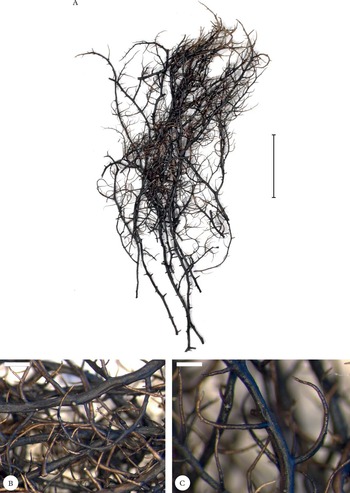
(Fig. 1)
Bryoria rigida, holotype. A, habitus; B, detail of branch with black and elongate fusiform pseudocyphellae; C, detail of branch with spinules. Scales: A=1 cm; B=1 mm; C=500 µm.
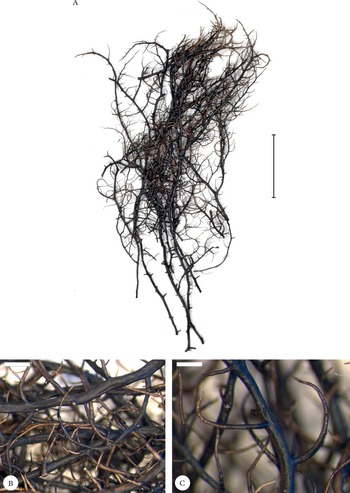
Thallus erect, forming loose cushions up to 5 cm high with prominent, to 0·8 mm broad, black main stems and rigid isotomic branches with short tertiary branchlets often olivaceous brown towards the apices. Pseudocyphellae black, elongate fusiform, plane or slightly depressed, c. 0·1 mm wide, 0·2–0·7 mm long, scattered, most common on the branchlets, without soralia or isidia. Branchlets and spinules pointing upwards at acute, c. 45°–65° angles, spinule bases constricted.
Apothecia and conidiomata unknown.
Chemistry. Cortex and medulla PD+ red-orange, all other reactions negative, containing fumarprotocetraric acid and often protocetraric acid as the main substances and traces of quaesitic and confumarprotocetraric acids (TLC).
Distribution and ecology. The new species is as yet known only from two localities in Yunnan, China, and Sikkim, India, but is likely to show a more continuous distribution in the Himalayan mountains. It appears to be restricted to the foggy, humid parts and is known from 3500–4300 m, occurring both on mossy rocks and branches of trees. The type locality is a partially shaded mixed forest of Rhododendron spp., Abies delavayi Franch. and Sinarundinaria nitida (Mitford ex Stapf) Nakai characterized by heavy fogs and a precipitation of c. 1874 mm per year. Average temperature in the area is 7–8°C.
Notes. This new species is certainly close to B. bicolor (Ehrh.) Brodo & D. Hawksw. (Jørgensen & Ryvarden Reference Jørgensen and Ryvarden1970) but its habit is quite distinct in its markedly stiff, coarse thallus which, in addition to fumarprotocetraric acid, often contains protocetraric acid as a major compound. The latter substance is often found in lichens containing fumarprotocetraric acid, but only in trace amounts, as is the case in B. bicolor. Since Brodo & Hawksworth (Reference Brodo and Hawksworth1977) do not record any satellite substances of B. bicolor, we have checked a selection of specimens and found that most of them also have traces of protocetraric acid and other related satellite substances (such as quaesitic acid).
In the molecular study (Myllys et al. Reference Myllys, Velmala, Holien, Halonen, Wang and Goward2011), the new species belongs to the section Divaricatae but is clearly separated from other species of the section. It groups together with B. bicolor, B. tenuis (E. Dahl) Brodo & D. Hawksw. and two unidentified species, all of them containing fumarprotocetraric acid. Outside Eurasia there are two little known members of the B. bicolor group, B. carlottae Brodo & D. Hawksw. (Brodo & Hawksworth Reference Brodo and Hawksworth1977) in North America and B. ruwenzoriensis (D. Hawksw.) Brodo & D. Hawksw. (Hawksworth Reference Hawksworth1971) in Africa, neither of which were included in the molecular phylogeny of Myllys et al. (Reference Myllys, Velmala, Holien, Halonen, Wang and Goward2011). Based on our examination of a paratype of B. carlottae and the holotype of B. ruwenzoriensis, the species lack quaesitic acid but contain traces of protocetraric and confumarprotocetraric acids in addition to fumarprotocetraric acid, and are morphologically different from our new species. Bryoria ruwenzoriensis has much coarser tertiary branchlets at right angles and is only doubtfully distinct from B. bicolor since typical material of this species is now known from the region (Krog & Swinscow Reference Krog and Swinscow1975); thus it appears to be an extreme form of B. bicolor. Bryoria carlottae is an altogether more gracile species with short spreading branchlets and is likely to be a separate species endemic to the Pacific Northwest.
Our discovery supports the view that the mountains of Asia are a centre for the sect. Divaricatae, and particularly the B. bicolor group (Jørgensen Reference Jørgensen1972).
Additional specimens examined. India:Sikkim: 45 km N of Darjeeling, near Dzongri, Dab-La-Gang, 27°29′N 88°09′E, alt. 4300 m, on Rhododendron, 6 iv 1978, E. Albertshofer (Obermeyer: Lichenotheca Graecensis 81 BG!, GZU, H!, UPS!).
Key to the ‘divaricate’ Bryoria species found in the Himalayan region
Note: All the divaricate species of the Himalayan region are treated here. The term refers to species which have spinulose side branches, are mostly erect to caespitose in growth form and often contain fumarprotocetraric acid (see Brodo & Hawksworth Reference Brodo and Hawksworth1977). In the phylogeny of Myllys et al. (Reference Myllys, Velmala, Holien, Halonen, Wang and Goward2011), however, section Divaricatae was more restricted, including only bicolorous taxa, while the other Asian species with spinulose side branches belong to the section Bryoria. The records of the species in the area are based on Jørgensen (Reference Jørgensen1972), Awasthi & Awasthi (Reference Awasthi and Awasthi1985), Wang & Harada (Reference Wang and Harada2001), Wang et al. (Reference Wang, Harada, Koh and Hur2005, Reference Wang, Harada, Koh and Hur2006) and Myllys et al. (Reference Myllys, Velmala, Holien, Halonen, Wang and Goward2011).
1 Thallus not truly bicolorous (species of section Bryoria, see Myllys et al. Reference Myllys, Velmala, Holien, Halonen, Wang and Goward2011) ... 2
Thallus bicolorous: blackened basal parts and more or less greyish brown to olive-brown apical branches and spinules (species of section Divaricatae, see Myllys et al. Reference Myllys, Velmala, Holien, Halonen, Wang and Goward2011) ... 9
2(1) Thallus sorediate; soralia with isidioid spinules ... 3
Thallus esorediate ... 5
3(2) Thallus UV+; lobaric acid ... B. perspinosa (Bystrek) Brodo & D. Hawksw.
Thallus UV− ... 4
4(3) Soralia broader than the branches ... B. poeltii (Bystrek) Brodo & D. Hawksw.
Soralia not broader than the branches ... B. furcellata (Fr.) Brodo & D. Hawksw.
5(2) Thallus pendent ... 6
Thallus erect or caespitose ... 7
6(5) Thallus sterile ... B. himalayana (Motyka) Brodo & D. Hawksw.
Thallus fertile ... B. lactinea (Nyl.) Brodo & D. Hawksw.
7(5) Thallus concolorous, dark brown or black; apothecia unknown ... B. nitidula (Th. Fr.) Brodo & D. Hawksw.
Thallus dark brown with paler parts (but not truly bicolorous), usually fertile ... 8
8(7) Thallus coarse, main stem distinct, thick, up to 0·9 mm diam., lateral spinules abundant, pseudocyphellae absent ... B. divergescens (Nyl.) Brodo & D. Hawksw.
Thallus more gracile, main branches up to 0·5 mm diam., side branches and lateral spinules sparse, pseudocyphellae present, depressed ... B. fastigiata Li S. Wang & H. Harada
9(1) Thallus sorediate; soralia with isidioid spinules; secondary substances absent ... 10
Thallus esorediate; fumarprotocetraric acid absent or present ... 11
10(9) Thallus robust, erect, main stem distinct; apothecia unknown ... B. smithii (Du Rietz) Brodo & D. Hawksw.
Thallus more delicate, almost pendent, without distinct main stem, usually fertile ... B. variabilis (Bystrek) Brodo & D. Hawksw.
11(9) Thallus PD−; secondary substances absent, usually fertile ... B. confusa (D. D. Awasthi) Brodo & D. Hawksw.
Thallus PD+ red-orange; fumarprototcetraric acid, usually sterile ... 12
12(11) Robust, coarse with distinct main stem ... B. rigida
More gracile, without distinct main stem ... 13
13(12) Third order branches common and well-developed ... B. bicolor
Third order branches absent or poorly developed ... B. tenuis (E. Dahl) Brodo & D. Hawksw.
We are indebted to the curators of BG, KUN and UPS for sending material on loan to us. Further thanks go to T. Tønsberg, BG, for assistance with chemical matters and A. Launis for photographing the type material. We are grateful to T. Ahti for valuable comments on the manuscript. The Academy of Finland is thanked for providing a grant to the second author (grant 1133858). National Natural Science Foundation of China (No. 31170023) and Flora Lichenum Sinicorum (No. KSCX2-EW-Z-9) provided grants to L.S.W.