Significant outcomes
-
• We found moderate PPI test-retest reliabilities across the different prepulse intensities, with high test-retest reliability when pooling across prepulse intensities and sessions.
-
• PPI across all prepulse intensities correlated significantly with the 0-back and 2-back conditions of the n-back paradigm.
-
• After regressing out the 0-back condition, only PPI with 76-dB prepulse intensity correlated significantly with the 2-back condition of the n-back paradigm.
Limitations
-
• To achieve an adequately powered assessment of test-retest reliability, we had to pool across the different prepulse levels and sessions.
-
• Menstrual cycle phase, which has been shown to affect PPI, has not been assessed in female subjects, which might increase variability of the data.
-
• We found correlation of PPI with WM only for the n-back paradigm, but not the CDT, possibly due to the limited variability of the CDT.
Introduction
The startle response (SR) is an evolutionary conserved reflex occurring across species and has been used to investigate neural substrates of learning and behavior (Swerdlow et al., Reference Swerdlow, Koob, Geyer, Mansbach and Braff1988). The blink reflex component of the SR can be easily measured by recording the contraction of the orbicularis oculi in response to an unexpected and intense stimulus (e.g. loud noise). If a weak, non-startling prepulse stimulus precedes the startle stimulus, a reduction of the SR is observed; this reduction in SR is called prepulse inhibition (PPI). PPI is thought to reflect a sensorimotor gating process (Braff & Geyer, Reference Braff and Geyer1990). PPI is a well-established high-throughput operational measure with high clinical relevance because it has been found to be reduced in different psychiatric disorders, including schizophrenia (Braff et al., Reference Braff, Grillon and Geyer1992), post-traumatic stress disorder (Grillon et al., Reference Grillon, Southwick and Charney1996), Alzheimer’s disease (Jafari et al., Reference Jafari, Kolb and Mohajerani2020), bipolar disorder (Mao et al., Reference Mao, Bo, Li, Wang, Ma and Wang2019), and comorbid anxiety and depressive disorders (Storozheva et al., Reference Storozheva, Akhapkin, Bolotina, Korendrukhina, Novototsky-Vlasov, Shcherbakova and Kirenskaya2021). Furthermore, reductions in PPI have been observed in corresponding animal models for psychiatric disorders (Valle-León et al., Reference Valle-León, Callado, Aso, Cajiao-Manrique, Sahlholm, López-Cano, Soler, Altafaj, Watanabe, Ferré, Fernández-Dueñas, Menchón and Ciruela2021).
Working memory (WM) dysfunction is a central cognitive deficit in a number of psychiatric disorders including schizophrenia and bipolar disorder (Barnes-Scheufler et al., Reference Barnes-Scheufler, Passow, Rösler, Mayer, Oertel, Kittel-Schneider, Matura, Reif and Bittner2021). Notably, for schizophrenia, there is clear evidence that disturbances in basic sensory processing contribute considerably to WM impairments (Haenschel et al., Reference Haenschel, Bittner, Haertling, Rotarska-Jagiela, Maurer, Singer and Linden2007; Dias et al., Reference Dias, Butler, Hoptman and Javitt2011; Bittner et al., Reference Bittner, Linden, Roebroeck, Härtling, Rotarska-Jagiela, Maurer, Goebel, Singer and Haenschel2015). Furthermore, the translational value of both constructs is underscored by their inclusion in the Research Domain Criteria (RDoC) outlined by the National Institute of Mental Health for the purpose of developing a brain systems-based psychiatric nosology (Insel et al., Reference Insel, Cuthbert, Garvey, Heinssen, Pine, Quinn, Sanislow and Wang2010). Here, PPI is considered part of the ‘Auditory Perception’ construct in the cognitive domain, which also explicitly includes WM (Cuthbert, Reference Cuthbert2014).
Existing studies point to the robustness and the moderate to high retest reliability of the PPI with a mean intraclass correlation (ICC) of 0.68 (Schwarzkopf et al., Reference Schwarzkopf, McCoy, Smith and Boutros1993; Abel et al., Reference Abel, Waikar, Pedro, Hemsley and Geyer1998; Flaten, Reference Flaten2002; Ludewig et al., Reference Ludewig, Geyer, Etzensberger and Vollenweider2002; Hessl et al., Reference Hessl, Berry-Kravis, Cordeiro, Yuhas, Ornitz, Campbell, Chruscinski, Hervey, Long and Hagerman2009; Cadenhead et al., Reference Cadenhead, Addington, Cannon, Cornblatt, de la Fuente-Sandoval, Mathalon, Perkins, Seidman, Tsuang, Walker, Woods, Bachman, Belger, Carrión, Donkers, Duncan, Johannesen, León-Ortiz, Light, Mondragón, Niznikiewicz, Nunag, Roach and Solís-Vivanco2013) and a positive association with cognitive processes (Bitsios & Giakoumaki, Reference Bitsios and Giakoumaki2005; Bitsios et al., Reference Bitsios, Giakoumaki, Theou and Frangou2006; Csomor et al., Reference Csomor, Stadler, Feldon, Yee, Geyer and Vollenweider2008; Holstein et al., Reference Holstein, Csomor, Geyer, Huber, Brugger, Studerus and Vollenweider2011), including WM processes (Csomor et al., Reference Csomor, Stadler, Feldon, Yee, Geyer and Vollenweider2008). Significant correlation of PPI and WM has been reported in mice (Csomor et al., Reference Csomor, Stadler, Feldon, Yee, Geyer and Vollenweider2008; Singer et al., Reference Singer, Hauser, Llano Lopez, Peleg-Raibstein, Feldon, Gargiulo and Yee2013; Peleg-Raibstein et al., Reference Peleg-Raibstein, Philipp, Feldon and Yee2015) and rats (Oliveras et al., Reference Oliveras, Río-Álamos, Cañete, Blázquez, Martínez-Membrives, Giorgi, Corda, Tobeña and Fernández-Teruel2015). For healthy subjects, Bitsios et al. (Reference Bitsios, Giakoumaki, Theou and Frangou2006) reported correlation of PPI with strategy formation but not simple perceptual processing. Furthermore, Bak et al. (Reference Bak, Mann, Fagerlund, Glenthøj, Jepsen and Oranje2017) found positive correlation between PPI and the CANTAB spatial WM task performance. Higher attentional capacity was found to be significantly associated with higher PPI (Yang et al., Reference Yang, Tian, Fan, Bo, Zhang, Li and Wang2017). Other studies failed to find correlations (Togay et al., Reference Togay, Çıkrıkçılı, Bayraktaroglu, Uslu, Noyan and Üçok2020) when considering clinical high-risk groups for psychosis or only report co-occurrence of PPI and WM deficits without correlations of the two variables. While the latter finding is explained by the assumption that cognitive (including WM) and PPI deficits represent two independently influencing factors at least in the presence of a psychiatric disorder, it is unclear why PPI is correlated with WM in healthy subjects. One hypothesis is that it is not WM capacity per se that is correlated with PPI, but more basal components that are prerequisite for successful WM processes, for example, vigilance and attentional focus (Scholes & Martin-Iverson, Reference Scholes and Martin-Iverson2009; Hahn et al., Reference Hahn, Robinson, Kaiser, Harvey, Beck, Leonard, Kappenman, Luck and Gold2010). If these basal components are seriously impaired [as in schizophrenia (Barnes-Scheufler et al., Reference Barnes-Scheufler, Passow, Rösler, Mayer, Oertel, Kittel-Schneider, Matura, Reif and Bittner2021)], higher-order skills that are based on these components can no longer be successfully implemented. In healthy subjects, however, PPI capacities vary within a ‘normal’ range and successful task performance might correlate within this range. If this assumption is valid, one would expect significant PPI-WM correlation in healthy subjects, but these correlations are not necessarily specific for WM and might be mediated by, for example, sustained attention or attention span (Scholes & Martin-Iverson, Reference Scholes and Martin-Iverson2009).
Aims of the study
In the present study, we aimed to assess and replicate high test-retest reliability of the PPI and its association with WM in two different tasks [i.e. n-back and change detection task (CDT)]. In this context, we wanted to specifically investigate how different prepulse intensities might correlate with performance in these WM paradigms. Due to the nature of the n-back task, we are able to disentangle specific WM components from cross-conditional processes and examine correlations of PPI with both components.
Experimental procedures
Participants
For the present study, 26 healthy participants were recruited via flyers that were distributed at the University Hospital Frankfurt. Participants were included in the study when they met the following inclusion criteria: age between 18 and 55 years, absence of psychiatric or neurological disorders in subjects or their first-degree family members, right-handedness, no head-related eczema and implants in the head or cranial region, no untreated thyroid dysfunction, and no visual and/or hearing impairments. Pregnancy, drug use in the last 48 h, excessive alcohol consumption on the previous day, or intake of medications that impair the ability to concentrate led to exclusion. Furthermore, extreme caffeine consumption (>400 mg caffeine) led to exclusion. Finally, proficiency in the German language was a prerequisite (at least C1 level).
Mental health was assessed with the German Version of the Mini-International Neuropsychiatric Interview (M.I.N.I.) (Ackenheil et al., Reference Ackenheil, Stotz, Dietz-Bauer and Vossen1999). To obtain an approximate IQ measure, the multiple-choice vocabulary intelligence test (Mehrfachwahl-Wortschatz-Intelligenztest; MWT-B) (Lehrl et al., Reference Lehrl, Triebig and Fischer1995) was performed. Handedness was determined with the German Version of the Edinburgh Handedness Inventory (Oldfield, Reference Oldfield1971). Vision was checked with Tests for Colour Blindness by Ishihara Shinobu (Kuchenbecker & Broschmann, Reference Kuchenbecker and Broschmann2016) and visual acuity with the Landolt ring chart 4 orientations (Wesemann, Reference Wesemann2002). For descriptive statistics, see Supplementary Table 1.
Three participants were excluded from the analysis because of univariate or bivariate outlier values in startle or PPI data. After exclusion, 23 participants remained in the analysis: 56.5% women (age in years M = 23.6; SD = 2.87) and 43.5% men (age in years M = 23.7; SD = 3.80). All participants were university students with a high school diploma as the highest level of education completed.
According to the study protocol approved by the Ethics Committee of the University Hospital Frankfurt (ID = 501/17), all participants had to sign a written consent form after receiving all relevant information in order to participate in the study. The anonymity of the participants was ensured by storing all data pseudonymized. Participants were informed that they were free to withdraw from the study at any time without giving reasons and were offered a monetary incentive of €10 per hour, which they received at the end of the second test session. Test-retest interval was M = 27.1 days (SD = 2.28, range: 21–32).
WM assessment
In the n-back task (Callicott et al., Reference Callicott, Ramsey, Tallent, Bertolino, Knable, Coppola, Goldberg, van Gelderen, Mattay, Frank, Moonen and Weinberger1998), subjects viewed a series of digits (1–4) presented sequentially for 500 ms (inter-stimulus interval = 1500 ms). One of the numbers in each frame was highlighted and represented the target number to be maintained in memory. As the sequence progressed, the subject indicated via a button press the highlighted number corresponding either to the currently displayed frame (0-back, control condition) or two frames previously (2-back, experimental condition). The stimuli were presented in a block design; each block lasted 28 s and four blocks were presented for each condition. The conditions were presented alternately, and the total run length is 4 min 16 s. All subjects practiced the task until they gave 60% correct answers in the 2-back condition.
WM performance was calculated as the sum of correctly answered 2-back minus 0-back trials. Furthermore, we calculated 2-back residuals by regressing out the 0-back performance from 2-back performance.
In the canonical CDT, three red bars with different orientations were displayed on a computer monitor. Subjects were instructed to memorize the exact orientation of these three red bars. After a variable delay (2800–3200 ms), subjects again saw three red bars. In 50% of the cases, these corresponded exactly to the previously shown bars. In the remaining cases, the orientation of one bar was changed. Subjects were asked to decide whether the orientation of bars had changed compared to the previously shown bars or not. If no change in the orientation of the three red bars was noticed, participants were asked to press the left mouse button. If the participants noticed that the orientation of one of the three red bars has changed, they were asked to press the right mouse button. During the entire duration of the test, a small black cross was visible in the center of the computer screen, in which the test participants were asked to fixate the entire time. Before the start of each new trial, the fixation cross briefly turned red to announce the impending start of the next trial. In total, the CDT included 70 trials (35 change and 35 no change trials). CDT WM performance was calculated based on the number of correct answers.
PPI testing
Acoustic stimulation was delivered binaurally through wireless headphones (Bose® Quiet Comfort® 25). All sound levels were calibrated by using an artificial ear (Brüel & Kjaer, type 4153). Subjects were continuously presented with 55-dB background noise (broadband white noise). Before the PPI, main experiment subjects were presented six startle stimuli (40 ms; 98-dB broadband noise) at intervals of 8–12 s each. In the PPI main experiment, the following stimuli were presented in a pseudo-randomised order (not more than one of the same type consecutively) with a variable interval of 10–20 s: 10 × startle stimulus, 10 × prepulse (20 ms broadband noise 64, 68, 72 and 76 dB, that is, 9, 13, 17 and 21 dB above background) followed by a startle stimulus (100 ms after prepulse onset), 10 × prepulse alone (76 dB) and 10 × no stimulus (3000 ms). After the main PPI experiment, six successive startle stimuli at 8–12 s intervals were presented. The test session lasted for 20 min.
Surface EMG was recorded using BrainAmp ExG16 amplifier with a sampling rate of 5000 Hz. The SR was measured from the orbicularis oculi muscle with two 6-mm Ag/AgCl cup electrodes with Elefix paste (Nihon Kohden) placed below the participant’s right eye approximately 1 cm under the pupil and 1 cm below the lateral canthus. Ground electrode was placed under the right clavicle. Relevant skin surface areas were previously treated with a slightly abrasive gel (Nuprep skin preparation gel). All resistances were less than 6 kOhm.
To preprocess and analyze the EMG data, BrainVisionAnalyzer 2.2 Software (Brain Products, 2019) was used. The first step in the preprocessing was manual artifact rejection, in which all major artifacts were marked and excluded from the further analysis. To filter the data, Butterworth zero-phase filters (low cut-off: 28 Hz, high cut-off: 450 Hz) and a notch filter (50 Hz) were used. The data were then rectified in order to obtain the same polarity across the dataset, and a 40-Hz low-pass filter was used to smooth the data. The data were segmented per condition, from −100 to 300 ms relatively to the onset of the startle pulse (i.e. startle pulse at 0 ms). After segmentation, the data were baseline corrected (−100 to −50 ms) in order to make sure that the values are comparable across different participants and conditions.
After preprocessing, trial-wise peak amplitudes were extracted in a time window between startle stimulus onset to 150 ms after stimulus onset. Trials ± 3 SD of baseline activity were excluded from further analysis. From the remaining trials, averages of the peak amplitude were calculated and PPI was calculated using the following formula:
 $${{{\rm PPI(\%)}=100 \times}} {{\rm startle\ amplitude_{\rm startle\ trials}-\rm startle\ amplitude_{{\rm prepulse}+\rm startle\ trials} \over \rm startle\ amplitude_{\rm startle\ trials}}} $$
Statistical analysis
SRs (without prepulse) were analyzed by a repeated measure analysis of variance (ANOVA) with the within-subject factors session (t1 and t2) and position (before (pre-), during (peri-) and after (post-) the PPI main experiment). Effects of prepulse intensities were analyzed by a repeated measure ANOVA with the within-subject factors session (t1 and t2) and prepulse intensities (64, 68, 72 and 76 dB) followed by linear trend analysis for factor prepulse intensities. Alpha was 0.05, and Greenhouse-Geiser correction was used whenever necessary.
Test-retest reliability was assessed using two variants of the ICC, namely ICC(2,1) and ICC(3,1), defined by Shrout and Fleiss (Reference Shrout and Fleiss1979) as:
ICC(2,1) = BMS-EMS/(BMS+(k-1)*EMS + k*(JMS-EMS)/N)
ICC(3,1) = BMS-EMS/BMS+(k-1)*EMS
where BMS is between-subjects mean square, EMS is error mean square, JMS is session mean square (the original terminology of ‘J’ is ‘Judge’), k is the number of repeated sessions and N is the number of subjects. Thus, in the current study, k = 2 and n = 23.
The calculation of both these variants allowed us to determine the reliability in terms of relative [consistent measures = ICC(3,1)] or absolute agreement [ICC(2,1)]. Both forms of the ICC estimate the correlation of the PPI between sessions, modeled by a two-way ANOVA. In the case of ICC(2,1), both effects (subjects and sessions) are assumed to be random, while for ICC(3,1) the effect of sessions is assumed to be fixed. Following Fleiss (Reference Fleiss1986), we denote ICC values < 0.4 as poor, 0.4–0.75 as fair to good and > 0.75 as excellent.
Single measure ICC (indexing reliability of a score from a single observation)
For further assessment of reliability, we also applied average measure ICC corresponding to an estimate of reliability in case of doubling number of trials (Noble et al., Reference Noble, Scheinost and Constable2019).
Correlation analyses were calculated using rank correlation coefficient according to Spearman (two-tailed, alpha = 0.05). WM performance data were averaged across sessions (for correlation results of the single sessions, see Supplementary Table 2).
Results
Startle response
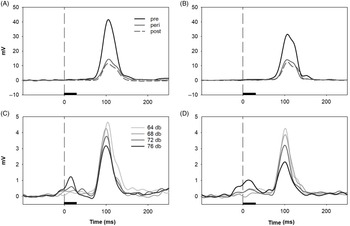
Averaged SR intensities pre-, peri- and post-PPI main experiment are shown in Fig. 1A (first session) and 1B (second session). No between-session habituation of the SR was evident [F(1,22) = 2.865, p = 0.105], but a highly significant within-session habituation [F(2,44) = 18.996, p < 0.001] was observed. The interaction of between- and within-session habituation was not significantly affected [F(2,44) = 2.484, p = 0.123].
Averaged waveforms (N = 23) for blink EMG response to startle stimuli. (A, B) Averaged startle amplitude of pulse-only trials pre-, peri- and post-PPI main experiment in the first (A) and second (B) session. (C, D) Startle amplitude for the different prepulse intensities during the prepulse+pulse trials in the first (C) and second session (D).

PPI results
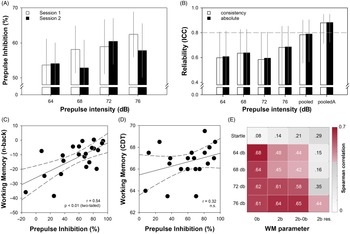
Averaged waveforms for blink EMG response to PPI trials separated for session 1 and 2 are shown in Fig. 1 (panel C and D). PPI (in percentage) for each prepulse intensity level and session is presented in Fig. 2A. No main effect of session [F(1,22) = 0.221, p = 0.643] or prepulse intensity [F(3,66) = 1.048, p = 0.377] and no significant interaction effect of session × prepulse intensity [F(3,66) = 0.401; p = 0.753] was evident. Descriptively, PPI increased with increasing prepulse intensities, but the linear trend was not significant [F(1,22) = 2.508, p = 0.128].
(A) Prepulse inhibition (PPI) results separated for the two sessions and the prepulse intensities. Data are presented as mean ± standard error of the mean. (B) Test-retest reliability for the separate prepulse intensities, the pooled single and the pooled average measures (see methods). Data indicate the intraclass correlation coefficient. Error bars indicate the 95% confidence interval. The dashed line indicates an ICC level of 0.8 reflecting the threshold for high reliability. (C, D) Correlation of the pooled PPI data with working memory (WM) performance (n-back (C): 2-back minus 0-back; CDT (D): averaged number of correct responses). (E) Correlation pattern of the startle response and the separate prepulse intensities with n-back task performance. Note that red colors are significant (r > 0.42), while non-significant values are plotted in gray color. PPI data were calculated based on the peak startle amplitude. Error bars in A represent standard error (SE), and in panel B the 95% confidence interval is shown. Dotted lines in panel C and D represent 95% confidence interval for mean. All variables in panel C-E are pooled across sessions.

Test-retest reliability
Test-retest reliability of PPI for the single-prepulse intensity levels was below 0.80 (see Fig. 2B). For the pooled PPI, the ICCs increased to 0.78 and increased further to 0.88 when using the average measure ICC of the pooled PPI.
Effect of gender
Explorative analyses of PPI for male (N = 10) and female (N = 13) participants separately revealed a significant prepulse intensity effect in females [F(3,36) = 3.043, p = 0.041] but not in males [F(3,27) = 0.304, p = 0.822]. Linear trend test of prepulse intensity was significant in females [F(1,12) = 6.744, p = 0.023] but not in males [F(1,9) = 0.018, p = 0.897]. Descriptively, PPI across all conditions was lower in females compared to males. However, this difference was not statistically significant (see Supplementary Figure 1).
WM Performance and correlation with PPI
WM performance data are shown in Table 1. Pooled across intensities and sessions, PPI was significantly correlated with n-back task performance (r = 0.54, p < 0.01) but not with CDT performance (see Fig. 2C and D). Because the test-retest interval differed between subjects (21 to 32 days), we performed a separate control analysis following a median split of the test-retest interval, showing comparable correlation between PPI and WM performance (shorter interval: N = 16, r = 0.63, p = 0.009; longer interval: N = 7, r = 0.50, p = 0.253).
Working memory performance data (% correct)

Abbreviations: CDT = change detection task; p = p-value; SD = standard deviation; T = t-value; WM = working memory.
The correlation pattern of the single-prepulse intensities and the SR with n-back parameters are shown in Fig. 2E. While all prepulse intensities were correlated with the 0-back condition, the strongest correlations with the 2-back condition were evident for the higher prepulse intensity levels. Residuals resulting from regressing out 0-back from 2-back condition were specifically correlated with the highest prepulse intensity level. The SR was not significantly correlated with any WM parameter. Performance data of the two WM tasks showed no significant correlation (r = 0.313, p = 0.179).
Control for prepulse EMG activity
In particular, at the highest prepulse intensity of 76 dB, prepulse-evoked EMG activity was evident (see Fig. 1C and D). The peak of the 76-dB prepulse activity was extracted and used as covariate to control correlation of PPI and WM. No changes in the significance of the correlations reported in Fig. 2E occurred, that is, significant correlation of ‘2b res.’ with the 76-dB condition could not be attributed to prepulse EMG activity (see Supplementary Table 3).
Moreover, using the data from the 76-dB prepulse only condition, we found that the prepulse-evoked activity is not correlated with WM performance (n-back: r = −0.19; p = 0.404; CDT: r = −0.14; p = 0.546).
Discussion
With the present study, we aimed to confirm the test-retest reliability of the PPI in humans and asses its correlation with WM performance at different prepulse intensities. We found high test-retest reliability (ICC > 0.80) when we pooled across the different prepulse levels and when the average measure ICC is considered (i.e. in case of doubling number of trials). Regarding correlations of PPI with WM performance, we found significant positive correlation of PPI with n-back task performance but not with CDT performance. Furthermore, significant correlation of PPI with n-back was evident for both, the 2-back and the 0-back condition. Thus, we were able to replicate and expand the findings from previous studies that suggested correlation of PPI with WM (e.g. Csomor et al., Reference Csomor, Stadler, Feldon, Yee, Geyer and Vollenweider2008; Scholes & Martin-Iverson, Reference Scholes and Martin-Iverson2009; Singer et al., Reference Singer, Hauser, Llano Lopez, Peleg-Raibstein, Feldon, Gargiulo and Yee2013; Yang et al., Reference Yang, Tian, Fan, Bo, Zhang, Li and Wang2017) by incorporating two different WM paradigms and assessing PPI at different prepulse intensities.
Regarding test-retest reliability of SR and PPI, both the SR with N = 10 trials and pooled across sessions (N = 20 trials) was found to be highly reliable (ICC 0.80 and 0.89, respectively). The PPI test-retest reliability is in accordance with published PPI test-retest studies that report ICCs from 0.49 (Abel et al., Reference Abel, Waikar, Pedro, Hemsley and Geyer1998) to 0.87 (Schwarzkopf et al., Reference Schwarzkopf, McCoy, Smith and Boutros1993; Quednow et al., Reference Quednow, Kühn, Beckmann, Westheide, Maier and Wagner2006). The existing test-retest reliability studies indicate a close relationship of number of trials and reliability. Existing studies with number of trials ∼ 80 show a mean ICC of ∼ 0.80 (Schwarzkopf et al., Reference Schwarzkopf, McCoy, Smith and Boutros1993; Quednow et al., Reference Quednow, Kühn, Beckmann, Westheide, Maier and Wagner2006; Cadenhead et al., Reference Cadenhead, Addington, Cannon, Cornblatt, de la Fuente-Sandoval, Mathalon, Perkins, Seidman, Tsuang, Walker, Woods, Bachman, Belger, Carrión, Donkers, Duncan, Johannesen, León-Ortiz, Light, Mondragón, Niznikiewicz, Nunag, Roach and Solís-Vivanco2013), while studies with <= 52 trials report a mean ICC of 0.60. In accordance with these findings, pooling across prepulse levels and sessions leading to 80 trials per subject a test-retest reliability of 0.84 was quantified in the present study. Fine-grained analyses quantifying the test-retest reliability of different prepulse levels with sufficient number of trials have to be investigated in future studies.
PPI levels have been shown to increase with increasing prepulse intensity (e.g. Swerdlow et al., Reference Swerdlow, Auerbach, Monroe, Hartston, Geyer and Braff1993). In the present study, we observed a similar prepulse-intensity-dependent increase in PPI, though this did not reach the level of statistical significance. We have used comparably high prepulse levels (i.e. 9–21 dB above background) compared to other studies (most commonly 2–16 dB above background; e.g. Swerdlow et al., Reference Swerdlow, Auerbach, Monroe, Hartston, Geyer and Braff1993; Kask et al., Reference Kask, Bäckström, Gulinello and Sundström-Poromaa2008), though other studies have used prepulse intensities more comparable to those used here (e.g. Csomor et al., Reference Csomor, Vollenweider, Feldon and Yee2005; Takahashi et al., Reference Takahashi, Iwase, Canuet, Yasuda, Ohi, Fukumoto, Iike, Nakahachi, Ikezawa, Azechi, Kurimoto, Ishii, Yoshida, Kazui, Hashimoto and Takeda2010; 6–18 and 12–20 dB, respectively). Notably, we obtained substantial PPI already at the lowest prepulse intensity, which might imply saturation of PPI and thus lead to the lack of significance. However, a study by Csomor et al. (Reference Csomor, Vollenweider, Feldon and Yee2005) only found prepulse-dependent increases in PPI when using a startle intensity of 105 or 115 dB, but not at 95 dB. Thus, the rather moderate startle intensity used here (96 dB) seems to be the most likely reason for the lack of a significant prepulse-intensity-dependent increase in PPI. Regardless of the reason, the stimuli chosen here resulted in a limited PPI range, which might complicate the interpretation of PPI data and consequently might have affected the level of correlation with the other measures.
Concerning the correlation of PPI with WM, existing studies reported positive correlations in a range from 0.24 (Scholes & Martin-Iverson, Reference Scholes and Martin-Iverson2009) to 0.64 (Csomor et al., Reference Csomor, Stadler, Feldon, Yee, Geyer and Vollenweider2008). Our observed correlation of PPI with n-back task performance (r = 0.52) is in accordance with these findings. Of note, we found significant correlations with both the 0-back and the 2-back condition. This indicates that it is not specifically the WM component that correlates with PPI, but rather basal attentional processes that are present in both conditions. This is in agreement with a previous report suggesting that basic attentional processes mediate the correlation between PPI and WM (Scholes & Martin-Iverson, Reference Scholes and Martin-Iverson2009). The non-significant correlation of PPI with CDT performance might indicate specific WM facets of the CDT that are correlated with PPI. These have a clear visual dominance in the CDT, whereas in the n-back task, in addition to visuospatial processing, verbal rehearsal and more complex motor operations occur. In fact, the n-back task has a considerably greater involvement of executive processes particularly in the 2-back condition (Kane et al., Reference Kane, Conway, Miura and Colflesh2007; Gajewski et al., Reference Gajewski, Hanisch, Falkenstein, Thönes and Wascher2018). Another likely explanation is the limited variance in the CDT performance data, leading to a ceiling effect.
Interestingly, we could show that the highest prepulse intensity level (76 dB) showed the highest correlation with the 2-back condition and was the only condition that showed significant correlation with 2-back when 0-back was regressed out (Fig. 1E). The lack of significant correlations for the lower prepulse intensities used in our experiment (i.e. 64, 68 and 72 dB) might be explained by reduced conscious detection of these stimuli. Detection of signals has been proposed to be tightly linked with attention and is therefore also in line with a stronger 0-back correlation. Supporting this notion, the study by Scholes and Martin-Iverson (Reference Scholes and Martin-Iverson2009) found correlation of PPI with WM using relatively high prepulse intensities (i.e. 74 and 14 dB above background) and linked this correlation to attentional processes.
Attentional modulation of PPI has been suggested to depend on the lead interval of the prepulse (i.e. the onset-onset interval between prepulse and pulse), with longer lead intervals (i.e. 120 ms) leading to stronger attentional modulation than shorter intervals (i.e. 60 ms) (e.g. Dawson et al., Reference Dawson, Hazlett, Filion, Nuechterlein and Schell1993; Filion et al., Reference Filion, Dawson and Schell1993). In the present study, we presented prepulses at a lead time of 100 ms, which is slightly shorter than the more commonly used 120-ms lead time. While we are not aware of any studies in humans investigating attentional modulation only at this lead interval, the study by Scholes and Martin-Iverson (Reference Scholes and Martin-Iverson2009) found that attentional processes were causative of the PPI-WM relationship when pooling across 60 and 100 ms lead intervals. Moreover, studies in rats suggest attentional modulation of PPI at 100-ms intervals (Du et al., Reference Du, Wu and Li2011; Wu et al., Reference Wu, Ding, Jia and Li2016). Importantly, a recent study showed that the attentional modulation of PPI also requires the use of longer continuous prepulses, while no attentional modulation of PPI was found using discrete prepulses (i.e. short bursts of ∼ 20 ms) (Poje & Filion, Reference Poje and Filion2021), as also done in the present study.
The acoustic SR is mainly mediated via a brainstem circuit involving the cochlear nuclei receiving the acoustic input. Stimuli that exceed a certain intensity (>80 dB) lead the cochlear nuclei to activate the caudal pontine reticular nucleus (PnC), which in turn innervates the motor neurons that mediate the motor output. PPI is mediated via a midbrain circuit involving the inferior colliculus and superior colliculus, which stimulate the pedunculopontine tegmental nucleus (PPTg), which inhibits the PnC, thus attenuating the SR. Most importantly, higher-order brain regions, including the hippocampus, amygdala, nucleus accumbens, prefrontal cortex (PFC) and orbitofrontal cortex have been shown to modulate PPI via inhibition of the PPTg (reviewed in Koch & Schnitzler, Reference Koch and Schnitzler1997; Koch, Reference Koch1999; Kohl et al., Reference Kohl, Heekeren, Klosterkötter and Kuhn2013).
As we did not specifically investigate the neural circuits underlying the correlation between PPI and WM, we can only hypothesize on the involved circuits. In primates, WM is mainly mediated by the PFC (Constantinidis & Klingberg, Reference Constantinidis and Klingberg2016). Given that this brain region is also importantly involved in attention (Katsuki & Constantinidis, Reference Katsuki and Constantinidis2014), it is most prudent to assume that the PPI-WM correlation might be a result of recruitment of the PFC, as also suggested by previous studies (Scholes & Martin-Iverson, Reference Scholes and Martin-Iverson2009). In addition, other brain regions that modulate PPI have also been shown to be involved in WM and attention, including the hippocampus (Squire & Dede, Reference Squire and Dede2015), the parahippocampal cortex (Constantinidis et al., Reference Constantinidis, Forest, Carolina, Inserm and Fédératif2004) and the PPTg (Vitale et al., Reference Vitale, Capozzo, Mazzone and Scarnati2019). Thus, a potential contribution of the hippocampus to the PPI-WM correlation is conceivable.
A few limitations related to our study need to be mentioned. To achieve a necessary PPI trial number, we had to pool across the different prepulse levels and sessions. Because our trial numbers for the separate prepulse conditions were too low to obtain sufficiently high test-retest reliability, we were not able to perform such more fine-grained analyses. Furthermore, pooling across sessions may introduce error due to the 4-week time interval between these sessions. Difference in the actual state of the subjects may have reduced the found test-retest reliability. However, because we found good reliability, we conclude that advantages from a higher trial number outperformed the error due to state differences. Nevertheless, in future studies, the applied paradigm should be modified and a greater number of trials within one prepulse intensity condition must be introduced. Moreover, a higher sample size as, for example, incorporated in other similar studies (Scholes & Martin-Iverson, Reference Scholes and Martin-Iverson2009; Yang et al., Reference Yang, Tian, Fan, Bo, Zhang, Li and Wang2017) might allow the separation of the test and retest session and avoid the need for pooling of the different prepulse intensities and thus allow for a more detailed analysis.
Another limitation is the lack of information on the phase of menstrual cycle or other factors affecting hormonal status in female participants. In most studies, PPI was shown to be lower in women compared to men, which seems mainly mediated by PPI fluctuations throughout the menstrual cycle (Swerdlow et al., Reference Swerdlow, Hartman and Auerbach1997, Reference Swerdlow, Bhakta, Rana, Kei, Chou and Talledo2017; Jovanovic et al., Reference Jovanovic, Szilagyi, Chakravorty, Fiallos, Lewison, Parwani, Schwartz, Gonzenbach, Rotrosen and Duncan2004; Aasen et al., Reference Aasen, Kolli and Kumari2005; Kumari et al., Reference Kumari, Aasen, Papadopoulos, Bojang, Poon, Halari and Cleare2008, Reference Kumari, Konstantinou, Papadopoulos, Aasen, Poon, Halari and Cleare2010). In our study, reduced PPI in females was evident at the descriptive level, but did not reach statistical significance, possibly due to the limited sample size (see Supplementary Figure 1). Effects of menstrual cycle on WM have been described in some studies (Rosenberg & Park, Reference Rosenberg and Park2002; Hampson & Morley, Reference Hampson and Morley2013), though not others (Jacobs & D’Esposito, Reference Jacobs and D’Esposito2011; Joseph et al., Reference Joseph, Swearingen, Corbly, Curry and Kelly2012; Hidalgo-Lopez & Pletzer, Reference Hidalgo-Lopez and Pletzer2021). Consequently, it is possible that in the present study, differences in the menstrual cycle of female participants might have differentially affected PPI and WM, which might in part explain the lack of correlation with the weaker prepulse intensities.
Importantly, in our study, the menstrual cycle phase in most of the female participants is expected to be the same in both test sessions, given the average menstrual cycle length of 28 days, which corresponds with the average time between test and retest session. Related to this, the variance in the retest interval may also have had an influence. However, separate analysis after a median split of the retest interval showed comparable correlation between PPI and WM performance.
In addition, hearing levels, which we did not assess in the tested subjects, might have affected startle and PPI. However, hearing levels were shown not to be predictive of startle threshold in elderly subjects (Ford et al., Reference Ford, Roth, Isaacks, White, Hood and Pfefferbaum1995). Yet, the magnitude of PPI was shown to be predictive of hearing levels, at least in rodents (Longenecker et al., Reference Longenecker, Alghamdi, Rosen and Galazyuk2016; Wake et al., Reference Wake, Ishizu, Abe and Takahashi2021). It should be noted that we only included relatively young, healthy subjects in this study, and known hearing impairments were considered an exclusion criterion. Thus, a major influence of hearing levels to our PPI findings seems unlikely.
The non-significant correlation between PPI and our second WM task (CDT) may be due to a lack of variance in the CDT performance data (see Table 1). As can be seen in Fig. 2D, the performance data were in a rather narrow range and suggestive of a ceiling effect. Therefore, to conclude that the PPI is specifically correlated with n-back versus CDT is inadequate. Nominally, the correlation of PPI with CDT was also positive, and presumably a larger sample size and a cognitively more demanding increased set size may have yielded significant results.
Our findings have several implications for models of impaired information processing and their treatment in neuropsychiatric disorders. The correlation observed in our study could be indicative of a joint underlying neurophysiological mechanism namely excitation-inhibition (E/I) balance, which appears to play an important role for PPI, WM and attention (Mishra et al., Reference Mishra, Fellous and Sejnowski2006; Yeomans et al., Reference Yeomans, Bosch, Alves, Daros, Ure and Schmid2010; Lim & Goldman, Reference Lim and Goldman2013; Murray et al., Reference Murray, Anticevic, Gancsos, Ichinose, Corlett, Krystal and Wang2014; Snyder et al., Reference Snyder, Morais and Smith2016; Inui et al., Reference Inui, Takeuchi, Sugiyama, Motomura and Nishihara2018; Bouchacourt & Buschman, Reference Bouchacourt and Buschman2019). This hypothesis could be tested directly using pharmacological interventions in healthy controls. Furthermore, converging evidence indicates that E/I imbalance is an important pathophysiological mechanism in a number of neuropsychiatric disorders including schizophrenia and autism spectrum disorders (Sohal & Rubenstein, Reference Sohal and Rubenstein2019). Transdiagnostic studies comparing the strength of correlation between PPI and WM might therefore be suitable to illuminate pathophysiological similarities and differences across disorders. Such an approach might also aid in the development of transdiagnostic biomarkers for cognitive dysfunction. Moreover, the correlation between PPI and WM performance suggests that cognitive remediation strategies targeting either process might also be beneficial for the other. Notably, Molina et al. (Reference Molina, Voytek, Thomas, Joshi, Bhakta, Talledo, Swerdlow and Light2020) reported that the NMDA modulator memantine normalized E/I balance in schizophrenia patients; startle measures conducted in these same patients indicated that memantine also normalized their PPI (Swerdlow et al., Reference Swerdlow, Bhakta, Chou, Talledo, Balvaneda and Light2016). However, among individuals, the magnitude of the drug effect on E/I and PPI was not significantly correlated (Molina et al., Reference Molina, Voytek, Thomas, Joshi, Bhakta, Talledo, Swerdlow and Light2020). Future studies should also include an assessment of the effects of memantine or other NMDA modulators on WM. Such pharmacological interventions might also elucidate the directionality of the observed correlation and thus provide crucial mechanistic insights.
To conclude, we found high test-retest-reliability of the PPI with a mean ICC of > 0.80 and a positive correlation with WM processes. Although the correlations of PPI and WM were not specific for WM performance when calculated across all prepulse levels, our analyses indicate that especially the highest PPI level (76 dB) is most strongly associated with WM. Overall, our findings emphasize the value of PPI for elucidating the complex relationship between these processes and higher-order cognitive domains, which can be of translational relevance in future studies.
Supplementary material
To view supplementary material for this article, please visit https://doi.org/10.1017/neu.2022.19.
Acknowledgements
None.
Author contributions
FF, HA, KF and MMP have written the manuscript. KF has carried out the study. KF and MMP have analyzed the data. RB contributed the CDT and gave significant input in writing the manuscript. AR, FF, HA and MMP designed the study and planned its content.
Financial support
This study has been supported in part by the Deutsche Forschungsgemeinschaft (FR3420/2–1 and 2–2 to FF). The funding agencies had no further role in study design, in the collection, analysis and interpretation of data, in the writing of the report and in the decision to submit the paper for publication.
Statement of interest
Andreas Reif received speaker’s honoraria from Janssen, Medice, Shire/Takeda, Servier and neuraxpharm, is on the Advisory boards for Janssen, Medice, Shire/Takeda and SAGE and received grant support from Medice. None of these relationships are directly related to the study reported herein. All other authors report no potential conflicts of interest.
Ethical standards
The authors assert that all procedures contributing to this work comply with the ethical standards of the relevant national and institutional committees on human experimentation and with the Helsinki Declaration of 1975, as revised in 2008.