Developmental dyslexia (DD) is a specific and persistent difficulty in acquiring adequate reading skills, in spite of average intelligence, sufficient education, and sociocultural opportunities. Although a wide number of hypotheses have been proposed in order to explain the cognitive impairment functionally causing the disorder, no agreement has been reached. The main theories trying to provide causal explanations range over different fields of cognition, attributing the deficit to phonology (e.g., Ramus et al., Reference Ramus, Rosen, Dakin, Day, Castellote and White2003), visual and auditory processing (e.g., Stein & Walsh, Reference Stein and Walsh1997; Tallal, Reference Tallal1980), or attention (e.g., Facoetti et al., Reference Facoetti, Lorusso, Paganoni, Cattaneo, Galli and Umilta2003). An open debate, in both the clinical and the academic environments, focuses on the linguistic nature of DD. Together with reading difficulties, some children with DD show problems involving the linguistic sphere. Phonological difficulties in DD have been definitively demonstrated (Ramus et al., Reference Ramus, Rosen, Dakin, Day, Castellote and White2003) as well as their causal link to reading difficulties (Snowling, Reference Snowling2000). Semantic, morphological, and syntactic skills have not received the same attention and have been only sporadically investigated. The few studies focusing on semantic skills did not reveal any differences between dyslexic and control children (Sabisch, Hahne, Glass, von Suchodoletz, & Friederici, Reference Sabisch, Hahne, Glass, von Suchodoletz and Friederici2006), whereas more problems have been reported in children with DD in those studies focusing on morphosyntactic and syntactic skills. Recent studies revealed reduced sensitivity to subject–verb agreement morphology (Rispens, Roeleven, & Koster, Reference Rispens, Roeleven and Koster2004) as well as impaired inflectional morphology (Joanisse, Manis, Keating, & Seidenberg, Reference Joanisse, Manis, Keating and Seidenberg2000) in children with DD. Impaired comprehension and/or production of complex syntactic constructions, such as relative clauses or passive sentences, have been reported in children and adults with the disorder (Barshalom, Crain, & Shankweiler, Reference Barshalom, Crain and Shankweiler1993; Waltzman & Cairns, Reference Waltzman and Cairns2000), particularly under demanding verbal working memory loads (Robertson & Joanisse, Reference Robertson and Joanisse2010). In addition, studies conducted on preschool children at risk for DD have reported language delays, specifically concerning perception and production of grammatical morphology (Scarborough, Reference Scarborough1990; van Alphen et al., Reference van Alphen, de Bree, Gerrits, de Jong, Wilsenach and Wijnen2004). These latter results suggest that it is not the lack of exposure to printed text that hampers comprehension and vocabulary growth and impairs overall language development, but there is something deeper in the development of language abilities of dyslexic children that goes wrong. The presence of linguistic deficits in DD, involving not only phonology but also morphosyntax and syntax, has increased the interest in the overlap between DD and specific language impairment (SLI; Bishop & Snowling, Reference Bishop and Snowling2004; Catts, Adlof, Hogan, & Weismer, Reference Catts, Adlof, Hogan and Weismer2005; Flax et al., Reference Flax, Realpe-Bonilla, Hirsch, Brzustowicz, Bartlett and Tallal2003; McArthur, Hogben, Edwards, Heath, & Mengler, Reference McArthur, Hogben, Edwards, Heath and Mengler2000), which is properly defined as a specific disorder in acquiring language. Although the two disorders have been treated as separate ones for many years, with the study of DD more focused on visual and perceptual difficulties, over the past 30 years a shift of emphasis has created a growing interest in the overlapping symptoms. Although assessment of oral language skills is not a standard practice in research studies or clinical evaluations of DD, in the few cases in which oral language has been examined, investigators have found that many children with reading disability also meet criteria for SLI (Catts et al., Reference Catts, Adlof, Hogan and Weismer2005; McArthur et al., Reference McArthur, Hogben, Edwards, Heath and Mengler2000). The occurrence of oral language impairments in DD has led some theorists to propose that DD and SLI simply differ quantitatively along a dimension of severity (Tallal, Allard, Miller, & Curtiss, Reference Tallal, Allard, Miller, Curtiss, Hulme and Snowling1997). Other authors suggest that DD and SLI are distinct disorders with different cognitive deficits and different behavioral manifestations that overlap due to comorbidity (Catts et al., Reference Catts, Adlof, Hogan and Weismer2005). Finally, Bishop and Snowling (Reference Bishop and Snowling2004) proposed a two-dimensional model where nonphonological and phonological deficits vary independently. Children with impairments limited to the phonological domain would have DD whereas children with deficits in both phonological and nonphonological domains would be diagnosed with SLI. This model, however, does not provide an explanation for the presence of nonphonological deficits in DD, which future research needs to specifically address.
To better investigate the language profile of DD, particularly sensitive measures should be used, such as event-related potentials (ERPs). This noninvasive method has the great advantage of providing online information about linguistic processing with an excellent temporal resolution, thus revealing mild anomalies that cannot be found by behavioral tasks. According to recent neurocognitive models (Friederici, Reference Friederici2002), different electrophysiological components are normally expected in response to morphosyntactic and semantic violations. Syntactic violations usually elicit a left anterior negativity (LAN) that occurs during an early time window (TW; between 100 and 500 ms) followed by a late positivity, beginning around 500 ms and lasting several hundred milliseconds, named P600 (Coulson, King, & Kutas, Reference Coulson, King and Kutas1998; Friederici, Reference Friederici2002). The negativity, almost always frontally distributed and more pronounced over left electrodes, has been interpreted as reflecting the detection of the morphosyntactic congruence errors. The P600, largest over centroparietal regions, is found in response to a larger series of syntactic violations, including phrase structure violations, subcategorization violations, and violations in the agreement of number and case (Hagoort, Brown, & Osterhout, Reference Hagoort, Brown, Osterhout and Hagoort1999) and has been suggested to reflect syntactic reanalysis processes (Hagoort, Brown, & Groothusen, Reference Hagoort, Brown and Groothusen1993; Osterhout & Holcomb, Reference Osterhout, Holcomb, Rugg and Coles1995). Semantic violations elicit a different electrophysiological component, named N400, that is a negativity occurring about 200 to 700 ms after the presentation of a critical stimulus (Kutas & Hillyard, Reference Kutas and Hillyard1980). Although the N400 is distributed over the scalp, it is most pronounced over centroparietal electrodes with a slight rightward shift (Kutas & Hillyard, Reference Kutas and Hillyard1982).
A few ERP studies have investigated the electrophysiological correlates of morphosyntactic and semantic violations in participants with DD (Rispens, Been, & Zwarts, Reference Rispens, Been and Zwarts2006; Sabisch et al., Reference Sabisch, Hahne, Glass, von Suchodoletz and Friederici2006), reporting differences in the LAN/P600 electrophysiological pattern but not in the N400. Rispens and colleagues (Reference Rispens, Been and Zwarts2006) have investigated the presence and latency of the P600 component in response to subject–verb agreement violations in Dutch-speaking adults with DD. Despite the absence of differences between dyslexic and control participants in judging the grammaticality of the sentences, the ERP data revealed subtle differences between groups, particularly related to latency (the P600 tended to peak later in the dyslexic group compared to the control group). Moreover, the dyslexic participants, as a group, did not show the component in response to sentences with a plural subject. This finding was interpreted in relation to the higher complexity of plural with respect to singular forms and led to the conclusion that “brain activation involved in syntactic repair is more affected by linguistic complexity in DD compared with nondyslexic individuals” (Rispens et al., Reference Rispens, Been and Zwarts2006, p. 134). Sabisch and colleagues (Reference Sabisch, Hahne, Glass, von Suchodoletz and Friederici2006) compared the electrophysiological responses to syntactic violations (phrase structure) or semantic violations (selectional restriction) in German-speaking children with and without DD. Similarly to Rispens and colleagues, no differences were found in the behavioral task (sentence correctness judgment task). In the ERPs, a similar N400 component was found in the two groups for the semantic violations, and a similar P600 was found for the syntactic violations. However, instead of the early starting bilaterally distributed anterior negativity shown by control children in response to syntactic violations, dyslexic children presented a delayed left lateralized anterior negativity. This result is discussed in terms of the delay, in dyslexic children, of the early and presumably highly automatic processes of phrase–structure building and of a lack of recognition of the prosodic cues (reflected in control participants’ right anterior negativity) that can facilitate syntactic processing. Although both studies find some anomalies in the ERP responses, their results differ considerably, possibly due to variations in the kind of violation (subject–verb agreement violations vs. phrase–structure violations), in ERP analyses (peaks vs. mean amplitude), and in the dyslexic population under examination (adults vs. children). Both studies have been carried out with children speaking languages belonging to the same family (Germanic languages). In view of the cross-linguistic differences observed in typical and dyslexic populations (Paulesu, Brunswick, & Paganelli, Reference Paulesu, Brunswick, Paganelli, Brunswick, McDougall and Davies2010) and of the differences between the two mentioned ERP studies, further ERP research with typologically different languages may strengthen the view that persistent language deficits are present in dyslexic individuals. Although differences in the sensitivity to phrase–structure building violations among languages are not expected, differences in subject–verb agreement violations may be expected, due to the language-specific features. Italian (a Romance language), compared to Dutch, is a language with a richer and more regular verbal agreement morphology, and this may affect DD participants’ sensitivity to subject–agreement violations. In addition, verbal plural agreement forms are often considered one of the clinical markers for SLI in Italian (Bortolini, Caselli, & Leonard, Reference Bortolini, Caselli and Leonard1997), and subject–verb agreement provides a well-proved paradigm to be tested electrophysiologically. As this paradigm has been widely used with healthy populations in different languages (Coulson et al., Reference Coulson, King and Kutas1998; Hagoort et al., Reference Hagoort, Brown and Groothusen1993; Osterhout & Holcomb, Reference Osterhout, Holcomb, Rugg and Coles1995; Rossi, Gugler, Hahne, & Friederici, Reference Rossi, Gugler, Hahne and Friederici2005), including Italian (Balconi & Pozzoli, Reference Balconi and Pozzoli2005; De Vincenzi et al., Reference De Vincenzi, Job, Di Matteo, Angrilli, Penolazzi and Ciccarelli2003), it provides a strong starting point for the study of clinical populations.
In the present study, we used this electrophysiological paradigm in order to investigate morphosyntactic processing in DD adults. Based on reported data from nonimpaired populations, the typical biphasic electrophysiological pattern (LAN/P600) was expected in response to morphosyntactic violations in the control participants whereas a different electrophysiological pattern or anomalies in the typical ERP components (concerning latency and/or mean amplitude) were expected in the dyslexic group. Based on Rispens et al.'s (Reference Rispens, Been and Zwarts2006) results, differences concerning the processing of singular and plural verbal forms were also expected, in light of the ascertained additional complexity of plural with respect to singular. Verbal plural agreement forms being a clinical marker of SLI, electrophysiological anomalies in DD in response to these forms were expected also in the light of the hypothesized overlap between the two disorders. Particular attention was devoted in the present study to the recruitment and selection of the dyslexic participants for which retrospective data (both diagnoses and medical records) were available. They were all adults who had received a formal diagnosis of DD during childhood but had no report of language impairments. At the moment of testing, both language and reading skills were reassessed, and all the dyslexic participants still showed significant deficits in reading but not in language skills.
METHODS
Participants
Sixteen young adults with DD (age range = 19–27 years, four females) and 16 control participants matched for gender and age participated in the study. All participants were volunteers, and an informed consent to take part in the experiment was obtained from each after the purpose and procedures of the study were explained. The study was approved by the ethics committee according to standards of the Helsinki Declaration (1964).
Participants with DD had been referred to the Unit of Cognitive Psychology and Neuropsychology because of learning difficulties during childhood and had been diagnosed as dyslexics based on standard inclusion and exclusion criteria (normal IQ, reading scores below 2 SD with respect to age norms, absence of neurological and sensoneural disorders, inadequate schooling and sociocultural opportunity) by an expert clinician using ICD-10 (World Health Organization, 1992). Their nonverbal or performance IQ at the time of the last formal clinical assessment, which was estimated by the Wechsler Intelligence Scale for Children—Revised (Wechsler, Reference Wechsler1994; n = 5), Cattell's “Culture Free” (Cattell, Reference Cattell1979; n = 10), or Raven's Advanced Progressive Matrices (Raven, Reference Raven1998; n = 1), was above 85 (M = 106.19, SD = 12.95). Based on past clinical reports, none of the dyslexic participants had a previous diagnosis of language impairment or a history of speech and language therapy. At the moment of testing the absence of a formal language disorder was further confirmed by administering a standardized battery for the assessment of language, the Bilingual Aphasia Test (BAT; Paradis, Reference Paradis1987), in which all participants scored above the normative cutoff. All the dyslexic participants were still impaired in reading skills, as assessed by a battery including word, nonword, and text reading. Their performance was still 2 SD below the norms in at least one of the standardized Italian reading tests included in the battery.
Control participants were selected to match each participant in the dyslexia group on gender and chronological age. Since the dyslexic participants had different degrees of school instruction (ranging from vocational school to university), the control participants were also selected to represent all the educational categories. No significant differences in educational level between the two groups (in years of education) emerged: control participants, M = 15, SD = 2.42; dyslexic participants, M = 14.06, SD = 2.74; t (30) = 1.025, p = .314. No data were available on participants’ socioeconomic status; however, it was ensured that participants from both groups came from comparable areas (with respect to urbanization and distance from main cities).
All of the control participants performed normally on a standardized Italian text-reading task, providing accuracy and speed scores in reading aloud (Judica & De Luca, Reference Judica and De Luca2005), according to norms based on educational level (distinguishing between high school and university). All participants were Italian native speakers and had normal or corrected to normal vision and normal hearing. In addition, all the participants were right handed.
Between dyslexic and control participants, there was no group difference in age: dyslexic participants, M = 22.67, SD = 2.29; control participants, M = 22.36, SD = 3.48; t (30) = –0.300; p = .767. As expected, a significant difference was found between z scores in the reading test concerning both speed, dyslexic participants, M = –20.22, SD = 33.66; control participants, M = – 0.807, SD = 1.99; t (15.153) = 2.301, p < .05, and accuracy, dyslexic participants, M = –3.12, SD = 1.77; control participants, M = 0.6445, SD = 0.64; t (20.207) = 7.808, p < .001.
Tasks
Standardized testing
The following reading test was administered to both dyslexic and control participants: Prova di velocità di lettura di brani per la Scuola Media Superiore (Text Reading Speed Test for High School; Judica & De Luca, Reference Judica and De Luca2005). This Italian test provides accuracy and speed scores in reading aloud texts. Norms are available both for high school students and for university students. According to the appropriate norms, z scores were computed for speed and accuracy.
An extended behavioral battery, including the following reading, reading-related, and language tests, was administered to the dyslexic participants only, in order to better define their neuropsychological characteristics and correlate them with ERP data.
READING
The Batteria per la valutazione della dislessia e disortografia (Battery for the Assessment of Developmental Reading and Spelling Disorders; Sartori, Job, & Tressoldi, Reference Sartori, Job and Tressoldi1995), which is an Italian reading and spelling assessment battery, was also administered. Speed and accuracy z scores were computed for single-word and nonword reading.
The Nuove prove di lettura MT per la scuola media inferiore (New Reading Tests for Secondary School; Cornoldi & Colpo, Reference Cornoldi and Colpo1995), developed by the MT group, are widely used Italian tests providing accuracy and speed scores in reading aloud age-normed texts. In particular, z scores were computed for speed and accuracy, according to the norms for the third (last) secondary school grade.
TESTS OF PHONEMIC AWARENESS
Phonemic awareness was assessed with three tasks taken from a battery with unpublished but wide and consistent normative data. In all of the tasks the experimenter provided auditory presentation of nonwords, and different types of explicit manipulations were requested (oral answers required):
• syllabic manipulation: moving the last syllable of a nonword to the beginning of the same nonword (e.g., “cu-sto-ne” should become “ne-cu-sto”);
• Spoonerism: swapping the initial phonemes of two one-syllable nonwords presented auditorily (e.g., “des” and “mag” should become “mes” and “dag”); and
• phoneme synthesis: integrating sequentially, auditorily presented phonemes into nonwords (e.g., l-e-m should become “lem”).
For each task, z scores were computed for speed and accuracy.
VERBAL SHORT-TERM MEMORY (STM)
STM was assessed by a monosyllabic nonword span test, a subtest of the same unpublished battery used for phonemic awareness. Participants had to repeat forwards the orally presented lists of one-syllable nonwords, increasing in number (e.g., “caf—nab”).
LANGUAGE
The language skills were assessed through the BAT (Paradis, Reference Paradis1987), a standardized test providing a detailed analysis of language proficiency at different linguistic levels (phonology, morphology, syntax, lexicon, and semantics). It was originally created to assess language abilities in bilingual aphasics, but Part B of the test provides information about linguistic competence in the main language. Normative data for Italian are provided. Seven of the 32 subtests were selected in order to investigate syntax (syntactic comprehension and grammatical judgment tasks), morphology (derivational morphology and morphological opposites tasks), and auditory comprehension skills (verbal auditory discrimination, repetition of sentences, and listening comprehension tasks).
Experimental task
MATERIAL
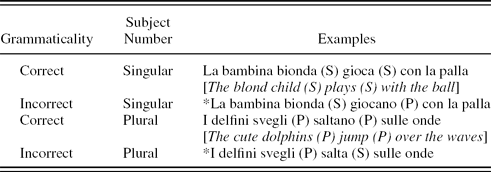
After an accurate inspection of the ERPs studies on subject–verb agreement violations, 168 simple Italian sentences were created, including a noun phrase (NP) subject, a present tense main verb, and an adjunct phrase. Half of the sentences had a singular NP subject, and half had a plural NP subject. For each sentence an incorrect form was created, changing the number of the main verb. Table 1 shows a sentence example for each experimental condition, where both grammaticality and subject number were manipulated.
Examples of stimuli

All verbs were intransitive or could be employed intransitively. The nouns and adjectives of the NP subjects were also carefully selected. They all were bisyllabic or contained three syllables, and in order to avoid potential ambiguous endings, the final vowel of both the noun and the adjective was always the unmarked one (<a> or <o> for singular and <e> or <i> for plural; singular nouns and adjectives ending with <e> were avoided). In order to keep the experimental sentences as varied as possible, sex (male and female) and animacy (humans, animals, and inanimate objects) of the NP subjects varied across sentences. These two variables were controlled within the experimental paradigm, but they were not entered as experimental variables. Moreover, each verb was used twice, but with different NP subjects, and always in different grammaticality conditions (once correct and once incorrect). In this way, exactly the same verbs were presented in the two conditions, thus allowing us to avoid differences (with respect to verb length, conjugation, frequency, concreteness, etc.) between conditions. Furthermore, all verbs to be used in the two subject number conditions were individually matched for length, conjugation, and frequency (e.g., giocare, “to play,” and saltare, “to jump”) before being assigned to the two conditions. Because the same sentences had to be used for another experiment involving children, all the words (nouns, adjectives, and verbs) were selected from a database providing frequency of occurrence for children (Marconi, Ott, Pesenti, Ratti, & Tavella, Reference Marconi, Ott, Pesenti, Ratti and Tavella1993). A plausibility judgment task was performed before starting the ERP experiment in order to avoid semantic implausibility, which could result in different ERP components. The correct sentences were then rated as “semantically plausible” (along a 5-point Likert scale) by 12 native speakers of Italian who did not take part in the following part of the experiment (age range = 18–40 years).
All sentences were spoken by two female native speakers of Italian. They were previously trained to normalize the acoustic pitches, and they were instructed to pronounce the sentences with natural sentence prosody. They were also asked to avoid coarticulation between the words by inserting a short pause into the speech stream (between NP subject and verb, and between the verb and the adjunct phrase). The sentences were then recorded into a silent cabin through Praat software. The recordings were then digitalized at a sampling rate of 44.1 kHz (16 bit; stereo). The two speakers pronounced the same number of sentences for each condition. Every sentence was pronounced twice, once with a singular verb and once with a plural one. Moreover, half of the sentences were pronounced correctly and half were pronounced incorrectly, and the incorrect or correct versions were created by a splicing procedure, where only the verb of the sentence was changed. In this way, half of the correct and half of the incorrect sentences presented in the experiment were the original recorded sentences, whereas the remaining sentences had been digitally modified.
Participants were presented with each sentence only once (in the correct or incorrect version). For this purpose, two lists differing only in grammaticality were created, and each individual was presented with only one list. Two pseudorandomized lists were created so that no more than two items of the same grammaticality (correct vs. incorrect) and subject number (singular vs. plural) conditions were presented in a row; no more than three items uttered by the same speaker, created with the same modality, and with NP subjects of the same sex or animacy, were presented in a row. Six blocks were created, each containing 28 experimental items and five or six fillers. The lists and the blocks were counterbalanced across participants to avoid order effects. Participants were assigned to a list pseudorandomly, and the presentation of the two lists was comparable between the two groups.
The stimuli were stored on a desktop computer and presented using STIM2 software package (Neuroscan) via headphones (Sennheiser HD270), at a comfortable volume of 80 dB. In addition to the 168 experimental sentences, 32 filler sentences with a different structure and type of violation were created and presented.
TASK-SPECIFIC PROCEDURE
During the experiment, participants listened to the sentences in a quiet room with dimmed lighting and were seated in a comfortable chair 100 cm away from the computer monitor. They were instructed to listen carefully to the sentences, in order to judge their grammaticality. The presentation of the trials was as follows. A fixation star appeared in the center of the monitor for 500 ms. Then the acoustic presentation of the sentence started, and the fixation star remained on the monitor until 500 ms after the offset of the sentence. Participants were requested to fixate on the star and to avoid eye blinks and movements. Each sentence was presented divided into three blocks, so that fixed pauses compatible with a natural sentence prosody were created between NP subject and verb (150 ms) and between verb and adjunct phrase (100 ms). After the last block offset, there was an additional break of 500 ms to prevent any movement elicited by the button press interfering with ERP recording. It was estimated that a longer pause was not necessary, because between the critical word (verb) and the requested movement, the whole adjunct phrase (mean duration = ~1200 ms) elapsed. After the break, a sound and a little face were presented, and participants were instructed to judge the grammaticality of the sentence by pressing one of two buttons on a response box. Stickers of a thumb-up and a thumb-down, respectively, corresponding to “correct” and “incorrect,” were attached to the buttons on the response box. There was no maximum response time, and the next trial started immediately after the response. Before the experiment started, 12 practice trials were provided to familiarize each participant with the task. Unlike the visual presentation, the auditory presentation of the sentences allows very accurate time locking of the ERP. In the present experiment, ERP were time locked both to the beginning of the critical word (verb) and to the beginning of the critical morpheme (gio*ca, “play,” third person singular, vs. gio*cano, “play,” third person plural), but only the ERP derived by this latter time locking will be presented.
ERP DATA ACQUISITION
An EEG was recorded from 15 silver/silver chloride electrodes placed according to the international 10–20 system at the following positions: F7/8, F3/4, Fz, T7/8, C3/4, Cz, P3/4, Pz, O1/2. Blinks and vertical eye movements as well as horizontal eye movements were recorded from two electrodes, located below and lateral to the left eye. EEG signals were recorded with the average of the right and left mastoid as reference. An electrode placed on each participant's forehead served as ground. All electrodes impedances were kept below 5 kΩ. All electrodes were connected to a Neuroscan amplifier (SynAmps version 1, Compumedics). The electrophysiological signals were digitalized at the rate of 1000 Hz and offline bandpass zero-phase filtered (1–40 Hz). The continuous EEG signal was then treated with an automatic rejection criterion applied to all the electrodes (sections >70 μV were excluded). All ERPs were time locked to the onset of the critical morpheme and calculated with respect to a baseline (covering the 100 ms prior to this point) for an epoch of 1200 ms.
General procedure
Both the standardized testing and the experimental task were conducted individually in laboratories of the scientific institute. The experimental task was always conducted first. It lasted approximately 45 min and an additional 30–45 min were necessary to prepare the participant for the EEG recording. The standardized tests were performed in the same session, after a long break. The testing sessions lasted about 2 hr for control participants and 3 hr for the dyslexic participants, undergoing extended behavioral testing.
RESULTS
Data analysis
First of all, a thorough description of the cognitive and neuropsychological profiles of the dyslexic sample is provided, in terms of reading, reading-related, and language skills. Then, dyslexic and control participants will be compared on the experimental task, taking into account both behavioral and electrophysiological data.
As to behavioral data (accuracy in the grammaticality judgment task), analysis was performed using Aʹ scores (see Rice, Wexler, & Redmond, Reference Rice, Wexler and Redmond1999; and Rispens et al., Reference Rispens, Roeleven and Koster2004), providing an index of the sensitivity to agreement violations for both groups (a one-way ANOVA was performed comparing the two groups). In addition, nonparametric tests (Mann–Whitney) were used to compare the two groups.
As to ERP data, statistical analyses will be presented, concerning both mean amplitudes and latencies of the expected components. Two TWs were selected, according to the literature and after an accurate inspection of the grand averages: 150–350 and 450–850 ms. Separate repeated-measure ANOVAs concerning the ERP mean amplitude were performed for each TW. The between-subject factor group (dyslexic participants vs. control participants) and three within-subject factors (grammaticality: correct vs. incorrect; hemisphere: left vs. right; caudality: anterior vs. central vs. posterior) were defined for analysis of data from 12 lateral electrodes. The variables hemisphere and caudality were completely crossed, yielding six regions of interest (ROIs), each of which had two electrodes: left anterior (F7 and F3), right anterior (F4 and F8), left central (T7 and C3), right central (C4 and T8), left posterior (P3 and O1), and right posterior (P4 and O2). The latter TW (450–850 ms), typically associated with the P600 component, was further analyzed, in order to determine the onset of the component and to detect possible differences in latency between the two groups. In particular, the P600 latency was computed with the single-subject approach, subtracting the ERP responses to grammatical sentences from the nongrammatical ones. The fractional area technique (Luck, Reference Luck2005) was used to define the latency of the component as the first time point at which a certain percentage of the total area has been reached. As suggested by Kiesel, Miller, Jolicoeur and Brisson (Reference Kiesel, Miller, Jolicoeur and Brisson2008) the component area to be reached was set at 30%, and a slightly positive boundary was defined (2% of the peak of the nongrammatical phrases, a maximum peak) in order not to include any negative values in the area. A repeated measure ANOVA was thus performed, where the between-subject factor group and two within-subject factors (caudality and hemisphere) were defined for analysis. Finally, two further ANOVAs were performed in the two TWs (150–350 and 450–850 ms) involving the within-subject factor subject number (singular vs. plural), resulting in a 2 (Group) × 2 (Grammaticality) × 2 (Subject Number) × 2 (Hemisphere) × 3 (Caudality) design.
In the last section of the results, Pearson correlations between reading/reading-related measures and language measures (standardized testing, behavioral, and electrophysiological data for the experimental task) will be presented.
Behavioral characterization of the dyslexic group
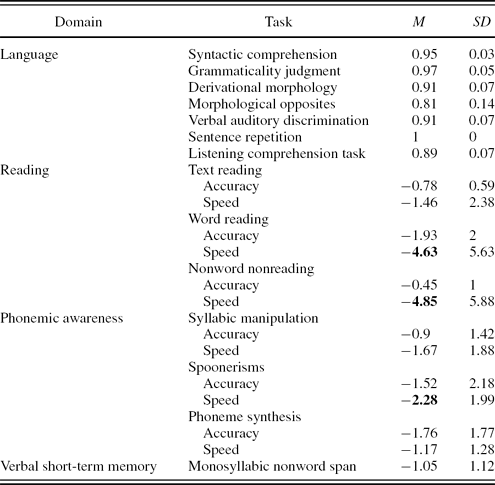
Table 2 shows the means and standard deviations for the reading, reading-related, and language measures collected through the standardized testing. Since control participants were not tested with this battery, the dyslexic group's scores are compared with existing normative data. As emerged from the table, dyslexic participants as a group were impaired in all reading tests and had borderline phonemic awareness skills. Language scores (BAT) appeared to be in the normal range, which is not surprising as an absence of language impairment was one of the inclusion criteria.
Description of the cognitive and neuropsychological profiles of the dyslexic sample in terms of language, reading, and reading-related (phonemic awareness and verbal short-term memory) skills
Note: The percentage of accuracy is used for the language measures, whereas z scores computed based on the mean and standard deviation of the normative population are presented for reading and reading-related measures. Test scores significantly below the norms are in bold.
Experimental task: Behavioral results
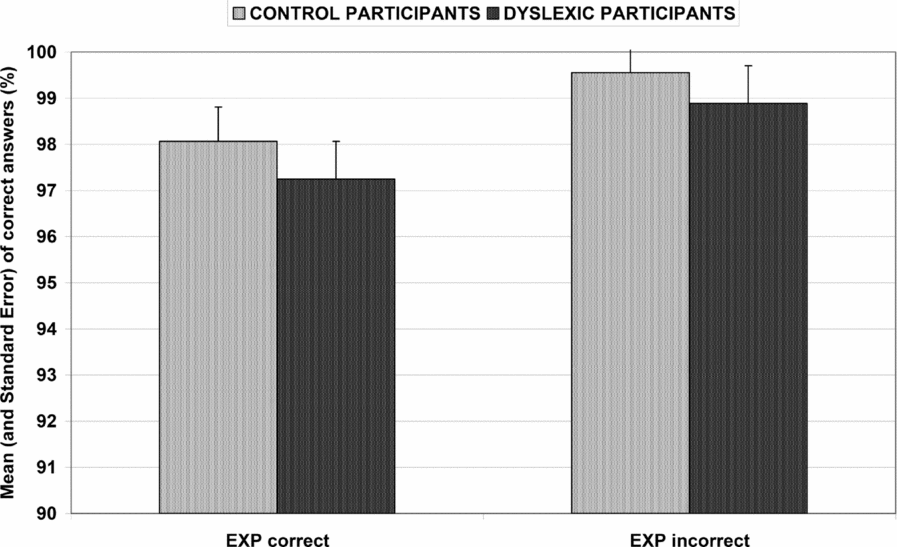
All participants performed above chance level in the grammaticality judgment task. The results are presented in Figure 1. The Aʹ scores were computed (control participants, M = 0.995, SD = 0.004; dyslexic participants, M = 0.989, SD = 0.009), showing a significant difference between groups, F (1, 30) = 4.792, p < .05. Because overall performance was very close to ceiling, nonparametric tests (Mann–Whitney) were also used to compare the two groups, yielding marginally significant results (U = 82.00, z = −1.761, p = .078). However, a further analysis taking into account the two sentence types showed that the two groups did clearly differ in their performance with ungrammatical sentences (U = 70, z = −2.483, p = .013), whereas they did not with grammatical sentences (U = 99.5, z = −1.115, p = .265).
Means (standard error) of correct answers (%) for dyslexic and control participants in the grammaticality judgment task.
Experimental task: ERP results
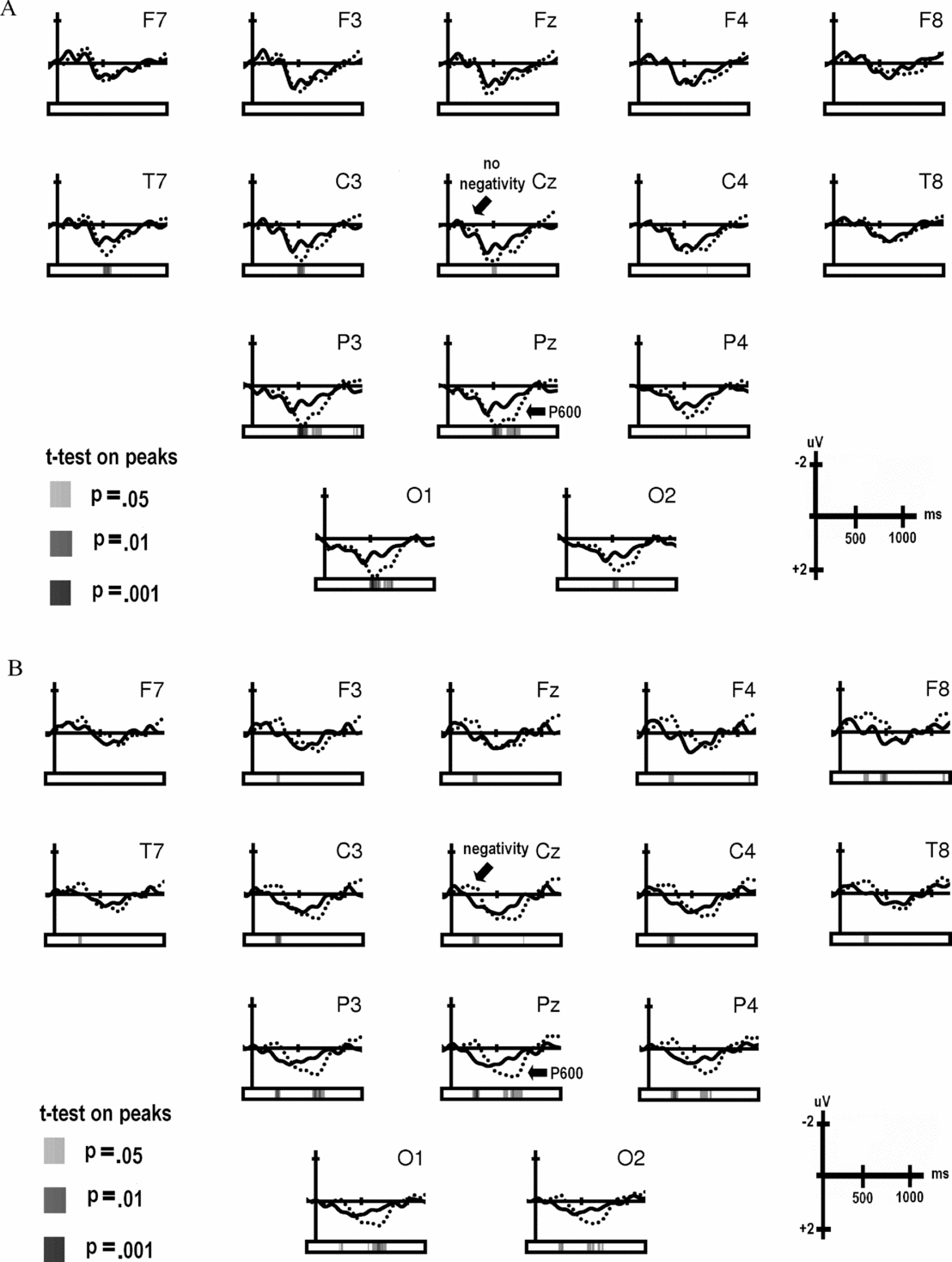
The ERP data for the incorrect versus the correct condition are displayed in Figure 2a and b. The plots reported are filtered with a 7-Hz low-pass filter for presentation purpose only. The subject–number agreement violation displays in both groups a broad positive wave, which can be interpreted as a P600. The wave is similar in amplitude for dyslexic and control participants, but it seems to be delayed in the dyslexic group. Partially in contrast to expectations and previous results, no LAN seems to emerge. However, an early negativity (peaking around 300 ms) broadly diffused all over the scalp is shown in the dyslexic group only.
Grand average event-related potentials of the (a) control and (b) dyslexic participants. The morphosyntactically incorrect condition (dotted line) is plotted against the correct condition (solid line). The axis of the ordinates indicates the onset of the critical morpheme. Negative voltage is plotted upward. The gray sections refer to statistically significant t tests performed on picks.
TW 150–350 MS
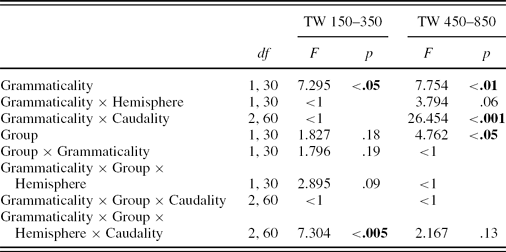
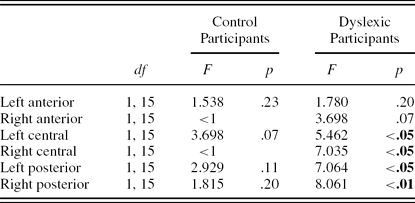
The results of the main analyses are reported in Table 3. A main effect of grammaticality emerges, indicating the presence of a statistically significant component that is neither left lateralized nor anteriorly located. Interactions involving the between-subject factor group approached statistical significance, and the four-way interaction Grammaticality × Group × Hemisphere × Caudality reached it. According to these results, and to the visual inspection of the grand average, which also suggests differences between groups, further analyses in this TW were performed. Separate ANOVAs for groups revealed a main effect of grammaticality only in the dyslexic group, F (1, 15) = 6.178, p < .05, and not in the control group, F (1, 15) = 1.365, p = .26. Separate analyses for ROIs are shown in Table 4. The main effect of grammaticality never reached statistical significance for the control group. However, the effect was significant for the dyslexic group, especially in the posterior areas, both left and right. Due to this generalized distribution of the component, it cannot be interpreted as a classical LAN.
Global analyses of event-related potential data for dyslexic and control participants in the subject–number agreement violation condition compared with the correct condition
Note: TW, time windows of 150–350 and 450–850 ms.
Separate analyses for dyslexic and control participants in the six regions of interest for the time window of 150–350 ms
TW 450–850 ms
The results of the main analyses are reported in Table 3. A main effect of grammaticality emerges. The significant interaction with caudality indicates the presence of a component differently distributed on the scalp. Paired t tests performed to compare correct and incorrect conditions at different regions reveal that the component is mainly localized at central, t (31) = –2.57, p < .05, and posterior regions, t (31) = –5.37, p < .001, thus confirming its possible interpretation as a P600. In addition, a main effect of group emerged, indicating substantial differences between the groups. Given the presence of the component in both groups, further analyses were performed in this TW, in order to check for latency differences between groups. A main effect of group emerged, F (1, 30) = 5.822, p < .05), showing a general delay of about 50 ms in the dyslexic group (dyslexic participants, M = 667, SD = 68; control participants, M = 611, SD = 62). In additional, a main effect of caudality, F (2, 60) = 4.638, p < .05, and a significant interaction, Caudality × Group, F (2, 60) = 3.793, p < .05, emerged, showing broader differences between groups at central regions, t (30) = 2.301, p = .001, with respect to anterior, t (30) = –2.12, p < .05, and posterior, t (30) < 1, ones.
NUMBER MANIPULATION
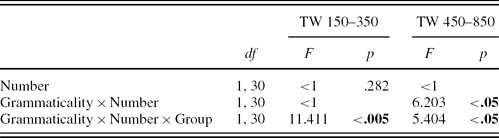
Further analyses were performed taking into account the within-subject factor subject number. This variable has an influence on the ERP data, in both the analyzed TWs (150–350 and 450–850 ms; see Table 5).
Analyses of event-related potential data for dyslexic and control participants taking into account the “subject number” manipulation
Note: TW, time windows of 150–350 and 450–850 ms.
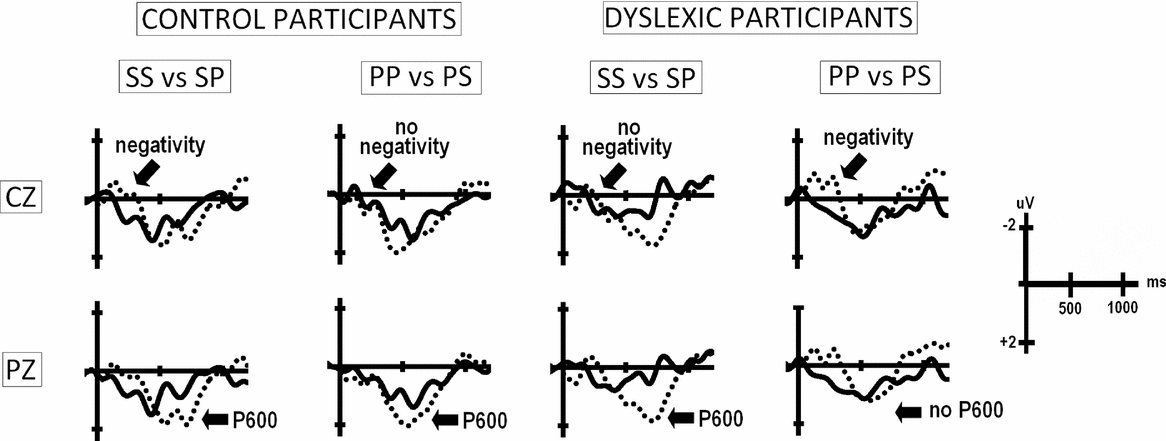
A three-way interaction (Grammaticality × Number × Group) emerged in the first TW (150–350 ms), as illustrated in Figure 3. In both groups, the two-way interaction Grammaticality × Number reached statistically significance, control group: F (1, 15) = 4.838, p < .05; dyslexic group: F (1, 15) = 6.667, p < .05, but with a completely different pattern. In the control group the electrophysiological response to the incorrect sentences differ from the response to the correct ones only in the singular condition, t (15) = 3.216, p < .01, whereas in the dyslexic group the difference emerges only in the plural condition, t (15) = 4.050, p = .001.
Grand average event-related potentials, separated according to the subject number manipulation (limited to CZ and PZ electrodes). The morphosyntactically incorrect condition (dotted line) is plotted against the correct condition (solid line). The axis of the ordinates indicates the onset of the critical morpheme. Negative voltage is plotted upward.
In the second TW (450–850 ms) the two-way interaction Grammaticality ×Number reached statistical significance only in the dyslexic group, F (1, 15) = 8.474, p < .05. As illustrated in Figure 3, a difference between the electrophysiological responses to correct and incorrect sentences in the dyslexic group emerged only in the singular condition, t (15) = –2.698, p < .05. By contrast, in the control group, no differences emerged in the way singular and plural are processed, Grammaticality × Number: F (1, 15) < 1.
Correlations between reading/reading-related measures and language measures
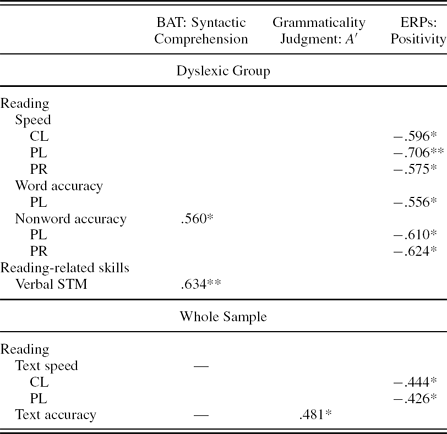
Pearson correlations were computed to estimate the relationship between reading/reading-related measures and language measures. For the dyslexic participants composite scores were created for reading and reading-related tests, based on a preliminary factorial analysis, resulting in four variables for reading (reading speed, word accuracy, nonword accuracy, and text accuracy) and two variables for phonological processing (phonemic awareness, resulting from the average of syllabic manipulation [speed and accuracy] and Spoonerism [speed and accuracy]; verbal STM, resulting from the average of phoneme synthesis [speed and accuracy] and verbal STM). Control participants only had measures for text reading (speed and accuracy). For the standardized language test (BAT, performed for the dyslexic participants only), the score on the syntactic comprehension subtest and a composite score named morphology (mean of two BAT subtests: derivational morphology and morphological opposites) were entered in the analysis. For the experimental task both behavioral (grammaticality judgment task) and ERP measures were entered into the analyses. In particular, the A’ score was entered as a behavioral index of sensitivity to the violations, whereas difference values (created subtracting the mean amplitude of correct sentences from the mean amplitude of incorrect sentences for each TW in the six ROIs) were used as electrophysiological indexes.
No correlations were found between different language measures (nor between behavioral and electrophysiological measures of the same experimental task), indicating that they represent different aspects of language processing. Table 6 displays the emerging correlations between reading/reading-related measures and language measures (only variables that significantly correlate with each others are presented). As emerges from the table, the syntactic comprehension subtest of the standardized linguistic test BAT correlated with both reading (nonword accuracy) and verbal STM. The A’ score correlated with reading (text accuracy) only when the whole sample was considered. In both cases the correlations were positive, meaning that worse reading performances were associated with worse linguistic ones. Concerning ERP measures, no correlations were found between reading/reading-related measures and the amplitude of the negativity in the TW 150–350 ms, whereas several correlations emerged between the amplitude of the positivity in the TW 450–850 ms and reading scores. Contrary to expectations, the direction of these correlations means that broader positivities were associated with worse reading scores.
Pearson correlations between reading/reading-related and language measures (standardized testing and experimental task results, concerning behavioral and electrophysiological measures)
Note: Only variables that significantly correlate with each others are presented. BAT, Bilingual Aphasia Test; ERPs, event-related potentials; STM, short-term memory.
DISCUSSION
The main aim of the present study was to investigate morphosyntactic processing in adults with DD, by means of an experimental task providing information about the behavioral skills through a grammaticality judgment task and about the electrophysiological responses to agreement violations. Both at the behavioral and the electrophysiological levels, dyslexic participants showed differences with respect to controls, thus confirming the hypothesis of a syntactic processing “weakness” in DD. At the electrophysiological level a classical biphasic pattern (LAN/P600) was expected for control participants, whereas anomalies were expected in the dyslexic group. Partially in line with expectations, agreement violations evoked in the control group a broad positive wave (P600) between 450 and 850 ms. The absence of the LAN, even in the control participants, is consistent with other studies that failed in finding such an electrophysiological component with subject–verb agreement violations in various languages (Balconi & Pozzoli, Reference Balconi and Pozzoli2005; Hagoort et al., Reference Hagoort, Brown and Groothusen1993; Rispens et al., Reference Rispens, Been and Zwarts2006). As the LAN is cross-linguistically less robust than other components (such as the P600 or the N400), it will not be further discussed. In the dyslexic group a P600 also emerged, similar to that found in the control group. However, statistical analyses showed subtle differences between the two groups concerning the latency of this electrophysiological component. The onset of the P600 was delayed by about 50 ms in the dyslexic group. Longer latencies for dyslexic children or adults have often been reported in previous studies, specifically concerning the P600 component (Rispens et al., Reference Rispens, Been and Zwarts2006) or different electrophysiological components (Breznitz & Leikin, Reference Breznitz and Leikin2000; Helenius, Salmelin, Service, & Connolly, Reference Helenius, Salmelin, Service and Connolly1999; Leikin, Reference Leikin2002; Sabisch et al., Reference Sabisch, Hahne, Glass, von Suchodoletz and Friederici2006; Torkildsen, Syversen, Simonsen, Moen, & Lindgren, Reference Torkildsen, Syversen, Simonsen, Moen and Lindgren2007). These results have been generally interpreted as reflecting slower processing speed. Unfortunately, in the present study the electrophysiological delay cannot be corroborated by the behavioral data, because reaction times could not be recorded for the behavioral task due to the specific task procedure that required a delayed response. No differences in the P600 amplitude emerged between the groups, although it strongly correlated with reading skills within the dyslexic group. In particular, the correlations between electrophysiological and behavioral data showed an increase in the P600 amplitude in dyslexic participants with more severe reading difficulties. Because the increase in the P600 amplitude has been often associated with an increase in syntactic integration difficulty (Kaan, Harris, Gibson, & Holcomb, Reference Kaan, Harris, Gibson and Holcomb2000), it could be hypothesized that the negative correlations between positivity amplitude and reading skills in the dyslexic participants might indicate the greater effort in syntactic integration, and generally in linguistic comprehension, for more severely affected individuals. This interpretation is further corroborated by the analyses of the behavioral correlations, also showing that the dyslexics with more severe reading and reading-related difficulties displayed greater language processing difficulties.
A further intriguing outcome was the statistically significant early negativity in dyslexic participants. Because of its topography, this broadly diffused component peaking around 300 ms cannot be functionally interpreted as a LAN, reflecting the automatic detection of the morphosyntactic error (Coulson et al., Reference Coulson, King and Kutas1998; Friederici, Reference Friederici2002). Rather, it resembles more an N400. Although the N400 is usually associated with semantic processing, N400-like components have been found to be associated with sentence processing and morphosyntactic violations in previous studies investigating special populations, such as children with a diagnosis of language impairment (Fonteneau & van der Lely, Reference Fonteneau and van der Lely2008), aphasic patients (Hagoort, Wassenaar, & Brown, Reference Hagoort, Wassenaar and Brown2003), and adults learning a second language (L2; Chen, Shu, Liu, Zhao, & Li, Reference Chen, Shu, Liu, Zhao and Li2007; Osterhout et al., Reference Osterhout, Poliakov, Inoue, McLaughlin, Valentine and Pitkanen2008; Weber & Lavric, Reference Weber and Lavric2008) or an artificial language (Morgan-Short, Sanz, Steinhauer, & Ullman, Reference Morgan-Short, Sanz, Steinhauer and Ullman2010). In some of these studies, the finding of an N400-like component instead of the biphasic LAN-P600 pattern is interpreted as a partial compensation of the not completely developed morphosyntactic skills by means of a neural circuitry associated with semantic processing. This interpretation is supported by the wide literature on the semantic role of the N400 component, usually associated with the degree of lexical–semantic predictability at the sentence level and, more generally, with lexical–semantic integration (Kutas & Hillyard, Reference Kutas and Hillyard1980). More refined interpretations could be provided, particularly when considering recent evidence from L2 learners. The literature in the last years has focused on second-language acquisition differentiating between stages of proficiency, ranging from very low to very high (nativelike) proficiency (for a review, see Steinhauer, White, & Drury, Reference Steinhauer, White and Drury2009). At the lowest stages, electrophysiological results show N400s in response to morphosyntactic violations (Morgan-Short et al., Reference Morgan-Short, Sanz, Steinhauer and Ullman2010; Osterhout et al., Reference Osterhout, Poliakov, Inoue, McLaughlin, Valentine and Pitkanen2008), often in addition to a small or delayed P600 (Osterhout et al., Reference Osterhout, Poliakov, Inoue, McLaughlin, Valentine and Pitkanen2008; Steinhauer, White, Cornell, Genesee, & White, Reference Steinhauer, White, Cornell, Genesee and White2006). Several cognitive processes have been assumed to contribute to these N400-like effects. In particular, it has been proposed that they reflect the low probability of the critical word in that position or a whole-form storage of morphologically complex forms. This last explanation comprises the declarative/procedural model proposed by Ullman (Reference Ullman2001). According to this model, the linguistic representation and processing of one's own native language is based on two neurocognitive mechanisms: a declarative memory system consisting of a lexical store of memorized words rooted in temporal lobe structures and a procedural memory system involved in processing combinatorial rules and rooted in frontal brain structures. When exposed to an implicit training, beginning L2 learners rely more on the declarative memory system (reflected in the N400s), as the procedural system is initially not accessible (Ullman, Reference Ullman and Sanz2005; for similar ideas, see also Clahsen & Felser, Reference Clahsen and Felser2006). The distinction proposed by Ullman (Reference Ullman2001) is particularly relevant within the morphological domain, where regular forms are produced by combination of rules (procedural memory system), whereas irregular forms are stored as full forms (declarative memory system). In support of this distinction, ERP studies on adults found LAN/P600 in response to regularizations (misapplication of rules to irregular verbs) and N400 in response to irregularizations (misapplications of irregular inflections; Lück, Hahne, & Clahsen, Reference Lück, Hahne and Clahsen2006). Extending this hypothesis to our study, it could be hypothesized that the dyslexic adults have difficulties in constructing implicit rules for handling inflectional morphology and thus rely more on storage or ground on aspects of lexical–semantic predictability, resulting in the N400 enhancement. Similar hypotheses have been proposed for explaining grammatical difficulties in children with SLI (Gopnik, Dalalakis, Fukuda, & Fukuda, Reference Gopnik, Dalalakis, Fukuda, Fukuda and Gopnik1997; van der Lely, Reference van der Lely2005). According to these hypotheses, SLI children cannot understand the internal structure of inflected words and thus preferentially use the lexical storage–associative system. For this reason, they do not show the normal regularity advantage, perform similarly on regular and irregular past-tense marking, and manifest similar frequency effects for regular and irregular verbs (Ullman & Gopnik, Reference Ullman and Gopnik1999; van der Lely & Ullman, Reference van der Lely and Ullman2001).
It could be hypothesized that in order to overcome the difficulties in constructing implicit rules for handling inflectional morphology, explicit agreement rules should be learned. Again, hypotheses from the study of L2 learning can provide an explanation. In particular, within the framework of universal grammar (Chomsky, Reference Chomsky1965), according to the fundamental difference hypothesis (Bley-Vroman, Reference Bley-Vroman, Gass and Schachter1989; DeKeyser, Reference DeKeyser2000), young children acquire their L1 implicitly with universal grammar mechanisms, whereas late language learners depend largely on explicit, domain-general cognitive functions. It could be hypothesized that, in order to process agreement violations, the dyslexic participants in the present study also try to retrieve the explicit rule, and this process could lead to enhanced latency and/or enhanced negativity. Whereas the enhanced latency might be intuitively explained by the detection of the violation not occurring automatically, but rather as an explicit verification process, the enhancement of the negativity requires some further clarifications. First, the retrieval of explicit rule knowledge is described by Steinhauer et al. (Reference Steinhauer, White and Drury2009) as one of the cognitive processes that may contribute to the N400 effect in low-proficient L2 learners (p. 32). Second, enhanced posterior negativities are described in response to sequence violations only in participants with explicit rule knowledge compared to participants with implicit rule knowledge (e.g., Eimer, Goschke, Schlaghecken, & Stürmer, Reference Eimer, Goschke, Schlaghecken and Stürmer1996; Rüsseler, Hennighausen, Münte, & Rösler, Reference Rüsseler, Hennighausen, Münte and Rösler2003).
A further finding of the present study concerns the way singular and plural forms are processed. Similarly to Rispens et al.'s results (Reference Rispens, Been and Zwarts2006), in the present study statistically significant effects emerged from the number manipulation. Dyslexic participants seem to have more difficulties when processing plural sentences, as shown by the enhanced amplitude of the N400-like component and by a broad positivity in response to the plural grammatical sentences, partially obscuring the P600 in response to the ungrammatical counterparts. A possible explanation for these findings involves the complexity of the plural forms with respect to the singular ones: plural NPs are less frequent and more marked forms and put more burden on sentence-processing mechanisms than singular NPs (Kaan et al., Reference Kaan, Harris, Gibson and Holcomb2000). The processing of linguistically marked forms may be more taxing for subjects who have troubles with language, for whatever reason is at the basis of their language disorders, be it limited processing resources or failure to acquire implicit rules. The greater complexity of plural forms with respect to singular ones is widely supported by the literature on language acquisition. Plural morphemes are usually reported to be acquired later than singular ones in various languages, Italian included (Guasti, Reference Guasti2002), and they appear in the speech of Italian-speaking children with longer mean length of utterance (MLU; Bortolini et al., Reference Bortolini, Caselli and Leonard1997; Caprin & Guasti, Reference Caprin and Guasti2009). This last study showed that plural morphemes start to be employed by children with MLU in words ranging between 1.5 and 2, and increase in children with MLU between 2.0 and 3.1. In addition, at least in the first phases of verbal agreement acquisition, a common error is the use of the third singular morpheme in the place of the third plural morpheme (Bortolini et al., Reference Bortolini, Caselli and Leonard1997; Caprin & Guasti, Reference Caprin and Guasti2009; Pizzuto & Caselli, Reference Pizzuto and Caselli1992). As Bortolini and colleagues argued, these findings are compatible with a prosodic account, mainly related to difficulties with the production and comprehension of weak syllables outside a strong–weak sequence. The singular/plural asymmetry is, moreover, supported by studies on the phenomenon of “agreement attraction,” observed when a noun, situated in the vicinity of the subject–verb agreement relation, imposes its number on the verb. A significantly stronger attraction is generated by plural intervening elements than by singular ones (Bock & Eberhard, Reference Bock and Eberhard1993; Franck, Lassi, Frauenfelder, & Rizzi, Reference Franck, Lassi, Frauenfelder and Rizzi2006; Garraffa, Reference Garraffa2009). Although these effects are explained in terms of markedness of plural nouns, the nature of this markedness is still unclear. Some approaches discuss markedness by referring to a formalism about linguistic oppositions that assumes syntactic features to be binary and expressed by a marked value possessing a distinctive property (+ number) and by an unmarked one (− number) lacking that property (Jakobson, Reference Jakobson and Jakobson1957). Other approaches, however, consider markedness just in terms of rarity or unexpectedness (Haspelmath, Reference Haspelmath2006) or in terms of “overt coding,” expressed by overt inflections (Diessel, Reference Diessel2007). Italian plural forms could thus be described as more marked in this perspective, as they are often less frequent and expressed by an additional syllable (at least in the verbal inflections considered in the present study). The consistent difference in length between singular and plural verbal forms, compounded with differences in frequency, could be responsible for the described electrophysiological results, with a different impact on dyslexics’ and controls’ electrophysiological responses. The difference found in the control participants, however, is still difficult to interpret and in need of further investigation. In particular, to our knowledge none of the ERP studies on agreement has ever analyzed singular and plural sentences separately. Thus, further studies in this direction seem necessary in order to understand the differences between singular and plural processing in typical participants. A role of this feature could be hypothesized to partially explain the nonrobustness of findings across studies, principally concerning the enhancement of negativities.
Despite the robustness of our findings, it should be noted that our participants were adult (noncompensated) developmental dyslexics. Although the generalizability of the study may be intrinsically limited by the age of our participants (Ramus et al., Reference Ramus, Rosen, Dakin, Day, Castellote and White2003), our sample could be considered heterogeneous and representative of the general dyslexic population, with respect to both scholastic achievement (ranging from technical school to university) and sex (4 females, 12 males, in line with reported prevalence; Liederman, Kantrowitz, & Flannery, Reference Liederman, Kantrowitz and Flannery2005). However, it is possible that our participants’ language skills have improved with age, partially compensating for their language deficit. In the present study, dyslexic participants were selected mainly based on a retrospective analysis of their language skills and on the absence of deficits in standardized language testing. The performance within the norms in the standardized language testing apparently contrasts with the results of the experimental task (requiring to judge the grammaticality of sentences presented auditorily), highlighting differences between control and dyslexic participants. In spite of close-to-ceiling performances in both groups, participants with DD turned out to be significantly more impaired at judging ungrammatical sentences than the control group. Thus, the discrepancy in performance between experimental tasks and standardized testing points to the lack of sensitivity of the clinical instruments available to investigate linguistic skills in adults, at least in Italian. Investigations focusing on school-aged children with DD might have more sensitive tests allowing researchers to partially overcome the problem. The study of dyslexic participants with additional SLI (currently under way at our laboratory) may allow us to better understand the nature of the linguistic deficits involved.
A further question is whether the language disorder in dyslexic subjects is due to their reduced exposure to printed text. However, as already mentioned in the Introduction, the findings reported in the literature of morphosyntactic delays in preschool children at risk for DD (Rispens, Reference Rispens2004; Scarborough, Reference Scarborough1990; van Alphen et al., Reference van Alphen, de Bree, Gerrits, de Jong, Wilsenach and Wijnen2004) do not support the idea that the linguistic deficits in DD individuals depend on the lack of exposure to written language. Furthermore, the linguistic stimuli used in the study were very simple and short sentences, which should be more typical of the spoken rather than of the written language. Nonetheless, the issue is a crucial one, and further investigations should better focus on it. Limitations of the present study are also the lack of accurate measures of socioeconomic status in the two groups and the lack of exact IQ measures for control participants, and we recommend these variables to be better controlled for in future studies. However, in the present study the socioeconomic status of the participants was partially controlled for by ensuring that participants from both groups came from comparable urban areas. In addition, the groups were matched on educational level and the difficulty of the experimental task was kept to a minimum. This should have prevented small differences in IQ (possibly due to reductions in verbal memory and processing speed in the dyslexic group, as often reported in the literature) from influencing the results, as suggested also by the absence of correlations between IQ and experimental variables in the group of dyslexic participants.
A final consideration concerns the possibility that the difference in the ERP pattern between the two groups reflects a dissimilarity in processing, rather than in linguistic competence. Difficulties in acoustical and phonetic/phonological processing in DD are widely reported in the literature (e.g., Tallal, Reference Tallal1980). Some authors suggested that these deficits may hamper the development of higher linguistic skills (Helenius et al., Reference Helenius, Salmelin, Service, Connolly, Leinonen and Lyytinen2002; Joanisse et al., Reference Joanisse, Manis, Keating and Seidenberg2000, Mody, Wehner, & Ahlfors, Reference Mody, Wehner and Ahlfors2008). In the present study, this explanation cannot be completely ruled out. The verbal inflections in Italian are mainly constituted by weak syllables, which may be difficult to process (Bortolini et al., Reference Bortolini, Caselli and Leonard1997). Further investigations could thus focus on the influence of processing difficulties on linguistic analysis.
In conclusion, the present results support the hypothesis of different and anomalous language processing modalities in DD, thus confirming a general morphosyntactic processing “weakness’” in DD that does not emerge from the tests usually employed to diagnose dyslexia. This result is particularly relevant within the open debate concerning the linguistic nature of DD and its overlap with SLI (e.g., Bishop & Snowling, Reference Bishop and Snowling2004). The existence of an indefinite border between the two disorders is thus confirmed, given the fact that anomalies in the morphosyntactic domain, typically impaired in SLI children, have been found in participants with DD. This clearly suggests that language is impaired, at least to some extent, in DD participants, something that current theories of dyslexia cannot account for in a straightforward way.
ACKNOWLEDGMENTS
Portions of this research and preliminary results were presented at the CUNY Conference on Human Sentence Processing (Davis, 2009), at the Neurobiology of Language Conference (Chicago, 2009) and at the Tokyo Conference on Psycholinguistics (Tokyo, 2010). We thank the audience of these events as well as Camilla Valnegri for help in constructing the experimental stimuli, Flavia Adani and Francesco Vespignani for methodological suggestions, and Eugenio Parise for reading and commenting on a first draft of this paper. We acknowledge the partial support of Grant PRIN 2007 (to C.C. and M.T.G.). Special thanks go to all of the participants in the study.