One in five kindergarteners meet criteria for an externalizing and/or internalizing disorder (Carter et al., Reference Carter, Wagmiller, Gray, McCarthy, Horwitz and Briggs-Gowan2010). For most of these children, the problematic behaviors will naturally subside over time. However, roughly 10% will continue to exhibit elevated problem behavior into adolescence (Costello, Compton, Keeler, & Angold, Reference Costello, Compton, Keeler and Angold2003; Shaffer et al., Reference Shaffer, Fisher, Dulcan, Davies, Piacentini, Schwab-Stone and Canino1996), while another group of children will begin exhibiting problem behavior as they approach adolescence (Miller & Votruba-Drzal, Reference Miller and Votruba-Drzal2017; Moffitt, Reference Moffitt, McGee and Mazorelle2017). Compared to peers without such problems, adolescents exhibiting externalizing and internalizing problems are at risk for worse psychosocial, educational, and economic outcomes later in life (e.g., Campbell, Spieker, Burchinal, Poe, & the National Institute of Child Health and Human Development Early Child Care Research Network, Reference Campbell, Spieker, Burchinal and Poe2006; Dekker et al., Reference Dekker, Ferdinand, Van Lang, Bongers, van der Ende and Verhulst2007), which makes understanding the etiology of such mental health issues of paramount importance.
Prior evidence documents that children from economically disadvantaged homes are more likely to display elevated levels of externalizing problems, such as aggression, disruptiveness, and defiance, and internalizing problems, including depression and anxiety (Carter et al., Reference Carter, Wagmiller, Gray, McCarthy, Horwitz and Briggs-Gowan2010; Miller & Votruba-Drzal, Reference Miller and Votruba-Drzal2017). Despite these observed income gaps in behavioral functioning, relations between income and the development of behavior problems are not well understood. Extant studies of income–behavior associations have largely ignored the developmental course of mental health problems, thus hampering our ability to draw clear conclusions. The current study used data from 7,581 children and their parents drawn from the National Longitudinal Study of Youth (NLSY79) and its child supplement to carefully study how income dynamics across three distinct developmental periods relate to trajectories of externalizing and internalizing problems from early childhood through adolescence.
A Developmental Perspective on Externalizing and Internalizing
A large body of developmental psychopathology research has demonstrated that externalizing and internalizing behaviors follow different developmental trajectories (Sameroff, Reference Sameroff2014; Sterba, Reference Sterba2014). Generally, externalizing behaviors follow a declining trajectory over time through early and middle childhood (Lopez-Romero, Romero, & Andershed, Reference López-Romero, Romero and Andershed2015; Miner & Clark-Stewart, Reference Miner and Clark-Stewart2008). Then, on average, externalizing problems increase again during adolescence (Scaramella, Conger, & Simons, Reference Scaramella, Conger and Simons1999) but decrease in young adulthood (Peterson, Bates, Dodge, Lansford, & Pettit, Reference Petersen, Bates, Dodge, Lansford and Pettit2015). Internalizing behavior problems tend to be low throughout early childhood but increase with the onset of puberty and the transition into adolescence (Costello, Egger, & Angold, Reference Costello, Egger and Angold2005; Hankin et al., Reference Hankin, Abramson, Moffitt, Silva, McGee and Angell1998).
Not all children, however, follow the same developmental course of behavior problems. Rather, children tend to follow one of several unique trajectories of externalizing and internalizing behavior problems. For externalizing, research has identified chronically high, high-desisting, moderate/moderate desisting, and low trajectory groups (Campbell et al., Reference Campbell, Spieker, Burchinal and Poe2006; Fanti & Henrich, Reference Fanti and Henrich2010; Nagin & Tremblay Reference Nagin and Tremblay1999; Shaw, Gilliom, Ingoldsby, & Nagin, Reference Shaw, Gilliom, Ingoldsby and Nagin2003). More recent studies have identified a fifth group of children who begin to exhibit high levels of externalizing behavior as they approach adolescence (Miller & Votruba-Drzal, Reference Miller and Votruba-Drzal2017; Moffitt, Reference Moffitt, McGee and Mazorelle2017). With regard to internalizing trajectories, research has consistently identified three or four trajectories: stable low; moderate stable; moderate increasing/decreasing; and stable high (Davis, Votruba-Drzal, & Silk, Reference Davis, Votruba-Drzal and Silk2015; Fanti & Heinrich, Reference Fanti and Henrich2010; Sterba, Prinstein, & Cox, Reference Sterba, Prinstein and Cox2007). There is significant variability within these average trajectories at the child level as well.
Theoretical Underpinnings for the Importance of Income Dynamics on the Development of Behavior Problems
We draw on family stress and resource/investment perspectives to conceptualize how aspects of family income dynamics, which consist of both level of household income (sometimes referred to as permanent income) and income volatility (variability in income over time), jointly shape behavioral functioning. The family stress model posits that low levels of family income create economic stress (Conger & Conger, Reference Conger and Conger2002). In turn, economic pressure leads to increased parental psychological distress and interfamilial conflict, which causes parents to display harsher and more detached parenting, as well as to administer harsh, physical, and inconsistent discipline (Conger et al., Reference Conger, Conger, Elder, Lorenz, Simons and Whitbeck1992; Conger & Conger Reference Conger and Conger2002; McLoyd, Reference McLoyd1990). These practices relate to increased internalizing and externalizing problems (e.g., Brotman et al., Reference Brotman, O'Neal, Huang, Gouley, Rosenfelt and Shrout2009; McKee et al., Reference McKee, Roland, Coffelt, Olson, Forehand, Massari and Zens2007). Extending this model, Hill, Morris, Gennetian, Wolf, and Tubbs (Reference Hill, Morris, Gennetian, Wolf and Tubbs2013) hypothesize that income volatility (i.e., income losses) may exacerbate family stress across the income distribution, as families try to make ends meet during leaner financial times or unexpected income loss. This may give rise to greater chaos and more disorganized family processes, which in turn threaten the provision of consistent and nurturing caregiving that promotes children's behavioral development. Moreover, this stress caused by economic strain has negative links to children's self-regulatory and attentional abilities (Blair & Raver, Reference Blair and Raver2012, Reference Blair and Raver2016; Brody, Flor, & Gibson, Reference Brody, Flor and Gibson1999; Evans & English, Reference Evans and English2002; Evans, Gonnella, Marcynyszyn, Gentile, & Salpekar, Reference Evans, Gonnella, Marcynyszyn, Gentile and Salpekar2005; Palacios-Barrios & Hanson, Reference Palacios-Barrios and Hanson2019). Both of these elements of executive functioning undergird positive behavioral development, and deficits could manifest in externalizing and internalizing problems (Choe, Olson, & Sameroff, Reference Choe, Olson and Sameroff2013; Flouri, Midouhas, & Joshi, Reference Flouri, Midouhas and Joshi2014; Wadsworth, Evans, Grant, Carter, & Duffy, Reference Wadsworth, Evans, Grant, Carter, Duffy and Cicchetti2016).
The resource/investment perspective argues that higher income and income stability facilitate consistent investments in materials and experiences that promote healthy child development (Becker, Reference Becker1991). Thus, children from economically disadvantaged households may exhibit higher levels of behavior problems than more advantaged peers because their parents have fewer resources to invest in things like enriching parent–child interactions, adequate health care and mental health services, and safe home and neighborhood environments (Leventhal & Brooks-Gunn, Reference Leventhal and Brooks-Gunn2000). Higher levels of income allow parents to make (or make more of) these important investments in their children (Votruba-Drzal, Reference Volruba-Drzal2003), which are then linked to better behavioral functioning (Yeung, Linver, & Brooks-Gunn, Reference Yeung, Linver and Brooks–Gunn2002). In addition, income volatility may constrain consumption during times of low levels of income, thereby limiting families’ ability to invest in children's development. Even during more prosperous financial times, income volatility may prevent families from choosing to invest in resources that require sustained expenditures, such as higher quality neighborhoods, child care, and schools, because they face economic uncertainty.
Empirical Findings of Associations Between Income Dynamics and Behavior Problems
Several studies have identified associations between income and behavioral functioning in childhood. Though income has been operationalized differently (e.g., continuous income, poverty status, etc.), findings are generally consistent. Higher levels of family income and income stability are commonly related to better behavioral functioning. Specifically, parents and teachers rate low-income children as having more behavior problems than their higher income peers (Blau, Reference Blau1999; Dearing, McCartney, & Taylor, Reference Dearing, McCartney and Taylor2006; Gershoff, Aber, Raver, & Lennon, Reference Gershoff, Aber, Raver and Lennon2007; Votruba-Drzal, Reference Votruba-Drzal2006). The income–behavior association exists across various domains of behavioral functioning, including externalizing problems, such as aggression and acting out, and internalizing problems, such as depression and anxiety (Blau, Reference Blau1999; Gershoff et al., Reference Gershoff, Aber, Raver and Lennon2007; Hao & Matsueda, Reference Hao and Matsueda2006). Moreover, both low-income and poverty status have been linked to more serious conduct problems in children, like oppositional defiant and attention–deficit/hyperactivity disorders (e.g., Costello et al., Reference Costello, Compton, Keeler and Angold2003; D'Onofrio et al., Reference D'Onofrio, Goodnight, Hulle, Rodgers, Rathouz, Waldman and Lahey2009; Larsson, Chang, D'Onofrio, & Lichtenstein, Reference Larsson, Chang, D'Onofrio and Lichtenstein2014; Lefebvre & Merrigan, Reference Lefebvre and Merrigan1998) and have negative links to children's self-regulatory and attentional abilities (Brody et al., Reference Brody, Flor and Gibson1999; Evans & English, Reference Evans and English2002; Evans et al., Reference Evans, Gonnella, Marcynyszyn, Gentile and Salpekar2005; Palacios-Barrios & Hanson, Reference Palacios-Barrios and Hanson2019).
Of note, some studies using more rigorous analytic methods to address unobserved heterogeneity between economically disadvantaged and more advantaged families fail to replicate income disparities in behavioral health (Duncan & Brooks-Gunn, Reference Duncan and Brooks-Gunn1997; Duncan, Kalil, & Ziol-Guest, Reference Duncan, Kalil and Ziol-Guest2008; Mayer, Reference Mayer1997). Yet, other research has identified links between income and behavior problems using quasi-experimental designs to control for endogeneity bias (e.g., Blau, Reference Blau1999; Dearing et al., Reference Dearing, McCartney and Taylor2006; D'Onofrio et al., Reference D'Onofrio, Goodnight, Hulle, Rodgers, Rathouz, Waldman and Lahey2009; Votruba-Drzal, Reference Votruba-Drzal2006), especially when it comes to externalizing problems (Magnuson & Votruba-Drzal, Reference Magnuson, Votruba-Drzal, Cancian and Danziger2009). Discrepancies may be due in part to problems with the way in which some studies have examined income and behavior problems.
Gaps in the Literature on Income and Behavioral Trajectories
Important limitations in the current literature leave unanswered questions regarding the extent to which income dynamics relate to behavioral development. Studies of income and behavior tend to focus on behavior problems at a single point in time (e.g., Hao & Matsueda, Reference Hao and Matsueda2006; Mistry, Biesanz, Taylor, Burchinal, & Cox, Reference Mistry, Biesanz, Taylor, Burchinal and Cox2004). Even longitudinal studies have typically only addressed short periods of development, like early childhood (e.g., Dearing et al., Reference Dearing, McCartney and Taylor2006; Eamon, Reference Eamon2000; Yueng et al., Reference Yeung, Linver and Brooks–Gunn2002). Other studies have sampled children at varying ages and developmental stages, and instead of exploring developmental differences, they collapsed across age when considering income–behavior associations (e.g., Blau, Reference Blau1999; D'Onofrio et al., Reference D'Onofrio, Goodnight, Hulle, Rodgers, Rathouz, Waldman and Lahey2009). In addition, many studies utilized a broad measure of problem behavior that does not distinguish between distinct domains of child psychopathology, like externalizing and internalizing symptoms (e.g., Blau, Reference Blau1999; Linver, Brooks-Gunn, & Kohen, Reference Linver, Brooks-Gunn and Kohen2002; Votruba-Drzal, Reference Votruba-Drzal2006).
These failures are problematic given extensive literature in developmental psychopathology showing that externalizing and internalizing disorders encompass different behaviors and follow distinct developmental courses. Externalizing and internalizing behaviors are normative at certain points in development (Sameroff, Reference Sameroff2014; Sterba, Reference Sterba2014), and membership in certain trajectory groups, not simply elevated behavior problems at one time point, best predicts adulthood behavioral impairments (Bongers, Koot, van der Ende, & Verhulst, Reference Bongers, Koot, van der Ende and Verhulst2008; Reef, Donker, VanMeurs, Verhulst, & van der Ende, Reference Reef, Donker, VanMeurs, Verhulst and van der Ende2011; Timmermans, Van Lier, & Koot, Reference Timmermans, Van Lier and Koot2008). In particular, sustained problem behavior over the course of childhood is indicative of serious mental health disorders (Sameroff, Reference Sameroff2014; Sterba, Reference Sterba2014). Yet, there is little evidence regarding the role of income dynamics in predicting trajectories of behavior problems. An exception is recent work by Miller and Votruba-Drzal (Reference Miller and Votruba-Drzal2017) that examined the role of income dynamics in predicting children's trajectories of internalizing and externalizing behaviors from kindergarten through fifth grade using longitudinal data from the Early Childhood Longitudinal Study—Kindergarten cohort (1998). That study found that higher cumulative income increased the likelihood of showing stably low levels of internalizing and externalizing across elementary school. In addition, children whose families experienced two or more waves of income loss were 2.5 times as likely to display increasing internalizing problems over time. Similarly, experiencing even one income loss predicted higher risk of belonging in the trajectory group exhibiting chronically high externalizing behaviors, while experiencing two or more losses was linked to a fivefold increase in these odds. This study, however, only followed behavioral trajectories until fifth grade and did not shed light on associations between income dynamics and behavioral trajectories into adolescence.
Another limitation in current research is the failure to carefully consider how distinct dimensions of income dynamics (i.e., cumulative family income, income volatility, or timing of income) differentially predict behavioral functioning. Studies tend to confound cumulative annual income with income volatility by failing to examine these separate aspects of income dynamics concurrently (e.g., Blau, Reference Blau1999; Mistry et al., Reference Mistry, Biesanz, Taylor, Burchinal and Cox2004). Some of the most widely cited studies documenting income's associations with children's behavior focus primarily on volatility, not cumulative family income. These include Elder's (Reference Elder1974) research on families living through the great depression, Conger and Elder's (Reference Conger and Elder1994) work on Iowa families during the 1980's farm crisis, and Costello, Erkanli, Copeland, and Angold's (Reference Costello, Erkanli, Copeland and Angold2010) study of income transfers resulting from the opening of a casino on a Native American reservation. In contrast, another group of studies examines yearly income or income-to-needs without considering volatility (e.g., Blau, Reference Blau1999; Votruba-Drzal, Reference Votruba-Drzal2006). Cumulative income and income volatility may simultaneously affect children. Thus, by not considering their concurrent associations, these studies may have generated biased results. For instance, given that cumulative income and income volatility are strongly correlated, variability in children's behavior may be attributed to low levels of income when high levels of income volatility were actually driving associations (e.g., Dynan, Elmendorf, & Sichel, Reference Dynan, Elmendorf and Sichel2007).
Further, studies have not explored timing-specific associations between income dynamics and behavioral trajectories. Associations between income and children's behavior in early childhood are well established (e.g., Dearing et al., Reference Dearing, McCartney and Taylor2006; Phillips & Shonkoff, Reference Phillips and Shonkoff2000). However, there are strong theoretical reasons to expect that family income dynamics during adolescence play an important role in predicting externalizing and internalizing problems. During adolescence, children experience changes in arousal and motivation due to pubertal maturation. At the same time, the regions of the brain that regulate these emotions are not completely developed (Steinberg, Reference Steinberg2005). Thus, many adolescents exhibit increased levels of internalizing and externalizing problems due to excessive downregulation of mood and motivation and an increased drive to engage in high-risk, sensation-seeking behavior (Steinberg, Reference Steinberg2005, Reference Steinberg2008). Concurrently, adolescence marks a time when children are becoming increasingly aware of economic inequality and family financial circumstances and strain (McLoyd, Reference McLoyd2019; McLoyd et al., Reference McLoyd, Kaplan, Purtell, Bagley, Hardaway, Smalls, Lerner and Steinberg2009), which may lead to strong income–behavior associations during adolescence. Yet, most studies do not differentiate income dynamics at different developmental stages, and this may underestimate the role that they play in shaping behavioral trajectories.
Addressing these limitations is vital for gaining a better understanding of how family income dynamics shape the development of behavior problems in childhood and adolescence. Results will also guide prevention and intervention efforts aimed at stemming the intergenerational transmission of economic disadvantage. This must be priority because US child poverty rates have remained stubbornly stable, and children's future earnings are increasingly tied to their parents’ economic circumstances (Aaronson & Mazumder, Reference Aaronson and Mazumder2008).
Research Aims
To enhance our knowledge of the role of income dynamics in predicting trajectories of behavior problems from early childhood through adolescence, this study draws data from 7,581 children and their families participating in the National Longitudinal Study of Youth (NLSY79) and its child supplement. First, it explores how cumulative yearly income and income volatility relate to trajectories of externalizing and internalizing from ages 4 through 14. Second, it considers whether the timing of income dynamics is important in predicting behavioral trajectories by exploring links between trajectories and yearly income and volatility at three distinct stages of development: early childhood, middle childhood, and early adolescence. We predict that higher levels of cumulative income and lower levels of income volatility will relate to trajectories of stably low externalizing and internalizing problems. We further hypothesize that income dynamics experienced in early childhood and adolescence will be important in predicting externalizing and internalizing trajectories.
Method
Participants
Data were drawn from the 1984–2014 waves of the NLSY. The Bureau of Labor Statistics initiated the NLSY in 1979 to gather longitudinal data on the labor market activities and other significant life events of young men and women in the United States. The original sample consisted of a nationally representative group of 12,868 men and women between the ages of 14 and 22, with an oversample of poor and minority individuals. The NLSY gathered income, employment, educational, and other data on the sample annually until 1994; data was collected biennially thereafter.
In 1986, the NLSY79 introduced the child supplement (NLSY-CS), a separate survey of all children born to NLSY79 female respondents. Starting in 1986, the NLSY interviewed and assessed these children biennially to follow their cognitive, physical, and behavioral development. The NLSY-CS follows children from their birth (or their age in 1986 if already born when incepted) through age of 14, at which point they become part of the NLSY79 Young Adult sample. The NLSY-CS includes direct assessments and parent reports of child development, including substantial data on children's behavioral development.
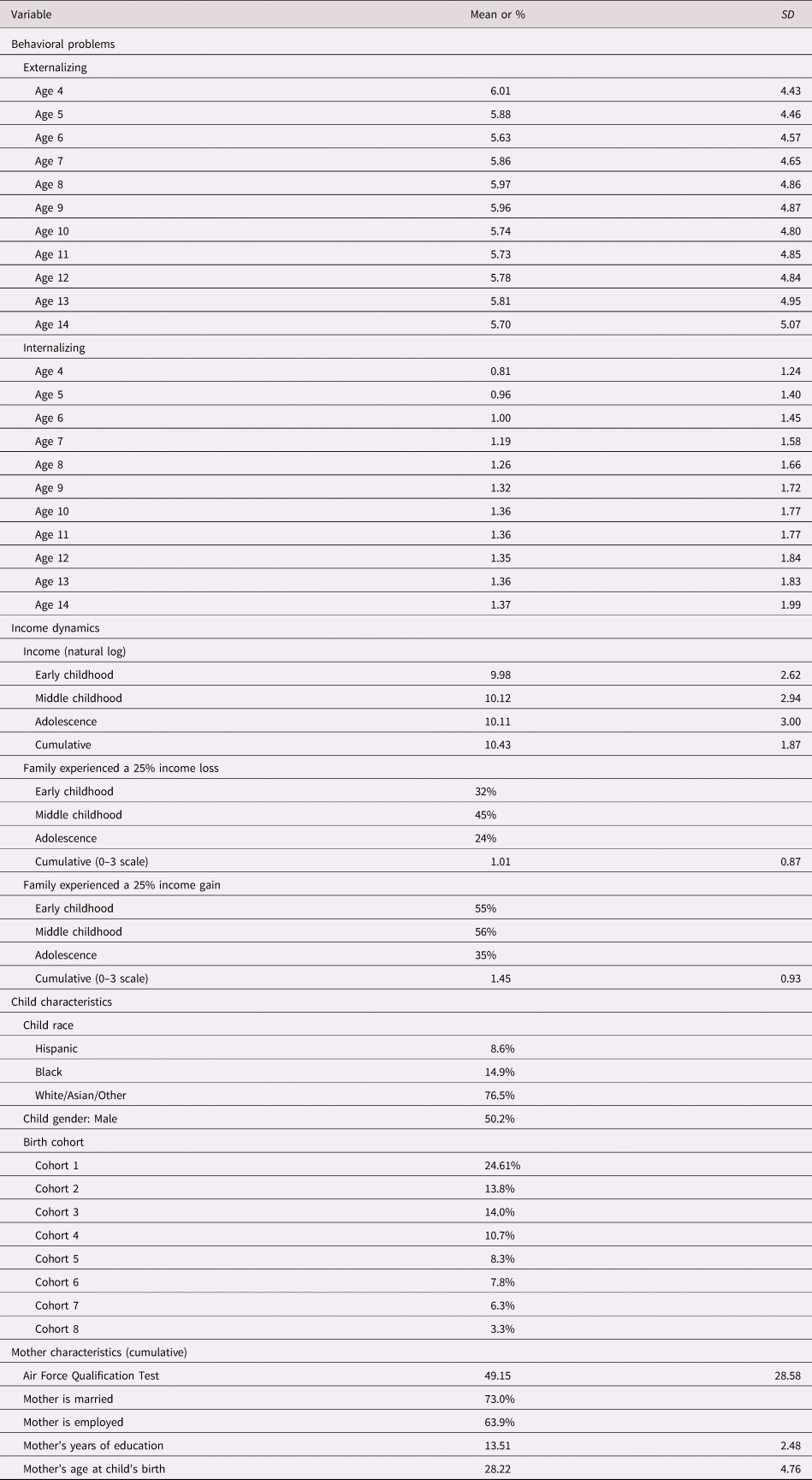
The current study utilized several cohorts of children captured by the NLSY-CS. The first cohort consists of children who were 0–5 years of age at the beginning of the NLSY-CS (in 1986) and were followed until age 14. The second, third, fourth, fifth, sixth, seventh, and eighth cohorts include children who passed the 0–14 age range during 1987–2002, 1989–2004, 1991–2006, 1993–2008, 1995–2010, 1997–2012, and 1999–2014. Our analytic sample contained the 7,476 children within these cohorts with valid sampling weights and outcome data. Of these children, 44.01% were missing data on one or more variables included in analyses. Missing data were imputed using multiple imputation implemented in Mplus (version 8.0; Muthén & Muthén, Reference Muthén and Muthén1998–2017) to create 20 imputed data sets (Royston, Reference Royston2005). Table 1 presents descriptive statistics for the full sample.
Weighted descriptive statistics

Measures
Behavioral functioning
The NLSY assessed behavioral functioning starting at age 4 using the Behavior Problems Index (Zill & Peterson, Reference Zill and Peterson1986), a multi-item, parent-reported inventory designed to measure the frequency, types, and scope of behavioral problems of children aged 4 to 14 years. Two broad factors tapping children's internalizing behaviors and externalizing behaviors have been identified in the Behavior Problems Index. These factors have been shown to be reliable and valid in prior research (CHRR, 2002). Parents were asked several questions about their children's behaviors over the prior 3 months on a 3-point ordinal scale (0 = not true, 1 = sometimes true, 2 = often true). Only the items that were asked consistently across all ages were used so that measures were consistent over time. Examples of these items include whether the child is impulsive, is disobedient at home, is cruel to others, and easily loses his/her temper for externalizing (14 items; α = .84–.89) and is fearful or anxious, is sad or depressed, and is withdrawn for internalizing (6 items; α = .67–.78).
Income dynamics
Each year (or every other year after 1994), the NLSY79 asked respondents to report on household income received in the prior calendar year from wages, salaries, and business earnings. In order to capture family income across birth through adolescence for our sample, we drew data representing income from 1980 through 2013. Family income for each year was escalated to year 2013 dollars using formulas provided by the Bureau of Labor Statistics’ Consumer Price Index so that income measured across different years was comparable (Duncan, Ziol-Guest, & Kalil, Reference Duncan, Ziol-Guest and Kalil2010). Escalation adjusts for monetary inflation over time.
Three income terms were created to examine the independent influences of yearly income in early childhood, middle childhood, and adolescence. Early childhood income averaged family income from the year before the child's birth to 5 years old. Middle childhood income averaged family income from 6 through 10 years of age. Adolescent income averaged family income from 11 through 14 years of age. The decision to use a cumulative income measure in each developmental period was based on prior research and the assumption that a child's development at any given point in time is the product of a family's cumulative income up to that point in the child's life, not simply income in the year of the assessment (Korenman, Miller, & Sjaastad, Reference Korenman, Miller and Sjaastad1995; Mayer, Reference Mayer1997). Finally, a cumulative income measure that averaged family income over all developmental periods (year before birth through age 14) was generated to examine relations between cumulative income and behavior problems. Income was transformed to units of 10,000 US dollars. The natural logarithm of this value was used in models because prior studies have shown that income changes matter more for children from more disadvantaged families (Votruba-Drzal, Reference Votruba-Drzal2006).
We also examined income volatility as a predictor of behavior problems. Income volatility measures were created for each developmental period by calculating the difference in income between 2 years to determine income change during that time (i.e., subtracting previous income from income earned 2 years later). We used the 2-year span because income was only measured every 2 years. Then, the change in income was divided by income at the earlier wave to represent the percent of income change. Next, two dichotomous indicators were created representing whether the family ever experienced a loss in income of at least 25% or a gain in income of at least 25% in any 2-year span during the developmental period. We chose the 25% cutoff based on prior research that examined income volatility (e.g., Hardy, Reference Hardy2014). These indicators were created for early childhood, middle childhood, and adolescence. In cumulative models, cumulative income volatility was represented by two variables denoting the number of developmental periods in which a loss of at least 25% or a gain of at least 25% was experienced. A value of 0 on the loss or gain variable indicates that the household never experienced an income loss or gain of at least 25%. A value of 3 on the loss or gain variable represents a household that experienced consistent losses or gains across all stages of development from early childhood through adolescence.
Child and family covariates
Several child and family characteristics that tend to correlate with family income and children's behavior were included in the models to control for their associations with the outcomes. Child covariates included gender (female reference group) and race/ethnicity, categorized as Hispanic, Black, or “other” (“other” reference group). We also controlled for the cohort in which the child was born using a series of dummy variables. Family covariates included number of children under the age of 18 living in the house, age of the mother at the birth of the subject child, percentage of waves mother was married, and percentage of waves mother was employed. Highest level of maternal education was coded as the highest grade that mothers had completed, ranging from 0 to 20 years, with 20 years representing 8 years of college or more. We also controlled for mothers’ percentile score on the Air Force Qualification Test, which measures aptitude on a variety of intellectual tasks like arithmetic reasoning, word knowledge, paragraph comprehension, and numerical operations. Time-varying family characteristics were averaged both within each developmental period and cumulatively across all periods to mirror the construction of the income variables.
Data analysis
We used latent class growth analysis (LCGA; MacCallum & Austin, Reference MacCallum and Austin2000) to model growth trajectories (or classes) of behavior problems among children from age 4 to age 14 and to test predictors of membership in these classes (Muthén, Reference Muthén and Kaplan2004). The LCGA method categorizes individuals into subpopulations, which captures information about interindividual differences in intraindividual change and identifies heterogeneity (or classes) within a larger population (Jung & Mickrama, Reference Jung and Mickrama2007). In LCGA estimation, the variance and covariance estimates for the growth factors within each class are assumed to be fixed to zero. By allowing the model parameters to differ across groups, LCGA allows for cross-group differences in the shape of developmental trajectories. Thus, instead of estimating a growth model for the entire population, differences in growth across unobserved subpopulations are modeled. This is particularly relevant for examining trajectories of behavior problems because it addresses such issues as course and timing of behaviors, which is helpful in identifying several classes that have more within-group homogeneity with respect to developmental course, precursors, and outcomes (e.g., Broidy et al., Reference Broidy, Nagin, Tremblay, Bates, Brame, Dodge and Lynam2003; Shaw, Hyde, & Brennan, Reference Shaw, Hyde and Brennan2012).
LCGA requires a determination of the number of classes that best describe the data. We used the Bayesian information criterion (BIC) to select the optimal model. Specifically, we selected the model with the smallest BIC. When BIC change did not clearly identify the optimal model, we used the entropy score. The best fitting model reflects the model with the optimal number of classes, and the most likely longitudinal change trend for each group.
Our first step was to identify externalizing and internalizing trajectory groups for our sample. Some research has shown that males and females exhibit different behavioral trajectories (e.g., Castelao & Kroner-Herwig, Reference Castelao and Kröner-Herwig2013; Gutman, Joshi, Parsonage, & Schoon, Reference Gutman, Joshi, Parsonage and Schoon2018; Schaeffer et al., Reference Schaeffer, Petras, Ialongo, Masyn, Hubbard, Poduska and Kellam2006; Steba et al., Reference Sterba, Prinstein and Cox2007), while other studies find no differences in trajectory groups by sex (Carter et al., Reference Carter, Wagmiller, Gray, McCarthy, Horwitz and Briggs-Gowan2010; Dekovic, Buist, & Reitz, Reference Dekovic, Buist and Reitz2004). Accordingly, it is important to test whether observed externalizing and internalizing trajectories are the same for both sexes. Analyses revealed no differences in trajectory groups between males and females, and thus we continued estimating trajectory groups for the sample as a whole. After identifying the optimal number of trajectory groups for each behavioral outcome, we estimated a series of latent class regression analyses to explore relations between income dynamics and behavioral trajectories, controlling for child and family covariates (Asparouhov & Muthén, Reference Asparouhov and Muthén2013). We estimated links between income dynamics at the three developmental stages and children's behavior trajectory group membership. In separate models, externalizing and internalizing were predicted by our developmental timing-specific measures of income dynamics (average family income and income volatility). The next aim was to examine links between cumulative income dynamics and behavior problems. Thus, we predicted externalizing and internalizing trajectories with our measures of cumulative annual income and income volatility.
We tested two additional model specifications to explore whether associations between income dynamics and behavioral trajectories differed for important subgroups. First, we examined whether income's links with behavioral trajectories varied for boys and girls by interacting our income dynamics measures with the gender indicator. Second, we tested whether income volatility's association with behavior differed by income level by interacting our volatility and yearly income terms. These additional specifications were tested with both the cumulative and timing-specific income measures.
All analyses were performed in Mplus 8, controlled for all covariates, and used custom weights created by the NLSY79 to adjust for clustering and oversampling (US Bureau of Labor Statistics, n.d.). Below we present results using coefficients and odd ratios (OR). Odds ratios indicate whether income dynamics put children at higher odds or lower odds of belonging to a group compared to the low-stable reference groups. A significant OR < 1 represents a decrease in the likelihood of being in the specified trajectory group compared to the low-stable group. A significant OR > 1 represents an increased likelihood of membership in that group rather than the low-stable group.
Results
Trajectories of externalizing and internalizing problems
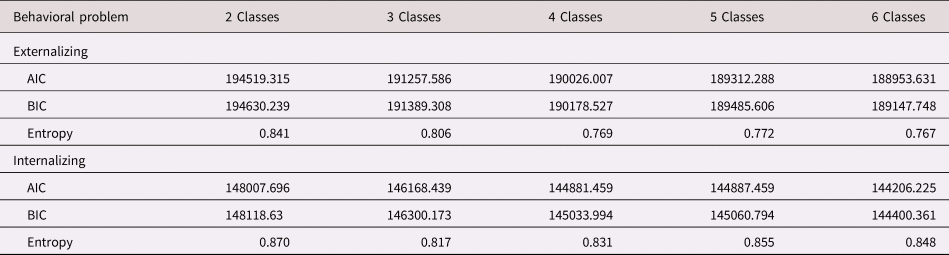
The first goal was to model developmental trajectories of externalizing and internalizing behaviors from ages 4 to 14. Table 2 presents model fit statistics when specifying different numbers of groups in a linear model (models with quadratic and cubic terms had worse model fit).
Model fit comparison for different numbers of groups

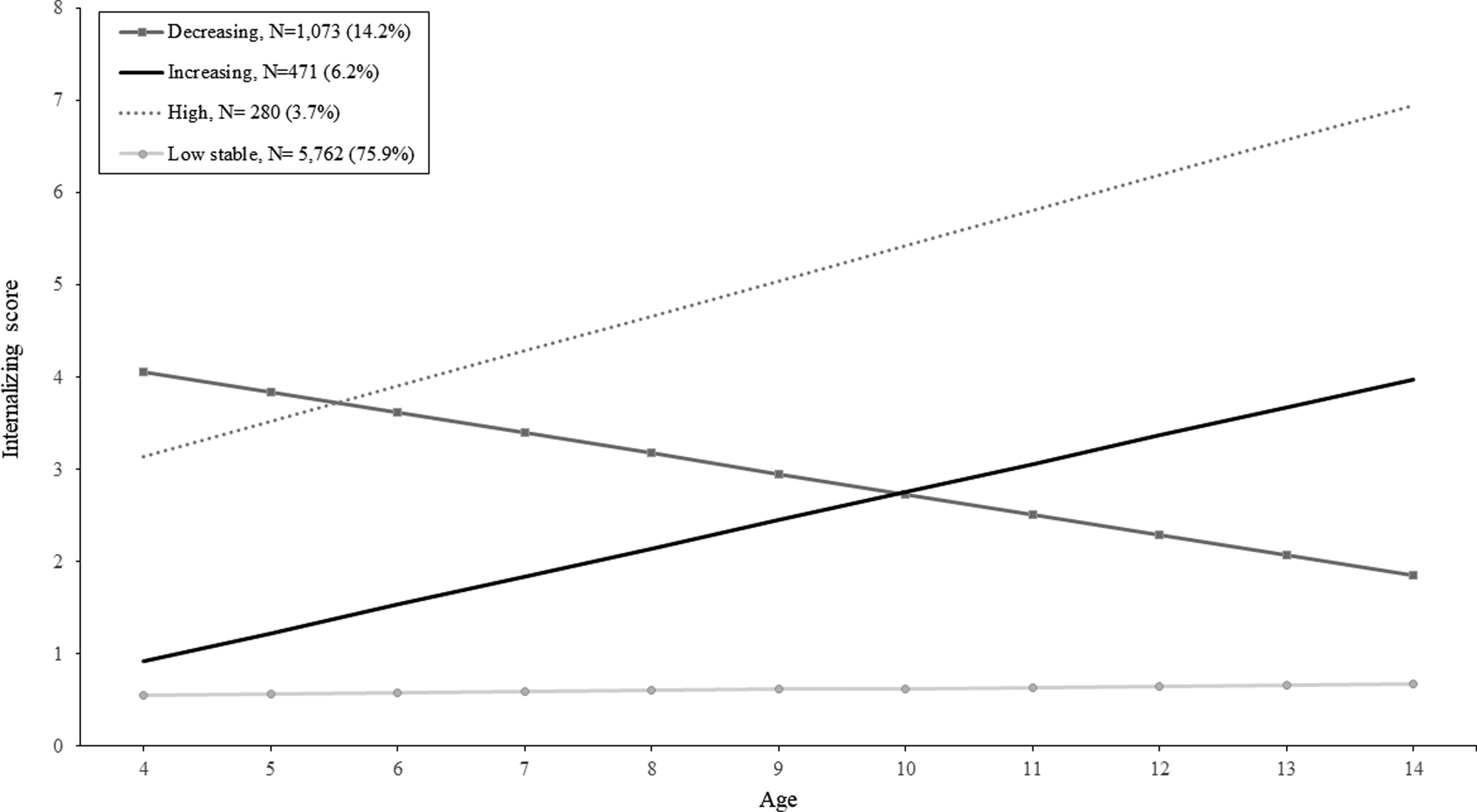
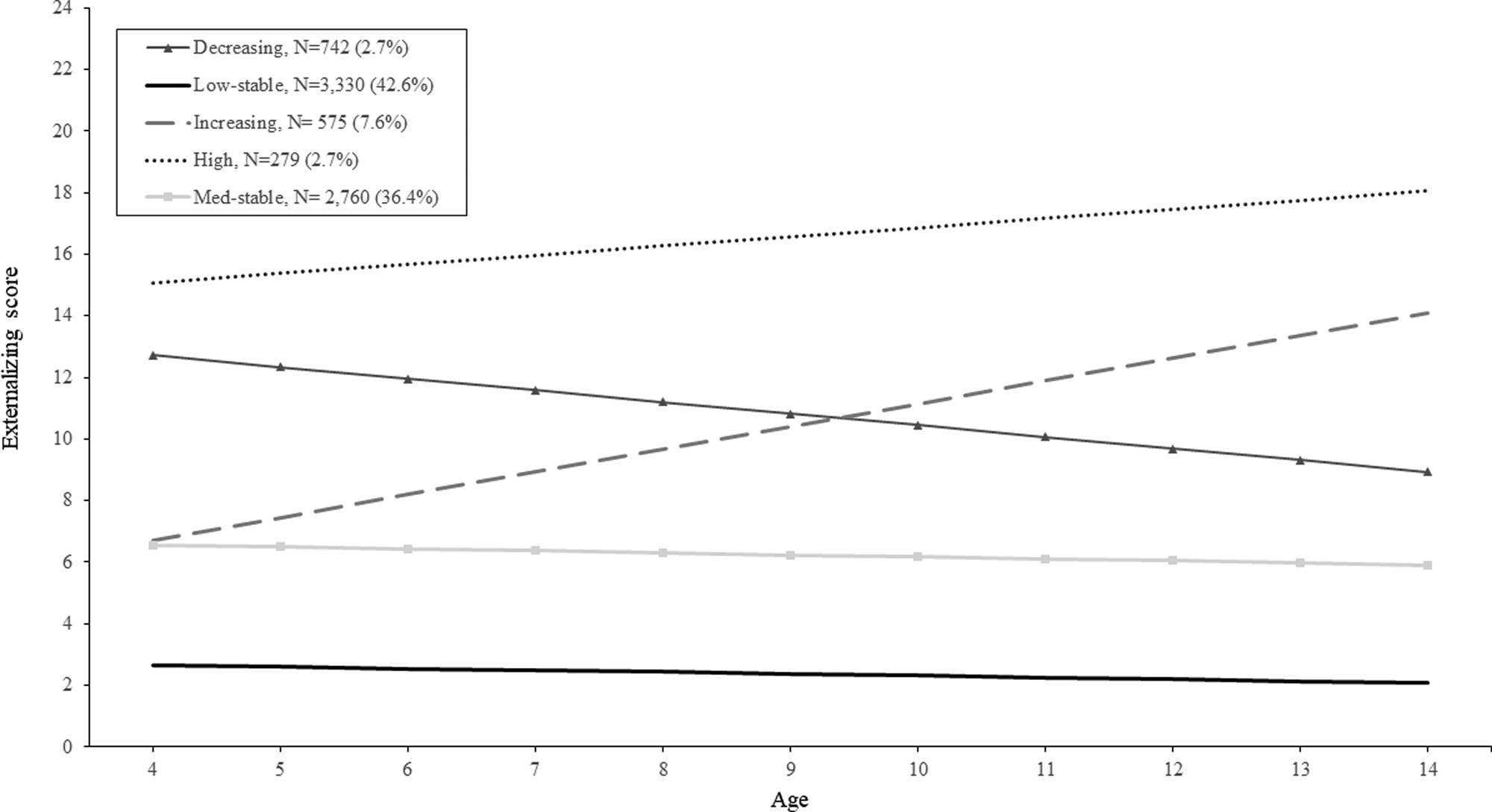
A five-group model was selected as the best fitting model for externalizing, which was indicated by the lack of significant reduction in the BIC and Akaike information criterion (AIC) in comparison with the six-class model. A four-group model was selected for internalizing because the BIC and AIC increased when testing a five-class model. Figures 1 and 2 depict the observed trajectories for externalizing and internalizing, respectively.
Trajectories of externalizing behavioral problems.

Trajectories of internalizing behavioral problems.

Externalizing
Two of the five externalizing trajectory groups showed stable and relatively low levels of externalizing problems over time. The largest percentage of children (42.6%; N = 3,330) fell into a “low-stable” group. These children exhibited stably low levels of externalizing from age 4 through age 14 (roughly 0.80 standard deviations [SD] below the sample mean). Next, a “middle-stable” group was identified, which was comprised of 36.4% of the sample (N = 2,760). Children in the middle-stable group displayed stably average levels of externalizing problems over time. Next, a small percentage of children (3.7%; N = 279) exhibited consistently higher than average levels of externalizing—the “high” group. Children in the high group exhibited externalizing problems that consistently hovered about 2.4 SD above the mean and increased slightly across time. The final two externalizing trajectory groups showed marked change over time, though in opposite directions. The “increasing” group (7.6%; N = 575) showed levels of externalizing problems that were similar to the middle-stable group at age 4, but externalizing problems increased over time. At age 14, children in the increasing group exhibited externalizing behaviors that were 1.18 SD greater than the mean. Finally, 9.8% (N = 742) of children were in a “high-decreasing” externalizing trajectory group. These children exhibited high levels of externalizing problems at age 4 (1.78 SD over the mean), but their problem behavior decreased over time. Despite the decrease, though, children in the high-decreasing group ended with higher than average levels of externalizing at age 14 (1.51 SD above the mean).
Internalizing
Turning to internalizing (Figure 2), the majority of children showed stably low levels of internalizing problems over time, with 75.9% (N = 5,762) of children falling into the low-stable group (0.47 SD below the mean on average). Next, children in the increasing group (6.2%; N = 471) began with slightly above average levels of internalizing at age 4 (0.60 SD above the mean), but by age 14 they exhibited internalizing problems roughly 1 full SD above mean levels. Next, the decreasing group (14.2%; N = 1,073) started with extremely high levels of internalizing problems (3.16 SD above the mean) but experienced a rapid decrease over time, exhibiting internalizing behaviors that were 0.58 SD above the mean at age 14. Stated differently, in early childhood, children in the decreasing group exhibited approximately 8 times greater levels of internalizing than the low-stable group, but by age 14, the difference between the two groups had been more than cut in half. Finally, a small percentage of children fell into the high group (3.7%; N = 280). These children were a full SD higher than average on internalizing in early childhood, and problems increased over time. By age 14, they exhibited internalizing behaviors that were 2.24 SD above the mean.
Income dynamics and trajectories of behavior problems
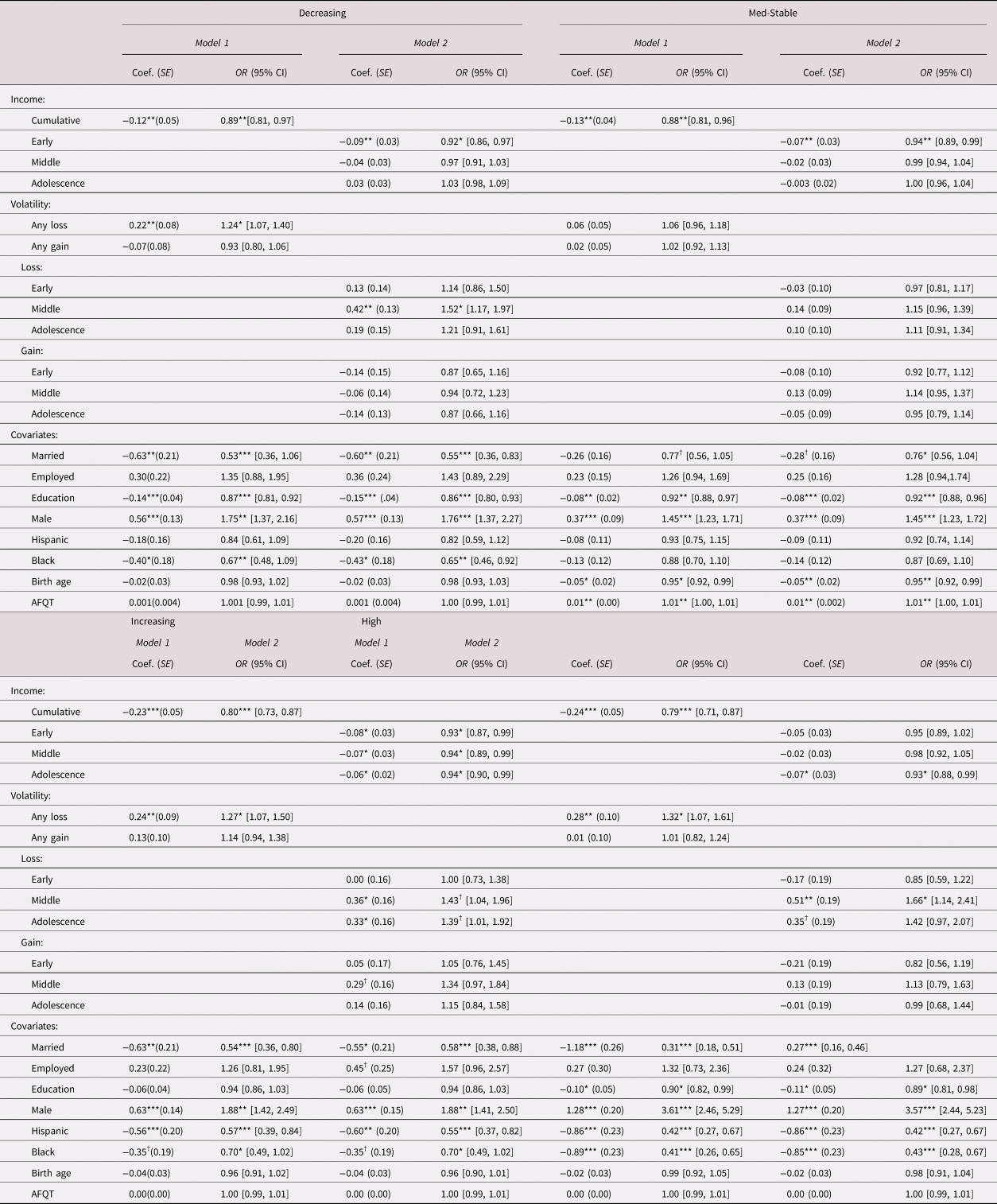
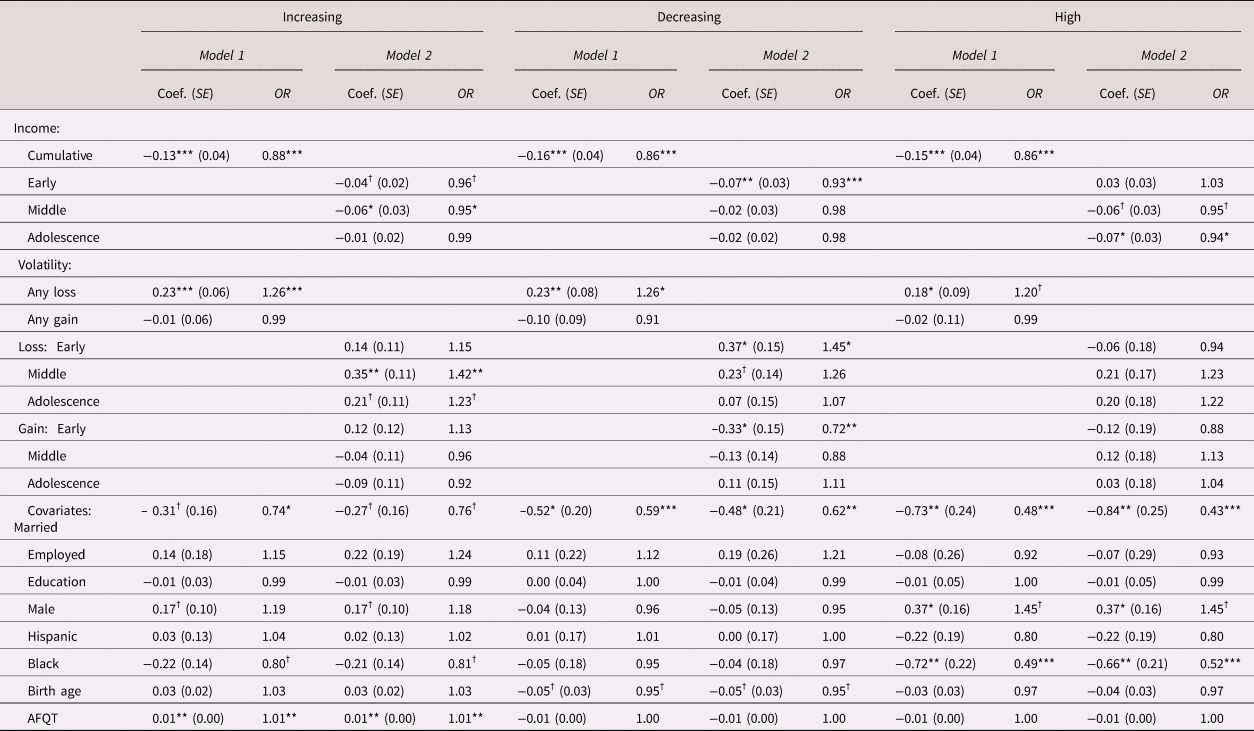
Next, this study asked whether yearly income and income volatility predicted membership in the various trajectories of externalizing and internalizing problems. Tables 3 and 4 present results from multinomial logistic regression models predicting membership in the externalizing and internalizing trajectory groups, respectively, with income dynamics.
Multinomial logistic regression predicting externalizing trajectory group by income and income volatility (low-stable is reference)

Note: Controls included in models are maternal marital status, maternal employment, maternal education, child gender, race/ethnicity, maternal age at birth, and AFQT. AFQT, Air Force Qualification Test.***p < .001. **p < .01. *p < .05. †p < .10.
Multinomial logistic regression predicting internalizing trajectory group by income and income volatility (low-stable is reference group)

Note: Controls included in models are maternal marital status, maternal employment, maternal education, child gender, race/ethnicity, maternal age at birth, and AFQT. AFQT, Air Force Qualification Test. ***p < .001. **p < .01. *p < .05. †p < .10.
Model 1, shown in the first column, illustrates results from models predicting trajectory group membership with cumulative yearly income and income volatility. Model 2, presented in the second column, shows results from models predicting trajectories with yearly income and income volatility at different developmental stages. Family income is measured in natural log units. An increase in a natural log unit corresponds to an approximately 2.71 factor increase. Thus, using as a hypothetical a family earning $10,000, a log unit increase in yearly income would represent a change from $10,000 to approximately $27,100.
Externalizing
Results examining associations between income dynamics and externalizing trajectories are presented in Table 3. Cumulative yearly income was related to the likelihood of being in the lowest risk externalizing trajectory group compared to all other groups. Specifically, when comparing the odds of being in the low-stable group instead of the high group, a log increase in yearly income related to 21% lower odds of being in the high group (OR = .778, 95% CI [.71, .87]). Higher yearly income was also associated with lower odds of being in the decreasing (OR = .89, 95% CI [.81, .96]), increasing (OR = .80, 95% CI [.72, .87]), and medium-stable (OR = .88, 95% CI [.81, .96]) groups compared to the low-stable group by 11%, 20%, and 12%, respectively. Higher yearly income was also related to a reduced likelihood of being in the high group compared to the decreasing (OR = .89, 95% CI [.81, .98]) and medium-stable (OR = .895, 95% CI [.82, .97]) groups, which are both comparatively lower risk groups.
With respect to volatility, results showed some links between income losses and externalizing trajectories. For each additional developmental period that the family experienced a 25% or greater loss of income, children odds of being in the increasing (OR = 1.24, 95% CI [1.07, 1.50]) or decreasing (OR = 1.27, 95% CI [1.07, 1.44]) rose by roughly 25%. Income gains were unrelated to externalizing trajectories.
Models in the second column show associations between timing-specific income dynamics and externalizing. With respect to yearly income, higher early childhood income related to lower odds of membership into the decreasing (OR = .92, 95% CI [.86, .97]), increasing (OR = .93, 95% CI [.87, .99]), and medium-stable (OR = .94, 95% CI [.89, .98]) groups compared to the low-stable group. For each log unit increase in yearly income during early childhood, the odds of being in the decreasing, increasing, and medium-stable groups compared to the low-stable group were reduced by 6%–8%. Yearly income earned during middle childhood related to membership in the increasing group compared to the low-stable group, with a log increase in yearly income linked to 6% (OR = .94, 95% CI [.89, .99]) lower odds of being in the increasing group. Middle childhood yearly income similarly related to the odds of being in the increasing group compared to the medium-stable group (trend; OR = .95, 95% CI [0.90, 1.01]). Yearly income during adolescence was linked to 6%–7% reductions in the odds of being in the increasing (OR = .94, 95% CI [.89, .98]) and high (OR = .93, 95% CI [.88, .99]) groups compared to the low-stable group. Higher yearly income during adolescence was associated with 9% lower odds of being in the high group or the increasing group as opposed to the decreasing (OR = .91, 95% CI [.84, .97]) and with 6% lower odds of membership in both of these groups in comparison to the medium-stable group (OR = .94, 95% CI [.88, .99]).
Timing-specific models revealed that income volatility during middle childhood was a particularly important predictor of externalizing trajectories. Specifically, experiencing an income loss of at least 25% during middle childhood related to higher odds of membership in the decreasing (OR = 1.51, 95% CI [1.16, 1.97]), high (OR = 1.66, 95% CI [1.14, 2.41]), and increasing groups (trend; OR = 1.43, 95% CI [1.04, 1.95]) compared to the low-stable group. Effect sizes ranged from a 51% increased likelihood of being in the decreasing and increasing groups to a 66% increase in the odds of being in the high group instead of the low-stable group. Income gains were again unrelated to externalizing trajectories.
Results showed that some child and family covariates were important predictors of membership in externalizing trajectories. In brief, being stably married, having higher levels of maternal education, being female, and being Black or Hispanic were generally related to greater likelihood of being in the lowest risk externalizing trajectory group compared to all other groups.
Internalizing
Table 4 shows the results of models predicting internalizing trajectory group membership with income dynamics. Model 1, which presents results from the cumulative income dynamics models, illustrates that cumulative yearly income predicted membership in all internalizing groups compared to the low-stable group.
Specifically, a log unit increase in yearly income was related to 12%–14% reductions in the odds of being in the increasing group (OR = .88, 95% CI [.82, .94]), decreasing group (OR = .86, 95% CI [.80, .92]), or high group (OR = .86, 95% CI [.79, .93]) instead of the low-stable group. In addition, for every additional developmental period during which children experienced an income loss of 25% or more, their odds of being in the high group increased by 20% (OR = 1.20, 95% CI [1.01, 1.43]), and their odds of being in the decreasing or increasing groups increased by 26% (OR = 1.26, 95% CI [1.09, 1.47]) compared to the low-stable group. Income gains were not associated with internalizing trajectories.
Model 2 presents findings regarding how timing-specific income dynamics related to internalizing trajectory group membership. Results indicate that yearly income in adolescence and middle childhood were most important in predicting membership in the high group in comparison to the low-stable group. Compared to the low-stable group, a log unit increase in yearly income during middle childhood is linked to 5% lower odds (OR = .95, 95% CI [.89, 1.00]) and the same change in adolescent income was associated with 6% lower odds (OR = 0.94, 95% CI [.89, .99]) of being in the high group. Early childhood income positively predicted odds of membership in the decreasing group compared to the low-stable group (OR = .93, 95% CI [.88, .98]). Higher yearly income during early (OR = .96, 95% CI [.91, 1.00]) and middle childhood (OR = .93, 95% CI [.90, .99]) was also associated with lower likelihood of being in the increasing group. In addition, higher yearly income during early childhood was associated with lower odds of being in the decreasing group in comparison to the low group (OR = .93, 95% CI [.88, .97]).
With respect to volatility, experiencing a loss of at least 25% of income in early childhood was associated with 45% higher odds of being in the decreasing group instead of the low-stable group (OR = 1.45, 95% CI [1.09, 1.93]). Next, experiencing a 25% or greater income loss during middle childhood related to 42% higher odds of membership in the increasing group compared to the low-stable group (OR = 1.42, 95% CI [1.15, 1.74]). Finally, income loss experienced during adolescence was marginally associated with 23% higher odds of belonging to the increasing group instead of the low-stable group (trend; OR = 1.23, 95% CI [1.00, 1.53]). However, there was one case in which income gains were associated with internalizing trajectories. Having an income gain of 25% or more during early childhood predicted higher odds of membership into the low group in comparison to the decreasing group (OR = 1.57, 95% CI [1.04, 1.87]).
With respect to child and family covariates, being stably married was related to the likelihood of being in the lowest risk internalizing trajectory group compared to all other groups. In comparison with the low-risk group, being female and being Black was associated with higher odds of being in the high group but no differences were found for other groups. It was surprising that a higher maternal Air Force Qualification Test score predicted greater odds of being in the increasing group compared to the low group.
Additional model specifications
Additional models tested whether income–behavioral trajectory links varied for boys and girls and whether associations between trajectories and income volatility differed by income level. Results showed that these associations were consistent across gender and level of income. Thus, these nonsignificant results are not presented here for the sake of parsimony (available from first author by request).
Discussion
Using data on a large, national sample of children born in the United States between 1981 and 2000 and detailed information on their family income from before birth through adolescence, this study aimed to uncover links between income dynamics at three distinct developmental periods and trajectories of externalizing and initializing problems from age 4 to 14. Most important, this study represents an important replication of prior developmental psychopathology work showing children follow one of several distinct patterns of externalizing and internalizing problems. The trajectories uncovered in this study are similar to those found in other studies using markedly different samples and different measures of behavior problems. For example, one of the earliest developmental psychopathology studies of externalizing problems by Nagin and Tremblay (Reference Nagin and Tremblay1999) utilized a sample of boys living in low-income areas in Montreal, Quebec, Canada. Observed trajectories were similar to those in the present study despite the difference in samples and that the externalizing measure in Nagin and Tremblay's study focused on physical aggression, hyperactivity, and oppositional or defiant behavior as opposed to a more general measure of externalizing like the one here. Similarly, Shaw et al. (Reference Shaw, Gilliom, Ingoldsby and Nagin2003) studied a small sample of low-income boys and examined trajectories of conduct problems specifically, while Feng, Shaw, and Silk (Reference Feng, Shaw and Silk2008) looked at trajectories of anxiety in the same sample. The externalizing and internalizing trajectories identified in this study also mirror findings from studies using samples and measures that more closely resemble those in the present study. Recently, researchers estimated trajectories of externalizing and internalizing in the Early Childhood Longitudinal Study—Kindergarten cohort, a large, nationally representative cohort of children (e.g., Miller & Votruba-Drzal, Reference Miller and Votruba-Drzal2017), and results were very similar to the results we obtained here in the NLSY. Such replication is an important aspect of the scientific method and necessary to produce confidence in our knowledge base (Duncan, Engel, Claessens, & Dowsett, Reference Duncan, Engel, Claessens and Dowsett2014).
Cumulative income dynamics are stronger predictors of trajectory membership
Results of this study illustrate that cumulative family income is a much stronger predictor of children's behavioral trajectories from early childhood through early adolescence than income earned at any one developmental period. These findings are consistent with “accumulation of inputs” theories of child development (e.g., Blau, Reference Blau1999; National Institute of Child Health and Human Development Early Child Care Research Network & Duncan, Reference Duncan2003; Votruba-Drzal, Reference Votruba-Drzal2006). “Accumulation of inputs” models suggest that children's development at a given point in time is an additive function of all the inputs, including income, they have received or experienced up to that point in time. Thus, findings like these showing the strength of longitudinal data illustrate the necessity of longitudinal studies for a fuller understanding of human development. Moreover, perhaps the weak and inconsistent associations observed in the literature on income and behavior problems are partly due to many of the studies failing to have longitudinal information on family income dynamics.
While reviews of the income–behavior literature have generally concluded that income relates to externalizing problems more strongly than internalizing problems, this study found associations between income and externalizing were of similar magnitude as those for income and internalizing. This could be due to the current study's application of a developmental psychopathology lens to the study of behavior problems. Prior studies that looked at internalizing at a single point in time or in early childhood (Dearing et al., Reference Dearing, McCartney and Taylor2006; Eamon, Reference Eamon2000; Hao & Matsueda, Reference Hao and Matsueda2006; Mistry et al., Reference Mistry, Biesanz, Taylor, Burchinal and Cox2004; Yueng et al., Reference Yeung, Linver and Brooks–Gunn2002) may have failed to identify children who will develop internalizing disorders at a different point in their development. This study, however, modeled trajectories of internalizing over time, and results illustrate that examining internalizing at a single point in time, especially in early childhood, results in missing as many as 20% of children who will develop these behaviors at another time and including a nonnegligible percentage of children who show declining rates of internalizing and will exhibit normal levels of internalizing behavior by adolescence (Leve, Kim, & Pears, Reference Leve, Kim and Pears2005; Miller & Votruba-Drzal, Reference Miller and Votruba-Drzal2017; Sterba et al., Reference Sterba, Prinstein and Cox2007). Thus, examining trajectories of behavioral development or, at least, attuning to children's age/developmental stage when studying correlates of behavior problems is vital.
Timing-specific income associations map on to developmental changes in behavior
While cumulative income dynamics proved to be the most robust predictor of behavioral trajectories, we did observe timing-specific associations between income and trajectories of externalizing and internalizing. Of note, timing-specific income dynamics tended to predict trajectories that involved changes in direction during the same specific developmental period. For instance, early childhood income most strongly relates to likelihood of membership in the decreasing group instead of the low-stable group. This makes sense because children in the decreasing group exhibit markedly higher levels of externalizing behaviors in early childhood as compared to the low-stable group. Thus, early childhood would be the most important time for contextual factors to influence membership in the decreasing group.
Similarly, middle childhood income related to membership in the increasing externalizing trajectory instead of the low- and medium-stable groups. Looking closely at the increasing trajectory, members exhibit similar levels of externalizing to the medium-stable group and slightly higher levels than the low-stable group during early childhood. However, a steady increase in externalizing beginning at middle childhood characterizes this group; thus, it is understandable that middle childhood income would predict differential membership into these trajectories. Finally, higher adolescent income related to decreased likelihood of membership in the stably high and increasing externalizing groups—the two groups that exhibit the highest levels of externalizing problems at adolescence—compared to the low- and medium-stable groups. These patterns of timing-specific income results are mirrored in the internalizing trajectory findings. This again underscores the pitfalls of studying income and behavior at a single point in time and the importance of examining behavior problems over the span of a child's development in a way that attends to stages of development.
Income losses are related to behavioral trajectories
An interesting finding from the timing-specific models is that income losses in middle childhood seem particularly problematic for maladaptive behavioral trajectories, especially with respect to externalizing. Experiencing an income loss in middle childhood related to a larger likelihood of being in the increasing externalizing and internalizing groups compared to the low-stable trajectory groups. It also related to a higher likelihood of being in the high-declining externalizing group as opposed to the low-stable group. What makes this finding even more remarkable is that, at least with respect to externalizing problems, while income losses in middle childhood relate to membership in higher risk trajectories, these associations are not evident in early childhood or, to a lesser extent, adolescence.
The income literature really highlights the importance of early childhood income in human development, but this study adds to a growing literature showing that income dynamics in middle childhood relate to behavioral developmental as well (Miller, Whitfield, Betancur, & Votruba-Drzal, Reference Miller, Whitfield, Betancur and Votruba-Drzal2019; Votruba-Drzal, Reference Votruba-Drzal2006). Results from this study support this burgeoning literature with respect to links between annual income and behavior problems (discussed above), but also in regard to negative income shocks experienced during middle childhood. Income loss in middle childhood appears to have important associations with maladaptive behavioral trajectories. These findings are strikingly consistent with recent research exploring the developmental timing of income dynamics and behavior (Miller et al., Reference Miller, Whitfield, Betancur and Votruba-Drzal2019). In that study, also using NLSY data, middle childhood income losses were related to increased externalizing problems during adolescence. This would map on to the finding in the present study regarding the almost twofold increase in likelihood of being in the increasing externalizing group (the group that exhibits the highest levels of externalizing in adolescence) instead of the low-stable group predicted by an income loss in middle childhood. Going back to the theoretical underpinnings of this study, we noted that adolescents are increasingly aware of family financial circumstances and strain (McLoyd, Reference McLoyd2019; McLoyd et al., Reference McLoyd, Kaplan, Purtell, Bagley, Hardaway, Smalls, Lerner and Steinberg2009), and adolescent awareness may be a pathway linking family economic strain and behavior problems (Harold & Conger, Reference Harold and Conger1997). An extensive elaboration of McLoyd's model demonstrated that adolescents’ perceptions of family hardship (i.e., economic stress as a family unit) influenced emotional distress (Conger, Conger, Matthews, & Elder, Reference Conger, Conger, Matthews and Elder1999), and this awareness could drive links between income volatility and behavior problems. This literature, however, has focused on adolescents. The results of this study suggest that children's understanding of family income instability and financial strain (and accompanying emotional distress) may begin during middle childhood.
Limitations
Results of this study are correlational and, thus, must be interpreted with caution. In particular, income is not randomly assigned to families. Rather, parents make choices that affect their earnings, like education level and employment, and factors influencing their selections also shape the proximal contexts in which their children develop. Accordingly, while we included many covariates in our models, such as mothers’ intellectual aptitude and a range of family demographic characteristics, it is possible that associations between income dynamics and trajectories of behavior problems are caused by unmeasured characteristics of parents or children in our sample. However, there is a growing literature using experimental or quasi-experimental designs to study associations between income and children's behavior that finds these associations may be causal (Duncan, Magnuson, & Votruba-Drzal, Reference Duncan, Magnuson and Votruba-Drzal2017). For example, drawing data from the Great Smoky Mountain Study of Youth, Akee, Copeland, Keeler, Angold, and Costello (Reference Akee, Copeland, Keeler, Angold and Costello2010) used a natural experiment to compare the behavioral functioning of Native American children with non–Native American children before and after a casino opened on tribal land. Starting in 1996, when the casino opened, every Native American, but no non–Native American, received an annual income supplement increase of around $8,500. Adolescents in families receiving income payments showed reductions in both externalizing and internalizing problems (Akee, Copeland, Keeler, Angold, and Costello, Reference Akee, Copeland, Keeler, Angold and Costello2010). Additional evidence for a causal connection between income and child behavior problems comes from several welfare evaluations studies in the United States and Canada in the 1990s that involved random assignment (Clark-Kauffmanm Duncan & Morris, Reference Clark-Kauffman, Duncan and Morris2003). By comparing effects of programs that only increased parental employment to those that increased both work and household income, these studies found evidence of a causal connection between increased family income and reduced behavioral problems in children (Gennetian & Miller, Reference Gennetian and Miller2002; Houston et al., Reference Huston, Duncan, Granger, Bos, McLoyd, Mistry and Ventura2001; Morris et al., Reference Morris, Hill, Gennetian, Rodrigues and Wolf2015). Therefore, while the current study's findings are correlational, they are supported by results from other quasi-experimental work.
Second, the measures of income dynamics used in this study did not include a more comprehensive measure of financial strain or material hardship, which has also been shown to be an important predictor of children's behavioral development (e.g., Gershoff et al., Reference Gershoff, Aber, Raver and Lennon2007; Zilanawana & Pilkauskas, Reference Zilanawala and Pilkauskas2012). Measures of material hardship include things like food insecurity, residential instability, and inadequate medical care. Unfortunately, information regarding these hardships is not available in the NLSY. Thus, the current study focuses on links between family income dynamics and behavior problems, but it cannot speak to the effects of variation in material hardships among families with similar levels of income and volatility.
Third, the effect sizes of links between income dynamics and behavior problems are small, though not necessarily inconsistent with prior studies of income and behavior (e.g., Blau, Reference Blau1999; Mistry et al., Reference Mistry, Biesanz, Taylor, Burchinal and Cox2004; Yueng et al., Reference Yeung, Linver and Brooks–Gunn2002). This may be due to the nature of the measures of income dynamics that are typically used in such studies, including the current study. Income measures are commonly generated using parents’ reports of their yearly incomes. The impact of income dynamics on families’ stress and investment decisions, and, in turn, on children's behavior, may be driven more by variability in income earned week-to-week or month-to-month than yearly income (Hill et al., Reference Hill, Morris, Gennetian, Wolf and Tubbs2013). Low-income families, in particular, have more instability in their earnings over a year than do higher income families (Morris, Hill, Gennetian, Rodrigues, & Wolf, Reference Morris, Hill, Gennetian, Rodrigues and Wolf2015; Ziliak, Hardy, & Bollinger, Reference Ziliak, Hardy and Bollinger2011), and income volatility in disadvantaged families has been steadily growing over the past decades (Morris et al., Reference Morris, Hill, Gennetian, Rodrigues and Wolf2015). Thus, fluctuations in income over weeks and months may be the strongest predictor of children's outcomes because it is a better picture of families’ actual abilities to meet daily needs. The failure of researchers to attend to intrayear income instability is largely driven by the lack of data that captures families’ earnings at a microlevel. A notable exception is research using data from the Survey of Income and Program Participation (e.g., Gennetian, Rodrigues, Hill, & Morris, Reference Gennetian, Rodrigues, Hill and Morris2018). The Survey of Income and Program Participation collected data on family income every 4 months, which allowed researchers to create measures of income and income volatility within a single year. Studies that focus on income dynamics measured at a more precise scale (e.g., weekly or monthly) are needed to better understand how income relates to child development, especially in low-income families where income varies widely within months and years.
Conclusion
This study utilized data on nearly 8,000 children collected prenatally through age 14 to estimate and replicate trajectories of externalizing and internalizing problems. Consistent with other studies using smaller convenience samples and larger representative data sets, results showed five unique externalizing trajectories and four unique internalizing trajectories. These trajectories were linked to both cumulative income dynamics and timing-specific income dynamics, though cumulative income had relatively stronger links to externalizing and internalizing trajectories. Findings highlight the importance of using a developmental psychopathology framework when considering income disparities in behavioral functioning. Specifically, choosing a single point in childhood to estimate income–behavior links will ignore a substantial proportion of children who exhibit increased levels of behavior problems at some other point in time. Studies that fail to examine behavior across development may obscure associations between income and externalizing and internalizing problems. Finally, our findings suggest that economic disadvantage at all stages of development plays a role in the formation of behavior problems. Accordingly, policies and programs that provide financial or other support to families with children of all ages may be best suited to reduce externalizing and internalizing problems in youth. This is crucial as these youth tend to develop deficits in adult functioning, which can perpetuate the intergenerational transmission of social and economic disadvantage.
Financial Support
Research reported in this publication was supported by the Eunice Kennedy Shriver National Institute of Child Health and Human Development of the National Institutes of Health under Award Number R03HD091610. The content is solely the responsibility of the authors and does not necessarily represent the official views of the National Institutes of Health.