1. Introduction
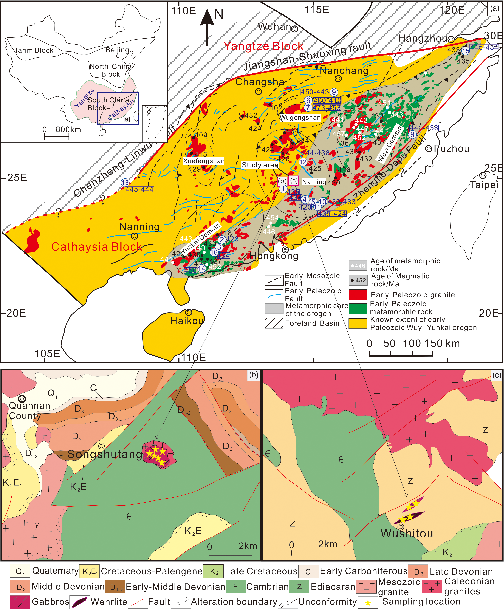
China was aggregated from three major Precambrian blocks during the Phanerozoic Eon: the South China, North China and Tarim blocks (Zhao & Cawood, Reference Zhao and Cawood2012). The South China Block (SCB) is a major continental block and occupies the bulk of southern China. It is traditionally considered to be separated from the North China Block by the Qinling–Dabie–Sulu orogen (Wang et al. Reference Wang, Fan, Zhang and Zhang2013 a) and evolved over a long-lived accretion–collision history from Proterozoic to Mesozoic times (Lin et al. Reference Lin, Xing, Davis, Yin, Wu, Li, Jiang and Chen2018; Liu et al. Reference Liu, Peng, Kusky, Polat and Han2018). The early Palaeozoic NE–SW-trending Wuyi–Yunkai orogen is a major orogenic belt in South China (Li et al. Reference Li, Li, Wartho, Clark, Li, Zhang and Bao2010). This orogen possibly stretches ~2000 km to the NE Korean Peninsula and SW Indochina Block and covers the southeastern half of the SCB (Fig. 1). This orogenic event, also regarded as the ‘Caledonian Orogeny’ and/or ‘Kwangian Orogeny’ in Chinese literature, is correlated with the Caledonian orogen in Europe (e.g. Huang, Reference Huang1980; Ren, Reference Ren1991; Wang et al. Reference Wang, Fan, Zhao, Ji and Peng2007; Zeng et al. Reference Zeng, Zhang, Zhou, Zhong, Xiang, Liu, Jin, Lü and Li2008; Li et al. Reference Li, Li, Wartho, Clark, Li, Zhang and Bao2010; Zhang, Q. et al. Reference Zhang, Santosh, Zhu, Chen and Huang2015). The Wuyi–Yunkai orogen is marked by a regional angular unconformity between Middle Devonian strata and pre-Devonian strata in the eastern SCB (Cathaysia Block) (e.g. Li et al. Reference Li, Li, Wartho, Clark, Li, Zhang and Bao2010; Zhang et al. Reference Zhang, Xu, Xia and Liu2017), the absence of upper Silurian sediments, intensive deformation, extensive folding of pre-Devonian rocks and widespread early Palaeozoic granitoid intrusions (e.g. Charvet et al. Reference Charvet, Shu, Faure, Choulet, Wang, Lu and Le Breton2010; Li et al. Reference Li, Lin, Li, He and Ge2017). The core of this orogen is defined by a zone of NE-trending regional upper-greenschist to granulite-facies metamorphism (e.g. Wang et al. Reference Wang, Zhang, Fan, Zhang and Zhang2013 b; Yu et al. Reference Yu, Zhang, Zhou, Weinberg, Zheng and Yang2019).
(a) A simplified regional geological map of eastern South China showing the distributions of the early Palaeozoic Wuyi–Yunkai orogen (modified from Yao et al. Reference Yao, Li, Li, Wang, Li and Yang2012 and Huang & Wang, Reference Huang and Wang2019). Sources for existing Ordovician–Silurian ultramafic–mafic rocks are from: 1 – Silurian Chayuanshan volcanic succession, Guangdong, Yao et al. (Reference Yao, Li, Li, Wang, Li and Yang2012); 2 – Silurian Longhugang gabbroic pluton, Northern Yunkai, Wang et al. (Reference Wang, Zhang, Fan, Zhang and Zhang2013b); 3 – Silurian Zhouya–Shiban gabbroic pluton, Northern Yunkai, Wang et al. (Reference Wang, Zhang, Fan, Zhang and Zhang2013b); 4 – Silurian Xinchuan gabbroic pluton, Southern Nanling, Wang et al. (Reference Wang, Zhang, Fan, Zhang and Zhang2013b); 5 – Silurian Xinsi gabbroic pluton, Southern Nanling, Wang et al. (Reference Wang, Zhang, Fan, Zhang and Zhang2013b); 6 – Taoyuan hornblende gabbro, Jiangxi, Zhong et al. (Reference Zhong, Ma, Zhang, Wang, She, Liu and Xu2013); 7 – Ordovician Eastern Wugongshan appinites, Jiangxi, Zhong et al. (Reference Zhong, Ma, Liu, Zhao, Zheng, Nong and Zhang2014); 8 – Silurian Dakang gabbroic pluton, Fujian, Zhang, Q. et al. (Reference Zhang, Jiang, Wang, Liu, Ni and Qing2015); 9 – Ordovician Songxi mafic intrusions, Jiangxi, Zhang, C. L. et al. (Reference Zhang, Zhu, Chen and Ye2016); 10 – Silurian Yonghe hornblende gabbro, Guangdong, Xu et al. (Reference Xu, Xu and Zeng2017); 11 – Silurian Longchuan, Longmu and Huwei gabbro-diorites, Guangdong, Jia et al. (Reference Jia, Wang and Yang2017); 12 – Silurian Tangshan and Danqian diorites, Jiangxi, Jia et al. (Reference Jia, Wang and Yang2017); 13 – Silurian Danling lamprophyre, Guangxi, Jia et al. (Reference Jia, Wang and Yang2017); 14 – Ordovician Zhuya gabbro, Guangdong, Yu, P. et al. (Reference Yu, Huang, Sun and He2018); 15 – Silurian Chencai mafic rocks, Zhejiang, Li et al. (Reference Li, Lin, Li, He and Ge2017) and Zhao et al. (Reference Zhao, Cui, Zhai, Zhou and Liu2019); 16 – Silurian Chidong gabbro, Northern Yunkai, Xu et al. (Reference Xu, Wang, Zhang, Xu and Gan2019). (b) A simplified geological map of the Songshutang area. (c) A simplified geological map of the Wushitou area.

Early Palaeozoic granitic rocks in the SCB are the main product of this orogenic event and are dominated by peraluminous gneissoids and massive granites. These granitic rocks crystallized between 400 and 470 Ma with a peak age of ~436 Ma and have a geochemical affinity to S- and I-type granites (Wang et al. Reference Wang, Zhang, Fan, Zhang and Zhang2013 b and reference therein). Numerous studies have been carried out on the origin and tectonic evolution of the Wuyi–Yunkai orogen; however, there are still controversies about whether it was an intracontinental orogen (e.g. Faure et al. Reference Faure, Shu, Wang, Charvet, Choulet and Monié2009; Charvet et al. Reference Charvet, Shu, Faure, Choulet, Wang, Lu and Le Breton2010; Feng et al. Reference Feng, Zhao, Ling, Chen, Chen, Sun, Jiang and Pu2014; Peng et al. Reference Peng, Fan, Zhao, Peng, Xia and Mao2015; Zhang, Q. et al. Reference Zhang, Jiang, Wang, Liu, Ni and Qing2015; Wang et al. Reference Wang, Shu and Yu2017; Ou et al. Reference Ou, Lai, Carvalho, Zi, Kong, Li and Jiang2018; Xie et al. Reference Xie, Ma, Zhao, Xie, Han, Li, Liu, Yao, Zhang and Lu2020) or an ocean subduction–collisional orogen (e.g. He et al. Reference He, Tang, Yue, Deng, Pan, Xing, Luo, Xu, Wei, Zhang, Xiao and Zhang2014; Peng et al. Reference Peng, Liu, Lin, Wu and Han2016; Chen et al. Reference Chen, Tong, Zhang, Zhu and Li2015; Zhang, C. L. et al. Reference Zhang, Zhu, Chen and Ye2016). According to these tectonic models, this orogeny is regarded as a consequence of the far-field stress of the collision between the SCB and NE Gondwana (e.g. Li et al. Reference Li, Li, Wartho, Clark, Li, Zhang and Bao2010; Yao & Li, Reference Yao and Li2019; Wang et al. Reference Wang, Li, Wang, Santosh and Chen2020) or of arc or continental collisions following the closure of the residual Huanan Ocean between the Yangtze and Cathaysia blocks (Liu et al. Reference Liu, Peng, Kusky, Polat and Han2018).
Unlike the extensive occurrence of early Palaeozoic granitic plutons and metamorphic events in the Wuyi–Yunkai orogen, details of synchronous ultramafic–mafic rocks, which are important for unravelling the origin of the orogen and understanding the evolution of the crust and mantle beneath it, remain unclear (Fig. 1a and references therein). Peng et al. (Reference Peng, Jin, Fu, Liu, He and Cai2006) proposed that the ultramafic–mafic plutons were part of the ophiolite complex caused by the closure of the ‘Palaeo South China Ocean’ in early Palaeozoic time. In contrast, Zhang, C. L. et al. (Reference Zhang, Santosh, Zhu, Chen and Huang2015) demonstrated that the early Palaeozoic mafic rocks were formed under a continental–continental collision orogeny. The model of partial melting of ancient lithospheric mantle or mantle wedge as a consequence of lithospheric delamination within an intracontinental regime during early Palaeozoic time has been widely accepted by most scholars (e.g. Yao et al. Reference Yao, Li, Li, Wang, Li and Yang2012; Wang et al. Reference Wang, Zhang, Fan, Zhang and Zhang2013 b; Zhong et al. Reference Zhong, Ma, Liu, Zhao, Zheng, Nong and Zhang2014; Zhang, Q. et al. Reference Zhang, Jiang, Wang, Liu, Ni and Qing2015; Zhang, C. L. et al. Reference Zhang, Zhu, Chen and Ye2016; Jia et al. Reference Jia, Wang and Yang2017; Liu et al. Reference Liu, Wang, Ma, Yang, Guo, Ou and Wang2020). More data and evidence are required to improve our understanding of the nature and evolution of the early Palaeozoic ultramafic–mafic rocks and orogenic events in the SCB. Wehrlite and high-MgO gabbroic rocks represent the least evolved primary melt, which records pivotal information about the mantle thermochemical state. Our recent investigations identified several Silurian wehrlite and high-MgO mafic plutons in southern Jiangxi Province, South China (Fig. 1b, c). In this study, we perform comprehensive petrological, zircon U–Pb age and whole-rock geochemical and Nd isotope analyses of these rocks. Based on the analysed data, we deduce the petrogenesis of the ultramafic–mafic rocks in this region and provide pivotal information about the tectonic setting of the Wuyi–Yunkai orogen in the SCB.
2. Geological background
The SCB is thought to have formed from the amalgamation of the Yangtze Block and Cathaysia Block during early Neoproterozoic time along the Jiangnan orogen (e.g. Li et al. Reference Li, Li, Zhou, Liu and Kinny2002; Li & Li, Reference Li and Li2007; Zhao & Cawood, Reference Zhao and Cawood2012; Cawood et al. Reference Cawood, Wang, Xu and Zhao2013; Hu et al. Reference Hu, Cawood, Du, Xu, Wang, Wang, Ma and Xu2017). The Yangtze Block is composed of Archaean–Palaeoproterozoic crystalline basement whereas the Cathaysia Block consists of Palaeo-Neoproterozoic lithologies with no exposed Archaean basement (e.g. Zhao & Cawood, Reference Zhao and Cawood2012; Cawood et al. Reference Cawood, Wang, Xu and Zhao2013; Hu et al. Reference Hu, Du, Cawood, Xu, Yu, Zhu and Yang2014; Wang et al. Reference Wang, Zhang, Fan, Zhang and Zhang2013 b). Neoproterozoic – early Palaeozoic low-grade/non-metamorphic deposits (Charvet et al. Reference Charvet, Shu, Faure, Choulet, Wang, Lu and Le Breton2010; Yao et al. Reference Yao, Li, Li, Wang, Li and Yang2012; Xia et al. Reference Xia, Xu, Zou and Liu2014) and Palaeoproterozoic – early Neoproterozoic high-grade metamorphic complexes (Zhao & Cawood, Reference Zhao and Cawood1999; Cawood et al. Reference Cawood, Wang, Xu and Zhao2013) are preserved in both the Yangtze and the Cathaysia blocks.
Multiple tectonic events have reshaped the SCB during Phanerozoic time (Zhao et al. Reference Zhao, Cui, Zhai, Zhou and Liu2019), such as the early Palaeozoic Wuyi–Yunkai orogeny (Kwangsian tectonic event), the Triassic Indosinian event and the Jurassic–Cretaceous Yanshanian event (e.g. Ren, Reference Ren1991; Zhao & Cawood, Reference Zhao and Cawood1999; Faure et al. Reference Faure, Shu, Wang, Charvet, Choulet and Monié2009; Charvet et al. Reference Charvet, Shu, Faure, Choulet, Wang, Lu and Le Breton2010; Cawood et al. Reference Cawood, Wang, Xu and Zhao2013; Wang et al. Reference Wang, Zhang, Fan, Zhang and Zhang2013 b; Yang et al. Reference Yang, Zeng, Cai, Li, Li, Meng and He2013; Xia et al. Reference Xia, Xu, Zou and Liu2014; Zhang et al. Reference Zhang, Liu, Yakymchuk, Sa, Zeng, Ding, Tang, Liu, Xu and Wang2019). The early Palaeozoic Wuyi–Yunkai orogeny is considered to be the first critical period during which extensive magmatic and metamorphic activities developed (Huang & Wang, Reference Huang and Wang2019) and many areas of the present-day crystalline basement in the SCB were reworked (Zhao et al. Reference Zhao, Cui, Zhai, Zhou and Liu2019). As a result of this orogeny, massive quantities of sediments were shed in the evolving Nanhua basin, and a large fold-and-thrust system developed (e.g. Li et al. Reference Li, Jia, Wu, Zhang, Yin, Wei and Li2013; Yao & Li, Reference Yao and Li2016). Most upper Neoproterozoic – Ordovician strata in the SCB have experienced upper-greenschist–granulite-facies metamorphism and are unconformable with the overlying Middle Devonian – Lower Triassic lower-greenschist-facies metamorphic rocks (e.g. Wang & Li, Reference Wang and Li2003; Hu et al. Reference Hu, Zhai, Ren, Wang and Tang2018). The unconformity between the upper and lower Palaeozoic packages is distributed widely in the eastern Yangtze Block and Cathaysia Block (Wang et al. Reference Wang, Zhang, Fan, Zhang and Zhang2013 b and references therein).
A large amount of precise geochronological data from associated magmatic and metamorphic rocks indicate that this early orogeny occurred between > 460 Ma (Middle Ordovician) and c. 415 Ma (around the Silurian–Devonian boundary) (e.g. Carter et al. Reference Carter, Roques, Bristow and Kinny2001; Kim et al. Reference Kim, Oh, Williams, Rubatto, Ryu, Rajesh, Kim, Guo and Zhai2006; Wang et al. Reference Wang, Fan, Zhao, Ji and Peng2007, Reference Wang, Fan, Zhang and Zhang2013 a; Li et al. Reference Li, Li, Wartho, Clark, Li, Zhang and Bao2010; Xia et al. Reference Xia, Xu, Zou and Liu2014; Yu et al. Reference Yu, Zhang, Zhou, Weinberg, Zheng and Yang2019), and this event was named after the widespread Ordovician–Devonian peraluminous gneissic and post-kinematic granites along the NE–SW-trending Wuyi–Yunkai Mountains (e.g. Ren, Reference Ren1991; Charvet et al. Reference Charvet, Shu, Faure, Choulet, Wang, Lu and Le Breton2010; Li et al. Reference Li, Li, Wartho, Clark, Li, Zhang and Bao2010; Wang et al. Reference Wang, Zhang, Fan, Zhang and Zhang2013 b; Zhang, J. et al. Reference Zhang, Ye, Li, Yuan, Dai, Zhang and Ma2016; Fig. 1a). These granitic plutons, which were considered representative of the magmatic response to this orogen (Xu et al. Reference Xu, Cawood and Du2016), generally intruded into the Neoproterozoic–Cambrian metamorphic basement rocks and can be divided into two stages based on their geographic distributions and petrographic characteristics (Huang & Wang, Reference Huang and Wang2019). The 450–430 Ma granitic rocks are widely distributed in the Wugongshan, Wuyi and Yunkai areas and are generally characterized by a gneissic texture with strong peraluminous compositions (e.g. Zhong et al. Reference Zhong, Ma, Zhang, Wang, She, Liu and Xu2013; Xu & Xu, Reference Xu and Xu2017; Qiu et al. Reference Qiu, Zhao, Yang, Lu, Jiang and Wu2018). Granitic rocks with ages of 440–400 Ma are mainly exposed in the Xuefengshan and Nanling areas and are usually massive with geochemical compositions approaching metaluminous I-type granites (e.g. Shu et al. Reference Shu, Wang, Cawood, Santosh and Xu2015; Song et al. Reference Song, Shu, Santosh and Li2015).
A zone of NE-trending regional upper-greenschist to granulite-facies metamorphism developed along the Wuyi–Yunkai region (Li et al. Reference Li, Li, Wartho, Clark, Li, Zhang and Bao2010; Yu et al. Reference Yu, Zhang, Zhou, Weinberg, Zheng and Yang2019). Early Palaeozoic granulites with a typical collision-related clockwise metamorphic P–T path are only distributed in the southeastern Cathaysia Block (Yu et al. Reference Yu, Zhang, Zhou, Weinberg, Zheng and Yang2019). Early Palaeozoic Cathaysia sequences are extensively overprinted by strong folding, thrusting and strike-slip shearing, whereas no coeval significant deformation has been found in the Yangtze Block (e.g. Charvet, Reference Charvet2013; Shu et al. Reference Shu, Wang, Cawood, Santosh and Xu2015).
Recently, Ordovician and Silurian mafic plutons and volcanic rocks were reported in northern and western Guangdong (Yao et al. Reference Yao, Li, Li, Wang, Li and Yang2012; Wang et al. Reference Wang, Zhang, Fan, Zhang and Zhang2013 b; Jia et al. Reference Jia, Wang and Yang2017; Yu, P. et al. Reference Yu, Zheng, Zhou, Chen, Niu and Yang2018; Xu et al. Reference Xu, Wang, Zhang, Xu and Gan2019), northern and southern Jiangxi (Zhong et al. Reference Zhong, Ma, Liu, Zhao, Zheng, Nong and Zhang2014; Zhang, C. L. et al. Reference Zhang, Zhu, Chen and Ye2016; Jia et al. Reference Jia, Wang and Yang2017), northern Guangxi (Jia et al. Reference Jia, Wang and Yang2017), central Fujian (Zhang, Q. et al. Reference Zhang, Jiang, Wang, Liu, Ni and Qing2015) and central Zhejiang (Li et al. Reference Li, Lin, Li, He and Ge2017; Zhao et al. Reference Zhao, Cui, Zhai, Zhou and Liu2019) (Fig. 1a). The early Palaeozoic Wuyi–Yunkai orogeny was further divided into an Ordovician primary compression stage and a Silurian collapse stage based on these new findings (Yao & Li, Reference Yao and Li2019). In our recent regional geological survey, a series of ultramafic–mafic plutons were identified in the Songshutang and Wushitou areas of southern Jiangxi Province in the Cathaysia Block.
3. Sampling and petrology
3.a. Geology of the Songshutang and Wushitou ultramafic–mafic rocks
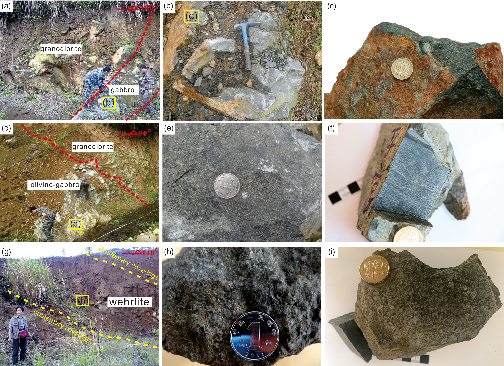
The Songshutang mafic pluton is located in the Dingnan area, southern Jiangxi Province, South China (Fig. 1b; 24° 43′ N, 114° 35′ E). The pluton intruded into granodiorite and Cambrian Shuishi Formation siltstones in a NW–SE direction with an overall plane circular shape covering ~0.5 km2. The mafic intrusions consist mainly of dark green olivine-gabbro, gabbro and leucogabbro gradually changing from the centre to the margin (Fig. 2a–f). Leucogabbro samples G07-2, G07-2-1 and G07-3, gabbro samples G07-5 and G07-5-1 and olivine-gabbro samples G07-4 and G07-4-1 were collected from the margin to the centre of the Songshutang intrusion.
Field photographs of the Songshutang and Wushitou ultramafic–mafic rocks in South China Block: (a–c) gabbro and leucogabbro of the Songshutang intrusions; (d–f) olivine-gabbro of the Songshutang intrusions; (g–i) Wushitou wehrlite. Length of hammer used for scale is ~30 cm; diameter of coin used for scale is ~1.7 cm.

The Wushitou ultramafic–mafic plutons are located in Dingnan County, southern Jiangxi Province (Fig. 1c; 24° 41′ N, 115° 06′ E). The lenticular-shaped ultramafic–mafic rocks, consisting of dark green wehrlite (Fig. 2g–i) and gabbro, intruded into the Ediacaran migmatites and/or metamorphic rocks, which stretch NE–SW up to hundreds of metres long (Fig. 2g). The two intrusions are separate from each other (Fig. 1). Two samples (G10-1 and G10-1-1) were collected from the mafic (gabbro) pluton, and two samples (G10-2 and G10-2-1) were collected from the ultramafic (wehrlite) pluton.
3.b. Petrology of the Songshutang and Wushitou intrusions
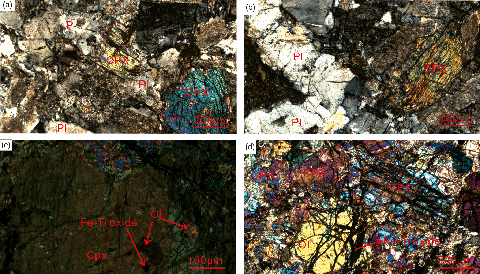
The olivine-gabbro samples (G07-4 and G07-4-1) from the Wushitou and Songshutang intrusions are massive with euhedral clinopyroxene (~35 %), plagioclase (~50 %), amphibole (~5 %) and minor olivine (less than 5 %) and Fe–Ti oxides (5–10 %) (Fig. 3a, b). The gabbro samples in the Wushitou (G07-5 and G07-5-1) and Songshutang (G10-1 and G10-1-1) intrusions are massive with euhedral clinopyroxene (~30 %), amphibole (~5 %), plagioclase (~60 %) and Fe–Ti oxides (~5 %) (Fig. 3a, b). The leucogabbro samples (G07-2, G07-2-1 and G07-3) in the Wushitou intrusion have euhedral clinopyroxene (~25 %), plagioclase (~70 %) and minor Fe–Ti oxides (less than 5 %). The grains of clinopyroxene, plagioclase and olivine in all samples are between 0.1 mm and 0.5 mm in size and are interspersed with each other (Fig. 3a, b). A small amount of plagioclase was altered to sericite, and clinopyroxene was altered to sericite. This is consistent with the slightly higher loss on ignition (LOI) percentages (Fig. 3a, b; online Supplementary Material Table S4). The wehrlite rocks are massive and coarse grained (0.1–1 mm) with a slight cumulate structure and consist of olivine (~50 %), clinopyroxene (~35 %) and Fe–Ti oxides (~15 %) (Fig. 3c, d). Olivine (~0.1 mm) enclosed in large clinopyroxene (0.5–1 mm), forming a poikilitic texture, is also preserved in the wehrlite of the Wushitou intrusions (Fig. 3c). Portions of olivine and clinopyroxene in the wehrlite were altered to serpentine and sericite and chlorite, respectively, consistent with the high LOI percentages (online Supplementary Material Table S4).
Photomicrographs of the Songshutang and Wushitou ultramafic–mafic rocks in South China Block: (a) gabbro of the Songshutang intrusions; (b) leucogabbro of Songshutang intrusions; (c, d) Wushitou wehrlite. Ol – olivine; Cpx – clinopyroxene; Pl – plagioclase.

4. Analytical methods
Eleven fresh ultramafic–mafic samples were collected from the Songshutang and Wushitou areas. Whole-rock major- and trace-element compositions and Sr–Nd isotopic analyses, and zircon U–Pb age dating, trace-element and Hf isotope analyses were conducted on these samples.
Zircons from gabbro samples G07-5 and G10-1 and leucogabbro samples G07-2 and G07-3 were selected for in situ U–Pb isotope analysis. Conventional heavy liquid and magnetic techniques were used for zircon selection under a binocular microscope at the Langfang Integrity Geological Services Incorporation. The high-resolution cathodoluminescence (CL) images of zircons were carried out using a JXA-8100 electron microscope at the State Key Laboratory of Geological Processes and Mineral Resources, China University of Geosciences in Wuhan (SKLGPMR, CUG). Zircon U–Pb dating and trace-element composition analyses were performed synchronously at the LA-ICP-MS laboratory of GPMR using an Agilent 7700a inductively coupled plasma mass spectrometer (ICP-MS). Laser ablation experiments were conducted using the GeoLas 200M laser-ablation system (MicroLas, Göttingen, Germany). The beam diameter was 32 μm. Zircon 91500 was used as an external standard, 29Si was used as an internal standard and NIST SRM610 was used as a reference material for calculating the element contents. The errors on single data points were quoted at the 1σ level, and the uncertainties in ages were quoted at the 95 % confidence level (2σ). Detailed analytical methods were similar to those described by Yang et al. (Reference Yang, Zhu, Zeng and Wan2019 b) and Shan et al. (Reference Shan, Rudnick, Hong, Xiao, Yong, Wen, Wen, John, Xuan and Qing2004).
In situ zircon Hf isotope analysis was conducted at the GPMR using a Neptune Plus multi-collector ICP-MS (Thermo Fisher Scientific, Germany). Zircons 91500 and GJ-1 were measured for external calibration twice every five analyses of the zircon samples and yielded weighted mean 176Hf/177Hf values of 0.282303 ± 8 (n = 15, 1σ) and 0.282009 ± 6 (n = 15, 1σ), respectively. The detailed analytical procedure was described by Hu et al. (Reference Hu, Gao, Liu, Hu, Chen and Yuan2008).
Whole-rock major-element concentrations were measured with an XRF-1800 sequential X-ray fluorescence (XRF) spectrometer at GPMR. The analytical precision (RSD) for major elements was better than 4 %, and the accuracy (RE) was better than 3 %. Trace and rare earth element (REE) analyses were determined by an Agilent 7500a ICP-MS at GPMR. The AGV-2, BHVO-2, BCR-2 and GSR-3 standards were used for calibration, and the analytical precision was better than 5 %. Whole-rock Sr–Nd isotopic ratios were determined at GPMR using a Finnigan Triton thermal ionization mass spectrometer (TIMS). The NBS987 and La Jolla standards, which yielded weighted mean 87Sr/86Sr ratios of 0.710254 ± 0.000008 (2σ) and weighted mean 143Nd/144Nd ratios of 0.511847 ± 0.000003 (2σ), respectively, were used for calibration. Isotopic ratios of 87Sr/86Sr = 8.375209 and 143Nd/144Nd = 0.721900 were used for the mass fractionation corrections. Detailed analytical methods were described by Ma et al. (Reference Ma, Zheng, Griffin, Zhang, Tang, Su and Ping2012) and Yang et al. (Reference Yang, Lyons, Zeng, Odigie, Bates and Hu2019 a).
5. Results
5.a. Zircon U–Pb age and trace elements
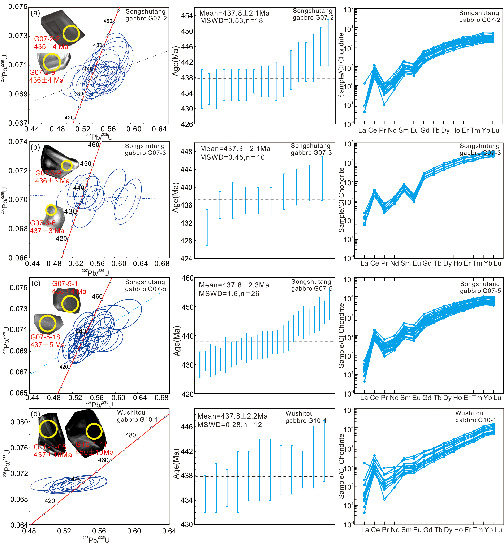
LA-ICP-MS zircon U–Pb dating and trace-element results for three samples of the Songshutang gabbro and one sample of the Wushitou gabbro are listed in online Supplementary Material Tables S1 and S2. Most of the zircon crystals are colourless and transparent and display well-developed prismatic crystal morphology and CL images with wide oscillatory zoning with lengths between 50 and 100 μm (Fig. 4). These characteristics are consistent with zircons from mafic rocks, which exhibit wider oscillatory zones than zircons from granite (Wu & Zheng, Reference Wu and Zheng2004). All analysis spots contain high Th/U ratios (> 1) and are characterized by typically steep chondrite-normalized REE patterns (GdN/YbN = 0.02–0.14) with positive Ce (1.5–11) and negative Eu (0.04–0.40) anomalies (Fig. 4). These characteristics are consistent with a magmatic origin (Hoskin & Ireland, Reference Hoskin and Ireland2000; Hoskin & Schaltegger, Reference Hoskin and Schaltegger2003), and the zircon U–Pb age could represent the crystallization age of these mafic plutons.
Concordia zircon U–Pb age and chondrite-normalized zircon trace-element pattern diagrams for the Songshutang and Wushitou gabbros in the SCB. The yellow circles on the CL images represent the LA-ICP-MS age spots; ellipse dimensions are 1r; spot diameter is 32 μm.

Twenty analyses of 20 zircons were undertaken on Songshutang gabbro G07-2, and all ages display concordance greater than 90 %. Eighteen of 20 analysis spots gave a weighted mean 206Pb–238U age of 437.8 ± 2.1 Ma (MSWD = 0.53, ranging from 447 to 435 Ma). Spots G07-2-18 and 19 provided older 206Pb–238U ages of 2505 and 2376 Ma, respectively, which are interpreted to be the ages of inherited zircons. Thirteen spots were analysed from Songshutang gabbro G07-3, and 11 analyses yielded concordant ages ranging from 442 to 431 Ma (except G07-3-8 = 1325 Ma). Ten analysis spots gave a weighted mean 206Pb–238U age of 437.3 ± 2.1 Ma (MSWD = 0.45). Twenty-seven spots on 27 zircon grains were selected for zircon U–Pb dating from Songshutang gabbro G07-5; 26 analysis spots yielded concordant ages ranging from 447 to 431 Ma and gave a weighted mean 206Pb–238U age of 437.8 ± 2.3 Ma (MSWD = 1.6) (Fig. 4). Twenty-one analysis spots on 21 zircon grains were selected from Wushitou gabbro G10-1 for zircon U–Pb dating, 20 of which yielded concordant ages. Twelve analysis spots gave a weighted mean 206Pb–238U age of 437.8 ± 2.2 Ma (MSWD = 0.28, ranging from 442 to 435 Ma).
5.b. Zircon Hf isotopes
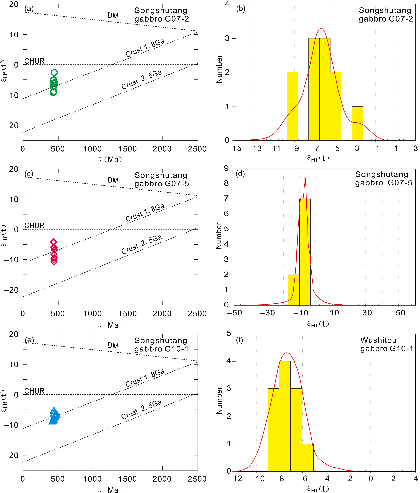
A total of 31 analysis spots distributed among the zircon grains from the Songshutang samples G07-2 and G07-5 and Wushitou sample G10-1 were selected for zircon Hf isotope analysis. The results are presented in online Supplementary Material Table S3 and Figure 5. Eleven analysis spots for sample G07-2 yielded 176Hf/177Hf ratios from 0.282257 to 0.282437 and ϵHf(t) values from −9.20 to −2.58 with corresponding Hf two-stage model ages (T DM2) from 1991 to 1586 Ma. Nine analysis spots from sample G07-5 yielded 176Hf/177Hf ratios from 0.282203 to 0.282435 and ϵHf(t) values from −10.84 to −4.21 and provided corresponding T DM2 ages from 2099 to 1676 Ma. Eleven analysis spots from sample G10-1 gave 176Hf/177Hf ratios from 0.282274 to 0.282367 and yielded negative ϵHf(t) values ranging from −8.67 to −5.19 with corresponding T DM2 ages from 1947 to 1745 Ma.
(a, c, e) ϵHf(t) value versus crystallization age diagrams, and (b, d, f) histograms of the zircon ϵHf(t) for the Songshutang and Wushitou samples.

5.c. Whole-rock major and trace elements
The whole-rock major- and trace-element compositions of the Songshutang and Wushitou ultramafic–mafic rocks are listed in online Supplementary Material Table S4 and Figures 6–9. Although we selected very fresh samples for the geochemical analyses, these ultramafic–mafic rocks have LOI concentrations ranging from 3.93–7.68 wt %, which display some plagioclase alteration. Two wehrlite samples from the Wushitou area have LOI concentrations of more than 10 % and will not be emphasized in the following discussions. Major-element values were recalculated on a volatile-free basis (online Supplementary Material Table S4). The Songshutang gabbroic samples have SiO2 concentrations of 45.42–47.99 wt % (mean = 46.48 wt %), Al2O3 concentrations of 4.17–8.84 wt % (mean = 6.14 wt %), TiO2 concentrations of 0.28–0.52 wt % (mean = 0.38 wt %), MgO concentrations of 17.87–30.19 wt % (mean = 25.26 wt %), CaO concentrations of 5.97–8.87 wt % (mean = 7.04 wt %), P2O5 concentrations of 0.08–0.16 wt % (mean = 0.13 wt %) and Mg nos of 74–83 (mean = 80). Compared to the Songshutang samples, the Wushitou samples have similar SiO2 concentrations (mean = 46.16 wt %), higher MgO concentrations (mean = 33.30 wt %), lower Al2O3 concentrations (mean = 1.17 wt %), lower TiO2 concentrations (mean = 0.11 wt %), lower CaO concentrations (mean = 4.60 wt %), lower P2O5 concentrations (mean = 0.03 wt %) and higher Mg nos (81–85).
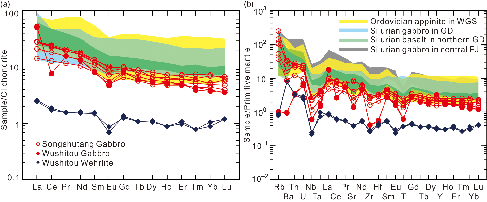
(a) Chondrite-normalized REE and primitive mantle-normalized trace-element patterns for the (a) Songshutang and (b) Wushitou ultramafic–mafic rocks in the SCB. Normalized values for chondrite and primitive mantle are from Sun & McDonough (Reference Sun, McDonough, Saunders and Norry1989); data for Ordovician appinites in Wugongshan (WGS) in the SCB are from Zhong et al. (Reference Zhong, Ma, Liu, Zhao, Zheng, Nong and Zhang2014); data for Silurian gabbro in Guangdong (GD) province are from Wang et al. (Reference Wang, Zhang, Fan, Zhang and Zhang2013b); data for Silurian basalt in northern GD are from Yao et al. (Reference Yao, Li, Li, Wang, Li and Yang2012); data for Silurian gabbro in central Fujian (FJ) province are from Zhang, Q. et al. (Reference Zhang, Jiang, Wang, Liu, Ni and Qing2015). Sampling locations of mafic rocks in the SCB are presented in Figure 1.

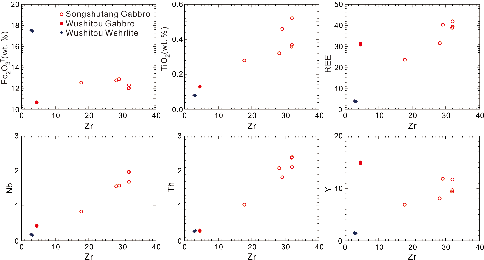
Fe2O3T, TiO2, REEs, Nb, Th and Y versus Zr for the Songshutang and Wushitou ultramafic–mafic suites in the SCB.

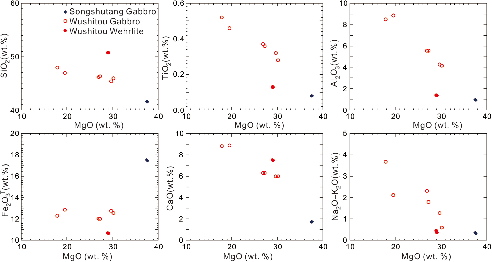
MgO versus selected major and trace elements for the Songshutang and Wushitou ultramafic–mafic suites in the SCB.

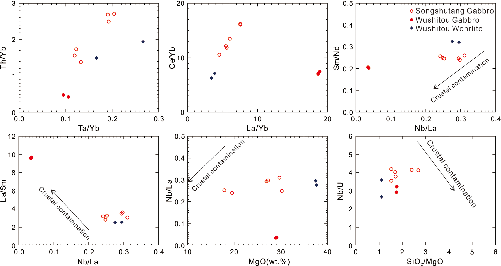
(a) Th/Yb versus Ta/Yb, (b) Ce/Yb versus La/Yb, (c) Sm/Nd versus Nb/La, (d) La/Sm versus Nb/La, (e) Nb/La versus MgO and (f) Nb/U versus SiO2/MgO diagrams for the Songshutang and Wushitou ultramafic–mafic suites in the SCB.

All Songshutang and Wushitou gabbroic rocks exhibit similar chondrite-normalized REE patterns, with total REE contents of 23.68–41.95 ppm, light REE/heavy REE (LREE/HREE) ratios of 3.88–5.31 and (La/Yb)N ratios of 3.23–13.55 (Fig. 6a). Compared to the gabbroic rocks, the two wehrlite samples have lower total REE contents of 3.80–3.96 ppm, consistent with a large amount of olivine in the samples (Fig. 3c). Most analyses of samples from the Songshutang and Wushitou plutons have total LREE concentrations higher than those of the primitive mantle and normal mid-ocean ridge basalt (N-MORB) (Sun & McDonough, Reference Sun, McDonough, Saunders and Norry1989). All samples from the Songshutang and Wushitou plutons exhibit negative Eu anomalies, with Eu/Eu* ratios of 0.69–0.88 and 0.45–0.67, respectively. On the primitive mantle-normalized spider diagram (Fig. 6b), all samples show a pattern with significant enrichments in Rb, Th, Ba and U and depletions in Nb, Ta, Zr, Hf and Ti, similar to those of the early Palaeozoic mafic rocks in the adjacent areas (Yao et al. Reference Yao, Li, Li, Wang, Li and Yang2012).
5.d. Whole-rock Sr–Nd isotopes
The whole-rock Sr–Nd isotope results are presented in online Supplementary Material Table S5. The Songshutang gabbroic samples have (87Sr/86Sr)i ratios from 0.70435 to 0.70753, (143Nd/144Nd)i values from 0.51161 to 0.51165, and ϵNd(t) values from −9.12 to −8.27. One gabbro sample and one wehrlite sample from the Wushitou plutons were chosen for Sr–Nd isotope analysis owing to the extremely low Nd value (0.75 ppm) and the 143Nd/144Nd ratio of wehrlite sample G10-2, which is below the detection limit. The G10-2 sample has a (87Sr/86Sr)i ratio of 0.71463. The G10-1 sample has a higher (87Sr/86Sr)i value (0.71336), a higher (143Nd/144Nd)i value (0.51179) and a higher ϵNd(t) value (−5.49) than the Songshutang samples. The whole-rock Nd two-stage model ages (T DM2) of the Songshutang and Wushitou mafic rocks were concentrated around ~1.9–1.6 Ga.
6. Discussion
6.a. Formation ages of the Songshutang and Wushitou ultramafic–mafic plutons
The Songshutang mafic pluton intruded into Cambrian Shuishi Formation siltstones, whereas the Wushitou ultramafic and mafic plutons intruded into Ediacaran migmatite and/or metamorphic rocks (Fig. 2). Thus, the Songshutang pluton was formed at least after the Cambrian, and the Wushitou intrusion formed later than the Ediacaran. Although no zircon age was obtained from the wehrlite in the Wushitou area and the contact relationship between the wehrlite and gabbro pluton in the Wushitou area remains unclear, the wehrlite and gabbro samples in the Wushitou area exhibit parallel chondrite-normalized REE patterns and LREE enrichment with slightly negative Eu anomalies, and on the primitive mantle-normalized spider diagram (Fig. 6b), all samples show a pattern with significant enrichments in Rb, Th, Ba and U and depletions in Nb, Ta, Zr, Hf and Ti. Therefore, the wehrlite in the Wushitou area most likely formed synchronously with the mafic intrusions in the Wushitou area. Furthermore, the zircon U–Pb ages of the Songshutang (G07-2, G07-3 and G07-5) and Wushitou (G10-1) gabbro and leucogabbro samples yielded consistent 206Pb–238U average ages of 437.8 ± 2.1 Ma, 437.3 ± 2.1 Ma, 437.8 ± 2.3 Ma and 437.8 ± 2.2 Ma, respectively, suggesting a Silurian (c. 437 Ma) formation age synchronous with the late-stage orogenic (440–415 Ma) felsic plutons (Li et al. Reference Li, Li, Wartho, Clark, Li, Zhang and Bao2010) and younger than the peak metamorphic ages of the Wuyi–Yunkai orogeny (460–440 Ma).
6.b. Evaluation of alteration, crystal fractionation and crustal contamination
The occurrence of secondary minerals, such as chlorite, serpentine, sericite and talc, and relatively high LOI percentages (online Supplementary Material Table S4) indicate that alteration could have been a possible factor modifying the geochemical compositions of the samples. The values of mobile elements, such as Cs, Rb, Ba, K and Sr, and large-ion lithophile elements (LILEs) could have been significantly changed and thus are likely unsuitable for discussing the petrogenesis of the Songshutang and Wushitou ultramafic–mafic plutons. Zr, as one of the most immobile elements during alteration, could be applied as an effective tracer of the mobility of other trace elements (Hastie et al. Reference Hastie, Mitchell, Treloar, Kerr, Neill and Barfod2013). Thus, the extent of alteration could be expressed as correlations between selected trace elements and Zr. Major elements (Fe2O3 T, TiO2), REEs and high-field-strength elements (HFSEs, such as Nb and Y) were correlated well with Zr (Fig. 7), suggesting that these elements were immobile during alteration and can be used to interpret the origin and evolution of the Songshutang and Wushitou ultramafic–mafic units.
In most oceanic basaltic rocks, the removal of olivine-rich assemblages could lead to the slight enrichment of silica in residual magmas, resulting in different MgO contents (e.g. Langmuir et al. Reference Langmuir, Klein, Plank, Phipps Morgan, Blackman and Sinton1992; Garcia et al. Reference Garcia, Foss, West and Mahoney1996). When the parental tholeiitic magmas cooled and evolved to a MgO content of ~9 %, the augite and plagioclase began crystallizing with olivine (Naumann & Geist, Reference Naumann and Geist1999). To further evaluate the effect of crystal fractionation, we examined MgO and selected major oxides in a binary diagram (Fig. 8). A positive correlation between MgO and Fe2O3 T, Ni and Co suggests that the samples could have experienced possible olivine crystal fractionation. A negative correlation between other major oxides (TiO2, Al2O3 and CaO) and MgO suggests that the samples have no significant fractionation of plagioclase and Fe–Ti oxides (Fig. 8). Moreover, plagioclase fractionation in the primary melt will cause significant positive Eu anomalies; however, our samples have slightly negative Eu anomalies (Fig. 6), indicating that no plagioclase fractionation occurred in the primary melt.
Crystal fractionation combined with crustal contamination plays an important role in the evolution of magma, which may alter the isotopic and elemental compositions of magma (DePaolo, Reference DePaolo1981; Zhao & Zhou, Reference Zhao and Zhou2007). The enrichment of LILEs and depletion of HFSEs in our samples indicated that the Songshutang and Wushitou mafic rocks may have undergone crustal contamination. Th/Ta, Sm/Nd, Th/Yb, Ta/Yb, Ce/Yb, La/Sm, Nb/La and Nb/U ratios were used to evaluate the effect of crustal contamination (Campbell & Griffiths, Reference Campbell and Griffiths1993; Baker et al. Reference Baker, Menzies, Thirlwall and Macpherson1997; Macdonald et al. Reference Macdonald, Rogers, Fitton, Black and Smith2001). As shown in Figure 9, the bivariate plots of Th/Yb versus Ta/Yb and Ce/Yb versus La/Yb exhibit positive correlations, which may have been caused by crustal contamination or derived from the lithospheric mantle. However, there is no significant correlation between Sm/Nd and Nb/La or between La/Sm and Nb/La, suggesting insignificant crustal contamination (Fig. 9).
6.c. Origin of the Wushitou and Songshutang ultramafic–mafic plutons
Basaltic primary melts are generally characterized by high Ni (> 400 ppm), Cr (> 1000 ppm) and Mg nos (73–81) (Sharma, Reference Sharma, Mahoney and Coffin1997; Wilson, Reference Wilson1989). The Songshutang and Wushitou gabbros and wehrlite have high Ni (508–2942 ppm), Cr (1477–4520 ppm) and Mg nos (74–85), indicating a relatively primary melt origin. PRIMELT3 software was used to calculate the primary melt composition for the gabbro and wehrlite samples with the least alteration and crustal contamination. Two gabbro samples with low SiO2 (< 50 wt %), low LOI (< 5 wt %), high Mg nos (74–85), high CaO (> 7 wt %), high Ni (> 500 ppm) and high Cr (> 1400 ppm) were chosen as initial materials to constrain the composition of the primary melt. KD (Fe/Mg)oliv/liq was chosen as 0.299–0.302, assuming that Fe2+/∑Fe = 0.90 in the melt (Herzberg & Asimow, Reference Herzberg and Asimow2015). The calculated primary basaltic melt comprises 46–50 % SiO2, 22.6–28.9 % MgO, 9.6–11.4 % Fe2O3 T and 0.13–0.44 % TiO2.
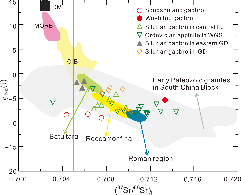
It is generally accepted that ultramafic–mafic rocks are typically derived from the lithospheric mantle or asthenospheric mantle (e.g. Sklyarov et al. Reference Sklyarov, Gladkochub, Mazukabzov, Menshagin, Watanabe and Pisarevsky2003; Zhao & Zhou, Reference Zhao and Zhou2007). The Nb/La ratio is a good index to distinguish lithospheric mantle and asthenospheric mantle contributions, as lithospheric mantle-derived melts are generally characterized by low Nb/La ratios, whereas asthenospheric mantle-derived melts have relatively high Nb/La ratios (Sun & McDonough, Reference Sun, McDonough, Saunders and Norry1989; Cui et al. Reference Cui, Jiang, Wang, Wang, Zhuo, Deng, Liao, Wu, Jiang and Wei2015). All Songshutang and Wushitou ultramafic–mafic rocks have nearly constant and relatively low Nb/La ratios (0.24–0.31), similar to typical lithospheric mantle-derived melts (~0.3; Cui et al. Reference Cui, Jiang, Wang, Wang, Zhuo, Deng, Liao, Wu, Jiang and Wei2015). Depletions in Nb, Ta, Zr, Hf and Ti (Fig. 6) suggest that the magma source may have experienced melt/fluid interaction before partial melting. Moreover, the Songshutang and Wushitou samples have relatively low ϵNd(t) values ranging from −9.12 to −5.49 and high initial 87Sr/86Sr ratios ((87Sr/86Sr)i = 0.70435 to 0.71463) (online Supplementary Material Table S5), which are comparable to those of typical melt from the lithospheric mantle (Depaolo & Daley, Reference Depaolo and Daley2000). In the diagram of ϵNd(t) versus (87Sr/86Sr)i, the Songshutang and Wushitou gabbros overlap with the potassic rocks in the Roccamonfina, Batu Tara and Roman regions, which originated from enriched lithospheric mantle related to subducted slab-derived melts (Nelson, Reference Nelson1992; Zhang, Q. et al. Reference Zhang, Jiang, Wang, Liu, Ni and Qing2015; Fig. 10). Thus, the primary melts of the Songshutang–Wushitou samples were likely modified by subduction-derived components.
Plots of whole-rock ϵNd(t) versus initial (87Sr/86Sr)i for the Songshutang and Wushitou ultramafic–mafic suites in the SCB. Data for Ordovician appinites in Wugongshan (WGS) in the SCB from Zhong et al. (Reference Zhong, Ma, Liu, Zhao, Zheng, Nong and Zhang2014); data for Silurian gabbro in Guangdong (GD) province are from Wang et al. (Reference Wang, Zhang, Fan, Zhang and Zhang2013b); data for Silurian gabbro in central Fujian (FJ) province are from Zhang, Q. et al. (Reference Zhang, Jiang, Wang, Liu, Ni and Qing2015); data for gabbro in eastern GD are from Xu et al. (Reference Xu, Xu and Zeng2017); data for the Roccamonfina, Roman region and Batu Tara are from Nelson (Reference Nelson1992); data for early Palaeozoic granites in the SCB are from Wang et al. (Reference Wang, Fan, Zhang and Zhang2013a and references therein).

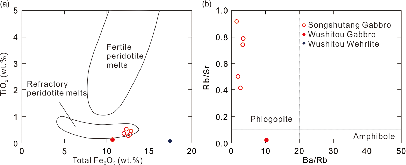
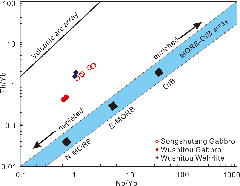
In contrast, the Songshutang and Wushitou ultramafic–mafic rocks have relatively low TiO2 contents (0.07–0.49 wt %) and plot within the field of experimental refractory peridotite melts on the diagram of TiO2 versus total Fe2O3 (Fig. 11a), also indicating a lithospheric mantle origin (Falloon et al. Reference Falloon, Green, Hatton and Harris1988). The relatively high Rb/Sr and low Ba/Rb in Figure 11b suggest a phlogopite-bearing source (Furman & Graham, Reference Furman, Graham, van der Hilst and McDonough1999), consistent with our petrographic observations that the samples contain amphibole, indicating that the primary magma was hydrous (Zhang, Q. et al. Reference Zhang, Jiang, Wang, Liu, Ni and Qing2015). Note also that the relatively low TiO2 values, the enrichment in LILEs and LREEs, and the depletion of HFSEs in our samples are similar to those of subduction-derived arc-type magmatic rocks (e.g. Cox, Reference Cox1980; Hole et al. Reference Hole, Saunders, Marriner and Tarney1984), which could be caused by ancient subduction, because the geological observations in South China reject the development of young and hot slab subduction during early–middle Palaeozoic time (Wang et al. Reference Wang, Zhang, Fan, Zhang and Zhang2013 b). On the Th/Yb versus Nb/Yb diagram (Fig. 12), all samples plot entirely above the MORB–OIB array, indicating that the magma source may have been modified by subduction-derived fluids or melts (Pearce & Peate, Reference Pearce and Peate1995). Additionally, the Songshutang and Wushitou ultramafic–mafic rocks comprise relatively low Nb/La ratios (0.24–0.31 and 0.03–0.30, respectively) and Nb/Th ratios (0.75–0.86 and 0.55–1.49, respectively) but high Th/Ta ratio (10.34–14.36 and 4.13–8.22, respectively) and LREE/HREE ratios (3.88–5.31 and 2.79–5.04, respectively), consistent with those of subduction-derived melts (e.g. Kessel et al. Reference Kessel, Schmidt, Ulmer and Pettke2005; Yao et al. Reference Yao, Li, Li, Wang, Li and Yang2012). Thus, the ancient subduction process possibly resulted in the interaction between subduction-derived fluids (or melts) and lithospheric mantle, further leading to lithospheric mantle enrichment in incompatible elements and hydrous phases.
Plots of (a) TiO2 versus Fe2O3T and (b) Rb/Sr versus Ba/Rb for the Songshutang and Wushitou ultramafic–mafic suites in the SCB. The fields of experimental peridotite melt in (a) are from Falloon et al. (Reference Falloon, Green, Hatton and Harris1988) and Zhang, Q. et al. (Reference Zhang, Jiang, Wang, Liu, Ni and Qing2015) and the fields of phlogopite and amphibole in (b) are from Furman & Graham (Reference Furman, Graham, van der Hilst and McDonough1999).

Th/Yb versus Nb/Yb diagram (modified from Pearce & Peate, Reference Pearce and Peate1995). N – normal; E – enriched; MORB – mid-ocean ridge basalts; OIB – ocean-island basalts.

The refractory nature of zircon enables this mineral, despite experiencing multistage tectonic-thermal events, to retain its initial Hf isotopic information, and thus zircon Hf isotopic compositions are generally used to track the origin and evolution of magma (e.g. Patchett et al. Reference Patchett, Kouvo, Hedge and Tatsumoto1982; Scherer et al. Reference Scherer, Cameron and Blichert2000). The 176Lu/177Hf ratios of the Songshutang and Wushitou mafic rocks vary from 0.0009 to 0.0061 and from 0.001 to 0.003, respectively (online Supplementary Material Table S3), with extremely low Lu contents, suggesting that the 176Hf resulting from the beta decay of 176Lu is imperceptible. This corroborates that the 176Lu/177Hf ratios can reflect the initial values of the zircon (Hu et al. Reference Hu, Liu, Gao, Liu, Zhang, Tong, Lin, Zong, Li and Chen2012). The Hf single-stage model ages (T DM1, 1.5–1.1 Ga) and Hf two-stage model ages (T DM2, 2.1–1.6 Ga, respectively) of the Songshutang and Wushitou samples are much older than their zircon U–Pb ages (c. 437 Ma), indicating that the protoliths of the samples may have originated from ancient lithospheric mantle. The whole-rock Nd two-stage model ages (T DM2, 1.9–1.6 Ma) also confirm that the plutons were derived from ancient lithospheric mantle.
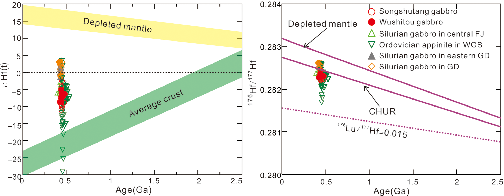
In addition, all the zircon Hf isotopic compositions of the Songshutang and Wushitou samples show negative ϵHf(t) values (with ϵHf(t) values of −10.84 to −2.58), and the plotted points on the ϵHf(t) value versus crystallization age diagrams are primarily located below the chondritic uniform reservoir (CHUR) in a narrow domain near the evolutionary trends of c. 1.8 Ga crustal rocks (Fig. 5). In addition, almost all Ordovician and Silurian mafic rocks in the SCB comprise low ϵHf(t) values (< 0) (Fig. 13), and the Hf two-stage model ages (T DM2) are mainly focused at ~2–1.1 Ga (Wang et al. Reference Wang, Zhang, Fan, Zhang and Zhang2013 b; Zhong et al. Reference Zhong, Ma, Liu, Zhao, Zheng, Nong and Zhang2014; Zhang, Q. et al. Reference Zhang, Jiang, Wang, Liu, Ni and Qing2015; Xu et al. Reference Xu, Xu and Zeng2017 and this study). Most of the zircons (c. 480–420 Ma) from the early Palaeozoic mafic rocks in the SCB plot between the evolution lines of the average continental crust and chondrite (Fig. 13 and references therein). Moreover, the whole-rock Nd two-stage model ages (T DM2) of the early Palaeozoic mafic rocks are concentrated at ~1.9–1.4 Ga (Yao et al. Reference Yao, Li, Li, Wang, Li and Yang2012; Wang et al. Reference Wang, Zhang, Fan, Zhang and Zhang2013 b; Zhong et al. Reference Zhong, Ma, Liu, Zhao, Zheng, Nong and Zhang2014; Zhang, Q. et al. Reference Zhang, Jiang, Wang, Liu, Ni and Qing2015 and this study). These results suggest an ancient (Meso-Palaeoproterozoic) metasomatized lithospheric mantle origin for most of the early Palaeozoic mafic rocks in South China.
Plots of ϵHf(t) and 176Hf/177Hf versus U–Pb age for zircons from the Songshutang and Wushitou ultramafic–mafic suites in the SCB. Data for Ordovician appinites in Wugongshan (WGS) in the SCB are from Zhong et al. (Reference Zhong, Ma, Liu, Zhao, Zheng, Nong and Zhang2014); data for Silurian gabbro in Guangdong (GD) province are from Wang et al. (Reference Wang, Zhang, Fan, Zhang and Zhang2013b); data for Silurian gabbro in central Fujian (FJ) province are from Zhang, Q. et al. (Reference Zhang, Jiang, Wang, Liu, Ni and Qing2015); data for gabbro in eastern GD are from Xu et al. (Reference Xu, Xu and Zeng2017). CHUR – chondritic uniform reservoir. Sampling locations of mafic rocks in the SCB are presented in Figure 1.

6.d. Timing, petrogenesis and tectonic implications for the Wuyi–Yunkai orogeny
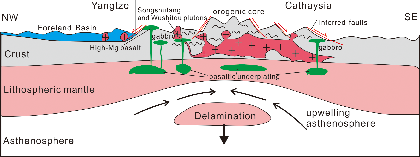
The lack of an early Palaeozoic ophiolite suite and deep-sea marine sediments (turbidite sedimentary records) in the SCB demonstrates that no subduction activity occurred during early Palaeozoic time in the SCB and that the orogen was an intraplate collision orogen caused by far-field tectonic stress (e.g. Faure et al. Reference Faure, Shu, Wang, Charvet, Choulet and Monié2009; Li et al. Reference Li, Li, Wartho, Clark, Li, Zhang and Bao2010; Yao et al. Reference Yao, Li, Li, Wang, Li and Yang2012; Wang et al. Reference Wang, Fan, Zhang and Zhang2013 a; Xu et al. Reference Xu, Cawood, Du, Huang and Wang2014). The mechanism of lithospheric mantle melting during the late orogeny was caused by late-orogenic collapse or lithospheric delamination in an intracontinental regime (Fig. 14; Yao et al. Reference Yao, Li, Li, Wang, Li and Yang2012; Wang et al. Reference Wang, Zhang, Fan, Zhang and Zhang2013 b; Zhang, Q. et al. Reference Zhang, Jiang, Wang, Liu, Ni and Qing2015). The estimated melting temperature for the early Palaeozoic mafic rocks in the SCB is ~1300 °C, similar to a MORB-like asthenospheric mantle (McKenzie & Bickle, Reference McKenzie and Bickle1988), supporting the hypothesis that the partially molten lithospheric mantle was heated by upwelling asthenosphere triggered by the sinking of the delaminated lithosphere (Yao et al. Reference Yao, Li, Li, Wang, Li and Yang2012; Zhang, Q. et al. Reference Zhang, Jiang, Wang, Liu, Ni and Qing2015). Variation trends in the plots of MgO versus Cr, Ni, Co, SiO2, TiO2, CaO, Al2O3, CaO/Al2O3 and Fe2O3 T (Fig. 8) indicate that the early Palaeozoic ultramafic–mafic units in the SCB were derived from the same melts in different fractional crystallization stages. The high MgO values of the Songshutang and Wushitou ultramafic–mafic units were possibly the first-stage products of the metasomatized lithospheric mantle sources (Fig. 8) with slight mineral (olivine) fractional crystallization from the primary melt, and then they formed the Chayuanshan basalt and the gabbroic rocks in the Dakang, Guiyang and Yunkai belts in South China (Fig. 1) with olivine and clinopyroxene fractional crystallization. Further evolution of these melts was shown to have formed dacite rocks in the SCB (Yao et al. Reference Yao, Li, Li, Wang, Li and Yang2012).
Sketch showing the possible evolutionary model of the Wuyi–Yunkai orogen during the late-orogenic stage (442–420 Ma), modified from Charvet et al. (Reference Charvet, Shu, Faure, Choulet, Wang, Lu and Le Breton2010), Li et al. (Reference Li, Li, Wartho, Clark, Li, Zhang and Bao2010) and Yao et al. (Reference Yao, Li, Li, Wang, Li and Yang2012).

In conclusion, lithospheric delamination is the most likely model for the post-extension of the Wuyi–Yunkai orogen, which also resulted in rapid exhumation (retrograde metamorphism), crustal uplift and extension (Zegers & van Keken, Reference Zegers and van Keken2001). With post-extensional tectonism, the upwelling of asthenospheric mantle induced partial melting of ancient lithospheric mantle forming ultramafic–mafic rocks in the Jiangxi (Songshutang and Wushitang), Guangdong and Fujian areas, also generated numerous I-type and S-type granites (442–406 Ma) in the metamorphic core of the Cathaysia Block (Fig. 14; Yao et al. Reference Yao, Li, Li, Wang, Li and Yang2012; Wang et al. Reference Wang, Zhang, Fan, Zhang and Zhang2013 b; Zhang, Q. et al. Reference Zhang, Jiang, Wang, Liu, Ni and Qing2015; Yu, Y. et al. Reference Yu, Huang, Sun and He2018; Xu et al. Reference Xu, Wang, Zhang, Xu and Gan2019).
7. Conclusions
-
(1) Zircon U–Pb dating of the Songshutang and Wushitou gabbros and leucogabbros yielded 206Pb–238U ages of 437.8 ± 2.1 Ma, 437.3 ± 2.1 Ma, 437.8 ± 2.3 Ma and 437.8 ± 2.2 Ma, which are synchronous with the late-orogenic (440–415 Ma) granitic plutons and younger than the peak metamorphic ages of the Wuyi–Yunkai orogeny (460–440 Ma) in the SCB.
-
(2) Geochemical, geochronological and isotopic data for the samples indicate that the magma sources of the Songshutang and Wushitou ultramafic–mafic rocks likely originated from the partial melting of ancient metasomatized lithospheric mantle in early Palaeozoic time.
-
(3) Late-orogenic lithospheric delamination was likely the main mechanism leading to the partial melting of the lithospheric mantle through the upwelling of the asthenospheric mantle and caused ultramafic–mafic rocks to form along the Wuyi–Yunkai orogenic belt. The high MgO values of the Songshutang ultramafic–mafic plutons were possibly the first-stage products of lithospheric mantle sources with slight olivine fractional crystallization from the primary melt.
Acknowledgements
Our thanks to Kathryn Goodenough and the two anonymous reviewers for their insightful suggestions and comments that greatly improved the manuscript. This work was financially supported by the China Postdoctoral Science Foundation (No. 2020M672087), National Natural Science Foundation of China (41972108), the Laboratory for Marine Mineral Resources, Qingdao National Laboratory for Marine Science and Technology (MMRZZ201804), Taishan Scholar Talent Team Support Plan for Advanced and Unique Discipline Areas, Major Scientific and Technological Innovation Projects of Shandong Province (2017CXGC1602, 2017CXGC1603), SDUST Research Fund (2015TDJH101) and the China Scholarship Council (201606410022). We are grateful to Yongsheng Liu and Zhaochu Hu for LA-ICP-MS analyses.
Supplementary material
To view supplementary material for this article, please visit https://doi.org/10.1017/S0016756820001272