Introduction
Personality disorder is the most prevalent mental disorder among people convicted of homicide in England and Wales (Shaw et al. Reference Shaw, Appleby, Amos, McDonnell, Harris, McCann, Kiernan, Davies, Bickley and Parsons1999b). Antisocial personality disorder (ASPD) is the form of personality disorder most frequently associated with violence. Despite a community prevalence of only 10/1000 men and approximately 2/1000 women (Coid et al. Reference Coid, Yang, Tyrer, Roberts and Ullrich2006a), it has been estimated that a quarter of all violent incidents in Britain are committed by people with ASPD (Coid et al. Reference Coid, Yang, Roberts and Ullrich2006b). Violent and other criminal offences committed by people with ASPD lead to high rates of contact with criminal justice services; over half of all male prisoners in Europe and North America have ASPD (Moran, Reference Moran1999). Costs associated with crime, together with social work and health costs, mean that the financial burden associated with antisocial behaviour is considerable (Scott et al. Reference Scott, Knapp, Henderson and Maughan2001). Despite this, there have been few attempts to develop and evaluate interventions to treat ASPD.
Psychological treatments have been shown to lead to behavioural change among people with other types of personality disorder (Duggan et al. Reference Duggan, Huband, Smailagic, Ferriter and Adams2007). Two randomized controlled trials in drug-abusing patients with ASPD have found no superior effect for more, compared with less, intensive interventions in drug abusers in the community (Brooner et al. Reference Brooner, Kidorf, King and Stoller1998) and, in cocaine-dependent in-patients, those with ASPD were more likely to abstain from cocaine use during treatment than patients without ASPD (Messina et al. Reference Messina, Farabee and Rawson2003). Experimental studies of community-based treatments for people with ASPD who are aggressive have not been conducted and debate continues about the role of health services in the management of people with ASPD (Eastman, Reference Eastman1999). Cognitive behaviour therapy (CBT) has shown promise in the treatment of other forms of personality disorder (Davidson et al. Reference Davidson, Norrie, Tyrer, Gumley, Tata, Murray and Palmer2006; Emmelkamp et al. Reference Emmelkamp, Benner, Kuipers, Feiertag, Koster and van Apeldoorn2006), but its effects among people with ASPD who are aggressive are unknown.
We therefore undertook an exploratory randomized trial of CBT for men with ASPD living in the community to see if it would be possible to manage and retain people in treatment and if the intervention might be associated with health improvements and reductions in aggression.
Method
Trial design
This was an exploratory randomized controlled trial with single blind assessments, carried out in two cities in the UK, Glasgow and London. Inclusion criteria were: males aged between 18 and 65 years; met criteria for ASPD using the Structured Clinical Interview for DSM-IV Axis II Personality Disorders (SCID-II; First et al. Reference First, Spitzer, Gibbon and Williams1996), living in the community; positive endorsement of any item on the MacArthur Community Violence Screening Instrument (MCVSI; Steadman et al. Reference Steadman, Mulvey, Monahan, Robbins, Appelbaum, Grisso, Roth and Silver1998, Reference Steadman, Silver, Monahan, Appelbaum, Robbins, Mulvey, Grisso, Roth and Banks2000), interview in the 6 months prior to baseline; and able to provide written informed consent. Exclusion criteria were: currently receiving in-patient psychiatric treatment; currently receiving a systematic psychological therapy; insufficient knowledge of English to enable participants to be adequately assessed and ability to understand the treatment approach; and diagnosis of psychosis (schizophrenia or bipolar-affective disorder). We did not exclude ASPD participants who were abusing alcohol or drugs as this is likely to be common in this group of participants (Compton et al. Reference Compton, Conway, Stinson, Colliver and Grant2005). The study was approved by the NHS Greater Glasgow Primary Care Trust (Community and Mental Health) Research Ethics Committee, St Mary's Research Ethics Committee and Ealing and WLMHT Local Research Ethics Committee.
Recruitment and randomization
Participants were identified by clinicians from new and existing patients referred to the National Health Service (NHS) from community mental health teams, forensic psychology and psychiatry services. After agreement to be contacted, a research assistant invited participants to take part in an interview to confirm the diagnosis of ASPD and inclusion criteria. Those participants who met the inclusion criteria and who agreed to give written informed consent to take part in the study then completed baseline assessments and were randomly allocated to either one of two active treatment groups: treatment as usual (TAU) or cognitive behaviour therapy (CBT) (for either 6 or 12 months). Randomization was also stratified by centre (Glasgow and London). The randomization schedules were generated by the study data centre, the Robertson Centre for Biostatistics, Glasgow University, and kept securely and confidentially by the trial coordinator at the study coordinating centre in Glasgow. The randomization schedule was constructed using the method of randomized permuted blocks of size 4. Randomization was conducted using a web-based system. The trial coordinator informed the referring agent of the result of randomization immediately and in writing, and then contacted the CBT therapists in each area with the participants' details so that CBT could be initiated.
Interventions
CBT
CBT is a structured, time-limited, psychosocial intervention developed to treat those with borderline and antisocial personality disorder within UK NHS out-patient settings (Davidson, Reference Davidson2007). Participants are encouraged to engage in treatment through a cognitive formulation of their problems. Therapy focuses on beliefs about self and others and behaviours that impair social and adaptive functioning. To determine the optimal components of therapy and the effect of the number of sessions on outcome, participants randomized to CBT received either 15 sessions of CBT over 6 months or 30 sessions of CBT over 12 months, each session lasting up to 1 hour.
TAU
We had no prior knowledge of what constituted usual treatment in the two locations and therefore we documented treatment received after each participant exited the trial. All participants received whatever treatment they would have received if the trial had not been in place.
Delivery of CBT
Seven therapists provided CBT in the trial. Their professional backgrounds were psychiatry (n=2), clinical psychology (n=2), counselling psychology (n=1), CBT therapist (n=1) and registered mental health nurse (n=1). One had 6 months' experience of CBT and the remainder had between 2 and 7 years' CBT experience. All had previous experience of managing individuals with personality disorder. All therapists received 3 days of initial training to socialize them to the specifics of the treatment model and then received a further training day during the trial. All therapists received ongoing case supervision in their centre throughout the trial on a weekly basis. Providing the participant consented, therapists were required to record a sample of CBT sessions from each participant. Therapist adherence to the model and competence in delivering the therapy were assessed among a random sample (30% of total) of audio-recordings using the Cognitive Therapy Rating Scale (CTRS; Young & Beck, Reference Young and Beck1980). Shaw et al. (Reference Shaw, Elkin, Yamaguchi, Olmsted, Vallis, Dobson, Lowery, Sotsky, Watkins and Imber1999a) used a cut-off score of 39 on the CTRS, below which therapists would not be considered as being competent enough to deliver CBT in a trial of CBT of depression. The mean therapists' score on the CTRS was 58, which is well within the ‘competent’ range.
Baseline and outcome measures
Aggression and offending behaviour were assessed by the MCVSI (Steadman et al. Reference Steadman, Mulvey, Monahan, Robbins, Appelbaum, Grisso, Roth and Silver1998, Reference Steadman, Silver, Monahan, Appelbaum, Robbins, Mulvey, Grisso, Roth and Banks2000). We also asked about four other behaviours (shouting angrily at others, threatening harm to others, causing damage to property, and self-harm). A structured interview for offending behaviour, adapted from the self-report offending questionnaire from the Cambridge study by David Farrington (2006), was used at baseline only to record offending activity in the 6 months prior to entry into the study. We used the Drug Abuse Screening Test (DAST; Skinner, Reference Skinner1982) (at baseline only) and the Alcohol Use Disorders Identification Test (AUDIT; Saunders et al. Reference Saunders, Aasland, Babor, de la Fuente and Grant1993) to identify alcohol and drug abuse. Levels of anxiety and depression were assessed using the Hospital Anxiety and Depression Rating Scale (HADS; Zigmond & Snaith, Reference Zigmond and Snaith1983) and anger was assessed using the Novaco Anger Scale and Provocation Inventory (NAS-PI; Novaco, Reference Novaco2003). Changes in social functioning were measured by the Social Functioning Questionnaire (SFQ; Tyrer et al. Reference Tyrer, Nur, Crawford, Karlsen, McLean, Rao and Johnson2005) and changes in beliefs thought to be related to negative and positive evaluations of self and others was measured by the Brief Core Schema Scales (BCSS; Fowler et al. Reference Fowler, Freeman, Smith, Kuipers, Bebbington, Bashforth, Coker, Gracie, Dunn and Garety2006). Literacy level was assessed at entry to the trial using the Test of Word Reading Efficacy (TOWRE; Torgesen et al. Reference Torgesen, Wagner and Rashotte1999). This gives a measure of an individual's ability to pronounce printed words accurately and fluently and is used to assess reading ability.
Blinding
The research assistants on each site carried out all assessments at 3-monthly intervals until the participant exited the trial (after 12 months) and were blind to treatment group allocation.
Economic evaluation
The primary objective of the economic evaluation was to estimate the cost of use of health and social care, and criminal justice services, from randomization to end of follow-up. This included the cost of psychiatric, accident and emergency, primary care, and social services using medical records and the Client Service Receipt Inventory (CSRI; Knapp & Beecham, Reference Knapp and Beecham1990). Data on service utilization during the trial were collected directly from case-notes at the end of the study. To maintain blindness, questions relating to community health service use were omitted from the CSRI at follow-up. Unit costs were mainly taken from Unit Costs of Health and Social Care 2007 (Personal Social Services Research Unit, 2007).
Schedule of assessments
The intention was to assess all participants at months 3, 6, 9 and 12 whether they completed treatment or not, providing consent was not withdrawn.
Impact on participants, significant others and referrers
To assess the acceptability and impact of being involved in a randomized controlled trial on participants, and their significant others, we used a semi-structured interview and questions rated on a Likert scale (1=not at all to 7=very much). We asked referrers to rate the benefit to the patient from being involved in the trial. We also noted any comments.
Statistical methods
All the analyses were performed on the TAU and CBT groups. Descriptive statistics for continuous variables are presented as number of observations (n), mean and standard deviation (s.d.). For categorical variables, counts and percentages are used.
Follow-up analyses for different questionnaires were based on data for baseline and the last visit a participant attended with non-missing data. The last visit might be any visit at time-points 3 to 12. Means and standard deviations for baseline, last visit and change from baseline to last visit are given for each treatment group. Finally, the treatment difference and estimate 95% confidence intervals (CIs) were estimated from an analysis of covariance of the changes from baseline adjusted for baseline levels.
Verbal aggression (a response of yes in either Q1 or Q2 of the MCVSI questionnaire is taken as a positive result) and physical aggression (a response of yes in at least one question from questions 3–10 in the MCVSI questionnaire is taken as a positive result) are summarized at baseline and last follow-up using counts and percentages and are analysed formally using a logistic regression analysis estimating the odds ratio (OR) and associated 95% CI between TAU and CBT groups or subgroups at last follow-up with adjustment for baseline value.
For simplicity, the results section reports baseline information for both groups and the sample as a whole. The comparison between groups (CBT versus TAU) is restricted to the CBT group as a whole (combining those who received 6 and 12 months of CBT compared with those with TAU). Where there is an indication of differences between those randomized to 6 or 12 months of CBT, this is reported separately in the tables and text.
All analyses were conducted using an intention-to-treat principle.
Results
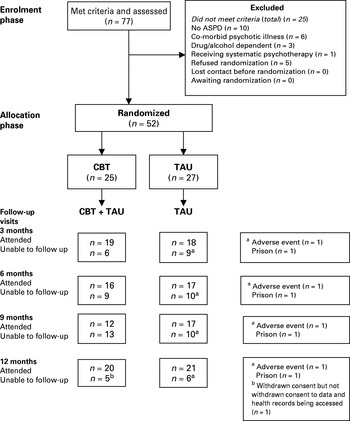
Seventy-seven participants were referred to the trial (see Fig. 1). Twenty-five did not meet entry criteria, five of whom refused randomization. The 52 (68%) who met eligibility criteria consented to participate in the study. Of these, 25 were randomized to CBT and 27 to TAU. Twenty-five participants were randomized from London and 27 from Glasgow. Follow-up rates for the study group as a whole were: 3 months (71%), 6 months (63%), 9 months (56%) and 12 months (79%). We were unable to follow up two men: one was sentenced to prison immediately after randomization for a crime committed prior to the trial and another could not be followed up, having made threats to members of the research team.
Flow of patients through the trial: Glasgow and London.

Baseline characteristics
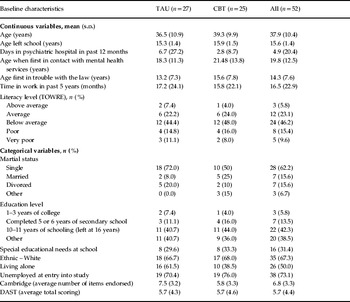
Baseline demographic and general clinical characteristics are reported in Table 1, split by randomized treatment and for the group as a whole. As expected, the groups were similar in respect to variables at baseline. The study group is characterized as being male, having an average age of 38 years and being predominately white (67%). The majority were single (62%) and only 16% were married. The average age on leaving school was 15.6 years, with only three men going on to a college course. Around 38% stated that they had special needs education at school. In the previous 5 years, the average number of months worked was 16.5 months. A minority (n=14) were employed at entry into the study. The group had an average age of 14.3 years when first in trouble with the law and admitted an average of 6.8 offences at baseline. The groups scored just below the threshold for problematic drug abuse (Gavin et al. Reference Gavin, Ross and Skinner1989). They were, on average, aged 19.8 years when first in contact with mental health services. Literacy levels, assessed by the TOWRE, were predominantly below average or poorer (71%). Of the 52 men, 51 reported verbal aggression and 45 admitted to physical aggression towards others in the 6 months prior to the study.
Baseline characteristics. Data shown are mean (s.d.) for continuous variables and number (%) for categorical variables. For time in work in the past 5 years there was one missing value in each treatment group

TAU, Treatment as usual; CBT, cognitive behaviour therapy; TOWRE, Test of Word Reading Efficacy; DAST, Drug Abuse Screening Test.
Attendance at CBT
Twenty-five patients were randomized to CBT and 27 to TAU. Those randomized to CBT were randomized to receive 6 months (n=12) or 12 months of CBT (n=13). Of the 25 men randomized to CBT, 11 attended more than 10 sessions, six attended between two and nine sessions, four attended one session and four did not attended any.
Psychometric measures
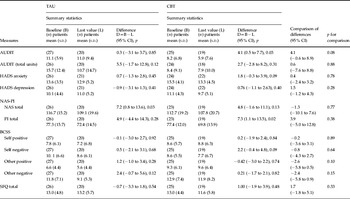
Table 2 reports baseline and 12-month outcome data for both groups. Overall, no differences were found between those randomized to CBT or TAU on any of the measures at the 12-month follow-up. Incidents of any acts of verbal or physical aggression decreased in both groups over the 12 months of the study. Numbers of participants reporting any act of verbal aggression reduced from 26 (96.30%) to 17 (80.95%) in the TAU group and from 25 (100%) to 17 (77.27%) in the CBT group. In terms of physical aggression, numbers of participants reporting any act of physical aggression decreased from 23 (85.10%) to eight (38.10%) in the TAU group and from 22 (88%) to seven (31.82%) in the CBT group.
Analyses of outcome scores: summary statistics for baseline and last visit attended data, analyses of changes from baseline within each treatment group and comparisons of changes from baseline between treatment groups

AUDIT, Alcohol Use Disorders Identification Test; HADS, Hospital Anxiety and Depression Scale; NAS-PI, Novaco Anger Scale and Provocation Inventory; BCSS, Brief Core Schema Scales; SFQ, Social Functioning Questionnaire.
There was a trend for less harmful drinking (AUDIT scores) in the CBT group compared to TAU although no difference was noted for alcohol consumption between the groups. The latter trend for less harmful drinking was also confirmed for those who received CBT for 6 months (p=0.06, data not shown). There was no difference between CBT and TAU groups on scores on anxiety or depression, or in terms of anger or anger provocation scores at 12 months. No differences were noted between the groups at 12 months on negative or positive beliefs about self or others although there was a trend in support of CBT for more positive beliefs about others. No differences between the groups were noted in terms of social functioning at 12 months although there was a trend for those who received 6 months of CBT to have improved social functioning compared to TAU (p=0.08, data not shown).
Costs of health, social work and criminal justice service use
Over the 12 months of the study, the total cost of services received, including health care, social work and criminal justice, was £31097 for TAU and £38004 for those in the CBT group. On average, the cost per participant for NHS services was £1133 in the TAU group and £1295 in the CBT group. The cost of CBT over the year for the 21 participants who attended sessions was £1300 per participant.
Impact on participants, significant others and referrers
Using semi-structured interviews and questions rated on a Likert scale (1=not at all to 7=very much), we assessed the impact of treatment on a number of patients from a user (n=27; 12 CBT, 15 TAU), significant other (n=4) and referring agent perspective (n=30). From the user perspective, those who received CBT rated their satisfaction in taking part in the study slightly higher than those in TAU (4.0 v. 3.2), but those in TAU rated the research assistant contact every 3 months higher (3.8 v. 4.0). Many of those randomized to TAU were being offered no follow-up from services and some expressed anger and distress at this. Only four significant others were available for interview; most patients did not nominate, or have, a significant other. From the perspective of significant others, a mixed picture emerged with regard to change in the patients' irresponsibility, mental health and temper but there was an indication from three out of four significant others that the men appeared to be more thoughtful and aware. Of the 30 referrers, only 13 had contact with patients over the year of the study. Referrers rated benefit to the patient from being in the study as an average rating of 3 (3.5 CBT, 1.8 TAU).
Discussion
This was an exploratory trial to prepare for a larger, more definitive trial as there are no randomized controlled trials of therapy with men with ASPD who are aggressive in the community. CBT for men with ASPD who were aggressive had no significant effect compared with usual treatment on anxiety, depression, anger, harmful drinking, negative or positive beliefs about self or others and social functioning at 12 months of follow-up. Incidents of any acts of verbal or physical aggression decreased in both groups over the year of the study. We noted trends, however, for those who received CBT to report more positive beliefs about others, and for less harmful alcohol use compared to TAU. The latter effect on harmful drinking was also confirmed in the 6-months CBT group. There was also a trend for those who received 6 months of CBT to have improved social functioning compared to TAU. An aim of the study was to assess the feasibility of conducting a trial in this group and to determine an estimate of efficacy. As an indication of the potential power of a future study, a trial with 82 subjects in each of two intervention groups would have 80% power at 5% significance to detect a reduction in aggression from 80% to 60% at follow-up.
Service use costs
Health-care costs for this group of men with ASPD are relatively small in comparison with social work and criminal justice costs. At the outset of the study, we did not have a clear description of usual treatment or service use for this group of patients. Although we did not examine the content of TAU per se, it is likely that, for those participants who were being seen by forensic services, usual treatment was directed at risk management of current potential violent situations. As both groups could receive their usual treatment, differences in violence rates between the groups might not be expected. This is what we found. Any benefits of cognitive behavioural approaches are likely to be more subtle and long-lasting and the CBT approach used here was developed for those with personality disorders. In addition, participants' health and therapy costs are modest given that the men in this study did have mental health problems but few were in touch with the original referrer during the 1 year in the study. We were unable to look at the issue of cost-effectiveness because of the small sample size and heterogeneity within the group in terms of service usage.
Strengths and weaknesses of the study
This small-scale feasibility study was underpowered to detect clinically important differences between groups and a larger sample is required to assess the effectiveness of CBT. We have, however, demonstrated that it is feasible to carry out a randomized controlled trial in ASPD. This is the first such trial of men in the community who are aggressive. The majority of men with ASPD found randomization acceptable, two-thirds attended therapy and the majority could be followed up over 1 year to assess outcomes.
There are some barriers that need to be overcome to operate a more definitive trial, such as problems encountered by poor literacy levels and improving motivation to enter into a trial, although the latter was less of a problem than expected. Assessing men with poor literacy and comprehension skills requires clinician-rated rather than self-rated assessment measures. Gathering information on progress from alternative sources such as significant others is not viable because few of these men had these relationships. Likewise, referring agents often had little contact with patients following referral to the trial and therefore cannot be a reliable source of information on progress. Reliance on self-report outcome data may have resulted in the under-recording of violent events. Collateral information would need to be obtained from other sources such as social services, prison, and criminal justice more broadly. The qualitative data suggest that an active control treatment may help to promote recruitment and retention in a future explanatory trial.
Acknowledgements
We thank Fiona Macaulay (Trial administrator), Sharon Kean (University of Glasgow), Susan Cameron (NHS Greater Glasgow and Clyde) and Natalie Coombs (Imperial College) who interviewed participants, significant others and referrers. We thank the trial therapists, Lindsay Dickson, Judith Halford, Melanie Sharp (all NHS Greater Glasgow and Clyde), Mike Booker, Adam Campbell, Giles Newton-Howes (Central and North West London NHS Foundation Trust) and Richard Longmore (Central and Northwest London NHS Foundation Trust).
The study was supported by a grant from the Medical Research Council, reference number G0400922. The study sponsor was Brian Rae, Research Manager, NHS Greater Glasgow and Clyde. Trial registration Current Controlled Trials: ISRCTN89922377.
Declaration of Interest
None.