Management Implications
Vincetoxicum rossicum (pale swallowwort) and the related Vincetoxicum nigrum (black swallowwort) are perennial, invasive vines of European origin that have been introduced into eastern North America. Mechanical control of Vincetoxicum spp. is generally considered ineffective, based primarily on studies that were conducted for 1 or 2 yr. We evaluated different frequencies of mowing over 7 yr in a high-density population of V. rossicum in Jefferson County, NY, USA. Vincetoxicum rossicum was mowed every 2 or 4 wk from June to August. Mowing three times per season eliminated seed production in all years. Stem densities, root crown densities, and percent cover of V. rossicum were also reduced, but only after at least 3 yr of repeated mowing. Mowing six times per season was not better than mowing three times. It is unclear whether similar results would apply to V. nigrum. Three monthly mowings beginning in June are recommended to prevent seeds in the short term and reduce V. rossicum populations in the long term. However, if mowing is stopped or reduced in frequency, it is likely that V. rossicum populations will recover.
Introduction
Pale swallowwort [Vincetoxicum rossicum (Kleopow) Barbarich = Cynanchum rossicum (Kleopow) Borhidi] and its congener, black swallowwort [Vincetoxicum nigrum (L.) Moench = Cynanchum louiseae Kartesz & Gandhi] (Apocynaceae), are long-lived, herbaceous perennial vines introduced from Europe into North America in the mid- to late 1800s. Within the last 40 yr, both species have become invasive across a range of managed and natural habitats involving open fields to forest understories, especially in New York, New England, and Ontario (DiTommaso et al. Reference DiTommaso, Lawlor and Darbyshire2005; Sheely and Raynal Reference Sheely and Raynal1996). Vincetoxicum rossicum is propagated via wind-dispersed seeds, although tillering from root crown buds can locally increase stem densities (Averill et al. Reference Averill, DiTommaso, Mohler and Milbrath2011). Broad-spectrum herbicides are currently the most effective means of control (DiTommaso et al. Reference DiTommaso, Milbrath, Bittner and Wesley2013; Mervosh and Gumbart Reference Mervosh and Gumbart2015), but may be undesirable due to cost, non-target effects in natural areas, and policies against chemical control on public lands. A biological control program is being implemented with the first release of an agent in 2013 (Young and Weed Reference Young and Weed2014). However, the agent Hypena opulenta (Christoph) (Lepidoptera: Erebidae) may not attack Vincetoxicum plants in open fields, or if it does, its projected impact in such habitats may be minimal (Milbrath et al. Reference Milbrath, Davis and Biazzo2018). Mechanical control is generally only considered to be suitable for small patches or for reducing seed production (Averill et al. Reference Averill, DiTommaso and Morris2008; Christensen Reference Christensen1998; DiTommaso et al. Reference DiTommaso, Milbrath, Bittner and Wesley2013). Despite mowing having broad impacts on other associated plant species, mowing is still a common practice for fields infested with V. rossicum, especially as open field infestations usually achieve the highest densities, have the highest population growth rates, and produce the greatest amounts of seeds for dispersing to new areas (Averill et al. Reference Averill, DiTommaso, Mohler and Milbrath2011; Milbrath et al. Reference Milbrath, Davis and Biazzo2018; Smith et al. Reference Smith, DiTommaso, Lehmann and Greipsson2006).
Mowing over 1 to 3 yr has not been effective for most perennial species (Bicksler and Masiunas Reference Bicksler and Masiunas2009; Schooler et al. Reference Schooler, Cook, Prichard and Yeates2010; Stanley et al. Reference Stanley, Kaye and Dunwiddie2011). However, mowing for only a few years does not allow its full impact to be demonstrated (Házi et al. Reference Házi, Bartha, Szentes, Wichmann and Penksza2011; Lundberg et al. Reference Lundberg, Kapfer and Måren2017), because several seasons of mowing may be needed to deplete root reserves (Hakansson Reference Hakansson1969; Ringselle et al. Reference Ringselle, Bergkvist, Aronsson and Andersson2015). Furthermore, although annually mowing once per season can have significant effects on some perennial species (Kaczmarek-Derda et al. Reference Kaczmarek-Derda, Østrem, Myromslien, Brandsæter and Netland2019; Meyer and Schmid Reference Meyer and Schmid1999a; Wilson and Clark Reference Wilson and Clark2001), repeated mowing within a growing season may be required for other species. In the case of V. rossicum, repeated mowing within 1 yr (Christensen Reference Christensen1998) or two cuttings per season for 2 yr (Averill et al. Reference Averill, DiTommaso and Morris2008; DiTommaso et al. Reference DiTommaso, Milbrath, Bittner and Wesley2013) did not reduce stem densities or cover, although these treatments reduced follicle (seed pod) production (Averill et al. Reference Averill, DiTommaso and Morris2008). A 6-yr common garden experiment demonstrated that clipping individual plants twice per season could prevent most follicle production, but at least 4 yr of such damage were needed to reduce plant biomass (Milbrath et al. Reference Milbrath, DiTommaso, Biazzo and Morris2016). Four clippings per season eliminated seed production and prevented growth and biomass accumulation (Milbrath et al. Reference Milbrath, DiTommaso, Biazzo and Morris2016). Thus, a high frequency of mechanical damage to V. rossicum appears necessary to prevent reproduction, but it was not known whether three mowings per season would produce the same result. It was also unclear whether mowing at higher frequencies (e.g., six) could more quickly reduce V. rossicum populations. No long-term studies have been conducted to evaluate the impact of mowing on existing infestations of V. rossicum. Mowing by land managers can range from an annual to weekly mowing during the summer, both for suppressing V. rossicum and for aesthetic reasons in public areas (J Schulz, personal communication). Land managers would benefit from knowing what within-season frequency of mowing is needed to prevent seed production and reduce V. rossicum stands, as well as how many years are needed to achieve these goals.
The objective of this study was to determine the impact of different mowing frequencies on the survival and cover of V. rossicum and associated plant species over 7 yr. We hypothesized that (1) several years of mowing would be needed to decrease V. rossicum densities and cover and (2) a higher mowing frequency would be more effective than a lower mowing frequency.
Materials and Methods
Field Site
The experiment was conducted at the Robert G. Wehle State Park, Jefferson County, NY, USA (43°52′47″N, 76°15′43″W) on the eastern shore of Lake Ontario. The 432-ha park was established in 2004; previously it had been privately owned and included disturbance from cattle grazing. The soil is a Benson-Galoo complex composed of shallow, loamy, mixed, nonacid, mesic soils. Soils are especially shallow (0 to 25 cm) and excessively drained in open field sections of the park. The ecological community was originally a calcareous pavement barrens (alvar), but now the fields are dominated by nonnative species. Vincetoxicum rossicum was first noticed on the property in 1990 (Heller Reference Heller1996), and it is widespread throughout the park and surrounding region. Other common species in the fields include: the broadleaf species field chickweed (Cerastium arvense L.), field speedwell (Veronica agrestis L.), black medic (Medicago lupulina L.), and sparrow vetch [Vicia tetrasperma (L.) Schreb.]; the grasses orchardgrass (Dactylis glomerata L.), quackgrass [Elymus repens (L.) Gould], timothy (Phleum pratense L.), Canada bluegrass (Poa compressa L.), and Kentucky bluegrass (Poa pratensis L.); and the woody species eastern redcedar (Juniperus virginiana L.), common juniper (Juniperus communis L.), prickly-ash (Zanthoxylum americanum Mill.), multiflora rose (Rosa multiflora Thunb.), and European buckthorn (Rhamnus cathartica L). Forest trees include sugar maple (Acer saccharum Marshall), shagbark hickory [Carya ovata (Mill.) K. Koch], white ash (Fraxinus americana L.), hophornbeam [Ostrya virginiana (Mill.) K. Koch], and arborvitae (Thuja occidentalis L.).
Experimental Design and Treatments
The study period was from May 2012 to July 2018 with mowing occurring from 2012 to 2017. The design included two factors in a repeated-measures design: three mowing treatments (unmowed control, mowing three or six times per season) in a one-way treatment structure in a randomized complete block design with repeated measures on years. Each treatment was replicated five times for a total of 15 experimental units measured up to seven times. The mowing study was established in a 0.4-ha, high-density (>100 stems m−2), open field stand of V. rossicum. Five blocks, 9 by 18 m, were established approximately 2.5 to 18 m apart. Each block was subdivided into three 3 by 18 m mowing strips marked with labeled polyvinyl chloride pipes at all plot corners. Two sampling subplots (1 by 1 m) were located down the center of each plot with at least 2 m between subplots and 1-m buffer zones to plot edges. Subplot corners were permanently marked with cut rebar and red rebar caps (Permamark Survey Markers, Barnette Industries, Loomis, CA), installed flush to the ground surface. One subplot within each plot was annually measured for nondestructive data (stem densities, plant cover, follicle production, canopy height). The other subplot was measured for destructive data (root crown counts). All subplots were randomly arranged within a given mowing plot.
All mowing plots were cut with a rotary mower (Husqvarna HD 800HW, Husqvarna Professional Products, Charlotte, NC) throughout the entire plot to a height of 8 cm, which is a typical mowing height for land managers. Plots mowed three times per season were mowed at 4-wk intervals around the beginning of June, July, and August. Plots mowed six times per season were mowed at 2-wk intervals beginning in June and typically ending mid-August. We also investigated but could not discern any effect of wind-dispersed seeds of V. rossicum moving into the mowed plots from unmowed areas of the field (for more information, see Supplementary Material S1).
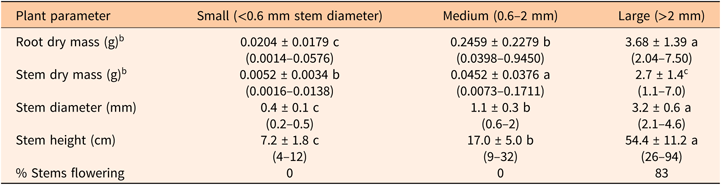
Before mowing each year (late May/early June), and in spring 2018 after the final year of mowing, we characterized the V. rossicum population and associated plant community in terms of stem and root densities and cover. To measure aboveground density, V. rossicum stems >10-cm tall (consisting of larger vegetative juveniles and flowering plants) were counted from each 1-m2 (nondestructive) subplot. Stems <10-cm tall (seedlings and young vegetative juveniles) were counted from two 0.0625-m2 quadrats placed on opposite corners of the subplot. To measure percent cover, the same observer visually estimated the cover of V. rossicum, other broadleaf plants, grasses, woody plants, and bare ground in the 1-m2 subplot. To measure root crown densities, a 0.25 by 0.25 m section of the destructive subplot was dug to a depth of 10 cm, bagged, and returned to the laboratory for processing. In subsequent years, a new section was removed 0.25 m away from the prior year’s collection, that is, in a checkerboard pattern, to minimize edge effects from previous digging. For each destructive sample, V. rossicum root crowns were counted and sorted into three stem-diameter size classes: small (< 0.6-mm stem diameter), medium (0.6 to 2 mm), and large (>2 mm). To confirm that the three size classes represented different life stages of V. rossicum, a separate subsample of plants was collected in early June for stem and root dry mass (n = 30 per size class) and again in late July when V. rossicum growth is near its peak for stem diameter, stem height, and the presence of flowers (Averill Reference Averill2009; n = 100 per size class). Analyses of these data (PROC MIXED, SAS v. 9.4, SAS Institute, Cary, NC) and our observations showed that the three size classes represent the following life stages: small (seedlings and young juveniles), medium (larger vegetative juveniles), and large (some vegetative juveniles, but mostly flowering plants) (see Table 1).
Size and reproductive characteristics for Vincetoxicum rossicum of three size classes, based on the diameter of stems, when sampled for biomass in early June and other parameters at maximum growth in late July.a

a Mean ± SD (minimum to maximum value), n = 100, except n = 30 for root and stem dry mass. For each row, individual means followed by the same letter are not different (F-protected LSD test, P > 0.05). Root dry mass F = 352.051, 87, P < 0.001; stem dry mass F = 127.211, 58, P < 0.001; stem diameter F = 1343.822, 297, P < 0.001; Stem height F = 1215.172, 297, P < 0.001.
b Small and medium: weighed to 0.0001 g; large: weighed to 0.01 g with roots cut to 10 cm.
c Data from Averill (Reference Averill2009) from plants collected in July.
To measure V. rossicum fecundity after mowing was finished for the season, follicles were counted from 30 randomly selected stems within each subplot in August. Seeds per stem were not estimated due to the lack of follicles in mown plots. Canopy height for each subplot was measured in late October/early November (up to 10 wk after the final mowing) from 2015 to 2017. A 30 by 46 cm falling plate meter (Rayburn and Lozier Reference Rayburn and Lozier2003), but with a cardboard plate instead of plexiglass attached to a meter stick, was used to estimate the postmowing stem heights of V. rossicum.
Statistical Analyses
For the dependent variables stem density (<10-cm tall, average of two counts per subplot, converted to m2), canopy height, and percent cover, a mixed model was used, including a repeated-measures analysis using an autoregressive covariance structure (PROC MIXED, SAS v. 9.4, SAS Institute). Dependent variables were transformed using the logarithmic or logit transformations to fit the assumptions of the model. For the dependent (count) variables of stem density (>10-cm tall) and root crown densities, a generalized linear mixed model with a negative binomial or Poisson (large root crown only) distribution, a log link, and an error term for repeated measures was used (PROC GLIMMIX, SAS v. 9.4, SAS Institute). In all analyses, mowing treatment and year were fixed effects, and the blocking factor was a random effect. Stepwise removal of nonsignificant interaction terms was done to determine the best model for each parameter. Preselected groups of means were compared using Fisher’s protected LSD test with the SLICE option and a modified Bonferroni correction (based on the actual number of comparisons being made for each parameter rather than all possible comparisons) (SAS v. 9.4, SAS Institute).
Results and Discussion
Pretreatment V. rossicum densities (year 1 = 2012; Figures 1 and 2) were not different among the three mowing treatments. Although percent cover was not assessed until year 2, no differences among mowing treatments were present that year for different cover categories (e.g., Figure 3), suggesting no pretreatment differences as well. Temperature and precipitation did not vary substantially among the 7 yr of the study (2012 to 2018) or from the 30-yr average at the site (data not shown; Northeast Regional Climate Center 2019). Some exceptions included a warmer than normal spring in 2012, higher June precipitation in some years, and a severe drought with very little precipitation in July 2016.
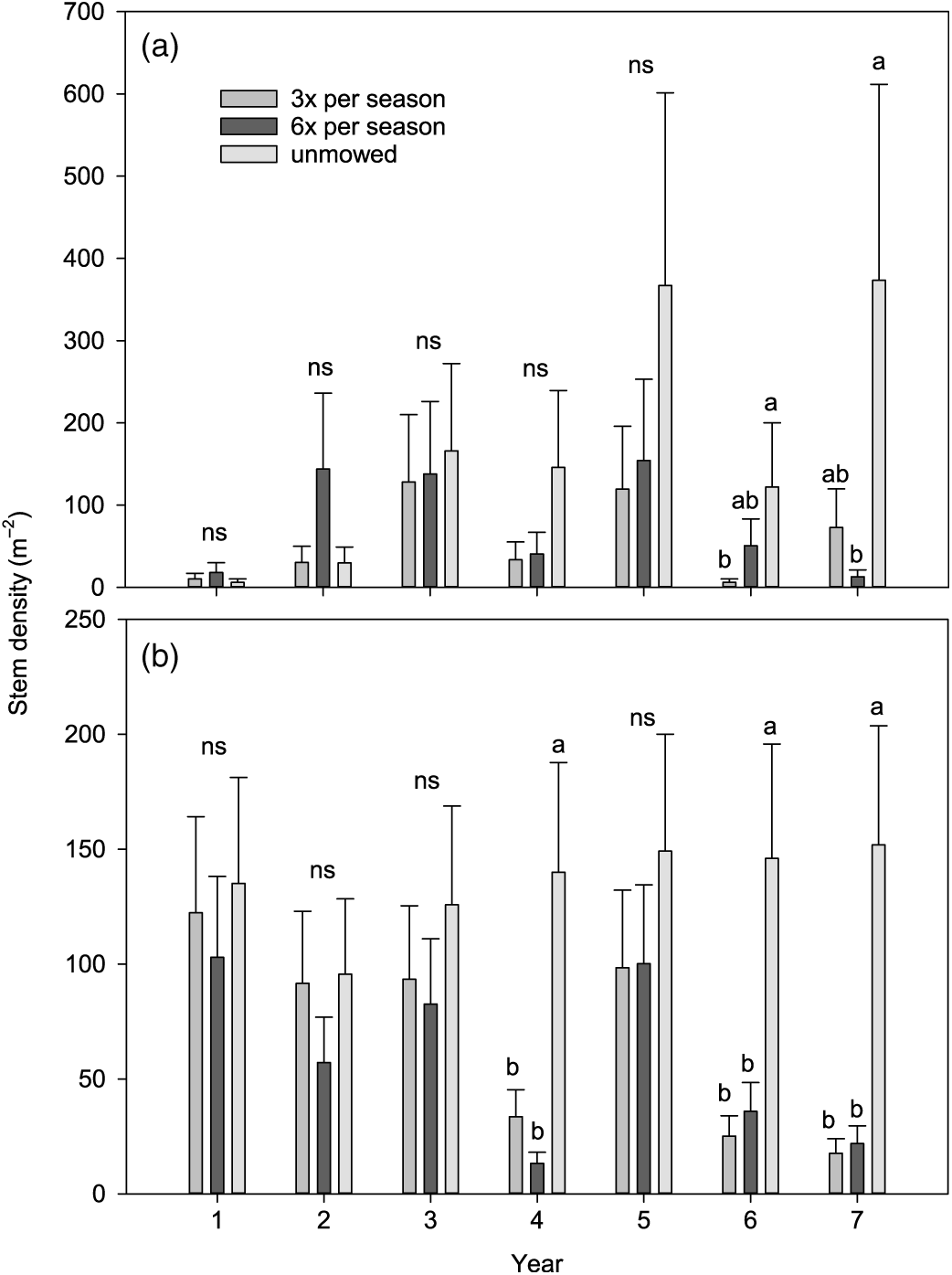
Mean (+SE, back transformed) stem densities per square meter (m−2) for Vincetoxicum rossicum (A) <10-cm tall and (B) >10-cm tall when mowed three or six times, or unmowed, over several years. Bars within each year and size class denoted by the same letter are not different (Fisher’s protected LSD test with Bonferroni correction, P > 0.05). “ns” indicates no significant differences.

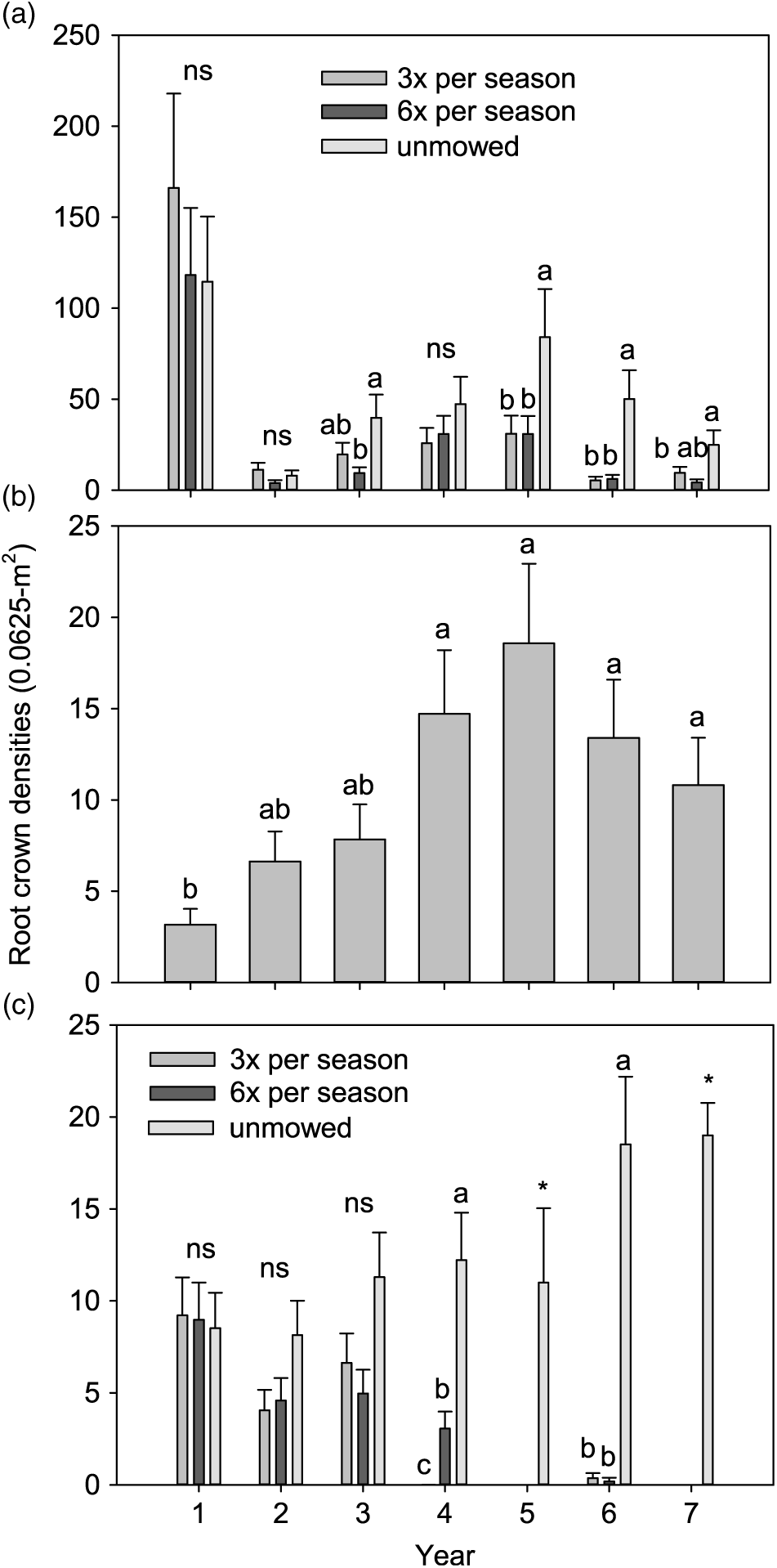
Mean (+SE, back transformed) root crown densities per 0.0625 m2 for Vincetoxicum rossicum (A) small, (B) medium, and (C) large crowns when mowed three or six times, or unmowed, over several years. Bars within each year and size class denoted by the same letter are not different (Fisher’s protected LSD test with Bonferroni correction, P > 0.05). “ns” indicates no significant differences. An asterisk (*) indicates analysis not possible due to few or no root crowns in mowed subplots.

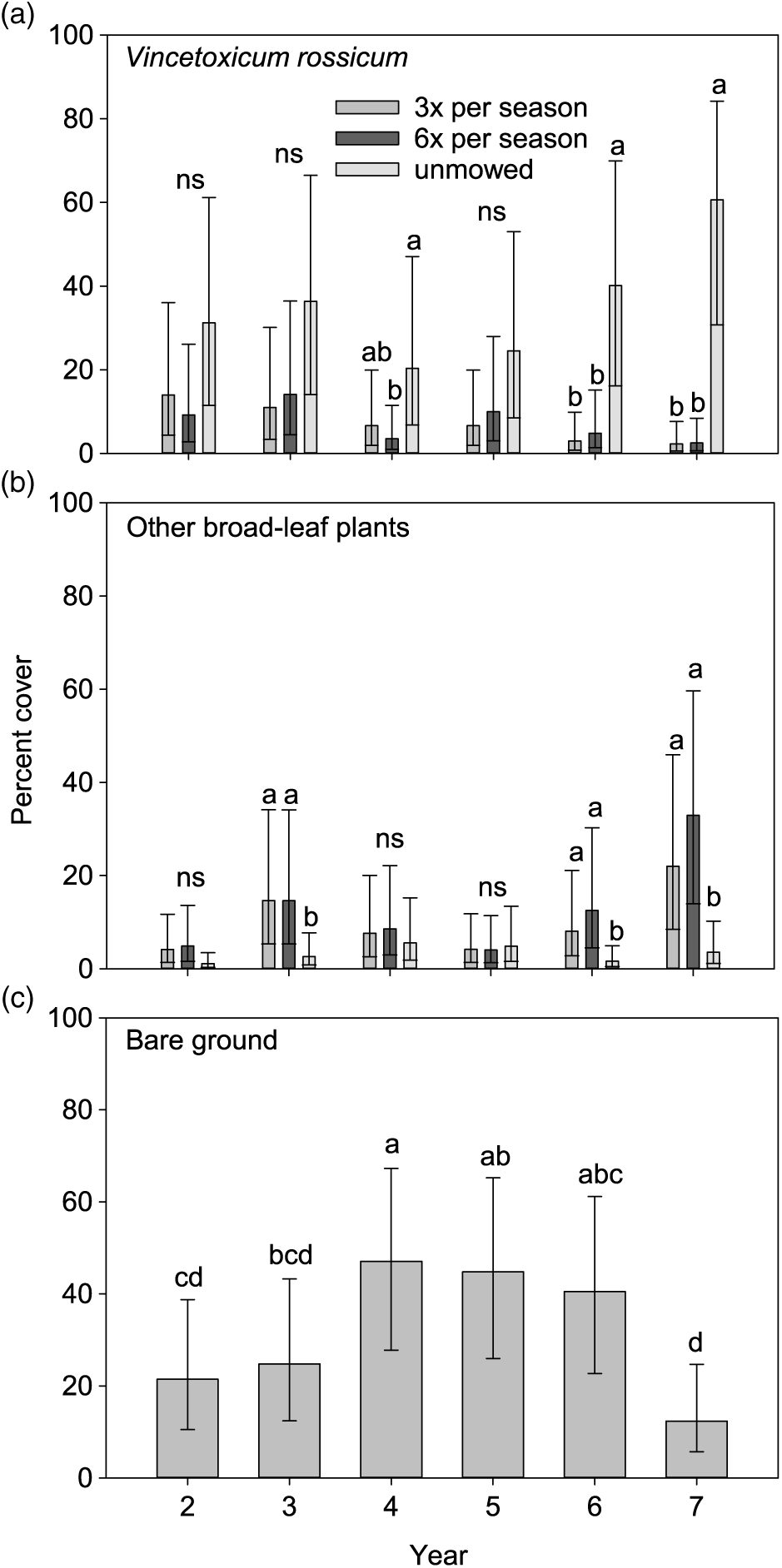
Mean (±95% confidence interval, back transformed) percent cover of (A) Vincetoxicum rossicum, (B) other broadleaf plants, and (C) bare ground when mowed three or six times, or unmowed, over several years (averaged over mowing treatments for bare ground). Bars within each year (A or B) or over years (C) denoted by the same letter are not different (Fisher’s protected LSD test with Bonferroni correction, P > 0.05). “ns” indicates no significant differences.

Spring Posttreatment Effects
Previous years’ mowing had little effect on the following years’ (years 2 to 7, 2013 to 2018) late-spring stem densities for V. rossicum plants <10-cm tall until the final year or two of the study (Figure 1A; Supplementary Table S1). This size class of stems included seedlings and small vegetative juveniles, many of which may escape mowing damage due to their short stature relative to the mowing height of 8 cm (e.g., see Table 1, “Small” column). Fewer V. rossicum stems >10-cm tall were present in years 4, 6, and 7, that is, after 3, 5, and 6 yr of mowing, respectively, in mowed plots compared with unmowed plots (Figure 1B; Supplementary Table S1). The two frequencies of mowing (three times, six times) did not differ from each other. These taller stem counts include all flowering adult plants as well as many vegetative juveniles (i.e., large and medium root crowns, see next paragraph). Stem counts are ideally conducted in summer for V. rossicum, but we could not do this, given the timing of mowing. Variability in spring temperatures can influence the timing of seedling emergence and growth, which may have contributed to some of the annual variation in stem counts for short plants. Late frosts can also partially kill larger stems, but we observed more consistent annual counts of stems >10-cm tall, particularly for the unmowed plots. This location is a high-density infestation (typically 100 to 200 stems m−2; unpublished data) and is unlikely to achieve higher densities.
Root crown densities (destructively measured from 0.0625 m2 samples) varied over time and in most cases with mowing (Supplementary Table S1). Small crowns were generally fewer in mowed plots than unmowed plots beginning in year 5 (Figure 2A). Medium-sized crowns (averaged over mowing treatments) increased in density and then appeared to stabilize, at least at the time when the experiment was ended (Figure 2B). The density of large crowns decreased dramatically beginning in year 4, or after 3 yr of mowing, and large crowns often were not recovered from the sampled sections of soil (Figure 2C). The reduction in small root crowns in mowed versus unmowed plots could indicate mortality due to the loss of cover provided by neighboring plants (Ryser Reference Ryser1993). Alternatively, seedling recruitment was likely insufficient to replace small individuals that had grown into the next size class. Without an annual seed rain (see “Late-Season Posttreatment Effects”), the seedbank of V. rossicum will be depleted in 3 yr (DiTommaso et al. Reference DiTommaso, Milbrath, Morris, Mohler and Biazzo2017). Increased light availability from mowing should promote the growth of smaller plants; seedling growth of V. rossicum increases with higher levels of light (Hotchkiss et al. Reference Hotchkiss, DiTommaso, Brainard and Mohler2008; Milbrath and Biazzo Reference Milbrath and Biazzo2016). However, V. rossicum can take several years (6 yr or more; unpublished data) to mature from a seedling (small crown) to a flowering plant (large crown) in the field. No studies to date have tracked crown size changes over time. Given the disparity in dry mass between medium and large crowns (Table 1), it seems unlikely that the decline in large crown density occurred through shrinkage of root crowns. Rather, under the site conditions of shallow soils and high intraspecific competition, repeated mowing may have killed the plants by exhausting their root reserves (Hakansson Reference Hakansson1969; Ringselle et al. Reference Ringselle, Bergkvist, Aronsson and Andersson2015). This contrasts with a multiyear common garden experiment in which no mortality was observed and root biomass was unchanged for V. rossicum clipped four times per season (Milbrath et al. Reference Milbrath, DiTommaso, Biazzo and Morris2016). However, conditions in the latter experiment were more ideal for the plants—deep moist soils and little plant competition.
Discrepancies between visual stem counts and root crown densities (if adjusted to 1-m2 equivalents) are likely due to the variable emergence of stems previously mentioned and variation in plant densities among subplots. Destructive sampling of crowns from different sections within a subplot over time also increases variability of the data. This may explain in part the large decrease in small root crowns from year 1 to year 2 (Figure 2A). However, the long-term trend indicates that root crown densities were initially similar among mowing treatments and only diverged after several years of mowing.
Percent cover of some plant groups or bare ground varied over time, in some cases in relation to mowing treatments (Supplementary Table S2). Cover of V. rossicum in late spring was consistently less, whereas cover of other broadleaf plants was greater, in mowed than unmowed plots in years 6 and 7 (Figure 3A and B). Species likely contributing to increased broadleaf cover include C. arvense, V. agrestis, common speedwell (Veronica officinalis L.), M. lupulina, V. tetrasperma, hairy vetch (Vicia villosa Roth), and field bindweed (Convolvulus arvensis L.), based on observations from long-term community assessment plots located in the same field (unpublished data). All of these species have a low or trailing growth habit, suitable for minimizing mower damage. Although V. rossicum is also a viny perennial, it typically has an upright growth habit of 1 m or less in open fields (Averill et al. Reference Averill, DiTommaso, Mohler and Milbrath2011). Vincetoxicum nigrum is more likely to produce trailing vines (JB and LRM, personal observation). Bare ground tended to increase and then decreased over the course of the experiment (Figure 3C), whereas percent cover of grasses (37 ± 17%) and the very few woody species present (0.02 ± 0.15%) did not vary over time for any mowing treatment. No native grasses are present at this site. Various cool-season Eurasian grasses are abundant (D. glomerata, E. repens, P. pratense, and P. pratensis), in part a result of previous land use for cattle grazing, and not surprisingly were unaffected by mowing.
Late-Season Posttreatment Effects
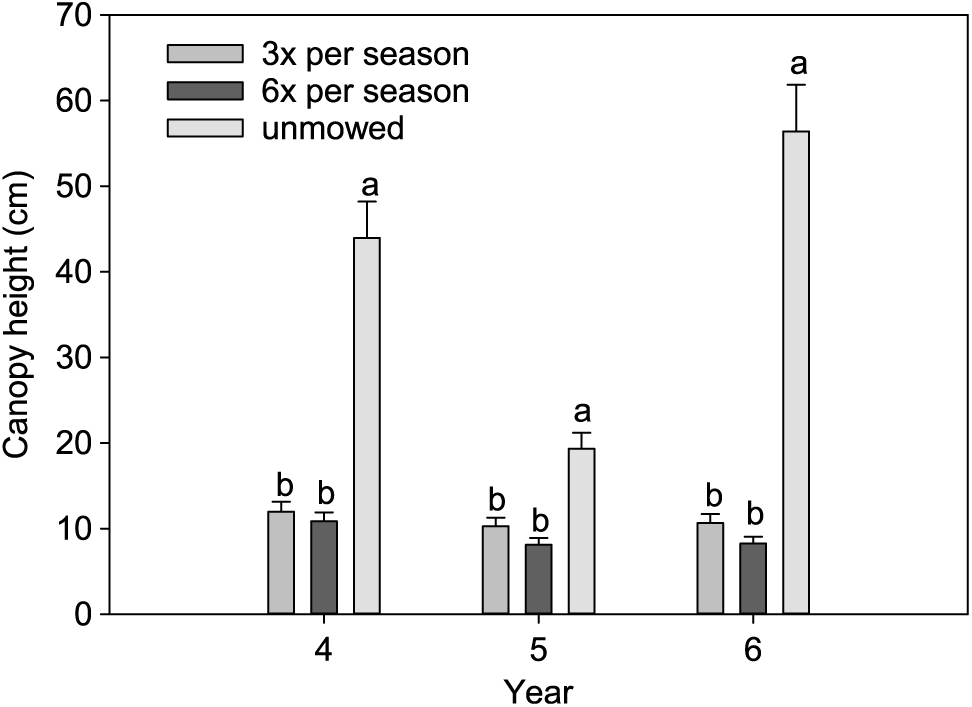
No follicles, and hence seeds, were successfully produced by V. rossicum when plants were mowed three or six times. A few underdeveloped follicles were occasionally present. Follicle production in unmowed plots occurred in all years, ranging from 6.5 ± 3.0 follicles per stem (year 3, 2014) to 0.8 ± 0.4 follicles per stem (during a severe drought in year 5, 2016). Vincetoxicum rossicum produces an average of 8 seeds per follicle in fields (Averill et al. Reference Averill, DiTommaso, Mohler and Milbrath2011). In previous studies, clipping V. rossicum and V. nigrum plants once (June) at 8 cm had limited effects on seed production, whereas plants clipped twice (June, July) produced few to no follicles (Averill et al. Reference Averill, DiTommaso and Morris2008; Milbrath et al. Reference Milbrath, DiTommaso, Biazzo and Morris2016). Only plants clipped four times (May, June, July, August) consistently produced no seeds (Milbrath et al. Reference Milbrath, DiTommaso, Biazzo and Morris2016). Our results demonstrate that three mowings on a monthly basis beginning late May/early June can eliminate V. rossicum seeds for that season. This would likely apply to other sites as well. Flowering by V. rossicum typically ceases by August, but V. nigrum can flower until a hard frost. It is therefore unknown whether three or four mowings are needed to prevent seed production in V. nigrum. Additional research is needed to determine whether an optimal time of mowing, based on the physiology of V. rossicum or V. nigrum, can further reduce mowing frequencies while still preventing seed production (Gustavsson Reference Gustavsson1997; McKague and Cappuccino Reference McKague and Cappuccino2005; Kaczmarek-Derda et al. Reference Kaczmarek-Derda, Østrem, Myromslien, Brandsæter and Netland2019). Canopy height of V. rossicum and other vegetation at the end of the growing season was shorter in the mowed than unmowed plots, and no differences in height occurred between mowing three or six times (Figure 4; Supplementary Table S1). Also, unmowed plots had a shorter canopy in year 5 (drought year) than in the other 2 yr (separation of means not shown; see Figure 4).
Mean (+SE, back transformed) canopy height of Vincetoxicum rossicum and other plants when mowed three or six times, or unmowed, over several years. Bars within each year denoted by the same letter are not different (Fisher’s protected LSD test with Bonferroni correction, P > 0.05).

This study focused on mowing effects on a single invasive plant species within a natural area. However, restoration or preservation of desired communities of conservation value and/or desirable forages in grazing lands is usually the goal (Lundberg et al. Reference Lundberg, Kapfer and Måren2017; Stanley et al. Reference Stanley, Kaye and Dunwiddie2011; Szépligeti et al. Reference Szépligeti, Kőrösi, Szentirmai, Házi, Bartha and Bartha2018; Tardella et al. Reference Tardella, Malatesta, Goia and Catorci2018). Mowing is a broad-spectrum management approach that can have differential effects on other plant species depending on phenology or growth habit. The various grasses and low-growing herbs in our study site did not appear to be harmed (and may have benefited) from mowing, but these were likely nonnative species, which are prevalent. Specific modifications to a mowing regime (blade height, phenological timing) can promote favored species (Wilson and Clark Reference Wilson and Clark2001). This has yet to be assessed for Vincetoxicum-dominated systems.
The time needed to suppress perennial weeds by mowing in predominantly grassland systems varies from a few to several years (Házi et al. Reference Házi, Bartha, Szentes, Wichmann and Penksza2011; Kaczmarek-Derda et al. Reference Kaczmarek-Derda, Østrem, Myromslien, Brandsæter and Netland2019; Meyer and Schmid Reference Meyer and Schmid1999a, Reference Meyer and Schmid1999b; Tardella et al. Reference Tardella, Malatesta, Goia and Catorci2018; Wilson and Clark Reference Wilson and Clark2001). In addition, some perennial weed species can be controlled with only one or two mowings within a growing season (Meyer and Schmid Reference Meyer and Schmid1999a, Reference Meyer and Schmid1999b; Szépligeti et al. Reference Szépligeti, Kőrösi, Szentirmai, Házi, Bartha and Bartha2018; Tardella et al. Reference Tardella, Malatesta, Goia and Catorci2018). In the case of V. rossicum, several years of high-frequency mowing are needed. A previous field-based study indicated a high tolerance of V. rossicum and V. nigrum to aboveground tissue loss (Milbrath et al. Reference Milbrath, DiTommaso, Biazzo and Morris2016). In the present study, we also observed few changes in V. rossicum during the first few years, even with intense intraspecific competition. Contrary to our expectations, mowing six times per season did not enhance the efficacy of mowing. Whether V. nigrum would be controlled by mowing three times per season is unknown, nor have physiological or demographic investigations of either species been pursued for optimizing the timing of mechanical control (Bourdôt et al. Reference Bourdôt, Basse and Cripps2016; Gustavsson Reference Gustavsson1997; Verwijst et al. Reference Verwijst, Tavaziva and Lundkvist2018).
Mowing for V. rossicum control will be limited to open field habitats due to inaccessibility of forest infestations to mowing equipment. Mowing three times per season eliminated seeds of V. rossicum within a given growing season. It also reduced V. rossicum density and percent cover but not until at least three, and more likely five, seasons of mowing had occurred. However, the continued presence of smaller V. rossicum plants (small and medium root crowns) suggests that the population would rebound if mowing were stopped, and might even rebound if mowing were only reduced in intensity (Dee et al. Reference Dee, Thomas, Thompson and Palmer2016). The integration of mechanical control with other tactics can enhance the efficacy of a management program and decrease the time needed to achieve control of perennial species (Lym and Nelson Reference Lym and Nelson2002; Miller Reference Miller2016; Tipping et al. Reference Tipping, Gettys, Minteer, Foley and Sardes2017). Little work on integrated approaches to Vincetoxicum control has been conducted to date (e.g., Averill et al. Reference Averill, DiTommaso and Morris2008). As a management tool, mowing can prevent the spread of V. rossicum by eliminating its wind-dispersed seeds. However, to suppress existing V. rossicum populations, mowing will need to be conducted every year.
Acknowledgments
This research was funded by the U.S. Department of Agriculture–Agricultural Research Service. No conflicts of interest have been declared. The authors would like to thank the New York State Office of Parks, Recreation and Historic Preservation for allowing this long-term field study; Jamie Freeman, Elizabeth Drake, Melissa Harbert, Zoya Kaufmann, Natalie Freidin, Xinyuan Shi, and Alanna Salwen (Cornell University) for technical support; Françoise Vermeylen (Cornell University) for statistical advice; and the anonymous reviewers for their comments, which improved this article. Mention of trade names or commercial products in this article is solely for the purpose of providing specific information and does not imply recommendation or endorsement by the U.S. Department of Agriculture. USDA is an equal opportunity provider and employer.
Supplementary material
To view supplementary material for this article, please visit https://doi.org/10.1017/inp.2019.22