Introduction
The National Health Service (NHS) is the name of the publically funded healthcare system in the United Kingdom. It was created by the National Health Service Act (1946) and has tended to be hierarchical (with a central organizing bureaucratic government department), based on what could be described as benign paternalism. It is founded on the principle of healthcare for all, based on need, free at the point of delivery. In this it differs from other healthcare systems around the world.
Historical context
Before the NHS, healthcare in England consisted of a combination of private and public services. Private services included the voluntary hospitals which traditionally provided free care and had developed largely from charitable foundations. Public services were run by local government and had grown out of the Poor Law system. Care was generally fragmented with limited access and wide variations geographically. The National Insurance Act (1911) predated the NHS and introduced sickness benefits funded by contributions from government, employers and employees, but this did not solve the systemic problems. Honigsbaum (Reference Honigsbaum1990) stresses the important role of the friendly societies which were formed by working men from the nineteenth century onwards and which provided sickness benefits to members, generally offering a capitation fee to the doctors involved. He argues that the medical profession, in supporting the creation of the NHS, chose state control in preference to control by the societies, but this illustrates the inherent difficulty of the conflict between the State and health service patient and the core issue of patient participation in health care. (For an account of the evolution of healthcare in Britain, see Baggott, Reference Baggott2004.)
Honigsbaum (Reference Honigsbaum1990) notes that no organized group spoke on behalf of patients in the lead-up to the NHS but that the interests of doctors and patients coincided. Aneurin Bevan, then Minister of Health, sent a message to the medical profession in the British Medical Journal (Bevan, Reference Bevan1948) which referred to freeing the “doctor-patient relationship” from the money factor: participation here referred to the participation of doctors. He also writes that his job was to provide resources and then:
“to leave you alone as professional men and women to use your skill and judgement without hindrance.” (Bevan, Reference Bevan1948)
In effect he asserted the centrality of the relationship between healthcare professional and patient, but this model is unlikely to be acceptable to politicians or the public in the twenty-first century. Benign and, hopefully, well-intentioned paternalism (Coulter, Reference Coulter1999) continued to be the approach in the health service for several decades. Ham and Alberti (Reference Ham and Alberti2002) describe the NHS as established on the basis of an implicit compact between the government (which determined the NHS budget and guaranteed care for all), the medical profession (with responsibility for care standards and delivery) and the public (paying taxes to fund heathcare).
In 1991 the Patients’ Charter was introduced and later revised in 1995. It set out some fundamental rights for patients. It states that it is helping the NHS to “listen to and act on people's views and needs”. Much of it remains aspirational today.
The NHS Plan, published in 2000, was promoted as shifting the balance of power in health services towards the patient:
“For the first time patients will have a real say in the NHS. They will have new powers and more influence over the way the NHS works . . .” (Department of Health, 2000, p. 12)
The Plan aimed to increase the involvement of patients and the public in all aspects of healthcare. It grew from previous work which had highlighted three partnership areas: (i) with patients and carers in connection with their own care; (ii) with patients and carers more generally in health and social care; and (iii) with the public as citizens who have a stake in health and social care, and followed the publication of a National Carers’ Strategy.
Since the NHS Plan, the rhetoric of health and social care policy documents produced by the UK government has continued to stress greater choice, greater influence in services at all levels, more individualized care for patients, and recognition of the important role of carers. The language used is interesting in that it concentrates on giving people more choice, putting people “in control”, services being “patient-led”, but, at the same time, emphasizes partnership and collaboration with patients, carers and members of the public. Terminology is, however, inconsistent. The House of Commons Health Committee (2007) used the term “patient and public involvement” (but then described the term as a “nebulous and ill-defined concept”). For clarity, this paper uses the following terms:
• “patient” for people who are or have been clients or consumers or users or survivors of health or social care (there is debate about the preferred term e.g. Simmons et al., Reference Simmons, Hawley, Gale and Sivakumaran2010);
• “carer” for the family members/family carers/friends or neighbors supporting patients; and
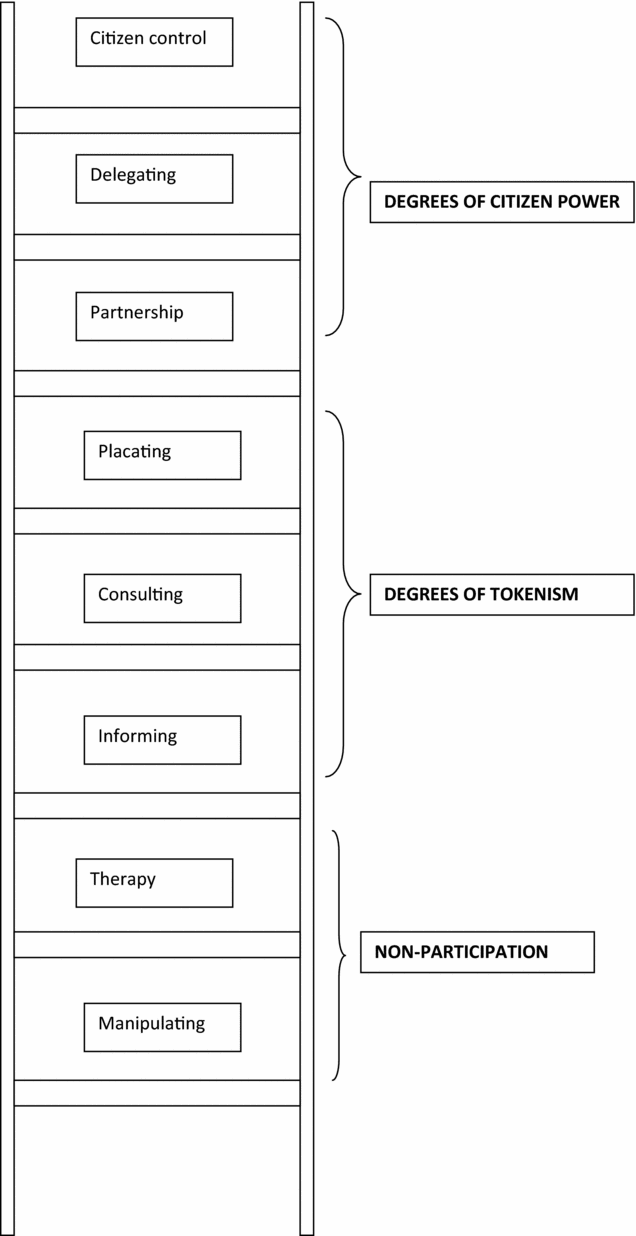
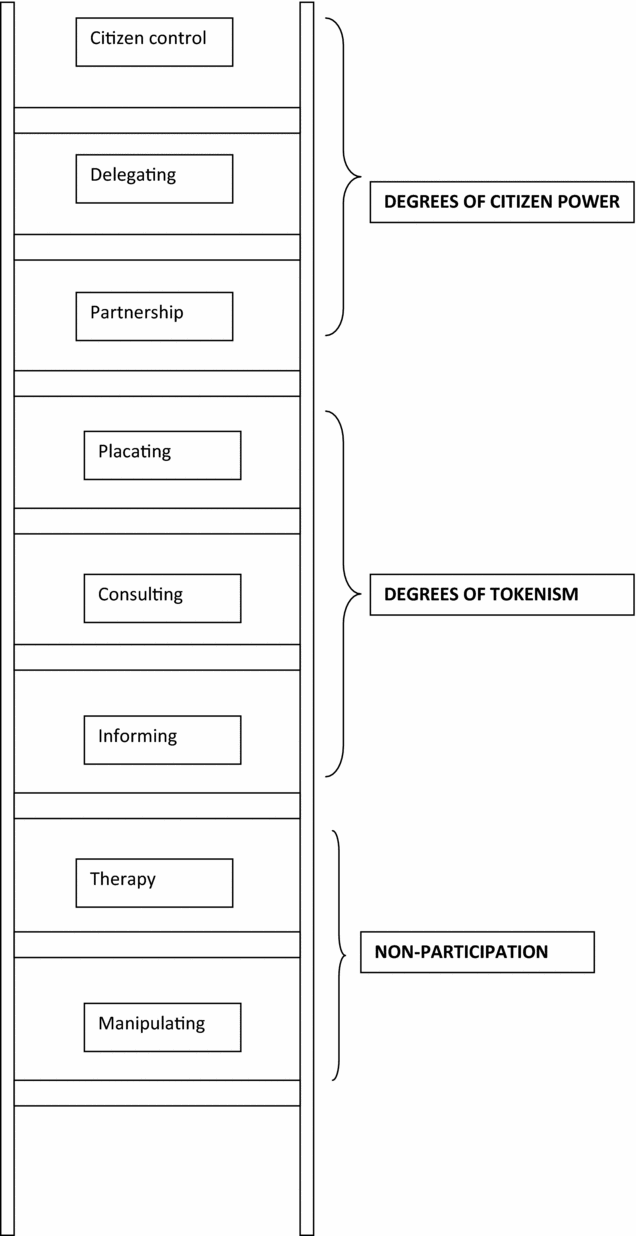
• “participation” to describe the involvement of patients and carers in services in various ways. This is taken from Arnstein's ladder of citizen participation (described in Hostick, Reference Hostick1998: see Figure 1) and is a form of what can be described as public participation: public participation involves organizational engagement, and contrasts with individual participation (an individual's everyday choices) and social participation (collective activities).
• The term “user movement” is retained in connection with mental health (see below).
• The term “client” is retained for people using systemic therapy services.
Despite the good intentions of policy documents, structures for patient and public participation have been unstable. Community Health Councils (CHCs), established in 1974 in England and Wales, introduced a framework for patient and public involvement. Their abolition was heralded by the NHS Plan, and in 2002 Patient Advice and Liaison Services (PALS) were established in England in all Primary Care Trusts and NHS Trusts. They were followed in 2003 by the establishment of the Commission for Patient and Public Involvement in Health (CPPIH), the Independent Complaints Advocacy Service (ICAS) and Patient and Public Involvement (PPI) Forums: the latter were then replaced by Local Involvement Networks (LINks) in 2007 alongside the abolition of the CPPIH (for a summary of milestones in PPI, see Andersson et al., nd). Talk of partnership continues: in 2009 the Department of Health published the NHS Constitution which stresses partnership and sets out rights and responsibilities for both patients and staff.
Arnstein's ladder of citizen participation modified from Hostick (Reference Hostick1998).
Ham and Alberti (Reference Ham and Alberti2002) argued that the implicit compact between government, healthcare professions and public has been undermined and broken down in response to changes over recent years and that a new one needed to be agreed. They saw trust and good communication between all parties as fundamental to this process. The participation of patients and carers in health and social care therefore carries far-reaching implications.
The mental health user movement
Wallcraft and Bryant (Reference Wallcraft and Bryant2003, p. 3) define the user movement as follows:
“The term ‘service user/survivor movement’ refers to the work of individuals who advocate for their personal and collective rights within the context of discrimination faced as a result of having experienced mental health difficulties and/or being diagnosed as having a mental illness.”
They date this movement's origins to as far back as the early 1600s. Campbell (Reference Campbell and Heller1996) dates the upsurge in the user movement to the mid-1980s and cites the pace of change in mental health services as creating uncertainties and hence opportunities for new ideas, alongside the growth in self-help, the anti-psychiatry movement and the influence of user movements in other countries. Crossley (Reference Crossley1999) cites similar factors in its development, dating the movement's birth to the early 1970s, and registering the strong involvement of non-users in the initiation of the movement, perhaps related to their position of power. Campbell (Reference Campbell and Heller1996) notes the need to increase participation amongst groups which experience multiple exclusions, referring specifically to black and minority ethnic groups (but older adults may be equally or even more invisible and excluded). Wallcraft et al. (Reference Wallcraft, Read and Sweeney2003) surveyed the service user movement in the early twenty-first century and found that it did not represent or include all mental health service users. In questions relating to equality, their questionnaire omitted issues relating to older age, asking only about minority ethnic groups, women's issues, and lesbian, gay and bisexual issues. Although one responding organization referred to older people as a community of interest, overall, older adults were conspicuous by their absence. Many of the big issues for the user movement in the past were probably not those which older adult groups would have regarded as pivotal, e.g. access to employment and detention under mental health legislation.
Older people's mental health
Old age psychiatry (also called geriatric psychiatry, psychogeriatrics, psychiatry of the elderly, and older people's mental health) is a relatively young specialty which concerns mental health services across the range of mental health problems in later life. It has developed over the past 40 years, with specialty status being achieved in the UK in1989 (Pitt et al., Reference Pitt, Arie, Benbow and Garner2006). Thus, the specialty has been developing over the period when the user movement has also been developing.
Patients of old age psychiatry services may be disadvantaged by several factors including: comorbid physical illness, sensory impairments, multiple medication use, frailty associated with advanced age, social circumstances, comorbid cognitive impairment along with other mental illness, limited finances, and the assumptions people make about advanced age and cognitive impairment. These factors are relevant to the relative absence of older patients within the user movement. Carers are more visible and carer support has been described as “a fundamental component of all aspects of service provision” (Benbow and Jolley, Reference Benbow, Jolley, Pathy, Sinclair and Morley2006). Although the role of the family in the care of children is clear and accepted, for older adults the case has had to be made (perhaps another example of ageist assumptions) (Benbow and Marriott, Reference Benbow and Marriott1997).
With regard to older people's mental health (OPMH) policy the National Service Framework (NSF) for Older People emphasized person-centered care (Standard 2) and the issue of choice, and the National Service Framework Mental Health included a standard on carer support. Unfortunately old age psychiatry fell between the two NSFs: when the NSF for Mental Health was published it did not apply to older adults and the NSF for Older People highlighted other priorities. Everybody's Business (Department of Health/Care Services Improvement Partnership, 2005) was later produced as a document focused on older people's mental health and described involvement of patients and carers in services as “central to quality improvement”, arguing that it should be embedded in the way staff and organizations operate. Everybody's Business appears to have had little influence, probably for several reasons: it brought no money into services, was a web-based document and was followed by a period of financial stringency and considerable upheaval in services. More recently the National Dementia Strategy (Department of Health, 2009) identifies “engaging with public and patients” as one of the world class commissioning competencies which fits with many of the Strategy's objectives, describing people with dementia and their carers as being fully engaged in the design and delivery of services.
New Horizons: A Shared Vision for Mental Health, published in 2009, makes the point that:
“Older people [should be] equally involved in the planning of their own individual care, service planning, foundation trust membership etc . . .” (HM Government, 2009, p. 85)
and includes older people and their care firmly within the sphere of mental health.
Despite these encouraging documents, patient and carer participation appears to have had, at best, a limited impact on old age psychiatry services in the UK. There are probably several reasons for this. One major reason is the persisting stigma attached to being older, coupled with the stigma of psychiatry and of possibly having cognitive impairment. These combine to make it more difficult for older people with mental health problems to get their voices heard. In addition, the recent drive towards age equality in services in the UK has sometimes been misunderstood as meaning that old age psychiatry services are themselves inherently ageist, since they are targeted at older people. (An alternative view is that to deny the specialist needs of older adults is itself age discrimination.)
Why is patient and carer participation a policy imperative?
It is clear that patient and carer participation is regarded as a policy imperative in the NHS, and a range of policy documents state that this participation carries a number of benefits, including the following:
• shaping services
• improving health outcomes
• ensuring quality.
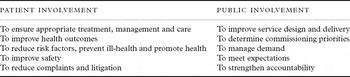
Coulter (nd) distinguishes between the potential benefits of patient involvement and public involvement (Table 1). A number of documents also reinforce an assumption that, as stakeholders in services, patients and carers have a right to influence how those services are provided. Putting People First, a government document on adult social care published in 2007, states that:
“real change will only be achieved through the participation of users and carers at every stage.” (p. 1)
Given the clarity of policy on the issue, it is interesting that patient and carer participation has not already become embedded within English health and social care systems. Soffe et al. (Reference Soffe, Read and Frude2004) surveyed the attitudes of clinical psychologists (in adult mental health services) to patient involvement and noted a discrepancy between policy and practice, suggesting that ways of understanding this include the assumption that “staff know best” and also that:
“staffs’ [sic] sense of disempowerment within the system [may render] them unable to hear users’ voices until their own voices [are] heard . . .”. (Soffe et al., Reference Soffe, Read and Frude2004, p. 591).
They also note that patient involvement may be threatening to staff, may impact on professional autonomy, and could potentially reduce the future role for staff groups in mental health services.
Potential benefits of patient involvement and public involvement, modified from Coulter (nd)

The House of Commons Health Committee (2007) cautioned that:
“Structures and procedures . . . will have little effect if the health service is not prepared to listen and make changes as a result of what they learn.” (House of Commons Health Committee, 2007, p. 5)
If learning from, and working with, patients and carers are seen solely as policy drivers, it is unlikely that patient and carer participation will become embedded in future health and social care practice. Rose et al. (Reference Rose, Fleischmann, Tonkiss, Campbell and Wykes2002) articulate this bluntly:
“There is a danger that government demands for agencies to demonstrate user involvement may mean that user activities become a formal procedure to be ticked off, rather than an embedded and powerful organisational practice.” (Rose et al., Reference Rose, Fleischmann, Tonkiss, Campbell and Wykes2002, pp. 16–17)
Cynics might wonder whether government emphasis on patient and carer involvement is just a means of shifting blame and the onus for change away from health structures and onto patients and carers or merely a populist ploy. In reality, patient and carer participation carries costs and, at a time of budgetary constraints, has dropped down the agenda of healthcare commissioning and provider organizations.
Benefits and drawbacks of patient/carer participation in healthcare?
It may appear that patient, carer and public participation in health care is largely an item of faith which asserts that it must bring benefits and that people have a right to be involved. There is, however, evidence in the literature of both benefits and drawbacks to patient and carer participation.
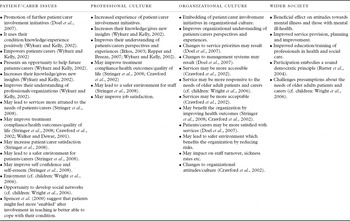
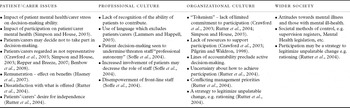
Table 2 sets out possible benefits of patient and carer participation and Table 3 possible drawbacks/constraints. Some of the drawbacks of patient and carer participation can be cited as arguments against participation initiatives, and they also indicate some of the practical difficulties of participation initiatives. Both tables use headings taken from the study by Hickey and Kipping (Reference Hickey and Kipping1998) in order to separate both benefits and drawbacks into those relating to each of four areas: patient/carer issues, professional culture, organizational culture and the wider society. This separation opens up the possibility that what may constitute a benefit in one area may at the same time constitute a drawback in another, e.g. changes to organizational culture may be regarded negatively by professionals but positively by patients and carers (or vice versa). This highlights the complexity of research into participation. The contents of both Tables 2 and 3 represent a distillation of the literature with inclusion of the author's interpretation of benefits which can reasonably be extrapolated from it.
Benefits of patient and carer participation in aspects of old age psychiatry divided into the categories identified in Hickey and Kipping (Reference Hickey and Kipping1998)

Constraints on/drawbacks of patient and carer participation in old age psychiatry divided into the categories identified in Hickey and Kipping (Reference Hickey and Kipping1998)

Hickey and Kipping (Reference Hickey and Kipping1998) argue that it is important to be realistic and to identify constraints in order to consider possible ways of overcoming them or, if they cannot be overcome, to avoid developing unrealistic expectations. However, the current literature focuses more on benefits and on processes of participation rather than outcomes. The lack of literature on constraints and drawbacks may reflect publication bias and adds further weight to the need to develop research on patient and carer participation in old age psychiatry.
A systemic perspective
Dallos and Draper (Reference Dallos and Draper2010) have chronicled the evolution of systemic therapy from its origins in cybernetics and systems theory in the 1950s along a rich and complex path into the twenty-first century as an integrated body of theory, applicable to institutions and organizations as well as therapy. They describe family therapy as
“a collaborative process, involving a co-construction of new ways of seeing problems . . . [which] requires a sociological awareness of issues of power . . . Added to this the therapist is expected to be aware of . . . potentially oppressive assumptions and practices inherent in their privileged position of power and status . . .” (Dallos and Draper, Reference Dallos and Draper2010, p. 97)
Some of its ideas can usefully be applied to healthcare and the participation of patients and carers.
Systemic theory argues that bringing together and exchanging a range of differing ideas and perspectives leads to creativity, dialogue and the evolution of ideas (Inger and Inger, Reference Inger and Inger1990). The idea of double description originated in the work of Bateson and is described by Jones (Reference Jones and Jones1993) as follows:
“obtaining more than one view of an event would enable us to achieve the cognitive or emotional equivalent of binocular vision, thus gaining, in a metaphorical sense, perspective on our observations and experiences.” (Jones, Reference Jones and Jones1993, p. 31)
However, the relationship between those involved is critical to developing the outcome. When Cecchin (Reference Cecchin, McNamee and Gergen1992) wrote that:
“what we discovered depended on the ‘discoverer’ . . .” (Cecchin, Reference Cecchin, McNamee and Gergen1992, p. 89)
he was writing about therapy, but could have been writing about encounters in both health and social care.
In systemic therapy it has been argued that power stems from the use of expert language and its imposition on the client's experience (Anderson and Goolishian, Reference Anderson and Goolishian1990). This criticism may be equally applicable to encounters in health and social care. In systemic therapy over the past twenty years or so there has been a move away from power and control (Hoffman, Reference Hoffman and Hoffman1993) towards an emphasis on collaboration (Anderson, Reference Anderson, Anderson and Gehart2007a) and dialogue (Anderson, Reference Anderson, Anderson and Gehart2007b). Alongside this are the debates about “not-knowing” and “client-as-expert” (Anderson, Reference Anderson2005). The concepts of “not-knowing” and “client-as-expert” involve respect and dignity for the client or patient and their family, a recognition that they hold expertise regarding their own/their family member's illness and/or circumstances, and a humble acceptance of the fact that the therapist or health professional does not necessarily know best, but must work with the family to help them determine which path to take. These concepts are not threats to the knowledge, expertise and skill of the therapist (or health/social care professional); instead they make the expertise of the professional available in partnership with the knowledge and experience of patient and carer. They provide foundations for a more balanced collaborative relationship between therapist (or health/social care professional) and the patients and carers they encounter. The “reflecting team” concept (Andersen, Reference Andersen, McNamee and Gergen1992) is a way of sharing the ideas of therapists with families. Before it was introduced, families often met with therapists and were “observed” by a team from behind a one-way screen. When the team came out from behind the screen and talked together about their ideas with the family listening, they became a reflecting team. This, then, was a move away from paternalism and secrecy towards openness and collaboration. It also involved a change in the power balance between families and the professionals working with them, a shift which has continued. Anderson (Reference Anderson, Anderson and Gehart2007a) has described collaborative therapy as a philosophical stance or way of being:
“The therapist wants to learn and understand the client from the client's perspective and preferences. The therapist wants to learn the client's lived experience and the meanings and understandings associated with it.” (Anderson, Reference Anderson, Anderson and Gehart2007a, p. 47)
This need for understanding is important in healthcare and underlies person-centered care and the burgeoning interest in the importance of the relationship between healthcare staff and their patients (Bridges et al., Reference Bridges, Flatley and Meyer2010). These systemic concepts encapsulate the idea of circular relationships, of bidirectional influences and the way in which the process between therapist and family (or in healthcare, between staff, patients and families) is mutually influenced and mutually influencing.
Taking this perspective enables patients and carers to exert more control, to subvert the expected power structure and start to influence the agenda and strategy of the organization they are working with, to the benefit of all concerned. It involves what Rober (Reference Rober2005) describes as receptivity and reflection on behalf of all those concerned. He goes on to write that:
“understanding becomes an active, creative process in which the meanings of the client make contact with the meanings of the therapist. In this process, new meanings emerge that are different from the original meanings of the client.” (Rober, Reference Rober2005, p. 481)
Systemic theory suggests that collaboration with patients, carers and the public might be expected to lead to change and evolution of services. This is not regarded as the pinnacle of participation in Arnstein's ladder, but to privilege citizen control is to replace one hierarchical system with another (see Figure 1). Although the patient inevitably participates (in a narrow sense) in any encounter with a health or social care professional, a systemic perspective indicates that what is important is the collaboration, the mutual exchange of views and the construction of an outcome which has been influenced by all participants in the interchange. At a time when healthcare professionals in the NHS feel increasingly disempowered, they might themselves gain from a closer partnership with their patients and patients’ families.
Conclusions
Although the participation of patients and carers is regarded as NHS policy and the user movement has had considerable impact on mental health services, both have had less impact in old age psychiatry for a number of reasons including ageism and the triple stigma of age, mental ill-health and possible cognitive impairment. From a systemic perspective, increasing participation of patients and carers in old age psychiatry should influence service development and facilitate the empowerment of older adults and their families. It is important that professionals support patient and carer participation, and we argue that the resulting partnership can also empower and support healthcare staff. At a time of considerable pressure on the NHS in the UK, patients and their families are our best allies.
Conflict of interest
None.
Acknowledgment
This paper is based on work submitted to Staffordshire University in respect of a PhD by published work (awarded in December 2010). The author wishes to thank all those who offered their support, including Rob Jones, Jim Radcliffe and Paul Kingston.