


Introduction
Occupational burnout is a significant issue for many healthcare professionals. Correlation of burnout with health-system financial stress and reduction in the quality of patient care has been well described. Reference Han, Shanafelt and Sinsky1,Reference Hodkinson, Zhou and Johnson2 Physician burnout consists of emotional exhaustion, feelings of depersonalization, and a reduced sense of accomplishment. Contributing factors include excessive workloads, administrative burdens, workflow inefficiencies, and workplace culture. Reference West, Dyrbye and Shanafelt3 Work hour restrictions could help; however, this may be negated by professional obligations extending beyond scheduled hours. Reference Guille and Sen4 Since the COVID-19 pandemic, healthcare worker burnout has increased by >10%. Reference Mohr, Elnahal and Marks5 Burnout in the infectious diseases (ID) setting has limited research. A 1992 US-based survey found that 43.5% of ID prescribers in multiple settings (private practice, government, academia, industry, foundation) reported high scores on emotional exhaustion, and 40.3% scored high on depersonalization, indicating high levels of burnout. Reference Deckard, Hicks and Hamory6 A 2019 study found that 53% of ID physicians met criteria for burnout, with 34% reporting emotional exhaustion and 38% depersonalization. Reference Nori, Bartash, Cowman, Dackis and Pirofski7
Pharmacist integration into outpatient clinics has been associated with reduced prescriber burnout. A survey-based study in the primary care setting showed that 91% of physicians and advanced practice providers (APPs) were extremely satisfied with integrated pharmacy services. Reference Haag, Yost and Kosloski Tarpenning8 Primary care prescribers reportedly view pharmacists as collaborative partners that complement their work and act as valuable resources, thus decreasing workload and mental exhaustion. Reference Funk, Pestka, Roth McClurg, Carroll and Sorensen9 However, it is unclear if these findings apply to specialty areas such as ID. The study objective was to evaluate ID prescribers’ perceptions of the impact of ambulatory-based pharmacists on key drivers of burnout.
Methods
This study was reviewed by the Mayo Clinic Institutional Review Board and deemed exempt. An anonymous electronic survey was distributed to Mayo Clinic ID physicians and APPs in Minnesota and Wisconsin with active ambulatory ID practice involving a clinical pharmacist. Pediatric ID staff, emeritus faculty, and those with inpatient or research only practice were excluded. A survey instrument developed by Haag et al. Reference Haag, Yost and Kosloski Tarpenning8 was utilized with minor wording modifications to reflect ID practice, while preserving the original domains. The instrument assesses 4 key drivers of burnout: workload and job demands, efficiency and resources, meaning in work, and social support and community at work. Additional questions assessed pharmacist impact on time for patient care, perceived workload reductions, and likelihood of recommending clinical pharmacy services. The survey was distributed via email on December 11, 2025, and remained open through January 9, 2026. Participants could enter a raffle, with one winner from each region randomly selected to receive $100.
Responses were summarized using frequencies and percentages. Comparisons of responses between provider types and practice locations were made using Wilcoxon rank sum tests for ordinal data, and Fisher’s exact tests for nominal data. All analyses were performed using SAS version 9.4 software (SAS Institute, Inc.; Cary, NC). Given the small sample size and the exploratory nature of this study, statistical significance was assessed at an alpha level of 0.10. Respondents completing only demographic items were only included in analysis of demographics data and were excluded from other analyses.
Results
Of 60 invited prescribers, 28 responded (46.7% response rate), and 2 were included only in demographics yielding a sample of 26 prescribers for full analysis: 20 physicians (76.9%) and 6 APPs (23.1%). The majority primarily practiced at the flagship site (64.3%). Almost all health-system prescribers (80.0%) utilized pharmacist services multiple times per day, whereas flagship site prescribers reported fewer interactions with 6 (37.5%) respondents reporting daily use (P < .001). A greater proportion of physicians (57.9%) compared with APPs (20%) strongly agreed that pharmacists increased professional development opportunities (P = .06) (Table 1).
Survey results analyzed by prescriber type

Table 1. Long description
A table comparing survey results by prescriber type, including physicians and advanced practice providers (APPs). The table has 74 rows and 5 columns. Column headers are Physician, APP, Total, and P-value. Row labels include Primary practice area, Length of time spent working with integrated clinical pharmacist at current practice site, Frequency of clinical pharmacist consultations in the past 6 months, Clinical practice areas co-managed with pharmacist, Satisfaction with clinical pharmacy services, Workload and job demand, Meaning in work, Social support and community at work, and Efficiency and resources. Each row provides data for physicians, APPs, and totals, with percentages for each category. Notable trends include high satisfaction with clinical pharmacy services and frequent consultations with clinical pharmacists.
Note. APP, advanced practice provider; QI, quality improvement; ID, infectious diseases; HIV, human immunodeficiency virus; PrEP, preexposure prophylaxis; OPAT, outpatient parenteral antimicrobial therapy; COpAT, complex outpatient antimicrobial therapy; NTM, non-tuberculous mycobacteria.
* Statistical significance.
a Values are number (N) and percentage (%) of respondents.
b Other includes: all of the above, both OPAT/COpAT and travel medicine, general infectious diseases, orthopedic infectious diseases.
c Includes curbsides and referrals.
d Key driver of burnout.
All responding participants reported being extremely satisfied with clinical pharmacy services. When ranking the likelihood of recommending pharmacy services to a colleague from 0 to 10 (10 being extremely likely), all participants gave a ranking of ≥8/10, with 21 participants giving a ranking of 10 (80.8%).
Regarding efficiency and resources, all respondents (100%) felt strongly that pharmacists have improved overall medication use within their practice and patients working directly with clinical pharmacists make progress toward achieving their health goals (Table 1).
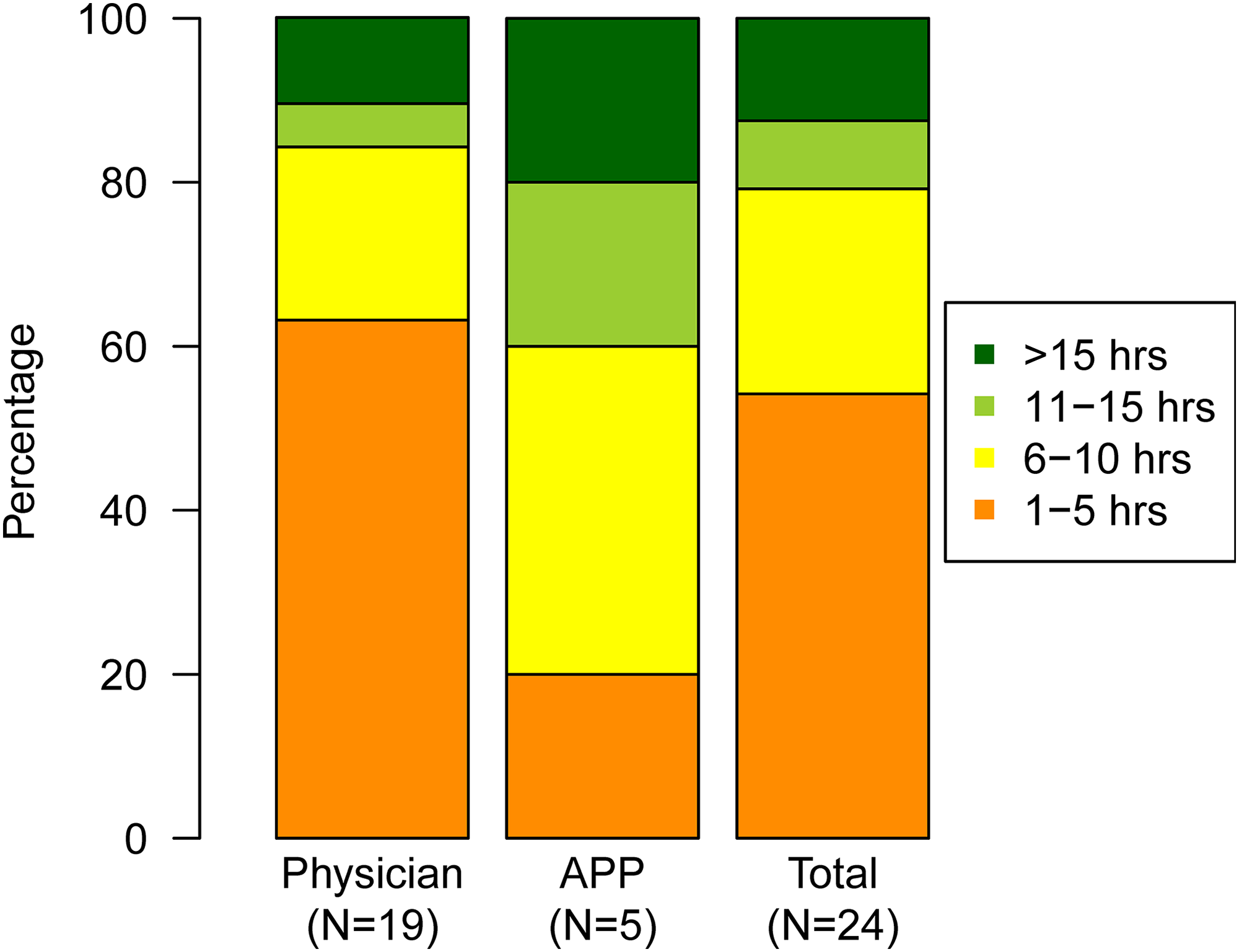
Most respondents (79.2%) strongly agreed that pharmacist integration allows more time for patient care and other professionally fulfilling activities. Respondents reported a median perceived weekly workload reduction of approximately 5 hours (Figure 1). Pharmacists were reported as involved in outpatient parenteral antimicrobial therapy (OPAT)/complex outpatient antimicrobial therapy (COpAT) (95.8%), human immunodeficiency virus (HIV) and nontuberculous mycobacteria (NTM) (91.7%), curbside consultations (83.3%), comprehensive medication management (75.0%), clinical staff drug education (58.3%), and chart review or eConsult (50.0%) (Table 1).
Estimated hours per week that clinical pharmacy services reduce workloada.
aDenominators may vary due to incomplete survey responses; percentages are calculated based on available responses for each item.

Over 90% of respondents agreed that pharmacists reduce emotional exhaustion when co-managing complex patients (83.3% strongly agreed, 12.5% somewhat agreed). Open-ended survey responses reflected that pharmacists are crucial members of the ambulatory care team. (Supplemental Table 1).
Discussion
In this cross-sectional survey, ID prescribers reported high satisfaction with ambulatory pharmacists in the ID clinic and perceived positive effects across key drivers of burnout: workload and job demands, meaning in work, efficiency and resources, and social support and community at work.
Most respondents agreed clinical pharmacy services decrease their workload, allowing them to see more patients or engage in other professionally fulfilling activities. This suggests pharmacists’ contributions to managing complex patients may reduce perceived task burden and support professional fulfillment. Respondents reported a median perceived workload reduction of 5 hours per week per respondent with 1 pharmacist full-time equivalent (FTE) per study site. A ratio of 1 pharmacist FTE to 5 hours of perceived workload reduction per prescriber could be further explored and validated.
In a multicenter, observational study, most prescribers (83.3%) engaged ID pharmacists for curbside consultations with an average time spent of 11.3 minutes per prescriber question. Reference Davis, Kufel and Kufel10 Inquiries regarding NTM and OPAT resulted in pharmacist-directed treatment changes in 96.8% and 95.5% of cases, respectively, further emphasizing the value pharmacists add to NTM and OPAT patient care. Additionally, HIV care had the greatest proportion of prescribers reporting this as their primary practice area. Our results on HIV pharmacists’ relationship with prescriber burnout add to the literature on clinical pharmacists’ utility in HIV care. Reference Molino Cde, Carnevale and Rodrigues11
Study limitations include its single health-system nature, including the survey instrument that has been utilized at a single institution. However, response rate was similar to the average for physician surveys. Reference Meyer, Benjamens, Moumni, Lange and Pol12 These results may not be generalizable to settings with different ID pharmacists. Further limitations include lack of control group, small sample size, self-reported outcomes, and no assessment of non-response bias. Additionally, impact on burnout of ID pharmacists was not measured. The American Hospital Association reported that 65% pharmacy professionals experienced burnout, the highest among healthcare professionals. 13 It is possible burnout within the broader healthcare team was not decreased but transferred to pharmacist(s). Future studies on this subject should incorporate pharmacists’ perspectives.
Our findings suggest ambulatory ID pharmacists positively influence key drivers of burnout among ID prescribers. Further research is needed to validate that 1 pharmacist reduces workload by 5 hours per week per prescriber allowing more time for patient care and other professionally fulfilling activities.
Supplementary material
The supplementary material for this article can be found at https://doi.org/10.1017/ash.2026.10847
Acknowledgments
The Mayo Midwest Pharmacy Research Committee (Mayo Clinic, Rochester, Minnesota) provided discretionary funding support for the investigator team. The Survey Research Center (Mayo Clinic, Rochester, Minnesota) assisted with the design and execution of the survey.
Financial support
There was no outside financial support for this study.
Competing interests
All authors report no conflicts of interest relevant to this study.



 Open access

