Central line–associated bloodstream infections (CLABSI) are common healthcare-associated infections that can lead to longer hospital stays and increased healthcare costs.Reference Han, Liang and Marschall 1 , Reference Whited and Lowe 2 Improved central line insertion practices have led to reductions in CLABSI rates in intensive care units (ICUs), but a substantial number of CLABSI occur among patients in non-ICU inpatient wards. 3 Of an estimated 250,000 CLABSI that occur in US hospitals annually, only approximately 80,000 occur in ICUs.Reference O’Grady, Alexander and Burns 4 Increased recognition of the problem of CLABSI outside of ICUs has led hospitals to expand CLABSI surveillance to non-ICU settings.
Central lines are commonly used outside ICUs. Although the proportion of patients with central lines is generally lower in non-ICU wards than in ICUs, the total number of non-ICU patients with central lines in any given hospital is often higher.Reference Climo, Diekema and Warren 5 – Reference Ajenjo, Morley and Russo 7 In addition, many patients in non-ICU settings have central lines in place for prolonged periods, which supports the use of interventions to improve central line use and maintenance practices as a means to prevent infection.Reference Kallen, Patel and O’Grady 8 Reported CLABSI rates in non-ICU settings range from 2 to 6 per 1,000 line-days,Reference Ajenjo, Morley and Russo 7 – Reference Trick, Miranda, Evans, Charles-Damte, Reilly and Clarke 14 which is similar to rates observed in ICUs before implementation of interventions to reduce CLABSI.Reference Marschall, Leone, Jones, Nihill, Fraser and Warren 10
Adherence to best practices for central line care after insertion is a well-established method to prevent CLABSI. Several organizations have noted the importance of central line maintenance practices in CLABSI prevention and have recommended that central line care be a focus of performance improvement and quality assurance in all programs.Reference Chopra, Krein, Olmsted, Safdar and Saint 15 , Reference O’Grady, Alexander and Burns 16 Nationally published guidelines provide specific catheter care recommendations, including education of healthcare personnel responsible for catheter maintenance; disinfection of hubs, needleless connectors, and injection ports before catheter access; use of chlorhexidine skin preparation with alcohol for skin antisepsis; and routinely changing transparent dressings every 5–7 days and gauze dressings every 2 days or whenever soiled, loose, or damp.Reference Chopra, Krein, Olmsted, Safdar and Saint 15 – Reference Marschall, Mermel and Classen 17 Yet, despite recognition of the importance of central line maintenance in relation to CLABSI prevention, adherence to best practices may be inadequate in non-ICU wards, which have not generally been included in CLABSI prevention efforts.Reference Trick, Vernon, Welbel, Wisniewski, Jernigan and Weinstein 6
The purpose of this study was to develop, implement, and evaluate a central line care maintenance bundle designed to optimize central line maintenance practices and reduce CLABSI in non-ICU settings at a large, academic medical center. Prior studies have demonstrated the effectiveness of bundled educational and behavioral interventions in improving compliance with recommended catheter care practices and reducing CLABSI incidence.Reference Coopersmith, Rebmann and Zack 18 – Reference Warren, Zack and Mayfield 24 However, most of these studies have focused exclusively on ICUs. We hypothesized that similar bundled interventions might reduce CLABSI incidence in non-ICU settings.
METHODS
Setting and Design
This before-after study with control group was conducted at Barnes-Jewish Hospital, a 1,250-bed urban tertiary care academic medical center. The study included all adult inpatients in 8 general medicine wards who had central lines in place for 1 or more days from July 1, 2012, through December 31, 2013. There were no exclusion criteria. Four wards were randomly selected to receive the intervention and 4 wards served as controls. Intervention and control wards had separate nursing leadership and staff nurses did not rotate between wards.
CLABSI prevention policies at Barnes-Jewish Hospital follow nationally published guidelines and emphasize proper dressing change procedure, chlorhexidine skin antisepsis, disinfection of catheter hubs/needleless connectors/injection ports prior to access, and daily reassessment of the need for continued central line access.Reference Han, Liang and Marschall 1 Education and training on central line care policies and procedures is provided to staff on an annual basis.
Intervention
A multifaceted, central line care maintenance bundle was developed focusing on maximizing aseptic technique for accessing catheters for blood draws and medication/fluid administration. The intervention bundle consisted of educational programs for nurses emphasizing catheter/dressing care; enhancement of hospital catheter-care policies; visual aids illustrating proper catheter care techniques, including accessing hubs; competency assessment; process monitoring; and consolidation/standardization of the supplies necessary for optimal central line maintenance into a convenient package located in a standard location on the study wards. Key components of the bundle included photo slides with pictures showing proper procedure for changing catheter dressings and regular feedback of data summarizing direct observations of catheter dressings and insertion sites for ward patients. Other measures associated with CLABSI prevention (ie, hand hygiene observations and training on catheter insertion practices) were already in place throughout the hospital before the start of the study.
The intervention bundle was implemented between October and December 2012. A 3-month preintervention period (July-September, 2012) preceded bundle implementation and was used to establish baseline catheter care practices and CLABSI rates. We collected data for the 12 months following the intervention period to determine the impact of the intervention once it had been fully implemented.
Data Collection
Patients with central lines were identified using hospital electronic medical records. Demographic and hospitalization data were also abstracted from electronic records, including age, race, sex, dates of hospital admission, and catheter start and end dates. For patients who had catheter-days on more than 1 study ward during their admission, the total number of catheter-days on intervention and control wards was calculated. Pharmacy records were used to determine the use of chemotherapy (all antineoplastic agents excluding hydroxyurea) and corticosteroids (ie, prednisone, hydrocortisone, or dexamethasone). Laboratory data were used to identify patients with neutropenia (ie, absolute neutrophil count <500 cells/microliter).
Throughout the study period, trained research assistants conducted twice weekly observations of existing central line dressings on each study ward. Observations were standardized and included whether the dressing was secured and intact; whether the dressing was clean and dry; whether the dressing was expired (48 hours for gauze dressings, 7 days for transparent); whether there was purulent discharge; whether the central line was secured; and whether the dressing was dated (date written on the dressing or recorded in the electronic medical record). These measures were used to calculate an overall dressing compliance score, with observations that met all 6 criteria being labeled as 100% compliant.
Reports summarizing dressing observation data and CLABSI rate data were regularly shared with staff on intervention wards as part of the intervention. These reports included data for each intervention ward and the combined data from all 4 intervention wards. Reports were shared with staff at monthly meetings during the intervention period and given to the nursing managers on each intervention ward every 2 months during the follow-up period.
Incident CLABSI data were collected via the hospital’s automated Non-ICU CLABSI Surveillance system.Reference Woeltje, McMullen, Butler, Goris and Doherty 25 The Non-ICU CLABSI Surveillance system applies an algorithm to electronic patient and microbiology data to identify CLABSI in non-ICU wards. The algorithm identifies positive blood cultures that are hospital-acquired (occur ≥48 hours after admission); positive for a noncommon skin contaminant; associated with a patient who had a central line in place in the 48 hours before the culture; and not associated with a positive culture of the same organism from another body site.Reference Woeltje, McMullen, Butler, Goris and Doherty 25 A study comparing the Non-ICU CLABSI Surveillance algorithm to manual medical chart review using National Healthcare Safety Network definitions to identify CLABSI determined that the Non-ICU CLABSI Surveillance system had 95% sensitivity and 97% specificity.Reference Woeltje, McMullen, Butler, Goris and Doherty 25
CLABSI were attributed to the ward where the patient was hospitalized at the time of infection. Infections were labeled early CLABSI if they occurred less than 14 days after the first recorded catheter-day; infections that occurred 14 or more days after line insertion were labeled late-onset CLABSI. This cutoff was based on the observation that intraluminal contamination increases after a catheter is in place for 2 weeks.Reference Frasca, Dahyot-Fizelier and Mimoz 26 Microbiologic data were obtained for each CLABSI to identify microbiologic etiology. Catheter-day denominator data were abstracted from medical informatics using midnight census data.
The study protocol was reviewed and approved by the Washington University Human Research Protection Office. The need for written informed consent was waived because this was a quality improvement project.
Analysis
The characteristics of patients on intervention vs control wards were compared using χ2 and t tests. Central line duration for intervention vs control wards and for patients who did vs did not develop CLABSI was compared using Mann-Whitney tests. Monthly device utilization ratios (catheter-days/patient-days) were calculated to identify potential differences in use of central lines over time. Dressing observation data from the preintervention period vs the combined intervention/follow-up period were compared using χ2 tests to evaluate the impact of the intervention bundle on catheter care practices. CLABSI incidence densities were calculated for the combined intervention and control wards, both before intervention and during intervention/follow-up. The effect of the intervention on the monthly CLABSI rate was evaluated using regression models with autoregressive integrated moving average errors, to account for the autocorrelation of errors over time.Reference Hyndman and Athanasopoulos 27 Microbiology data were evaluated to identify the types of organisms associated with CLABSI. The proportion of early vs late CLABSI during the preintervention vs intervention/follow-up periods was compared using Fisher exact tests. Data were analyzed using SPSS Statistics, version 21.0 (IBM), and R Statistical Software, version 3.2.3 (R Core Team).
RESULTS
There were 25,542 catheter-days associated with 5,054 admissions during the study period; 13,394 catheter-days occurred on intervention wards and 12,148 on control wards. There were 4,410 catheter-days during the preintervention period, 4,249 during the intervention period, and 16,883 during the follow-up period. Forty-three CLABSI were identified, 26 (60.5%) on intervention wards and 17 (39.5%) on control wards. Ten CLABSI occurred during the preintervention period, 6 during the intervention period, and 27 during follow-up. Eighteen infections (41.9%) were classified as late-onset CLABSI.
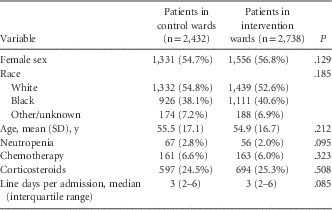
There were no significant differences in patient demographic characteristics or in chemotherapy or corticosteroid use for patients on intervention vs control wards (Table 1). The median number of catheter-days per admission was 3 for both intervention and control wards (P=.085) and remained stable throughout the study period (data not shown). The device utilization ratio was also similar for intervention and control wards (0.31 for intervention floors and 0.32 for control floors) and remained stable throughout the study (0.30 before the intervention vs 0.31 during/after the intervention on the intervention wards and 0.32 both before and during/after the intervention on the control wards).
Comparison of Patient Demographic Characteristics by Intervention Status in Study of Use of Central Line Care Maintenance Bundle to Reduce Central Line–Associated Bloodstream Infection in Non–Intensive Care Unit Settings

NOTE. Data are no. (%) of patients unless otherwise indicated.
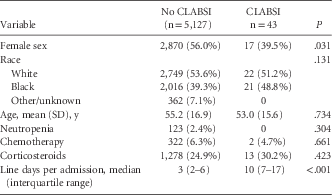
Males were more likely to develop CLABSI than females (60.5% of CLABSI patients were male vs 44.0% of non-CLABSI patients; P=.031) (Table 2). Patients who developed CLABSI also had a longer median duration of catheterization than patients who did not develop CLABSI (10 vs 3 days; P<.001).
Comparison of Patients by Central Line–Associated Bloodstream Infection (CLABSI) Status in Study of Use of Central Line Care Maintenance Bundle to Reduce CLABSI in Non–Intensive Care Unit Settings

NOTE. Data are no. (%) of patients unless otherwise indicated.
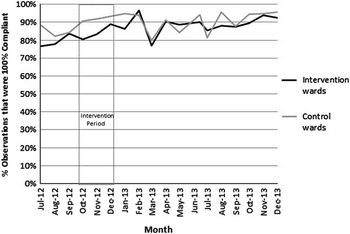
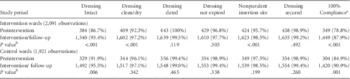
A total of 4,012 central line dressing observations were made for the study: 801 during the preintervention period, 579 during the intervention period, and 2,632 during the follow-up period. Approximately 55% of observed lines were single- or double-lumen peripherally inserted central catheters. The remainder were triple-lumen nontunneled central lines or dialysis catheters. There was no significant difference in the proportion of peripherally inserted central catheters on the intervention vs control wards (54.1% vs 56.1%; P=.183). The results of the dressing observations is shown in Table 3. The proportion of dressings observed to be 100% compliant (meeting all 6 compliance measures) was higher on control wards than on intervention wards during the preintervention period (84.9% vs 78.8%; P=.026) and remained higher during the intervention/follow-up period (90.9% vs 87.9%; P=.007). On intervention wards, the proportion of dressings achieving 100% compliance increased from 78.8% before intervention to 87.9% during intervention/follow-up (difference, +9.1%; P<.001) (Figure 1). However, dressing compliance on control wards also improved during the study period, with the proportion of 100% compliant dressings increasing from 84.9% before intervention to 90.9% during intervention/follow-up (difference, +6.0%; P=.001).
Proportion of central line insertion sites/dressings that were 100% compliant (6/6 measures) for the combined intervention and control wards.

Comparison of Dressing Observations, by Period and Intervention Status, in Study of Use of Central Line Care Maintenance Bundle to Reduce Central Line–Associated Bloodstream Infection in Non–Intensive Care Unit Settings

a Composite score incorporating all 6 of the individual dressing quality measures; dressings observed to have 6 of 6 measures compliant were defined as being 100% compliant.
b Comparison of preintervention to intervention/follow-up period.
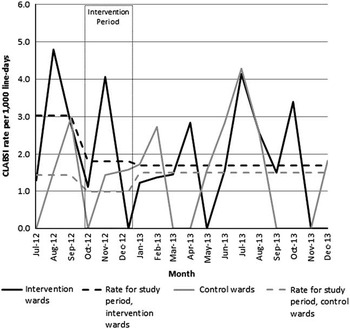
On the intervention wards, the preintervention CLABSI incidence density was 3.02 per 1,000 catheter-days vs 1.72 per 1,000 catheter-days during/after the intervention (incidence rate ratio, 0.57). On the control wards, CLABSI incidence was 1.43 per 1,000 catheter-days before the intervention vs 1.39 per 1,000 catheter-days during/after the intervention (incidence rate ratio, 0.97) (Figure 2). Autoregressive integrated moving average analysis indicated that, during the study period, the monthly CLABSI incidence density decreased at a rate of 2.5% per month on the intervention floors (−2.5% [95% CI, −5.3% to 0.4%]), though this decrease was not statistically significant. On control floors, the monthly CLABSI rate decreased at a rate of 1.1% (−1.1% [95% CI, −2.1% to −0.1%]), which was marginally significant. There was no statistically significant difference in mean CLABSI incidence rates for the intervention vs control wards during the preintervention period (incidence rate ratio, 2.10 [95% CI, 0.56–7.89]) or during the intervention/follow-up period (incidence rate ratio, 1.23 [95% CI, 0.62–2.45]).
Central line–associated bloodstream infection (CLABSI) rates over time by intervention status for the combined intervention and control wards, with mean rate by study period.

For the CLABSI that occurred during the study period, the types of organisms identified upon microbiologic analysis included gram-positive aerobes (37.7%), gram-negative aerobes (31.9%), anaerobes (15.9%), and fungi (13.0%). There was no association between early vs late CLABSI status and the types of organisms identified (P=.651). Eighteen CLABSI (41.9%) were polymicrobial. The proportion of CLABSI that was late-onset in the preintervention period vs the intervention/follow-up period was similar in the intervention wards (4/7 [57.1%] vs 9/19 [47.4%]; P>.99) and in the control wards (0/3 [0%] vs 5/14 [35.7%]; P=.515).
DISCUSSION
We found that implementation of the central line care maintenance bundle was associated with improved insertion site care on both intervention and control wards. The intervention was also associated with a decrease in CLABSI incidence on the intervention floors, although this decrease was not statistically significant, and a smaller but marginally significant decrease on control wards.
The dressing observation data revealed gaps in catheter care practices on both intervention and control wards. Problems with improperly dated or undated dressings have been reported in other studies of catheter care practices.Reference Rupp, Cassling and Faber 28 In the survey of nurses that we conducted to inform this study, nurses frequently mentioned undated dressings as being a barrier to performing dressing changes (data not shown). Further work is needed to facilitate accurate recording of dressing changes and to integrate reminders into electronic medical record systems.
We also found that baseline compliance with optimal dressing care practices was higher on control wards than on intervention wards. In addition, while there was a 9.1% improvement in compliance on intervention wards between the preintervention and intervention/follow-up periods, there was a 6.0% improvement in compliance on control wards over the same periods. This indicates that larger secular trends in improved dressing care hospital-wide may potentially account for some of the observed improvement. Overall baseline compliance with optimal dressing care practices was high on both intervention and control wards even at baseline (78.8% and 84.9%, respectively). This is in contrast to previous observational studies at other teaching hospitals, where dressing and insertion site care noncompliance was reported to be 31%–44.8%.Reference Rupp, Cassling and Faber 28 , Reference Shapey, Foster, Whitehouse, Jumaa and Bion 29
Improvement in catheter care practices on intervention wards following introduction of the central line care maintenance bundle was correlated with a 43% decrease in CLABSI on intervention floors; however, this decrease did not achieve statistical significance. There was a smaller but marginally significant decrease in the CLABSI rate on control wards, along with improvement in catheter care practices during the study period. It is possible that, because compliance with catheter care practices in these wards was already high at baseline, the impact of further improvements was minimized. It is also possible that hub disinfection practices did not change in response to the intervention, reducing the impact on CLABSI incidence. However, it is also possible that the observation period was too short to detect a significant change in rates over time, especially because the rates in some wards were zero over some months. Further study is needed to determine why better catheter maintenance did not lead to lower CLABSI rates.
Examination of microbiology data identified gram-positive and gram-negative aerobes as the most common sources of infection for the CLABSI identified during the study period, with many patients having multiple organisms identified upon blood culture. There was no statistical difference in the proportion of CLABSI that were late-onset during the preintervention vs intervention/follow-up periods on either intervention or control wards. However, the small number of CLABSI patients in this sample would have made any differences difficult to detect.
In our study population, patients with central lines who developed CLABSI were more likely to be male and had longer average catheter duration than patients with central lines who did not develop CLABSI. Male sex has previously been identified as a risk factor for catheter-related BSI in studies involving ICU patients,Reference Zingg, Imhof, Maggiorini, Stocker, Keller and Ruef 30 , Reference Lissauer, Leekha, Preas, Thom and Johnson 31 and longer catheter duration is well known to increase risk for CLABSI owing to extended exposure to risk.Reference Frasca, Dahyot-Fizelier and Mimoz 26 , Reference Klevens, Edwards and Richards 32
Strengths of this study include a focus on CLABSI prevention in non-ICU settings, direct observation of catheter insertion site care practices, and detailed microbiology data. The main limitation of this study was the small number of patients who developed CLABSI, which made it difficult to determine the impact of the central line care maintenance bundle on CLABSI incidence.
Reduction of CLABSI incidence within ICUs in the United States over the past decade has been a major success in the field of healthcare-associated infection prevention.Reference Fagan, Edwards, Park, Fridkin and Magill 33 Translation of these benefits to patients outside the ICU is needed. Additional studies are still needed to determine the optimal strategy to make this occur.
ACKNOWLEDGMENTS
We thank Candice Cass and Rachel Hartzell, for their assistance in conducting this study; and the nursing staff at Barnes-Jewish Hospital, for their cooperation, without which this study would not have been possible.
Financial support. Centers for Disease Control and Prevention (CDC) Prevention Epicenters (grant 1U54CK000162-01).
Potential conflicts of interest. All authors report no conflicts of interest relevant to this article.
SUPPLEMENTARY MATERIAL
For supplementary materials referred to in this article, please visit http://dx.doi.org/10.1017/ice.2016.32