Introduction
This article investigates the extent to which antipoverty programmes known as the Social Missions in Hugo Chávez's Venezuela represent a real rupture in Venezuelan social policies. Venezuela, like most Latin American countries, possesses a system of social protection that is both hybrid and highly fragmented. Social security is contributory based and linked to occupational status, with high coverage for workers in the public sector and almost no coverage for workers in the informal economy. In the 1950s and 1960s, the state played a crucial role in economic and social development under the auspices of a Keynesian/social investment paradigm. The state extracted resources from staples export and import of manufactured goods in order to achieve a pattern of inward growth, based on de-coupling from Western economies (Filgueira, Reference Filgueira2005: 10; Munck, Reference Munck2008: 53). In 1958, the Punto Fijo regime established a social pact between the two main governing parties and the trade unions based on the petro state's role as entrepreneur, employer and provider of social welfare. As in other Latin American countries, there was a strong aspiration to provide health care and education on a universal basis (Abel and Lewis, Reference Abel, Lewis, Abel and Lewis2002; Barrientos, Reference Barrientos, Gough and Wood2004; Draibe and Riesco, Reference Draibe, Riesco and Riesgo2007; Filgueira, Reference Filgueira2005). This model came to a halt in the 1980s, when the dependency on oil revenues appeared to be no longer sustainable.
Like most Latin American governments in the 1980s and 1990s, the government of Carlos Andrés Pérez implemented austerity measures referred to as the Gran Viraje (the Great U-Turn). The Venezuelan social pact – the redistribution of oil revenues to the majority of the population in exchange for political support for the regime – was in practice dismantled. In an effort to contain the rising tide of poverty, the government implemented ad hoc cash transfer programmes, with little success. It was in this context that Hugo Chávez became head of the Venezuelan state in 1998. The new president promised to break away from the neo-liberal policies of his predecessors and to place human welfare at the heart of the ‘Bolivarian Revolution’ (1998–present).
In 1998, a new social policy paradigm was developed based on the idea that the enabling state had to encourage bottom–up initiatives in order to ensure that local communities effectively manage and own social policies. What emerged was a form of positive discrimination for poor people since the state had to ensure universal access to basic social services such as health, education and nutrition, while at the same time ensuring preferential access to these services for the most vulnerable (Pozas, Reference Pozas2005: 105). The Missions are based on the politics of targeting since they are established in areas with high poverty rates. To live above the poverty line one must be able to buy two baskets of goods per person in a given household. In 2010, the international poverty line is US$1.25 a day. Individuals whose daily income is less than US$1.25 a day fall into the extreme poverty or indigence category. Given that such indicators are not always readily available, the government often uses the high density of ranchos (crudely brick-built and often precarious slum dwellings) as a proxy for indentifying poor urban areas, where a majority of resources are being concentrated. The new social policy model can be best defined as a sort of local universalism, in the sense that there is a real effort to eradicate poverty and to address all dimensions of social exclusion. It must be noted, however, that the government has so far been unable to reform the social security system in order to provide universal coverage to all citizens, regardless of their occupational status. This means that this universalism remains an aspiration rather than a reality.
This tension between universalism and targeted support for poor people is at the heart of the current debate on social policy in Venezuela. Partisans of a universal-institutional social policy model argue that the focus on low-income individuals operates to the detriment of universal social services such as health care, thus undermining the establishment of a legal framework of social rights guaranteed by the Constitution of 1999. But support for poor people is the government trademark, thus making it particularly difficult for Hugo Chávez to switch back to a more universal logic. The question can be summarised as follows: are the Missions rooted in a sustainable model that seeks to increase the state's institutional capacities? Or do they represent a short-term response to pressing social needs, and as such a failure to break away from past social experiences in Venezuela?
This article is divided into three sections. The first section characterises the Venezuelan social state based on the development state literature. The second section analyses the development of the Missions, notably the Mission Vuelvan Caras, now Che Guevara. This section is based on the qualitative case-study method. The fact that the government does not publish rigorous quantitative data means that researchers face more serious difficulties in getting access to reliable governmental publications than is usually the case in less polarised environments. As a result, most of the sources are secondary and of qualitative nature. Secondary sources include in particular unofficial evaluation studies commissioned by the National Institute for Social investigations, el Instituto Latinoamericano de Investigaciones Sociales, ILDIS. The ILDIS is a think tank with a social and political modernisation agenda funded by the German foundation Friedrich Erbert. The ILDIS publishes comprehensive and critical assessment of social policies in Venezuela. Primary sources result from a series of ten semi-structured interviews (in Spanish) with government officials in the Fundación Che Guevara and the Ministerio del Poder Popular para las Comunas y Protección Social (MINEP), the department in charge of social affairs, and in the Misión Madres del Barrio. These interviews were conducted during a research trip in Caracas in September 2008. In April 2010, the author conducted five further semi-structured interviews with officials from the Missions Che Guevara and Madres del Barrio. In addition to these formal interviews, the author visited local development projects in Caracas and in the city's surroundings, near the airport Simon Bolivar. These visits provided the opportunity to conduct informal conversations with officials and beneficiaries, thus amounting to a form of semi-ethnographic research. In particular, in September 2008, Emma Hermoso, the vice-minister for the Ministerio del Poder Popular para la Economía Comunal (MINEC, now MINEP) in charge of social affairs, kindly organised the visit to a ‘socialist commune’, la comuna Gual y España. Gual y España had been inaugurated by President Chávez at the end of August 2008 and was subsequently portrayed as a successful example of what a local alternative to capitalism could look like. It was then that the author conducted a series of informal conversations with the militaryFootnote 1 – as well as with various cooperative workers and the representative of the MINEC who was in charge of organising the visit.
This form of semi-ethnographic research is not completely objective, and the author is of course aware of potential cultural bias or even ideological bias on her part. New forms of social experiments, with their emphasis on community participation at the grassroots level, can appear to be amateurish because they lack the form of technocratic expertise that dominates public policy-making in the Western world. As a result, the argument presented here is founded on the author's interpretation of secondary sources, interview data and informal observations and conversations. The third section provides an assessment of the Missions and identifies ruptures and continuities with previous social assistance policies.
The Venezuelan state in comparative perspective and the crisis of rentismo
The Venezuelan social state is best defined as an informal-conservative welfare state. In the 1990s, Latin American societies were characterised by a high level of informal employment: informal sector employment represented 47 per cent of total employment, with 52 per cent for Venezuela (Gerstenfeld, Reference Gerstenfeld, Abel and Lewis2002: 58). Households and families provided the main protection against social risks, such as loss of income due to unemployment, old age or ill health, although the capacity of families to protect individuals against such risks is declining (Barrientos, Reference Barrientos, Gough and Wood2004: 124–129).
In the typology of Esping-Andersen, the welfare state in Latin America is conservative/corporatist because the most important component of the nascent social protection system is social insurance, but on a highly selective and occupational basis. The social insurance fund, el Instituto Venezolano de los Seguros Sociales (IVSS), is extremely fragmented. It is constituted of an agglomeration of specific insurance funds, each fund catering for the needs of its contributing employees according to a corporatist and clientelist logic. Since 52 per cent of Venezuelan workers work in the informal economy, the IVSS does not protect half of the labour force against social risks such as ill health, old age and unemployment. In the absence of any serious attempt to unify and rationalise the IVSS, this corporatist and clientelist logic has become increasingly exclusionary (Polanco, Reference Polanco and Maingon2006: 230–2).
The Venezuelan social state emerged in its modern form after 1958. The social protection system was universalist, in the sense that the state guaranteed access to health and education, in order to improve the level of human capital and modernise the country. This project of social and economic modernisation was predominant in the 1950s, 1960s and to a lesser extent the 1970s. The benefits of oil revenues were redistributed to the middle class and to a much lesser extent the working class through social programmes, mainly health, education and subsidised goods and services. This policy was known as ‘sowing the oil’ (International Crisis Group, 2007: 3). But the major contradiction of this model of social protection laid in its fragmentation and its stratification; access to social insurance was conditioned by occupational status, with a divide between rural and urban workers, private and public sector employees, formal and informal sector employees (D'Elia et al., Reference D'Elia, Lacruz, Maingon and Maingon2006: 195).
In the 1980s, political elites initiated a radical change in the direction of social policy, from a universalist model towards a compensatory social assistance model. Means-tested policies took the form of conditional cash transfer programmes and were designed to mitigate the impact of neo-liberal economic policies on the most vulnerable sections of the population, mainly families, children and older people.
In the early 1980s, Venezuelan society was faced with three main pressures: the explosion of external debt from 1983, the lack of diversification of the national economy which reinforced the dependency on oil rents, and lastly the exhaustion of a redistributive system which had helped maintain a form of social peace in the 1960s and 1970s (Salamanca, Reference Salamanca1994; Kornblith, Reference Kornblith1994). Between 1979 and 1989, under the leadership of the governments of Luis Herrera Campins (1979–84) and Jaime Lusinchi (1984–89), foreign debt escalated, increasing from $9 billion in 1979 to $30 billion in 1989 (Coronil, Reference Coronil1997: 370–1). Moreover, the quality of public services deteriorated sharply, especially in health and education. The poverty rate, defined in terms of individual ability to buy a basket of basic goods and services, increased from 31 per cent in 1981 to 53 per cent in 1989 (CEPAL, 2008: 8).
The government of Carlos Andrés Pérez announced the implementation of a structural adjustment plan, the Gran Viraje. This policy meant dismantling the network of protections that was at the heart of the social pact established by the Punto Fijo Republic (Coronil, Reference Coronil1997: 376). Neo-liberal economic policies based on wage restraint and a laisser-faire approach vis-à-vis the labour market were advocated by a group of economists trained in North American universities. These economists belonged to the best business school of Caracas, el Instituto de Estudioses Superiores de Administracion (IESA). These ‘IESA boys’ were given senior positions in the new administration (Di John, Reference Di John2005). They believed that universal social policies were ineffective. Indeed, it was widely held in the 1980s and 1990s that it was best to concentrate spending efforts on the poorest sections of the population, especially women and young children (Mkandawire, Reference Mkandawire2005).
In this context, Carlos Andrés Pérez launched the Anti-Poverty Programme, Plan de Enfrentamiento a la Pobreza (PEP) in 1989–90 (Chacín, Reference Chacín2003: 27). The PEP was very much inspired by the New Social Policy Agenda promoted by the World Bank in the 1990s (Mkandawire, Reference Mkandawire and Mkandawire2004; Molyneux, Reference Molyneux2006: 429–31). Four major principles underpinned the New Social Policy Agenda: (1) decentralised social services are deemed more efficient than central state bureaucracies; (2) non-governmental organisations (NGOs) play an active role in service delivery and policy design at grassroots levels; (3) empowerment of programme beneficiaries is promoted through community participation; and (4) programmes are administered by independent administrative units in order to bypass traditional state agencies.
The PEP included programmes such as direct food subsidies for families in need (Beca Alimentaria), child care centres in poor neighbourhoods and rural areas, nutritional supplement for expecting mothers and the newborn (PAMI), a social investment fund aimed at financing urban infrastructure in the barrios (FONVIS) and support for micro-enterprise programmes. An intergovernmental unit, la Comisión Presidencial para el Enfrentamiento de la Pobreza, supervised policy coordination and implementation (Navarro, Reference Navarro and Savedof1997: 30–66). The Ministry of Family became responsible for programme design and implementation, but, as a result of weak institutional capacity at the central level, the government came to rely on ad hoc parallel organisations, the foundations or social funds which were set up to support community initiatives and which involved emergent NGOS. Each foundation was responsible for the implementation of a specific programme (Foundations PAMI, FONVIS, FONCOFIN, etc.). These foundations bypassed the traditional state structures, which were seen as inefficient and lacking flexibility and reactivity. The creation of parallel structures to government agencies has been and remains a central element of social assistance programmes in Latin America (Barrientos and Santibáñez, Reference Barrientos and Santibáñez2009: 7). These compensatory programmes became institutionalised and were placed under the responsibility of the Venezuelan Agency in 1996. The Venezuelan Agency administered no fewer than 14 social assistance programmes, especially support for the most vulnerable sections of the population (family benefits, nutritional supplement programme distributed in schools, nutritional programme for expectant mothers and newborns as well as pre and post-natal care, PAMI).
Employment and activation programmes (vocational education for young people)
Antipoverty programmes were characterised by a lack of political and institutional accountability, high spending volatility and short-term opportunistic bureaucratic behaviour. As policy implementation relied on ad hoc units created outside the remit of traditional ministries, there was a frequent turf war between these new ad hoc units and the traditional ministries that continued to control part of the programme operation, thus jeopardising effective programme implementation and coverage (Navarro, Reference Navarro and Savedof1997: 46–52).
The inability of the traditional governing elites to come up with alternative policies, as well as their perceived indifference to the population's plight, accentuated the crisis of legitimacy and representativeness of the Punto Fijo Republic. Against this background, Hugo Chávez was swept into power by a heterogeneous coalition, with elements from the far left, but also the traditional right.
The Missions: analysis of a social programme
When Hugo Chávez became President in 1998, he inherited a deeply impoverished and highly polarised country. However, the government did not break away from prudent economic management (Buxton, Reference Buxton, Ellner and Hellinger2003: 124). Instead, the government stabilised the economic situation and designed a new constitution, the Bolivarian Constitution of 1999. The new administration was fully committed to the idea of a universal welfare state with a right to ‘life, work, culture, education, social justice and equality’, as formalised by Title III of the new constitution (Buxton, Reference Buxton, Ellner and Hellinger2003: 127). Central to the Bolivarian social model was the idea of empowerment of the poor through community participation and NGOs’ involvement in social policy initiatives (Buxton, Reference Buxton, Grugel and Riggorizzi2007). Although the government did not implement new social innovations, at least during the period 1999–2003 (Chacín, Reference Chacín2003; Maingon, Reference Maingon2004), it nevertheless recalibrated previous antipoverty programmes. It also created a Unified Social Fund (FUS) in order to centralise all budgetary initiatives for social programmes (Penfold-Beccera, Reference Penfold-Becerra2007). However, the only real innovation was the Plan Bolivar 2000 directly managed by the armed forces.
In 2003, as the country dipped into a political and economic crisis aggravated by a failed coup and an oil strike, Chávez's popularity among his core constituency severely deteriorated: support for Chávez among the lowest income group was about 34 per cent, down from 94 per cent at the start of the administration (Corrales, Reference Corrales2005: 113). The degradation of living standards of poor and middle-class people obliged the government to provide a quick response to pressing social needs. Indeed, poverty rates (the proportion of individuals in households unable to buy basic goods and services) started rising again in 2001, from 39 per cent in 2001 to 55.1 per cent in 2003. Meanwhile, extreme poverty (the proportion of individuals estimated to be living on the equivalent of less than US$1.25 per day) rose from 14.4 per cent in 2001 to 25 per cent in 2003 (Molina, Reference Molina2003). The government created a series of emergency social programmes, the Missions, in order to attend to the basic needs of low-income individuals in terms of nutrition, health and education. The Missions played an important role in the electoral mobilisation of Chávez's key constituency during the campaign for a recall referendum initiated by the opposition in 2004. The government ran a highly successful electoral campaign based on the theme ‘Que no te quiten tus misiones’ (‘Don't let them take your missions’).
The Missions are national social assistance programmes regulated by national legislation. They are grounded on a multi-dimensional view of poverty, and aim to act on several dimensions of poverty at once (Barrientos and Santinabez, 2009: 12). They target the poorest and use a variety of selection methods, including geographical proxies such as the number of ranchos in a given area and means tests. The Missions are funded mainly by the central government budget and by oil revenues from the national oil company, PdVSA (Petróleos de Venezuela). Each Mission is created by a presidential decree, which defines the budget of the Mission.
The best-known and popular Missions, Barrio Adentro and Mercal, were originally created in the municipality of Caracas in 2003 in order to attend to urgent health and alimentation needs. In February 2003, the city of Caracas asked the Cuban government to send Cuban doctors to deprived neighbourhoods, the barrios. Health care centres were set up in the heart of the barrios and Cuban doctors provided on-site services. The programme was first piloted on an experimental basis, and was then rolled out nationally. In December 2003, Hugo Chávez created by decree the Mission Barrio Adentro. The Mission Mercal provided subsidised food in government-sponsored cooperatives. Mercal responded to the food crisis provoked by the general strike in February 2003. The programme was rolled out nationally when Chávez created Mercal by decree in December 2004.
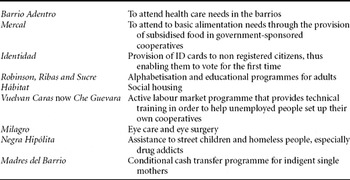
From 2004, the government used the massive windfall in oil revenues to fund the expansion of the Missions; the government created a new Mission each time it identified a new social need. There were approximately 30 Missions in 2008 (Aponte, Reference Aponte2007). Table 1 provides an overview of the main Missions and their objectives.
Overview of the main Missions

The Missions are ad hoc administrations, parallel to the state. The foundations administer the budgetary resources. In practice, each Mission is placed under the authority of the presidency, bypassing the authority of the ministries. Each Mission has a special budget. Volunteers from the NGO sector or social movement (or both), referred to as facilitadores, play an important role in the operation of the Missions. The facilitadores work in the barrios either as social workers or instructors, sometimes both, in exchange for a meagre salary. In executive posts, public employees are nominated on the basis of a Venezuelan spoil system. These posts are referred to as ‘cargos de confianza y libre remoción’, which means that employees are nominated on the basis of their political affiliation and the nomination be revoked at any point in time. For the opposition, the proliferation of the Missions is a symptom of three major flaws: a pattern of institutional improvisation, a lack of long-term planning and a clientelist redistribution of oil revenues to Chávez's key constituency, that is poor people. For the chavista administration, the Missions represent another way of making social policy more in touch with people's real needs and more flexible than old-fashioned social policies. The administration argues that traditional bureaucracies such as departmental governments cannot implement the outreach philosophy that is at the heart of the Missions. In particular, the Missions meet existing needs locally, by providing immediate access to social services via community engagement. The Missions rely on a network of volunteers as well as community organisations and beneficiaries to identify existing local social needs. Last but not least, the Missions are based on a holistic model of social inclusion which attempts to address individual needs (culture, education, health care, housing, employment, etc.) as well as local collective needs (endogenous development initiatives and cooperatives funded by micro-credits). The Missions represent, at least in theory, a social experiment which combines an individual-centred approach with a local development model. They have become the flagship social programmes of the government. Given the popularity of these programmes, the opposition has promised to retain the main Missions should they return to power.
Since 2004, the government has become increasingly radicalised (Buxton, Reference Buxton, Grugel and Riggorizzi2007). The Chávez administration has renamed the ‘Bolivarian project’ ‘Socialism for the 21st Century’, the contours of which can be defined by seven principles and objectives:
• There should be rejection of the former Punto Fijo ‘partyarchy’ and its redistribution of oil revenues to the upper and middle classes and its redirection to a fraction of the low-income individuals and the lower-middle class.
• The state should assume a proactive role in the economy as the motor of the revolution through the nationalisation of strategic industries and the promotion of economic development in textile, agriculture, manufacturing, tourism and infrastructure (frentes de batalla productivos).
• Economic development should be endogenous and rest upon an economic alliance in the region, so that the revolution can continue to export and import under economically advantageous conditions for all parties.
• The state should shape the forms of the protagonist democracy, notably by sponsoring and monitoring the Communal Councils (there is no independent civil movement).
• People must play an active role in the revolutionary process (idea of a permanent revolution) through civic engagement and involvement in the construction of a socialist economy.
• Market-led mechanisms should ultimately disappear and be replaced instead by alternative forms of resource allocation (state-led development, co-management, cooperatives).
• The socialist project should promote new values (altruism, solidarity, social utility of work as opposed to the pursuit of financial profit, consumerism and individualism).
It was in a context of increased political polarisation and radicalisation that the Mission Vuelvan Caras was created in March 2004. Vuelvan Caras was an active labour market programme, which helped the unemployed set up their own socio-economic projects through the provision of generic and specialist training. The aim was to create a model of endogenous development based on local socio-economic projects. An important component of the generic training course was to get recipients acquainted with new models of governance based on solidarity and social utility. One of the leading intellectual influences behind Vuelvan Caras was Carlos Lang, a member of the guerrillas in the 1960s–1970s. Lang developed the idea of productive battlefronts (frentes de batalla productivos) based on the collaboration between the people and the revolutionary government in order to transform the country's socio-economic structure through work and education. Participants were given a monthly allocation. Once they had received generic and specialised training, they were supposed to launch their own economic projects, mainly cooperatives. In 2004–05, Vuelvan Caras had recruited approximately 355,000 individuals, out of which 298,000 had received socio-economic training; 264,720 had been authorised to create their cooperatives. In total, 6,814 cooperatives had been created, as well as 130 units of endogenous development (Observatorio Socialista de Venezuela, 2008).
According to senior officials in the MINEC and in the Fundación Che Guevara, Vuelvan Caras represented a governmental failure because individuals were mainly attracted by the monthly allocation and because Vuelvan Caras did not create a network of economically sustainable cooperatives or social production enterprises. Five reasons account for this governmental failure.
First, the cooperatives faced tremendous difficulties in getting access to circuits of distribution controlled by big corporations; many projects were not economically viable, let alone profitable (d'Elia et al., Reference D'Elia, Lacruz, Maingon and Maingon2006: 76, Piñeiro, Reference Piñeiro2009). The government deplored the persistence of what it perceived to be a culture of greed and idleness. Most individuals enrolled in the programme only to receive the monthly allocation, a fact plainly acknowledged by the Vice-Ministry for Training and Communal Development, Emma Hermoso.Footnote 2 The problem, from the government's point of view, was that individuals were only motivated by greed, instead of being inspired by altruism and solidarity.
Second, as pointed out by the most complete assessment of the Missions to date (d'Elia et al., Reference D'Elia, Lacruz, Maingon and Maingon2006), the constitution of cooperatives reflected a culture of amateurism both on the participants’ and the government's sides. On the participants’ side, the following problems were identified: lack of managerial rigour (most cooperatives did not even use book accounts), use of the cooperatives as a means of increasing the flexibility of the workforce (exploitation) and internal rivalries between associates. On the government's side, there was insufficient support and follow-up available to the cooperatives, especially in terms of administration, accountancy and human resources management (d'Elia et al., Reference D'Elia, Lacruz, Maingon and Maingon2006: 77).
Third, a phenomenon of massive desertion occurred as a result of irregularities in the payment of the monthly allowances to the facilitadores and beneficiaries alike. For instance, in July 2004, the instructors in the state of Zulia organised a demonstration to protest against the suppression of their monthly allowance. From 2005, approximately 15,000 students quit the Mission. Indeed, the participants became demoralised and weary as they were also actively involved in educational Missions, in heath committees and in all the forms of community participation sponsored by the government. One interviewee explained in this respect:
From 2005 to 2006 we witnessed a movement of massive desertion. Field work studies showed that people became tired, especially as they had to deal with inefficiency in public administration and implementation.Footnote 3
Fourth, the programme suffered from a lack of interdepartmental coordination, since Vuelvan Caras was placed under the authority of four different departments (Department of Work, Department of Trade, Ministry of Defence and the National Institute for Educational Cooperation, INCE). To address this problem, the President placed the Mission under the authority of a single department, the Ministry of Communal Economy, MINEC, renamed MINEP, in charge of endogenous development projects. However, this measure failed to improve significantly interdepartmental coordination at the central level. Fifth, the programme suffered from a lack of continuity in terms of political orientations, especially as there was a high degree of turnover at the executive level. This process of permanent change became a clear obstacle to programme consolidation (Hintze, Reference Hintze2008).
This failure led to a recalibration of the programme in September 2007. The decree of 12 August 2008 established the Fundación Che Guevara to administer the Mission. One of the main objectives of the Mission is to engineer revolutionary social consciousness among its participants. In this respect, the creation of the Mission reflects the radicalisation of the ‘Bolivarian Revolution’. The Mission no longer aims to reduce unemployment but to create a new human being according to the terms of the economic and social plan of 2007–13.Footnote 4 The units of endogenous development (NUDES), the cooperatives and enterprises of social production represent the three major forms of the organisation of production that aim to change radically the structure of the economy. The underlying idea is that the new socialist economy will not be totally nationalised, as the private sector will continue to play an important role in wealth creation. However, the private sector will be crowded out by the development of the social and communal economy. The new goal is also to establish a socialist communal economy in partnership with the central government.Footnote 5 There is no longer a monthly allocation for programme participants.
In September 2008, personal observations based on informal conversations with the personnel in the MINEC and interviews with senior officials suggested that the Mission Che Guevara suffered from a high degree of turnover as young recruits were moved frequently between government departments. Almost all the interviewees in Che Guevara were very recent appointees. All interviewees had integrated the culture of permanent change associated with the last phase of the ‘Bolivarian Revolution’. They were ready to move to other posts should the revolution need their services in another programme. Adherence to change for the necessities of the revolution has become a real mantra and guiding principle of policy design. Such a culture of permanent change and turnover was detrimental to programme consolidation, let alone institutionalisation, as various studies have shown (D'Elia and Cabezas, Reference D'Elia and Cabezas2008; Hintze, Reference Hintze2008).
In April 2010, when I interviewed Francy Rodriguez, President of the Fundación Che Guevara, she confirmed that the Mission was in a ‘difficult situation’ and gave the ‘official line’ according to which the major problem with the Mission was the lack of ideological and political formation. The objective, she said, was to create ‘a new man whose actions are in agreement with his discourses and values. There is a new focus on quality, both in terms of socialist management, but also in terms of production.’ Asked to comment about the lack of institutionalisation, which had been identified as one of the major problems of the Mission, she acknowledged that this was an issue of concern. Indeed, each official is a political appointee, but the appointment can be revoked at any time, and Francy Rodriguez said ‘The Cubans criticised us for this, because there is no continuity in executive posts.’Footnote 6 The lack of institutionalisation represents one of the major problems facing not only the Mission Che Guevara but also the Missions in general. But this is hardly a new phenomenon in Venezuela's recent social history; indeed, antipoverty policies implemented by Hugo Chávez's predecessors equally suffered from a lack of institutionalisation. The issue of policy continuity and sustainability reflects the lack of state capacity and failing institutions, which constitutes an ongoing issue in Venezuela.
Ruptures and continuities
The Missions represent both a combination of ruptures and continuities. The first major innovation was the rise in social expenditure. Social spending as a proportion of the GDP increased from 8.8 per cent in 1990/91 to 11.7 per cent in 2004/05 (CEPAL, 2007). This measure takes into account all social spending programmes, including the Missions. For Penfold-Beccera (Reference Penfold-Becerra2007), total public spending for the Missions represented 6 per cent of the GDP in 2006. Clearly, the government of Hugo Chávez has made poverty alleviation a central political priority, using oil revenues to sustain the rise in social spending. It is the amount of money devoted to social investment and cash transfer programmes that represents a break from the management of previous administrations. This spending effort was made possible by the abundance of petrodollars from 2004, and by the fact that PdVSA was given a direct role in the social and economic development in the Constitution of 1999.
Second, the government achieved a major reduction in poverty rates as defined by the number of individuals living on less than US$1.25 a day. Between 1999 and 2001, poverty rates declined steeply, but rose again between 2001 and 2003, which explains Chávez's loss of popularity among his core constituency in 2002–03. However, the Missions were created in 2002–03, that is before oil prices started rising and, more importantly, before the government could draw additional revenues from the rising oil prices, which happened only in 2004. Therefore, to explain the creation of the Missions as a result of the surge in oil prices and subsequent governmental revenues would be a mistake. It is the degradation of living standards in 2002 and 2003 and the subsequent loss of legitimacy of the Chávez government that explained the creation of the Missions. The Missions then played a crucial role in the mobilisation of the electorate, especially with the Mission Identidad (Penfold-Beccera, Reference Penfold-Becerra2007). Between 2005 and 2006, headcount poverty rates decreased from 37.1 per cent to 30.2 per cent (CEPAL, 2007: 58). Social inequalities as measured by the GINI coefficient also decreased sharply. The GINI index declined from 0.50 to 0.44 between 2002 and 2006 (CEPAL, 2007). In sum, the economic recovery, the reduction in open unemployment and the multiplication of the Missions all contributed to the decrease in poverty rates.
However, the Missions display important elements of continuity. Traditionally social programmes were characterised by:
• a high reliance on oil revenues, which undermined the state's ability to implement coherent, long-term policies;
• a lack of political and institutional accountability as social programmes were established outside the remit of existing institutions;
• high spending volatility due to the fluctuation in oil prices, and
• short-term opportunistic bureaucratic behaviour (Karl, Reference Karl1997: 116–60).
As we shall see, these patterns continue to characterise the operation of the Missions.
First, the Venezuelan social state remains highly dependent on oil revenues. In practice, the government of Hugo Chávez was not prepared to monitor the massive windfall in oil revenues created by the rise in oil prices. Like other governments in the Punto Fijo regime (Karl, Reference Karl1997), the new government did not have the capacity to deal with such a sudden increase in revenues (Buxton, Reference Buxton, Grugel and Riggorizzi2007). According to Hidalgo (Reference Hidalgo2009), Hugo Chávez made exactly the same mistakes as his predecessors, especially Carlos Andrés Pérez (1974–9). It is no coincidence that the Missions proliferated precisely when the government started to reap the benefits of the rise in oil prices. In fact, the reliance on oil revenues means that, paradoxically, Venezuelan state institutional capacities are severely limited, as demonstrated by Karl (Reference Karl1997).
Second, the Missions exacerbate the pattern of institutional bypassing that had characterised previous antipoverty programmes in the period 1990–1999. In contemporary Venezuela, the personnel of the foundations administer the day-to-day activities of the Missions, since each Mission is placed under the responsibility of a specific foundation. The same operational principles were applied to ad hoc antipoverty programmes developed during the presidencies of Carlos Andrés Pérez and Raphael Caldera. In this respect, there is a strong pattern of continuity, which suggests that the enduring problem of weak institutions has not been addressed by the current government.
Third, there is ample evidence of a short-term vision based on the belief that oil revenues are by definition going to increase, thus allowing the government to subsidise projects and local initiatives that are not economically viable. This is particularly obvious in the case of the cooperatives, the development of which corresponds to massive job creation programmes through the injection of micro-credits in the local economy. But, left to their own devices, a sizeable majority of these cooperatives and endogenous development projects would simply not survive. Cooperative members often lack basic administrative and technical skills and are as a result unable to compete with their capitalist counterparts, even with the massive injection of micro-credit (Piñeiro, Reference Piñeiro2009: 841–2). There is thus a strong element of window-dressing for micro-development projects, which, on closer inspection, are the functional equivalent of occupational welfare programmes. This is a commonly held view in the literature on cooperatives and social development projects in Venezuela (Hintze, Reference Hintze2009, Piñeiro, Reference Piñeiro2009). Moreover, this claim has been backed up by participant observations. Indeed, most of the cooperatives visited in Caracas in September 2008 were specialised in the production of uniforms, to the extent that after each interview I was given Che Guevara hats and various kinds of revolutionary T-shirts.
Officials admit, albeit indirectly, that the cooperatives do not have an economic or productive rationale. According to a representative of the Direction of Cooperatives (SUNACOP), the real purpose of the cooperatives is not to increase national production and to diversify the economy, but to give local people a sense of purpose and a job. In other words, it is social utility, not economic utility, that matters, which is of course consistent with the Marxist perspective that underlines the ‘Bolivarian revolution’:
Cooperatives represent a new way of life, a means of improving people's living standards, a way of giving people a work full of dignity and exempt of exploitation.Footnote 7
When pressed to answer a question about the economic viability of the cooperatives, the representative dismissed the question by stating that:
We'll have oil for the next 100 years so we use these resources to invest in the popular economy.Footnote 8
Fourth, with a few exceptions, especially in relation to Madres del Barrio which seems to operate on an institutionalised and routinely formalised basis, in some crucial ways most of the interviewees in the administration appear to lack experience, insight and expertise. This is particularly true of the younger recruits in Che Guevara, who appear to have been chosen on the basis of their political loyalty. In particular, interview data suggest that younger members of the chavista administration are either political activists who have been promoted to an administrative post (and, in some cases, a ministerial position) or young technocrats who have been nominated on the basis of their political and ideological affinity with the ‘Bolivarian Revolution’. These remarks cannot be generalised; indeed, they only apply to the Mission Che Guevara. But, at least in the case of Che Guevara, this suggests that programme operation is characterised by some degree of inexperience. Whether such policies can become institutionalised is thus open to question.
Fifth, the administration promotes the notion of individual responsibility in order to break with the culture of perceived facility and passivity which had characterised the relationship between the state welfare recipients in the past (Chacín, Reference Chacín2003). Somewhat surprisingly for an otherwise ‘revolutionary’ administration, senior officials manifest a strong adhesion to relatively socially conservative values, such as the belief in the work ethic and moral agency. They also reject idleness and passivity. Such moralist discourses are familiar to the author, who has commented upon similar discourses in completely different contexts, namely welfare reform in the UK and in the United States (Daguerre, Reference Daguerre2004, Reference Daguerre2008).
The Mission Madres del Barrio is typical of a temporary, conditional cash assistance programme. Indeed, single mothers receive a monthly allowance which can be withdrawn if they do not comply with programme requirements, such as sending their children to school or getting involved in community work. The Mission operates in two phases. In the first phase, women receive a wide range of support in order to prepare them to participate in the second phase of the programme. In this second phase, women have to design their own economic project, be it a cooperative or any form of social enterprise. Projects are subsidised by micro-credit, and the ultimate aim of the programme is individual self-sufficiency and autonomy, as explained by a representative of the Mission Madres del Barrio in Caracas:
With his financial help, mothers will improve their lives at all levels. But the ultimate goal is that they walk alone, help is temporary.Footnote 9
In other words, the Missions are based on the notion of an active citizenship. Social policy aims to promote financial self-sufficiency on terms that contradict the Marxist principles that underlie other elements of the ‘Bolivarian revolution’.
Conclusion
This article has argued that, despite real and positive changes compared to the Punto Fijo period (1958–98), the Social Missions have yet not been integrated into the state apparatus. The government of Hugo Chávez has inherited weak institutions and has not been able to reinforce the state apparatus. The lack of institutional capacity, which was one of the major flaws of the Punto Fijo regime (Buxton, Reference Buxton, Grugel and Riggorizzi2007), continues to characterise the Venezuelan state under the presidency of Hugo Chávez, suggesting a strong underlying pattern of path-dependency. In particular, the government of Hugo Chávez has been unable to implement a comprehensive reform of the social insurance system, which instead has been allowed to atrophy. Moreover, the social agenda is governed by contradictory ideological imperatives. On the one hand, the current government wants to place wellbeing and human value at the heart of its vaguely defined ‘Bolivarian project’; but, on the other hand, it emphasises very individualist and moralistic values such as absence of individual responsibility and agency. This is part of the legacy of the 1990s Social Policy Agenda which has shaped most conditional social programmes in Latin America. Indeed, most of the Missions reproduce crucial components of the antipoverty programmes initiated under the presidency of Carlos Andrés Pérez in the early 1990s, for two main reasons. First, they exaggerate the pattern of institutional bypassing that had prevailed during the last years of the Punto Fijo regime. Second, they are based on values and operating principles (community participation, NGOs’ involvement, individual responsibility) which have been formalised by the World Bank in the 1990s. But the most important element of continuity remains the dependence on oil revenues, and the vulnerability of social programmes to external shocks such as falling commodity prices in petro states. In the past, such dependence has led to tremendous fluctuations in social expenditure, thus undermining the role of automatic stabilisers generally attributed to social programmes at times of economic crisis. Whether the current government will be able to maintain the level of social spending at the level of 2003–06 is open to question, and certainly past experiences suggest that governments did not manage to protect citizens against rising social risks at times of economic crisis.
Acknowledgements
The author would like to thank Diego Sánchez-Ancochea, University of Oxford, for his very useful comments on an earlier version of this article, as well as two as anonymous referees. The author would also like to express her gratitude to the Centre for International Studies and Research (CERI, Sciences-Po Paris) and the British Academy for the financial support which enabled her to carry out the fieldwork in Venezuela.