





Introduction
Caregiver burden has been defined as the multidimensional stress perceived by individuals who provide ongoing care to a relative or loved one over time (Liu et al. Reference Liu, Heffernan and Tan2020). Caregivers are individuals who assist people with functional dependence that limits their ability to perform activities of daily living independently (Ministerio de Salud y Protección Social 2015). Two main types of caregivers are recognized. Formal caregivers are trained professionals who provide care in exchange for financial remuneration, whereas informal caregivers are typically family members, relatives, friends, or neighbors who provide care without formal training or economic compensation (Li and Song Reference Li, Song, D and Dupre2019).
Informal caregivers play a central role in supporting individuals with advanced illnesses. Their responsibilities often include assistance with activities of daily living, transportation, household tasks, emotional support, companionship, medication administration, and other health-care–related activities (Li and Song Reference Li, Song, D and Dupre2019). Within palliative care, these responsibilities frequently intensify as disease progresses and patients experience increasing physical and functional decline. Consequently, caregivers have become an essential component of the interdisciplinary palliative care approach and should be considered both providers and recipients of care (Choi and Seo Reference Choi and Seo2019).
Home-based palliative care provides comprehensive support for patients with life-limiting illnesses within their own homes and is increasingly recognized as an important model of care because it promotes comfort, symptom control, and the possibility of remaining in the preferred place of care at the end of life (Gomes et al. Reference Gomes, Calanzani and Koffman2015; Shepperd et al. Reference Shepperd, Gonçalves-bradley and Straus2021). However, this model also transfers a substantial proportion of caregiving responsibilities to family members, potentially increasing physical, emotional, social, and financial demands.
Caregiver burden develops when caregiving demands exceed available coping resources (Kissane Reference Kissane2018). Previous studies have shown that caregiver burden is associated with a broad range of factors related both to the caregiver and to the patient. Caregiver-related factors include age, sex, psychological distress, self-perceived health status, economic resources, and access to health-care services (Bainbridge et al. Reference Bainbridge, Krueger and Lohfeld2009; Gardiner et al. Reference Gardiner, Brereton and Frey2014). Patient-related factors include functional dependence, symptom burden, and care needs (Bainbridge et al. Reference Bainbridge, Krueger and Lohfeld2009). In addition, caregiving intensity, measured through the number of hours dedicated to care and the duration of the caregiving process, has been consistently associated with higher levels of burden, although no universal definition exists regarding what constitutes a prolonged caregiving period because this varies according to disease trajectory and prognosis (Bainbridge et al. Reference Bainbridge, Krueger and Lohfeld2009; Bijnsdorp et al. Reference Bijnsdorp, Pasman and Boot2020).
Evidence also suggests that caregiver burden is influenced by contextual and psychosocial factors. Unmet support needs, understood as insufficient practical, emotional, or respite support from family networks or health-care teams, have been associated with increased burden. Similarly, lower family satisfaction with palliative care services and greater psychological distress have been linked to poorer caregiver outcomes (Naoki et al. Reference Naoki, Matsuda and Maeda2018). Among caregivers of patients with advanced dementia, burden tends to increase with greater care intensity and progressive loss of patient autonomy (Sternberg et al. Reference Sternberg, Sabar and Katz2019). Studies conducted in Brazil have additionally reported associations between caregiver burden, depressive symptoms, prolonged caregiving duration, and higher levels of patient functional dependence (Silva et al. Reference Silva, Fhon and Rodrigues2021).
Caregiver burden is highly prevalent among family caregivers of patients receiving palliative care. In Colombia, approximately 74% of informal caregivers of patients with terminal cancer have reported intense caregiver burden (Amador Ahumada et al. Reference Amador Ahumada, Puello Alcocer and Valencia Jimenez2020). Similarly, studies conducted in home-based palliative care settings in Spain found that 63.6% of caregivers reported feeling overwhelmed, while nearly half experienced symptoms of anxiety and 18.2% reported depression (Perpiñá-Galvañ et al. Reference Perpiñá-Galvañ, Orts-beneito and Fernández-alcántara2019). In Germany, approximately one-third of caregivers of patients with advanced cancer receiving home-based palliative care reported clinically significant anxiety and depression (Götze et al. Reference Götze, Brähler and Gansera2018). Likewise, a study conducted in Argentina found that 67% of caregivers of patients receiving palliative care experienced caregiver burden (Tripodoro et al. Reference Tripodoro, Veloso and Llanos2015). These findings suggest that caregiver burden represents a major challenge across diverse health-care systems and care settings. In Latin America, where palliative care services remain unevenly distributed and health-care resources are often limited, caregiving demands may be even greater (Bonilla Reference Bonilla2021).
Despite growing evidence regarding caregiver burden, studies examining factors associated with caregiver burden in home-based palliative care in Latin América remain limited. In Colombia, the palliative care program at Clínica Colsanitas provides interdisciplinary home-based care for patients with advanced illnesses during the last months of life. The average length of stay in this program before death is 44.4 days (range: 1–294 days), and patients may be discharged because of death or referral to hospital or hospice care. Given the limited regional evidence and the increasing relevance of home-based palliative care, the aim of this study was to identify the factors associated with caregiver burden among caregivers of patients receiving home-based palliative care in Bogotá, Colombia.
Methods
Study design: An analytic cross-sectional study was conducted between March 2022 and February 2024 among caregivers of patients receiving home-based palliative care in Bogotá, Colombia. The program is delivered by a high-complexity health-care institution and provides interdisciplinary care to patients with life-threatening illnesses.
Study population: Formal and informal caregivers aged 18 years or older who were actively providing care to patients with either oncologic or non-oncologic diagnoses in a home-based setting were eligible for inclusion. Participants were recruited using convenience sampling. Exclusion criteria included caregivers of patients receiving care in institutional settings (e.g., hospital units, nursing homes, or similar facilities), those with cognitive impairment or communication disorders that could interfere with data collection, and caregivers of patients who had died or been discharged from the program at the time of data collection.
Variables: Data were collected from clinical records and through questionnaires administered via telephone interviews. Variables were organized into 3 domains: caregiver-related, caregiving context, and patient-related variables.
Caregiver-related variables included sociodemographic characteristics (age, sex, marital status, caregiver profile – family member, domestic worker, nursing assistant, or community member – relationship to the patient, educational level, cohabitation with the patient, and caregiving training), health status (presence of chronic diseases, number of comorbidities, presence of motor limitations, defined as self-reported musculoskeletal or neurological conditions that limited the caregiver’s ability to perform caregiving-related physical activities, and hours of sleep per day), and leisure and self-care practices (engagement in recreational or social support activities, attendance at medical appointments, dietary care, physical activity, and personal hygiene practices). Emotional symptoms were assessed using the Depression, Anxiety and Stress Scale-21 (DASS-21), and caregiver burden was measured using the Zarit Burden Interview (ZBI).
Caregiving context variables included duration of caregiving, hours of care provided per day, number of caregiving days per week, number of individuals involved in caregiving, number of hours of external support received per day, and receipt of financial compensation.
Patient-related variables included sex, age, marital status, socioeconomic status, educational level, and income. Monthly income was self-reported and categorized in Colombian pesos (COP) as follows: <COP 1,000,000; COP 1,000,000–2,999,999; COP 3,000,000–4,999,999; ≥COP 5,000,000; or no income. Additional variables included family structure (blended family, extended, nuclear, single-parent, homoparental, or de facto union), cohabitation status (living with family, non-family, or alone), housing tenure (owned, family-owned, or rented), type of disease (oncologic/non-oncologic), and functional status assessed using the Karnofsky Performance Status (KPS) and the Palliative Performance Scale (PPS).
Instruments
ZBI: The ZBI, developed by Zarit et al. (Reference Zarit, Reever and Bach-peterson1980), is a 22-item Likert-type scale with response options ranging from 0 (“never”) to 4 (“always”). The instrument assesses the perceived negative impact of caregiving on caregivers’ physical, social, and emotional well-being. Total scores below 46 indicate absence of burden, scores between 46 and 56 indicate mild burden, and scores above 56 indicate intense burden. The ZBI was validated in Colombia by Vélez et al. (Reference Vélez Lopera, Berbesí Fernández and Cardona Arango2012), showing a sensitivity of 81.58% and a specificity of 96.35% (Vélez Lopera et al. Reference Vélez Lopera, Berbesí Fernández and Cardona Arango2012).
DASS-21: The DASS-21, originally developed by Antony et al. (Reference Antony, Bieling and Cox1998), assesses psychological distress across 3 domains: depression (items 3, 5, 10, 13, 16, 17, and 21), anxiety (items 2, 4, 7, 9, 15, 19, and 20), and stress (items 1, 6, 8, 11, 12, 14, and 18). Each item is rated on a 4-point Likert scale ranging from 0 (“Did not apply to me”) to 3 (“Applied to me most of the time”). Subscale scores indicate symptom severity ranging from mild to extremely severe. The Colombian adaptation by Ruiz et al. (Reference Ruiz, Garcíaa Martín and Suárez Falcón2017) demonstrated excellent internal consistency, with Cronbach’s alpha values ranging from 0.80 to 0.92 across subscales and from 0.92 to 0.95 overall.
Data analysis: Descriptive statistics were used to summarize the study variables. Qualitative variables were expressed as absolute and relative frequencies, while quantitative variables were summarized using measures of central tendency and dispersion. The distribution of continuous variables was assessed using the Shapiro–Wilk test. Normally distributed variables are presented as mean ± standard deviation, whereas non-normally distributed variables are reported as median and interquartile range (IQR).
Caregiver burden was analyzed both as a continuous variable and as a categorical variable with 3 levels (no burden, mild burden, and intense burden) to describe its distribution within the sample. For descriptive and comparative purposes, caregiver burden was additionally dichotomized as present (mild or intense burden) or absent (no burden) to facilitate clinical interpretation and group comparisons. Comparative analyses of sociodemographic, clinical, and caregiving-related characteristics were conducted according to the presence or absence of caregiver burden. The Chi-square test or Fisher’s test was used for categorical variables, the Student’s t-test for normally distributed continuous variables, and the Mann–Whitney U test for non-normally distributed variables.
For inferential analyses aligned with the study objective, caregiver burden was treated as a continuous outcome. Bivariate linear regression analyses were performed to examine associations between each independent variable and caregiver burden. Variables with a p-value < 0.25 were considered for inclusion in the multivariate model, together with variables selected based on theoretical relevance and biological plausibility. A multiple linear regression model was constructed using the backward selection method, with prior assessment of potential interactions and confounding. All analyses were performed using Stata® version 16 (StataCorp, College Station, TX, USA).
Results
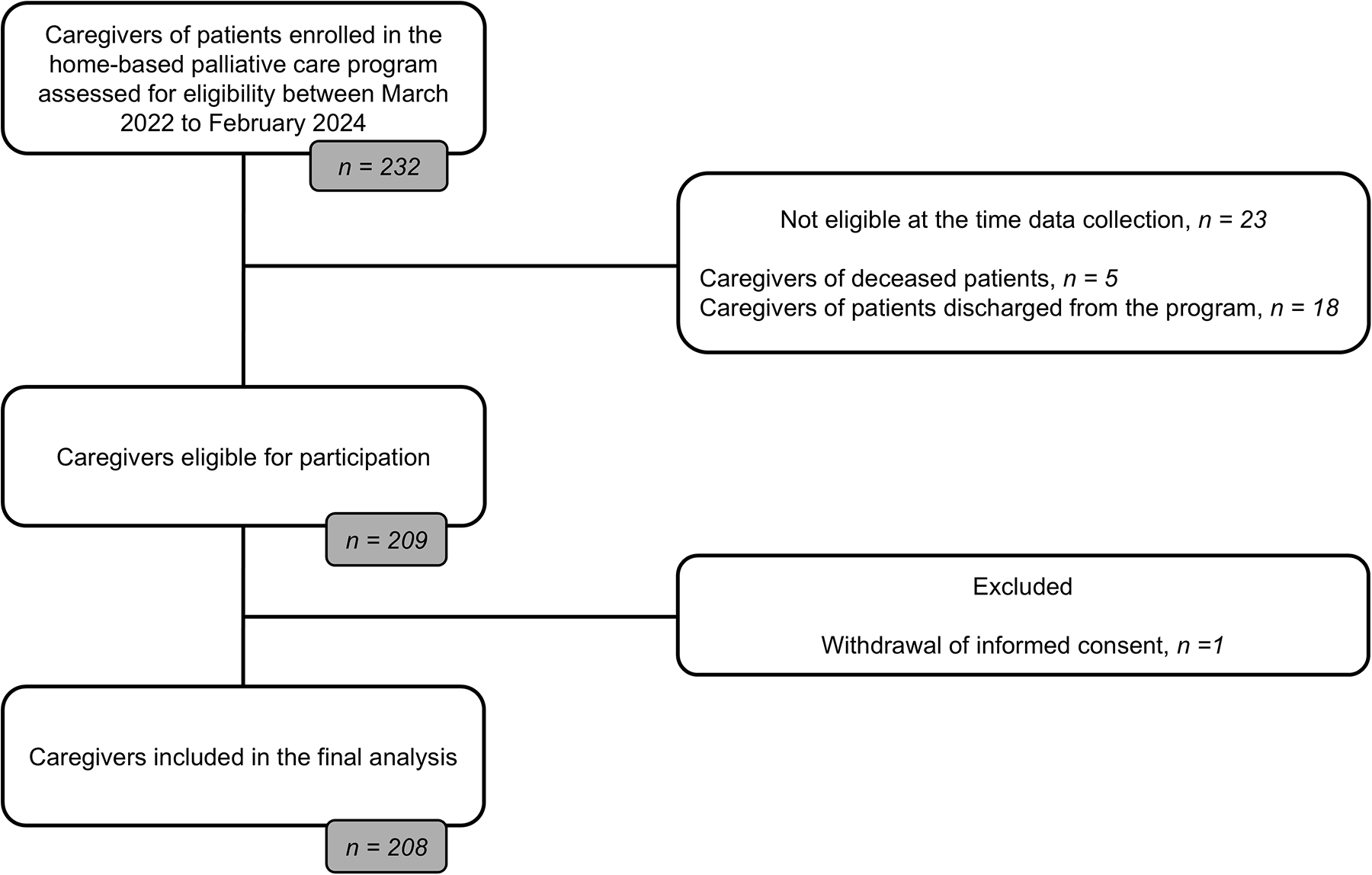
During the recruitment period (March 2022 to February 2024), a total of 232 caregivers were initially assessed for eligibility within the home-based palliative care program. Of these, 23 caregivers were excluded because they were not eligible at the time of data collection (5 were caregivers of deceased patients and 18 were caregivers of patients who had been discharged from the program). Consequently, a final sample of 208 caregivers was included in the analysis. The participant flow is shown in Figure 1.
Flow chart of study participants.

Sociodemographic, clinical, and psychological characteristics of caregivers
The caregivers had a median age of 56 years, and the majority were women (86%; n = 179). A substantial proportion were single (42.8%; n = 89), most were relatives of the patient (74%; n = 154), primarily children and spouses, and 70.7% (n = 147) lived with the patient. Although 69.2% (n = 144) had completed higher education, 79.8% (n = 166) had not received formal caregiving training.
The mean ZBI score was 42.5 ± 12.9. Overall, 59.6% (n = 124) of caregivers reported no burden, 29.8% (n = 62) reported mild burden, and 10.6% (n = 22) experienced intense burden. Table 1 presents the sociodemographic characteristics of caregivers according to burden status. No statistically significant differences were observed between caregivers with and without burden across the sociodemographic variables analyzed.
Sociodemographic characteristics of caregivers according to caregiver burden status

Table 1 Long description
Caregiver characteristics are compared between those reporting caregiver burden (84 people) and those not reporting burden (124 people), with totals for all 208 caregivers. Median age was similar in both groups: 55 years in the burden group and 56 years in the no-burden group. Women were the majority in both groups (about 89 percent with burden and 84 percent without), and men were a small minority. Marital status distributions were broadly comparable; single and married were the most common categories, and widowed caregivers were more frequent in the burden group (6 percent) than in the no-burden group (under 1 percent). Most caregivers were family members (about 74 percent in both groups), and most were informal caregivers (about 85 to 90 percent). Relationship to the patient was similar across groups, with adult children the largest category (about 49 percent with burden and 44 percent without), followed by spouses and non-consanguineous caregivers. Educational level showed a pattern of more undergraduate education in the burden group (58 percent) and more postgraduate education in the no-burden group (24 percent), but this difference was not statistically significant. Living with the patient was common in both groups (about 74 percent with burden and 69 percent without). Across all listed variables, the reported p-values indicate no statistically significant group differences, so observed percentage differences should be interpreted cautiously.
Q1 = First quartile (25th percentile); Q3 = Third quartile (75th percentile).
a Mann–Whitney U test.
b Chi-square test.
c Fisher’s exact test.
Most caregivers (61.5%; n = 128) did not report chronic illnesses. Motor limitations were more frequent among caregivers with burden than among those without burden (22.6% vs 12.1%; p = 0.044). The median sleep duration was 6 hours per day (IQR: 5–7), with no statistically significant differences between groups (Table 2).
Clinical and psychological characteristics of caregivers according to caregiver burden status

Table 2 Long description
Caregiver clinical and psychological characteristics are compared between those with caregiver burden (84 people) and those without (124 people), with totals for all 208 caregivers. Chronic disease prevalence was similar in both groups, about 38 percent, and the distribution of chronic disease counts (none, one, or two or more) was also similar. Motor limitation differed between groups: 22.6 percent in the burden group versus 12.1 percent in the no-burden group, and this was the only comparison with a statistically significant p-value. Median sleep duration was 6 hours per day in both groups, with a slightly lower lower-quartile value in the burden group, but the difference was not statistically significant. Depression, anxiety, and stress were common in both groups and showed no statistically significant differences; for example, depression was 44.1 percent with burden versus 37.9 percent without. Results reflect group comparisons and do not establish causation.
Q1 = First quartile (25th percentile); Q3 = Third quartile (75th percentile).
a Chi-square test.
b Mann–Whitney U test.
Regarding psychological symptoms, 40.4% (n = 84) reported depressive symptoms, 38.9% (n = 81) anxiety, and 47.1% (n = 98) stress, predominantly at mild to moderate levels (Table 2).
Caregiving characteristics
The median duration of caregiving was 17.5 months (IQR: 7–55). Caregivers provided a median of 18 hours of care per day (IQR: 12–24), across all 7 days of the week. Although caregivers with burden reported providing more hours of care per day than those without burden (median: 24 vs. 16 hours), this difference was not statistically significant (p = 0.238).
Regarding caregiving support, 83% (n = 174) reported receiving assistance from 1 or 2 additional individuals, with a median of 12 hours of support per day (IQR: 5–24). Caregivers with burden reported significantly fewer hours of support compared with those without burden (median: 8 vs 12 hours; p = 0.011). Only 32.2% received assistance from formal caregivers, and 73.6% provided care without any form of financial compensation (Table 3).
Caregiving characteristics according to caregiver burden status

Table 3 Long description
Caregiving characteristics are compared between caregivers with burden and without burden, with overall results also shown. Most measures are reported as medians with first and third quartiles. Duration of caregiving was similar across groups, about 17 months with burden and 19 months without burden, and the difference was not statistically significant. Daily caregiving hours were also similar, with a median of 24 hours in the burden group and 16 hours in the no-burden group, without a statistically significant difference. Both groups reported caregiving 7 days per week and typically had 1 to 2 people providing support, with no statistically significant differences. The main difference was hours per day with caregiving support: median 8 hours in the burden group versus 12 hours in the no-burden group, and this difference was statistically significant. Receiving financial remuneration was nearly identical in both groups at about 26 percent, with no statistically significant difference. P-values indicate statistical testing and do not establish causation.
Q1 = First quartile (25th percentile); Q3 = Third quartile (75th percentile).
a Mann–Whitney U test.
b Chi-square test.
Self-care and leisure activities
Overall, 27.9% (n = 58) of caregivers reported engaging in leisure activities, and 46.4% (n = 97) participated in social support activities. Regarding self-care practices, 40.9% (n = 85) reported attending medical appointments or maintaining personal hygiene routines, 30.3% (n = 63) engaged in physical activity, and 17.2% (n = 36) reported following healthy dietary habits. Comparative analysis showed that participation in social support activities was significantly associated with caregiver burden (chi-square test, p = 0.013). No statistically significant differences were observed in leisure activities or other self-care variables.
Characteristics of patients receiving home-based palliative care
The median age of the patients was 85 years (IQR: 76–91), and 64.9% (n = 135) were women. Nearly half were widowed (47.6%; n = 99), and more than half belonged to a middle socioeconomic stratum (51.4%; n = 107). A blended family structure was reported in 46.6% (n = 97), and 58.2% (n = 121) lived in their own homes, most commonly with relatives (75.9%; n = 158).
Regarding education, 41.3% (n = 86) had completed university-level education, and 66.8% (n = 139) reported having an income. Clinically, 51.4% (n = 107) had non-oncologic conditions, most commonly frailty and dementia. Functional status assessments revealed a median score of 40 points on both the KPS and PPS (IQR: 40–50 and 30–40, respectively), indicating severe functional impairment requiring substantial assistance. No statistically significant associations were observed between patient-related variables and caregiver burden (Table 4).
Sociodemographic and clinical characteristics of the patients receiving home-based palliative care

Table 4 Long description
Patient characteristics are summarized for 208 home-based palliative care recipients, comparing those with caregiver burden (84) versus no burden (124), with p-values for group differences. Median age was about 85 years in both groups, with nearly identical quartile ranges and no meaningful difference. Functional status scores were low and similar across groups: Karnofsky median 40 and Palliative Performance Scale median 40, with no significant differences. Women were the majority overall (about two thirds) and in both burden groups, and disease type was split roughly evenly between oncologic and non-oncologic, without significant group differences. Marital status was most often widowed (about half), followed by married (about one third), with similar distributions by burden status. Socioeconomic and education levels were broadly comparable; medium socioeconomic status and undergraduate education were most common, and low socioeconomic status appeared more frequent in the burden group but was not statistically significant. About one third reported no income, and most lived with relatives; housing tenure was most often owning the home, with similar patterns across groups. Interpretation should note that some measures have smaller sample sizes than the full cohort, and the p-values indicate no statistically significant differences for the listed variables.
Q1 = First quartile (25th percentile); Q3 = Third quartile (75th percentile).
COP = Colombian pesos.
Converted using an approximate exchange rate of 1 USD ≈ 3,800 COP during the study period.
a Mann–Whitney U test.
b Chi-square test.
c Fisher’s exact test.
Multivariate linear regression
In the multivariate linear regression analysis (Table 5), the final model explained 10% of the variability in caregiver burden (adjusted R 2 = 0.10). Caregiving support was associated with lower caregiver burden scores (β = −6.31; p = 0.009), whereas the presence of caregiver motor limitations (β = 4.78; p = 0.045) and caregiver depression (β = 3.81; p = 0.034) were associated with higher caregiver burden scores.
Multivariable linear regression model for caregiver burden

β = regression coefficient; CI = confidence interval. Adjusted R 2 = 0.10.
Discussion
The main results of this study show that most caregivers of patients with oncologic and non-oncologic conditions receiving home-based palliative care were women, family members, and provided care without financial remuneration. Overall, 40.4% of caregivers experienced mild to intense caregiver burden. Limited caregiving support, caregiver depression, and caregiver motor limitations were identified as factors associated with higher levels of burden.
Regarding caregiver characteristics, the median age of caregivers was 56 years, and the majority of caregivers were women, fewer than half were single, and many were the patients’ children. These findings are consistent with previous studies conducted in palliative and end-of-life settings (Tripodoro et al. Reference Tripodoro, Veloso and Llanos2015; Washington et al. Reference Washington, Pike and Demiris2015; Aira Ferrer et al. Reference Aira Ferrer, Domínguez Lorenzo and Cano González2017; O’Neil et al. Reference O’Neil, Prigerson and Mmoledi2018; Bijnsdorp et al. Reference Bijnsdorp, Pasman and Boot2020; Silva et al. Reference Silva, Fhon and Rodrigues2021; Tang et al. Reference Tang, Li and Xue2021; Kochuvilayil and Varma Reference Kochuvilayil and Varma2024). Most caregivers lived with the patient and had not received formal caregiving training, despite having a high level of formal education. This pattern has also been reported in prior studies and highlights a persistent gap between educational attainment and preparedness for caregiving roles (Malik et al. Reference Malik, Gysels and Higginson2013; Aira Ferrer et al. Reference Aira Ferrer, Domínguez Lorenzo and Cano González2017; Perpiñá-Galvañ et al. Reference Perpiñá-Galvañ, Orts-beneito and Fernández-alcántara2019; Bijnsdorp et al. Reference Bijnsdorp, Pasman and Boot2020). These findings further underscore that caregiving remains a highly gendered role, not only within home-based care but across palliative care settings more broadly (Alam et al. Reference Alam, Hannon and Zimmermann2020; Rokicka and Zajkowska Reference Rokicka and Zajkowska2020).
Compared with studies conducted in other care contexts, the present study identified a higher proportion of caregivers reporting chronic illnesses, elevated stress levels, and shorter caregiving duration (Washington et al. Reference Washington, Pike and Demiris2015; Aira Ferrer et al. Reference Aira Ferrer, Domínguez Lorenzo and Cano González2017; Ashghali Farahani et al. Reference Ashghali Farahani, Najafi Ghezeljeh and Haghani2021; Silva et al. Reference Silva, Fhon and Rodrigues2021). Nevertheless, similarities were observed with respect to the number of caregiving days per week, the number of hours of care provided per day, the frequency of depressive symptoms, and disruptions in basic self-care activities, such as attending medical appointments and engaging in physical activity (Sabo and Chin Reference Sabo and Chin2021; Silva et al. Reference Silva, Fhon and Rodrigues2021; Tang et al. Reference Tang, Li and Xue2021). In inpatient settings, for example, up to 32% of caregivers have been reported to experience intense burden, which has been associated with emotional symptoms, including anxiety and depression, as well as insufficient caregiving support (Soto-Guerrero et al. Reference Soto-Guerrero, Palacios and Langer2024).
The emotional distress observed among caregivers may be explained by the multiple challenges inherent to the caregiving role, including a lack of formal training, anticipatory grief, and the emotional demands of caring for a loved one with an advanced, life-limiting illness (Wittenberg et al. Reference Wittenberg, Saada and Prosser2013). Moreover, changes in caregivers’ physical and mental health are closely linked to persistent difficulties in engaging in self-care activities, despite caregivers’ awareness of their importance (Aoun et al. Reference Aoun, Grande and Howting2015; Bijnsdorp et al. Reference Bijnsdorp, Pasman and Boot2020; Sabo and Chin Reference Sabo and Chin2021). The demands of caregiving frequently limit engagement in health-promoting behaviors, such as maintaining balanced nutrition, participating in physical activity, attending regular medical appointments, and obtaining adequate rest (Sabo and Chin Reference Sabo and Chin2021; Ogugu et al. Reference Ogugu, Reilly and Mbe2024). Supporting caregivers’ access to personal time, leisure activities, spiritual practices, and social support is therefore essential for maintaining their overall well-being (Aoun et al. Reference Aoun, Grande and Howting2015; Huis In Het Veld et al. Reference Huis In Het Veld, Verkaik and Van Meijel2016; Rokicka and Zajkowska Reference Rokicka and Zajkowska2020; Sabo and Chin Reference Sabo and Chin2021; Ogugu et al. Reference Ogugu, Reilly and Mbe2024). In this context, stress management has emerged as a core component of caregiver self-care, demonstrating protective effects against anxiety, depression, and caregiver burden (Sabo and Chin Reference Sabo and Chin2021).
Several caregiver and patient characteristics identified in this study appear to be consistent across palliative care settings, including caregiver age, sex, kinship, cohabitation with the patient, unpaid caregiving, prolonged daily caregiving hours (often exceeding 14 hours), and high emotional burden. However, differences across care contexts have been reported regarding educational levels and marital status, with caregivers in institutional settings more frequently being married and having lower levels of formal education (Alam et al. Reference Alam, Hannon and Zimmermann2020; Bijnsdorp et al. Reference Bijnsdorp, Pasman and Boot2020; Kochuvilayil and Varma Reference Kochuvilayil and Varma2024).
Previous studies have identified stress, anxiety, depression, coping strategies, quality of life, social support, and self-efficacy as factors associated with caregiver burden (Tripodoro et al. Reference Tripodoro, Veloso and Llanos2015; Götze et al. Reference Götze, Brähler and Gansera2018; Sternberg et al. Reference Sternberg, Sabar and Katz2019; Silva et al. Reference Silva, Fhon and Rodrigues2021). Notably, the present study identified caregiver motor limitation as a factor associated with caregiver burden, a finding that has not been previously reported in existing literature. This association should be interpreted within the specific context of home-based palliative care, which represents a central contribution of this study. In home-based settings, caregiving activities are predominantly performed within the domestic environment and often involve physically demanding tasks, such as assisting with transfers, personal hygiene, and patient mobility (Aoun et al. Reference Aoun, Grande and Howting2015; Bijnsdorp et al. Reference Bijnsdorp, Pasman and Boot2020). Caregivers with preexisting motor limitations may therefore experience greater physical strain and reduced functional capacity to perform these tasks, contributing to higher perceived burden.
In addition, caregiver depression was associated with higher levels of burden, while caregiving support emerged as a protective factor. Although the final multivariate model explained a modest proportion of the variability in caregiver burden (adjusted R 2 = 0.10), the identified factors – caregiving support, caregiver motor limitation, and caregiver depression – were statistically significant and clinically meaningful. These findings should be interpreted as exploratory and not causal, given the cross-sectional design of the study. These results are consistent with previous studies demonstrating that depressive and anxiety symptoms increase the likelihood of caregiver burden (Ahmad Zubaidi et al. Reference Ahmad Zubaidi, Ariffin and Oun2020) and that social support may mediate the relationship between caregiver burden and quality of life among caregivers of patients with terminal cancer (Zhang et al. Reference Zhang, Li and Zhang2024).
Overall, this study provides a comprehensive characterization of caregivers’ sociodemographic, clinical, and psychological profiles and identifies key factors associated with caregiver burden in a home-based palliative care context. These insights offer a valuable and important foundation for the development of preventive and supportive interventions aimed at improving the well-being of caregivers and, by extension, the quality of care provided to patients across home-based, hospice, outpatient, and inpatient palliative care settings.
This study has several limitations that should be acknowledged. First, the study sample was drawn from an urban home-based palliative care program affiliated with a single high-complexity health-care institution, which may limit the generalizability of the findings to caregivers in rural areas or other care settings. However, this specific context also provides valuable insight into the unique challenges faced by caregivers delivering care at home, where physical demands may disproportionately affect those with preexisting motor limitations. Second, the cross-sectional design of the study precludes causal inferences regarding the associations observed between caregiver burden and the identified factors. Although statistically significant associations were identified, longitudinal studies are needed to better understand the temporal relationships and potential causal pathways underlying caregiver burden in home-based palliative care. Third, data on caregiver characteristics and psychological symptoms were collected through self-reported measures, which may be subject to reporting and recall bias. Nevertheless, validated instruments were used to assess caregiver burden and psychological symptoms, which enhance the internal validity and reliability of the findings.
Finally, although the multivariate model explained a modest proportion of the variance in caregiver burden, the identified factors (caregiving support, caregiver motor limitations, and caregiver depression) were statistically significant and clinically relevant. These findings underscore the multifactorial nature of caregiver burden and suggest that additional unmeasured variables, such as coping strategies, cultural factors, and health system characteristics, may also play an important role. Future research should incorporate longitudinal designs and include caregivers from diverse geographic regions and care settings to further inform the development of comprehensive caregiver support interventions and evidence-based policy initiatives.
In conclusion, this study shows that primary caregivers of patients receiving home-based palliative care are predominantly middle-aged women, many of whom have chronic illnesses and experience psychological challenges, including depression, anxiety, stress, and caregiver burden. Most lack formal caregiving training and provide extensive daily care without financial compensation. Caregiver motor limitations and depressive symptoms were associated with higher levels of caregiver burden, whereas caregiving support was associated with lower burden. These findings highlight the importance not only of caregivers’ psychological well-being but also their physical health, functional capacity, and socioeconomic needs within home-based palliative care programs.
Strengthening caregiving support networks, improving access to psychological and rehabilitative services, and promoting interventions that foster caregiver self-care are essential strategies to mitigate caregiver burden. Furthermore, the development and implementation of public policies that formally recognize caregivers as essential contributors to the health-care system, and that provide social, economic, and health protections, are critical to improving outcomes for both caregivers and care recipients.
Acknowledgments
The authors would like to thank the health-care professionals from the home-based palliative care program at Colsanitas Clinics, especially Dr. María Victoria Mera, as well as the patients and their families. This study would not have been possible without their valuable support.
Author contributions
All authors contributed to the study conception and design. Material preparation and data collection were performed by H.F.R.E., A.A.G.P., and C.N.B.-A. Data analysis was performed by J.B.-C. The first draft of the manuscript was written by X.A.H.-B. and J.B.-C. All authors commented on previous versions of the manuscript and approved the final manuscript.
Funding
This research received no specific grant from any funding agency in the public, commercial, or non-profit sectors.
Competing interests
The authors declare none.
Ethical approval
This study was conducted in accordance with the principles of the Declaration of Helsinki and Resolution 8430 of 1993 issued by the Colombian Ministry of Health. Ethical approval was obtained from the Research Ethics Committee of Fundación Universitaria Sanitas (January 17, 2022; CEIFUS 060-22).
Ethics and consents
Written informed consent was obtained from all individual participants included in the study.


 Open access

