Central venous catheters (CVCs) are frequently used for vascular access, most often using the subclavian or internal jugular vein in patients requiring intensive care or prolonged medication administration. Disadvantages of CVCs include the requirement for specific training for insertion by physicians; line occlusion; and serious complications including pneumothorax, inadvertent arterial puncture, and nerve damage.Reference Johansson, Hammarskjold, Lundberg and Arnlind1 Peripherally inserted central catheters (PICCs) are a type of central catheter that serve as nonpermanent vascular access devices.Reference Sharp, Esterman, McCutcheon, Hearse and Cummings2 Advantages of PICCs compared to CVCs include fewer serious complications because the upper thoracic veins are avoided and cost was reduced because specially trained nurses or other healthcare professional staff may insert them.Reference Johansson, Hammarskjold, Lundberg and Arnlind1 Previously, PICC lines were considered to be associated with reduced infection rates but more recent studies have demonstrated similar rates between PICCs and other central-line catheters.Reference Maki, Kluger and Crnich3, Reference Ajenjo, Morley and Russo4 Additional benefits of PICCs include the ability to retain the access for months at a time, compared to midline catheters, which often require replacement after a month.Reference Sharp, Esterman, McCutcheon, Hearse and Cummings2 Indications for PICC insertion include delivery of long-term intravenous antibiotics, chemotherapeutic agents, and parenteral nutrition. Despite the multitude of benefits for PICCs, side effects may include pain at the insertion site (39.9%), bleeding (20%), dislodgment (20%), superficial thrombophlebitis (7%), infection (6%–10%), and leakage (6%).Reference Sharp, Esterman, McCutcheon, Hearse and Cummings2, Reference Blum5
Although most adverse events appear to be relatively minor, limited reports have been published of other serious adverse events including deep venous thrombosis, bloodstream infection, hypersensitivity reactions, and anaphylaxis.Reference Briars6–Reference Vanek, Kupensky and Thomson9 Haworth et alReference Haworth, Niven, Moorcroft, Phillips, Dodd and Webb7 described 3 patients who, after insertion of an Ohmeda Hydrocath, became profoundly unwell (including hypotension, respiratory distress, bronchospasm, tachycardia and flushing), requiring immediate catheter removal and administration of epinephrine and hydrocortisone in 1 case.Reference Haworth, Niven, Moorcroft, Phillips, Dodd and Webb7 Specific reactions to elastomeric hydrogel midline and PICC cathetersReference Briars6, Reference Vanek, Kupensky and Thomson9–Reference Moorcroft, Niven and Quantrill11 have also been recorded, but the Haworth studyReference Haworth, Niven, Moorcroft, Phillips, Dodd and Webb7 highlighted unusual reactions to polyurethane that had not been reported previously.
PICC insertions have increasingly been utilized as an effective means of long-term parenteral therapies. Post licensing, studies have suggested that while uncommon, significant side effects including life-threatening clinical adverse events continue to occur.Reference Chopra, Flanders and Saint12, Reference Grau, Clarivet, Lotthe, Bommart and Parer13 In early 2010, nursing staff from 3 adult acute-care hospitals began noting severe hypersensitivity-type reactions immediately following PICC insertion in groups of patients requiring them predominantly for long-term antimicrobial administration. In our current study, we sought to characterize serious adverse events within a diverse group of adult patients in tertiary-care hospitals within our health region.
Methods
Study background, setting, and rationale
The Calgary Health Zone provides all medical services to the city of Calgary, Alberta, Canada, and several surrounding communities, resulting in a catchment area of ∼1.4 million individuals. PICCs are placed by a team of specialized nurses in each of the 4 tertiary-care adult hospitals. In early 2010, the Calgary Health Zone adopted the PowerPICC SOLO catheter (Bard Access Systems, Salt Lake City, UT) along with the Groshong PICC (Bard Access Systems) with a magnetized stylet wire, the Sherlock TLS (Bard Access Systems). The components of the catheter stylet tip were elucidated via a search of the US patent registry (magnetized stylet neodymium-iron-boron mixture, US patents 8388541 CR Bard and 5879297 Lucent Medical Systems). Prior to this implementation, adverse events were minimal and were noted to consist of rare vasovagal reactions. Following the adoption of the Sherlock TLS, significant adverse events suggestive of anaphylaxis and anaphylactoid reactions occurring during or postinsertion were noted by experienced nursing staff prompting a prospective site-based monitoring for adverse events.
Data sources and study design
From October 2010 to November 2014, patients at 2 tertiary-care hospitals in Calgary were systematically monitored prospectively for significant adverse events following insertion of the PowerPICC SOLO catheter or the Groshong PICC with the Sherlock TLS. Detailed data about the patients, the indication for PICC insertion, the type of catheter, and the nature of any serious reactions with the details of the symptoms and signs, time of onset and management required (oxygen administration, positioning, catheter removal, fluid resuscitation) were recorded in the nursing notes and later transcribed to a database (Excel version 10.0 software, Microsoft, Redmond, WA). As a comparator, insertion data were also collected prospectively from a new adult tertiary-care hospital site that had opened in February 2013 but using the BioFlo PICC (Angiodynamics, Latham, NY) without a magnetized stylet tip. In addition, to increase the robustness of the comparative analysis, data were also collected prospectively from a cohort of patients at The Ottawa Hospital, in Ottawa, Ontario, which had a longstanding PICC service and had a purpose-built Microsoft Access PICC database that recorded data from 2008 onwards, including reactions on PICC insertions. They had used both the PowerPICC SOLO catheter but exclusively without the magnetized stylet and the BioFlo PICC.Reference McDiarmid, Scrivens and Carrier14 Furthermore, from April 2010 to November 2014, adverse events, defined as any clinical compromise prompting intervention or further management, were concurrently collected and recorded.Reference McDiarmid15
Definitions
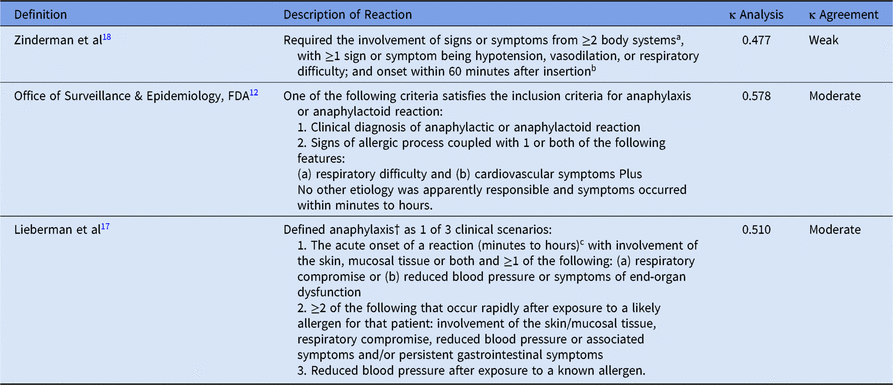
To elucidate anaphylaxis or anaphylactoid (anaphylactic-like) reactions, 3 definitions were utilized from the literature (Table 1).Reference Huang and Scarazzini16–Reference Zinderman, Landow and Wise18 We have used the terms anaphylaxis and anaphylactoid reactions interchangeably for our purposes because the criteria are similar (with IgE-mediated events being considered anaphylaxis and non IgE-mediated events being considered anaphylactoid reactions).Reference Grau, Clarivet, Lotthe, Bommart and Parer13 We used 3 definitions because the symptoms and signs of anaphylaxis or anaphylactoid reactions can mimic many other conditions; we attempted to reduce bias in overinterpretation of observed clinical reactions and to allow comparisons of event rates based on the different definitions. Minor modifications to inclusion criteria were any patients that had severe chest pain, had abdominal pain, or required an intensive care code to be activated due to the severity of the symptoms and signs exhibited by the patients. Notably, 2 of the definitionsReference McDiarmid, Scrivens and Carrier14, Reference Huang and Scarazzini16 listed the onset of the symptoms and signs to have occurred either within minutes to hours or within 60 minutes of the inciting event. The third definition from the Joint Council of Allergy, Asthma, and Immunology listed 3 scenarios in their definitions,Reference Grau, Clarivet, Lotthe, Bommart and Parer13 one of which required the onset within minutes to hours, and we chose the latter for consistency within our definitions. One of the definitionsReference Chopra, Flanders and Saint12 explicitly indicated that no other etiology was considered to be responsible and the Joint Council of Allergy, Asthma, and Immunology definitionReference Grau, Clarivet, Lotthe, Bommart and Parer13 had an annotation attached to their definitions that other diagnoses should be excluded. We used a consistent definition of acute onset within minutes to an hour following the inciting event, that is, insertion of the PICC line and that other diagnoses were considered unlikely (Table 1). Comparisons were then conducted with all event rates at the different study locations and between the various catheter types. Ethical approval was obtained through the University of Calgary Institutional Research Information Services Solution panel (no. REB18-0859).
Definitions of Anaphylactic and Anaphylactic-Like Reactions Utilized for PICC Insertion Reactions

Note. PICC, peripherally inserted central-line catheter.
a Cardiovascular (hypotension, vasodilatation, flushing, tachycardia, bradycardia), respiratory (tachypnea, wheezing, stridor, laryngeal edema, respiratory distress, dyspnea, chest pain), dermatologic (urticaria, lip or facial edema), gastrointestinal (nausea, vomiting, abdominal pain), other (anxiety, feeling of impending doom, diaphoresis).
b Revised from infusion in the original definition to insertion of PICC line for this study.
c Onset within minutes to hours scenario was chosen and allowed for consistency with the other 2 definitions.
† For consistency, exclusion of other diagnoses was used across all definitions.
Statistical analysis
Two expert clinicians (J.M.C. and M.D.P.) were used to assess interrater agreement using the Cohen κ to determine agreement between each independent raters’ opinion.Reference McHugh19 The κ coefficients were calculated as described previously, using the proportion of rate opinion and the expected proportion. Based on interpretations described, κ agreement was defined as near perfect (>0.90), strong (0.80–0.90), moderate (0.60–0.79), weak (0.40–0.59), minimal (0.21–0.39), and none (0–0.20).Reference McHugh19
Event rates were summarized using frequencies and percentages for categorical variables. Assessments of lot numbers, patient profiles, and medications or conditions known to be associated with a higher likelihood of anaphylaxis or anaphylactoid reactions were also conducted. Analysis of the event rates in the comparison groups was performed using the Student t test for continuous variables and the χ2 test for categorical variables, with Yates correction or the Fisher exact test for a cell size <5 as appropriate. Only 1 catheter insertion per patient was assessed.
Results
Patients at 2 tertiary-care hospitals in Calgary were identified between 2010 and 2014 that experienced adverse clinical reactions following insertion of the PowerPICC SOLO or Groshong PICC using the Sherlock TLS. There were 5,957 insertions from site A and 2300 from site B during this period (n = 8,257). In total, using the PowerPICC SOLO or Groshong PICC, 32 reactions from site A (0.54%) and 5 reactions from site B (0.22%) were observed that were noted to represent significant adverse events (mean event rate, 0.45%). Notably, all 37 reactions occurred within minutes of PICC insertion. Several definitions (Table 1) were used to determine whether individual events met criteria for anaphylaxis or anaphylactoid reactions. From all reactions recorded, those meeting criteria included 34 of 37 (91.9%) using definition 1, 30 of 37 (81.8%) using definition 2, and 20 of 37 (54.1%) using definition 3.
To elucidate interrater significance between 2 clinical experts, patients who met criteria for anaphylactic or anaphylactoid reactions were weak agreement for criteria 1 and moderate agreement for both criteria 2 and 3. In general, using definition 2 had the highest κ agreement, where a range of 51%–59% of patients met criteria for anaphylactic or anaphylactoid reactions following PICC insertion.
To further determine whether anaphylactic or anaphylactoid reactions were limited to a single delivery system, a comparison population was used by PICC insertion using the BioFlo PICC across centers in Ottawa (n = 7,889) and Calgary (n = 491). Again, using all 3 definitions, none met criteria for anaphylactic or anaphylactoid reactions.
To determine whether differences in reactions occurred between the varying PICC insertion systems, reactions using the PowerPICC SOLO or Groshong PICC without the magnetized stylet versus the BioFlo PICC were compared; no difference was observed (P > .05). In contrast, anaphylactic or anaphylactoid reactions were significantly more likely to occur using the PowerPICC SOLO with the magnetized stylet as compared to The Ottawa Hospital cohort (0 of 15,252) without the magnetized stylet (P < .0001), with significance maintained across all 3 definitions. Finally, anaphylactic or anaphylactoid reactions were significantly associated with the PowerPICC SOLO or Groshong PICC with the magnetized stylet as compared to the BioFlo PICC (P < .0001), again across all definitions.
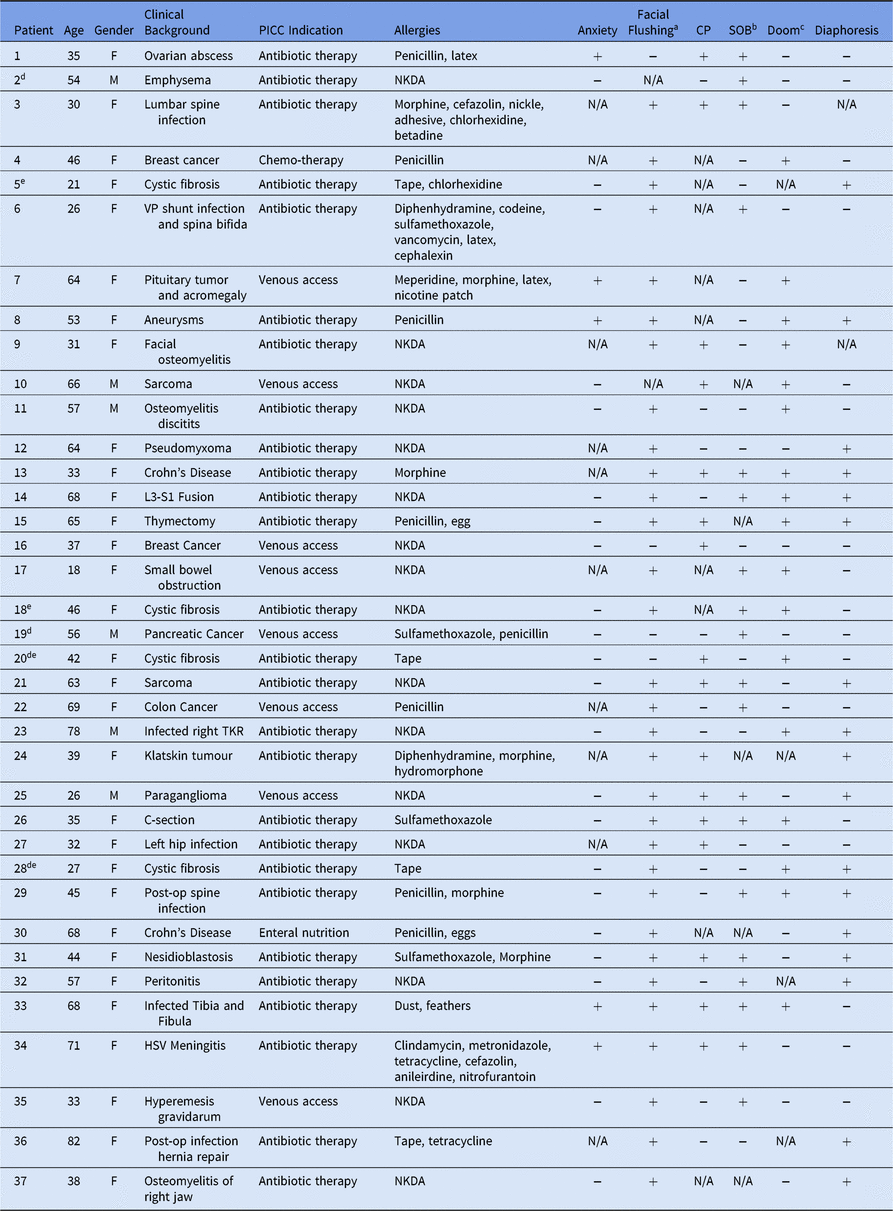
All those with significant adverse reactions (n = 37) were identified, and demographic and treatment information was extracted (Table 2). The median age of patients was 46.5 years old (IQR, 18–76), and most were female (31, 79.5%). The indications for PICC insertion consisted primarily for the provision of long-term intravenous antibiotics (25 of 37, 67.6%), venous access (8 of 37, 21.6%), parenteral nutrition (1 of 37, 2.7%), and chemotherapy (1 of 37, 2.7%). Of patients with reactions, over half had documented preceding drug and environmental allergies (21 of 37, 56.8%), with one-third demonstrating multiple allergic responses (13 of 37, 35.2%). Only 2 of 37 patients were on angiotensin converting enzyme inhibitors. All sites in both Calgary and Ottawa used identical skin preparations, buffered lidocaine, flushes, and similar dressings. No apparent deviations in aseptic technique were identified at any of the sites and type of infusion between sites was similar.
Demographics of Patients Exhibiting Reactions to PICC Insertion

Note. NKDA, no known drug allergies; N/A, no available data from clinical records; CP, chest pain; SOB, shortness of breath.
a Facial flushing noted as the physical sign of moderate to severe erythema of the facies with 1 patient noted to have urticaria in addition to facial erythema.
b 6 patients had documented desaturations (range, 51%–92%); additional 3 patients had tachycardia (range, 106–144).
c Doom, a sense by the patient of impending clinical demise.
d Denotes immediate life-threatening clinical compromise requiring calling of a code, or death within 30 d (all were code incidents and no deaths were recorded).
e Denotes patients with cystic fibrosis.
Among those with reactions, the largest subset of patients experiencing adverse reactions had cystic fibrosis (CF) (n = 4, 10.8%). All 4 patients met criteria for anaphylactic or anaphylactoid reactions across all 3 definitions, and 2 patients (50%) were described as having serious reactions. Patients 20 and 28 both incurred significant respiratory compromise during PICC insertion, resulting in a severe clinical demise requiring activation of the “code blue” system and intensive care unit (ICU) team intervention. In contrast, only 2 other patients from the remainder of the cohort (excluding CF patients) experienced similar severe reactions requiring ICU intervention (6.1%). A retrospective assessment of the Ottawa cohort revealed CF patients who did have PICC insertion, but no adverse reactions were noted, in contrast to this study.
At our center, in the CF population, the rate of PICC insertion is estimated to be 25–40 per year among a population of 160 patients. In addition, the incidence rate of anaphylactic or anaphylactoid reactions in the CF population at our center was 10%–16%, significantly higher than non-CF patients (P < .001). Of the 4 CF patients, 3 (75%) had documented allergies, notably all to tape or tape adhesive.
Discussion
Complications of PICC insertions have generally been described in the published literature as case reports, which may introduce bias with limited available evidence. To better understand the natural history of and risk factors associated with PICC adverse events, prospective observational studies are required. A recent large retrospective cohort study of 656 patients demonstrated catheter-related bloodstream infections (0.6%), deep venous thrombosis (1.5%), superficial venous thrombosis (2.1%), and requirement of thrombolytics for occluded catheters.Reference McDiarmid, Scrivens and Carrier14 The authors acknowledged lower rates of serious PICC-related complications than prior reports, in part due to expertise from trained nursing staff for insertion. Our study focuses specifically on anaphylactic or anaphylactoid reactions occurring exclusively with the use of the PowerPICC SOLO or Groshing PICCs with the magnetized Sherlock TLS. In Ottawa, from October 1998 to April 2012, of 12,585 PICC insertions, a total of 1,947 (15.5%) demonstrated complications, but no clear anaphylactic or anaphylactoid reactions occurred (personal communication, S McDiarmid, September 2015).
Compared to central venous catheters, midline catheters serve as an alternative for nonpermanent vascular access device toward noncaustic drug delivery with different anatomical endpoints for tip termination.Reference Sharp, Esterman, McCutcheon, Hearse and Cummings2 Despite the benefits listed, in 1990 the Food and Drug Administration (FDA) in the United States released data on Landmark midline reactions (Menlo Care, Menlo Park, CA) where multiple cases of adverse events (including 3 cardiac arrests and 2 deaths) were observed following their insertion.20 Similarly, a large prospective study by Mermel et alReference Mermel, Parenteau and Tow10 assessing midline catheter-related infections among hospitalized patients noted several severe clinical adverse events during insertion including erythroderma, hypotension, chest tightness, and shortness of breath. In total, Mermel et alReference Mermel, Parenteau and Tow10 found 53 cases of adverse events with prominent clinical features highlighting, urticaria, abdominal pain, and dyspnea.20 The etiology behind these hypersensitivity reactions has been speculated to occur from sources including catheter components (intrinsic or extrinsic material), residual material associated with packaging of the catheter, injectable fluids and medications, or anatomic location.Reference Mermel, Parenteau and Tow10 Notably, the authors concluded that these adverse events represented hypersensitivity as opposed to anaphylactic or anaphylactoid reactions, which have been limited to case reports in the literature.
In our study, we identified a disproportionate number of patients with CF who met the clinical criteria for anaphylactic or anaphylactoid reactions. Indeed, there are similar case series of CF individuals experiencing anaphylactoid reactions with vascular access device insertions in the literature.Reference Briars6, Reference Haworth, Niven, Moorcroft, Phillips, Dodd and Webb7 It is unclear why patients with CF appear to be disproportionally affected, and to our knowledge, there have been no other reports in the literature, apart from those presented here. We curtailed the use of PICCs with the use of the magnetized stylet at our centers following this analysis. Given the high rates of antibiotic allergy in the CF population compared to the general population, there may be an element of IgE-mediated immediate anaphylaxis.Reference Parmar and Nasser21 In the Haworth series, patient skin tests to water extracts from the line, guide wire, and gloves failed to provide a positive reaction. Additionally, IgE-specific antibodies to latex and ethylene oxide were normal, suggesting an alternative mechanism. In CF patients with allergic bronchopulmonary aspergillosis (ABPA), flow cytometry studies after exposure to antigen have shown that blood basophils are primed and subsequently hyperresponsive.Reference Gernez, Dunn and Everson22 Thus, there may be a role in antigen stimulation by PICC components in CF patients related to basophilic response; however, this is an area for future study.
One potential explanation for the anaphylactic or anaphylactoid reactions we observed may be related to the magnetized stylet component of the PowerPICC SOLO. Components within the magnet stylet (neodymium) have been shown to be a major stimulus for basophil and or mast cell degranulation.Reference Suzuki, Inoue and Ra23 Furthermore, heavy metals including silver and gold have been shown in vitro to potentiate mast cell activation.Reference Hayama, Suzuki, Inoue, Ochiai, Terui and Ra24, Reference Suzuki, Yoshimaru, Yamashita, Matsui, Yamaki and Shimizu25 Potential leaching of the stylet components into a major vessel may possibly implicated in the anaphylactic or anaphylactoid reactions observed in our study.
The discrepancy in anaphylactic or anaphylactoid reactions between 2 sites, Ottawa and Calgary, raises several points. A retrospective review confirmed similar procedures between the 2 sites: identical skin preparation, buffered lidocaine, saline flushes, and skin dressings. Within the Calgary Health Zone, there were no differences between devices manufactured at different times (ie, different lots). At all insertions, aseptic technique was utilized adequately as evaluated by independent infection and prevention control. The discordance may be in part due to a selected patient population who are prone to allergic manifestations, including CF individuals.
Our study demonstrates several limitations, including the use of a retrospective cohort analysis for the comparative population. Given that categories are nominal (ie, absent or present) for criteria to meet definitions for anaphylaxis or anaphylactoid reactions, there is always a concern with interpretation of more subtle clinical presentations. We acknowledge the possibility of other explanations for the observed clinical events, but we used 2 expert clinicians in a nonbiased observational manner to try to mitigate these concerns. In addition, the reporting of very similar reactions using the PowerPICC SOLO or Groshing PICC with the Sherlock TLS within the US FDA Center for Devices and Radiological Health Medical Product Safety Network (MedSun) and the Canadian Medical Devices Sentinel Network – Health Canada Reporting Project provides supportive evidence for our observations. Notably, the manufacturer was advised of the concerns and responded by updating its labeling to indicate that anaphylactic or anaphylactic-like reactions occur in a small percentage of the population during placement, positioning, flushing of CVCs or cleaning of the catheter exit site. Alternative definitions, such as the accepted Brighton definition for anaphylaxis,Reference Ruggeberg, Gold and Bayas26 may increase specificity of true anaphylactic reactions but will require further quality control assessment. Additionally, our study lacked a control group and thus may limit the generalizability of results to other populations.
The clinician should be cognizant of the number of models and manufacturers of PICCs and the numerous proprietary materials. As such, findings pertaining to a particular type of product may not translate to others. Finally, the nature of the mechanism behind anaphylactic or anaphylactoid reactions in these patients may be multifactorial and requires further studies to discern biological plausibility.
In conclusion, this study highlights potential anaphylactic or anaphylactoid reactions with insertion of PowerPICC SOLO or Groshing PICC using the Sherlock TLS. Given the disproportionate rate of anaphylactic or anaphylactic-like reactions following PICC insertion observed in CF patients (ie, 10- to 20-fold higher compared to the general population, 10%–16% vs 0.5%), our observations suggest the need for additional clinical vigilance in the CF population. Furthermore, these findings suggest that disease-specific reports of adverse reactions associated with medical devices may be important in identifying their biologic basis.
Acknowledgments
We would like to acknowledge all the nursing and support staff engaged in the insertion of PICC lines at each of the sites. In particular, we would like to acknowledge Diane Jack as the original designer for data organization as part of this study.
Financial support
The authors have no financial relationships relevant to this article to disclose.
Conflicts of interest
The authors have no potential conflicts of interest to disclose.