1 Introduction
Surface waves not only have a major effect on large objects such as marine structures, but are also crucial for the survival of small insects such as water striders. The locomotion of these aquatic creatures relies on generating surface waves with their hind feet, thereby allowing them to rapidly skip across the water surface (Hu & Bush Reference Hu and Bush2010; Gao & Feng Reference Gao and Feng2011) or to jump into the air (Koh et al. Reference Koh, Yang, Jung, Jung, Son, Lee, Jablonski, Wood, Kim and Cho2015). In daily lives, Chinese-tea drinkers gently shake a cup to produce ripples on the water surface, so as to sink the floating tea leaves. Wave–particle interaction is also relevant in various industrial processes such as water membrane dedusting (Jaworek et al. Reference Jaworek, Balachandran, Krupa, Kulon and Lackowski2006), mineral flotation (Ueda et al. Reference Ueda, Tanaka, Uemura and Iguchi2010) and wet scrubbing (Wang, Song & Yao Reference Wang, Song and Yao2015), which involve a number of particles impacting onto liquid–gas interfaces at the same time. The surface waves induced by the impact of individual particles have a significant effect on the critical impact speed for a group of particles, beyond which the particles are expected to completely penetrate the interface (Liu, He & Evans Reference Liu, He and Evans2014). Therefore, surface waves play an important role in the interaction of small objects with the gas–liquid interface, and may even determine whether the impacting particles, which are denser than the liquid, sink or float.
The interaction of small objects with liquid–gas interfaces is rich in flow phenomena, for example, air entrainment at the top of the objects (Aristoff et al. Reference Aristoff, Truscott, Techet and Bush2010), crown splashing (Marston et al. Reference Marston, Truscott, Speirs, Mansoor and Thoroddsen2016), cavity formation (Mansoor et al. Reference Mansoor, Marston, Vakarelski and Thoroddsen2014; Speirs et al. Reference Speirs, Mansoor, Belden and Truscott2019) and breaking through the water (Kim et al. Reference Kim, Hasanyan, Gemmell, Lee and Jung2015; Chang et al. Reference Chang, Myeong, Virot, Clanet, Kim and Jung2019). In particular, after impacting onto a water pool at a relatively slow speed, a superhydrophobic millimetre-sized sphere could end up with different flow regimes: sinking into the water, bouncing back into the air or oscillating at the water surface (Lee & Kim Reference Lee and Kim2008). The wettability of the sphere was also found to affect the regime of the impacting particles, and scaling models have been proposed to account for the critical conditions at the onset of different regimes (Chen et al. Reference Chen, Liu, Lu and Ding2018). However, all these studies mainly consider a sufficiently wide pool, and thus the surface waves induced by the impact have negligible effect on the impact dynamics.
To deepen our understanding of the interaction between the surface waves and the dynamics of small objects, we focus on the impact of a hydrophobic sphere onto a confined pool. The sphere impact gives rise to the surface waves, which propagate radially outwards and reflect back from the pool boundary, and the return of the surface wave may interfere with the motion of the sphere. The flow phenomena can be described by a group of dimensionless parameters, namely the Weber number  $We$ (
 $=\unicode[STIX]{x1D70C}U_{0}^{2}D/\unicode[STIX]{x1D6FE}$), the Bond number
 $Bo$ (
 $=\unicode[STIX]{x1D70C}gD^{2}/\unicode[STIX]{x1D6FE}$), the Reynolds number
 $Re$ (
 $=\unicode[STIX]{x1D70C}U_{0}D/\unicode[STIX]{x1D707}$), the density ratio of the sphere to the liquid
 $\unicode[STIX]{x1D701}$ (
 $=\unicode[STIX]{x1D70C}_{s}/\unicode[STIX]{x1D70C}$), the diameter ratio of the pool to the sphere
 $S/D$ and the wettability of the sphere (denoted by the contact angle
 $\unicode[STIX]{x1D703}$), where
 $U_{0}$ is the impact velocity,
 $D$ and
 $\unicode[STIX]{x1D70C}_{s}$ the diameter and density of the sphere,
 $\unicode[STIX]{x1D70C}$ and
 $\unicode[STIX]{x1D707}$ the density and viscosity of the liquid,
 $S$ the diameter of the pool,
 $g$ the gravity and
 $\unicode[STIX]{x1D6FE}$ the surface tension coefficient. Liu et al. (Reference Liu, He and Evans2014) experimentally investigated the submersion of particles with lower density than water after impacting onto a confined air–water interface, in a range of flow parameters of
 $We=5{-}50$,
 $Bo=2{-}5$,
 $Re=1000{-}5000$ and
 $S=2D{-}30D$. For an impacting sphere of the same size, it was found that the critical impact speed for submersion
 $U_{p}$ increases with
 $S$, especially when
 $S$ is smaller than an effective value
 $S_{c}$ (
 ${\approx}4D{-}6D$), and that
 $U_{p}$ is more or less the same when
 $S>S_{c}$. These experimental observations indicate that
 $S$ does have a significant effect on the impact dynamics of the sphere. However, it remains unclear what role the impact-induced surface waves play in the impact process in a confined pool, and why the value of
 $S_{c}$ is apparently only dependent on the size of the impacting sphere.
In this article, we numerically investigate the impact of a hydrophobic sphere onto a confined pool, aiming to interpret the effect of the pool size on the submersion of impacting spheres and the role of the surface waves in the sphere–interface interaction. A diffuse-interface immersed-boundary (DIIB) method (Liu & Ding Reference Liu and Ding2015) is adopted in the numerical studies, as it is able to simulate fluid–structure interaction involving dynamic wetting (Liu, Gao & Ding Reference Liu, Gao and Ding2017). To study the onset of submersion in a confined pool in a relatively wide range of impact speeds and sphere diameters, the spheres with lower density than the liquid are considered in the present study. The dynamics of the impacting sphere with density lower than the liquid is expected to be similar to that of the sphere with higher density, except that the former would float after submersion whereas the latter would sink. Compared with previous experiments (Liu et al. Reference Liu, He and Evans2014), we consider a wider range of sphere diameters ( $Bo\sim 10^{-2}{-}10^{2}$) and pool sizes (
 $S\sim 1.5D{-}20D$), and similar
 $We$ (
 ${\sim}1{-}30$) and
 $Re$ (
 ${\sim}O(10^{3})$). Numerical simulations provide not only the phase diagram at different sphere sizes, but also the flow details that are difficult to access in experiments. We analyze the horizontal propagation of the surface waves and the dynamics of impacting spheres in a wide pool, and assess the interaction between the reflected waves and sphere motion in a confined pool based on some key flow features identified in simulations. A scaling law is proposed to correlate
 $We$ and
 $Bo$ with
 $S$ at the onset of sphere submersion in the presence of reflected surface waves, to interpret the mechanism leading to the fate change of impacting spheres.
2 Numerical methods
We consider here the axisymmetric simulation of a sphere impacting onto a confined pool at a speed of  $U_{0}$ using the DIIB method. The DIIB method allows us to simulate the interaction between moving rigid objects and liquid–gas interfaces on the Cartesian mesh (Liu & Ding Reference Liu and Ding2015; Liu et al. Reference Liu, Gao and Ding2017). The liquid–gas interfaces are represented by the contours of the volume fractions of the liquid,
 $C_{L}$, and its evolution can be tracked by
 $$\begin{eqnarray}\frac{\unicode[STIX]{x2202}C_{L}}{\unicode[STIX]{x2202}t}+\unicode[STIX]{x1D735}\boldsymbol{\cdot }(\boldsymbol{u}C_{L})=\frac{1}{Pe}\unicode[STIX]{x1D6FB}^{2}\unicode[STIX]{x1D713},\end{eqnarray}$$
where  $u$ is the flow velocity and
 $\unicode[STIX]{x1D713}$ is the chemical potential:
 $$\begin{eqnarray}\unicode[STIX]{x1D713}=C_{L}^{3}-1.5C_{L}^{2}+0.5C_{L}-C_{L}C_{S}(1-C_{L}-C_{S})-Cn^{2}\unicode[STIX]{x1D6FB}^{2}C_{L}.\end{eqnarray}$$
In the present study, the Cahn number  $Cn$ is set to
 $0.75\unicode[STIX]{x0394}x/D$ and the Péclet number
 $Pe$ to
 $1/Cn$, where
 $\unicode[STIX]{x0394}x$ is the mesh size. The rigid objects are represented by the volume fraction of the solid,
 $C_{S}$, which is prescribed according to the position of objects. More details about numerical implementation can be found in Liu et al. (Reference Liu, Gao and Ding2017).
The DIIB method has been verified previously for an impacting particle at a liquid–gas interface by comparing with experiments (Lee & Kim Reference Lee and Kim2008) with respect to the evolution of the sphere position (Liu et al. Reference Liu, Gao and Ding2017) and the phase diagram (Chen et al. Reference Chen, Liu, Lu and Ding2018). The same code is used in the present study. All the simulations are performed on a uniform Cartesian mesh with  $\unicode[STIX]{x0394}x=0.005D$, based on the convergence test with successive mesh refinement (
 $\unicode[STIX]{x0394}x=0.01D$,
 $0.005D$ and
 $0.0025D$).
3 Results and discussion
In the present study,  $Bo$ and
 $We$ are varied by changing the sphere diameter and the impact velocity, respectively. Therefore, we have
 $Re\propto We^{1/2}Bo^{1/4}$. For the convenience of analysis, we fix the wettability of the sphere to
 $\unicode[STIX]{x1D703}=108^{\circ }$, the wettability of the sidewall at the pool boundary to
 $90^{\circ }$, the density ratio of solid to liquid to
 $\unicode[STIX]{x1D701}=0.855$ and the density and viscosity ratio of gas to liquid to
 $0.001$ and
 $0.018$, respectively. The dimensionless time
 $\unicode[STIX]{x1D70F}$ (
 $=t\,U_{0}/D$) is used to illustrate the time variation of numerical results. Unless stated otherwise, a wide pool is referred to as
 $S=20D$ hereafter; it has been confirmed that all results with
 $S>20D$ are indistinguishable from those with
 $S=20D$ for the time span considered, in terms of time evolution of sphere displacement and interface shape.
3.1 Flow features
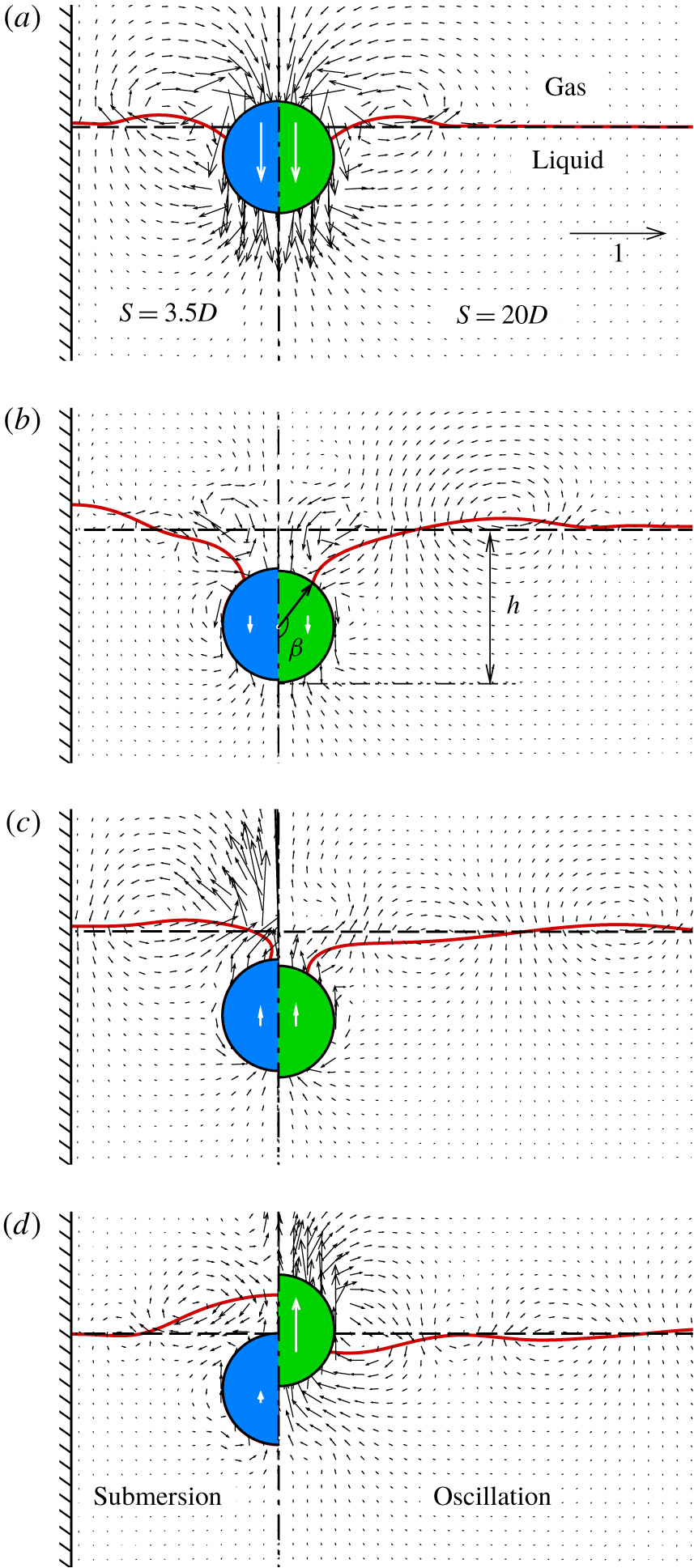
A confined pool can affect the dynamics of an impacting sphere, and may even change its fate. Figure 1 shows the dynamics of spheres impacting onto a confined pool ( $S=3.5D$) and a wide pool at
 $Bo=3.4$ and
 $We=13.5$, with respect to velocity vectors and interface snapshots. At the early stage of impact (
 $\unicode[STIX]{x1D70F}\leqslant 1$), there is no difference between the impact dynamics in the two pools, regarding the sphere position
 $h$, horizontal propagation of the surface waves, contact line position and flow structures. The difference becomes notable when the surface waves reflect from the sidewall and are approaching the sphere (figure 1b). In particular, the convergence of the reflected surface waves at the symmetry axis pushes the liquid radially inwards, thereby detaching the contact line from the sphere (figure 1c). Eventually, the sphere pierces the interface and fully submerges in the confined pool (figure 1d). It is, thus, referred to as the regime of submersion hereafter. By contrast, the impact of the sphere onto a wide pool results in surface waves propagating horizontally outwards, and ends up with sphere oscillating at the liquid–gas interface. This flow phenomenon is referred to as the regime of oscillation hereafter. The comparison of impact dynamics between the confined pool and the wide pool is also shown in the supplementary movie 1 available online at https://doi.org/10.1017/jfm.2019.964 at
 $\unicode[STIX]{x1D703}=108^{\circ }$,
 $\unicode[STIX]{x1D701}=0.855$,
 $We=13.5$ and
 $Bo=3.4$. Obviously, the pool size and the properties of the sidewall can have a big difference on the dynamic interaction between the sphere and the liquid–gas interface, and thus play an important role in determining the flow regimes.
Snapshots of a sphere impacting onto water pools of different size at  $Bo=3.4$ and
 $We=13.5$, in terms of the liquid–gas interface and velocity vectors. The dimensionless times
 $\unicode[STIX]{x1D70F}$ from (a) to (d) correspond to
 $1$,
 $2.5$,
 $4.2$ and
 $6$, respectively. In each panel, the left half shows the result with
 $S=3.5D$ and the right half shows that with
 $S=20D$. The solid curve represents the liquid–gas interfaces, and the dashed line indicates the undisturbed interface. The arrow at the bottom-right corner of panel (a) denotes the reference velocity.

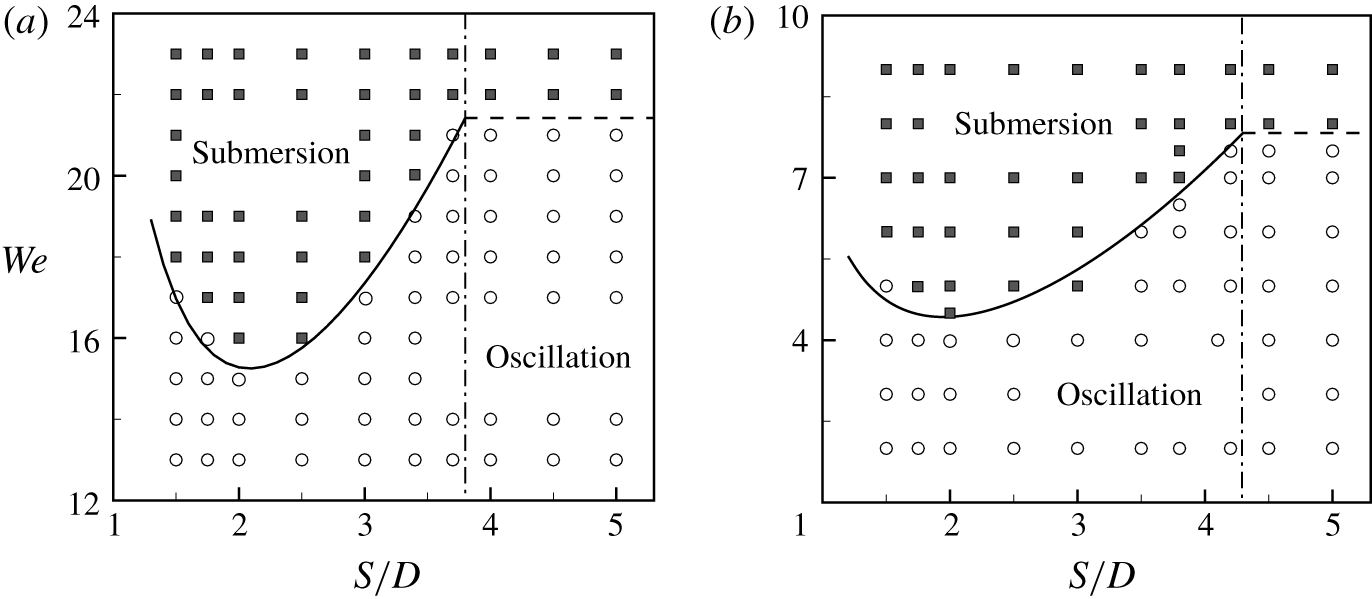
The flow regimes in terms of  $We$ versus
 $S/D$: (a)
 $Bo=0.05$ and (b)
 $Bo=12$. The solid squares and empty circles denote the spheres in the regimes of submersion and oscillation, respectively. The solid curves represent the theoretical prediction by (3.9), with a prefactor of
 $3.1$ in (a) and
 $0.7$ in (b). The dashed line represents the critical Weber number that separates the regimes of submersion and oscillation in a wide pool. The dash-dotted line indicates the effective pool size
 $S_{c}$, beyond which the regime of the impacting spheres is not affected by the pool size
 $S$. The value of
 $S_{c}$ is 3.7 in (a) and 4.2 in (b).

To investigate the effect of the pool size on the fate of the impacting spheres, numerical experiments are systematically performed. Figure 2 shows the phase diagrams at  $Bo=0.05$ and
 $12$ with respect to
 $We$ versus
 $S/D$. The boundaries separating the submersion regime from the oscillation regime assume a shape of ‘
 $\sqrt{\quad }$’. It is interesting to see that the pool size appears to have no effect on the critical impact speed (or
 $We$) when
 $S$ is larger than an effective value
 $S_{c}$, specifically,
 $S_{c}\approx 3.7D$ for
 $Bo=0.05$, and
 $S_{c}\approx 4.2D$ for
 $Bo=12$. This is consistent with experimental observations, in which the value of
 $S_{c}$ was found to be around
 $4D$–
 $6D$ (Liu et al. Reference Liu, He and Evans2014). Furthermore, in the cases of
 $S<S_{c}$, we find that at the same impacting velocity, there may exist two distinct values of
 $S$ at which the flow regime changes. The two flow regimes can be well distinguished by a curved line, which is a theoretical prediction and will be elaborated on in § 3.4. It is noteworthy that the critical impact speed (i.e.
 $We$) decreases with increasing
 $S$ roughly for
 $S<2$, which was not observed in the previous experiments (Liu et al. Reference Liu, He and Evans2014), probably because of the relatively wide pool (
 $S>2$) or the presence of meniscus at the side wall in the experiments (note that the contact angle is set to
 $90^{\circ }$ at the side wall in our simulations). It is noteworthy that a superhydrophobic dense sphere, which bounces from the water surface after impacting onto a wide pool, could also be sunk by the reflected waves in a narrow pool; an example can be seen in supplementary movie 2 at
 $\unicode[STIX]{x1D703}=150^{\circ }$,
 $\unicode[STIX]{x1D701}=1.2$,
 $We=23$ and
 $Bo=0.5$.
To reveal the underlying mechanism that leads to the fate change, it is crucial to understand the propagation of the surface waves, the motion of the impacting sphere and the interaction between them. We assume that the propagation of the surface waves has no effect on the sphere motion until it reflects back from the side wall and converges at the symmetry axis. Therefore, in the following two sections we only consider the spheres in the oscillation regime in a wide pool, to investigate the propagation of the ripples on the pool surface (§ 3.2) and the dynamics of impacting spheres (§ 3.3), respectively. Their interaction will be analyzed in § 3.4, to interpret the effect of pool confinement.
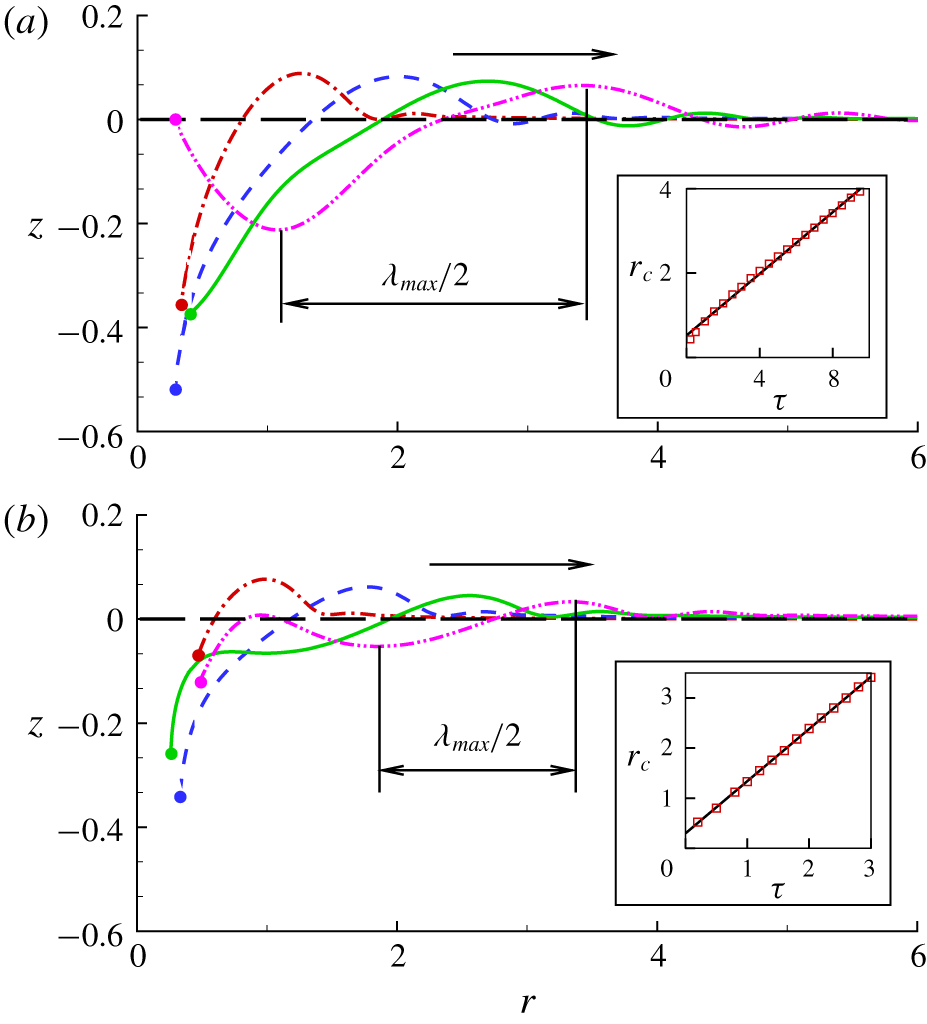
Snapshots of gravity–capillary waves induced by sphere impact at different dimensionless times:  $\unicode[STIX]{x1D70F}=0.7$ (dash-dotted),
 $1.4$ (dashed),
 $2.1$ (solid) and
 $2.8$ (dash-dot-dotted), with (a)
 $Bo=0.54$ and
 $We=15$, and (b)
 $Bo=12$ and
 $We=6$. The filled circle at the left end of each interface denotes the position of the contact line on the sphere, and the long-dashed line at
 $z=0$ represents the undisturbed liquid–gas interface. The radial position of the crest of the most significant wave,
 $r_{c}$, is shown as a function of time in the inset of each panel, and the solid line represents a linear fitting of the results.

3.2 Horizontal propagation of gravity–capillary waves in a wide pool
The impact of the sphere onto the pool deforms the gas–liquid interface, consequently giving rise to ripples propagating on the pool surface. These ripples in a wide pool travel radially outwards and are supposed not to affect the sphere dynamics. Figure 3 shows the ripple evolution for two impacting spheres in the oscillation regime, in which the contact line positions are displayed rather than the spheres for a better visualization of results. We can see that the impact-induced ripples are generally composed of waves of various wavelength, and propagate horizontally in a dispersive manner. In particular, they are mainly capillary waves at  $Bo=0.54$ and gravity waves at
 $Bo=12$. Moreover, the wave with the longest wavelength
 $\unicode[STIX]{x1D706}_{max}$ has the largest amplitude (and also inertia). Thus, this wave is the dominant wave. It is reasonable to expect that its reflection from the side wall would affect the sphere motion if the sphere impact took place in a confined pool. In the simulations,
 $\unicode[STIX]{x1D706}_{max}$ is measured by the horizontal distance between the crest and trough of the most significant wave (figure 3). Accordingly, its phase speed
 $c_{max}$ can be approximated by numerical differentiation of the crest position with time, and is found to be more or less a constant (see the insets of figure 3).
For the incompressible inviscid liquid pool of infinite depth, when the amplitude of the surface wave is small compared with its wavelength  $\unicode[STIX]{x1D706}$, the dispersion relation between the wave frequency
 $\unicode[STIX]{x1D714}$ and the wavenumber
 $k$ follows
 $\unicode[STIX]{x1D714}^{2}=gk+\unicode[STIX]{x1D6FE}k^{3}/\unicode[STIX]{x1D70C}$ (Acheson Reference Acheson1990; Lighthill Reference Lighthill2001). By substituting the definition
 $\unicode[STIX]{x1D706}=2\unicode[STIX]{x03C0}/k$ and the phase speed
 $c=\unicode[STIX]{x1D714}/k$ into the dispersion relation, we can obtain
 $$\begin{eqnarray}\frac{c(\unicode[STIX]{x1D706})}{U_{c}}\approx \sqrt{\frac{\unicode[STIX]{x1D706}}{2\unicode[STIX]{x03C0}l_{c}}+\frac{2\unicode[STIX]{x03C0}l_{c}}{\unicode[STIX]{x1D706}}},\end{eqnarray}$$
where  $l_{c}=\sqrt{\unicode[STIX]{x1D6FE}/(\unicode[STIX]{x1D70C}g)}$ is the capillary length and
 $U_{c}=(g\unicode[STIX]{x1D6FE}/\unicode[STIX]{x1D70C})^{1/4}$ is the characteristic speed of gravity–capillary waves (Raphaël & De Gennes Reference Raphaël and De Gennes1996). As the amplitude of the gravity–capillary waves is much smaller than the wavelength and
 $Re\sim O(10^{3})$ in the cases considered here, in principle (3.1) can be used to theoretically estimate the phase speed of the surface waves in the numerical experiments.
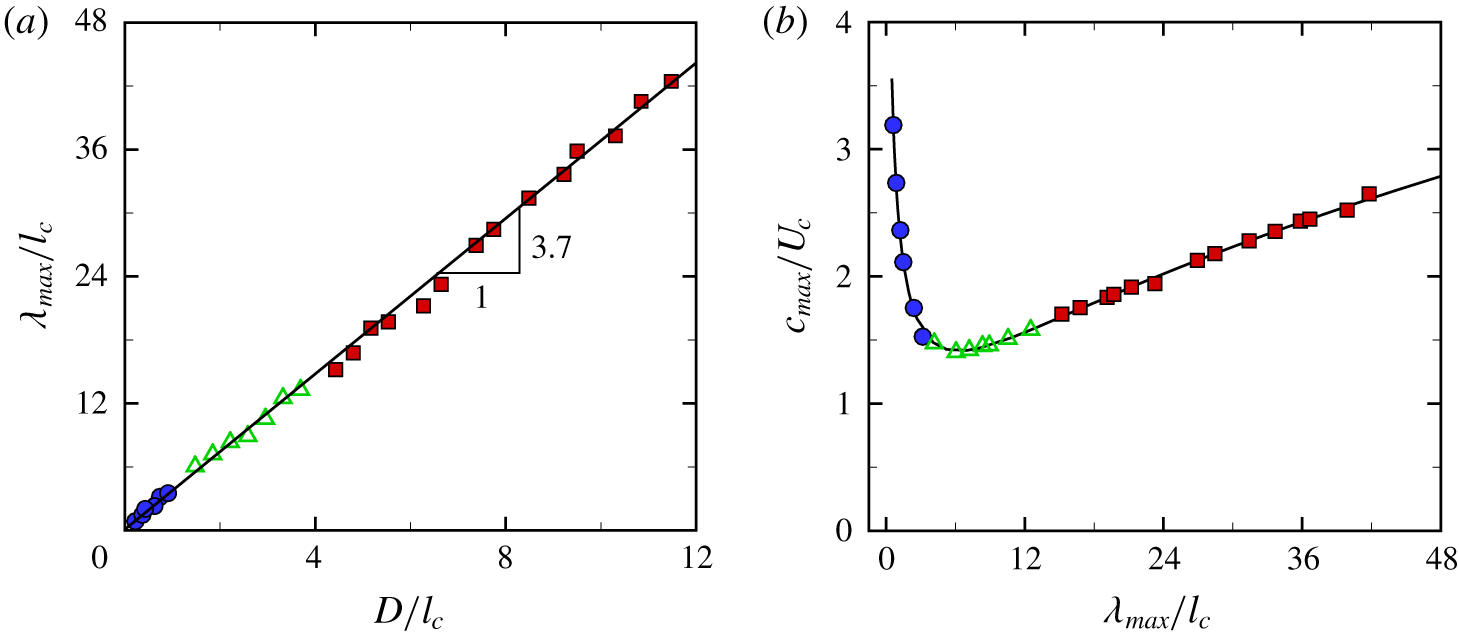
Figure 4(a) shows the variation of  $\unicode[STIX]{x1D706}_{max}$ versus
 $D$ at the onset of submersion in a wide pool. It is clear that
 $\unicode[STIX]{x1D706}_{max}$ is proportional to
 $D$; more specifically, we can have
 $$\begin{eqnarray}\unicode[STIX]{x1D706}_{max}\approx 3.7D,\end{eqnarray}$$
no matter whether the wave is capillarity-dominant (i.e.  $D<l_{c}$ or
 $Bo<1$), gravity-dominant (i.e.
 $D>4l_{c}$ or
 $Bo>16$) or a combination of both (i.e.
 $l_{c}\leqslant D\leqslant 4l_{c}$ or
 $1\leqslant Bo\leqslant 16$). This suggests that the diameter of the sphere is a generic length in the interface deformation owing to sphere impact. The theoretical prediction of
 $c_{max}$ can be obtained by substituting (3.2) into (3.1). Figure 4(b) shows the numerical results of
 $c_{max}/U_{c}$ as a function of
 $\unicode[STIX]{x1D706}_{max}/l_{c}$, along with the theoretical prediction. We can see that good agreement has been achieved. Therefore, the theoretical prediction of
 $c_{max}$ by (3.1) can be used in the analysis of interaction between the reflected waves and the sphere dynamics.
(a) Variation of  $\unicode[STIX]{x1D706}_{max}$ as a function of
 $D$ at onset of submersion. The solid line indicates
 $\unicode[STIX]{x1D706}_{max}=3.7D$. (b) The comparison of
 $c_{max}$ between the numerical results and the theoretical prediction of (3.1) (solid curve). Note that the cases in (a) and (b) are the same, and the circles, squares and triangles represent the capillarity-dominant (
 $D<l_{c}$ or
 $Bo<1$), gravity-dominant (
 $D>4l_{c}$ or
 $Bo>16$) and gravity–capillary waves (
 $l_{c}\leqslant D\leqslant 4l_{c}$ or
 $1\leqslant Bo\leqslant 16$), respectively.

3.3 Dynamics of impacting spheres in a wide pool
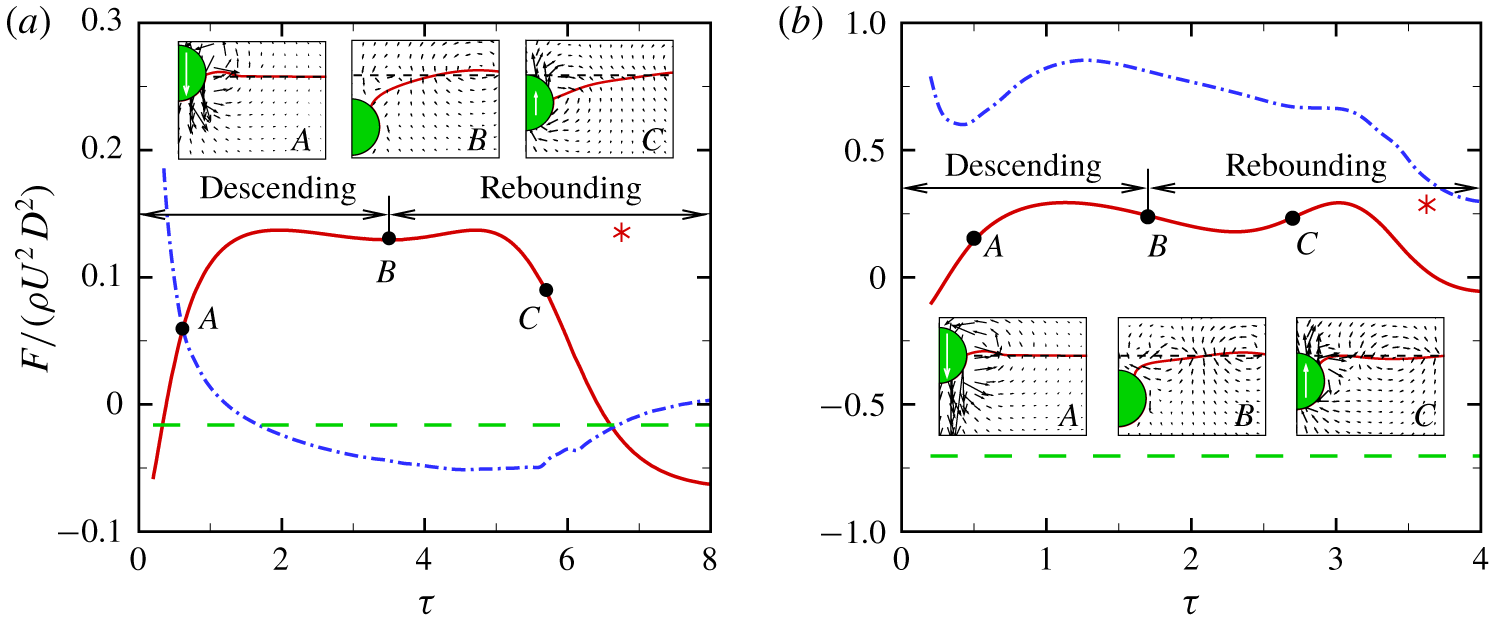
Time evolution of the vertical component of the forces exerted on oscillating spheres in a wide pool: the capillary force (solid line), hydrodynamic force (dash-dotted line) and gravity force (dashed line), with (a)  $Bo=0.54$ and
 $We=15$, (b)
 $Bo=12$ and
 $We=6$. The insets show the snapshots of the sphere, interface and velocity vectors at different stages of sphere motion: descending (
 $A$), the start of rebounding (
 $B$) and return to the water surface (
 $C$). The symbol
 $\ast$ denotes the maximum value of the vertical component of the capillary force.

In this section, we investigate the dynamics of an impacting sphere in a wide pool. Obviously, the initial inertia of the impacting sphere makes it prone to submerge in the liquid, but its trajectory is determined by the forces exerted on it. At relatively low  $Bo$ and
 $We$, the forces include capillary force, hydrodynamic force and gravitational force. Figure 5 shows the time variation of the vertical component of the forces acting on the impacting sphere in the oscillation regime at
 $Bo=0.54$ and
 $12$. Note that the hydrodynamic force consists of the viscous force, the buoyancy force, the pressure drag force and the added-mass effect. For the relatively small sphere (
 $Bo=0.54$), the capillary force (exerted by the interface at moving contact lines) is found to be the dominant force: it first impedes the downward movement of the sphere and restrains it from being fully submerged during the sphere descending, and then it promotes the rebounding of the sphere to the water surface (figure 5a). In the two processes, the vertical component of the capillary force mainly keeps near its maximum value that it could exert on the sphere, that is,
 $\unicode[STIX]{x03C0}\unicode[STIX]{x1D6FE}D\sin ^{2}(\unicode[STIX]{x1D703}/2)$ (Chen et al. Reference Chen, Liu, Lu and Ding2018). Among the components of the hydrodynamic force, the pressure drag force is very large at the very early stage of impact (
 $\unicode[STIX]{x1D70F}<0.5$), owing to the significant difference in velocity between the sphere and the surrounding liquid. Then, the viscous force and the added-mass effect gradually become dominant, and account for the negative value of the hydrodynamic force (
 $2<\unicode[STIX]{x1D70F}<6$). By contrast, for the relatively large sphere (
 $Bo=12$), the gravity and hydrodynamic force are found to be the dominant forces (figure 5b). As the hydrodynamic force is mainly made up of the buoyancy force in this case, its sign remains positive. It is also interesting to see that the magnitude of the capillary force has small variation before the sphere rises to the water surface, and is close to its maximum value.
The magnitude of the forces acting on the sphere can be estimated as follows: capillary force ( ${\approx}\unicode[STIX]{x03C0}\unicode[STIX]{x1D6FE}D\sin ^{2}(\unicode[STIX]{x1D703}/2)$), gravity force (
 $=\unicode[STIX]{x03C0}\unicode[STIX]{x1D701}\unicode[STIX]{x1D70C}D^{3}g/6$), buoyancy force (
 ${\approx}\unicode[STIX]{x03C0}\unicode[STIX]{x1D70C}D^{3}g/6$) and the effect due to added mass (
 ${\approx}\unicode[STIX]{x03C0}\unicode[STIX]{x1D70C}D^{3}a/12$), where
 $a$ is the acceleration of the sphere. The effect of the viscous force and pressure drag force can be neglected here, because the former is rather small compared with the capillary force (e.g. the capillary number
 $Ca=\unicode[STIX]{x1D707}U_{0}/\unicode[STIX]{x1D6FE}=0.01$ at
 $Bo=0.54$ and
 $We=15$, and
 $Ca=0.003$ at
 $Bo=12$ and
 $We=6$) and the latter is only important at the very beginning of the impact. Therefore, we can approximate the sphere motion in the vertical direction according to the Newton’s second law of motion by
 $$\begin{eqnarray}\frac{\unicode[STIX]{x03C0}\unicode[STIX]{x1D701}\unicode[STIX]{x1D70C}D^{3}}{6}a\approx \unicode[STIX]{x03C0}\unicode[STIX]{x1D6FE}D\sin ^{2}(\unicode[STIX]{x1D703}/2)-\frac{\unicode[STIX]{x03C0}\unicode[STIX]{x1D701}\unicode[STIX]{x1D70C}D^{3}g}{6}+\frac{\unicode[STIX]{x03C0}\unicode[STIX]{x1D70C}D^{3}g}{6}-\frac{\unicode[STIX]{x03C0}\unicode[STIX]{x1D70C}D^{3}a}{12}.\end{eqnarray}$$
As a result, the acceleration of the sphere in the dimensionless form can be estimated by
 $$\begin{eqnarray}\frac{a}{g}\approx \frac{6\sin ^{2}(\unicode[STIX]{x1D703}/2)/Bo+1-\unicode[STIX]{x1D701}}{\unicode[STIX]{x1D701}+1/2}.\end{eqnarray}$$
Clearly, we can have  $a/g\sim 6\sin ^{2}(\unicode[STIX]{x1D703}/2)/(Bo(\unicode[STIX]{x1D701}+1/2))$ for
 $Bo\ll 1$, and
 $a/g\sim (1-\unicode[STIX]{x1D701})/(\unicode[STIX]{x1D701}+1/2)$ for
 $Bo\gg 1$.
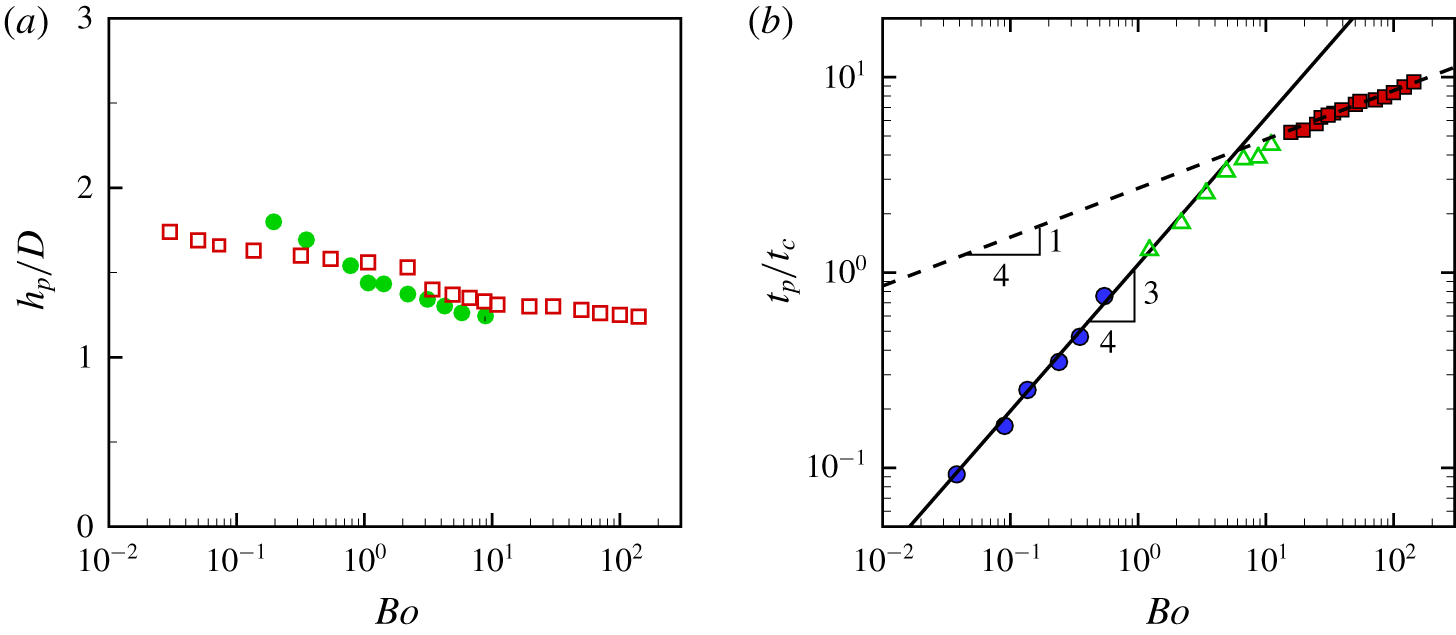
(a) Variation of  $h_{p}$ as a function of
 $Bo$. The filled circles denote the experimental data of Aristoff & Bush (Reference Aristoff and Bush2009) at low Weber numbers, and the empty squares represent our numerical results. (b) Variation of critical sinking time
 $t_{p}$ as a function of
 $Bo$. The solid line denotes the theoretical prediction of (3.5) with a prefactor of 2, and the dashed line denotes the theoretical prediction of (3.6) with a prefactor of 0.9. The circles, squares and triangles in (b) represent the capillarity-dominant (
 $Bo<1$), gravity-dominant (
 $Bo>16$) and gravity–capillary waves (
 $1\leqslant Bo\leqslant 16$), respectively.

At low Weber and Bond numbers, sphere submersion occurs in a wide pool if the impacting sphere still descends when the contact line reaches the peak of the sphere. In the following, a scaling analysis of the duration of sphere descending at onset of submersion,  $t_{p}$, is performed, based on the flow features identified in simulations. Here, the onset of submersion is referred to the critical impact condition at which a further increase of impact speed would lead to the regime change to sphere submersion. Numerical results of the depth of sphere bottom when the sphere starts to rebound at onset of submersion (namely
 $h_{p}$) are shown in figure 6(a) for a wide range of Bond numbers (
 ${\sim}O(10^{-2}){-}O(10^{2})$). We can see that
 $h_{p}/D$ is weakly dependent on
 $Bo$, and decreases from
 $1.75$ to
 $1.25$ with increasing
 $Bo$ in the four orders of
 $Bo$. Interestingly, this finding is also consistent with the experimental observations of the sinking spheres at low Weber numbers (
 $We<1$) by Aristoff & Bush (Reference Aristoff and Bush2009), despite the difference in the density ratio (
 $\unicode[STIX]{x1D701}=7.7$ in their experiments). The fact of
 $h_{p}\sim D$ naturally gives rise to a time scale
 ${\sim}\sqrt{\stackrel{}{D}/a}$, which can be reasonably associated with
 $t_{p}$. Substituting (3.4) into this scaling law, we can obtain the theoretical prediction of
 $t_{p}$ in the limit of low
 $Bo$,
 $$\begin{eqnarray}t_{p}\sim \left[\frac{\unicode[STIX]{x1D701}+\displaystyle \frac{1}{2}}{6\sin ^{2}\left(\displaystyle \frac{\unicode[STIX]{x1D703}}{2}\right)}\right]^{1/2}\left(\frac{\unicode[STIX]{x1D70C}D^{3}}{\unicode[STIX]{x1D6FE}}\right)^{1/2}=t_{c}\,Bo^{3/4}\left[\frac{\unicode[STIX]{x1D701}+\displaystyle \frac{1}{2}}{6\sin ^{2}\left(\displaystyle \frac{\unicode[STIX]{x1D703}}{2}\right)}\right]^{1/2},\end{eqnarray}$$
and in the limit of high  $Bo$,
 $$\begin{eqnarray}t_{p}\sim \left(\frac{\unicode[STIX]{x1D701}+\frac{1}{2}}{1-\unicode[STIX]{x1D701}}\right)^{1/2}\left(\frac{D}{g}\right)^{1/2}=t_{c}\,Bo^{1/4}\,\left(\frac{\unicode[STIX]{x1D701}+\frac{1}{2}}{1-\unicode[STIX]{x1D701}}\right)^{1/2},\end{eqnarray}$$
where the characteristic time scale  $t_{c}=l_{c}/U_{c}=(\unicode[STIX]{x1D6FE}/(\unicode[STIX]{x1D70C}g^{3}))^{1/4}$ corresponds to the time for a gravity-capillary wave to travel a distance of capillary length.
Numerical results of  $t_{p}$ are plotted in figure 6(b) as a function of
 $Bo$ on a log–log scale. It is clear that there exist two power-law regimes, corresponding to
 $t_{p}/t_{c}\sim Bo^{3/4}$ for
 $Bo\leqslant 1$ and
 $t_{p}/t_{c}\sim Bo^{1/4}$ for
 $Bo\geqslant 20$, respectively. Therefore, the numerical results agree well with the theoretical predictions. The results in figure 7(b) also justify the use of
 $t_{c}$ as the time scale for the descending time of the sphere at onset of submersion in the previous experiments (
 $Bo=0.244-0.544$) (Vella, Lee & Kim Reference Vella, Lee and Kim2006; Lee & Kim Reference Lee and Kim2008) and numerical simulations (
 $Bo=0.48$) (Chen et al. Reference Chen, Liu, Lu and Ding2018) at relatively low Weber number.
3.4 Effect of the confined pool: theoretical analysis
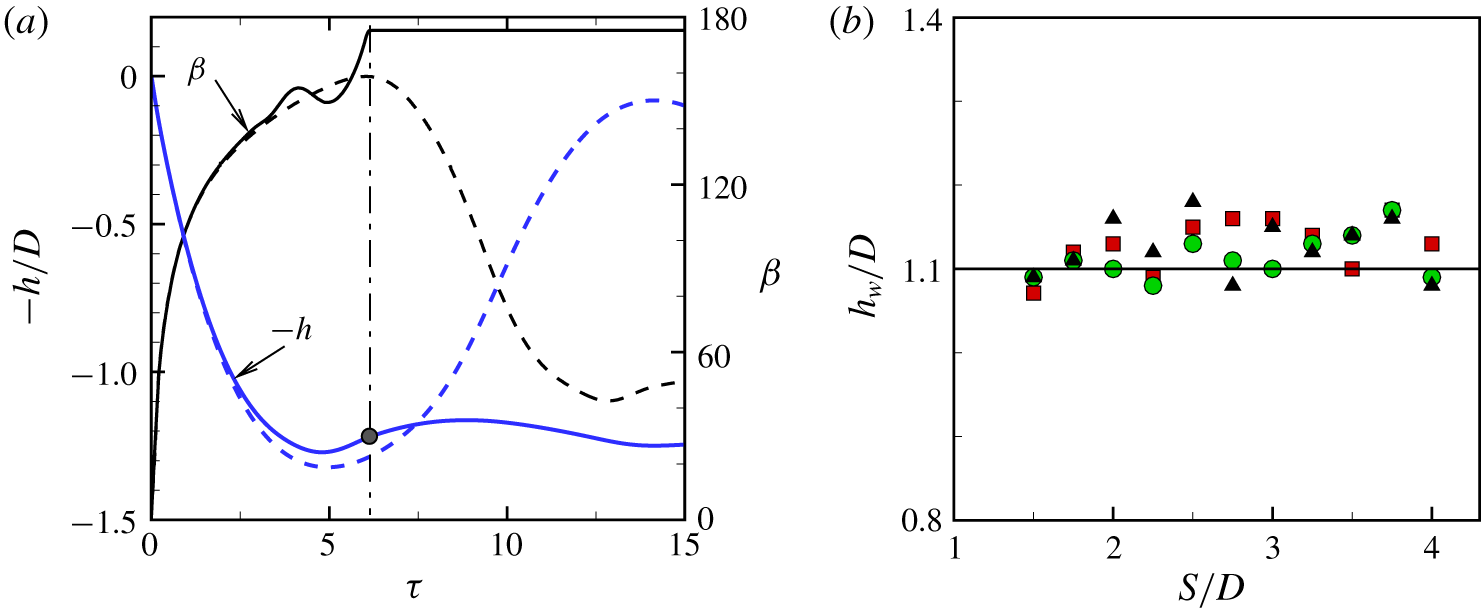
(a) Impact dynamics of spheres at  $Bo=0.05$ and
 $We=19$, with respect to the sphere displacement
 $h$ and contact line position
 $\unicode[STIX]{x1D6FD}$. Solid lines denote the results at the onset of submersion in a confined pool (
 $S=3.5D$), and dashed lines denote the results in a wide pool (
 $S=20D$). The circle indicates the moment when the sphere is submerged. Note that the undisturbed surface corresponds to
 $h=0$ (see figure 1b), and
 $h>0$ means underwater. (b) Distribution of the critical sphere displacement at the onset of submersion,
 $h_{w}$, as a function of
 $S$ for different Bond numbers:
 $Bo=0.05$ (▫),
 $3.4$ (○) and
 $12$ (▵), respectively.

At the return of the gravity–capillary waves in a confined pool, the rising sphere would be submerged if it could not come to the water surface in time. Figure 7(a) shows the impact dynamics of a sphere at the onset of submersion owing to the convergence of the reflected waves, with respect to the time variation of  $h$ and the contact line position
 $\unicode[STIX]{x1D6FD}$ (see the definition of
 $h$ and
 $\unicode[STIX]{x1D6FD}$ in figure 1b). The return of the surface waves makes the contact line oscillate on the sphere, and also causes the trajectory of the sphere to deviate from that in a wide pool. The detachment of the contact line from the sphere (i.e.
 $\unicode[STIX]{x1D6FD}=180^{\circ }$) implies the start of the sphere submersion. Figure 7(b) shows the distribution of
 $h$ at the onset of submersion,
 $h_{w}$, as a function of
 $S/D$ for different
 $Bo$. We can see that
 $h_{w}$ is not very sensitive to either
 $Bo$ or
 $S$, and specifically,
 $h_{w}\approx 1.1D$ with a maximum difference of 7 %.
Under the critical condition, the rising of the impacting sphere (particularly at the onset of submersion in a wide pool) to the water surface may take place simultaneously with the return of the surface waves to the symmetry axis. It is reasonable to expect that in this case the size of this confined pool corresponds to  $S_{c}$, beyond which the pool size would have no effect on the regime of the sphere. We also assume that the rising process of the sphere has the same time scale as its descending process (i.e.
 $t_{p}$), owing to the fact that the restoring forces of the same scale are exerted on the sphere during the two processes (figure 5). Therefore, we can have
 $S_{c}\sim c_{max}\,t_{p}$. In the limit of
 $Bo\ll 1$ (or
 $D\ll l_{c}$), (3.2) suggests
 $\unicode[STIX]{x1D706}_{max}\ll l_{c}$. Accordingly, the theoretical prediction of
 $c_{max}$ can be simplified from (3.1) to
 $c_{max}\approx U_{c}\sqrt{2\unicode[STIX]{x03C0}l_{c}/\unicode[STIX]{x1D706}_{max}}=(2\unicode[STIX]{x03C0}/\unicode[STIX]{x1D6FC})^{1/2}(\unicode[STIX]{x1D70C}D/\unicode[STIX]{x1D6FE})^{-1/2}$, where
 $\unicode[STIX]{x1D6FC}=3.7$ comes from (3.2). Further substituting (3.5) into
 $S_{c}\sim c_{max}\,t_{p}$, we can obtain
 $$\begin{eqnarray}S_{c}\sim \left[\frac{\unicode[STIX]{x1D701}+\displaystyle \frac{1}{2}}{6\sin ^{2}\left(\displaystyle \frac{\unicode[STIX]{x1D703}}{2}\right)}\right]^{1/2}D.\end{eqnarray}$$
Similarly, in the limit of  $Bo\gg 1$ (or
 $\unicode[STIX]{x1D706}_{max}\gg l_{c}$), taking
 $c_{max}\approx U_{c}\sqrt{\unicode[STIX]{x1D706}_{max}/(2\unicode[STIX]{x03C0}l_{c})}=(2\unicode[STIX]{x03C0}/\unicode[STIX]{x1D6FC})^{-1/2}(gD)^{1/2}$ and (3.6) into account, we can obtain
 $$\begin{eqnarray}S_{c}\sim \left(\frac{\unicode[STIX]{x1D701}+\frac{1}{2}}{1-\unicode[STIX]{x1D701}}\right)^{1/2}D.\end{eqnarray}$$
The scaling laws in (3.7) and (3.8) suggest that the value of  $S_{c}$ depends on the size of the sphere, no matter whether the surface waves are the gravity or capillary waves. This is consistent with the observations in our numerical experiments, that is,
 $S_{c}$ has similar values for
 $Bo=0.05{-}20$.
In the cases of  $S<S_{c}$, we tentatively assume the non-submerging sphere experiences a more or less uniform acceleration in the descending and ascending processes. Therefore, the time duration of the two processes at the onset of submersion,
 $t_{w}$, can be approximated by solving
 $D\approx U_{0}t_{w}-(1/2)a\,t_{w}^{2}$ with the knowledge of
 $h_{w}\approx 1.1D$. Clearly,
 $t_{w}$ has two solutions at the same impact velocity, primarily due to the different state of sphere motion at the return of surface waves. The smaller
 $t_{w}$ corresponds to the sphere descending and the bigger
 $t_{w}$ corresponds to the sphere ascending. As the corresponding important pool size
 $S_{w}$ has a scale
 ${\sim}t_{w}c_{max}$, it should also have two values (
 $S_{w,1}$ and
 $S_{w,2}$) accordingly, and yield
 $$\begin{eqnarray}\displaystyle We^{1/2}-\frac{6\sin ^{2}\left(\displaystyle \frac{\unicode[STIX]{x1D703}}{2}\right)+(1-\unicode[STIX]{x1D701})Bo}{2\unicode[STIX]{x1D701}+1}\sqrt{\frac{2\unicode[STIX]{x03C0}\unicode[STIX]{x1D6FC}}{\unicode[STIX]{x1D6FC}^{2}Bo+4\unicode[STIX]{x03C0}^{2}}}\frac{S_{w}}{D}\sim \sqrt{\frac{\unicode[STIX]{x1D6FC}^{2}Bo+4\unicode[STIX]{x03C0}^{2}}{2\unicode[STIX]{x03C0}\unicode[STIX]{x1D6FC}}}\frac{D}{S_{w}}. & & \displaystyle\end{eqnarray}$$
The theoretical prediction of (3.9) is plotted in the phase diagrams in figure 2. Clearly, the theoretical predictions accurately define the boundaries separating the regimes of oscillation and submersion, thereby justifying the theoretical analysis of the effect of the confined pool.
4 Conclusion
The impact of a hydrophobic sphere onto a confined pool has been numerically investigated, with a focus on the fate change of the non-submerging spheres owing to the reflected surface waves. We find that for a wide range of sphere diameters ( $Bo=10^{-2}{-}10^{2}$) the critical dimensionless pool size
 $S_{c}$ is very similar (
 ${\approx}3.5D{-}4.2D$). In the cases with
 $S<S_{c}$, it is also interesting to see that at the same impact speed, there possibly exist two
 $S_{w}$, between which the non-submerging spheres will be sunk by the convergence of the reflected surface waves. Further analysis suggests that the smaller (larger)
 $S_{w}$ results from the collision of the descending (ascending) spheres with the reflected waves. Among the impact-induced capillary–gravity waves, the dominant one is found to have the largest wavelength, which is only related to the sphere diameter, that is,
 $\unicode[STIX]{x1D706}_{max}\approx 3.7D$. For a confined pool with size
 $S_{c}$, the return of this wave to the symmetry axis coincides with the rising of the impacting sphere (particularly at the onset of submersion in a wide pool) to the water surface. Theoretical analysis has confirmed in such cases that
 $S_{c}$ is dependent on
 $D$, no matter whether the surface waves are gravity or capillary waves. A scaling law is proposed to correlate
 $We$ and
 $Bo$ with
 $S_{w}$, and is shown to be good agreement with the numerical results.
Acknowledgements
We are grateful for the support of the National Natural Science Foundation of China (grant nos. 11425210, 11621202, 11672288, 11932019), the Strategic Priority Research Program of the Chinese Academy of Sciences (grant no. XDB22040103) and the Fundamental Research Funds for the Central Universities. H.C. and H.-R.L. contributed equally to this article.
Declaration of interests
The authors report no conflict of interest.
Supplementary movie
Supplementary movie is available at https://doi.org/10.1017/jfm.2019.964.