Introduction
Human population growth and associated activities (e.g., industrial and domestic) increase global energy demands (International Energy Agency 2019). Energy-extracting projects are widely disrupting ecosystem structure and function (Vitousek et al. Reference Vitousek, Mooney, Lubchenco and Melillo1997), their impacts varying with circumstances including energy source, project area and geographical location. In Neotropical regions, where biodiversity is a major component of important economic activities such as tourism but energy demands are rapidly increasing, understanding the implications of energy-extracting projects is key to developing sustainable ways to coexist.
Here, we used the development of a geothermal project in Costa Rica, a megadiverse country that heavily relies on renewable energies, to investigate the ecological consequences of habitat modification for the native mammal fauna. Considered to be a more sustainable option because of its reduced environmental impact compared to other sources of renewable energy such as wind and hydroelectricity or thermal power stations running on fossil fuels (Instituto para la Diversificación y Ahorro de la Energía 2008), geothermal energy has become the second most important source of renewable energy in Costa Rica (Centro Nacional de Control de Electricidad 2022). Specifically, through acoustic monitoring, we examine how the establishment of geothermal drilling pads within the Proyecto Geotérmico Las Pailas II (Fig. 1; hereafter Las Pailas II) influences the composition of the community of Neotropical aerial insectivorous bats that, due to traits such as their stability and population sensitivity to short- and long-term effects, have been identified as ecological indicators of habitat quality (Wickramasinghe et al. Reference Wickramasinghe, Harris, Jones and Vaughan2003, Kalcounis-Rueppell et al. Reference Kalcounis-Rueppell, Payne, Huff and Boyko2007, Jones et al. Reference Jones, Jacobs, Kunz, Willig and Racey2009).
(a) Diagrammatic map of the study area, (b) detail of sampling design and (c) aerial view of one of the artificial clearings and surroundings at the Proyecto Geotérmico Las Pailas II, Costa Rica. PN = Parque Nacional.

Because Las Pailas II is located in a highly forested region near a national protected area where forest openings for the establishment of drilling pads are considered a type of artificial disturbance to a mature and stable habitat (Fig. 1c), it presents an exceptional opportunity to learn how its creation can affect the structure and functionality of forests and the animal communities associated with them (Markesteijn Reference Markesteijn2015).
Using as a basis the null hypothesis that there is no difference between habitats due to the increased habitat range provided by the combination of open spaces and adjacent forests, in addition to the flying capacity and foraging preferences of aerial insectivorous bats (i.e., open and border spaces; Denzinger & Schnitzler Reference Denzinger and Schnitzler2013), we tested whether their diversity and activity would be greatest at borders in comparison with open and closed (i.e., forest) spaces and whether community composition would differ among habitats.
Methods
Study site
The study was carried out between 1 and 25 September 2016 at the Proyecto Geotérmico Las Pailas II, Liberia, Guanacaste, Costa Rica (353294 FE and 1189655 FN; coordinates are from the Costa Rica Transversal Mercator 2005 (CRTM05) projection system). Located in the south-east of the volcanic solid Rincón de la Vieja (Instituto Costarricense de Electricidad 2012) at 600–800 m altitude, Las Pailas II is characterized by the presence of a premontane wetland forest transition to tropical basal life zone and a tropical wetland forest transition to premontane life zone (Holdridge Reference Holdridge1967). The project is spread over a total area of 211 ha, mostly covered by primary forest with some human modifications (Instituto Costarricense de Electricidad 2013). The annual precipitation range is 1500–3000 mm and that of temperature is 24–27°C. The area has a dry period between December and May and a wet period between June and November (Instituto Costarricense de Electricidad 2013).
Data collection
Within the area developed between 2014 and 2015 for the drilling of production and reinjection wells for geothermal exploitation (Fig. 1c), data collection was performed at three sites in each of four rectangular (1.3 ha each) drilling pads or artificial clearings (i.e., Cl-11, Cl-12, Cl-15 and Cl-16) c. 800 m from each other (Fig. 1a,b; Instituto Costarricense de Electricidad 2013). Moreover, based on the information that bat calls vary between open, border and closed spaces (Schaub & Schnitzler Reference Schaub and Schnitzler2007), our sampling sites were: (1) the centre of the space in the forest opened by the establishment of production and reinjection wells for geothermic exploitation; (2) on the border of the clearing, 48 m from its centre; and (3) in forest 500 m from the border of the clearing (Fig. 1a,b). In the clearing, border and forest sites in each drilling pad, passive acoustic monitoring (i.e., without interference from the observer; Tovar & Acevedo Reference Tovar and Acevedo2021) was conducted by simultaneously employing three ultrasonic recording devices (i.e., two SM3BAT song meters and one SM2 song meter) and their corresponding microphones (placed at 30 cm and 2 m from the ground, respectively; Mora et al. Reference Mora, Macías, Rojas, Rodríguez, Quiñonez and García2002, Trejo Reference Trejo2011) for five consecutive nights for a total of 20 nights of monitoring.
Based on the methods of Alpízar et al. (Reference Alpízar, Víquez, Hong, Rodríguez-Herrera and González2012) and Arias-Aguilar et al. (Reference Arias-Aguilar, Chacón-Madrigal and Rodríguez-Herrera2015), the three devices were programmed to record each night from 17:30 to 23:00, in recording periods of 10 min with rest intervals of 20 min, for a total of 2.16 h of recording in each location (clearing, border and forest) per night. The recording parameters focused on the characteristics of the aerial insectivorous guild of Neotropical bats (families Emballonuridae, Mormoopidae, Vespertilionidae and Molossidae; Jones & Holderied Reference Jones and Holderied2007), with a range of 12–192 kHz and with a recording duration of 1.5–200 min. All vocalizations recorded were stored in WAV format for further species identification and data analysis.
Data analysis
Acoustic data and spectrograms were produced with the software Kaleidoscope 4.0.4 and analysed using the Hamming window at 512 fast Fourier transform (FFT). All call sequences were identified manually to the finest taxonomic level possible by comparing structural and frequency parameters with reference call sequences available in the literature (O’Farrell & Miller Reference O’Farrell and Miller1999, Jung et al. Reference Jung, Kalko and Helversen2007, MacSwiney et al. Reference MacSwiney, Clarke and Racey2008). Following Jung & Kalko (Reference Jung and Kalko2011) and due to the challenges of distinguishing between Eumops species from Tadarida brasiliensis and Nyctinomops laticaudatus, these calls were treated as the complex Eumops–Tadarida–Nyctinomops (hereafter Eum–Tad–Nyc).
Due to our sampling design, which does not account for species abundances (Jost Reference Jost2006), we compared the diversity of the sampling locations by obtaining the effective number of species (i.e., Hill numbers; Hill Reference Hill1973), the alpha-diversity (i.e., the number of species in a particular community), the beta-diversity (i.e., the difference in species between different types of communities or habitats) and the gamma-diversity (i.e., the number of species in a group of habitats; Forman & Godron Reference Forman and Godron1986, Moreno Reference Moreno2001, Jost Reference Jost2006) of communities with a diversity of order zero (which refers to the species richness; Jost Reference Jost2006).
We differentiated between the activity levels of bats in the different habitats by analysing the bat passes per species, which refers to the relative activity (i.e., minimum of three consecutive echolocation calls), and the terminal phases of the bat calls, which refers to the feeding activity (i.e., a series of short signals with high repetition before the capture of an insect; Schnitzler & Kalko Reference Schnitzler and Kalko2001), using non-metric multidimensional scaling (NMDS) analysis, analysis of similarities (ANOSIM; Oksanen et al. Reference Oksanen, Simpson, Blanchet, Kindt, Legendre and Minchin2022) and multiple Kruskal–Wallis rank sum tests with post-hoc comparisons (i.e., Dunn’s test). All analyses were performed in R (R Core Team 2018) with simple functions (Kruskal–Wallis) and using the ‘FSA’ package (post-hoc; Ogle et al. Reference Ogle, Doll, Wheeler and Dinno2023), the ‘entropart’ package (true diversity and NMDS; Marcon & Herault Reference Marcon and Herault2015), the ‘vegan’ package (ANOSIM; Oksanen et al. Reference Oksanen, Simpson, Blanchet, Kindt, Legendre and Minchin2022) and the ‘ggstatsplot’ package (box plots; Patil Reference Patil2021).
Results
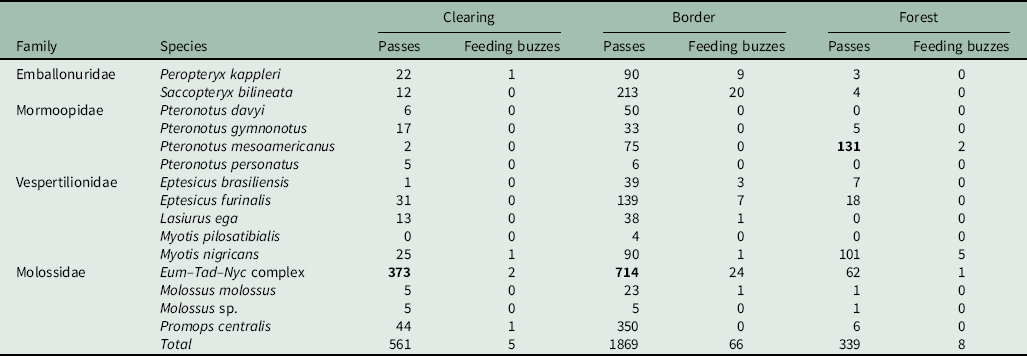
A total of 2493 positive recordings of bat calls were detected during the study period. We were able to assign 13 different calls to the species level, one to the genus level (i.e., Molossus) and a group of calls as a complex of species (Eum–Tad–Nyc; Table 1).
Relative and feeding activities of each insectivorous bat species detected at each habitat type. Numbers in bold indicate the species with the highest relative activity at each sampling habitat.

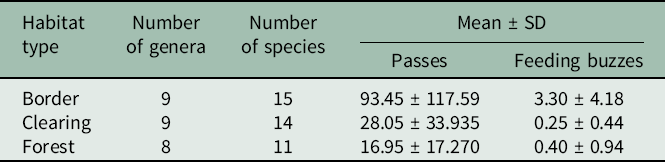
Diversity analysis indicated that the border habitats had the highest alpha-diversity (15 species), followed by the clearings (14 species) and the forested sites (11 species). The most frequent bat species in the study was represented by the complex Eum–Tad–Nyc, followed by Pteronotus mesoamericanus, Myotis nigricans, Promops centralis and Eptesicus furinalis (Table 1). Overall, the average alpha-diversity was 13.33 species, the average beta-diversity was 1.125 and the average gamma-diversity was 15 effective species. In the clearing habitats, the most representative species were the complex Eum–Tad–Nyc, followed by P. centralis and E. furinalis, and in the border sites, the most representative species were also the complex Eum–Tad–Nyc, followed by P. centralis and Saccopteryx bilineata. The forest sites were dominated by species such as P. mesoamericanus, M. nigricans and the complex Eum–Tad–Nyc.
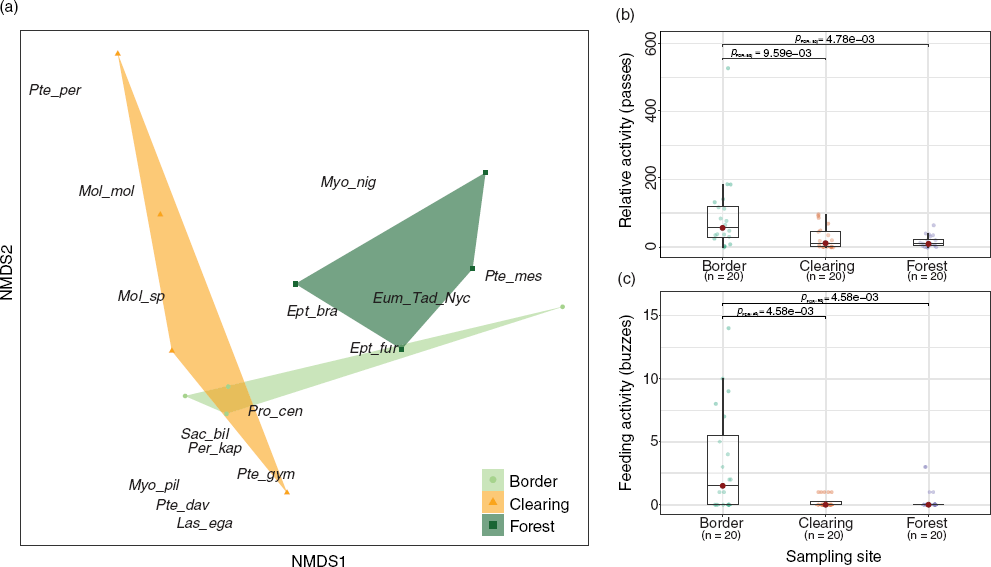
The NMDS analysis (stress level = 0.11) and the analysis of similarities (R = 0.41, p = 0.005) showed that the habitats were slightly different from each other (Fig. 2a), with the complex Eum–Tad–Nyc showing higher affinity with respect to the clearing and border and the species P. mesoamericanus showing higher affinity with respect to the forest.
(a) Non-metric multidimensional scaling (NMDS) and the (b) relative and (c) feeding activities of insectivorous bats across sampling sites. The bars in (b) and (c) show significant pairwise comparisons with Dunn’s test. P-values were calculated using the false discovery rate adjustment method.

From 2769 bat passes and 79 feeding buzzes detected and identified at the sampling locations (Tables 1 & 2), we found that both the relative activity (χ2 = 11.73; df = 2; p = 0.002) and feeding activity (χ2 = 34.34; df = 2; p < 0.001) differed among habitats (Fig. 2b,c). Here, the complex Eum–Tad–Nyc showed the highest relative and feeding activities in open and border spaces, while P. mesoamericanus and M. nigricans were the species with respectively higher relative and feeding activities in the forest sites. Post-hoc comparisons did not show significant differences in all possible comparisons, with only the border habitats showing higher relative and feeding activities when compared with the other two types of habitats (Fig. 2b,c).
Taxonomic composition and mean relative and feeding activities of aerial insectivorous bats at each habitat type.

Discussion
Our results show how the diversity and activity of Neotropical insectivorous bat species differed along a perturbation gradient created by the establishment of a geothermal project in Costa Rica. Similar to other studies focused on bats (Tena et al. Reference Tena, de Paz, de la Peña, Fandos, Redondo and Tellería2020) and other taxa (e.g., galling insects; de Araújo & do Espírito-Santo Filho Reference De Araújo and do Espírito-Santo Filho2012), the creation of clearings within the forest seemed to be the major cause of the biodiversity and activity changes. Different processes may help to explain why the creation of open spaces strongly influences the structure and activity patterns of animal communities (e.g., the habitat heterogeneity and edge effect hypothesis of Hamm & Drossel Reference Hamm and Drossel2017). For instance, in the case of bats, we argue that the creation of such a gradient in the forest canopy may increase insect availability and facilitate the occurrence of edge-habitat specialists, which will result in acoustic and foraging advantages for a broader sample of aerial insectivorous species (Weller & Zabel Reference Weller and Zabel2002, Schaub & Schnitzler Reference Schaub and Schnitzler2007).
Although we do not have direct evidence of an increase in food resource availability at border habitats, our results suggest that, overall, the relative activity and feeding passes (i.e., a direct measure of feeding attempts) of aerial insectivorous bats significantly increased at the forest edges, which is suggestive of a foraging advantage in comparison with open spaces where insects might not be as abundant and with forests where insects might be as abundant and diverse but hunting them presents special challenges such as obstacle avoidance.
From an acoustic perspective, on the other hand, forest borders may represent places with a combination of characteristics that allows species adapted to forage in uncluttered and background-cluttered spaces (Schnitzler & Kalko Reference Schnitzler and Kalko2001) to efficiently hunt for food. These two acoustic groups can be found in the Vespertilionidae, Emballonuridae, Mormoopidae and Molossidae, all of which were detected in all three habitats at Las Pailas II (Table 1). In this sense, the differentiation of the habitats that we detected might come from a unique species such as the moustached bat (i.e., P. mesoamericanus: Mormoopidae) and unique groups such as the free-tailed bats (e.g., Eum–Tad–Nyc: Molossidae), which are acoustically specialized to background-cluttered (i.e., through the use long constant-frequency components flanked by brief frequency modulations in their calls) and uncluttered spaces (i.e., through the use of overlap-sensitive, narrowband signals of long duration and low frequency in their calls), respectively (Schnitzler & Kalko Reference Schnitzler and Kalko2001, Vater et al. Reference Vater, Kössl, Foeller, Coro, Mora and Russel2003). Reduced detection of bat passes and feeding buzzes at the forest habitats (Fig. 2b,c) might also be due to methodological limitations of acoustic devices and sound dissipation caused by large and frequent obstacles (e.g., leaves, branches, trees, etc.); nevertheless, considering the large differences observed in our results (i.e., detection at the borders), we do not believe these limitations to be sufficient to challenge the conclusions drawn from the patterns detected.
We conclude that the small-scale deforestation at Las Pailas II has triggered changes in the community composition and activity of the aerial insectivorous bats across the perturbation gradient. These effects are probably associated with the modification of the 15% of the total land cover necessary for equipment and structure installation (Instituto Costarricense de Electricidad 2013, Centro de Servicios de Recursos Geotérmicos 2014). However, considering that the project represents an efficient way to generate high-quality energy with consequences matching those that can be detected when a natural clearing in the forest is opened (e.g., through a fallen tree), we consider this research to be an important step in quantifying and understanding the influence of human activities in highly diverse and understudied Neotropical ecosystems. The patterns found here refer specifically to the guild of Neotropical aerial insectivorous bat species. Nevertheless, because of the various responses (e.g., positive, neutral or negative) of other taxonomic groups and even ecological interactions (e.g., mutualisms and antagonisms) to edge effects created by fragmentation or habitat loss (e.g., Magrach et al. Reference Magrach, Laurance, Larrinaga and Santamaria2014, González et al. Reference González, Gómez-Silva, Ramírez and Fontúrbel2020), we highlight the importance and necessity of incorporating other taxonomic indicators to inform decision-making processes related to the expansion or establishment of new geothermal projects.
Acknowledgments
We thank the Centro de Servicio de Recursos Geotérmicos, Instituto Costarricense de Electricidad (ICE) and the Escuela de Biología, Universidad de Costa Rica, for providing logistical support to develop this research. We are also grateful to Luis Girón, Priscilla Alpízar and Adriana Arias for sharing their knowledge of acoustic identification of Neotropical bat species.
Financial support
This research did not receive any specific grant from any funding agency, commercial sector or non-profit.
Competing interests
The authors declare none.
Ethical standards
None.