Introduction
Although only 1.6% of Americans consider themselves as being gay or lesbian and 0.7% consider themselves as bisexual (2013 National Health Interview Survey), these individuals have a much higher rate of smoking than the general population. In the most recent published survey in 2014, the prevalence of current cigarette smoking amongst lesbian, gay, and bisexual individuals was 23.9%, compared with 14.9% amongst heterosexual (HTSX)/straight individuals (CDC, 2015). The lesbian, gay, bisexual, and transgender (LGBT) communities in the United States are disproportionately impacted by smoking, including both incidence rates and a lower rate of cessation success (National LGBT Tobacco Control Network, 2015; Tang et al., Reference Tang, Greenwood, Cowling, Lloyd, Roeseler and Bal2004). A recent study suggests the LGBT community smokes at a rate almost 50% to 200% higher than the general population (National LGBT Tobacco Control Network, 2015; Tang et al., Reference Tang, Greenwood, Cowling, Lloyd, Roeseler and Bal2004). In comparison to the general population, more LGBT individuals believe their smoking increases the risk of diseases such as lung cancer and heart disease, but fewer make quit attempts (75% compared with 80% of all adults) (GLSEN and Harris Interactive, 2008).
One of the contributing factors to this dramatic disparity is the prejudice and discrimination that are commonly experienced by members of LGBT communities, who because of this social stigma, may be deprived of a sense of safety and well-being (Meyer, Ouellette, Haile & McFarlane, Reference Meyer, Ouellette, Haile and McFarlane2011). Homophobia and transphobia likely contribute to higher levels of substance abuse and other problematic behaviours that LGBT individuals may turn to as coping strategies (Hunt & Byrd, Reference Hunt and Byrd2012). Another contributing factor to the increased prevalence of tobacco use amongst the LGBT individuals is that tobacco companies have aggressively directed their advertising to the LGBT population, spending an average of 13 million dollars per year in marketing. In addition, the tobacco industry has supported LGBT events including Pride, other community events, and HIV organisations (Federal Trade Commission, 2007; Smith & Malone, Reference Smith and Malone2003). Previous research has demonstrated that stress associated with living in a society often hostile to LGBT individuals, can directly contribute to higher smoking rates, particularly amongst LGBT youth (Hunt & Byrd, Reference Hunt and Byrd2012). A final contributing factor is the varying attitudes regarding the need for tailored cessation interventions (Harding, Bensley & Corrigan, Reference Harding, Bensley and Corrigan2004; Schwappach, Reference Schwappach2008). The LGBT communities, similar to any other heterogeneous group, should offer individual and personalised cessation services (Levinson, Hood, Mahajan & Russ, Reference Levinson, Hood, Mahajan and Russ2012).
Available in all US states, telephonic quitlines offer evidence-based cessation practices including a combination of counselling and nicotine replacement therapy (NRT) to populations (Fiore, Reference Fiore, Jaen, Baker, Bailey, Benowitz and Curry2008; Stead, Hartmann-Boyce, Perera, & Lancaster, Reference Stead, Hartmann-Boyce, Perera and Lancaster2013; Zhu et al., Reference Zhu, Anderson, Tedeschi, Rosbrook, Johnson, Byrd and Gutiérrez-Terrell2002). These public services are advantageous for many smokers because treatment is not face-to-face which eliminates transportation and anonymity concerns, and services are offered at low to no cost. For the general population, a recent Cochrane Review found that proactive telephonic services help smokers to quit compared to brief counselling or self-help materials (Stead et al., 2013). Nationally, in 2012, the North American Quitline Consortium (NAQC) reported public quitline self-reported 30-day abstinence at 7 months to be approximately 30% (NAQC, 2012). Quitline interventions have enormous potential to lessen the burden of tobacco in LGBT communities given that quitline practices include cultural competency training, sexual orientation, and gender identity as a part of the intake process, LGBT specific written materials and other promising practices (CDC, 2012).
In the current study, we report on data from the largest non-profit provider of quitline services, National Jewish Health (NJH), which serves 15 states across the US. Our primary aim is to examine how LGBT callers differ from their straight/HTSX callers in terms of other demographic characteristics, tobacco use history, and the prevalence and consequences of emotional or mental health problems. A better understanding of the unique characteristics of LGBT quitline callers may help direct future efforts towards tailored treatment services for this high-risk and underserved population and increase the number of individuals who successfully quit tobacco use.
Methods
Sample
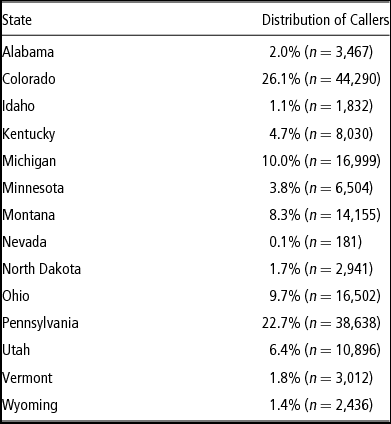
NJH has been a quitline service provider since December 2002, and has served over 1 million participants across multiple states, many corporations, and numerous health plans. For the current study, we report on data collected from callers from within the 14 states (Table 1), who received quitline services between January 1, 2012 and December 31, 2014. Analyses of these de-identified, archived data were part of ongoing quality improvement efforts. As such, quitline callers were not enrolled in a research study, and this project was exempt from IRB review. The standard treatment services offered through the quitline include an intake assessment and up to five coaching calls, with the opportunity for additional calls throughout the programme. The programme also allows participants to receive a variable amount (differs by state) of NRT provided at no cost and to receive messages via text message and/or e-mail. The programme is advertised widely in each state through print, radio, television, and earned media. In most states, the programme is available to state residents. Due to budgetary constraints in a few states, eligibility for the programme is limited to the uninsured and underinsured. For callers who enrolled in the quitline programme more than once, only their first intake interview (if it occurred between 2012 and 2014) was included in the present dataset. Callers who did not respond to the intake question addressing sexual orientation and self-identified sex were excluded from the present study. The current sample consists of 169,883 individuals, ranging in age (at intake) from 18 years to 96 years old (mean = 45.9; s.d. 14.0). LGBT callers make up 4.7% (n = 8,012 callers) of that total sample.
Distribution of callers across 14 participating states

Measures
Quitline intake assessment
Participants who enrolled in the quitline programme completed the minimal data set (MDS) questions recommended by NAQC, which allows for comparisons and pooling of data across quitlines (MDS questions are available through NAQC; www.naquitline.org.). The MDS, consisting of 18 questions is collected from eligible callers at intake. Question categories include reasons for calling, awareness of the quitline, tobacco use history, previous cessation treatment, and demographics. Aligned with the recommendations of the Behavioral Health Advisory Forum, and endorsed by NAQC as a component of the MDS, a series of mental health screening questions were also asked during the intake interview for all callers: (a) ‘Do you have a mental health condition, such as an anxiety disorder, depression disorder, bipolar disorder, alcohol or drug abuse, or schizophrenia?’ (b) ‘During the past two weeks, have you experienced any emotional challenges such as excessive stress, feeling depressed or anxious?’, and (c) ‘During the past two weeks, have you experienced any emotional challenges that have interfered with your work, family life, or social activities?’ If any of these three questions elicits a ‘Yes’ response, the caller is then asked, ‘Do you believe that these mental health conditions or emotional challenges will interfere with your ability to quit? If participants endorsed a mental health question, then the coach worked with them to identify the appropriate mental health resources and/or provide state mental health resources where applicable.
Data Analysis
Quitline data were analysed using SPSS Statistical Software (IBM, 2015). Descriptive statistics were computed using standard methods. Mean differences between groups were analysed using independent sample t-tests. Group differences in proportions were analysed using Pearson chi-square tests. Tests of association were conducted using correlational methods for within-group analyses. Due to the large sample sizes in the current study, p-values were set at 0.001 to avoid highlighting the statistical significance of trivially small effect sizes.
Results
Demographics
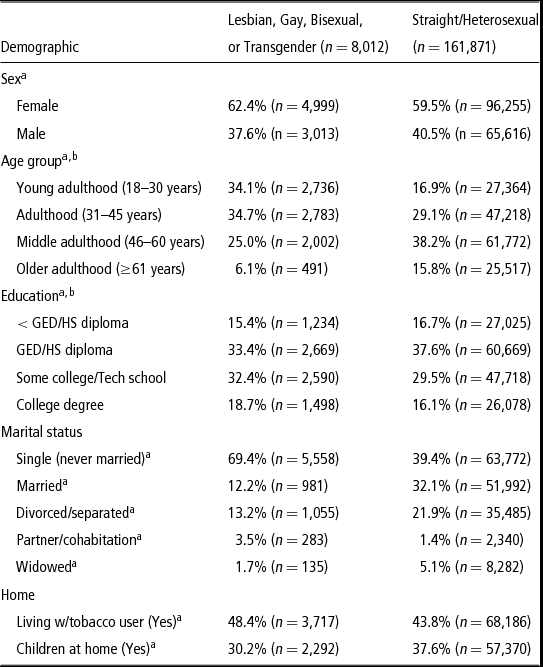
The current sample consisted of 169,883 individuals. Overall, the gender distribution of callers was about 60% female and 40% male. As shown in Table 2, this gender difference was just slightly greater in the LGBT group (62.4% female; 37.6% male) than in the HTSX group (59.5% female; 40.5% male). LGBT callers were, on average, nearly 8 years younger (mean = 38.7 years., s.d. = 13.0) than HTSX callers (mean = 46.2 years.; s.d. 14.0). Indeed, twice as many LGBT callers were in the young adult age range (18–30 years) than HTSX callers. Approximately three-quarters of the quitline callers self-identify as White/Caucasian (LGBT, 70.4%; HTSX, 73.8%), the second largest racial group is Black/African American (LGBT, 15.4%; HTSX, 14.3%). Nearly 8% of callers identify as ethnically Hispanic or Latino (LGBT, 9.8; HTSX, 7.6%).
Comparison of demographic characteristics

a p < 0.001.
b For Age Group and Education analyses were based on a comparison of the ordinal scale scores between the two groups. Thus, a single indicator of statistical significance is presented for those multiple-degree-of-freedom tests. For all categorical variables (e.g., Children at home: Yes/No), significance is noted for each category, based on a single-degree-of-freedom test.
LGBT callers were more likely to have earned a college degree (18.7%) than HTSX callers (16.1%). However, amongst callers who reported no college education, LGBT callers (33.4%) were less likely than HTSX (37.6%) callers to have achieved a GED or high school diploma. Though opportunities for the legal marriage between same sex partners during the period of study were limited across many states, 12.2% of LGBT callers reported being married and 13.2% reported being currently separated or divorced. In both of these marital status categories, HTSX callers were more likely to be married (32.1%) or separated/divorced (21.9%) than LGBT callers. More than two-thirds of the LGBT callers reported being single (69.4%) at intake, whilst only 39.4% of HTSX callers reported their status as single. Despite dramatically higher rates of being single, LGBT callers were more likely to live with another tobacco user (48.4%) than HTSX callers (43.8%). HTSX callers were significantly more likely to report having children in their homes (37.6%) than LGBT callers (30.2%). (p < 0.001).
Tobacco Use History and Previous Treatment
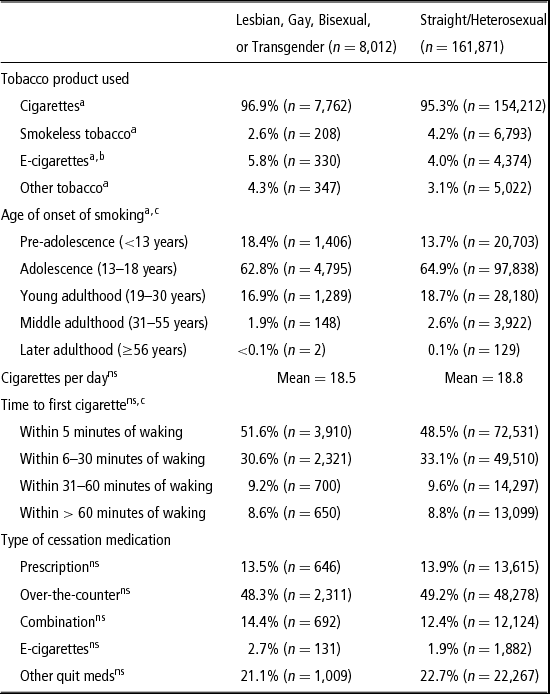
The prevalence of cigarette smoking was extremely high in the full quitline sample (>95%); a comparison of smoking rates in the two groups showed higher rates (96.9%) in the LGBT callers (Table 3; χ1 2 = 44.40; p < 0.001). Less than 5% of callers, regardless of group, reported using other forms of tobacco. Though the LGBT caller group was significantly more likely to report using E-cigarettes (χ1 2 = 45.95; p < 0.001) or ‘Other’ tobacco products (χ1 2 = 37.65; p < 0.001), including (pipes, cigars, or other uncategorised forms), they were less likely to use smokeless tobacco (χ1 2 = 49.54; p < 0.001). A comparison of age of onset of smoking showed a strikingly higher rate of pre-adolescent onset (defined as younger than 13 years) in the LGBT group (18.4%) versus the HTSX group (13.7%). Though rates of adolescent and young adult onset of smoking were higher in the HTSX group, an overall comparison of the mean age of onset in the two groups showed that the LGBT callers reported a slightly, but statistically significant, earlier age of onset (mean = 16.1 years) than the HTSX callers (mean = 16.7 years) (t = 9.53; p < 0.001). Both groups of callers (who smoked cigarettes), reported currently smoking just under one pack of cigarettes (~19 cigarettes) per day. Whilst a greater proportion of LGBT smokers reported their time to first cigarette (considered a proxy indicator for nicotine dependence) to be within 5 minutes of waking, the overall comparison showed no significant differences for the groups.
Comparison of tobacco use and treatment history

a p < 0.001 ns = non-significant.
b Approximately 30% of the study sample was not asked about electronic cigarettes; thus, the percentage of clients responding ‘yes’ was based on the 70% of the study sample that was asked.
c For Age of Onset of Smoking and Time to First Cigarette analyses were based on a comparison of the ordinal scale scores between the two groups. Thus, a single indicator of statistical significance is presented for the multiple-degree-of-freedom test. For all categorical variables (e.g., Tobacco Product Used), significance is noted for each category, based on a single-degree-of-freedom test.
Callers with at least one previous quit attempt were asked whether or not they used any type of cessation medication. Amongst the 60% who reported that they did use cessation medication, over-the-counter cessation medications were the most commonly used; 48.3% of LGBT callers and 49.2% of HTSX callers reported using nicotine patches, gum, lozenges, inhaler, and/or nasal spray. Just over one in every seven callers (both groups) who used any cessation medications reported using prescription cessation medications including bupropion (Wellbutrin or Zyban) or varenicline (Chantix). LGBT callers were more likely to use E-cigarettes or a combination of cessation medications compared to HTSX callers.
The number of coaching sessions utilised by callers in the LGBT group (mean = 1.98; s.d. = 1.72) was comparable to the number utilised in the HTSX group (mean = 1.90; s.d. = 1.79).
Mental Health
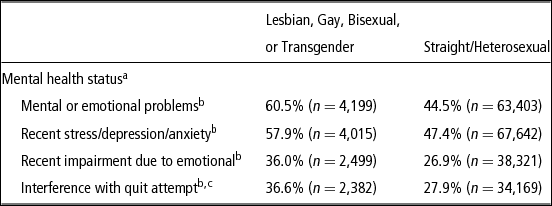
The most striking factors that discriminate between the LGBT and HTSX caller groups are related to mental health status. As shown in Table 4, the rates of acknowledgement of mental health or emotional problems are significantly higher in the LGBT group (60.5%), compared with rates in the HTSX group (44.5%) (χ1 2 = 687.63; p < 0.001). These elevated rates for the LGBT callers are also observed for recent stress, depression, or anxiety (57.9% vs. 47.4%; χ1 2 = 287.86; p < 0.001), and recent life impairments due to mental health problems (36.0% vs. 26.9%; χ1 2 = 278.33; p < 0.001). Amongst callers who reported one or more of these mental health issues, a significantly larger proportion of LGBT callers reported that they expected their mental or emotional difficulties to interfere with their cessation attempt as compared to HTSX callers (36.6% vs. 27.9%; χ1 2 = 228.31; p < 0.001).
Comparison of mental health indicators

a Approximately 88% of full quitline sample was queried about mental health status.
b LGBT > HTSX; p < 0.001.
c Only those callers who responded ‘yes’ to at least one of the mental health status questions were asked about the possible interference with their quit attempt.
Predictors of Tobacco Use and Mental Health Status in the LGBT Group
Gender
Women in the LGBT group reported a slightly, but statistically significant, earlier age of onset of tobacco use (15.8 years) than men in the LGBT group (16.6 years) (p < 0.001). However, women reported fewer cigarettes per day (17.5 CPD) than men (20.0 CPD) in the LGBT group (p < 0.001). There were no gender differences in severity of nicotine dependence as measured by time to first cigarette after waking. Men and women in the LGBT group had very comparable rates of use of each type of tobacco cessation medications. The women were more likely to report mental health problems (for each of the three indicators) than men in the LGBT group (range: χ1 2 = 79.9 to 101.8; all p < 0.001).
Age
Older LGBT callers reported being significantly older when beginning their tobacco use (r = 0.17; p < 0.001), smoked a greater number of cigarettes per day (r = 0.16; p < 0.001), and reported a shorter time to first cigarette after waking (r = 0.08; p < 0.001). In the LGBT caller group, those who reported current or prior mental health problems were significantly younger at time of intake than those who did not report mental health problems (t = 3.56 to 8.38; all p < 0.001), with mean age differences ranging from 1 to 3 years.
Discussion
Data collection for LGBT communities is clearly lacking. This study contributes to the broader understanding of LGBT tobacco prevalence by characterising LGBT quitline callers, including an exploration of reported mental health conditions as they relate to tobacco use and cessation efforts. Below we discuss these findings and their potential clinical implications.
A primary finding is that the LGBT population starts smoking at an earlier age than their HTSX counterparts. This is a significant concern due to clear evidence that the earlier one starts using tobacco, the more difficult it is to quit (Benowitz, Reference Benowitz2008). Youth most often ‘come out’ as LGBT in their late childhood through teen years (Savin-Williams, Reference Savin-Williams2005). The stressors of coming out occur just when youth are at greatest risk for beginning to smoke, making this a particularly high-risk time for LGBT youth. In addition, discrimination is all too common for many LGBT individuals, which can range from subtle alienation to active harassment or abuse (The 2013 National School Climate Survey). These difficult and isolating experiences can contribute to higher levels of substance abuse as a coping strategy (Hunt & Byrd, Reference Hunt and Byrd2012). Another contributor to LGBT youth smoking is tobacco industry targeting. Tobacco companies have masterfully used ‘civil rights’ and ‘freedom to choose’ themes to create seeming alliances with youth and the LGBT community specifically, whilst really encouraging tobacco use (Hunt & Byrd, Reference Hunt and Byrd2012).
When looking at the households of tobacco users in the general population who choose to call the quitline, only a minority report being ‘single’. Despite the fact that LGBT callers are much more likely to report being single than HTSX callers (69.4% vs. 39.4%), LGBT callers are more likely to report living with another tobacco user (48.4% vs. 43.8%).
One of the most significant study findings is that the LGBT population has a higher incidence of mental health issues than the HTSX participants. This finding is consistent with the substantial literature that the LGBT community, smokers, and non-smokers, is disproportionately impacted by mental health (Institute of Medicine, 2011; Meyer, Reference Meyer2003). In addition, these individuals feel that their mental health issues negatively impact their ability to have a successful quit attempt. In comparison to the general population of quitline callers, these results suggest that quitting tobacco is significantly harder for this demographic due to commonly experienced mental health concerns (Lukowski, Morris, Young, & Tinkelman, Reference Lukowski, Morris, Young and Tinkelman2015).
All of these factors not only indicate the difficulties that this population of tobacco users face, but also suggests that different cessation strategies and approaches may be necessary to assist LGBT tobacco users to quit. Having a better understanding of the barriers to a successful quit attempt in this demographic allows quitlines to better provide information to coaches to help in their discussions with LGBT tobacco users. With this information, coaches might approach the causes of nicotine addiction with more understanding and population-specific tools.
There are several limitations in this report. All of the data comes from a single provider of quitline services. It is certainly possible that other providers may have different findings and thus, the data may not be generalisable. The data does not reflect the demographics of those who are tobacco users who do not call quitlines. It is possible that those who do not use this mode of cessation or do not try cessation at all may have different demographic findings. The data used to obtain the collective LGBT individuals gender for this study was self-reported. We did not break out the individual groups and analyse the data separately for the groups. Lastly, the states from which the data come from may not reflect the broader population of LGBT tobacco users.
Conclusion
Tobacco use continues to disproportionately impact the LGBT population including quitline callers. Better meeting the needs of and increased reach to LGBT tobacco users are key to continued gains in overall reduction of tobacco use and its impact on this population. This study utilised a large dataset to add to the scientific literature by further developing the existing understanding of LGBT tobacco users. This expanded characterisation of LGBT tobacco users suggests potential tailored approaches to tobacco cessation services for this population. In particular, the prevalence of mental health conditions, younger age of smoking onset, younger age of quitlines callers, and increased likelihood of living with other tobacco users found in this large, multistate sample of LGBT quitline callers has important implications for further investigation and possible modification of quitline services.
Acknowledgements
None.
Financial Support
None.
Conflict of Interest
None.
Ethical Standards
The authors assert that all procedures contributing to this work comply with the ethical standards of the relevant national and institutional guides on the care and use of laboratory animals.