

Although only a very small fraction of Muslims worldwide express support for terrorism and political violence (Telhami Reference Telhami2013), worries about Muslim radicalization are widespread in Western societies (Poushter Reference Poushter2017). The problem of foreign fighters from Europe joining the Islamic State of Iraq and Syria, combined with deadly attacks on European soil since 9/11,Footnote 1 undoubtedly contribute to these concerns (Benmelech and Klor Reference Benmelech and Klor2018). It is therefore critical to understand the factors that contribute to radicalization and support for violence among Muslims in Europe.
Prior work has focused on the radicalization of Muslims outside of Western societies and has explored the effect of various factors (but see, for example, Doosje, Loseman and Bos Reference Doosje, Loseman and Bos2013; van Bergen et al. Reference van Bergen2015), including socioeconomic status (Blair et al. Reference Blair2013; Fair et al. Reference Fair2018a; Fair, Littman and Nugent Reference Fair, Littman and Nugent2018b; Krueger and Malečková Reference Krueger and Malečková2003), religion (Fair et al. Reference Fair2018a; Fair, Littman and Nugent Reference Fair, Littman and Nugent2018b; Ginges, Hansen and Norenzayan Reference Ginges, Hansen and Norenzayan2009), exposure to violence (Canetti Reference Canetti2017), attitudes towards democracy (Piazza Reference Piazza2019; Zhirkov, Verkuyten and Weesie Reference Zhirkov, Verkuyten and Weesie2014), and opinions on American culture and foreign policy (Ciftci, O'Donnell and Tanner Reference Ciftci, O'Donnell and Tanner2017). Other work has combined several explanations to develop multifaceted theoretical frameworks that integrate many factors that may lead to radicalization (for example, Abbas Reference Abbas2012; Alimi, Demetriou and Bosi Reference Alimi, Demetriou and Bosi2015; Eleftheriadou Reference Eleftheriadou2018; Esposito Reference Esposito, Esposito and Iner2018).
We focus on radicalization in Europe. Rather than attempting to provide an overarching explanation of radicalization, we isolate a previously overlooked factor: anti-Muslim rhetoric by Western politicians. Western leaders frequently use ‘us vs. them’ terminology to discuss Muslims, depicting them as the ‘negative other’ and linking Islam to terrorism, hatred and violence (Bartolucci Reference Bartolucci2012). Extremist organizations worldwide exploit such rhetoric as a radicalization tool (Lyons-Padilla et al. Reference Lyons-Padilla2015). Terrorist propaganda uses quotes, images and references from Western leaders as examples of Muslim identity under threat and for recruitment (Hellmich Reference Hellmich2014, 242; Ingram Reference Ingram2017). The fact that both politicians and terrorist groups are focused on rhetoric and its impact, and words alone are thought to have substantial importance, provides a strong motivation for a careful analysis that isolates the power of Western political rhetoric to produce radical tendencies among Muslims.
Prior work has explored the effect of Islamophobia or general anti-Islam public sentiment on the emergence of (violent) radicalization in young European Muslims (Doosje, Loseman and Bos Reference Doosje, Loseman and Bos2013; Mitts Reference Mitts2019). However, we do not know whether the kind of specific anti-Islam rhetoric by Western politicians that terrorist organizations use is able to fuel radical tendencies and to do so independently of other factors that are conducive to radicalization. Our goal is to systematically study exactly that. We ask whether such rhetoric alone triggers radical attitudes and, on the flipside, whether pro-Islam rhetoric by Western politicians fosters de-radicalization.
Because our goal is to isolate the effect of Western politicians' rhetoric on radical attitudes among Muslims, we adopt a research design with high internal validity and conduct a series of experimental studies over a five-month period in Bosnia and Herzegovina (hereafter Bosnia) – a European democracy where Muslims are natives and do not suffer from systematic socio-economic deprivation as a group. This removes contextual factors that may be conducive to radicalization and allows us to isolate the effect of Western political rhetoric by randomly exposing subjects to Muslim-related statements by Western politicians. Furthermore, Bosnia offers a relevant and realistic context for this study because (1) references to religious identity remain sensitive due to the 1990s ethno-religiously charged war and (2) terrorist organizations target Bosnian Muslims with Western rhetoric, hoping to radicalize them (Rose Reference Rose2016; Rubic Reference Rubic2015).
We study both pro- and anti-Muslim rhetoric by US politicians and focus on three outcomes: (a) strength of Muslim identity, (b) out-group animosity (captured by anti-Americanism) and (c) condoning the use of violence to defend one's in-group. Contrary to expectations, we do not find that identity threat in the form of anti-Muslim rhetoric by US politicians affects any of these outcomes. We find that pro-Muslim rhetoric does not affect the strength of one's Muslim identity or the likelihood of condoning the use of violence. However, it leads to a significantly more positive view of the United States. We interpret our findings as evidence that Western rhetoric alone is not likely to make people express radical attitudes.
Political Rhetoric, Identity Threat and Radicalization
Radicalization is a multi-stage process that occurs over time and is not necessarily linear (Borum Reference Borum2011). Analytically, it can be divided into cognitive radicalization (the process of developing extremist beliefs) and behavioral radicalization (the process of engaging in violence) (Borum Reference Borum2011; Neumann Reference Neumann2013; Nilsson Reference Nilsson2018). In this letter, we focus only on cognitive radicalization – the expression of radical sympathies and attitudes (Mitts Reference Mitts2019), including a willingness to use violence to achieve political goals (Doosje, Loseman and Bos Reference Doosje, Loseman and Bos2013).
Does hostile rhetoric by Western politicians lead to radical sympathies among Muslims?Footnote 2 While this question has not been studied directly, prior work has shown that group threat plays an important role in producing radical sympathies (for example, Doosje, Loseman and Bos Reference Doosje, Loseman and Bos2013; Mitts Reference Mitts2019). Drawing on social identity theory (Tajfel and Turner Reference Tajfel, Turner, Worchel and Austin1986), previous studies have argued that such threats against one's group constitute an attack on positive self-image that breeds resentment, anger and frustration (Doosje, Loseman and Bos Reference Doosje, Loseman and Bos2013). Hostile political rhetoric (for example, name calling, racial profiling, negative presentation of Islam, etc.) by Western leaders can easily become a source of such threats because it targets Muslims as a group and portrays them in a negative, inferior light (Adida, Laitin and Valfort Reference Adida, Laitin and Valfort2016; Lyons-Padilla et al. Reference Lyons-Padilla2015; Mitts Reference Mitts2019). That is, it raises the salience of Muslim identity while simultaneously diminishing its value (Doosje, Loseman and Bos Reference Doosje, Loseman and Bos2013).
From their desire to uphold a positive self-image, individuals may respond to this threat by promoting their group's superiority or by negatively distinguishing themselves from the out-group (Brewer Reference Brewer1999). The need to restore the positive value of one's own group may be accompanied by a desire for (and the approval of) violent action (Doosje, Loseman and Bos Reference Doosje, Loseman and Bos2013). In short, when their Muslim identity is threatened, individuals may respond with efforts to defend their identity's worth by (a) reinforcing feelings of in-group superiority, (b) intensifying negative attitudes toward the out-group and (c) endorsing violence. We provide further detail on the theory in Appendix Section 1.
Prior work has focused on the effect of identity threat on radicalization. However, political rhetoric can also be positive. Does such positive rhetoric weaken Muslim identity, out-group animosity and radical sympathies? This flipside of identity threat is not well understood or theorized about despite its relevance. We draw theoretical guidance from the mutual intergroup differentiation model (Hewstone and Brown Reference Hewstone and Brown1986), which suggests that positive political rhetoric has the potential to lower the threat to Muslims’ identities because it emphasizes equal group status and acknowledges different perspectives in an appreciative manner. If this is true, then pro-Islam rhetoric may help downplay individuals' Muslim identity and suppress out-group animosity and radical sympathies.
Case Selection
While Western Europe has a significant and growing share of Muslims, it has a notable disadvantage as a potential research site for our study: Muslims are generally immigrants and, as a result, are systematically poorer, suffer from greater unemployment, and are under-represented in public life (Dancygier et al. Reference Dancygier2015). Thus, Muslims as a group have an inferior social status, which can cause individuals to distance themselves from society and to become amenable to radical ideas or accepting of criminal behavior regardless of threats to their Muslim identity (Adida, Laitin and Valfort Reference Adida, Laitin and Valfort2016; Smith et al. Reference Smith2012). Therefore, studying Muslim immigrants does not allow us to explore whether (or how much) anti-Islam rhetoric alone, absent social disadvantage, affects radical sympathies.
To overcome this challenge, we conducted an experiment with Muslim respondents in Bosnia – a European democracy where Muslims are natives and do not suffer from systematic socio-economic deprivation. Muslims constitute about 45 per cent of Bosnia's native population, with the rest divided between Orthodox Christian Serbs and Catholic Croats. Bosnian Muslims have similar incomes and literacy rates as Serbs and Croats and are equally well represented politically, with reserved legislative and executive seats for all three groups (Hadzic, Carlson and Tavits Reference Hadzic, Carlson and Tavits2020; Jukic Reference Jukic2016). This parity in social status between Muslims and the rest of the native (non-Muslim) population allows us to better isolate whether and how much Islam-related rhetoric alone affects radical sympathies.
Experimental Design
We conducted experiments – five separate studies – involving a total of 2,608 Bosnian Muslims between March and July 2017. Ipsos fielded the experiments as part of its nationally representative monthly omnibus surveys. Interviews were conducted face to face in the participants’ native languages, and our experiment was included only in interviews with Muslim respondents across five waves of the survey. Each wave included an average of 522 Muslim respondents out of 1,200 total interviews (about 43 per cent). We combine the surveys into a single analysis, resulting in a highly powered study (n = 2,608).
We use quotes from US politicians as a realistic and representative source of Western rhetoric in the Bosnian context. These statements represent the kind of anti-Muslim rhetoric employed in the West and are often blamed for producing radical responses among Muslims. Additionally, Bosnian citizens have developed a special relationship with and interest in the politics of the United States because of (a) its role in ending the Bosnian War (Sarajevo Times 2016a) and (b) the large Bosnian diaspora that resides in the United States. In 2016, Bosnian news agencies produced myriad stories about the impact of the Bosnian vote in the US presidential election (Sarajevo Times 2016b). Given the strong and unique ties between the two countries, statements by US politicians are not likely to be dismissed and are likely to provoke strong reactions among Bosnian Muslims. We provide further justification for using quotes from the United States rather than Europe in Appendix 2.
Experimental Manipulation
We assigned each respondent into one of three conditions: (1) a control condition, which provided no Islam-related messages to respondents, (2) an anti-Islam condition that exposed respondents to messages, delivered by a prominent US politician, that attack Islam and (3) a pro-Islam condition that exposed respondents to quotes by a prominent US politician portraying Islam in a positive light.
A common preamble preceded both treatments: ‘The following comment was recently made by a prominent politician in America about US immigration policy.’ The respondents assigned to the anti-Islam condition then read the following message: ‘I think Islam hates us. There is something there, a tremendous hatred … And we can't allow people coming into this country who have this hatred of the United States’. Those assigned to the pro-Islam condition instead read: ‘Let's be clear: Islam is not our adversary. Muslims are peaceful and tolerant people and have nothing whatsoever to do with terrorism … they need to feel not just invited, but welcomed within the American society’. The quotes are statements made by presidential candidates Donald Trump and Hillary Clinton, respectively; these are not hypothetical or deceptive vignettes, which is important for maximizing external validity (Hughes and Huby Reference Hughes and Huby2004). While not exactly symmetric, as we explain in Appendix 2, we expect the statements to be of equal strength because both include the same three essential components: they reference (a) Islam's perceived relationship to the United States (ally vs. adversary), (b) people who practice Islam and their traits (hateful vs. peaceful) and (c) immigration from Islamic countries.
Since both quotes refer to the issue of immigration, we were concerned about a potential compound treatment. We therefore included a question, presented immediately after the treatment, about the importance of immigration in Bosnia. This question primed respondents equally on the issue of immigration (see Appendix 2). Randomization and balance checks reported in Appendix 3 show that respondents' demographics do not predict treatment assignment.
Outcome Variables
Post-treatment, respondents answered items measuring the three outcomes of interest that follow from our theory: strength of Muslim identity, out-group animosity and endorsement of violence. We relied on prior research to construct these items as described in Appendix 2.
First, to measure the strength of their Muslim Identity, respondents were asked their agreement (on a 5-point scale from ‘strongly disagree’ to ‘strongly agree’) with the following statement: ‘Being Muslim is unimportant to my sense of what kind of a person I am.’ This is a standard way of measuring the strength of one's group identity (Perez Reference Perez2015), and it allows us to test whether Muslims develop a stronger collective identity after being subjected to an identity threat (or boost).
Secondly, we measure respondents' level of out-group animosity by inquiring about their views of the United States with the following question (variable name US Favorable): ‘Do you have a favorable or unfavorable view of the US?’ The response options for this item were binary, with ‘favorable’ coded as 1 and ‘unfavorable’ as 0. For our purposes, this item captures the strength of out-group animosity, although prior work has also treated anti-Americanism as one manifestation of radicalization (O'Duffy Reference O'Duffy2008; see also Blaydes and Linzer Reference Blaydes and Linzer2012).
Finally, to measure respondents' level of sympathy with the use of violence – a radical tactic – we asked them about their level of agreement (on a 5-point scale from ‘strongly disagree’ to ‘strongly agree’) with the following statement (variable name Approve Violence): ‘I can understand others who use violence to defend their ethnic or religious group.’ This item has been used in prior studies of Muslim radicalization (for example, van Bergen et al. Reference van Bergen2015).
Results
We first analyze whether the pro- and anti-Islam treatments significantly impact respondents' strength of Muslim Identity (results reported in Appendix 4). Figure 1, Panel A presents both anti- and pro-Islam treatment effects and shows that neither treatment has a statistically significant influence.
The effect of anti- and pro-Islam rhetoric on radical attitudes
Note: the panels display coefficients from OLS regression models and 95 per cent confidence intervals. Logit and probit results are in Appendix 4.
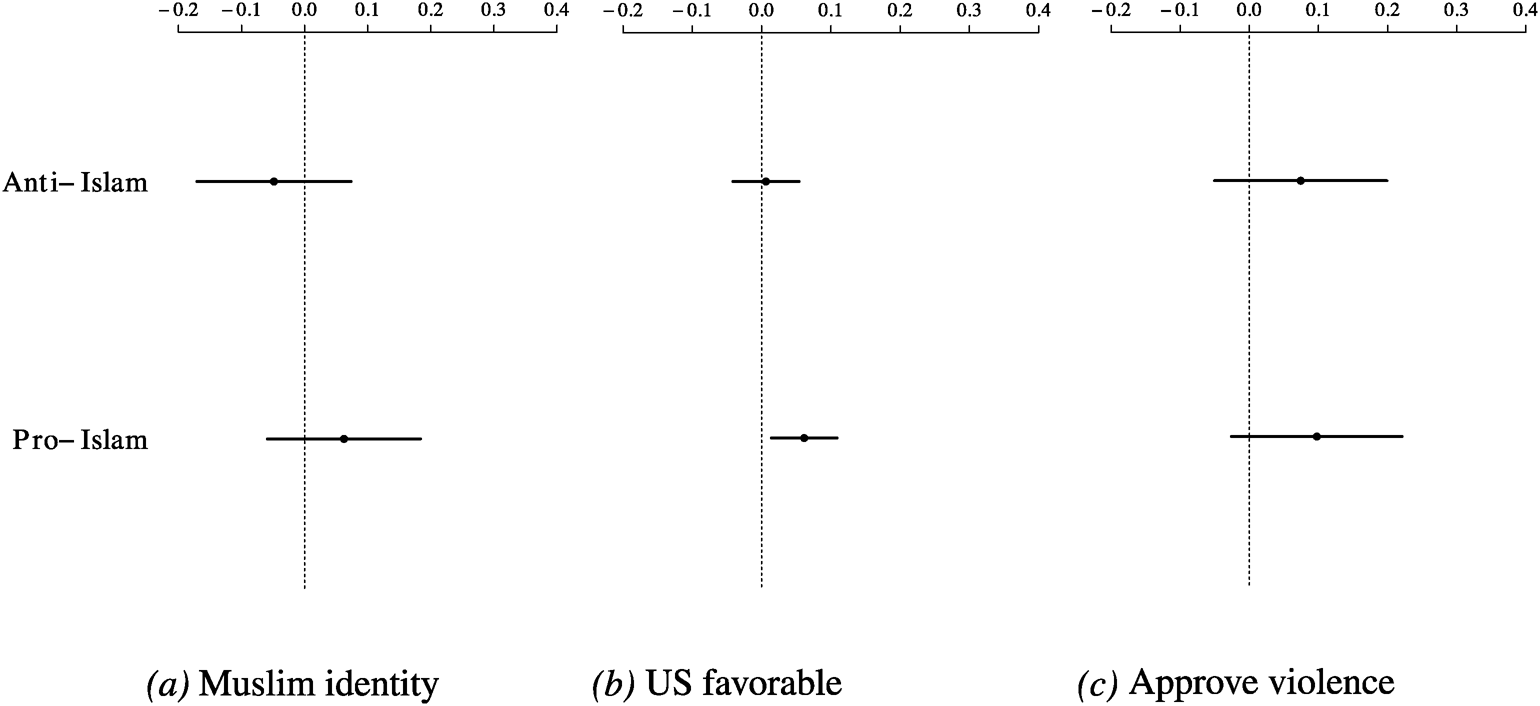
We further explore whether respondents react to pro- or anti-Islam messages by altering their opinions about the out-group. Figure 1, Panel B indicates that this is true for only one of the treatments. The top section of the panel shows that the anti-Islam treatment has no effect on US Favorable. Interestingly, respondents who received the pro-Islam treatment reduced out-group animosity by a statistically and substantively significant amount. This asymmetry calls for further investigation. It is possible that respondents may be accustomed to anti-Islam identity threat and build this into their evaluation of out-group Western politicians, resulting in a null effect. The pro-Islam treatment might have been more unexpected and therefore provoked a stronger reaction. Of course, we cannot read too much into this single finding, and future work is needed to draw conclusions about the differential effects of positive and negative rhetoric.
With at best mixed results so far, we move to examining the approval of violence. Panel C of Figure 1 shows that subjects exposed to negative messages about Islam were not more likely to express radical sympathies compared to subjects in the control group. We find similar null results for the pro-Islam treatment.
Given the findings in previous studies of radicalization and theoretical expectations about the effect of identity threat, the null results are unexpected. This motivated us to perform additional robustness tests by including covariates, time fixed effects, exploring heterogeneous treatment effects (including whether the effects are different for the two regions of Bosnia – Republika Srpska and Federation of Bosnia and Herzegovina – given that sectarian tensions are greater in the former), and checking for floor or ceiling effects (see Appendices 5 and 6). The results of these robustness tests are consistent with those presented here.
We do not believe our results are due to a weak treatment. The statements that we use are very strongly worded: the rhetoric in the anti-Islam treatment drew harsh criticism in Bosnia. Importantly, the pro-Islam treatment does produce a significant effect on out-group favorability, suggesting that it is unlikely that the treatment was weak. It is also not the case that in Bosnia Muslim identity is of low salience and therefore hard to provoke. Ever since the ethno-religiously charged war in the 1990s, references to religious identity remain sensitive (Hadzic, Carlson and Tavits Reference Hadzic, Carlson and Tavits2020), suggesting that Bosnian Muslims should be easy to provoke. That we were unable to find effects despite Bosnia being a ‘likely case’ suggests that the null effect may be more general in nature.
Discussion and Conclusion
We find that high-profile rhetorical attacks against Islam do not heighten Muslim identity, generate out-group animosity (anti-Americanism, in our case) or increase the approval of violence. We also tested for the potential effects of similarly high-profile positive political rhetoric about Islam and found that Muslims' identity strength and radical sympathies are unmoved by such praise. Hearing high-profile praise produced one positive effect, however it increased Muslims' favorability toward Western societies.
While we find that anti-Islam rhetoric from Western politicians alone fails to provoke radical tendencies in Muslim populations, it does not imply that hostile rhetoric never matters. It is possible that such rhetoric breeds radicalization only in combination with conducive contextual factors, some of which the existing literature has studied. For example, rhetoric from Western politicians might contribute to radicalization among Muslims who, as a group, are suffering from socio-economic deprivation (Adida, Laitin and Valfort Reference Adida, Laitin and Valfort2016; Blair et al.2013; Fair et al. Reference Fair2018a; Krueger and Malečková Reference Krueger and Malečková2003; Smith et al. Reference Smith2012). Muslims who are functioning well within their community might be able to more easily discount threatening rhetoric as cheap talk. In contexts where Muslim are socio-economically deprived relative to other groups, however, identity threat may resonate more strongly because it is magnified by socio-economic threat. Alternatively, extreme rhetoric may inspire the already radicalized, functioning as a catalyst for (and not necessarily an instigator of) radical tendencies. Or hostile rhetoric may need to be present for a longer period of time in order to take effect. Future research could more explicitly explore some of these possible conditions under which hostile rhetoric from Western political leaders propels Muslim radicalization.
Our findings about the positive effect of pro-Islam rhetoric are also noteworthy. The effects are limited, but still encouraging. While approval of the use of violence does not decline in response to pro-Islam rhetoric by Western politicians, anti-Americanism does. Some prior work has treated anti-Americanism as one manifestation of radicalization (O'Duffy Reference O'Duffy2008). That rhetorical tools can mitigate this animosity is promising and calls for more research into the potential positive effects of political rhetoric in advancing intergroup relations.
Finally, our hypotheses were informed by social identity theory, which prescribes that hostility toward one's group poses identity threat and triggers defensive responses. Our null findings imply that further work is needed on the conditions under which hostility has these effects (as discussed above), the type of hostility that matters, and about whether identity threat is needed at all for radical attitudes to develop. If identity threat alone does not breed radicalization, some of the strategies designed to combat radicalization, like cultural assimilation programs, may not have their desired effect. Similarly, if the positive effects of pro-Islam rhetoric hold under different conditions, policy makers may use such rhetoric to help facilitate relations among different groups.
Supplementary material
Data replication sets are available in Harvard Dataverse at: https://doi.org/10.7910/DVN/UW5CSR, and online appendices are available at https://doi.org/10.1017/S0007123420000484.
Acknowledgements
We would like to thank Efrén O. Pérez and Dalston Ward for helpful comments on earlier versions of this manuscript, and Dan Butler for his invaluable contributions at the design and data collection stages of this project.
Financial support
Support for this research was provided by the Weidenbaum Center on the Economy, Government, and Public Policy.



