INTRODUCTION
One of the key issues in radiocarbon (14C) dating is how accurate and strong is the temporal relationship between the event we want to date and the material from which the 14C concentration can be measured. In other words, we can date an event only if we can identify a material that can be directly associated with that event, keeping in mind, however, that our result will always be interpreted as a terminus post quem. Such a consideration can be particularly important when we would like to date an artifact, since measuring the 14C abundance in raw material does not necessarily give us the information about when that artifact was created, considering that the possible offset can depend, for instance, on the nature of the material itself and/or the production process characteristics. This is clearly the case for written documents with organic inks on supports of either animal or plant origin. The easiest and way to date a written document is probably dating the organic material of the support material: in this case, no significant limitations on the sampled mass are likely to be present (indeed, the sample can be reasonably obtained from the borders of the document without affecting the integrity of the written part). In this case, however, it is clear that a possible temporal discrepancy between the age of the support and the manufacture of the document could be taken into account, and this can perhaps represent a limitation raised by some questioners when 14C is meant to support—or not—authenticity issues (see, for example, the intense debates on the authenticity of the Vinland Map and Dead Sea Scrolls [Bonani et al. Reference Bonani, Ivy, Wolfli, Broshi, Carmi and Strugnell1992; Donahue et al. Reference Donahue, Olin and Harbottle2002]). In such a context, the possibility to directly date the inks or the pigments used to write on the support would give us a stronger indication to help in authentication problems. Actually, for early times, we can plausibly hypothesize that inks and colors were produced in small numbers by hand using common and natural materials, so we can generally expect a short period between their manufacture and their usage. Thus, dating the organic components of inks or colors can give us an age that is likely to be closer to the age of the event (even though, in principle, we cannot exclude some possible apparent aging due to e.g. the old-wood effect in the case of a charcoal-based ink). However, sampling a portion of ink or color necessarily means sampling a portion of the text and thus the measurement can be potentially invasive unless the AMS setup allows us to minimize the sample mass as much as possible, hopefully down to the micrograms scale (Hendricks et al. Reference Hendriks, Hajdas, McIntyre, Kuffner, Scherrer and Ferreira2016; Steier et al. Reference Steier, Liebl, Kutschera, Wild and Golser2017).
Among all the possible writing supports used in antiquity, we decided to focus our attention on papyrus, since this material represents one of the most commonly used supports in many civilizations and through many different periods, as for instance in ancient Egypt. Ancient Egyptian papyrus documents have often been found in very bad preservation conditions, frequently disrupted into many several fragments or reused as mummy cartonnages, or anyway mixed and glued in rolls. Reconstructing the chronology of such documents is clearly of interest to the archaeological community. Palaeography is typically a powerful tool to date documents. Absolute dating methods such as 14C can be very useful to support palaeographic studies, especially in cases when a counterfeit is suspected (see, for example, Oliveira et al. Reference Oliveira, Araujo, Macario and Cid2015). Actually, during the 19th century, a fervent interest in Old Egypt spread all over Europe, leading to an increasing demand for archaeological remains and artworks, and this is well known to have contributed to a vivid market of fakes and forgeries (Lucarelli and Müller-Roth Reference Lucarelli and Müller-Roth2014). However, when 14C is used as a support to solve authenticity issues, dating the writing substrate may just give us a hint, with always a possible criticism: even though the material, e.g. the papyrus, has been measured to be consistent with the original attribution, one can say that a forger might have used an old, blank support from an earlier time to prepare the fake (for example, a similar debate can be found in the non-specialistic literature about the possible dating of the so-called Artemidorous papyrus, even though 14C dating of the papyrus itself proved that the material was original [Fedi et al. Reference Fedi, Carraresi, Grassi, Migliori, Taccetti, Terrasi and Mandò2010]). Such ambiguity may be solved by dating the ink, for example, as it has been already shown e.g. on colors components in other cases related to cultural heritage (Hendricks et al. Reference Hendriks, Hajdas, Ferreira, Scherrer, Zumbühl, Smith, Welte, Wacker, Synal and Günther2019).
As far as ancient Egyptian papyri are concerned, the most commonly used inks were of organic origin (Christiansen et al. Reference Christiansen, Buti, Dalby, Lindelof, Ryholt and Vila2017; Goler et al. Reference Goler, Hagadorn, Ratzan, Bagnall, Cacciola, McInerney and Yardley2019), at least until the 4th century BCE. They were typically manufactured mixing some carbon-based materials, such as charcoal fragments, obtained from combustion of wood or other plant material, or soot, or also cokes, as derived from carbonization of e.g. yeast or bone, with some organic binder, such as Arabic gum (Winter Reference Winter1983). Both the carbonaceous particulate-like component and the Arabic gum are in principle good candidates to be dated by 14C. As far as the association of the obtained date and the event to be dated are concerned, the gum binder would be preferable, considering that the carbon fraction might have been produced using old material. Nevertheless, the choice of the material is influenced by some clear limitations, such as possible difficulties in sampling the sufficient amount for the measurement; possible difficulties to indeed isolate the “good” component to be dated, clearly minimizing the possible contaminations or interferences.
In this paper, we report our preliminary investigations on the feasibility of directly dating organic ink on papyrus, showing our measurements on test samples prepared following the old manufacturing processes, even though using modern materials. Among all the possible recipes describing the manufacture of old carbon-based black inks, we decided to focus on inks based on charcoal particles derived from wood combustion dispersed in Arabic gum.
MATERIALS AND METHODS
We prepared our own organic ink according to this procedure:
-
charcoal fragments obtained from wood combustion (small branches from heterogeneous origin—olive trees, apricot and peach trees—and thus likely to be different in age) were finely ground in a mortar;
-
Arabic gum, supplied by fine-art shop, was dissolved in warm water (40°C) in the ratio 5 g:20 mL;
-
the mixture of charcoals and Arabic gum solution was filtered (mesh size of about 0.5 mm) to remove the larger fragments.
As for papyrus, we used a modern one purchased in fine-art shop: the supplier ensured us that the material had been manufactured according to the traditional procedures, without adding any glues or resins, being the stickiness of the fibers naturally due to the papyrus extractives. We prepared two different kinds of test samples: so-called large “tile” samples, obtained covering papyrus square fragments (about 4 × 4 cm2, about 150 mg) with a thick layer of home-made ink (about 100 mg before drying), indicated as Ink_ATR1 and Ink_ATR2 in the following; more realistic samples, obtained writing on smaller papyrus fragments (about 3 × 3 cm2, about 80 mg) using about 6 mg of inks, as measured before complete drying, indicated as 6mg_0, 6mg_1 and 6mg_2 in the following. All prepared test samples were left for about five months in the laboratory under natural variations of light, temperature, and humidity, to resemble natural aging, although clearly mild. Raw materials were characterized by their 14C content and their composition using spectroscopic methods, such as FTIR and ATR, as well as the datable components extracted from the samples.
14C AMS measurements were performed at INFN-LABEC, Florence, using the dedicated beam line of the 3MV tandem accelerator (Fedi et al. Reference Fedi, Cartocci, Manetti, Taccetti and Mandò2007). Traditional-sized large samples (about 700 micrograms graphite) were prepared using the multi-purpose combustion-graphitization line (Fedi et al. Reference Fedi, Bernardoni, Caforio, Calzolai, Carraresi, Manetti, Taccetti and Mandò2013), while smaller samples of the order of 50 micrograms graphite were prepared using the newly assembled so-called Lilliput reactors, specifically designed and assembled to graphitize very small samples, down to 50 micrograms (Fedi et al. Reference Fedi, Barone, Barile, Liccioli and Manetti2020). 14C/12C isotopic ratios as measured by AMS were normalized using the ratio measured in a set of NIST OxAcII samples after correction for background (by measuring blank samples) and for isotopic fractionation (by measuring 13C/12C along the AMS beam line itself).
FTIR spectra were acquired using a Shimadzu FT-IR 8400S spectrometer (45 scans, 4 cm–1 resolution) and elaborated thanks to Lab Solution IR v. 2.16 software. ATR spectra were acquired using a Shimadzu IRAffinity-1 spectrometer, equipped with a single reflection crystal, and elaborated using Lab Solution IR v. 2.16 as well.
Characterization of Raw Material and Choice of the Datable Component
Thanks to the high solubility in water of the Arabic gum, we may expect to detach the ink from the support by soaking the sample in water or, better, in warm water. The binder would be found directly dissolved in the extraction water, while the charcoal-based particles would be found dispersed in the solution. In principle, as discussed above, considering the smaller offset between the age we can measure and the date of the document manufacture that we may expect, the Arabic gum should be the preferred material to be dated. However, the binder and the extractives collected from the papyrus are likely to have a very similar chemical structure, as we indeed verified by FTIR. Figure 1 shows the comparison between a typical spectrum acquired on the Arabic gum, used to prepare the ink as explained in the previous section, and a typical spectrum acquired on the mixture of extracts collected after immersing the papyrus fragments in water at 50°C for 6 hr (after extraction, the papyrus soluble fractions were fully dried using a rotavap device prior to being analyzed by FTIR). The polysaccharose composition of the Arabic gum is evident by looking for instance to the peaks at 3429 cm–1 and at 1610 cm–1, due to the O-H group present in the sugars, or the peaks at 1074 cm–1, 1031 cm-1 and 975 cm–1, in the so-called fingerprint region, all associable to C-O-H and C-O-C. If we compare the signals from the extracts, we can notice that, even though the intensities are different, especially because of the different amount of water content in the two materials, the pattern of the peaks is similar, suggesting a basically polysaccharose composition for the extracts as well. All things considered, in the present study, we have thus decided to focus on the carbon-based particles recovered after the extraction procedure.
Comparison of FTIR spectra acquired on the raw Arabic gum used to prepare the inks in this work and on the papyrus extracts collected after soaking a papyrus fragment in warm water.

Before any tests were conducted on the prepared written papyrus samples (see their description in the previous section), all the raw materials were characterized by their 14C content. Table 1 summarizes the obtained results. Samples Fi3981, Fi4081, and Fi4082 were prepared from charcoal fragments randomly collected among all the charcoals that were available to prepare the ink. The measured scattering among the three 14C concentrations may appear surprising; however, it can be explained if we keep in mind that those charcoals were produced by wood burning, without any control on the collection, and thus on the age, of the used wood and branches (and in fact the measured 14C concentrations cover a period basically starting since the early 2000s). The 14C concentration measured in the papyrus extractives is pretty surprising as well, being older than expected: this can be explained by considering the presence of an artificial polysaccharose gum, in spite of the supplier assurances, or by hypothesizing a sort of aging due to fossil carbon emitting sources in the papyri plantation area, as can be found in the literature (Lichtfouse et al. Reference Lichtfouse, Lichtfouse, Kashgarian and Bol2005; Turnbull et al. Reference Turnbull, Keller, Norris and Wiltshire2016). As can be seen in the table, we also measured the 14C concentration in charcoal particles after recovering them from the prepared ink. To recover those particles, the insoluble fraction of the ink collected by centrifugation was first rinsed with deionized water for 10 times to clean from any possible residue due to Arabic gum and then treated according to our standard ABA procedure (see the C_ink in Table 1). The measured 14C concentration is in the range of the measured 14C concentrations of the raw charcoals, suggesting that after rinsing several times with water, a possible contamination due to some Arabic gum is very unlikely.
14C concentrations measured in the raw materials used to prepare inks and written papyrus test samples. In the case of the Arabic gum and the charcoal particles recovered from the prepared ink, two graphite targets were prepared from each of the material: the shown concentration was evaluated as the weighted average of the two measured fractions (after of course checking the statistical compatibility between them); the shown mass corresponds to each of the measured fractions. Uncertainties are quoted at 1 sigma.

Tests on “Tile” Large Samples
The written large papyrus samples were used to check the effectiveness of the extraction procedure and the cleanliness level of the recovered materials.
After the complete drying and natural aging, about 25 mg of ink was estimated to be present on the two samples. Charcoal particles were extracted and collected through a simple procedure: bath in ultra-pure water at 50°C for 8 hr; settling at 25°C for 16 hr to allow for complete setting of the charcoal particles; recovery of the set material by centrifugation. Then, each of the samples were pretreated according to slightly different steps:
1. bath in ultra-pure water at 50°C for 30 min, to enhance removal of possible Arabic gum, followed by a bath in 1M HCl at 80°C for 1 hr (sample Ink_ATR1);
2. just bath in 1M HCl at 80°C for 1 hr (sample Ink_ATR2).
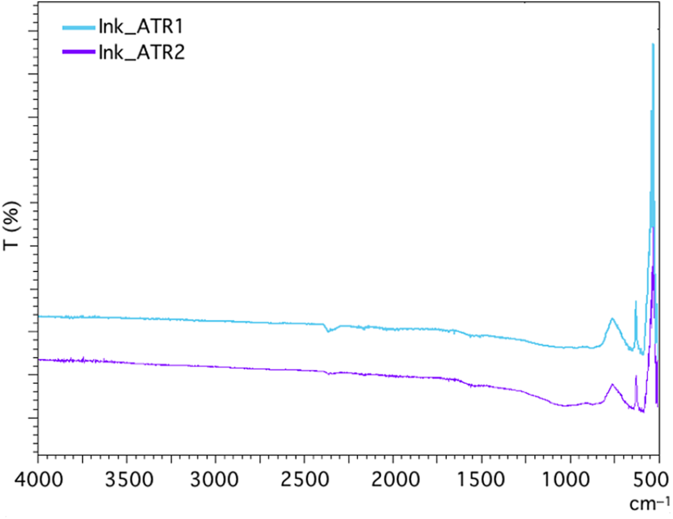
The collected materials were checked by ATR (see Figure 2). As it can be noticed, no “real” signal is present in the spectra: no peak associable to any typical Arabic gum or papyrus extractives bonds is visible. Even though small traces of such components may be hidden in the spectra by the high background due to the great absorption of the black material, this suggests that both pretreatments were successful in the removal of possible contaminations of the recovered charcoal particles. Thus, considering that small masses were collected from both Ink_ATR1 and Ink_ATR2, we decided to combine the samples obtaining Ink_ATR of mass about 1.2 mg. This sample was graphitized and measured by AMS (lab code Fi4031), getting a 14C concentration of 107.62±0.53 pMC, which is well compatible with the 14C concentrations of the raw charcoals (see by comparison Table 1).
ATR spectra acquired on Ink_ATR1 and Ink_ATR2 samples (charcoal particles recovered from the written large “tile” samples).

Tests on Small “6 mg” Samples
After the complete drying and natural aging, about 1÷1.5 mg of ink was estimated to be present on the 6mg_0, 6mg_1 and 6mg_2 samples. Charcoal particles were extracted and collected through the same procedure described before for the large “tile” samples: bath in ultra-pure water at 50°C for 8 hr; settling at 25°C for 16 hr to allow for complete setting of the charcoals particles; recovery of the particles by centrifugation. Considering what was observed in the case of the large samples and to minimize the possibility to lose material, only the bath in 1M HCl at 80°C for 1 hr was used as pretreatment. Charcoal particles to be combusted were collected by drying the neutralised solution directly pipetted in the tin capsules for combustion in the elemental analyzer. About 0.2 ÷ 0.3 mg of carbon were recovered from each of the samples. From each of 6mg_0 and 6mg_1, a graphite sample of about 50 micrograms were prepared; in the case of 6mg_2, the cleaned mass was sufficient to prepare two separate 50 micrograms graphite targets. Table 2 shows the measured 14C concentrations, which are also reported in Figure 3, where they are compared to the data obtained measuring the other charcoal-related samples. 14C concentrations measured in the 6mg-series samples were consistent one with another. The compatibility of these data with the concentrations measured in Ink_ATR and C_ink is satisfying too. On the contrary, if we compare them to the data collected from the raw charcoal fragments, we can draw some comments that are not as plain as one can expect. Even though the agreement of Fi3981 is fully satisfying, the other two charcoal samples appear not to be consistent with the 6-mg-series samples from the statistical point of view. However, as already pointed out above, a significant heterogeneity of the 14C concentrations in the original charcoal fragments “population” can be expected: thus, we can just comment about a general compatibility of the micrograms-sized samples with the raw materials.
14C concentrations measured in the small written papyrus samples. In the case of 6mg_2, enough material to prepare two separate graphite targets was recovered and combusted: CO2 was split into two reaction chambers and independently graphitized; 14C concentration of 6mg_2 was then estimated as the weighted average of the two measured fractions, considering their consistency from the statistical point of view. Uncertainties are quoted at 1 sigma.

14C concentrations measured by AMS in all the charcoal-related samples analyzed in this work.

CONCLUSIONS
The aim of the present work was verifying whether a component of a black carbon ink may be extracted and 14C dated. Data shown in Figure 3 suggests that the proposed procedure to extract and pretreat charcoal particles as the most appropriate datable material in a carbon-based black ink on papyrus is efficient and reliable. In particular, samples belonging to the “6 mg” series, which can reasonably approach the real cases, are promising: the extraction procedure and the graphitization setup has been proved to be solid to collect and measure graphite samples as small as 50 micrograms.
The next step is necessarily represented by tests on “real” old papyri. In particular, we will check the amount of charcoal-related materials that we can collect, considering that in a “real” sample we can expect that some of the original material has been lost or that a different black organic ink, produced using e.g. soot instead of wood charcoal, might have been used. Of course, all the present discussion can be applied just on organic inks and not metallic ones, such as iron-gall inks that have become the most used inks in the past since about the 4th–5th centuries CE. A preliminary observation by analytical methods as X-ray fluorescence or Raman spectroscopy will be essential to select those documents that are likely to be dated through the charcoal particles recovered from organic black ink.