The first month of President Trump's leadership was particularly newsworthy for the administration's issuing of the controversial travel ban. In its original iteration, the executive order temporarily prohibited citizens from seven countries including Iraq, Iran, Libya, Sudan, Syria, and Yemen from entering the United States (Trump, Reference Trump2017). The restriction also applied to refugees from Syria, as the President clearly stated in the executive order (p. 8979), “I hereby proclaim that the entry of nationals of Syria as refugees is detrimental to the interests of the United States and thus suspend any such entry until such time as I have determined that sufficient changes have been made to the USRAP to ensure that admission of Syrian refugees is consistent with the national interest.” Although the policy led to an immediate eruption of protests across the nation (Newman, Reference Newman2017), public opinion remained almost evenly split between those who supported and condemned the decision (CNN, 2017; NBC/WSJ, 2017).
In researching the supporters of the travel ban, think tank publications devoted significant attention to the attitudes of the evangelical laity. For instance, a Pew Research Center study conducted in February 2017 (Pew Research Center, 2017) found 76% white evangelicals supported the executive order, as compared to 50% white mainliners, 36% Catholics, and 24% unaffiliated.Footnote 1 A similar study conducted around the same time by the Public Religion Research Institute (PRRI, 2017) found evangelicals were not merely the only religious group with majority support for the policy, but also reported a noticeable spike in support from 55% in May 2016 to 61% in February 2017. Such findings contributed to the popular understanding that evangelicals were the biggest champions of Trump's refugee policy. However, what problematized the presumption is the wide gap that existed in attitudes on the travel ban between evangelical leaders and their followers.
In sharp contrast to lay evangelicals, religious leaders in the community were vocal in their criticism of Trump's refugee policy. Soon after the executive order went into effect, 100 evangelical pastors purchased an advertisement on The Washington Post condemning the prohibitions placed on refugees. The opening sentences of the advertisement addressed to President Trump and Vice-President Pence stated (World Relief, 2017):
As Christian pastors and leaders, we are deeply concerned by the recently announced moratorium on refugee resettlement. Our care for the oppressed and suffering is rooted in the call of Jesus to “love our neighbor as we love ourselves.” In the story of the Good Samaritan (Luke 10:25–37), Jesus makes it clear that our “neighbor” includes the stranger and anyone fleeing persecution and violence, regardless of their faith or country.
Similar sentiments were expressed by members of the Evangelical Immigration Table (EIT), a non-profit organization run by evangelical pastors and organizations like World Vision, World Relief, and the National Association of Evangelicals, with the purpose of seeking immigration reform in tune with the core values of the Bible. In their letter to the President and the Vice-President, members of the EIT mentioned (EIT, 2017, 1):
Evangelical churches and ministries have long played a key role in welcoming, resettling, and assisting in the integration of refugees from various parts of the world. As such, we are troubled by the recent executive order temporarily halting refugee resettlement and dramatically reducing the number of refugees who could be considered for resettlement to the U.S.
Although such a stark contrast in attitudes on refugee resettlement between the leadership and the laity may seem puzzling at first glance, there have been similar differences in opinion regarding other areas of immigration policy. For instance, immediately after President Obama's re-election in 2012, members of the EIT pleaded for comprehensive immigration reform, whereas 43% of white evangelicals expressed favorable attitudes toward making the immigration process significantly more difficult to encourage self-deportation (Djupe, Reference Djupe2013). Likewise, Margolis (Reference Margolis2018) highlighted countervailing cues received by evangelical church goers; while religious opinion leaders favored comprehensive immigration reform, political elites within the Republican Party undermined such influences by arguing against the same.
Given the divide in perceptions between religious leaders and the laity, the role of religious background—especially evangelical identity—in driving a distinct set of preferences regarding Syrian refugees warrants further inquiry. Although several scholars have investigated the relationship between religious affiliation and immigration-related attitudes (Daniels, Reference Daniels2005; Daniels and von der Rurh, Reference Daniels and von der Rurh2005; Brint and Abrutyn, Reference Brint and Abrutyn2010; Kaftan, Reference Kaftan2014; Ben-Nun Bloom et al., Reference Ben-Nun Bloom, Arikan and Lahav2015a, Reference Ben-Nun Bloom, Arikan and Manche2015b; Creighton and Jamal, Reference Creighton and Jamal2015; Kim, Reference Kim2017; Margolis, Reference Margolis2018), analysis of religiously motivated public opinion on refugee policies is rare. Probably the only exceptions include the studies on attitudes toward Syrian refugees by Newman (Reference Newman2018) and Adida et al. (Reference Adida, Lo and Platas2019). While Newman (Reference Newman2018) found partisan cues and news consumption habits outperformed the influence of most religious factors in determining attitudes toward Syrian refugees, Adida et al. (Reference Adida, Lo and Platas2019) demonstrated Americans had a clear preference for refugees from Syria who were Christian, English-speaking, high-skilled, and female.
The current analysis contributes to the existing literature by shedding new light on religious factors driving opinion on Syrian refugees along three interesting lines. First, it extends Newman's (Reference Newman2018) analysis by including variables on Muslim stereotypes and religious traditionalism along with already-examined measures of religious identity and behavior. Similarly, it builds on Adida et al.'s (Reference Adida, Lo and Platas2019) work by providing a more comprehensive measure of religious identity, including evangelicals—compared to the simple categorization of religious groups into Catholics, Protestants, and Jewish by the former—and accounting for the effects of religious belief and behavior. Second, it challenges the monolithic characterization of evangelicals by analyzing the attitudes of various socioeconomic groups within the evangelical tradition. Finally, it delves deeper into the role of religious background in shaping such attitudes by examining the mediated effects of religious identity and religiosity via political predispositions and Muslim stereotypes.
In pursuing these three new lines of inquiry, this study engages with relevant theoretical perspectives including the ethno-religious approach, the dual-conversion approach, the minority marginalization perspective, and re-structuralism to analyze the effect of religious background on attitudes toward Syrian refugees. Furthermore, by analyzing variations in attitudes toward Syrian refugees across socioeconomic groups within the evangelical tradition and examining both direct and mediated effects of religious identity and religiosity, the current study seeks to better understand the divide in opinion between regular evangelicals and their church leaders.
The findings from this analysis reveal a scenario that is more complicated than the popular rhetoric: although evangelical identity makes respondents more opposed to Syrian refugees, evangelicals are by no means the only group with such attitudes. In contrast to the surveys cited toward the beginning of this paper, after controlling the effects of religiosity, demographics, and socioeconomic status, both Catholics and evangelicals remain opposed to Syrian refugees. However, what makes evangelicals distinctive is that their opposition is significantly mediated by stereotypical views of Muslims. Ceteris paribus, evangelicals are the only religious tradition that is significantly more likely to hold Muslim stereotypes, and therefore, remain more opposed to Syrian refugees. This finding has interesting implications for the puzzle regarding the divergence in opinion between evangelical church leaders and the laity, as it suggests that the pro-refugee rhetoric from the church elite alone may not be sufficient for mobilizing the churchgoers in favor of Syrian asylum seekers. Especially when the migrants in question are predominantly Muslim, the call for welcoming refugees must be accompanied by an emphasis on inter-faith understanding, which actively counters Muslim stereotypes among the laity.
Furthermore, some of the most interesting findings from the analysis relate to the effects of religious beliefs and behavior. For example, biblical literalists across religious traditions are significantly more opposed to refugees than their progressive counterparts. Frequent church attendees, on the contrary, are significantly more favorable than those who attend worship services less frequently. Since regular church goers are significantly more sympathetic toward Syrian refugees, it may be argued that recruiting more involved congregants to build a stronger pro-refugee coalition, and reviving interest among dormant church members in inter-faith understanding can help build greater support for Syrian refugees. Finally, the analysis captures significant differences within the evangelical community along the lines of age, gender, and educational attainment, thereby highlighting the risk of glossing over meaningful differences when treating all members of the community the same without considering socioeconomic cleavages within the tradition. To illustrate, women, younger evangelicals, and those with higher educational attainment are more likely to favor Syrian refugees. This finding has the potential to recast the generalized understanding regarding the divide between church-leadership and laity. If women, younger members of the church, and those with more education are supportive of Syrian refugees, it is possible to argue that the views of the church leaders were at least in sync with certain sections of the evangelical community. Moreover, one could expect that strengthening participation of these groups within the evangelical community could possibly make a dent on the mainstream's resistance to Syrian refugees.
Theoretical context
Dating back to the work of Durkheim (Reference Durkheim1915), the ethno-religious approach focuses on the role of religious identity, or “belonging” to religious traditions, in shaping public opinion and political behavior. According to Wald and Smidt (Reference Wald, Smidt, Leege and Kellstedt1993), religious traditions act as “social collectives” characterized by members with shared history and common experience, which leads them to respond similarly to sociopolitical developments. In the context of American society, it is possible to conceptualize religious belonging in terms of membership to seven major religious traditions (see Kellstedt and Smidt, Reference Kellstedt, Smidt, Leege and Kellstedt1993) including evangelical Protestant, mainline Protestant, Black Protestant, Catholic, Jewish, other religious traditions, and the non-religious. In The Faith Factor, Green (Reference Green2010) identifies three distinct causal mechanisms through which religious traditions impact members. These channels include exposure to core values, cues from religious leadership, and “external appeals” from political leaders through religious messages.
Given the divergence in opinion on Syrian refugees between the religious leaders and their followers within the evangelical tradition, it is pertinent to delve deeper into the role of shared identity in shaping the laity's attitudes. Of particular importance here is Tajfel and Turner's (Reference Tajfel, Turner, Jost and Sidanius2004) social identity theory (SIT) on intergroup relations. This theory argues that to maintain or establish their own superiority, in-group members often tend to “otherize” those belonging to out-groups through a process of competitive comparisons. Multiple studies on immigration attitudes in the context of inter-group relations (e.g., Daniels and von der Rurh, Reference Daniels and von der Rurh2005; Brader et al., Reference Brader, Valentino and Suhay2008; Strabac and Listhaug, Reference Strabac and Listhaug2008; Ben-Nun Bloom et al., Reference Ben-Nun Bloom, Arikan and Lahav2015a) have found evidence in support of SIT. For example, Ben-Nun Bloom et al. (Reference Ben-Nun Bloom, Arikan and Manche2015b) found religious identity leads individuals to lean against policies that favor immigrants from out-groups.
SIT is relevant to the current analysis because a majority of Syrian refugees accepted to the United States in the recent past have been Sunni Muslims (Zong and Batalova, Reference Zong and Batalova2017), and a good majority of mainstream American society has generally harbored negative feelings toward the Muslim community (Kalkan et al., Reference Kalkan, Layman and Uslaner2009). This pattern is true for both evangelical church leaders and their followers, particularly in the aftermath of the September 11 terrorist attacks (Cimino, Reference Cimino2005). Unlike mainliners and Catholics, evangelicals have been less interested in inter-faith understanding and have emphasized more on the doctrinal and historical differences between their religion and Islam (Rock, Reference Rock2011).Footnote 2 Therefore, in accordance with the causal premises of the ethno-religious approach and SIT, it is reasonable to expect lay evangelicals will not only be more disapproving of Syrian refugees, but also more prejudiced toward Muslims, and therefore, more opposed to refugees from Syria, in turn. Moreover, in the absence of the leadership's emphasis on inter-faith understanding, especially in terms of actively deterring prejudice against Muslims, their pro-refugee rhetoric alone is unlikely to engender support for Syrian asylum seekers among the laity.
Additionally, the literature on Christian nationalism is relevant for explaining evangelicals' disapproval of Syrian refugees, as well as their intolerance for Muslims. According to Whitehead and Perry (Reference Whitehead and Perry2020), Christian nationalism involves a highly restrictive perception of national identity. Subsequently, it limits the in-group to those who are native-born, Christian, and white, while actively otherizing Muslims, racial minorities, and non-white immigrants as direct threats to their idea of American nationhood. Although Christian nationalism transcends denominational boundaries, it is generally agreed that such beliefs are more pervasive among evangelicals (McDaniel et al., Reference McDaniel, Nooruddin and Shortle2011, Reference McDaniel, Nooruddin and Shortle2022; Shortle and Gaddie, Reference Shortle and Gaddie2015; Whitehead and Perry, Reference Whitehead and Perry2020). To illustrate, Shortle and Gaddie (Reference Shortle and Gaddie2015, 440–441) suggest:
Evangelicals primarily, but not exclusively, subscribe to this religiously conflated version of national identity that makes anti-Muslim attitudes likely. We argue that both prejudice and intolerance for Muslims can therefore be explained through Christian nationalism, which symbolically constructs a conflated view of American identity and religious identity that omits Muslims from consideration as true citizens deserving of protection.
Given this line of argument, it is possible to hypothesize that evangelicals will not only be more opposed to Syrian refugees, but would also be exceedingly prejudiced against Muslims, which in turn would aggravate their disapproval of refugees migrating to the United States from Syria.
In this regard, it is relevant to engage with Kim's (Reference Kim2017) double conversion theory, which analyzes the effect of evangelical identity on immigration attitudes from the perspective of race. This approach highlights differences in immigration attitudes among evangelicals due to differences in their racial/ethnic backgrounds. By comparing the racial/ethnic composition of the group, it is possible to get a sense of the diversity of people represented within the evangelical tradition. According to the Pew Research Center's (2015) “Religious Landscape Study,” the evangelical community consists of 76% whites, 11% Latinos, 6% African Americans,Footnote 3 2% Asians, and 5% belonging to other races. Thus, grouping individuals from minority racial/ethnic groups with white evangelicals runs the risk of glossing over interesting differences among them. To address the effect of racial/ethnic diversity within the evangelical tradition, Kim (Reference Kim2017) proposes the double conversion theory, which states immigration attitudes of Latino evangelicals will be noticeably different from their white, non-Latino counterparts, since the former's perceptions will not only be tempered by their religious background, but also their racial/ethnic identity, which coincides with their relatively recent immigration experience to the United States.
Similar to Kim's approach, Melkonian-Hoover and Kellstedt (Reference Melkonian-Hoover and Kellstedt2019) find significant differences in immigration attitudes along racial/ethnic divides within the evangelical community, with white evangelicals demonstrating the most conservative views on comprehensive immigration reform. Further, Wong (Reference Wong2018) adds that despite holding substantially different attitudes on immigration, multiple structural barriers prevent racial/ethnic minorities from making a dent in the white evangelical agenda. If the racial/ethnic divide within the evangelical community on immigration attitudes extends to the domain of refugee policy, it is reasonable to expect white (non-Hispanic) evangelicals' perceptions on Syrian refugees will be significantly different, and possibly less favorable compared to the Hispanics within the same religious tradition. Hence, the pro-refugee cues from the church leaders may resonate more with Hispanics, as opposed to their white counterparts.
The minority marginalization perspective (Myrdal, Reference Myrdal1944; Allport, Reference Allport1979; Betz, Reference Betz1994) is also relevant to this analysis. According to the approach, members of minority groups are more likely to support policies that favor other minorities. Given their own experience with marginalization, individuals in minority groups would empathize more with the struggles of out-group members in a similar situation. This theory has been applied to the study of immigration attitudes in the past. For example, in an analysis of multiple Western developed countries including the United States, Fetzer (Reference Fetzer2000) found those belonging to minority religious traditions were more pro-immigration than those from dominant groups. Focusing on the United States alone, Knoll (Reference Knoll2009) found Jewish Americans and Latter-day Saints as significantly more favorable toward lenient immigration policies. In light of these findings, it would be appropriate to expect members of minority religious traditions, especially the Jewish, to be more welcoming of Syrian refugees compared to Protestants in general, and evangelicals in particular.
While the ethno-religious, double conversion, and minority marginalization approaches draw heavily on the causal influence of religious identity, re-structuralism is primarily concerned with differences in religiosity within and across different religious traditions. The origins of re-structuralist arguments may be traced back to Hunter's (Reference Hunter1991) culture war thesis. According to Hunter, major conflicts in the American polity would eventually take place along the cultural fault lines between the orthodox and progressive wings of society. In this divide, the progressives would represent individuals from different religious traditions that are willing to adapt their beliefs and behavior to the changing needs of contemporary society. In contrast, the orthodoxy would include traditionalist voices from varied religious identities that are married to a rigid and unchanging interpretation of their faith. Consequently, progressive members from Jewish, Catholic, and Protestant communities would be in permanent conflict with their orthodox counterparts. Hence, the resultant divide will not be among religious traditions, but within and across religious traditions, and along the lines of religiosity, as opposed to affiliation.
Re-structuralist arguments, though not without criticisms, are prominent in religion and politics research (e.g., Layman, Reference Layman1997; Guth, Reference Guth, Smidt, Kellstedt and Guth2009; Green, Reference Green2010), and have been subsequently extended to the analysis of immigration attitudes (Daniels and van Rurh, Reference Daniels and von der Rurh2005; Knoll, Reference Knoll2009; Brint and Abrutyn, Reference Brint and Abrutyn2010; Ben-Nun Bloom et al., Reference Ben-Nun Bloom, Arikan and Manche2015b). Although these studies do not yield identical findings, they certainly produce a general consensus: religious identity and religiosity—in the form of belief and behavior—have distinct impacts on public opinion regarding immigration. For instance, after controlling for religious identity, Knoll (Reference Knoll2009) and Melkonian-Hoover and Kellstedt (Reference Melkonian-Hoover and Kellstedt2019) found frequent church attendees were more likely to support pro-immigration policies compared to those who attended worship services less often. Similarly, Daniels and van Rurh (Reference Daniels and von der Rurh2005) found noteworthy differences between the attitudes of pre- and post-Vatican II Catholics. Additionally, they noticed important variations in public opinion between members of fundamentalist Protestant denominations and their more progressive counterparts. Considering these findings, it is reasonable to expect significant differences in favorability toward Syrian refugees between those with traditionalist beliefs and behavior and their progressive peers.
Data and methods
The data for this project is obtained from the American National Election Studies (ANES) 2016 Time Series Study. It is appropriate to use this dataset for the analysis because it includes variables on religious identity, behavior, and beliefs along with measures regarding perceptions toward Syrian refugees and Muslims. The data are also timely since the survey was conducted between September 7, 2016 and January 8, 2017 when the anti-refugee rhetoric from the Trump campaign was fresh in the minds of survey respondents. The dependent variable for the study is operationalized using the survey question that asks, “Do you favor, oppose, or neither favor nor oppose allowing Syrian refugees to come to the United States?” Responses to this question were coded to range from one to three, with one, two, and three representing favorable, middle-of-the-road, and opposing views, respectively.
The independent variables for this analysis are divided into measures for religious belonging, believing, and behavior. Variables for religious belonging capture the effects of religious identity on attitudes toward Syrian refugees and are operationalized following the coding scheme developed by Steensland et al. (Reference Steensland, Park, Regnerus, Robisnon, Bradford Wilcox and Woodberry2000), which was subsequently adapted by Brooks and Manza (Reference Brooks and Manza2004) for ANES datasets.Footnote 4 This strategy classifies religious traditions in the United States into seven categories, namely, mainliners, evangelicals, Black Protestants, Catholic, Jewish, other religious traditions, and the non-religious. Mainline tradition is used as the reference category for religious identity measures due to two main reasons. First, since mainliners and evangelicals are the two biggest sects within American Protestantism, it is interesting to compare evangelical attitudes with that of the mainliners. The comparison is also interesting given the rise of evangelicals and the decline of mainliners on the Republican side since the 1970s (Brooks and Manza, Reference Brooks and Manza2004).
The impact of religiosity is analyzed in terms of the effects of religious beliefs and behavior, respectively. Religious belief is operationalized using the ANES question regarding attitudes on biblical literalism. The responses to this variable are coded to range from one to three, with three representing those who consider the Bible to be the literal word of God, and one representing those who think the Bible is written by men and is not the literal word of God. Thus, those placed on the higher end of this scale may be seen as identifying with traditionalist beliefs, compared to those on the lower end with more progressive interpretations of the Scriptures.
Although biblical literalism is usually associated with evangelicals, it tends to hold a special significance for many other religious traditions in the United States (Kellstedt and Smidt, Reference Kellstedt, Smidt, Leege and Kellstedt1993). For instance, Layman and Green (Reference Layman and Green2006) found the measure to be relevant across religious groups when their index for religious traditionalism for Catholics demonstrated a strong correlation with the variable on literalism. However, when interpreting findings from the current analysis, one must use caution since the literalism measure only captures a specific dimension of religious beliefs, and is not exactly comparable to more general measures that account for the multi-dimensional impacts of believing via elements like attitudes on God and afterlife.
Religious behavior is operationalized using the church attendance measure. This variable measures the frequency of worship attendance on a five-point scale, with five representing those who go to church at least once a week, and one representing those who never go to church. Thus, like the literalism measure, responses on the higher end of the church attendance scale denote traditionalist behavior, compared to those on the lower end with more progressive habits. As in the case of the previous measure, one must use caution while interpreting findings regarding the effects of religious behavior from the current study, since it only focuses on the public dimension of religious behavior without including measures of private devotion including frequency of personal prayer and religious donations.
To account for the mediated effects of the religious variables via stereotypical attitudes regarding Muslims, the analysis takes advantage of the ANES question on group stereotypes, which requires respondents to self-place themselves on a seven-point scale ranging from one (Muslims as essentially peaceful) to seven (Muslims as violent). Given this coding scheme, those on the higher end of the scale may be safely considered more prejudiced against Muslims than those placed on the lower end. Likewise, the analysis includes measures on political predispositions to capture mediated effects of religious identity and religiosity via party ID and ideology. Both party ID and ideology are operationalized using seven-point scales with higher codes representing strong Republican identities and extremely conservative views, respectively.
Following previous literature (e.g., Daniels and van Rurh, Reference Daniels and von der Rurh2005; Knoll, Reference Knoll2009; Newman, Reference Newman2018), the analysis controls for the effects of demographics and socioeconomic status using measures for age (interval-level measure ranging from 18 to 90), gender (dummies for male, female, and other gender, with male used as the baseline), race/ethnicity (dummies for white [non-Hispanic], African Americans [non-Hispanic], Hispanics, and other races [non-Hispanic], with white [non-Hispanic] as the reference category), residence in South (dummy variable with 1 = South and 0 = all other regions), income (ordinal measure ranging from 1 = less than $5,000 to 28 = $250,000 or more), and education (ordinal measure ranging from 1 = some school, but no degree to 6 = graduate degree). Additionally, the variable for perceptions on the state of the economy (ordinal scale ranging from one [gotten much better] to five [gotten much worse]) is included to control for the economic self-interest thesis (Olzak, Reference Olzak1992; Burns and Gimpel, Reference Burns and Gimpel2000), which suggests natives are likely to oppose immigration on grounds of competition over limited resources from foreigners, especially when they are concerned about economic slowdown at the macro-level.
The Karlson, Holm, and Breen (KHB) method (Karlson et al., Reference Karlson, Anders and Richard2012) is used to distinguish the independent effects of the religious variables from effects that are mediated by political predisposition, Muslim stereotypes, and other related controls. The benefit of using the KHB method is its ability to separately report effects of religious variables without controls (from the reduced model), and the effects of religious identity and religiosity with all the controls (from the full model). If the coefficients for the affiliation, belief, and behavior measures are identical across the models, it is safe to argue the effects of the religious factors are purely independent, and unmediated by other factors. But, if there are differences in coefficients between the models, there arises the possibility of mediated effects of the religious variables, especially via political predispositions and stereotypical attitudes about Muslims.
Another advantage of the KHB method is it can compute how much of the difference in coefficients of the main independent variables between the full and reduced models is attributable to individual controls included in the full model. In so doing, it can reveal valuable information regarding the path of mediated effects for the religious variables via stereotypical attitudes, party ID, and ideology. In this context, it is important to mention the KHB method is vital for capturing mediated effects in nonlinear models with categorical dependent variables (see Karlson et al., Reference Karlson, Anders and Richard2012). Unlike linear models, direct comparison of coefficients across differently specified models is impossible in nonlinear models (e.g., logit, probit, and ordered logit), as the latter cannot distinguish between changes caused due to confounding and changes caused by rescaling. The KHB method addresses this challenge by specifically identifying changes in effects that are due to confounding.
While the KHB models capture effects of religious identity and religiosity in light of the arguments associated with the ethno-religious approach, re-structuralism, and the minority marginalization perspective, the stratified model with an ordered logit estimator tests the double conversion thesis for respondents within the evangelical community. By stratifying the data cases with evangelical tradition, this model compares the variation in attitudes toward Syrian refugees across different demographic categories within the group. In so doing, it can show whether attitudes of Hispanic evangelicals were significantly different from their white, non-Hispanic peers. Similarly, it can identify interesting variations in attitude within the community due to differences in religiosity, demographics, socioeconomic status, and perceptions on the health of the national economy.
Results
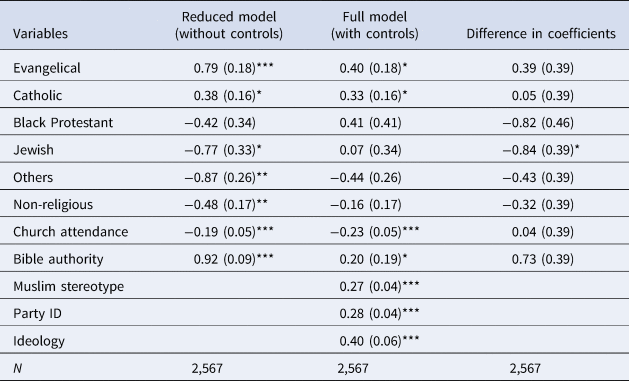
The findings in Table 1 compare the effects of religious identity, beliefs, and behavior across the reduced (without controls) and full (with controls) models. The first column reporting results from the reduced model suggests evangelicals and Catholics are the only religious groups significantly more opposed to Syrian refugees compared to the reference category of mainliners. Effects for the Jewish, members of other traditions, and the non-religious are negative and statistically significant, which means that compared to mainliners, members of these groups are significantly less opposed to allowing Syrian refugees into the United States. Some interesting findings emerge regarding the measures for church attendance and Bible authority. All else equal, those attending church more frequently are significantly less opposed to allowing Syrian refugees than less-frequent attendees. Biblical literalists, however, remain more opposed to refugees than their progressive counterparts.
Comparing effects of religious identity, religiosity, Muslim stereotype, and political predispositions across restricted and full models

Estimates of restricted model and full model obtained using the “KHB” command in Stata. Differences in effects are also computed using the same command. Ordered logit estimators. Mainline Protestants are used as the baseline category for religious group dummies. NES weight used is V1610102. Also obtained, but not reported are coefficients of demographic and socioeconomic status-related controls from the full model.
*p < 0.05; **p < 0.01; ***p < 0.001.
The pattern of effects obtained in the reduced model changes to a certain extent when compared to findings from the full model (with all the controls). The measures for evangelical and Catholic identity are the only to religious tradition variables that remain statistically significant. The dummy variables for the Jewish, non-religious, and other religious traditions fail to retain any statistically significant effect in the full model. On the contrary, the religiosity measures, including church attendance and biblical literalism continue to have strongly significant effects in the same direction as in the reduced model.
In this context, it is relevant to discuss findings on the effects of political predisposition and stereotypical attitudes regarding Muslims from the full model. The coefficients of the aforementioned variables are significant and consistent with expectations. Those with Republican leanings and conservative views are more opposed to refugees. Similarly, respondents who consider Muslims violent are more opposed than those who are less amenable to the stereotype.
The findings from Table 1 have interesting implications for the ethno-religious approach, re-structuralism, and the minority marginalization perspective. The evidence from both models regarding evangelicals and Catholics provide support for the ethno-religious thesis. However, they do not imply the possibility for “evangelical distinctiveness,” as both Catholics and evangelicals react similarly to Syrian refugees. Outside of these two traditions, identity-based differences do not exist for the other religious groups studied in this paper. Although the reduced model demonstrates support for the minority marginalization perspective, the evidence presented in the full model significantly undermines its applicability in the specific context of allowing Syrian refugees to the United States. This is evident because while members of the Jewish community are significantly less opposed to Syrian refugees in the reduced model, the variable fails to maintain statistical significance in the full model.
Interestingly, re-structuralist arguments are strongly supported across the two models. For example, in both models, frequent church attendees are significantly less opposed to refugees than those who attended worship services less often.Footnote 5 Likewise, literalists are significantly more opposed than their progressive peers. The finding regarding church attendance is not at all unexpected, since Knoll (Reference Knoll2009) observed a similar pattern while analyzing the effect of worship attendance on immigration attitudes in general. However, what remains to be explained is the reason for the difference in attitudes between frequent and less-frequent attendees. One possible explanation could be frequent attendees are more liberal in their views because they are better exposed to the preaching of their religious leaders who are generally supportive of asylum seekers. Another possible factor could be identified from the contact hypothesis (Allport, Reference Allport1979), which suggests greater exposure to and familiarity with out-group members leads to cooperation, and, therefore, less restrictive views on immigration.
At first glance, the direction of the coefficient for the literalism measure may appear puzzling because nothing in the Bible can be interpreted to justify opposition toward those needing shelter and security. However, the finding is not completely unanticipated since those advocating stricter immigration policies have often cited Romans 13:1, which upholds the moral obligation to submit to government authorities for justifying restrictions on immigration (Bauman and Yang, Reference Bauman and Yang2013; Jacobs, Reference Jacobs2018). Hoffmeier's (Reference Hoffmeier2009) analysis suggests that the verse particularly applies to immigrants who have undermined the rule of law. As refugees do not automatically fall in that category, Romans 13:1 may appear unrelated for the purposes of this analysis. However, the case of Syrian refugees is different, and can be tied back to Romans 13:1, as the travel ban issued by the Trump administration portrayed them as threats to US national interest (Trump, Reference Trump2017).
Moreover, Ben-Nun et al. (Reference Ben-Nun Bloom, Arikan and Manche2015b) found religious beliefs work in favor of immigration only when natives share religious and ethnic similarities with the immigrant community. Considering Syria is a Muslim majority nation, it is not at all surprising that traditional beliefs worked against asylum seekers. Additionally, Melkonian-Hoover and Kellstedt (Reference Melkonian-Hoover and Kellstedt2014) found biblical literalists were significantly more opposed to comprehensive immigration reform compared to their more progressive peers. This pattern definitely validates re-structuralist arguments, as the gap between the literalists and the non-literalists persisted even after controlling for religious identity, church attendance, political predispositions, stereotypical attitudes, demographics, and socioeconomic status.
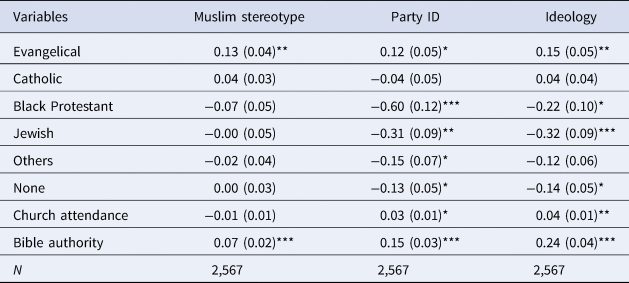
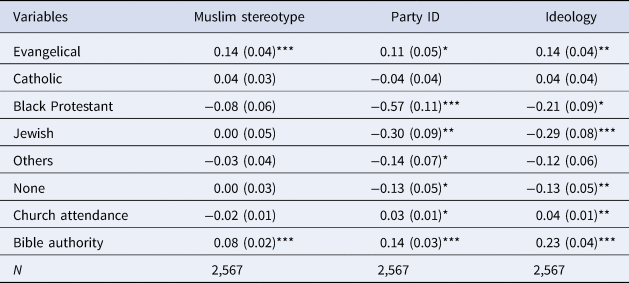
The difference in coefficients for the religious variables between the full and reduced models is reported in the third column of Table 1. Since none of the coefficients are identical across the two models—albeit not always statistically significant—it is interesting to explore mediated effects of religious identity and religiosity via stereotypical attitudes regarding Muslims and political predispositions, respectively. The first column of Table 2 presents indirect effects of the religious measures via Muslim stereotypes. In this column, evangelicals are the only group where religious affiliation leads to significantly more stereotypical attitudes toward Islam compared to mainliners, and therefore, more opposition toward Syrian refugees, in turn. This pattern tends to support both the ethno-religious hypothesis and the case for evangelical distinctiveness, since evangelical opposition to asylum seekers from Syria is significantly driven by stereotypes, and such a pattern is statistically unique to the evangelical tradition. Moreover, it validates the general consensus in the Christian nationalism literature, which finds evangelicals as more likely to support an insular view of national identity that clearly treats Muslims as outsiders. Re-structuralist arguments are also supported in this column, as literalists are significantly more likely to have stereotypical attitudes compared to their progressive counterparts, which in turn lead them to be more opposed to asylum seekers.
Indirect effects of the religious variables via Muslim stereotype, party ID, and ideology

Indirect effects of the religious variables via Muslim stereotype, ideology, and party ID obtained by using the “KHB” command in Stata. NES weight used is V1610102. Also obtained, but not reported are the contributions of individual demographic controls to the difference reported in the fourth column of Table 1.
*p < 0.05; **p < 0.01; ***p < 0.001.
Both ethno-religious and re-structuralist arguments were supported in the mediated effects of religious variables via political predispositions (reported in the second and third columns of Table 2). While affiliation to evangelical Protestantism made individuals more Republican and conservative compared to mainliners, and therefore, more opposed to refugees, all other traditions with the sole exception of Catholicism made respondents more Democratic and liberal, and therefore, more favorable toward refugees.Footnote 6 The ethno-religious approach was supported as indirect effects via political predispositions remained divided along lines of religious identity. Re-structuralist arguments are also validated since both church attendance and literalism had significant and positive mediated effects via political predispositions, leading to less favorable attitudes toward refugees among individuals with traditional beliefs and behavior, respectively. This implies that ceteris paribus, frequent church attendance and belief in biblical literalism makes individuals significantly more Republican and more conservative, and, therefore, more opposed to Syrian refugees, in turn.
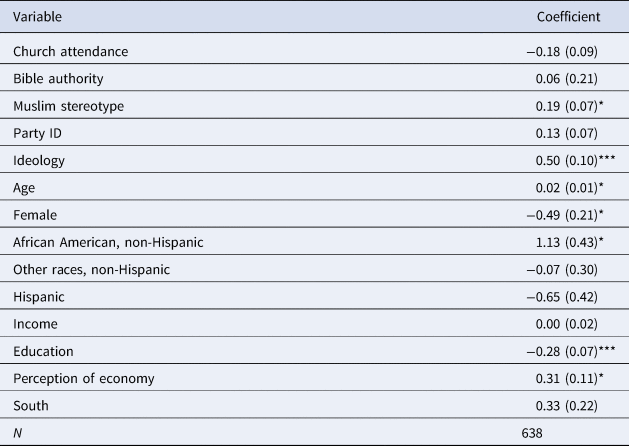
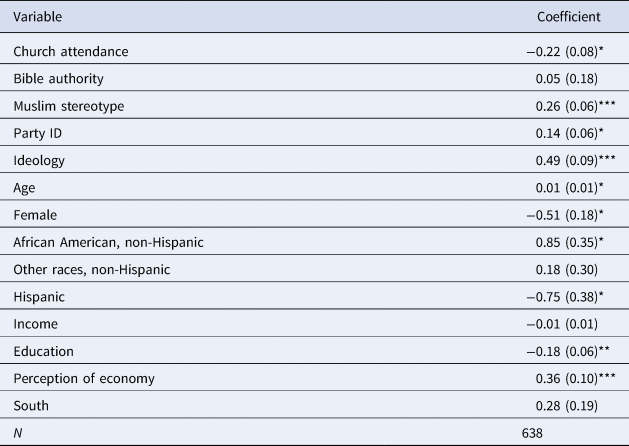
Table 3 reports findings from the stratified model with evangelicals. The results reported in the table capture variations in attitudes within the evangelical community due to differences in religiosity, political predispositions, stereotypical attitudes, demographics, and socioeconomic status. From the demographic standpoint, older members were more opposed to refugees compared to younger ones. Similarly, women were significantly less opposed than males. As for race/ethnicity, the coefficient for the African American (non-Hispanic) dummy variable is particularly noteworthy, since it implies African Americans were significantly more opposed to refugees compared to their white counterparts. These findings are by no means unexpected. Notwithstanding the inconsistencies in findings regarding Black support for immigration, several studies have documented economic insecurity relative to other minority groups (Gay, Reference Gay2006), lower socioeconomic status (Nteta, Reference Nteta2013), ethno-centrism (Kinder and Kam, Reference Kinder and Kam2010), and negative assessment of in-group members (Cummings and Lambert, Reference Cummings and Lambert1997) contributing to significantly high levels of anti-immigrant sentiments among African Americans. In light of Trump's 2016 campaign, Carter and King-Meadows (Reference Carter and King-Meadows2019) found that due to their prejudice against Latinos, concerns about economic security, emphasis on “linked faith” and national identity, Blacks decidedly adopted an unsympathetic attitude toward all immigrants. These sentiments remained palpable, even though African Americans did not end up voting for Trump in the 2016 elections.
Stratified model comparing effects of religiosity, Muslim stereotype, political predispositions, socioeconomic status, and demographic controls within the evangelical community

Ordered logit estimates, all tests two-tailed, and standard errors in parentheses. White, non-Hispanic used as baseline for race dummies. NES weight used is V1610102.
*p < 0.05; **p < 0.01; ***p < 0.001.
However, the finding for the Hispanic dummy variable fails to support the double conversion thesis, as the coefficient is not statistically significant. That said, it is worth mentioning that coefficient for this measure is negative, implying Hispanics were less opposed—if not significantly so—to refugees compared to whites. With regard to socioeconomic status, less-educated evangelicals and those with pessimistic assessments of the economy were more opposed to refugees. Likewise, stereotypical attitudes and conservative political ideology worked against allowing refugees into the United States.
Probably the most interesting finding in Table 3 is regarding the church attendance measure. The coefficient for the church attendance variable in the model for evangelicals is negative and almost statistically significant (p = 0.05). This means that all else equal, even within the evangelical community, frequent church attendees could be less opposed to Syrian refuges compared to those who sparingly took part in public worship. This could also mean that the efforts of the clergy in advocating for the refugees were not in vain, since their appeals resonated with those who regularly attended worship services. However, because the p value for this measure is equal to 0.05, and not less than 0.05, the coefficient must be interpreted carefully as it involves a case of borderline statistical significance. All in all, findings from Table 3 reveal interesting variations within the evangelical community, which serves as a cautionary note against treating the entire community as a monolithic whole. To illustrate, when looking at the findings for women, highly educated, and younger evangelicals, it is possible to argue that unlike the conventional wisdom that argues substantial differences between the attitudes of evangelical leadership and laity, opinions of women, highly educated, and younger evangelicals mirror the sentiments of the church elites.
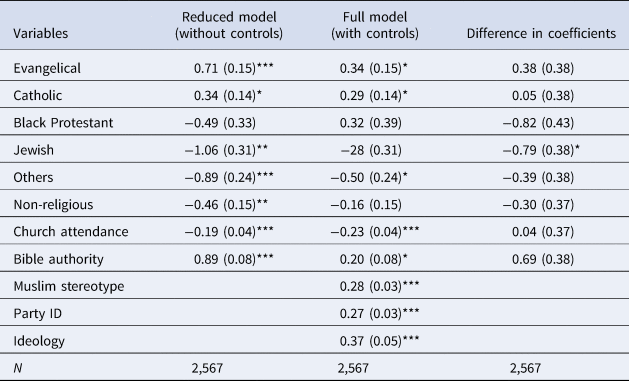
Finally, to ensure the findings from Tables 1–3 were robust, a second variable from the ANES 2016 Time Series Study (2019) on allowing Syrian refugees was used to check the reliability of the results reported above. This was done by running three models with identical independent and control variables, but using the second measure on Syrian refugees as the dependent variable. This measure of attitude toward allowing Syrian refugees is similar to the one used in the paper, but uses a seven-point scale to measure the strength of opinion. This variable is coded to range from one to seven, with one representing “favor a great deal” and seven denoting “oppose a great deal.” The findings obtained from these models are almost identical to those reported in Tables 1–3 of this paper, and are presented in Tables A1–A3 for reference.
Discussion
Following Trump's travel ban and the resultant prohibition on Syrian refugees in January 2017, many singled out lay evangelicals as one of the biggest champions of the President's executive order. More importantly, the stance of lay evangelicals was contrasted with the pro-immigration rhetoric of their church elite, resulting in an attitudinal gap between church leaders and their followers. The analysis presented in this study, however, reveals a more complicated picture: although evangelicals demonstrate significantly higher levels of opposition toward Syrian refugees, similar sentiments are also reflected within the Catholic community. Therefore, this finding undermines the case for evangelical distinctiveness. That said, what sets evangelicals apart from other religious traditions is the role of Muslim stereotypes in shaping their views on Syrian refugees. All else equal, evangelical identity was the only religious affiliation—compared to mainliners—which made individuals more prone to Muslim stereotypes, and therefore, more opposed to refugees from Syria, in turn.
Evangelical distinctiveness in holding Muslim stereotypes is in tune with the ethno-religious approach (Durkheim, Reference Durkheim1915) and SIT (Tajfel and Turner, Reference Tajfel, Turner, Jost and Sidanius2004). While the ethno-religious approach focuses on the primacy of religious belonging—in this case evangelical identity—in driving distinct opinions, SIT maintains that in-group members often “otherize” out-group members to establish their own supremacy. Unlike mainliners and Catholics, evangelicals have generally resisted inter-faith dialogue, and focused more on the many differences between Islam and their faith (Rock, Reference Rock2011). This could explain why Catholics did not hold the same stereotype, even though they were like evangelicals in their opposition to Syrian refugees. Therefore, it is not surprising that evangelicals were the only group significantly prone to Muslim stereotypes, which in turn made them more opposed to Syrian refugees. Furthermore, this finding is also in congruence with the Christian nationalism literature, which associates a limited view of national identity based on “otherizing” Muslims along with non-white racial minorities primarily—although not exclusively—with the evangelical tradition (McDaniel et al., Reference McDaniel, Nooruddin and Shortle2011, Reference McDaniel, Nooruddin and Shortle2022; Shortle and Gaddie, Reference Shortle and Gaddie2015; Whitehead and Perry, Reference Whitehead and Perry2020).
In addition to measures of religious identity, religiosity plays a key role in affecting attitudes toward Syrian refugees. Ceteris paribus, frequent churchgoers are significantly more likely to display favorable attitudes toward refugees compared to those who attend public worship less frequently. On the contrary, biblical literalists remain significantly more opposed compared to those believing in a more progressive interpretation of the Scriptures. More importantly, findings from this study caution against treating evangelicals as a monolithic category. When analyzing patterns within the evangelical community, differences along demographic and socioeconomic lines become obvious in explaining attitudes toward refugees. For instance, women and younger individuals within the evangelical community hold much more favorable attitudes toward Syrian refugees. This finding requires a reassessment of the conventional understanding of the gap between the church elite and the laity, as it demonstrates that certain sections of the evangelical community are indeed demonstrating attitudes similar to the clergy. Therefore, one must be careful and not generalize the elite–laity gap for the entire evangelical tradition.
The findings from this study have interesting policy implications. According to Esses et al. (Reference Esses, Dovidio and Hodson2002), public opinion on immigration matters, since it has meaningful impacts on policy sustainability, immigrant experience, and “the collective vision of national identity.” Since evangelical identity reinforces Muslim stereotypes as well as conservative ideological beliefs and a strong Republican identity, an increased political influence of the group could mean limited policy support for refugees from Muslim majority countries. Even if pro-immigration policies admit Muslim asylum seekers, they are unlikely to experience a smooth integration into American society and are likely to be considered by some as outsiders in the context of the nation's collective identity. However, since evangelicals do not represent a monolithic category, creating opportunities for greater participation of women and younger evangelicals could possibly balance out opposing sentiments from the anti-immigration fractions. This could also go a long way in bridging the gap between the church leadership and the laity.
Moreover, a simultaneous emphasis on inter-faith understanding and pro-refugee policies from the church elite can potentially help address prejudice against Muslims, thereby creating at least among some sections of the laity a more welcoming attitude toward Syrian refugees. In fact, Wallsten and Nteta (Reference Wallsten and Nteta2016) found high-profile religious leaders were remarkably successful in changing certain church members' perceptions on creating a path to citizenship and developing a more sympathetic attitude for undocumented immigrants.Footnote 7 Furthermore, the impact of elite messaging on pro-immigration opinion was particularly effective among multiple denominations, including Southern Baptists. By that logic, exposing church attendees to well-known denominational leaders' views promoting multi-faith understanding and compassion for refugees can encourage at least some members from the pews to mimic the sentiments of the church elites.
Additionally, evangelical organizations have a long history of supporting refugee populations with resettlement services. Of these organizations, World Relief and Bethany Christian Services (EIT, 2022) have made incredible contributions by providing various resources to refugee families, including housing, transportation, medical support, language training, and employment help. Similarly, the Southern Baptist Convention adopted a resolution in June 2016 suggesting “Southern Baptist churches and families to welcome and adopt refugees into their churches and homes as a means to demonstrate to the nations that our God longs for every tribe, tongue and nation to be welcomed at his throne” (qtd in Fausset and Blinder, Reference Fausset and Blinder2016). Given the finding on church attendance from this study, greater involvement of congregants in faith-based resettlement efforts can be a potential tool for mitigating hostile feelings toward refugees.
Finally, like any other analysis, the findings from this study are not without limitations. First, due to the unavailability of relevant data in the ANES dataset, the study relies on very specific measures for religious belief and behavior. Similarly, in conceptualizing the variable for refugee support, the measure looks at Syrian refugees in general, without disaggregating them by age, gender, and religious affiliation. Thus, in the future, it would be interesting to examine whether the patterns identified in this study persist with more expansive measures of religious belief and behavior. Likewise, it would be valuable to investigate if the level of support for Syrian refugees remains the same across different demographic categories of the asylum-seeking population.
Acknowledgments
This paper was previously presented at the Annual Meeting of the International Studies Association's Midwest Conference at St. Louis, MO in November 2018, and the Annual Meeting of the Midwest Political Science Association at Chicago, IL in April 2019. The author is grateful to Ryan Claassen, Amanda Murdie, Luke Perez, and the editors and anonymous reviewers of Politics and Religion for their valuable comments and feedback.
Financial support
The research presented in this paper was not supported by any external funding.
Competing interests
None.
Oindrila Roy is an Associate Professor of International Relations at Cottey College. Her research examines religiously motivated foreign policy public opinion in the United States.
Appendix
Comparing effects of religious identity, religiosity, Muslim stereotype, and political predispositions across restricted and full models (DV: expanded Syrian refugees support measure [seven-point scale])

Indirect effects of the religious variables via Muslim stereotype, party ID, and ideology (DV: expanded Syrian refugees support measure [seven-point scale])

Stratified model comparing effects of religiosity, Muslim stereotype, political predispositions, socioeconomic status, and demographic controls within the evangelical community (DV: expanded Syrian refugees support measure [seven-point scale])