INTRODUCTION
The erect, robust-branching bryozoan Pentapora fascialis (Pallas, 1766) is a conspicuous subtidal species colonizing hard rock substrates, cobble and boulder areas and also other living species (gorgonians) from 1 m depth down to 60 m or more (Hayward & McKinney, Reference Hayward and McKinney2002; Novosel et al., Reference Novosel, Olujic, Cocito, Požar-Domac and Moyano2004). It occurs along the western coast of Britain as far north as the Hebrides and St Kilda, and eastwards along the English Channel, towards its limit in Sussex. The species occurs southwards into the western Mediterranean, with records in the Adriatic and Ionian Seas and along the coast of Tunisia (Hayward & Ryland, Reference Hayward, Ryland, Barnes and Crothers1999; Cocito & Ferdeghini, Reference Cocito and Ferdeghini2001; Mustapha et al., Reference Mustapha, Komatsu, Hattour, Sammari and Zarrouk2002).
Colonial growth of P. fascialis begins with a small encrusting patch that develops into bilaminar sheets (Hayward & Ryland, Reference Hayward, Ryland, Barnes and Crothers1999). These then go on to develop into an erect foliose structure, 20–30 cm in diameter, occasionally up to 80 cm (Cocito et al., Reference Cocito, Sgorbini and Bianchi1998). Growth occurs in one of two ways, either by the formation of slender dichotomous branches or by the development of fused laminae, thus corresponding to the adeoniform and eschariform morphotypes respectively (McKinney & Jackson, Reference McKinney and Jackson1989). This may be a response to different water flow directions and velocities (Cocito & Ferdeghini, Reference Cocito, Ferdeghini, Herrera Cubilla and Jackson2000) or it may be due to genetic makeup.
There have been some recent taxonomic issues concerning Pentapora. It was considered by Gautier (Reference Gautier1962) to comprise two different species, namely, Pentapora fascialis (Pallas) and Pentapora foliacea (Ellis & Solander). Zabala & Maluquer (Reference Zabala and Maluquer1988) relegated these to subspecies and in 1999 they were merged into a single species, P. fascialis, by Hayward & Ryland. In this study we will refer to it as the single species P. fascialis but it should be noted that genetic research is currently underway in order to clarify the systematics of the different morphological types.
Pentapora fascialis is a distinguishing species of the ‘facies with large branching Bryozoa’ among the ‘biocoenoses of the coastal detritic bottoms’ of the circalittoral zone (Habitat Directive 92/43 EEC). Together with other bryozoans, the species lives on both hard substrata and as an epizoan on gorgonians within different facies of coralligenous biocoenoses (Pérès & Picard, Reference Pérès and Picard1964; Bellan-Santini et al., Reference Bellan-Santini, Bellan, Bitar, Harmelin and Pergent2002). The high vulnerability of the habitat provided by P. fascialis and also its abundant associated diversity make its protection a priority (Bardat et al., Reference Bardat, Bensettiti and Hindermeyer1997).
As with many bryozoans, Pentapora fascialis produces a heavily calcified skeleton that withstands current flow. The colonies can develop into large reef-like constructions that provide living space for other species, thereby increasing the diversity of habitats where they occur. An interesting recent development has been the use of P. fascialis colonies as a bioindicator of seasonal variations in temperature through analysis of zooid size variation. This method has been applied in two studies (O'Dea, Reference O'Dea2005; Lombardi et al., Reference Lombardi, Cocito, Occhipinti-Ambrogi and Hiscock2006). When a colony is damaged or eventually dies its skeleton is deposited into the sediment, providing a source of carbonate (Smith et al., Reference Smith, Stewart, Key and Jamet1998; Cocito, Reference Cocito2004).
Current knowledge on the extent and distribution of carbonate build-ups and carbonate production by P. fascialis is limited. The eastern Ligurian Sea and the karstic freshwater springs in the north-eastern Adriatic Sea are the only Mediterranean regions to have been studied so far (Cocito & Ferdeghini, Reference Cocito and Ferdeghini2001; Cocito et al., Reference Cocito, Novosel and Novosel2004).
Analysis of the occurrence of P. fascialis and its growth habits, along with an indication of how the morphology of the species responds to different environmental conditions, should increase our current understanding of its ecological variability. Contemporary knowledge of the distribution of this large carbonate producing bryozoan will provide new data for the re-evaluation of the carbonate budget of the Mediterranean.
The aim of our study was therefore to map the distribution and morphology of the species P. fascialis along the western coast of Italy. Observations were made of bathymetric range, the substrates on which colonies develop, colony density and size, and colony morphology (form of the colony and branches).
MATERIALS AND METHODS
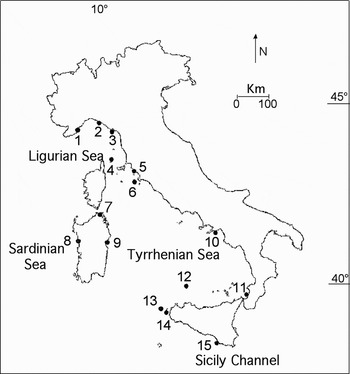
The study was carried out during the period 2001 to 2003 in 15 localities along the western coast of Italy, extending from the Ligurian Sea in the north to Sicily in the south (Figure 1).
Map showing the location of the 15 sites selected for surveying colonies of Pentapora fascialis (site numbers correspond with the names given in Table 1).

SCUBA divers recorded a variety of data including the depth range of P. fascialis colonies, the type of substrate on which colonies lived (hard, artificial and other organisms), colony size in diameter (<10 cm, 10–20 cm, >20 cm), colony density (<1/m2, 1–2/m2, >2/m2), colony morphology (sub-spherical or ellipsoidal) and the branching form (expanded, foliaceous laminae or slender, dichotomous branches) of colonies. The collection of this data was facilitated by the setting out of three transect lines at each location. Five replicate quadrats (1 m2) were randomly placed along each transect line, then the number and size of colonies present within each quadrat was recorded by pairs of divers on an underwater recording slate.
Voucher colonies of P. fascialis with the different growth forms and branching types were collected from each location in order to establish a baseline for accurate taxonomic identification. These colonies were preserved by air drying following careful transportation to the laboratory.
Frequency distribution graphs were constructed from the data to analyse: (a) the size-classes of P. fascialis colonies growing on different substrate types; (b) the size-classes of colonies in relation to colony morphology; (c) the type of substrate in relation to colony morphology; and (d) the colony morphology in relation to branching type.
A multivariate descriptive method, the multiple correspondence analysis (MCA), was used to analyse correlation between variables. Data on colony size, colony density, colony form and branch type were converted to a 0–1 matrix and treated separately for the two types of substrate more frequently used by P. fascialis, organic and hard. As all colonies growing on organic substrate displayed dichotomous branches, branch form was not considered as a variable in the MCA. Analogously, colony form was not considered in the MCA on hard substrate, where all colonies had the ellipsoidal form.
RESULTS
Distribution of P. fascialis colonies
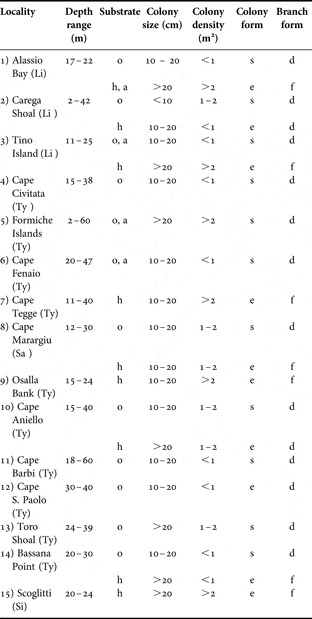
The distribution of Pentapora fascialis colonies on western Italian coasts was documented by SCUBA surveys. 517 colonies were recorded in total, from a depth of 11 to 60 m (Table 1). The shallowest colonies (11 m deep) were found at Tino Island and Cape Tegge, whereas at the Formiche Islands and Cape Barbi P. fascialis occurred down to 60 m of depth.
Study localities, number of colonies observed, depth-range of distribution, type of substrate (o, other organisms; h, hard; a, artificial), colony size, density, form (s, sub-spherical; e, ellipsoidal) and branch form (d, dichotomous; f, foliaceous). Li, Ligurian Sea; Ty, Tyrrhenian Sea; Sa, Sardinian Sea; Si, Sicily Channel.

Size-class distribution of colonies in relation to substrate and colony morphology
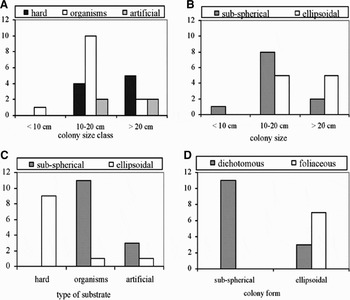
The modal size-class of colonies recorded was the 10 to 20 cm category of colony diameter with 87.7% of colonies being assigned to this category (see Table 1). In 10 of the localities surveyed, this size-class of colony was found commonly growing as epizoans on gorgonians and, to a lesser extent, colonizing hard substrates (Figure 2A). Colonies were occasionally observed on artificial substrates. When growing epizooically, the main substrate for attachment of colonies of P. fascialis was provided by the living branches and the bare axial skeleton of branches, specifically those affected by necrosis on the gorgonian Paramuricea clavata (Risso). Colonies were also recorded on living gorgonians of the species Eunicella singularis (Esper) and Leptogorgia sarmentosa (Linnaeus) and on the sponge Cacospongia scalaris (Schmidt). These substrate preferences were recorded at both Tino Island and Carega Shoal at Portofino. Hard bedrock and rocky blocks were also common substrates for the bryozoan colonies (Table 1). Artificial substrata harboured colonies of P. fascialis in the depth-range 17 to 20 m. These substrata include the submerged breakwaters surveyed in the Bay of Alassio and fishing nets/lines discarded on the seabed at Cape Fenaio, Tino Island and the Formiche Islands.
Frequency distribution of Pentapora fascialis colonies in the 15 localities: (A) size-classes type of substrate; (B) size-class colony form; (C) type of substrate colony form; (D) branch colony form.

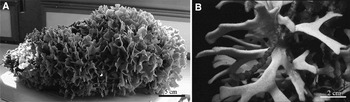
Larger colonies of P. fascialis (>20 cm diameter) frequently occurred on hard bedrock reefs and rock/boulder seabed habitat types. At Alassio Bay, Tino Island, Cape Aniello, Toro Shoal and Scoglitti colonies reached some 50 cm across, sometimes greater. Large colonies developed into a depressed globular zoarial form (Figure 3A) with an elliptic perimeter (i.e. ellipsoidal; Figure 2B) and the major axis was generally observed to be parallel to the direction of dominant current flow.
Pentapora fascialis growth forms: (A) depressed globular colony with an elliptic perimeter and expanded, foliaceous laminae; (B) detail of slender, dichotomous branches of a subspherical colony growing on the gorgonian Paramuricea clavata.

Small colonies of P. fascialis (<10 cm) usually occurred as epizoans and were scarce (Figure 2A). These colonies tended to exhibit a subspherical growth form, which was dominant in small colonies of P. fascialis (10–20 cm in diameter or less) (Figure 2B).
Colony form of P. fascialis in relation to substrate and branching form
The small size-category of P. fascialis colonies (<10 cm) with subspherical growth form frequently grew either on other organisms or on artificial substrates such as fishing nets and lines (Figure 2C). Larger ellipsoidal colony forms were dominant on hard substrates (Figure 2C) where they commonly developed foliaceous laminae that were convoluted and fused to varying degrees (Figures 2D & 3B). On the other hand, dichotomous branches were less frequently developed in ellipsoidal colonies, being dominant in smaller subspherical colonies.
Colony density and growth form of P. fascialis
At Alassio Bay, Tino Island, Cape Tegge, Osalla Bank, Scoglitti, where colony density was high (Table 1), ellipsoidal colonies often had subcircular expansions at the colony edge, formed by the fusion of satellite colonies. The narrow branched, sub-spherical P. fascialis colonies growing on other organisms or fishing nets and lines occurred at lower densities of <1 colony/m2, and less frequently, 1–2 colony/m2. These colonies did not appear to have undergone any fusion events.
DISCUSSION
The aim of this study was to investigate the distribution and morphology of the bryozoan species P. fascialis along the western coast of Italy. This study was necessary for two reasons. Firstly, to gather morphological and ecological data with which to supplement detailed analysis to study the taxonomic systematics of the Pentaporidae and secondly, to facilitate better estimates of carbonate production to enable the calculation of an accurate carbonate budget for this region of the Mediterranean Sea.
Observations from this study show that colonies of the bryozoan P. fascialis occurred at all fifteen locations studied during the investigation from Alassio Bay in the north to Scoglitti in the south. This corresponds to a latitudinal range of approximately 7 degrees (45 to 38 degrees N, as shown in Figure 1). Pentapora fascialis colonies occupied a depth-range of 11 to 60 m, and in terms of density represent an important part of the sessile benthos stretching from the Ligurian Sea in the north to the Sicily Channel in the south. The shallowest depth record (at 1 m) was recorded by Novosel et al. (Reference Novosel, Olujic, Cocito, Požar-Domac and Moyano2004) from the Kola Cove location (north-eastern Adriatic Sea). It has been hypothesized that cold submarine freshwater springs in this area provide protection to colonies from the high surface temperatures that can arise during summer months. In these unique environmental conditions, with nutrient- and bicarbonate-rich waters and strong, steady currents, the feeding ability and carbonate building performance of the bryozoan colonies is greatly enhanced. The deepest specimen was observed at about 70 m depth from the top of a shoal off Mazara del Vallo (TP), southern Sicily (M. Gristina, personal communication).
Colonies of P. fascialis were typically an important component of the zoobenthos in the transition zone between the infralittoral and the circalittoral, specifically in the ‘circalittoral sciaphilic algal community’. This type of community, fully developed in most of the locations, occurred either at the foot of cliffs, or on rocky surfaces emerging from the sediment. Pentapora fascialis was also a common epizoan in facies that were characterized by gorgonians within the coralligenous biocoenoses on rocky cliffs with high hydrodynamics. This is in accord with previous studies on the French coasts (Augier, Reference Augier1982; Bellan-Santini et al., Reference Bellan-Santini, Bellan, Bitar, Harmelin and Pergent2002) and in the north-eastern Adriatic Sea, where the most common distribution patterns observed for the species refer to rocky walls and gorgonian stalks attached to cobbles and boulders on flat soft-sediment (Hayward & McKinney, Reference Hayward and McKinney2002; McKinney, Reference McKinney2007). Around the British Isles, P. fascialis colony morphologies are only of the fused laminar morphology. The species is distributed from as far north as the Shetland Isles, around the west coast of the UK, with occasional records around the west coast of Ireland, through the Irish Sea and Cardigan Bay and up through the English Channel as far east as Beachy Head (NBN gateway). In UK coastal waters, P. fascialis colonies are found attached to bedrock, large boulders, cobbles and pebbles, they have not been recorded living on seafans.
Substrate is one of the main environmental parameters that controls bryozoan colonization, settlement and growth (Hageman et al., Reference Hageman, James and Bone1997; Taylor & Wilson, Reference Taylor and Wilson2003; Amini et al., Reference Amini, Adabi, Burrett and Quilty2004). Natural marine hard substrates both biogenic (live and partially dead gorgonians, sponges) and abiogenic materials (rocks, cobbles and boulder) represent the preferred substrate for P. fascialis colonization compared to unconsolidated sediments, on which the taxon has never been found. Large, long-lived gorgonians, such as Paramuricea clavata, Eunicella singularis and Leptogorgia sarmentosa, and large sponges offer, analogously to rocky substrata and boulders, relatively stable habitats, even in moderately exposed sites, for the rigidly erect species that rises from sediment avoiding being covered with mud. According to previous observations (Cocito & Ferdeghini, Reference Cocito, Ferdeghini, Herrera Cubilla and Jackson2000), the species only developed dichotomous branches when living on an organic substrate, which could represent a limiting factor for the development of large colonies and for high colony densities to occur. In contrast, on hard substrates ellipsoidal colonies were found bearing both foliacaeous laminae and dichotomous branches. Foliaceous laminae were associated with the highest density of colonies in contrast to the Atlantic environment where colonies, typically displaying foliaceous morphology, are usually smaller in size and characterized by low densities (Lombardi personal observation; MarLIN website).
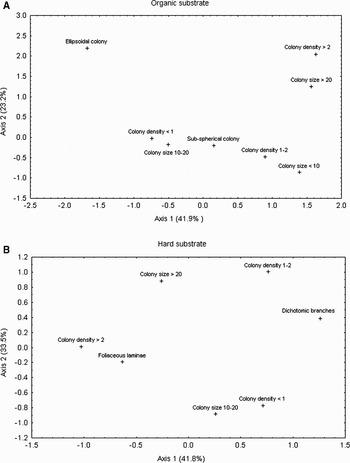
At the 15 localities studied, most of the bryozoan colonies were found in current swept areas, particularly at capes, shoals and banks where food availability to benthic suspension feeders is guaranteed by the hydrodynamic regime (Gili & Ros, Reference Gili and Ros1985). Many bryozoans display a diversity of colony morphologies that interact with water flow affecting resistance to current action and food capture (McKinney & Jackson, Reference McKinney and Jackson1989). A relationship between morphology of P. fascialis colonies and the local environment was proposed by Cocito & Ferdeghini (Reference Cocito, Ferdeghini, Herrera Cubilla and Jackson2000), who considered variations in colony morphology to be an important adaptive mechanism of suspension feeders to their local environment. Small colonies of P. fascialis with slender, dichotomous branches may represent an adaptive response to conditions where colonies grow in a multidirectional flow. In contrast, large colonies with expanded thick laminae, may be a response to the increased capacity of colonies to withstand flow stress, allowing colonies to take advantage of strong laminar currents. In our study, for colonies growing on an organic substrate, the MCA analysis divided ellipsoidal forms from large, high-density colonies (Figure 4A). For colonies growing on hard substrata, colonies with dichotomous branches were separated from those occurring at highest density (>2 colony/m2), and medium size colonies weakly clustered together with low density distribution away from large colonies growing at intermediate density (1–2 colony/m2) (Figure 4B). These results therefore provide further support for the hypothesis of Cocito & Ferdeghini (2000).
(A) Relationships among colony size, colony density and colony form for Pentapora fascialis growing on organic substrate according to the multiple correspondence analysis; (B) relationships among colony size, colony density and branch form for P. fascialis growing on hard substrata. Variable categories are given in Table 1. Both graphs show the first and second factorial planes.

Further functional analyses of different morphotypes across a wider range of environments are required to characterize more accurately the relationship between colony morphology and ecology, particularly with respect to hydrodynamic regime. One possibility would be to grow colonies of Pentapora in flow tanks of different regimes, or to transplant young colonies into different regimes in the natural environment.
Considerable phenotypic plasticity is exhibited by P. fascialis in terms of variation in the size and morphology of the colony, and branching pattern. Genetic studies and detailed morphometrics at the zooid level are currently underway. This approach will further clarify the taxonomic relationships between different colony morphologies and the level of genetic differentiation between branching and foliaceous colonies.
In accordance with previous reports (Gautier, Reference Gautier1962; Hayward & Ryland, Reference Hayward, Ryland, Barnes and Crothers1999), we found the most frequent size-class to be 10 to 20 cm in colony diameter. However, colonies growing on hard bedrocks and rocky bottoms frequently reached some 50 cm across. Apart from one record of a colony of 1 m in diameter in the Adriatic Sea (Cocito et al., Reference Cocito, Novosel and Novosel2004), larger sized colonies (80 cm in diameter, 50 cm in height) were previously described only from the Ligurian Sea (Cocito et al., Reference Cocito, Sgorbini and Bianchi1998). The fragility of the carbonate skeleton of the colony makes the species very sensitive to damage by human activities, in particular dredging and diving activities. In one study, a reduction in the average size of P. fascialis colonies was reported in areas where frequent diving and dredging activities were taking place (Sala et al., Reference Sala, Garrabou and Zabala1996). Other threats such as water pollution, changes in sedimentation rate, fine sediment input and trawl fishing have been reported for large, erect bryozoans (Harmelin & Capo, Reference Harmelin, Capo and Jackson2002). Due to recent increases of water turbidity and sewage, large, erect ramose bryozoan colonies have been reduced in number or have even disappeared in several urban coastal areas of the Mediterranean Sea. Losses of colonies due to anthropogenic activities, clearly has repercussions for the overall levels of biodiversity of these coralligenous biocoenoses.
In summary our study brings useful new information regarding the large-scale distribution and growth habits of the conspicuous reef constructing bryozoan species, P. fascialis. We advocate further studies of this type, particularly in other areas of the Mediterranean and also into the Atlantic to establish the distribution of colony morphologies and growth types throughout the range of the species. Such data will be of considerable importance in calculating the component that these organisms contribute to regional carbon sinks. These regional sinks are a highly significant component of the global carbon cycle. A basic knowledge of the biogeographical distribution of major current carbon producing organisms is essential to further our understanding of the impacts (e.g. ocean acidification) of climate change in relation to carbon cycling. This is necessary both to clarify events from the past (through the fossil record) and also to inform for the future (for modelling the effects of climate change).
ACKNOWLEDGEMENTS
Thanks to R. Sandulli, A. Peirano and S. Sgorbini for assistance with fieldwork and to ten diving centres for logistical support with SCUBA. We are also grateful to A. Marchini for help in statistical analysis and to E. Bontempo for the underwater picture.