Introduction
Gravitational waves are ripples in the curvature of spacetime that propagate as waves outward from the most extreme events in the Universe, such as colliding black holes. Their existence was predicted by Albert Einstein in 1916.Reference Einstein 1 Owing to their negligible attenuation by matter, they offer a new way to study the Universe. Gravitational-wave science is a rich and interdisciplinary field that encompasses fundamental physics, astrophysics, astronomy, cosmology and nuclear physics. Signals from the coalescence of compact binary sources allow stringent tests of general relativity (GR) in the strong-field regime. This yields a tight limit on the mass of the graviton, the hypothetical particle that comes in to play in a possible quantum theory of gravity. Moreover, accurate tests of Lorentz invariance are possible. The study of tidal effects of binary neutron stars (BNS) yields information on their equation of state. Mergers of binary black holes and neutron stars allow measuring the Hubble parameter and can also be used as cosmic distance markers to map the expansion history of the Universe, shedding light on the mysterious Dark Energy. On a more speculative note, the brief period of inflation almost immediately after the Big Bang filled the Universe with a faint background of ‘primordial’ gravitational waves. Their eventual observation will not only yield a fascinating picture of our infant Universe as it was just after the Big Bang, but may allow probing the quantum nature of gravity.
The first direct detection of gravitational waves with the Laser Interferometer Gravitational-Wave Observatory (LIGO) in Livingston and Hanford, USA, occurred on 14 September 2015 and has been designated GW150914.Reference Abbott 2 The event was already classified as promising on the day itself, and shortly thereafter it was determined with a significance of more than 5.1 sigma (probability 99.999 98%) that the origin was astrophysical. Further analysis has shown that GW150914 is most likely due to the merger of two black holes of 36 and 29 solar masses; three solar masses of energy were transmitted in the form of gravitational waves, making this the most powerful event ever seen. The event is so ‘loud’ that it is visible to the eye in the band-passed and whitened data. The detection represented several scientific breakthroughs simultaneously: it constitutes the first direct detection of gravitational waves, but also provided the first direct evidence of the existence of black holes. It was also the first observation of the merger of two black holes, and finally it gave us access to the strong-field dynamics of pure spacetime. A second clear detection (GW151226)Reference Abbott 3 took place on 26 December 2015, with black holes of 14 and 8 solar masses fusing together. GW170104 was the third eventReference Abbott 4 in which a 50-solar-mass binary black hole coalescence was observed at redshift 0.2 (distance 2.7 billion light years). On 8 June 2017, event GW170608 was recorded.Reference Abbott 5 It originated from the merger of two 12 and 7 solar-mass black holes at redshift 0.07 (distance 960 million light years). All these observations were made with the LIGO detectors only, while the Virgo gravitational detector (near Pisa, Italy) was offline for an upgrade.
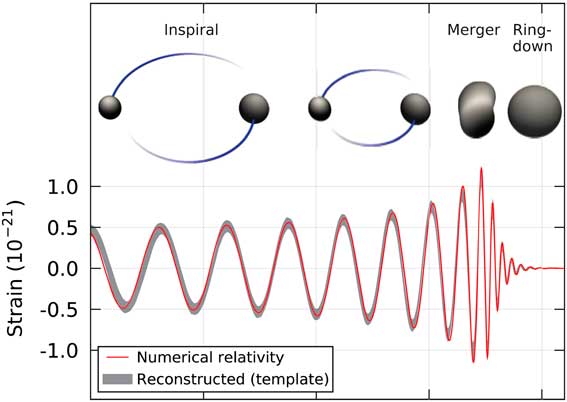
GW150914 was a so-called ‘golden event’, meaning its total mass was such that the merger occurred at a frequency where the detectors are the most sensitive. Figure 1 illustrates the process. It begins with two black holes that follow a spiral movement (‘inspiral’), radiating kinetic energy and angular momentum in the form of gravitational waves. Then, when the last stable orbit is reached, the black holes collapse to coalesce into a single more massive black hole (‘merger’). The latter sheds its excitations (‘ringdown’) and finally comes to rest. The early inspiral can be described with the so-called post-Newtonian formalism, where the phase of the gravitational wave can be written as an expansion in powers of v/c (where v is the characteristic velocity of the black holes and c the speed of light). In previous research (for example, radio astronomy observations on binary neutron stars), only the leading-order post-Newtonian contribution could be accurately measured. With GW150914, for the first time, limits can be placed on possible violations of general relativity in higher-order post-Newtonian coefficients. In addition, observables related to the pre-merger and merger regimes can be measured. GW150914 and GW151226 provided complementary information: the former proved to be particularly sensitive to the strong nonlinear behaviour of spacetime near merger, while the latter enabled accurate testing of the initial process of the binary object due to a much longer inspiral signal. One of the most important post-Newtonian parameters is the one at (v/c)Reference Abbott 3 above leading order, sensitive to the dynamic self-interaction of spacetime. We have now measured this coefficient and found it to be consistent with GR within about 10%. By the end of this decade, as information of a growing number of detections can be combined, this uncertainty will decrease to about 1%; see also Ref. Reference Abbott6.
Estimated relative amplitude of gravitational waves of GW150914. The full bandwidth of the waveforms is shown. The depictions show model results based on numerical relativity simulations of the horizons of black holes as they fuse.

The third detection, GW170104, was special in the sense that it was possible to constrain its black hole spins by measuring the effective inspiral spin parameter,
 $$\chi _{{{\rm eff}}} {\equals}{\minus}0.12_{{{\minus}0.30}}^{{{\plus}0.21}} $$
, a mass-weighted combination of the spin components along the orbital axis. This result implies that spin configurations with both component spins positively aligned with the orbital angular momentum are disfavoured and, if confirmed by future detections, this may provide clues about the formation mechanism of such events.
If it turns out that gravity is described by a quantum field theory, then the graviton is the particle that mediates the interaction. The joint LIGO Virgo Collaboration (LVC) has used the measurement data to place an upper limit on the mass of the hypothetical graviton. If this mass is not zero, it has an effect on a classical gravitational wave: the higher-frequency components would then travel slightly faster than the low-frequency components, and also more slowly than the speed of light. This effect is cumulative over the travelled path (more than a billion light years) from wave source to detector, such that an accurate measurement can be performed. This led to the best dynamic upper limit on the graviton mass: m g≤7.7×10⁻²³ eV/c 2, the first ultra-high-precision resultReference Abbott 7 of gravitational wave physics.
Advanced Virgo
Advanced Virgo, like Advanced LIGO, is a second-generation gravitational wave detector. Important improvements were made to increase the sensitivity compared with the first incarnation of Virgo. For example, larger beam spots and heavier test masses (i.e. the core mirrors) were employed. The optics is now of higher quality and features improved lower-loss coatings. Shot noise was reduced by increasing the finesse of cavities. As a consequence, the design provides Advanced Virgo with more laser power in the interferometer arms (up to 700 kW), requiring the compensation of aberrations due to thermally induced disturbances of optical components. To this end, a complex adaptive optics, the so-called Thermal Compensation System (TCS) was realized. The system is based on different types of wavefront sensors and contactless thermal actuators, which makes it possible to correct aberrations both statically and dynamically.
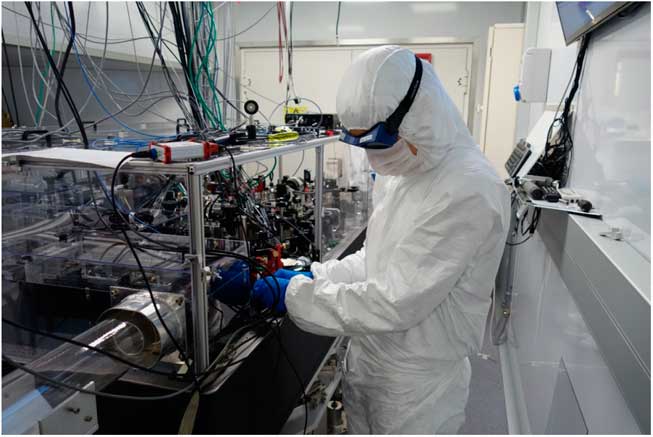
For these TCS wavefront sensors, so-called phase cameras have been developed that allow the wavefront of the input laser beam to be compared with that of the wavefronts in the interferometer at the sub-nanometre level (Figure 2). These include information on optical aberrations, which are then corrected for by means of the TCS actuators.
A PhD student from the Vrije Universiteit Amsterdam installing the reference phase camera for Advanced Virgo in the laser room of the European Gravitational Observatory (EGO) in Cascina, Italy.

The sensing system has been improved to minimize stray light affecting the instrument. The various optical sensors used for linear and angular alignment of Virgo’s main optical components have been placed on optical benches in vacuum, while a new set of baffles and diaphragms catch diffuse light. The sensors allow for the relative orientation of all vibration-free core optical elements within the required accuracy of some nanoradians. Compact seismic damping systems have been designed that offer more than six orders of magnitude vibration isolation in all six degrees of freedom. Five such systems have been integrated into the detector since the summer of 2016.
Four cryogenic vacuum links, one of the largest infrastructure projects of Advanced Virgo, have been realized and have been in continuous operation since the end of 2015. They have proven to be effective in reducing gas pressure in the interferometer arms (note that Virgo has the largest ultra-high vacuum system in Europe, with about 6800 m3 volume). Achieving vacuum pressures below 10−9 mbar is important for the successful operation of Virgo because otherwise the sensitivity will be limited by the phase noise caused by the random scattering of the laser beam from the gas molecules.
Virgo and LIGO Joint Results
Advanced Virgo was partially completed in early 2017, and first commissioning was carried out until summer 2017. From 1 August 2017, Virgo participated in the second science run of the LVC, along with the two LIGO detectors. This 3.5-week joint run was the first data taking with three second-generation kilometre-scale interferometers. Virgo’s performance was good, with a highest BNS range of 28.2 Mpc and a longest stable lock stretch of 69 hours. Virgo’s science duty cycle was about 85%.
The added scientific value of Virgo in the network was the increased dataset, since besides the usual LIGO Louisiana (LLO) and LIGO Hanford (LHO) coincidences, LLO-Virgo and LHO-Virgo coincidences, as well as LLO-LHO-Virgo triple coincidences were also collected. Moreover, both sky coverage (due to complementary antenna patterns) and sky location of sources were improved. The LIGO–Virgo network allowed, for the first time, a measurement of gravitational-wave polarization and an improvement in the distance measurement. Furthermore, a threefold coincidence measurement resulted in increased robustness of gravitational-wave detection and improved parameter estimation.
The first three-detector observation was made on 14 August 2017 at 10:30:43 UTC.Reference Abbott 7 The detected gravitational waves were emitted during the final moments of the merger of two black holes with masses about 31 and 25 times the mass of the Sun and located about 1.8 billion light-years from Earth. The newly produced spinning black hole has about 53 times the mass of our Sun. This means that about three solar masses were converted into gravitational-wave energy during the coalescence.
Overall, the Universe volume that is likely to contain the source shrunk by more than a factor of 30 when moving from a two-detector network to a three-detector network. The sky region for GW170814 has a size of only 60 degReference Abbott 2 (90% probability), about 20 times better than for the two LIGO interferometers alone; also the accuracy with which the source distance is measured benefits from the addition of Virgo. Being able to point to a smaller volume is important as many compact object mergers – for example when neutron stars are involved – are expected to produce broadband electromagnetic emission in addition to gravitational waves. The precision pointing information enabled 25 telescope facilities to perform follow-up observations based on the LIGO-Virgo detection, but no counterpart was identified – as expected for black holes.
Three days later, on 17 August 2017 at 12∶41:04 UTC, the Advanced LIGO and Advanced Virgo gravitational-wave detectors made their first observation of a binary neutron star inspiral.Reference Abbott 8 GW170817 produced the ‘loudest’ signal measured so far, and was detected with a combined signal-to-noise ratio of 32.4. The inferred component masses of the binary, when restricting the component spins to the range inferred in binary neutron stars, were in the range 1.17–1.60 solar masses, with the total mass of the system 2.74 solar masses. The source was localized within a sky region of 28 degReference Abbott 2 and had a luminosity distance of 40 Mpc (130 million light years), the closest and most precisely localized gravitational-wave signal yet.
GW170817 was associated with gamma ray burst GRB 170817A, detected by the satellite-based Gamma ray Burst Monitor Fermi-GBM and the International Gamma-Ray Astrophysics Laboratory INTEGRAL, 1.7 s after the coalescence. This corroborates the hypothesis of a neutron star merger and provides the first direct evidence of a link between these mergers and short gamma ray bursts. Subsequently, a series of transient counterparts was identified across the entire electromagnetic spectrum in the same location. This further supports the interpretation of this event as a neutron star merger. This unprecedented joint gravitational and electromagnetic observation provides insight into fundamental physics, astrophysics, nuclear physics, gravitation, and cosmology. Less than two years after the debut of gravitational-wave astronomy, GW170817 marks the beginning of a new era of discovery.
A Window on New Science
It is important to look towards the future. We expect that in the years to come, we will be able to detect a significant sample (perhaps hundreds) of gravitational waves of binary neutron stars. While two neutron stars move around each other, tidal forces will induce deformations in the stars, influencing their trajectories. These effects leave an imprint on the transmitted gravitational waves and are measurable. The degree to which a neutron star is deformable is determined by the neutron star equation of state, an expression of its pressure as a function of its density. This constitutes one of the most important open questions in astrophysics: theoretical predictions for a neutron star’s equation of state vary by an order of magnitude. The results of simulations demonstrate that by observing multiple binary neutron star mergers we can distinguish between the various predictions for this equation of state.
The frequency dependence and amplitude of the gravitational-wave signal gives a direct measurement of the luminosity distance of the source. The redshift of the source can be measured by astronomers detecting the source’s electromagnetic signals. Together, distance and redshift can be used to infer cosmological parameters independently of the cosmic distance ladder. Already for event GW170817, using the association with galaxy NGC 4993 and the luminosity distance directly measured from the gravitational-wave signal, the Hubble constant was inferred to be
 $H_{0} {\equals}70_{{{\minus}8}}^{{{\plus}\!\!12}} $
km s−1 Mpc−1. These so-called standard sirens bypass the systematic uncertainties in the conventional distance ladder, i.e. the combined observations using a succession of different techniques by which astronomers determine distances to celestial objects. Standard sirens hold great promise for future studies of gravitational wave cosmology.
Colliding black holes offer a unique opportunity to study these relativistic compact spacetime objects. The so-called ‘no-hair’ theorem states that the geometry of a stationary black hole is solely determined by its mass and angular momentum (and possibly electric charge, although the latter is expected to be zero for astrophysical black holes). It follows that the different vibrational states of the ringdown process (which can be described as linear perturbations of a stationary black hole) have characteristic frequencies and damping times that depend solely on the black hole’s mass and spin. We have the ambition to use gravitational waves to test this postulate in detail. Another interesting opportunity we want to explore in the near future is the existence of echoes in the gravitational waves of black hole mergers. Based on Hawking’s information paradox, it can be argued that the horizon of a black hole changes into a so-called firewall, a curtain of high-energy particles and radiation. If that is the case, part of the gravitational radiation that usually disappears in the black hole will be reflected outwards. In practice, this means that a series of echoes will be observed in the signal. Even if the characteristic longitudinal scale of these corrections is determined by the Planck scale (1.6×10⁻³¹ m), the echoes will be so ‘loud’ that they can, in principle, be measured.
In addition to the binary systems described above, rapidly rotating neutron stars that have small non-spherical deformations (as small as 0.1 mm) can be sources of detectable gravitational waves. Such signals are weak, but are transmitted continuously. This allows for long integration times, such that they can, in principle, be extracted from the data. Detecting such radiation can provide additional information on neutron stars, especially about their crust. Many neutron stars are part of a binary system, the other component of which is an ordinary star. The binary motion causes Doppler modulation in the signal that significantly complicates data analysis. The continuous-waves analysis group of LVC has developed several analytical methods to allow gravitational-wave detection from such systems. An all-sky search on LIGO’s first measurement period is in preparation.
Future Perspective: Einstein Telescope
It is expected that, in 2020, the international network will be strengthened with KAGRA, an underground cryogenic interferometer with 3 km long arms, under construction in Japan, and around 2024 with LIGO India (also termed IndIGO), a LIGO-like interferometer that will be built in the state of Maharashtra, India.
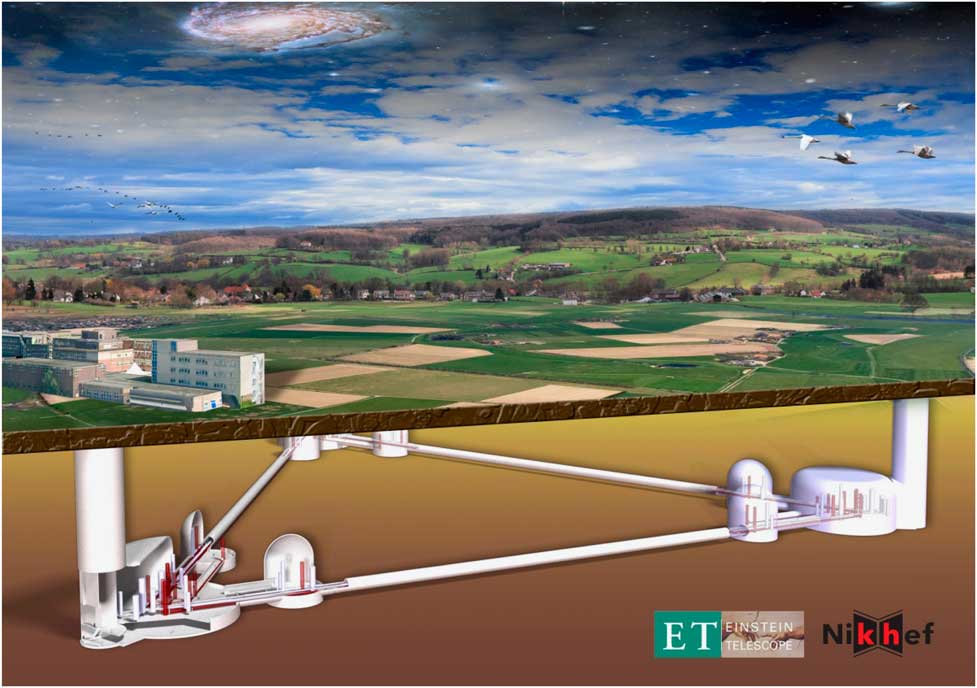
Gravitational waves provide a new way to study the Universe, and interferometers are perfect instruments for investigating the fine tuning of our theory of gravity, either Einstein’s GR or an alternative theory. We will constantly improve the sensitivity of our instruments, but if we want to detect signals from the entire Universe, a new measurement facility is called for that can detect gravitational waves extremely accurately: the Einstein Telescope (ET). Although the source of GW150914 may seem far away, at a distance of 1.3 billion light years, it is only at a redshift z=0.09. The Einstein Telescope makes it possible to measure collisions of black holes up to z≈20, thus into the Dark Ages of the early Universe, before the formation the first stars. This observatory will consist of laser beams that form an underground triangle in three ten-kilometre long vacuum tubes (see Figure 3). Between mirrors in the tubes, the laser beams are reflected back and forth. When the phases of the various wavefronts do not exactly cancel each other, a small quantity of light will be observed by the photo detectors. This is the imprint of a passing gravitational wave.
Conceptual overview of the Einstein Telescope facility. Three interferometers in a triangular topology with 10 km long arms are placed underground to suppress seismic and Newtonian noise. Optical components are located in ultra-high vacuum and in a cryogenic environment. The background shows the landscape of the border region of Belgium–Germany–Netherlands, one of the possible sites to host the facility.

Founding institutions for the Einstein Telescope (ET) that carried out the Conceptual Design Report (CDR) 9 are from the main European stakeholders in gravitational waves research at LIGO, GEO and Virgo: the European Gravitational Observatory EGO, INFN, the Albert Einstein Institute Hannover, CNRS, the University of Birmingham, the University of Glasgow, Nikhef and Cardiff University. In parallel, an ET Science Team consisting of more than 220 scientists from 57 institutions was formed to investigate in detail the scientific potential of the observatory. For the CDR, the suitability of about 15 potential European underground sites has been studied. In recent years various regional groups, e.g. from Hungary, Sardinia and the Netherlands, have begun systematic studies of geophysical properties of sites to host the observatory.
The Einstein Telescope will scan a volume of the Universe that is more than a thousand times larger than will ever be possible with current instruments. Each year we will detect hundreds of thousands of gravitational waves from binary sources distributed through the entire Universe. This will allow us to perform cosmological observations, such as determining the time evolution of the Dark Energy equation of state parameter. Because the Einstein Telescope measures gravitational waves from the densest regions of matter, the earliest stages after the Big Bang and the most extreme distortions of spacetime near black holes, we will get a better understanding of the origin and evolution of the Universe. The Einstein Telescope is therefore of great significance for international fundamental physics, astrophysics, astronomy, cosmology, and nuclear physics. Moreover, it will enable high-quality and innovative basic research, the basis of technological advancement and innovation. A great opportunity!
Acknowledgement
This work is part of the research programme ‘Advanced Virgo – Probing the dynamics of spacetime’, which is (partly) financed by the Netherlands Organization for Scientific Research (NWO) under project number 680-45-113.
Jo van den Brand is spokesperson of the Virgo Collaboration. In 1988, he completed his PhD at the University of Amsterdam on research involving nuclear physics and particle physics. He has previously held positions at MIT, the University of Wisconsin, and Nikhef. He is currently a professor at VU University Amsterdam. His group has made important instrumentation contributions to the Virgo experiment in Italy, while in parallel carrying out a systematic study in a Bayesian framework of model independent tests of the validity of General Relativity by using gravitational-wave events. His research led to the discovery of gravitational waves by the LIGO and Virgo Collaborations in 2015. He is a co-initiator of the Einstein Telescope, a proposal for a future gravitational observatory, and initiated Nikhef’s gravitational physics programme in the Netherlands, which he directed until 2017.