1. Introduction
Learning to read is one of the most important skills a child achieves during childhood, having a tremendous impact throughout their lives. Literacy also impacts language and cognition in significant ways. Indeed, contrary to what occurs with speech, children are not naturally wired to read. Reading is a recent cultural invention, that has been part of the human culture for only ∼5,400 years, and it has become widespread around the world only in the last few hundred years (and it is still absent in some populations; see Castro-Caldas & Reis, Reference Castro-Caldas and Reis2003, for a review of studies with illiterates). For this complex ability to be possible, the brain needs to recruit areas originally devoted to object and face recognition and put them at service of this ‘new’ cultural function (e.g., Cohen et al., Reference Cohen, Dehaene, Naccache, Lehéricy, Dehaene-Lambertz, Hénaff and Michel2000; Dehaene, Reference Dehaene2005; Dehaene & Cohen, Reference Dehaene and Cohen2007, Reference Dehaene and Cohen2011; Dehaene et al., Reference Dehaene, Cohen, Morais and Kolinsky2015; Lachmann & van Leeuwen, Reference Lachmann and van Leeuwen2007; Nakamura et al., Reference Nakamura, Kuo, Pegado, Cohen, Tzeng and Dehaene2012).
This brain transformation has at least two ensuing consequences: the properties of the cortical territories that the new reading area (the so-called ‘visual word form area’) ‘invades’ constrain reading; and the cognitive demands that reading requires reshape the previous functional organization of the visual recognition areas the visual word form area relies on (e.g., Cohen et al., Reference Cohen, Dehaene, Naccache, Lehéricy, Dehaene-Lambertz, Hénaff and Michel2000; Dehaene, Reference Dehaene2005; Dehaene & Cohen, Reference Dehaene and Cohen2007, Reference Dehaene and Cohen2011; Kolinsky, Reference Kolinsky, Pollatsek and Treiman2015; Kolinsky et al., Reference Kolinsky, Verhaeghe, Fernandes, Mengarda, Grimm-Cabral and Morais2011; Pegado et al., Reference Pegado, Nakamura, Cohen and Dehaene2011, Reference Pegado, Nakamura, Braga, Ventura, Nunes, Jobert, Morais, Cohen, Kolinsky and Dehaene2014). For instance, it has been argued that, because the visual recognition system is largely insensitive to spatial orientation, this property, known as ‘mirror invariance’, has detrimental effects on word recognition, at least in languages with orthographic systems containing enantiomorphs (i.e., letters whose reverse images correspond to other letters in the alphabet, such as the letters ‘b’ and ‘d’; see, however, Danziger & Pederson, Reference Danziger and Pederson1998, and Pederson, Reference Pederson2003, for evidence in languages without enantiomorphs). Indeed, in those languages, the correct recognition of words containing reversed letters, such as the European Portuguese words bom ‘good’ and dom ‘gift’, requires the visual word recognition system to treat ‘b’ and ‘d’ not as mirror images of the same ‘object’, but rather as different orthographic representations (see Soares, Lages et al., Reference Soares, Lages, Oliveira and Hernández-Cabrera2019, for a further discussion). Therefore, a skillful reading in alphabetic languages requires the visual word recognition system to actively suppress the mirror-generalization mechanism, which seems to be automatically activated to word recognition (as it is for object/face recognition), even though recent evidence suggests that this mechanism cannot be completely deactivated, as a mirror-letter reading cost is observed not only in non-expert readers (developing readers) but also in adult skilled readers (e.g., Duñabeitia et al., Reference Duñabeitia, Molinaro and Carreiras2011, Reference Duñabeitia, Dimitropoulou, Estévez and Carreiras2013; Fernandes et al., Reference Fernandes, Leite and Kolinsky2016; Perea et al., Reference Perea, Moret-Tatay and Panadero2011; Soares, Lages et al., Reference Soares, Lages, Oliveira and Hernández-Cabrera2019; see also Soares, Lages et al., Reference Soares, Lages, Velho, Oliveira and Hernández2021, for recent evidence with non-reversal letters).
Learning to read also affects cognition. In particular, it has been argued that literacy enhances an analytical part-based mode of processing that does not seem to be originally instilled in the visual recognition areas (e.g., Dehaene et al., Reference Dehaene, Cohen, Sigman and Vinckier2005, Reference Dehaene, Pegado, Braga, Ventura, Nunes, Jobert, Dehaene-Lambertz, Kolinsky, Morais and Cohen2010; Duñabeitia et al., Reference Duñabeitia, Orihuela and Carreiras2014; Lachmann et al., Reference Lachmann, Khera, Srinivasan and van Leeuwen2012; Malik-Moraleda et al., Reference Malik-Moraleda, Orihuela, Carreiras and Duñabeita2018; Ventura et al., Reference Ventura, Fernandes, Cohen, Morais, Kolinsky and Dehaene2013). Indeed, reading requires the visual recognition system to perform, at the earliest stages of visual word recognition, a detailed featural analysis of the typographic features of the letters to efficiently discriminate between letters that are very similar to each other, such as ‘f’ and ‘t’ (see Grainger et al., Reference Grainger, Rey and Dufau2008, for a review of feature-based models on letter recognition, Soares, Velho, & Oliveira, Reference Soares, Velho and Oliveira2020, for evidence on the effects of visual letter similarity/confusability at early stages of visual word recognition, and also Winters & Morin, Reference Winters and Morin2019, for evidence on why letters evolved to look the way they do). The cognitive demands made by an efficient letter and word processor affect the previous functional organization of the visual recognition areas recruited for those functions by reducing their reliance on a more holistic mode of processing (see Bowers et al., Reference Bowers, Vankov and Ludwig2016; Richler & Gauthier, Reference Richler and Gauthier2014), even when it may have adverse effects in performance. For example, using a same–different matching task, in which participants were asked to decide whether the bottom halves of two pictures displaying faces or houses were the same or different without being distracted by the top part of the images, Ventura et al. (Reference Ventura, Fernandes, Cohen, Morais, Kolinsky and Dehaene2013) showed that both literates and ex-illiterates (i.e., individuals who learned to read as adults) were better than illiterates at performing this task. Note that a holistic mode of processing was indicated by the composite effect, i.e., the tendency of participants to perceive as different two identical bottom halves when they were paired with different top halves. Also, in a recent work aimed at analyzing the consequences of literacy in the ability to identify the constituents of strings made up either of letters or visual objects, Malik-Moraleda et al. (Reference Malik-Moraleda, Orihuela, Carreiras and Duñabeita2018) found that literates outperformed illiterates in parsing all types of stimuli. Interestingly, the authors also found that, while illiterates identified linguistic materials (letters) in a similar way to non-linguistic materials (objects), literates performed better with letters than with objects, and better with words than with pseudo-words. These results were interpreted as an advantage of literates to ‘break down’ letter strings into smaller units, and as a demonstration that literacy promotes a kind of ‘part-based’ mode of processing that is not inherent to the visual system.
This ‘new’ mode of cognitive functioning that literacy seems to promote may, however, produce detrimental effects, not only in object/face processing, as the results of Ventura et al. (Reference Ventura, Fernandes, Cohen, Morais, Kolinsky and Dehaene2013) show, but, importantly, in other levels of language processing. Indeed, in the context of the Starting Big Hypothesis (SBH), Arnon (Reference Arnon2010) claimed that literacy shifts learners’ attention from larger ‘multiword phrases’ units into smaller ‘single-word’ units and that this shift in the size of language processing unit might explain why adults are less effective than children at learning a second language (see also Arnon & Christiansen, Reference Arnon and Christiansen2017). Specifically, it was argued that, even though relying on smaller units might be advantageous at certain levels of language processing (e.g., vocabulary acquisition), it can hamper other levels of linguistic processing that depend on the establishment of relationships between different linguistic elements, such as the learning of gender/number agreement. Recent studies examining the learning of another language through the use of ‘multiword’ vs. ‘single-word’ units in both adults (e.g., Arnon & Christiansen Reference Arnon and Christiansen2017; Arnon & Ramscar Reference Arnon and Ramscar2012; Paul & Grüter Reference Paul and Grüter2016; Siegelman & Arnon, Reference Siegelman and Arnon2015) and children (e.g., Havron et al., Reference Havron, Raviv and Arnon2018) seem to support these claims. For example, in one of the first studies testing the SBH, Arnon and Ramscar (Reference Arnon and Ramscar2012) showed that participants who were first exposed to a block of full sentences from an artificial language, and then to a block of single nouns of that language, were better than participants trained in the opposite order at selecting the correct article in a forced-choice task, and at producing the correct article for a given noun. Paul and Grüter (Reference Paul and Grüter2016) found similar results in a group of English native speakers learning Chinese as a second language, and Havron et al. (Reference Havron, Raviv and Arnon2018) showed preliterates (first-grade children) learned better than literates (third-grade children) on a task requiring article–noun gender agreement, but not on a task involving acquiring novel nouns from an artificial language.
Taken together, these findings seem to support the view that literacy boosts the reliance on smaller linguistic units, and that this shift may have adverse effects on the capacity of learning the rules underlying the way different units can be combined to produce meaningful strings, i.e., grammatical knowledge, assumed as one of the most distinctive features of human language (see Christiansen & Arnon, Reference Christiansen and Arnon2017; also Soares, Oliveira, et al., Reference Soares, Oliveira, Comesaña and Costa2018, Reference Soares, Oliveira, Ferreira, Comesaña, Macedo, Ferré, Acuña-Fariña, Hernández-Cabrera and Fraga2019, for recent evidence in second-language processing). However, to the best of our knowledge, no previous study aimed to test if this shift that literacy seems to promote is restricted, at least in its inception, to linguistic materials, or if it is extended to other kinds of (non-linguistic) materials. The current work aimed to directly address these issues, by testing how preschool and primary-school children learn the rules underlying the way different elements are combined in an artificial grammar learning (AGL) paradigm, implemented with either linguistic or non-linguistic materials (i.e., strings of letters or colors).
The AGL paradigm has been extensively used in research to study how individuals extract the underlying regularities from a series of inputs, a cognitive skill known as implicit learning (e.g., Berry & Dienes, Reference Berry and Dienes1993; Reber, Reference Reber1967, Reference Reber1989, Reference Reber1993; see also Kaufman et al., Reference Kaufman, DeYoung, Gray, Jiménez, Brown and Mackintosh2010), which is assumed to play a significant role in the acquisition of a wide range of abilities from perceptual and motor skills (e.g., Abrahamse et al., Reference Abrahamse, Jiménez, Verwey and Clegg2010) to social cognition (e.g., Payne & Gawronski, Reference Payne, Gawronski, Gawronski and Payne2010) and the learning of many rule-governed aspects of language (e.g., Pacton et al., Reference Pacton, Perruchet, Fayol and Cleeremans2001). This paradigm was introduced by Reber (Reference Reber1967; see, however, Christiansen, Reference Christiansen2019, for previous contributions) in an experimental procedure that involved two phases. First, during a training phase, participants are exposed to a set of letter strings generated from a finite-state grammar, where only certain sequences of letters are allowed, without any information about the rules underlying the construction of those strings. Later, over a test phase, participants are told that the previous strings were generated according to a set of complex rules, and are asked to decide whether a new set of letter strings conform or fail to conform to the same rules (i.e., to perform a grammaticality judgment task). Participants’ performance is typically greater than chance, even though they cannot verbalize the rules of that grammar, which has been taken to indicate that learning was implicit (but see Perruchet & Pacteau, Reference Perruchet and Pacteau1990; Shanks et al., Reference Shanks, Johnstone and Staggs1997; and Jiménez et al., Reference Jiménez, Oliveira and Soares2020, for alternative interpretations).
Since the original study, many authors have used this task with both adults (e.g., Chang & Knowlton, Reference Chang and Knowlton2004; Horan et al., Reference Horan, Green, Knowlton, Wynn, Mintz and Nuechterlein2008; Jiménez et al., Reference Jiménez, Oliveira and Soares2020; Kahta & Schiff, Reference Kahta and Schiff2016; Laasonen et al., Reference Laasonen, Väre, Oksanen-Hennah, Leppämäki, Tani, Harno, Hokkanen, Pothos and Cleeremans2014; Pothos & Bailey, Reference Pothos and Bailey2000; Pothos & Kirk, Reference Pothos and Kirk2004; Schiff et al., Reference Schiff, Sasson, Star and Kahta2017) and children (e.g., Ise et al., Reference Ise, Arnoldi, Bartling and Schulte-Körne2012; Katan et al., Reference Katan, Kahta, Sasson and Schiff2017; Nigro et al., Reference Nigro, Jiménez-Fernández, Simpson and Defior2016; Pavlidou et al., Reference Pavlidou, Williams and Kelly2009, Reference Pavlidou, Kelly and Williams2010; Pavlidou & Williams, Reference Pavlidou and Williams2014; Schiff et al., Reference Schiff, Sasson, Star and Kahta2017; Soares, Nunes et al., Reference Soares, Nunes, Martins and Lousada2018; Witt & Vinter, Reference Witt and Vinter2012, Reference Witt and Vinter2017), and using not only letters as stimuli but also other non-linguistic stimuli such as geometrical shapes (e.g., Kahta & Schiff, Reference Kahta and Schiff2016; Katan et al., Reference Katan, Kahta, Sasson and Schiff2017; Pavlidou et al., Reference Pavlidou, Williams and Kelly2009, Reference Pavlidou, Kelly and Williams2010; Pavlidou & Williams, Reference Pavlidou and Williams2014; Schiff et al., Reference Schiff, Sasson, Star and Kahta2017) or colors (e.g., Soares, Nunes et al., Reference Soares, Nunes, Martins and Lousada2018; Jiménez et al., Reference Jiménez, Oliveira and Soares2020; Witt & Vinter, Reference Witt and Vinter2012, Reference Witt and Vinter2017), particularly with children, in an attempt to use more developmentally suited materials. Thus, this paradigm provides an excellent opportunity to test whether literacy affects the capacity of preschool and primary-school children to learn the rules underlying an artificial grammar and to examine if the potential impact of literacy on grammar learning is modulated by the type of stimuli (linguistic vs. non-linguistic) used in the AGL task.
For these purposes, we collected AGL data from children enrolled in the last year of preschool education and children enrolled in the first year of primary-school education (first-graders) using the finite-state grammar developed by Knowlton and Squire (Reference Knowlton and Squire1996), and widely used in research with both adults (e.g., Chang & Knowlton, Reference Chang and Knowlton2004; Horan et al., Reference Horan, Green, Knowlton, Wynn, Mintz and Nuechterlein2008; Jiménez et al., Reference Jiménez, Oliveira and Soares2020; Laasonen et al., Reference Laasonen, Väre, Oksanen-Hennah, Leppämäki, Tani, Harno, Hokkanen, Pothos and Cleeremans2014; Pothos & Bailey, Reference Pothos and Bailey2000; Pothos & Kirk, Reference Pothos and Kirk2004) and children (e.g., Pavlidou et al., Reference Pavlidou, Williams and Kelly2009, Reference Pavlidou, Kelly and Williams2010; Pavlidou & Williams, Reference Pavlidou and Williams2014; Soares, Nunes et al., Reference Soares, Nunes, Martins and Lousada2018), because it allows the analysis of participants’ AGL performance according to not only the grammaticality of the strings presented over the test phase but also the similarity of each of these strings with respect to those presented over the training phase, with a measure defined as their ‘chunk strength’ (see footnote Footnote 1 for details). The comparison between two groups as close in age to each other was intended to keep all the remaining conditions involving their cognitive development as similar as possible while differing in their reading abilities. Note that although the pedagogical practices in Portuguese preschool education, particularly in the last preschool year, involve the use of activities aimed at developing emergent literacy skills, in line with the Curricular Guidelines for Preschool Education in Portugal (Ministério da Educação, 1997), learning how to read and write only begins formally when children enter primary school, typically at six years of age (see Alves Martins, Reference Alves Martins2007, and also Soares, Lousada, & Ramalho, Reference Soares, Lousada, Ramalho, Alves and Leite2021, for a discussion about these practices).
Even though the original understanding of implicit learning (e.g., Reber, Reference Reber1967, Reference Reber1993) proposed an age-invariant model, according to which implicit learning functions mature early in infancy and remain stable across development, accumulated evidence has suggested that it can improve over time (e.g., Janacsek et al., Reference Janacsek, Fiser and Nemeth2012; Lukács & Kemény, Reference Lukács and Kemény2015; Thomas et al., Reference Thomas, Hunt., Vizueta, Sommer, Durston, Yang and Worden2004; see Zwart et al., Reference Zwart, Vissers, Kessels and Maes2017, for a review). Therefore, even though our two groups of participants were very close in age, we expected that primary-school children could show better AGL performance than preschool children. Nonetheless, if learning to read promotes a shift from larger ‘multiword phrases’ units to smaller ‘single-word’ units as the SBH predicts, we anticipate improvements in grammar learning from the last year of preschool education to the first year of primary-school education to be more noticeable in the AGL task performed with non-linguistic (colors) than with linguistic (letters) materials. Indeed, although the analytic mode of processing promoted by literacy training can generalize to other areas of cognitive functioning, we expect that, at this early stage of reading acquisition, it would impact grammar learning more strongly with linguistic material (letters) than non-linguistic stimuli (colors), as the change in the size of language unit might not create the optimal conditions for AGL to improve when implemented with linguistic materials (letters), at least as much as observed when implemented with non-linguistic (colors) materials. For preschoolers, however, differences in performance as a function of the type of materials used in the AGL tasks were not expected.
2. Method
2.1. participants
Forty-six children enrolled in the last year of preschool (24 female; M age = 5.5; SD = 0.51) and 52 children enrolled in the first grade of primary school (24 female; M age = 6.5; SD = 0.54) recruited from two private schools in Guimarães (northern Portugal) participated in the experiment. All children presented European Portuguese as their native language, normal or corrected-to-normal vision, and no history of language, learning, or neurological disabilities, as reported by their teachers. Half of the preschool (12 female; M age = 5.4; SD = 0.51) and half of the primary-school children (12 female; M age = 6.5; SD = 0.51) performed the AGL task with letter strings (AGLletters), while the other half of the preschool (12 female; M age = 5.6; SD = 0.51) and primary-school children (12 female; M age = 6.5; SD = 0.58) performed an analogue version of the task with color strings (AGLcolors). In each group, children were randomly assigned to AGLletters and AGLcolors tasks, with the same number of children per task both in preschool (23 + 23 = 46) and primary school (26 + 26 = 52) groups. Data from four preschool participants assigned to the letters condition, who did not understand the test instructions, as shown by their endorsement of all, or all but one, of the testing strings as grammatical, were removed from the analyses. Note that in the original study conducted by Knowlton and Squire (Reference Knowlton and Squire1996, Experiment 1), the authors tested 11 amnesic patients plus 18 control participants. They obtained large effects both for their main (grammaticality and chunk strength) and interaction (grammaticality ✕ chunk strength) effects. Although the effect sizes were not reported, their estimation from the statistics provided in the paper enables us to define a sample size of 20 participants as enough to reproduce the same effects (see footnote Footnote 2). Also, the computation of effect sizes based on the most comparable studies conducted with typically developing children (e.g., Pavlidou et al., Reference Pavlidou, Williams and Kelly2009, Reference Pavlidou, Kelly and Williams2010; Pavlidou & Williams, Reference Pavlidou and Williams2014; Soares, Nunes et al., Reference Soares, Nunes, Martins and Lousada2018) showed that they found significant effects of grammar learning regularly using groups of 16 participants. Notably, in Pavlidou et al. (Reference Pavlidou, Williams and Kelly2009), which relied on exactly the same material, though replacing the original letters with geometrical shapes, the authors reported a mean of correct grammatical discriminations of 18.94 (SD = 2.29) which, compared to the chance-level performance of 16, amounted to a very large effect size (d = 1.28). Thus, we assumed that assigning about 20 participants per experiment would be enough to allow grammatical learning effects to emerge in both groups of participants.
Written informed consent was obtained from the parents of all children. The study was approved by the local Ethics Committee (University of Minho, Braga, Portugal, SECSH 028/2018).
2.2. materials
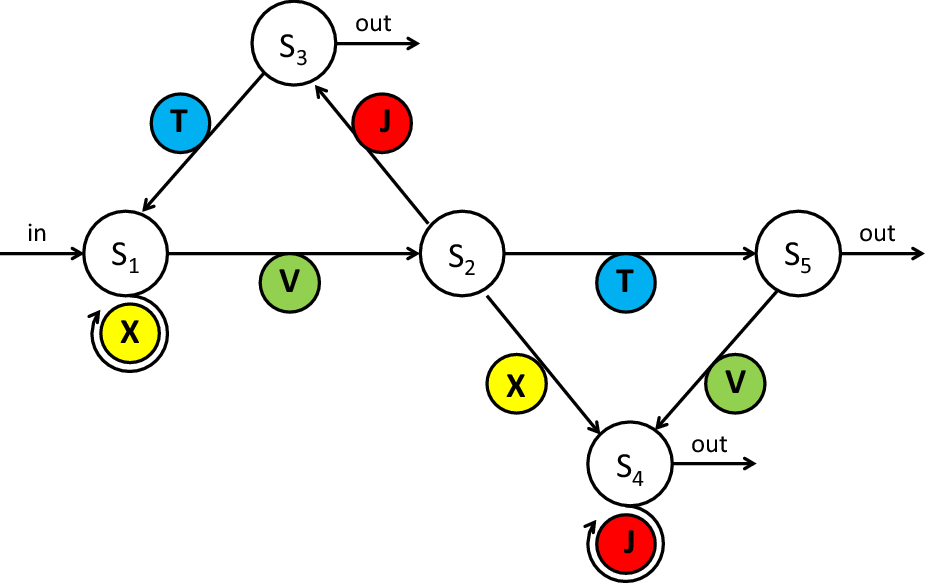
Grammatical stimuli were drawn from the finite-state grammar by Knowlton and Squire (Reference Knowlton and Squire1996). Figure 1 depicts that grammar implemented both with the letters originally used by Knowlton and Squire (‘X’, ‘V’, ‘J’, and ‘T’) to generate the letter strings used in the AGLletters task, and with the colors used here to replace these letters (‘yellow’, ‘green’, ‘red’, and ‘blue’, respectively) to generate the color strings used in the AGLcolors task. Note that, in contrast to other paradigms, such as the statistical learning paradigm introduced by Saffran and colleagues (Saffran et al., Reference Saffran, Aslin and Newport1996, Reference Saffran, Johnson, Aslin and Newport1999), which uses sequences of consonants and vowels (syllables) to produce sequences of three-syllable, highly predictable ‘words’ (see, however, Bogaerts et al., Reference Bogaerts, Siegelman and Frost2016; Siegelman et al., Reference Siegelman, Bogaerts and Frost2017; and Soares, Gutiérrez-Domínguez et al., Reference Soares, Gutiérrez-Domínguez, Vasconcelos, Oliveira, Tomé and Jiménez2020, for recent works using triplets with different levels of predictability), in the AGL paradigm the strings are typically made of single consonants to minimize the influence of phonological processing in grammar learning. In Figure 1, the direction of the arrows specifies the rules that determine how letters/colors can be combined to create grammatical strings, including the permissible initial and final states and the legal transitions between states. For instance, the letter string ‘XXVX’ is grammatical as it conforms to the rules, whereas ‘XT’ is illegal or non-grammatical as it violates those rules (i.e., arrow directions).
Finite-state grammar used by Knowlton and Squire (Reference Knowlton and Squire1996) as obtained from Jiménez et al. (Reference Jiménez, Oliveira and Soares2020, p. 2).

For the AGLletters task, we relied on the same 23 grammatical strings used by Knowlton and Squire (Reference Knowlton and Squire1996) in the training phase and on the same 32 strings used by the them in the test phase (i.e., on the grammaticality judgment task), which were evenly classified as grammatical or non-grammatical, and as having high- or low-chunk strength (see Table 1). As mentioned, chunk strength is a measure that indexes the level of similarity between the strings presented in the test and training phases, and is obtained by computing the number of times a given chunk (i.e., sequences of bigrams and trigrams in the test strings) appeared over the training set. Note that, in the context of the AGL paradigm, chunk strength is a more informative measure of participants’ familiarity with the fragments of a particular test string than could be the overall transitional probability of generating each fragment by following the grammar rules, because the former index depends on the specific subsample of grammatical strings on which the learners were trained, rather than on the full set of possible strings which could in principle be generated from that structure. Thus, a test string with a high-chunk strength corresponds to a string that resembles the training strings, as the bigrams and trigrams that it entails appeared often on the strings presented during the training phase, whereas a test string with a low-chunk strength resembles them less closely. See Table 1 for a presentation of this metric across the experimental conditions. For the AGLcolors task, we used exactly the same training and test strings used in the AGLletters task by replacing the letters with their respective colors. For convenience, Table 1 presents only the training and test strings implemented with letters. The full list of materials is available at <https://osf.io/4m5yq/>.
Strings used in the training and test phases in the AGL task conducted with letters

notes. HC: high-chunk strength; LC: low-chunk strength; CS: chunk strength.
2.3. procedure
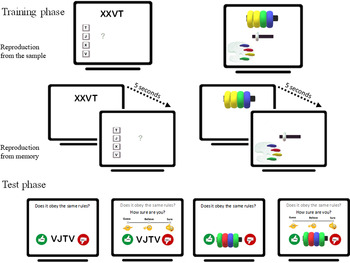
Data were collected individually in a quiet room in the schools attended by the children, following the same procedures used by Jiménez et al. (Reference Jiménez, Oliveira and Soares2020) in a recent study conducted with European Portuguese adult skilled readers. The presentation of the stimuli and the recording of the responses were controlled by Inquisit 3 software (Inquisit, 2011). In both versions of the AGL task, children were presented successively with the training and the test phases. In the training phase, the 23 strings were presented three times in different blocks. In the first block, children were asked to reproduce each of the 23 strings while the string remained visible on the screen (i.e., reproduction from the sample). In the second and third blocks, children were asked to memorize each string for five seconds, and then to reproduce it from memory after the string disappeared from the screen (i.e., reproduction from memory). Therefore, the training phase comprised the response to 23 trials that were repeated three times (one from the sample and two from memory) in different blocks (69 trials in total). In each block, trials were randomized per participant. Each trial began with the presentation of a string (made up of either letters or colors), centered on the upper part of a 15″ computer screen, as illustrated in Figure 2. Then, participants were asked to reproduce each string in sequence from left to right (firstly from the sample and subsequently from memory, as mentioned above) by clicking with the computer mouse on each of the four possible letters (‘X’, ‘V’, ‘J’, and ‘T’) or colors (‘yellow’, ‘green’, ‘red’, and ‘blue’) that entailed each of the strings (see Figure 2). Once a response was made, the chosen element (letter or color) appeared immediately on the computer screen. Corrections were not allowed. If an error occurred, participants had at most three opportunities to reproduce each string successfully before advancing to the next trial. This option aimed to avoid the frustration that confrontation with successive failures could generate and to ensure the children’s motivation to perform the task.
Illustration of the experimental set-up used in the AGL task performed with letters (AGLletters) and in the AGL task performed with colors (AGLcolors).

After the training phase, children were informed that the strings presented in the training phase followed some complex rules and were asked to perform a grammaticality judgment task, i.e., to decide if a new set of strings followed those rules or not. Responses were made by clicking, using the computer mouse, on one of two buttons displayed on the right or left side of the computer screen, representing a ‘yes’ and a ‘no’ response (see Figure 2). To minimize response bias, participants were informed that exactly half of the strings conformed to the rules, whereas the other half did not. Finally, during this phase, participants were asked to rate the degree of confidence they had on each of the ‘yes’/‘no’ responses made to the test strings by using a three-point scale labeled ‘guessing’, ‘believe’, and ‘sure’, represented by different emoticons to ease children’s assessments (see Figure 2). This last procedure was used to examine the implicit/explicit nature of the knowledge acquired through the performance of the AGL tasks. In the instructions, child-friendly language was used to guarantee that children understood what they were asked to do in this part of the task. However, the data from four participants from the preschool group exposed to the letter task were excluded from the analyses because, despite the instructions, they gave the same (‘yes’) response to all the 32 test items, suggesting that they did not understand the grammaticality judgment task.
3. Results
Grammar learning was analyzed in each of the AGL tasks and groups of participants by computing firstly the percentage (%) of correct responses to each of the test trials (coded as 1 for a correct response and 0 for an incorrect response) to analyze whether children’s AGL performance in each group and AGL task was significantly different from the chance level (50%). Note that, in each grammaticality judgment task, the maximum performance corresponds to 32 correct responses (100%), the minimum performance to no correct responses (0%), and chance performance to 16 correct responses (50%). We have also conducted a univariate ANalysis Of VAriance (ANOVA) on the % of correct responses to further examine if differences in the performance across AGL tasks in the same group of participants, and across participants in the same AGL task, reached statistical significance.
From the data obtained in each grammaticality judgment task, we have also computed the proportion of test strings endorsed as grammatical (i.e., number of ‘yes’ responses regardless of the fact that they turned to be correct or incorrect) in each of the four experimental conditions (grammatical and non-grammatical strings of high- and low-chunk strength, respectively), as typically observed in the AGL studies (e.g., Abrams & Reber, Reference Abrams and Reber1988; Chang & Knowlton, Reference Chang and Knowlton2004; Don et al., Reference Don, Schellenberg, Reber, DiGirolamo and Wang2003; Horan et al., Reference Horan, Green, Knowlton, Wynn, Mintz and Nuechterlein2008; Jiménez et al., Reference Jiménez, Oliveira and Soares2020; Kahta & Schiff, Reference Kahta and Schiff2016; Katan et al., Reference Katan, Kahta, Sasson and Schiff2017; Laasonen et al., Reference Laasonen, Väre, Oksanen-Hennah, Leppämäki, Tani, Harno, Hokkanen, Pothos and Cleeremans2014; Pothos & Bailey, Reference Pothos and Bailey2000; Pothos & Kirk, Reference Pothos and Kirk2004; Pothos & Wood, Reference Pothos and Wood2009) to obtain a detailed analysis of children’s AGL performance. On the proportion of endorsements, we conducted a repeated-measures ANOVA to test whether the number of endorsements for grammatical and non-grammatical strings of high- and low-chunk strength, indicative of grammar learning, differ across AGL tasks and groups of participants. Moreover, to ascertain whether these results could have been affected by some kind of knowledge that could be classified as explicit, we scored the confidence responses given by the children after each grammatical judgment as ‘1’ for ‘guess’, ‘2’ for ‘believe’, and ‘3’, for a ‘sure’ labels, and then we averaged those ratings for each participant and separately for their correct (i.e., endorsements on grammatical strings and correct rejections on non-grammatical strings) and incorrect responses (misses on grammatical strings and errors in non-grammatical strings) in each experimental condition. On the confidence rates obtained by each group in each experimental condition, we have also conducted a repeated-measures ANOVA to examine if children were more confident on their correct than on the incorrect responses, which would suggest the presence of explicit knowledge, according to Dienes and Seth’s (Reference Dienes and Seth2010) procedure. Finally, to assess whether potential differences in AGL performance in the letters and the colors conditions could be explained by differences in the amount of exposition to the strings during the training phase, we also analyzed the number of repetitions that each exemplar required to be correctly reproduced in the training phase.
To proceed in the most comprehensible way, we first present the results describing performance on the training phase, and then we will describe the results observed on the test phase for each dependent variable, namely the % of correct responses, endorsement rates, and confidence rates. The analyses were conducted with IBM-SPSS software (IBM, 2020). Results that reach statistical significance (α = .05) are reported. Non-significant results are only reported in comparisons of interest, or when they are close to significance levels. The Greenhouse–Geisser correction for non-sphericity was used when appropriate. Post-hoc tests for multiple comparisons were adjusted with the Bonferroni correction. Measures of effect size (Eta squared, ηp2) are also reported for main and interaction effects. The data files used in the statistical analyses reported here are available at <https://osf.io/4m5yq/>.
3.1. training phase
Table 2 presents the mean number of repetitions needed to correctly reproduce either the strings of letters (AGLletters) or the strings of colors (AGLcolors) from both the sample and memory procedure by each group of participants. A repeated-measures ANOVA was conducted on the number of repetitions based on the following factors: (2) type of stimuli × (2) group × (2) type of reproduction experiment, the first two manipulated as between-participants factors, and the last one as a within-participants factor. The analysis revealed a main effect of type of reproduction (F(1, 90) = 1031.64, p < .001, ηp² = .92), indicating that the children needed more repetitions to reproduce the strings from memory than from the sample (1.82 vs. 1.09). It also revealed a significant group effect (F(1, 90) = 15.462, p < .001, ηp² = .15), indicating that preschoolers needed more repetitions than first graders (1.51 vs. 1.40) to correctly reproduce the strings.
Mean (SDs) number of repetitions needed to correctly reproduce the strings from the training phase in AGL task performed with letters (AGLletters) and colors (AGLcolors) by preschool and primary-school children

The two-way ANOVA: group (2) × type of reproduction (2) also reached statistical significance (F(1, 90) = 9.86, p =.002, ηp² = .10). This effect showed that the differences between preschoolers and first-graders were observed only in the memory procedure (1.91 vs. 1.73, p <.001). Finally, the three-way ANOVA: group (2) × type of reproduction (2) × type of stimuli (2) effect was also significant (F(1, 90) = 7.52, p = .007, ηp² = .08). This effect showed that the differences between preschoolers and first-graders in the memory procedure were only observed for the letter condition (1.95 vs. 1.64, p < .001). In addition, the three-way interaction also revealed that first-graders needed more repetitions to reproduce the colors than the letter strings from memory (1.82 vs. 1.64, p = .003). Thus, it appears that primary-school children’s familiarity with reading produced a specific advantage in committing those letter strings to memory and in reproducing them from it. Also, the fact that younger children needed more repetitions than first-graders to reproduce the strings correctly in the memory procedure suggests that, despite the close age range between the two groups, preschoolers might show limited cognitive resources to allow them to correctly retrieve the strings, particularly the longer strings, from memory.
3.2. test phase
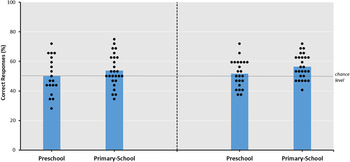
The mean percentage of correct responses obtained by each group of participants in the grammaticality judgment task performed in the letters and colors conditions are presented in Figure 3. The results from one-sample t-tests against the chance level showed that the AGL performance of preschoolers did not differ significantly from chance either in the AGLletters (t(18) = 0.057, p = .955) or in the AGLcolors (t(22) = 0.843, p = .408) tasks. The results from primary-school children revealed clear above-chance performance in the AGL task performed with colors (t(25) = 3.885, p = .001), but only marginal differences from chance in the AGL task performed with letters (t(25) = 1.792, p = .085). Moreover, an ANOVA on the percentage of correct responses considering (2) group × (2) type of stimuli as between-participants factors showed that the only effect that reached statistical significance was the main effect of group (F(1, 90) = 3.909, p = .050, ηp² = .042), indicating that primary-school children outperformed preschool children when the AGL performance in both tasks was taken as a whole (55% vs. 51%, respectively), though differences across tasks failed to reach statistical significance both in the group of preschoolers (p = .131) and in first-graders (p = .250).
Percentage of correct responses to the test strings by preschool and primary-school children in the AGL task performed with letters (left panel) and in the AGL task performed with colors (right panel).

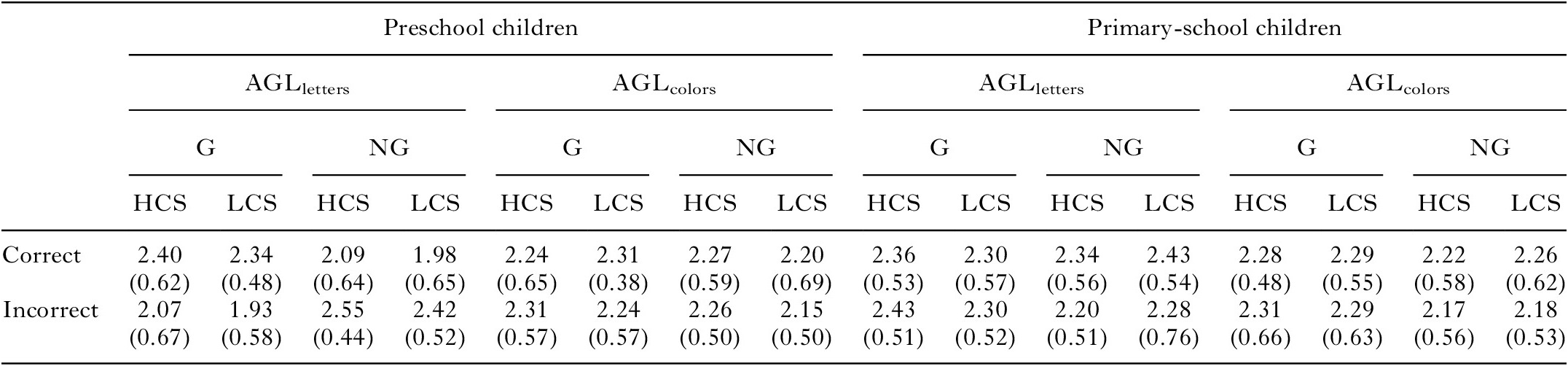
Despite the fact that reliable signs of grammar learning had been observed only in the group of primary-school children, we nevertheless conducted further analyses considering the two groups of children (preschool vs. primary-school children) and the AGL performance obtained from both learning conditions (letters vs. colors) to get a deeper understanding of how children’s responses could have been affected by the grammaticality and chunk strength of the test items. To that end, a repeated-measures ANOVA on the proportion of items endorsed as grammatical was conducted with the following factors: (2) group × (2) type of stimuli × (2) grammaticality × (2) chunk strength, the first two manipulated as between-participants factors, and the last two as within-participants factors. Note that in these analyses we used endorsement rates (i.e., the proportion of ‘yes’ responses to the test strings in each experimental condition) instead of the percentage of correct responses used in the previous analyses, because endorsement rates are the most widely used dependent variable in the literature, and because they allow us to discriminate whether AGL performance in each task arose either from the correct endorsement of grammatical strings or from the correct rejection on non-grammatical strings. Table 3 presents the mean endorsement rates obtained by preschool and primary-school children in the AGLletters and AGLcolors tasks, in each of the four experimental conditions.
Mean (SDs) of the endorsement rates (proportion) obtained by preschool and primary-school children in the AGL task performed with letters (AGLletters) and with colors (AGLcolors) per experimental condition

notes: G: grammatical; NG: non-grammatical; HCS: high-chunk strength; LCS: low-chunk strength.
The results from the repeated-measures ANOVA showed a main effect of grammaticality (F(1, 90) = 7.952, p = .006, ηp² = .081) and a main effect of chunk strength (F(1, 90) = 4.863, p = .030, ηp² = .051). These effects revealed that grammatical strings elicited a higher number of endorsements than non-grammatical strings (0.60 vs. 0.54) and that strings with high-chunk strength elicited a higher number of endorsements than did those with low-chunk strength (0.59 vs. 0.55). The two-way ANOVA: group × grammaticality effect also reached statistical significance (F(1, 90) = 3.90, p = .051, ηp² = .042). This effect revealed that the difference between the number of endorsements for grammatical and non-grammatical strings (indicative of grammar learning) reached statistical significance in primary-school children (0.59 vs. 0.49, respectively; p < .001), but not in preschool children (0.60 vs. 0.58, respectively; p = .573), confirming the previous results. Moreover, the comparisons of the endorsement rates in each grammaticality condition across groups showed that the difference arose for non-grammatical strings, indicating that primary-school children endorsed non-grammatical strings significantly less than preschool children (0.49 vs. 0.58, p = .025).
Taken together, the results showed that, even though both primary-school and preschool children tended to endorse a larger number of grammatical than non-grammatical strings, reliable signs of grammar learning were observed only for the older participants. Moreover, it is also important to emphasize that, although a tendency for grammar learning was observed in the AGL task performed with letters, statistically significant evidence that first-graders learned the rules underlying the artificial grammar emerged only when the grammar was implemented with color materials. Table 4 presents the mean confidence rates for correct and incorrect decisions for grammatical and non-grammatical strings, of high- and low-chunk strength from the AGLletters and AGLcolors tasks performed by preschool and primary-school children.
Mean (SDs) of the confidence rates obtained by preschool and primary-school children in the AGL task performed with letters (AGLletters) and with colors (AGLcolors) per experimental condition for the correct and incorrect responses in the test phase

notes: G: grammatical; NG: non-grammatical; HCS: high-chunk strength; LCS: low-chunk strength.
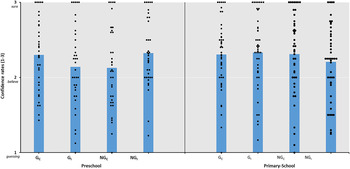
A repeated-measures ANOVA was conducted on the confidence rates obtained from the children who had at least one datapoint per experimental condition (see footnote Footnote 3) based on the following factors: (2) group × (2) type of stimuli × (2) grammaticality × (2) chunk strength × (2) correctness of the decision, the the first two manipulated as between-participants factors, and the last two as within-participants factors. The results showed that only the three-way ANOVA, (2) group × (2) grammaticality × (2) correctness of the decision, approached statistical significance (F(1, 78) = 3.861, p = .053, ηp² = .047). Figure 4 depicts that interaction.
Confidence rates (1–3) for correct and incorrect responses in the grammatical and non-grammatical strings by preschool (left panel) and primary-school children (right panel).
notes: GC: grammatical correct; GI: grammatical incorrect; NGC: non-grammatical correct; NGI: non-grammatical incorrect.

A further inspection of the results showed, however, that all the contrasts failed to reach statistical significance, in both the preschool and primary-school children. The only contrast that approached statistical significance was the tendency for preschool children to show higher confidence rates on their correct than on their incorrect non-grammatical responses (2.30 vs. 2.12, p = .068), and higher confidence rates on their incorrect than on their correct grammatical responses (2.33 vs. 2.13, p = .075). These results indicate that children’s AGL performance was not affected by the emergence of any explicit knowledge, as they demonstrate only that they tended to be more confident in their affirmative responses than on their negative responses, regardless of their correctness.
4. Discussion
This work aimed to analyze the extent to which literacy impacts the ability of preschool and primary-school children to learn the rules underlying a finite-state grammar in the AGL paradigm implemented with either linguistic (letter strings) or non-linguistic (color strings) materials, to further examine whether the impact of literacy on children’s AGL performance was modulated by the type of stimuli. Although recent evidence suggests that grammar learning, as tested throughout the use of AGL paradigms, can improve over time, we have hypothesized that, if learning to read promotes a shift from larger ‘multiword phrases’ units to smaller ‘single-word’ units, as predicted by the SBH, improvements in grammar learning from the last year of preschool education to the first year of primary school education should be more noticeable in the task performed with non-linguistic (colors) rather than with linguistic (letters) materials. Indeed, although the reliance on smaller linguistic units that literacy seems to promote can generalize to other areas of cognitive functioning, we expected that, at this early stage of reading acquisition, literacy would impact grammar learning more strongly with linguistic (letters) than with non-linguistic (colors) materials. Thus, comparing grammar learning in preliterate and literate children, using exactly the same finite-state grammar implemented with either linguistic or non-linguistic materials, can provide new insights into how learning to read reshapes cognition. Therefore, we hypothesized that, if learning to read made children’s performance more reliant on smaller units, especially when the task involved linguistic material, then first-graders should see their AGL performance more adversely affected when performing the task with letters than with color materials. For preschool children, however, no differences were expected between materials.
The results provide support to our hypotheses, as primary-school children showed better performance in the AGL task than did preschool children, but this advantage, and indeed the only reliable signs of grammar learning, were due to the group who implemented the task with colors, whereas performance from the primary school group which was trained with letters differed only marginally from chance. These findings seem to support not only the view that AGL improves with age, in line with recent studies on the dynamics of implicit learning throughout development (e.g., Janacsek et al., Reference Janacsek, Fiser and Nemeth2012; Lukács & Kemény, Reference Lukács and Kemény2015; Thomas et al., Reference Thomas, Hunt., Vizueta, Sommer, Durston, Yang and Worden2004; Zwart et al., Reference Zwart, Vissers, Kessels and Maes2017) but also, importantly, that, even though with age participants become more able to explore the artificial grammar structure implemented with colors, this effect is not observed in a similar way when exactly the same structure is implemented with letters, as could be expected if learning to read makes children more reliant on a piecemeal analysis of these linguistic units, which might not create the optimal conditions for learning these structures. Although additional studies should be conducted to provide stronger support for these conclusions, by recruiting children from more advanced levels of reading acquisition, and by directly testing children’s levels of reading proficiency and letter discrimination, the fact that AGL performance did increase more strongly in the color condition, precisely at a moment in which school training is heavily focused on the process of learning to read, offers promising data that ask for further investigation.
It should be noted, however, that a recent study conducted with the same materials in a sample of adult skilled readers (Jiménez et al., Reference Jiménez, Oliveira and Soares2020) reported an opposite pattern of results. Indeed, the authors observed that reliable signs of grammar learning were observed exclusively in the AGL task performed with letters, but not with color materials. This paradoxical result can be accounted for if we consider that, on the one hand, as reading proficiency increases the visual word recognition system might develop more effective strategies to deal with the potentially detrimental effects that the use of an analytical part-based mode of functioning can provoke to other levels of linguistic processing, and, on the other hand, as exposure to print increases, the likelihood of this ‘new’ mode of functioning to spread to other areas of visual processing also increases, reducing the reliance on the use of a holistic mode of processing with non-linguistic materials (e.g., Bowers et al., Reference Bowers, Vankov and Ludwig2016; Dehaene et al., Reference Dehaene, Cohen, Sigman and Vinckier2005, Reference Dehaene, Pegado, Braga, Ventura, Nunes, Jobert, Dehaene-Lambertz, Kolinsky, Morais and Cohen2010; Grainger et al., Reference Grainger, Rey and Dufau2008; Lachmann et al., Reference Lachmann, Khera, Srinivasan and van Leeuwen2012; Malik-Moraleda et al., Reference Malik-Moraleda, Orihuela, Carreiras and Duñabeita2018; Richler & Gauthier, Reference Richler and Gauthier2014; Ventura et al., Reference Ventura, Fernandes, Cohen, Morais, Kolinsky and Dehaene2013).
Although more research is needed, it is important to highlight that a detailed analysis of the results obtained by Jiménez et al. (Reference Jiménez, Oliveira and Soares2020) in the AGLletters task, and those obtained here in the AGLcolors task, converge in showing that the grammaticality effects observed in both cases were mostly due to the fact that Jiménez et al.’s (Reference Jiménez, Oliveira and Soares2020) skilled reader participants and the beginning developing reader (first-graders) participants from our sample, endorsed a lower number of non-grammatical strings from the low-chunk strength condition as grammatical, and not, as would be expected, a higher number of grammatical strings (either from high- or low-chunk strength conditions) as grammatical. Indeed, although the four-way interaction effect did not reach statistical significance in our data, a further inspection of the results from primary-school children indicated that what led the results beyond chance in the AGLcolors task was precisely that first-graders endorsed as grammatical fewer of the non-grammatical strings with low-chunk strength (0.45 vs. 0.54 for non-grammatical strings with high-chunk strength), whereas in the case of grammatical strings the difference between high- and low-chunk strength strings was considerably reduced (0.64 vs. 0.60). These findings suggest that the grammar learning observed in both our data and that of Jiménez et al. arose from an increased ability of participants to correctly reject non-grammatical strings containing highly salient features that allowed participants to identify them as non-grammatical, such as illegal onsets (i.e., strings starting with ‘J’ or ‘T’ in the case of the letters condition), illegal immediate repetitions (i.e., ‘VV’ in the letters condition), or illegal bigrams (i.e., ‘XT’, ‘VV’, ‘TT’, ‘TJ’, ‘JX’, or ‘JV’, in the letters condition). As pointed out by Jiménez et al. (Reference Jiménez, Oliveira and Soares2020), a potential confound between the role of such surface features and the distinction between high- and low-chunk strength may ultimately challenge the conclusion that learners in these tasks may be acquiring more abstract information than that conveyed by their permissible bigrams and legal onsets (see also Perruchet & Pacteau, Reference Perruchet and Pacteau1990, or Shanks et al., Reference Shanks, Johnstone and Staggs1997, for similar arguments). Thus, before drawing strong conclusions on the effect that literacy exerts on grammar learning with linguistic and non-linguistic materials, further research is needed to test whether the same pattern would be obtained with other artificial grammars that would be built to overcome these limitations (see Jiménez et al., Reference Jiménez, Oliveira and Soares2020, or Schiff & Katan, Reference Schiff and Katan2014, for examples of some of these potential alternative grammars).
Another result from the present experiment that deserves attention is the fact that AGL performance in preschool children was not significantly different from chance in either of the two tasks. This finding is not consistent with previous work conducted with children using either linguistic or non-linguistic materials (e.g., Ise et al., Reference Ise, Arnoldi, Bartling and Schulte-Körne2012; Katan et al., Reference Katan, Kahta, Sasson and Schiff2017; Nigro et al., Reference Nigro, Jiménez-Fernández, Simpson and Defior2016; Pavlidou et al., Reference Pavlidou, Williams and Kelly2009, Reference Pavlidou, Kelly and Williams2010; Pavlidou, & Williams, Reference Pavlidou and Williams2014), but it is worth noting that most of these studies were conducted with older children. An exception to this comes from studies by Witt and Vinter (Reference Witt and Vinter2012, Reference Witt and Vinter2017), who included five- to eight-year-old children, and studied how AGL performance was affected by thr perceptual properties of the materials (i.e., the inclusion of adjacent and non-adjacent repetitions). Overall, the results showed that children were sensitive to the presence of those salient features and that this sensitivity increased with age. Therefore, the enhancement in AGL performance observed here between preschool and primary-school children might rely on an increased sensitivity to detect perceptual salient stimuli (i.e., illegal onsets, illegal immediate repetitions, or illegal bigrams), rather than on the ability of first-graders to extract any more complex rules defined by the finite-state grammar. In any case, despite the limitations derived from the use of Knowlton and Squire’s (Reference Knowlton and Squire1996) finite-state grammar concerning the nature of the underlying knowledge (see Jiménez et al., Reference Jiménez, Oliveira and Soares2020, for a deeper discussion), an important result that remains to be explained is why children are more sensitive to these features when the task is implemented with non-linguistic material rather than with linguistic stimuli.
Another result that deserves mention in the study is the fact preschool children found it particularly difficult to reproduce the strings from memory over the training phase, particularly in the letters condition. They not only needed more attempts to correctly reproduce the strings, but also failed more often to provide a successful response, even after three available attempts. An inspection of the number of items for which children did not provide a correct reproduction from memory after three available attempts showed that preschoolers failed on average 17.8% of the trials, while first-graders failed on average 11% of the trials (p < .001). The difference in the number of failures between the letters and colors conditions reached statistical significance both in preschool children (26.1% vs. 11%, p < .001) and in primary-school children (13.2% vs. 8.9%, p = .03). These failures occurred mainly in the longer strings (i.e., strings made up of five and six elements), and particularly in those not containing immediate repetitions (e.g., ‘VJTVXJ’, ‘XVJTVJ’), which reached almost 50% of failures in both groups. However, in longer strings containing immediate repetitions, such as ‘XVXJJJ’ or ‘XXXXVX’, the number of failures was consistently lower in both groups. These results are in line with Witt and Vinter’s (Reference Witt and Vinter2012, Reference Witt and Vinter2017) results, indicating that children are highly sensitive to the visual salient features presented in the stimuli but, importantly, suggest that these failures were not due to the lack of attention to the task, but rather that they might arise from working memory limitations, particularly when children cannot rely on salient visual cues (as immediate repetitions) to reduce cognitive load. The fact that preschool children failed to reproduce the strings more often than primary-school children might also point to problems in the items’ encoding, which might explain the absence of reliable learning in both tasks. However, it is important to stress that, precisely because of that, preschoolers were exposed more frequently to each string. Nevertheless, a posterior analysis conducted to test if the differences in the number of failures to correctly reproduce the strings during the training phase could account for the results observed in the grammatical judgment task, considering exclusively the children that reached at least 80% of correct reproductions in each task (which lead to the exclusion of five preschool children and two primary-school children in the AGLletters condition, but none in the AGLcolors condition) led basically to the same pattern of results.
Thus, what we want to highlight as a final remark is that, despite the caution required by the interpretation of these results, the higher difficulty found in primary-school children to learn the same grammatical structure when it was implemented with linguistic rather than with non-linguistic materials is promising and warrants further inspection. Note that we are not claiming that learning to read worsen children’s AGL, as would be directly predicted from the SBH (e.g., Arnon, Reference Arnon2010; Arnon & Christiansen, Reference Arnon and Christiansen2017; Arnon & Ramscar, Reference Arnon and Ramscar2012; Havron et al., Reference Havron, Raviv and Arnon2018; Paul & Grüter, Reference Paul and Grüter2016; Siegelman & Arnon, Reference Siegelman and Arnon2015). The absence of any reliable sign of grammar learning in preschoolers, regardless of the material used, prevented us from sustaining such a conclusion. However, what these results illustrate is that AGL performance improves from the last year of preschool to the first year of primary school, but that the observed improvement does not proceed homogeneously for all kinds of materials, but seems to be less pronounced in the letters condition, consistent with the hypothesis that the mode of processing induced by literacy, as claimed by the SBH (e.g., Arnon, Reference Arnon2010; Arnon & Christiansen, Reference Arnon and Christiansen2017; Arnon & Ramscar, Reference Arnon and Ramscar2012; Havron et al., Reference Havron, Raviv and Arnon2018; Paul & Grüter, Reference Paul and Grüter2016; Siegelman & Arnon, Reference Siegelman and Arnon2015; see also Bowers et al., Reference Bowers, Vankov and Ludwig2016; Malik-Moraleda et al., Reference Malik-Moraleda, Orihuela, Carreiras and Duñabeita2018; Richler & Gauthier, Reference Richler and Gauthier2014; Ventura et al., Reference Ventura, Fernandes, Cohen, Morais, Kolinsky and Dehaene2013) might not be optimal to allow implicit learning in an AGL task. Although more research is undoubtedly needed, particularly using more controlled finite-state grammars and children from more advanced levels of reading acquisition, testing their reading proficiency using standardized tests, the difference found in primary-school children when exposed exactly to the same structure as implemented either with linguistic or non-linguistic materials offers a promising result that deserves further scrutiny. Whether the observed differences can be accounted for by the changes that learning to read brings to the cognitive system is an exciting line of research that this study aims to have opened.