Irish step dancingFootnote 1 is, arguably, one of the most globally recognized genres of traditional, culturally specific dance. The descriptor “step” means that the dancing “involves a concentration on foot movements close to the floor in which the tempo of the accompanying music is beaten out by the dancer” (Brennan Reference Brennan1999, 63). The worldwide recognition has been largely due to the stage show Riverdance, created in 1994, and the subsequent shows such as Lord of the Dance and Feet of Flames. Step dancing has also benefitted from recent scholarly attention, with its history, development, and cultural significance discussed in a range of publications (Brennan Reference Brennan1999; Foley Reference Foley2001, Reference Foley2013; F. Hall, Reference Hall2008; Wulff Reference Wulff2009). The globalization of step dancing began with processes of emigration from Ireland, but the stage productions allowed many more people to be exposed to the dance form. Currently, the genre is propagated within a variety of disparate geographical and sociocultural contexts, and so there is potential for a worldwide study of the localized idiosyncrasies which may be identified, recorded, and analyzed.
This article presents research about step dancing competitionsFootnote 2 in Australia, and hence there is a need for some preparatory discussion of both the Australian context and the nature of competitions. Australia is a nation which has been inhabited by indigenous people for centuries, but which has a relatively recent immigrant settlement history, dating from the arrival of the first group of British ships in 1788. These ships carried military and administrative personnel, whose tasks included surveying the new land to determine its agricultural and economic potential, supervising the construction of buildings and roads, and controlling the prisoners who had been banished from homes and loved ones to serve their custodial sentences in a land which is thousands of kilometers away from the places they knew as home (O'Farrell Reference O'Farrell1986). The ships contained approximately 1,500 people, some of whom were IrishFootnote 3 (Reid Reference Reid2012), thus making the Irish one of the oldest nonindigenous groups to reside in Australia. In total, 39,000 prisoners were sent from Ireland to various locations in Australia between 1788 and 1868, before the decision was made, by the British government, to abolish transportation (National Archives of Ireland n.d.). An even larger number of migrants left Ireland voluntarily; 300,000 free settlers arrived in Australia between 1851 and 1914 (Department of Social Services 2014). The migratory flow continues even now, and in the 2016 population census, Irish ancestry was the third most commonly listed, following “English” and “Australian” (Australian Bureau of Statistics 2017), although the latter category may disguise the presence of even more people with Irish ancestry.
The situation for Irish immigrants in Australia up until the early twentieth century was dire; they were treated with disdain by the British administration (D. Hall Reference Hall2014; Hall and Malcolm Reference Hall and Malcolm2016; O'Farrell Reference O'Farrell1986), and the subsequent positioning of the Irish immigrant community has a direct bearing on the historical analysis of Irish dancing practices in Australia. The marginalization of people who had migrated from Ireland to Australia (for whatever reason) provides fundamental contextualization for step dancingFootnote 4 within the settler society. Stereotypical representations of Irish immigrants were commonplace up until the middle of the twentieth century. For example, an article on the difference between crime in England and in Ireland published in The Times in London on June 19, 1947, was reprinted later that year in the Sydney Morning Herald, which stated that
The Celtic Thug is not the member of a secret and separate sect. It is a national profession.…What makes Irish improvement almost a moral impossibility is the fact that the greater part … sympathize and conspire with the murderer. (The Sydney Morning Herald 1947)
This popular conceptualization of Irish people as being culturally and morally inferior is also demonstrated in nineteenth century newspaper advertisements for positions vacant, which often carried the caveat “No Irish Need Apply” along with a description of the tasks to be performed by the prospective employee (Hall and Malcolm Reference Hall and Malcolm2016). Finally, Irish immigrants were frequently depicted in cartoons with simian facial features, a practice which had its origins in a dubious but widely accepted scientific theory which claimed that certain people groups’ physical features represented particular behavioral characteristics. Thus, the Irish, who were considered to be intellectually deficient and ethically bankrupt, were drawn with apelike faces so as to reinforce the position of British superiority over those who were believed to be a little less than human (D. Hall Reference Hall2014; see also Curtis Reference Curtis1996 for discussion of the same phenomenon outside of Australia).
This historical and cultural background information is vital to comprehending the practice of step dancing in Australia; no dance genre is rightly understood when devoid of its social context and, as I will explain in greater detail later in this article, one of the fundamental changes in step dancing competitions concerns the shift away from the notion that the step dancer represents Ireland and Irish culture. Dancing is, for immigrant groups, an important means through which they can promote intracommunity cohesion (Tabar Reference Tabar2005), and often the dancing acts in a way in which it had not needed to act within the homeland context: it becomes a marker of difference from the general population (Tabar Reference Tabar2005; Wilcox Reference Wilcox2011). Dancing may act as an assertion of personal identity (Silverman Reference Silverman2012), reminding immigrants of their ancestral origins and providing a temporary refuge from a society which may shun and ostracize them.
So, research about the changing aesthetic and judicial frameworks of step dancing competitions is not only about the dancing itself but is also concerned with the contextual influences which have molded step dancing in Australia. Additionally, such scholarship exposes the stimuli for change which have been developed in both Ireland and across the world and illustrates the recently generated effects of the global recognition and media-driven popularity of the genre. Step dancing competitions and the changes which have been adopted over the past 150 years provide a rich field from which to gather data which are not only of interest to ethnochoreologists but also to a wider audience within the academic community. Unfortunately, dance research is still, in Australia, an underdeveloped field. In particular, much more work is needed in the examination of both the dances of Australia's indigenous peoples and the dance practices of the multifarious immigrant communities in twenty-first century Australia.Footnote 5
My association with step dancing in Australia is multifaceted. In late 1994, I enrolled my older daughter in step dance classes after seeing an advertisement in the local newspaper. While Riverdance had been presented to the world at the Eurovision Song Contest earlier that year, the full-length show had not yet been developed, and very few Australians, including myself, were aware of its existence. I chose step dancing for my children because of my interest in traditional dance genres rather than Western high art or popular dance styles. I quickly became enthralled, learning the easier dances myself. I progressed to a variety of voluntary tasks within the school, including helping with concert practices and controlling activities backstage, managing public performances, and assisting with beginner and team dancing classes. I have attended step dancing competitions for twenty-five years and have undertaken ethnographic research at the doctoral level among the current cohort of step dancers at a typical dance school in Sydney, Australia.Footnote 6 Additionally, I have recently carried out extensive examination of the archival resources, especially digitized versions of Australian newspapers, which are curated by the National Library of Australia. The multimodal methodology underpinning this article serves to strengthen the findings and interpretation of the data. I will make comparisons between past and present conventions, evaluating the similarities and differences between step dance practices in Australia and those in Ireland.
One of the most significant spheres of investigation which has emerged during my research has been the metamorphosis of step dancing competitions. The elements of a competition, no matter the discipline or sport within which a competition takes place, may be discerned from the various sociological analyses which have been constructed over time. Georg Simmel, writing in the early twentieth century, noted that a competition involves seeking the favor of a third party who is not competing in the event (as discussed in Werron Reference Werron2015, 187–188). Most often, this third party is someone with considerable experience in the competition discipline and may be accorded a title such as examiner, assessor, or, as in the case of dance competitions, adjudicator. The notion of a third party can also be extended to include the informal viewers, that is, the audience members, although this article will focus on issues concerning official adjudication.
Competitions also involve a contest between rivals who are undertaking a mutual quest for excellence (Shields and Bredemeier Reference Shields and Bredemeier2009). This facet, too, has remained constant in step dancing competitions; there are still prizes for the victorious dancer, and the competitions act as a mode of self-assessment for competitors. Teachers watch their students perform on stage and develop strategies to improve technique and presentation. Local and regional competitions also provide the necessary stage experience required before attempting to compete at state or national championship levels. A final characteristic of competitions involves the foregrounding of interpretation, which may be given more credence than the structure of the competitive event (Shields, Funk, and Bredemeier Reference Shields, Funk and Bredemeier2016). Certainly, interpretation has, and continues to be, a feature of step dancing competitions, but it is the substance of the interpretation which has undergone a fundamental change over time.
This article explores the forces which, over time, have molded competitions at local, regional, national, and now global levels. In the late nineteenth and early twentieth centuries, in both Ireland and Australia, discourses of legitimacy, authenticity, and Irish identity were privileged, whereas currently, the focus is on individuals and their methods of attracting the attention of adjudicators. It interrogates the characteristics of step dance competitions and identifies catalysts of change within the accepted aesthetic framework. Overall, the local situation (in Australia) has emulated changes which have been initiated in the epicenter of the global step dancing network, Ireland (Hassrick Reference Hassrick2012). The broader sociocultural landscape, with variations in the perception of Ireland and its emigrants, contextualizes the competitive milieu. Additionally, the metamorphosis of the genre itself, from ethnically specific custom to poly-cultural global phenomenon, generates further dynamics which continue to transform step dancing's competitive ethos.
The comparisons made in this article are multidimensional: as well as comparing practical trends in Australia with those which have been noted in the context of Ireland itself, the progressions will be analyzed at multiple levels of activity. Sociologist and social anthropologist Barbara O'Connor suggests that a study of dance should consider both “the micro-level of the individual dancer,” as well as the “macro-level” in which various groups and collectives are able to “determine the predominant meanings of dance and regulate and control dance practice” (Reference O'Connor2013, 9). Hence, the article will examine the effects of change on individuals who compete and discuss the role of organizations in the development of step dancing as a globally practiced genre.
Step Dancing Competitions in Late Nineteenth-Century and Early Twentieth-Century Australia
Comparison necessitates knowledge of the two entities which are being compared, and so a good starting point is a description of the characteristics of a step dancing competition at the end of the nineteenth century. At this time, the notion of competition was already an integral part of step dancing practice in Ireland (Brennan, Reference Brennan1999; Foley Reference Foley2013). The competitions in Ireland were not always isolated events but were often part of a larger festival, where vocal and literary sections were also contested (Foley Reference Foley2013), while in Australia in 1888, a competitive festival included “a mixture of horse racing, foot-racing and step-dancing” (Dayle-Ford Catholic Sports 1888, 3). The Gaelic League, an organization which sponsored culturally specific activities such as step dancing to promote notions of Irish identity, assumed responsibility for organizing competitions in Ireland (Foley Reference Foley2013). The Gaelic League in Australia administered many competitions (e.g., the Gaelic League Feis Footnote 7; Freeman's Journal 1926), but on other occasions, these events were held under the auspices of the Catholic Church or the various Irish immigrant organizations such as the Irish National Association (Cullinane Reference Cullinane2006), a diasporic collective without equivalent in Ireland itself.
Up until the first half of the twentieth century, dancers in Ireland learned their craft from a “dancing master” (Foley Reference Foley2013, 62–67). The masters would have a geographical area within which they plied their trade and there was some rivalry between them, which sometimes manifested in public dance challenges (Brennan Reference Brennan1999). There were no formalized qualifications, nor were there any national conglomerations of masters or overarching governing bodies. Irish immigrants in Australia learned to dance within the same system with which they had been familiar in Ireland, although by the early twentieth century the formal term “dancing master” had largely slipped out of common usage (Mollenhauer Reference Mollenhauer2018; Cullinane Reference Cullinane2006).
Sharon Phelan (Reference Phelan2014) records that in the nineteenth century, competitions between dance masters in Ireland were sometimes judged by members of the audience. In Australia, the trend was for the appointment of selected individuals to the position of adjudicator. For example, O'Mara (Reference O'Mara1918, 2) records the death of Patrick White, who “took a keen interest in Irish step dancing, in which he was generally recognized as a fine judge,” but there is no description of his prowess as a dancer. The amateur status of step dance adjudicators eventually led, naturally, to some highly contested results being given, which in turn resulted in complaints from experienced dancers. One prominent step dancer in Sydney wrote a letter in which he argued
I hold it absurd for any gentleman to take the position of judge who does not understand one step of the dance he is called upon to judge. Yet, unfortunately, we find them accepting such positions, on the old plea that “though I cannot dance myself, I can tell a good dancer, and tell also when he makes a mistake, and when he is keeping good time, etc., etc.” (Purtill Reference Purtill1898, 7)
Purtill's ire is easily comprehended; how can someone make a valid judgment about an activity in which he has no experience? In Ireland at the time, some adjudicators also had little prowess as dancers but were considered to be experts in the constitution of Irish culture (F. Hall, Reference Hall2008). The foundation for the subsequent development of formal qualifications was, therefore, grounded in practical realities, although the process took some time. The practice of formal adjudicatory qualifications did not emerge, even in Ireland, until the 1940s (Foley Reference Foley2013), and in Australia, not until the 1950s (Cullinane Reference Cullinane2006).
In addition to the level of qualification among those appointed as judges, one of the most significant changes in competition praxis has occurred within the accepted adjudicative framework. In the late nineteenth and early twentieth centuries, the notion of “Irishness” was foregrounded in a way which was appreciated by step dancing aficionado and lay person alike. The expectation of a display of embodied “Irishness” by dancers exemplified the concept that performances which are inspired by bodily memories are able to evoke images of past times (Connerton Reference Connerton1989). In Ireland, “step dancing was part of [the people's] cultural memory, history and identity” (Foley Reference Foley2013, 102). The Gaelic League deliberately chose step dancing, toward the end of the nineteenth century, as one means through which to foster pride in Irish nationhood and heritage (Foley Reference Foley2013). While news from Ireland took several months to reach Australia during that era, the notion of Irish national and cultural identification, elicited through performances of step dancing, was also salient in the Australian context. The Irish community in Australia followed the trend, generated in Ireland, of the appropriation of step dancing as a potent multisensorial stimulus of nationalistic feelings.
As outlined in the introductory section of this article, experiences of ostracism were commonplace, and so step dancing was a vital means of expressing “Irishness” and performances (including competitions) were important loci of community bonding. Thus, a dancer whose performance represented a departure from significations of step dance practices in Ireland was deemed to be just as unacceptable as one who danced out of time or whose choreographic technique was inadequate. The privileging of a cultural rather than aesthetic framework within step dancing competitions was supported by the contexts within which competitions were held during the late nineteenth and early twentieth centuries. Step dancing was practiced at many events and festivals organized by either the Catholic Church (which, in Australia at that time was a predominantly Irish immigrant institution) or the other culturally specific Irish organizations (O'Farrell, Reference O'Farrell1986), as discussed above.
Importantly, the dancing itself was understood by Irish immigrants and their descendants to embody the best and most noble characteristics of Irish culture. For example,
Irish dancing is a product of Gaelic civilization, and the men and women of that civilisation were renowned for their courtliness of manners and delicacy of taste, both of which they displayed in national dancing as in every other form of national art. (A Mere IrishmanFootnote 8 1927b, 19)
Hence, audience members expected to see embodied notions of Ireland (as they so fondly remembered it) being enacted every time a competitor performed, and so the level of cultural signification portrayed by each dancer was an important benchmark by which that dancer's success was measured. In 1885, it was stated that the step dancing at a competition on St. Patrick's Day in Australia would please the viewers, for “those who hail from Erin will fully appreciate the dancing, bringing back as it does remembrances of the social jovialities of youth” (The Ballarat Star 1885, 2).
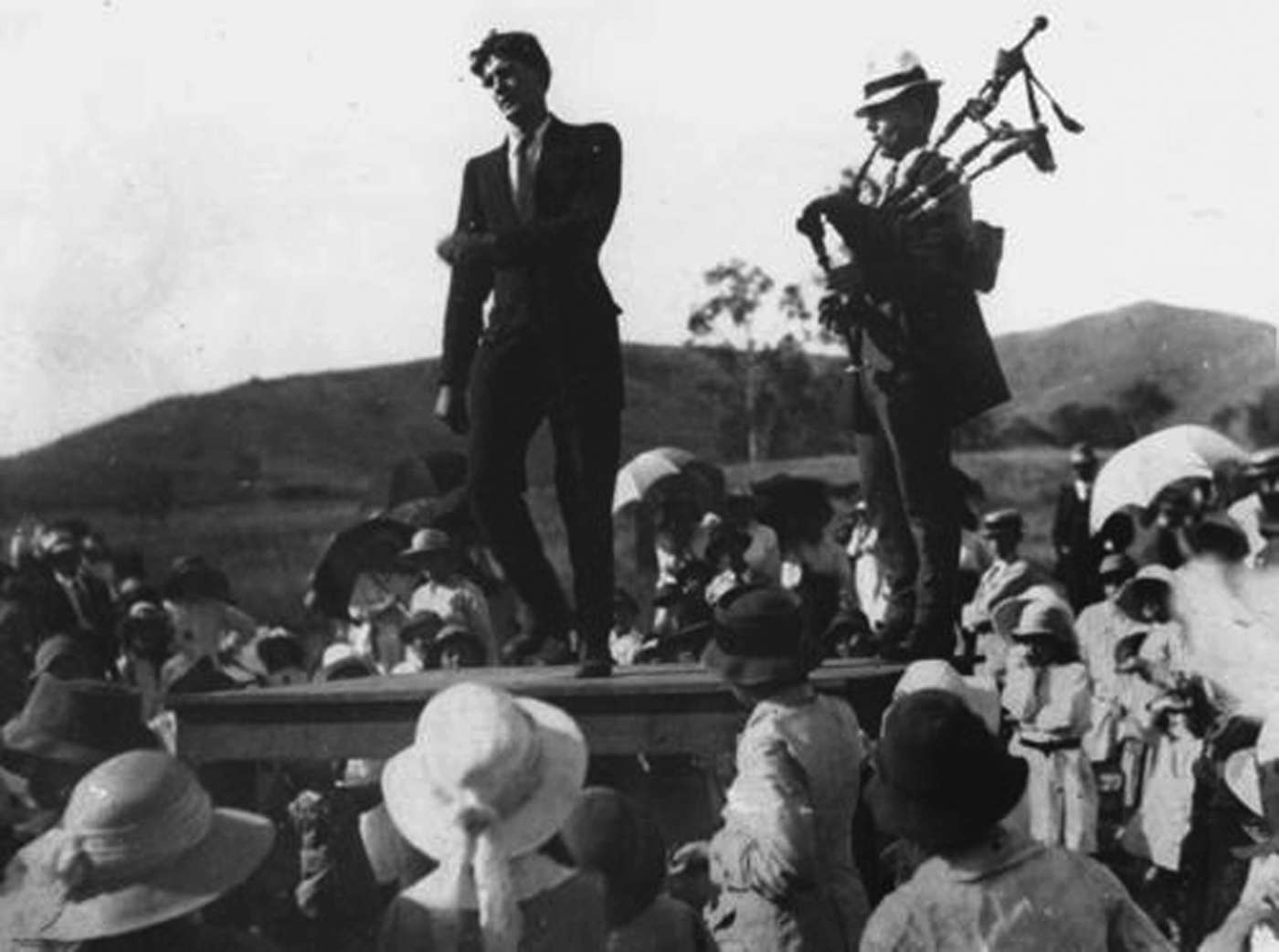
The concept of the embodiment being related to the dancing itself is further substantiated by the lack of specific costumes for step dancing at the end of the nineteenth century; it was not the clothing worn by the performers which was generating the nostalgic fervor. Phelan (Reference Phelan2014) states that costumes did not begin to appear in Ireland until the early twentieth century, so the mnemonic stimuli, which reminded people of places and people in Ireland, must have arisen from the movements of the dancers (and, of course, the musical accompaniment). Performers in Australia in the late nineteenth and early twentieth centuries danced in street clothes (see Photo 1), as was the practice in Ireland in the same era (Brennan Reference Brennan1999, 48–49), thus signifying that step dancing was a skill which was grounded within the context of everyday life and could be acquired by regular people without significant financial outlay for specialized apparel.
Irish dancer accompanied by a piper, 1916, Mount Morgan, 2003. Accession Number: 80-9-22. State Library of Queensland.

There was also an implied requirement that step dancing in Australia should adhere to the stylistic nuances that people remembered from performances they had witnessed in Ireland. Writing in 1900, an anonymous author argued that “if the Dublin style [of dancing] is correct the Sydney style is not, which I am sure will be approved of by every dancer or critic of dancing in Sydney” (Irish Celt 1900, 9). This direct comparison between Ireland and Australia exerted pressure on Australian dancers, adjudicators, and audiences to elicit their memories of the art as practiced in Ireland and to employ those memories as a yardstick for performative evaluations in Australia. Over the Australian summer of 1926–1927, a heated debate about dance style appeared in a number of Sydney newspapers. The dispute began with a report about the results of the Gaelic League Feis, in which the author engages in extensive criticism of the step dancing she or he had witnessed at the competition:
Irish dancing as it is generally done in Australia is the most corrupted phase of Irish art, and all lovers of the beautiful should be grateful to the Gaelic League for trying to raise it to its proper standard. The dancing competitions at the Feis might be divided into two classes: (1) those whose performance was in accordance with the traditional Irish style and (2) those who were completely at variance with it.… Dancers and teachers of Irish dancing in Australia pay far too much attention to difficult and intricate steps. The simplest steps beautifully danced are far more artistic and give much more pleasure than complex steps performed with an awkward carriage, superfluous vigor and obvious physical distress. (Freeman's Journal 1926, 21)
The writer thus divides the dancers at the competition into two groups: first, those who were pupils of the Gaelic League and who, in his/her opinion, adhered closely to the “correct” style of step dancing, and second, all other dancers whose overly athletic style did not appeal to the reporter. The final sentence in the quote, along with other parts of this article, was copied directly, although without acknowledgement, from O'Keefe and O'Brien (Reference O'Keefe and O'Brien1902, xxiv–xxv), and the likely motivation was to present an authoritative commentary. Multiple letters ensued, and there is insufficient space to include all of them here. However, Reader (1927, 22) states that “I consider the dancers who did the ‘athletic exercises’ as stated by the critic, are the true performers of the traditional Irish style as it was taught in Ireland 50 years ago.” Another writer asks,
What the public wants to know is, what style of Irish dancing is in accordance with the traditional canons of the art and the spirit and character of the Irish times of which the various step and figure dances are the physical expression and why? (A Mere Irishman 1927a, 32)
Both writers were concerned with the continuity of tradition and the notion of authenticity, explicitly linking the style of dancing with conceptualizations of Ireland, and in particular, Irish history and culture. So, the coupling of step dancing and Irish nationalistic sentiments in Australia, as expressed in the newspapers of the late nineteenth and early twentieth centuries, was congruent with the nationalistic fervor exhibited in Ireland.
There is insufficient space here to provide an exhaustive analysis of the characteristics of step dancing competitions in Australia in the nineteenth and early twentieth centuries, but in this section I have described some of the most important facets, with particular emphasis on the dancing as being a representation of the Ireland, which was so fondly remembered by Irish immigrants in Australia. The material presented so far provides a picture of the nature of step dancing competitions as practiced in Australia until around the middle of the twentieth century. In the next section, I move on to discuss the sociopolitical and choreographic changes which influenced the step dancing genre, its practitioners, and the context and structure of step dancing competitions.
Catalysts of Change Throughout the Twentieth and Twenty-First Centuries
Stimuli for changes in the aesthetic framework of Irish dancing emerged from both the broader sociocultural developments in Australia in the early to mid-twentieth centuries (the etic influences) and the various emergent trends from within the dance genre itself (the emic factors). Additional impetus was supplied by the theatricalized step dancing shows which appeared in the late twentieth century, which served to augment and accelerate many innovative developments. The changes demonstrate the shifting focus within the genre, from the culture of Ireland to the culture of step dancing.
Earlier, I described the social strata within which the working-class Irish immigrants found themselves until around the end of the nineteenth century. However, from the 1880s, Irish Australians began to rebut racially based criticisms (Stratton Reference Stratton and Moreton-Robinson2004) in forums such as the public newspapers, and by the beginning of the twentieth century, their economic status had grown to equal that of their English and Scottish counterparts (Campbell Reference Campbell2002). So, the Irish immigrant community had been brought in from the margins, and Irishness had become an accepted variation within the Anglo-Australian majority population sector.Footnote 9 This social shift was, unfortunately, based on the need to bolster the majority population sector in the face of an increasingly diversified flow of immigrants into the nation as the twentieth century progressed. Importantly, to be Irish no longer meant being an outcast; as Rónan McDonald (Reference McDonald2015), former Professor of Irish Studies at the University of New South Wales, comments, “the Catholic Irish were assimilated into Australian life when other threats seemed greater … later waves of immigrants from eastern Europe, the south Mediterranean and Asia made Irish Catholic otherness seem less pronounced. Suddenly, the Irish did not seem so different.” Hence, notions of cultural specificity no longer seemed so important.
In addition to this sociopolitical change, the genre of step dancing was itself being transformed across multiple domains. By the 1920s, the Gaelic League in Ireland had decided that dancing needed its own specific administrative body, and after several iterations, this body was designated An Coimisiún Le Rincí Gaelacha, the Irish Dancing Commission (IDC) (Brennan Reference Brennan1999; Foley Reference Foley2013). The IDC was established to provide greater global governance of the genre and its students, teachers, and competitions (Foley Reference Foley2013). Formalization processes also developed in Australia; indeed, the notation of competition rules began in Melbourne in 1932, when the Irish National Dancing and National Dress Promoters’ Association of Victoria formulated their competitive requirements for dancers, teachers, and adjudicators (Cullinane Reference Cullinane2006, 36), but later the IDC's rulebook became globally accepted. Over time, multiple additions and revisions have resulted in a complex, multisectioned list of regulations by which all those who are affiliated with the IDC must abide in order to receive official recognition (An Coimisiún Le Rincí Gaelacha 2017). The IDC exerts universal control of sufficient rigidity to inspire its description as “the classical organizational form of modern economy and administration: standardized, efficient and quality controlled mass-production” (Kavanagh, Kuhling, and Keohane Reference Kavanagh, Kuhling and Keohane2008, 735–736).
Both teachers and adjudicators must pass examinations set by the IDC, and step dancing schools, along with the individual students, must be registered with the IDC in order to participate in competitions which are organized under the auspices of the parental organization. From Australia, the first person travelled to Ireland to undertake the teachers’ qualification in 1953, while teachers from the United States first sat the examination in Ireland in 1959 (Cullinane Reference Cullinane2006, 132). The Australian Irish Dancing Association is the local administrative body (Cullinane Reference Cullinane2006), and its affiliation with the IDC is evident in all directorial statements on its website (Australian Irish Dancing Association 2019). The equivalent organization in the United States, in both structure and connection with the IDC, is the Irish Dance Teachers’ Association of North America (2019). Thus, IDC-registered competitions are an important means through which the IDC may generate and perpetuate a hierarchy of power and knowledge, even as far away as Australia (Kavanagh, Kuhling, and Keohane Reference Kavanagh, Kuhling and Keohane2008).
In addition to the global increase in regulatory control, there were also some choreographic trends which changed the face of step dancing. In the early twentieth century, step dancing did not possess the athletic difficulty exhibited by current dancers (Brennan Reference Brennan1999). One important change in the 1920s in Ireland (and brought to Australia in the 1950s) was instigated by the introduction of soft shoes, which make little sound on the floor (Cullinane, Reference Cullinane2006). The girls’ version resembles the pumps used for Scottish Highland dancing, while the boys’ version has a soft sole under the ball of the foot, but a solid heel so some sound is heard during soft shoe dances performed by males. Employment of these shoes meant that reels (in  $\displaystyle{4 \over 4}$ time) and slip jigsFootnote 10 (in
 $\displaystyle{9 \over 8}$ time) became more balletic in style for dancers of both genders (Cullinane Reference Cullinane2001): the movements of their legs became more elevated, and dancers covered a greater surface area on the floor. This augmented range of motion in both vertical and horizontal dimensions was also facilitated by both the increasingly younger age of competitive step dancers and the mounting of competitions in venues with larger stages across which dancers could travel in their choreographies (Foley Reference Foley2013). Both of these factors also affected Australian competitions: the dancer Michael Purtill, whose complaint about adjudicators at the end of the nineteenth century was cited earlier in the article, began competing at age forty-nine, whereas the participants in my recent ethnography were aged between five and twenty-five (Mollenhauer Reference Mollenhauer2018). The open-air venue shown in Photo 1 was later replaced with indoor locations around Australia, such as the hall used for the Gaelic League Feis (Freeman's Journal 1926), as cited in the previous section of this essay.
Following the stage shows which emerged in the late twentieth century, further choreographic innovations have been observed. Foley (Reference Foley2013) notes that the steps which are performed by current dancers are more intricate than those which were taught previously. Indeed, it is often the “innovative and clever choreographic choices” which render a dancer more likely to be noticed by the adjudicators (De Gallaí Reference De Gallaí2013, 105). The necessity to seek out new means of impressing adjudicators has meant that step dance choreographers (usually the teachers) have sought to stretch the boundaries of what is acceptable in order to demonstrate their position at the forefront of stylistic trends within the genre.
Such changes have been observed in the Australian context as well. A current Australian dance mother, Kirstie,Footnote 11 who had danced herself in the 1960s and 1970s, has noticed the difference between the choreographies she learned and those performed by her son in the twenty-first century, saying “definitely it was a more, more traditional in that sense [when she danced], you know that there seems to be huge advances in the choreography from what we had.” Kirstie also observed that “there's a lot more work on fitness and stamina than there used to be” in a dance class, which now often begin with exercise drills and stretches (F. Hall Reference Hall2008). The parent of three elite-level dancers, Jessica, remarked that “if you don't have that strength and stamina and gymnastic-ness and all that goes with that training, you will not be able to get through, with the amount of ‘tricks’ that they put in your dancing these days.” The “tricks” referenced by Jessica include recently introduced movements with names such as “bicycles” and “butterflies” (Foley Reference Foley2013, 178). To be noticed by adjudicators, competitors strive to fit in with the “accepted kinaesthetic vocabulary of the day” (191) and work to comply with current choreographic trends, although miniscule digressions are sometimes observed. Jessica's comment also highlights the increasing similarity between step dancers and athletes; a simple internet search reveals the existence of multiple online strength and flexibility training programs which have been designed specifically for the needs of twenty-first century step dancers (for example, see Irish Dance Athlete 2017).
Another important area of change has been the modernization of step dancing costumes. There was no “Irish national dress” (Wulff Reference Wulff2009, 97) on which dance costumes could be modelled, so the Gaelic League introduced a prescribed costuming style as part of its promotion of Irish cultural activities in the early twentieth century (Phelan Reference Phelan2014). Male dancers wore the kilt until around the mid-1990s, and several theories have been posited about the demise of this costume. Some argue that the kilt was considered to be overly feminine and therefore contributed to higher rates of attrition among male dancers (Brennan Reference Brennan1999). With the higher movements of the dancers’ legs, the audience members often glimpsed more than they, or the performers, bargained for during a performance by a male dancer in a kilt, and so the males quickly abandoned kilts in favor of trousers (Varade Reference Varade2015). Finally, the kilt's departure may be seen as a conscious effort to emulate the black trousers worn by male dancers in Riverdance (Wulff Reference Wulff2009). The first Australian to win a World Men's Championship wore a kilt in 1996 (Cullinane Reference Cullinane2006, 74), but I have not seen any males wearing kilts in competitions since that era. It is likely that the passing of the kilt in Australia stemmed from the same issues which have been raised by the scholars cited in this discussion.
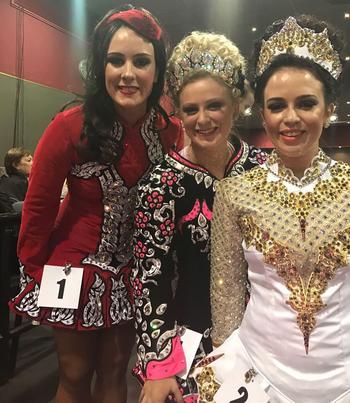
Female dancers’ dresses have become increasingly intricate with, once again, acceleration of change since the late twentieth century. Kirstie, dancer from the 1960s and 1970s, recalls that on costumes of her era “there were no sparkles, and then we went through a thing, pleated, like they were pleated, similar to the stiff ones but they were soft, and they had less embroidery [than modern dresses].” Now, dressmakers advertise themselves as possessing the cutting edge in style, materials, and decorative features, including the use of sequins, diamantes (rhinestones), and other forms of eye-catching adornments (Varade Reference Varade2015; see Photo 2). Indeed, the phrase “choice of champions” is often employed by makers and vendors in an effort to emphasize the competitive potential of their goods (Hallmore Dance Products 2019). Glitter is not confined to dresses; elaborate tiaras, earrings, and extra hair decorations are used, and even the white dancing socks worn by female dancers now come with small rhinestones on them. The use of makeup and leg tanning is also common practice. There is certainly very little connection between current costumes and Irish dress from any previous period of history (Brennan Reference Brennan1999); rather, costumes are a tool through which dancers seek to construct their own images of the champion step dancer (Varade Reference Varade2015).
Female dancers in competition attire, Sydney, 2017. © Milton Baar, MediaImages.

Several generalized social developments in Westernized nations also influenced the ongoing changes in costumes, particularly with reference to distant locations such as Australia. First, due to the increased ease of international travel, many more dancers from Australia are able to compete in Ireland and elsewhere around the world and so are able to transport knowledge of current trends back to their home dance environment (Varade Reference Varade2015). However, there is still a fiscal disadvantage for Australian dancers: as Simon, a current dancer, observed, “It costs too much to compete with the elite, for [Australians]; it costs two or three thousand dollars to go over [to Ireland] just for one competition.” Second, the electronic age has allowed dancers in Australia and elsewhere to view what is happening overseas at the present time and thus keep abreast of worldwide costuming fashions. Elite Sydney dancer Vivian remarked that “on YouTube there's always the Parade of Champions from Ireland … National Championships … people go on and watch them and see all these champions.” Whatever happens at a competition in Ireland, or elsewhere in the world, it is instantly visible to all dancers, no matter their geographical location. The nature of current competition presentation for female dancers may be seen in Photo 2.
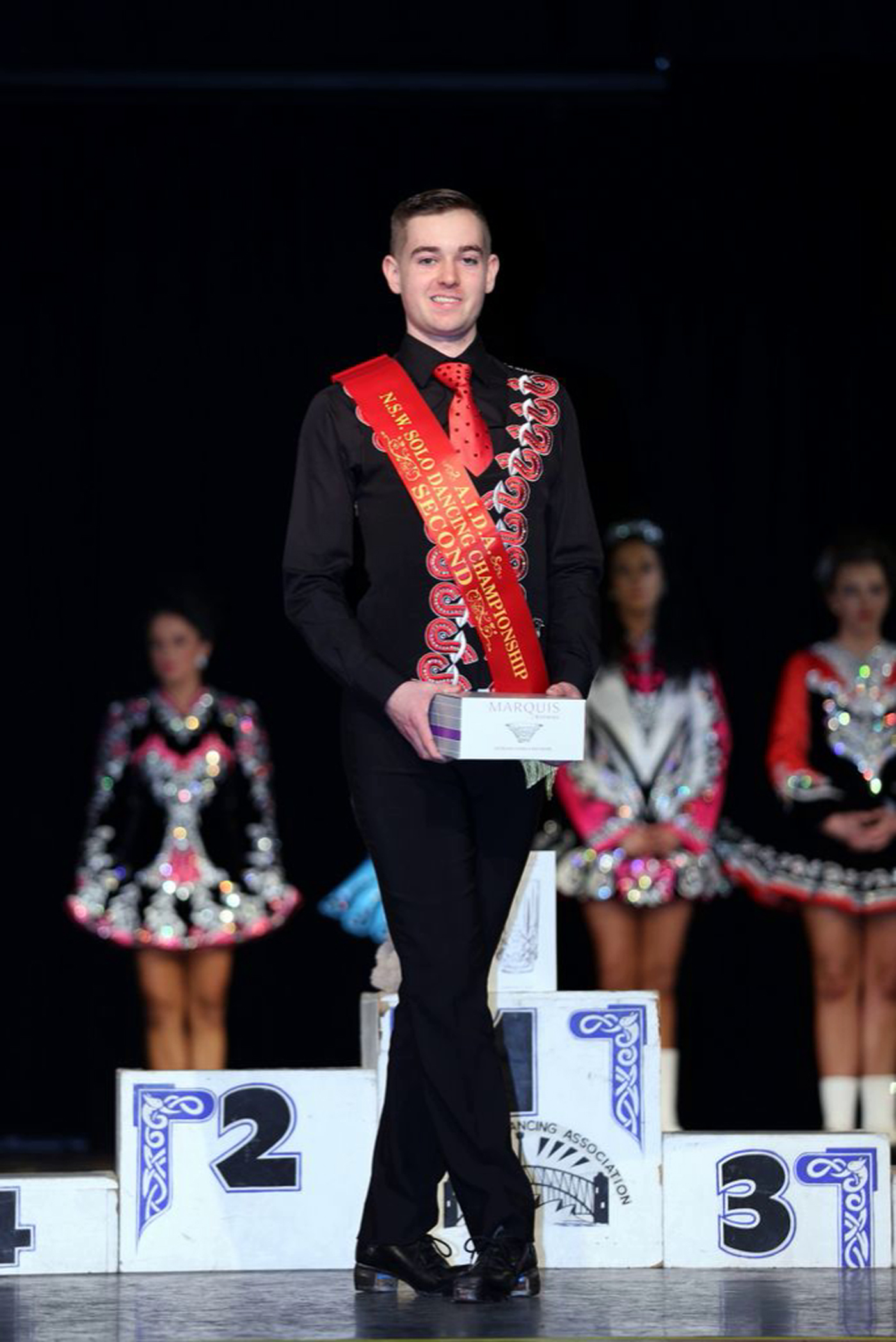
Male costumes, too, have become increasingly decorated and highly colorful, although the cost to attire a male dancer remains significantly less than for a female, since trousers and shirts may be purchased at regular clothing stores and there are fewer accessories, such as wigs, involved in their outfits (see Photo 3).
Male dancer in competition attire, Sydney, 2017. © Milton Baar, MediaImages.

Teachers, dancers, parents of dancers, and adjudicators have combined to contribute to a constantly evolving sartorial industry which serves the genre. As Frank Hall (Reference Hall2008, 64) notes, “if adjudicators are having difficulty deciding between two dancers, they often employ their costuming preferences in order to determine which dancer is to be awarded the winner's prize.” From the perspective of a current parent of dancers, Charlotte commented, “I think people want new dresses because ‘you have to keep up with the Joneses.’” In other words, dancers succumb to the pressure to conform to the latest fashions.
While the trends which have already been identified in this section of the article brought about change from the middle of the twentieth century, there is little doubt that the 1990s was the decade in which the most rapid transformations began. There is a considerable body of literature which examines the effects of Riverdance and other Irish dancing stage shows on both step dancing (Foley Reference Foley2001, Reference Foley2013; F. Hall Reference Hall2008; Wulff Reference Wulff2009) and traditional Irish music (Scahill Reference Scahill2009). These scholars have drawn attention to the fusion of Irish dancing and music with theatrical motifs and other genres of dance and music. However, I suggest that another significant effect which resulted from the stage shows was the sudden influx of students to Irish dancing schools around the world (Wulff Reference Wulff2009). If there are more dancing students in a genre there are, automatically, more competitors, and so greater effort needs to be expended in order to attract the approval of the adjudicators and, ultimately, to be awarded first prize. This factor, I argue, is likely to continue to drive choreographic and sartorial innovations well into the future.
The increasingly large cohort of step dance participants is also characterized by an escalation in the cultural diversity within that population, a topic which I have explored elsewhere (Mollenhauer Reference Mollenhauer2015). Since there are now greater numbers of participants who do not have any Irish ancestry, there is a diminished sense of step dancing as an embodied representation of Ireland and Irish cultural traditions, because these notions have no personal salience for many of the competitive cohort. The non-Irish participants in the genre may believe they are embodying Ireland and its culture when they dance, but they are, in fact, presenting an interpretation of Irish dancing and its rituals and customs (Wulff Reference Wulff2009). This distinction is important, and has also been identified among practitioners of Irish traditional music who do not possess ancestral links to Ireland (Rapuano Reference Rapuano2001). Where once the step dancing population was a subset of the global Irish community, a portion of it now rests outside of the genetically determined boundaries of that community.
So, with a much larger group of participants and the increasingly disparate composition of that cohort, attempts to expand the aesthetic boundaries are likely to be made by greater numbers of participants and in a larger variety of ways than ever before. Foley (Reference Foley2013, 178) suggests that step dancing teachers and experienced dancers have, at times, observed a particularly appealing movement within the canon of another dance genre and have then “subtly adapted these movements into steps” for use in the Irish dance form. With reference to costumes, it is suggested that “Irish-American cultural influences and ideologies shape global Irish dancing industries” (Brennan Reference Brennan1999, 158), indicating that the Irish diaspora, with its exposure to other influences, has been the source of some innovative developments.
However, any such trends are subject to the global control of the IDC, as described earlier, and so innovations are bound by the prescriptive hegemony of the governing organization. A perusal of the IDC website pages reveals multiple documents relating to items such as bodysuits and underwear (on the “Costume” web page) as well as the detailed choreographic guidelines provided in the “Syllabus for the 2019 World Championships” (An Comisíun le Rinci Gaelacha 2019). These rules mean that the goal in competitions is to be the dancer who best conforms to the “institutionalized aesthetic and technique” as prescribed by the IDC (Foley Reference Foley2013, 191). In recognition of the rate of rapid progress within the genre, the IDC constantly updates its rules and regulations to either allow for or prohibit innovative developments, as may be discerned from the documents on its website (An Comisíun le Rinci Gaelacha 2017). However, the level of organizational control remains constant and its unyielding power persists, in spite of the numerical growth and increased heterogeneity within the global step dancing community.
The changes in organizational structure, choreography, and costuming are indeed the most prominent, but there are other changes which deserve a brief description. The first is the various ways in which competitions have been rendered more economical in terms of the time taken for each section, and the second is the more restricted dissemination of the results of competitions. Photo 1 in this article shows a competitor dancing on his own, which was once the most common procedure; footage of a competition in Dublin in 1929 also shows solo dancers competing one at a time (British Pathé Reference Pathé2014). However, the rising number of competitors has meant that now, there is insufficient time for every dancer to dance each roundFootnote 12 of a competition alone on the stage. Currently, the usual practice is for three (or two, among older age groups) dancers to be on stage together in the first two rounds of a championship, while only in the final round do dancers perform a solo dance. Another time-saving measure has involved the tailoring of dances; in 1938, the rules for a competition to be held in Sydney specified that up to six steps could be danced for each dance being performed (The Catholic Press 1938). Using the reel as an example, this would have represented a maximum possible length of 96 bars of music, whereas current championship rules in Ireland, Australia, and the United States prescribe a reel which is only forty-eight bars in length (An Coimisiún Le Rincí Gaelacha 2019; Australian Irish Dancing Association 2019; Irish Dance Teachers’ Association of North America 2019). Footnote 13 While the reduction in steps also relates to the current, more athletic style of dancing, which would be difficult to sustain for six steps, the time saving factor is certainly beneficial.
The dissemination of competition results has also changed markedly since the middle of the twentieth century when competition results were still being presented in general community newspapers. Admittedly, some of the results presented up to that time were published in the Irish Catholic publications of the era (Hamson Reference Hamson1927), but even this practice has ceased. Results and rankings are now presented within the confines of the Irish dancing community, and this presentation usually occurs through electronic means. One option is a formal results website such as Feisresults (2018), which offers details of prestigious international competitions such as Oireachtas Rince Na Cruinne (World Championships), Oireachtas Rince Na hÉireann (All Ireland Championships), and the North American Irish Dance Championships. There are also informal means through which competition results may be disseminated, including the Facebook pages of the IDC and the Australian Irish Dancing Association, along with pages of both individual competitors and dance schools.
Thus, Irish step dancing competitions are now highly stylized events which operate within strict guidelines. The concept of Irish culture has been superseded by the notion of Irish step dancing culture, which includes many features which would be unrecognizable to dancers from earlier periods in step dancing's competition history. The changes which have been noted and discussed in this article have resulted from both external and internal stimuli, and in combination, these changes serve to provide a narrative which adds to existing discourses surrounding both step dancing itself and the broader situation of the Irish immigrant community in Australia. While Ireland remains as the pivotal point toward which the global step dancing participant cohort's attention is focused, the increasingly heterogeneous nature of that cohort has served as a significant influence in the shifting focus within Irish step dancing competitions. Where once, the dancing represented Ireland and Irishness, and the adjudicative framework at competitions was culturally focused, the multiple pressures from both inside and outside the step dancing community have combined to move the principal emphasis toward aesthetics and the performative value of a dancer's technique, choreography, and visual presentation.
Conclusion
In this article, I have explored some of the changes which have emerged within the competitive framework of step dancing since the late nineteenth century, with a particular focus on Australia. Influential factors which affected competitions at that time arose from both the sociocultural context experienced by Irish immigrants in Australia and from within the community of dancers themselves. In the late nineteenth and early twentieth centuries, embodied Irish identity (as demonstrated at a step dancing competition) initially assumed a vital role in sustaining Irish immigrant morale but then lost a measure of salience as Irish-Australians grew in economic, social, and political stature. Later, as the Irish community was absorbed into the majority population sector, the necessity for emotional sustenance, as acquired from a dance performance, diminished.
This is not to say that step dancing no longer has a role in embodying notions of Ireland or that current Irish-Australian step dancers do not construct representations of Ireland through dance. Rather, step dancing in Australia illustrates the nexus of three fields of globalization, as the worldwide spread of step dancing has enmeshed itself with both the generalized popularity of Ireland and its traditions (Kavanagh, Kuhling, and Keohane Reference Kavanagh, Kuhling and Keohane2008; Rapuano, Reference Rapuano2001) and the “global entertainment culture” (O'Connor Reference O'Connor2013, 126) in which dance plays an important role. So while previously, dance was used to develop and bolster the collective self-confidence of Irish-Australians, it is now able to capitalize on a situation in which Irish identity is celebrated rather than denigrated, and thus dance can represent that self-confidence at full maturity. The multiple fields of globalization have embraced non-Irish competitors as well. These dancers are also included in the maxim that “when step dancers perform, they embody culture” (Foley Reference Foley2013, 227), but the culture of Ireland is overlaid with, and at times perhaps overshadowed by, the current aesthetic requirements of step dancing competitions.
Within the cohort of step dancers, processes of specialization, including the registration of teachers, adjudicators, and competitive events, and the emergence of the IDC as a regulatory body with global influence, were the main agents of change from the early twentieth century. Various other characteristics of the late twentieth and early twenty-first centuries, such as greater accessibility to international travel, electronic sources of information, and of course the global popularity of step dancing (as a result of the stage shows) have accelerated the rate of growth and change in all areas of dance praxis, including competitions.
While the examples employed in this article have been drawn from Australia, the references to step dance practice in Ireland (Brennan, Reference Brennan1999; Foley Reference Foley2013; Wulff Reference Wulff2009) and the United States (Varade Reference Varade2015) suggests that the progression of step dancing in Australia mirrors the changes which have been noted elsewhere around the world. Step dancing is, indeed, characterized by global homogeneity in its structure and practice. Thus, the claim that the IDC provides an excellent example of efficient control is exemplified in the findings of this article, and the competitions, which have been the focus of the discussion, are an important mode of maintaining that power (Kavanagh, Kuhling, and Keohane Reference Kavanagh, Kuhling and Keohane2008). However, the use of localized examples, such as those provided here, not only grounds the research geographically but illuminates the complexities of the local-global dichotomy within the very specific field of step dancing.
The global control exerted by the IDC also provides a counterpoint to the constant desire, especially among elite-level competitors, to be constantly searching for some means by which they can attract the adjudicators’ attention and emerge victorious from the contest. The adjudicator, as noted by Werron (Reference Werron2015), is an integral part of a formal competition; in step dancing, the adjudicators’ opinions are the ultimate goal because it is only through their approval that a dancer can win. The desire to win is the driving force behind the manifold choreographic and sartorial innovations which have emerged, especially in the past twenty-five years, when competitor numbers have increased dramatically both within and outside of Ireland (Mollenhauer Reference Mollenhauer2015; Wulff Reference Wulff2009). The increased presence of participants without any genetic link to Ireland would, under other circumstances, most likely result in a further move away from representations of Ireland, but this influence is mitigated by the monitoring of IDC through their multiple rules and regulations. If a dancer wants to win at a competition which is registered with the IDC and boost his or her reputation as a dancer, they are, quite simply, compelled to comply with the IDC's guidelines.
There are more aspects of step dancing competitions which could have been addressed in this essay, including alterations to musical tempos and issues of gender balance, but space did not permit such musings here. The presence of these other factors suggests that much more research and writing about step dancing competitions is needed. The article has also only addressed the topic within one geographical location, Australia. Comparative work from other locations in which IDC competitions are held would be welcome additions to the global narrative about the genre.
However, this article adds to the existing canon of literature on step dancing and to the important but relatively neglected topic of immigrants’ dance practices in Australia. It has examined step dancing competitions and the transformations which have developed in relation to both individual dancers and the organizational structures which oversee the genre (O'Connor Reference O'Connor2013). The Irish in Australia have one of the longest settlement histories of any nonindigenous sector of the Australian population, and investigations of their traditions represent important additions to their migration narrative. Step dancing has long been cherished by the Irish community in Australia, and the diffusion of step dancing into the broader population provides many avenues of inquiry for scholars. Dancers from a hundred years ago would hardly recognize the genre today, and we can only imagine what step dancing will look like a hundred years from now.