Introduction
Of the five newly recognized genera of Acacia Mill. s.l., Senegalia and Vachellia are found in Africa (including Madagascar), and are represented by c. 69 and 73 species, respectively (Kyalangalilwa et al., Reference Kyalangalilwa, Boatwright, Daru, Maurin and van der Bank2013). In Ethiopia, the genus Acacia s.l. is the third dominant group of woody leguminous plants represented by more than 49 indigenous species (Belay et al., Reference Belay, Vestber and Assefa2013). The Acacia-Commiphora, Burseraceae woodland and bush land vegetation type of Ethiopia is represented in large areas of the dry lowland to the east of the highlands and in the Rift Valley (IBC, 2005). Drought-tolerant small-leaved trees and shrubs are characteristic of this vegetation type in Ethiopia (Lemenih and Kassa, Reference Lemenih and Kassa2011). Several resin species of Burseraceae that comprise of several resin species of Commiphora and Boswellia are of considerable commercial value as raw material for balm, myrrh, incense and frankincense (Hedberg and Edwards, Reference Hedberg and Edwards1989).
Seeds of different Acacia s.l. species are lost to insects, rodents, fungal decomposition, species of wild animals and livestock (Southgate, Reference Southgate1978; Ernst et al., Reference Ernst, Tolsma and Decelle1989; Miller, Reference Miller1996; Or and Ward, Reference Or and Ward2003). In arid and semiarid areas, seeds and pods of various Acacia s.l. species are subject to beetles (Coleoptera: Chrysomelidae: Bruchinae), plant bugs (Hemiptera), moths and butterflies (Lepidoptera), and phytophagous wasps (Hymenoptera) infestation (Southgate, Reference Southgate1978; Or and Ward, Reference Or and Ward2003). Of these pests, Bruchinae are the major pests on trees and shrubs of Leguminosae growing in desert and tropical environments (Southgate, Reference Southgate1978; Fox et al., Reference Fox, Wallin, Bush, Czesak and Messina2012). The rate of attack can reach 99% in Africa and 70% in Central America (Janzen, Reference Janzen1980; Ernst et al., Reference Ernst, Tolsma and Decelle1989). Following damage to the cotyledon, the viability of infested seeds is threatened, although they may not be rendered nonviable (Derbel et al., Reference Derbel, Noumi, Anton and Chaieb2007).
Although damage by different seed predators in Ethiopia on the seeds of Vachellia and Senegalia species is observed (Bekele-Tesemma, Reference Bekele-Tesemma, Tengnas, Kelbessa, Demissew and Maundu2007), there is insufficient information on the type and rate of seed infestation in different Acacia s.l. species. Therefore, the objectives of this study were to: (1) collect and describe seed predators involved in seed damage of Senegalia senegal, Vachellia abyssinica, V. seyal and V. tortilis; (2) determine the level of damage; and (3) analyse its impact on seed germination of these species in Ethiopia.
Materials and methods
Study areas
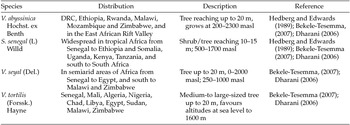
This study was conducted in the wooded grasslands of the Rift Valley of Ethiopia around Lake Langano (7º36′N; 38º43′E, 1582 masl), 200 km southwest of Addis Ababa, the capital city of Ethiopia, and Menagesha (9º00′N; 38º35′E, 2200–3000 masl), 25 km west of Addis Ababa, both located in Central Ethiopia. The tree stratum of the Rift Valley of Ethiopia consists of the following Acacia s.l. species: Faidherbia albida, S. senegal, V. etbaica, V. seyal, and V. tortilis (Friis et al., Reference Friis, Demissew and van Breugel2011), whereas Juniperus procera (Cupressaceae) and Podocarpus gracilior (now named Afrocarpus gracilior) (Podocarpaceae) are dominant in Menagesha forest (Demissew, Reference Demissew1988). Acacia s.l. species are used for firewood, charcoal production, poles, posts, medicine, fodder, bee forage, nitrogen fixation and improvement of soil fertility, tool handles, fences, wind breaks and for tannin and dye (Hedberg and Edwards, Reference Hedberg and Edwards1989; Dharani, Reference Dharani2006; Bekele-Tesemma, Reference Bekele-Tesemma, Tengnas, Kelbessa, Demissew and Maundu2007). Although these species are not included in the Red List of Endemic Trees and Shrubs of Ethiopia and Eritrea (Vivero et al., Reference Vivero, Kelbessa and Demissew2005) anthropogenic pressure, charcoal production and agricultural encroachment threaten their continued existence (IBC, 2005; Marshall et al., Reference Marshall, Platts, Gereau, Kindeketa, Kang'ethe and Marchant2012). Table 1 describes the study species.
Description of the Acacia s.l. study species

Collection of seeds and insects
Seed pods that had not yet dehisced were randomly collected from more than 10 healthy and mature trees separated 50m apart, which were obtained by shaking branches of S. senegal, V. abyssinica, V. seyal, and V. tortilis to release pods over a canvas sheet that was spread beneath the canopy as described in Omondi et al. (Reference Omondi, Maua and Gachathi2004). These pods were dried in the sun and threshed lightly to release intact seeds onto the canvas sheet. Pods and seeds of S. senegal, V. seyal and V. tortilis were collected around Lake Langano, and V. abyssinica from Menagesha forest between December 2014 and January 2015. Pods and seeds were packed in polypropylene bags and transported to Central Ethiopia Environment and Forestry Research Centre (CEEFRC) for further laboratory studies. Seeds that were perforated by beetle larvae were handpicked and kept in plastic vessel covered with nylon mesh to allow emergence of adult bruchines. In addition, adult bruchines already hatched and available in the polypropylene bags were collected, and separately preserved in 70% ethanol in glass tubes. Insect specimens were identified to genus level at FRC and sent to Dr Alex Delobel (personal communication), former senior entomologist in the Muséum National d'Histoire Naturelle, Paris, France to further identify them to species level, and to confirm their identity.
Characterization of seed damage
From a composite 1 kg seed sample of each study species, subsamples of 250 g seeds were removed to determine the percentage seed damaged and the position of adult bruchine emergence holes. All seeds were visually inspected for presence or absence of adult exit holes, and categorized into damaged and undamaged seeds. The positions of exit holes were classified as ‘top’ and ‘base’ infestation: the ‘top’ being close to the point at which the radicle protrudes and the ‘base’ referring to that part of the seed furthest from the mycopylar end. Furthermore, the number of exit holes per seed was counted. To look for the association between number of holes in the pods and number of damaged seeds before the pods open, 100 pods each of V. abyssinica and V. tortilis were randomly picked and classified into pods with no hole (1), one hole (2), two holes (3) and three holes (4).
Germination capacity of infested seeds
The seed germination of the four study species was carried out as stated by Fox et al. (Reference Fox, Wallin, Bush, Czesak and Messina2012) and Rodrigues et al. (Reference Rodrigues, Viana, Ribeiro-Costa and Rossi2012) with slight modification. Seeds were divided among five treatments: control (no manipulation) (a), healthy seeds but nicked at the tip using scissors where the radicle protrudes (b); beetle-damaged seeds with one exit hole at the tip (c); beetle-damaged seeds with one exit hole at the base (d); and beetle-damaged seeds with one exit hole at the base but nicked (e) as stated in (b) above. These seeds were placed in 90 mm diameter glass Petri dishes lined with moistened double filter paper. Each treatment had five replicates of 20 seeds. All Petri dishes were kept at room temperature (20–25 °C) on a laboratory bench in 12 hr natural light. Filter paper within the Petri dishes was regularly moistened with distilled water to avoid drying out. A seed was assumed germinated when a radicle protruded at least 2 mm from the seed coat (Jaskani et al., Reference Jaskani, Kwon, Kim and Abbas2006). Germination was recorded every two days for 12 consecutive days after sowing, and seeds were removed from the dishes once they had germinated. Thereafter, the experiment was terminated.
Data analysis
After estimating the level of seed beetle emergence, we applied square root transformation to the data to fit the assumption of parametric statistical tests, i.e. Levene's test of homogeneity of variance using IBM SPSS Statistics 20.0. Subsequently, two-way ANOVA was conducted using study species and seed germination treatments as main factors. Least significant difference (LSD) mean separation was used to compare the two factors at P<0.05 using IBM SPSS Statistics 20.0.
Results
Seed beetle emergence
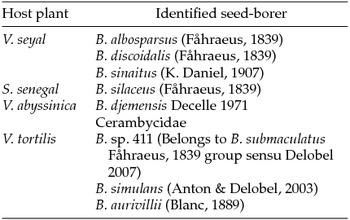
We obtained eight distinct seed beetle species (Coleoptera: Chrysomelidae: Bruchinae) from the collected seeds. In addition, we obtained specimens corresponding to an unknown species of longhorn beetle (Cerambycidae). These seed predators were unequally distributed across the study species (Table 2).
List of host-predators

Characterization of seed damage
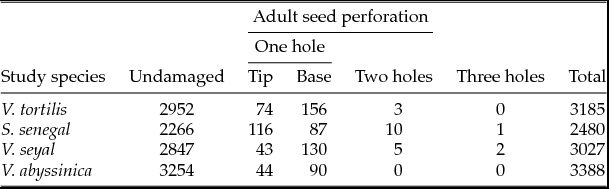
The percentage seed attack on S. senegal, V. tortilis, V. seyal and V. abyssinica was, respectively 8.63, 7.32, 5.95 and 3.96. In these species, there were a greater number of seeds with single exit holes than with multiple exit holes (P< 0.05). In addition, where there was a single exit hole more seeds were perforated at the base than at the tip (Table 3).
Extent of damage and position of adult emergence holes in 250 g seeds of Vachellia and Senegalia species

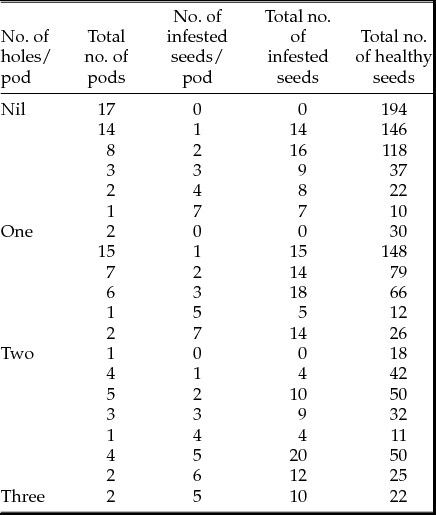
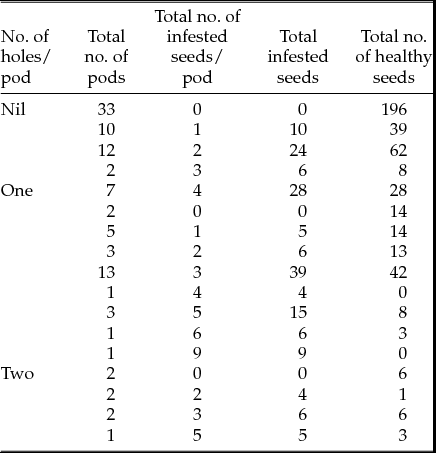
The number of holes observed on the surface of the pods of V. abyssinica and V. tortilis was in line with the number of healthy and/or damaged seeds inside the pods. In general, as the number of holes in a pod increased, the number of healthy seeds decreased and the number of damaged seeds increased. Also, the total number of pods per group decreased as the number of holes increased. In both species, less than 2% of pods had three holes in their surface (Tables 4 and 5).
Number of Vachellia tortilis infested seeds with respect to pods (N=100 pods)

Number of Vachellia abyssinica infested seeds with respect to pods (N=100 pods)

Seed germination
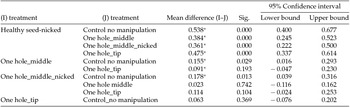
A Levene's test on seed germination of study species fit the assumption of equality of variances (P=0.25 i.e. P >0.05). The two-way ANOVA model also depicted statistically significant difference observed in percentage germination of the two main factors (Table 6). There was a significant species effect on seed germination count, F (3, 80) =4.67, P=0.005, partial η2 =0.15. Senegalia senegal (M =0.64) had higher seed germination count than V. seyal (M =0.51), V. tortilis (M =0.45.) and V. abyssinica (M =0.42). Similarly, there were significant treatment effects on seed germination of Vachellia and Senegalia species F (4, 80) =18.02, at P=0.001, partial η2 =0.47. Healthy seeds nicked at the tip (M=0.86) had higher seed germination than seeds having one exit hole at the base but nicked at the tip (M =0.49), seeds having one exit hole in the base but not nicked (M=0.47), seeds having one exit hole at the tip but not nicked (M =0.38), and control seeds that were manipulated by nicking at the tip (M =0.32). There was no significant interaction effect of species and seed germination treatments in the rate of seed germination among study species F (12, 80) =1.48, P=0.15, partial η2 =0.18.
Pair-wise comparisons LSD

Based on estimated marginal means.
*The mean difference is significant at the 0.05 level.
Adjustment for multiple comparisons: LSD (equivalent to no adjustments).
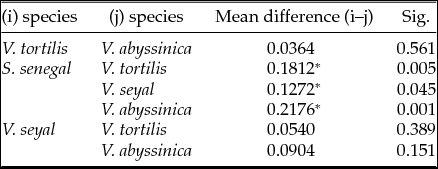
There were significant differences between species, among which, significant interaction was observed between S. senegal and V. abyssinica at α = 0.001 (Table 7).
Multiple comparisons of seed germination (LCD)

Based on observed means.
The error term is mean square (error)=0.049.
*The mean difference is significant at the 0.05 level.
Discussion
Although various bruchines are known to attack the seeds of these study species elsewhere, only a few of these predators were reported in Ethiopia. Accordingly, Bruchidius djemensis was collected between Addis Allem and Djem-Djem, and Bale Province, Sof Omar, Ilubator Province, 60 km SSE of Bedele in unspecified host plant (Delobel et al., Reference Delobel, Anton, Le Ru and Kergoat2013). In addition, Anton and Delobel (Reference Anton and Delobel2003) had reported B. simulans on V. tortilis in Gamu Gofa Province, Ziway and Lake Langano, Ethiopia. Particularly, the location stated as Addis Allem and Djem-Djem is 20 to 40 km away from Menagesha forest where B. djemensis was reared from V. abyssinica in this study. Similarly, Ziway is 40 km east of Lake Langano.
A noticeable variation in percent of seed predation has been recorded between the current and previous studies. Even though the rate of infestation of V. tortilis was less than 8% in this study, in other studies it was 10 to 82% (Ernst et al., Reference Ernst, Tolsma and Decelle1989), 20 to 47% (Miller, Reference Miller1994) and 25.9 to 79.9% (Derbel et al., Reference Derbel, Noumi, Anton and Chaieb2007), likely due to the variation in the months, years and place of seed collection (Ribeiro-Costa and Almeida Reference Ribeiro-Costa, Almeida, Panizzi and Parra2012). On the other hand, the presence of unsuccessful adult bruchines inside pods of some V. abyssinica and V. tortilis also showed that bruchines complete their development (including pupation) within a seed or pod of a host plant (Brier, Reference Brier and Bailey2007). In addition, the larvae of bruchines later consume the embryo and cotyledon of seeds, which has been observed to decrease the viability and germination of the seeds.
Conclusions and recommendation
This study found a total of eight different seed predators associated with S. senegal, V. abyssinica, V. seyal and V. tortilis in Ethiopia. The study also found a number of previously unreported Acacia s.l. seed predators both in Ethiopia and elsewhere. The study highlights the importance of conducting further research on the type, abundance and distribution of seed predator(s) in other Acacia s.l. species not included in this study.
Acknowledgements
I would like to thank Dr Alex Delobel for helping to identify and authenticate the insect specimens. I also thank Neway Adele, Genene Tesfaye, Legesse Alemu, Aynalem Tekeba, Tiruwork Tesfa, Almaz Asefa and Yeshi Ketema for collecting the seeds and for laboratory work. I also acknowledge Dr Abeje Eshete, Director of Forestry Research Centre, and Mr Anteneh Tamirat and Abiyselasse Mulat from the Ethiopian Institute of Biodiversity who facilitated my field work, and sent the specimens abroad. Last but not least, I would like to thank Dr Chris Parker, Dr Bayeh Mulatu and Dr Alemu Gezahgne for their constructive comments and proofreading of this manuscript.