Implications
In this study, a comparison with the worldwide cattle panel, representative of African, European and zebu populations, revealed that the genome of the studied populations have a mixed origin issued from gene-flow among local breeds and more recent introgression of European origin. Such information is necessary for the establishment of a strategy for the preservation and genetic improvement of this bovine species for economic purposes and the creation of cryopreservation to ensure systematic archiving of semen to prevent accidental loss due to disasters.
Introduction
The worldwide distribution of taurine cattle can be reconstructed on the basis of historical classifications and archeological evidence combined with the comparison of mitochondrial DNA, Y-Chromosome and autosomal DNA. This reconstruction remains subject to debate. One of the main hypotheses that has been formulated is that during the Neolithic revolution, taurine (humpless cattle) and zebu (humped cattle) were domesticated in two different primary domestication centers located in the Fertile Crescent and in the Indus Valley, respectively (Loftus et al., Reference Loftus, MacHugh, Bradley, Sharp and Cunningham1994). Expansion of the first agricultural societies introduced cattle to most parts of Asia, Africa and Europe.
About 2000 BP, people began to migrate throughout central and Southern Africa. However, zebu began to arrive in large numbers in eastern Africa (African horn) during Muslim expansion from the end of the 7th century AD. They spread northwards, westwards and southwards, although it is believed that the major wave of zebu introduction occurred during the 19th century during the rinderpest epidemic outbreak (Payne and Hodges, Reference Payne and Hodges1997).
All indigenous cattle breeds of Algeria, Morocco and Tunisia originated from the shorthorn type cattle that were introduced into Egypt from Asia. They are all closely related to the Brown Atlas basic type and they differentiated in separate breeds in the Maghreb countries (Epstein, Reference Epstein1971).
In Algeria, local breeds are varieties of the ‘Brune de l’Atlas’ type: Guelma (currently Guelmoise (GUE)), Cheurfa (CHE) and ‘Sétifienne’ (AnGR, 2003) and they are found in the eastern area of Algeria near the Tunisian border (Felius, Reference Felius1995). Moreover, another local cattle named Cheliff (currently Chelifienne (CHF)) has its habitat in the center of Algeria. The Djerba cattle population cited by Epstein (Reference Epstein1971), the shorthorn cattle of Tunisia, is restricted to the Biskra (BIS) region. Algeria has 1.8 million cattle (Ministère de l’Agriculture, de l’Agroalimentaire et de la Forêt (MAAF), 2012). The local population accounts for about 78% of the total livestock, while imported livestock and crossbred are estimated at about 22% of which 59% are located in the Northeast, 22% in the center, 14% in the North and only 5% in the south of the country (AnGR, 2003).
In Morocco, the local breeds are also known as ‘Brune de l’Atlas’: Oulmès-Zaër (OUL) and Tidili (TID). The OUL is located at the ‘Khémisset’ region in the center of Morocco. The TID breed was identified for the first time in 1981 at the foothills of the High Atlas in the Ouarzazate region (Ezzahiri et al., Reference Ezzahiri, Ouchtou and Dahbar1984). This breed is selected for milk production. Morocco has 2.8 million cattle (Sraïri et al., Reference Sraïri, Benyoucef and Kraiem2013). The local with 43%, crossbred (36%) and improved purebred (mainly Holstein-Freisian and Montbeliarde with 21%) breed-types. However, the proportion of each breed-type varies according to the region and the production system. The local cattle population is mainly raised in the difficult and marginal areas of the country. Conversely, the improved breed-types (improved pure breeds and their crosses) are mainly met in the irrigated areas and the favorable rainfed areas.
Local cattle are often cited for their hardiness, their resistance to harsh climatic conditions (heat, cold, drought, etc.), their ability to value mediocre food, for being well adapted to mountain environments and their resistance to parasites and diseases. However, their milk production and growth rate are low (AnGR, 2003; Boujenane et al., Reference Boujenane, Ghoddane and Benidir2004).
In Algeria, the local populations are endangered by massive crossing with imported breeds to improve the efficiency of dairy herds in the genetic improvement of dairy capital (Yakhlef, Reference Yakhlef1989). In Morocco, the local cattle population has steadily declined over the years due to its weak milk production and growth performance, the massive importation and grading in improved breeds (Boujenane et al., Reference Boujenane, Ghoddane and Benidir2004). This was due in part to the absence of a national breeding program governing biodiversity. The conservation of local breeds and the monitoring of their genetic diversity are fundamental to meet future breeding needs, especially in the context of global climate change (Hoffmann, Reference Hoffmann2010). The genetic diversity found in domestic breeds allows farmers to develop new characteristics in response to changes in environment, diseases or market conditions (Maudet et al., Reference Maudet, Luikart and Taberlet2002). Moreover, no molecular biological study of their genetic characterization and standardization has been made. A real priority to develop backup plans and preservation of these local genetic resources is essential. Single nucleotide polymorphisms (SNP) have become the marker of choice for many studies in animal genetics and genomics (Ramos et al., Reference Ramos, Megens, Crooijmans, Schook and Groenen2011).
The objectives of this study were to assess the genetic diversity, population structure and relationships within and between six Maghrebin cattle populations: four Algerian, CHE; GUE; CHF and BIS and two Moroccan, OUL and TID. For this purpose, we genotyped 203 unrelated individuals using the Illumina BovineSNP50 Bead Chip (Matukumalli et al., Reference Matukumalli, Lawley, Schnabel, Taylor, Allan, Heaton, O’Connell, Moore, Smith, Sonstegard and Van Tassellet2009) and combined these genotypes to those already published from 37 other representative populations of cattle from Africa, Europe and zebu (Gautier et al., Reference Gautier, Laloë and Moazami-Goudarzi2010). The resulting information should provide a basis for future conservation guidelines of the Algerian and Moroccan cattle populations.
Material and methods
Study sites
This study included 203 unrelated animals from Algeria (121 animals) belonging to 86 farmers from seven departments: BIS, from 12 rural districts of Biskra in the east; both CHE and GUE, based in 14 regions in the lake area (Annaba) to the north-east; CHF based in seven regions in the mountainous areas (Chlef) in the northwest of Algeria. From Morocco (82 animals), two breeds OUL and TID. Oulmès-Zaër belonged to farmers located in 37 rural districts of ‘Oulmès,’ Boukachmir and Aït Ichou of the ‘Khémisset province’ in the center of Morocco, whereas TID animals were selected from 30 farms in 12 rural districts of the Ouarzazate province in the south-east of Morocco. To ensure a representative sampling, for each population, the animals were selected from several different farms across the traditional rearing area after detailed discussions with farmers concerning their management practices.
Sample collection, genotyping and quality control
Frozen blood of 10 ml was used for DNA extraction of the 121 Algerian samples using the Stratagene kit according to the manufacturer’s protocol (Promega, Madison, WI, USA). DNA of the Moroccan OUL and TID breeds was extracted from fresh blood collected in EDTA tubes using the Isolate II blood DNA Kit according to the manufacturer’s protocol (Bioline, Tauton, MA, USA). In total, 203 (BIS (n=30), CHE (n=31) GUE (n=30), CHF (n=30), TID (n=30) and OUL (n=52, including 39 individuals already analyzed in (Gautier et al., Reference Gautier, Flori, Riebler, Jaffrézic, Laloë, Gut, Moazami-Goudarzi and Foulley2009)), were genotyped on the Illumina BovineSNP50 chip assay v2 (Matukumalli et al., Reference Matukumalli, Lawley, Schnabel, Taylor, Allan, Heaton, O’Connell, Moore, Smith, Sonstegard and Van Tassellet2009) at the INRA Labogena core facilities (Jouy-en-Josas, France) using standard procedures (http://www.illumina.com). These data were combined with genotypes from previous studies (Matukumalli et al., Reference Matukumalli, Lawley, Schnabel, Taylor, Allan, Heaton, O’Connell, Moore, Smith, Sonstegard and Van Tassellet2009; Gautier et al., Reference Gautier, Laloë and Moazami-Goudarzi2010), that have been made available in the WIDDE database (Sempéré et al., Reference Sempéré, Moazami-Goudarzi, Eggen, Laloë, Gautier and Flori2015) which included (i) European Taurine (EUT) belonging to four different breeds, that is Holstein (HOL) (n=30), Abondance (ABO) (n=22), Tarine (TAR) (n=18) and Montbéliard (MON) (n=30), (ii) West African Taurine (WAT) belonging to four different breeds, that is Baoulé (BAO) (n=29), Somba (SOM) (n=44), Lagune (LAG) (n=44) and N’Dama (NDA) (n=25), (iii) Zebu (ZEB) individuals from three Indian or Brazilian pure Zebu, that is Nelore (NEL) (n=21), Gir (GIR) (n=24), Brahman (BRM) (n=25) and from African Zebu, that is Fulani Zebu (ZFU) (n=43), Bororo Zebu (ZBO) (n=23), Zebu from Madagascar (ZMA) (n=35) and (iv) individuals from three admixed breeds Borgou (BOR) (n=45), Kuri (KUR) (n=47) and Santa Gertrudis (SGT) (n=24). The whole data set includes 732 individuals belonging to 23 different breeds (Gautier et al., Reference Gautier, Laloë and Moazami-Goudarzi2010).
Raw signal intensities on the 50 309 autosomal-SNP were converted into genotype calls with GenomeStudio (v.1.6.3; Illumina). Among these, we discarded SNP that (i) displayed a minor allele frequency <0.01 in all samples (ii) were genotyped on <75% of the individuals of one breed and (iii) did not pass Hardy–Weinberg equilibrium tests following the procedure described by Gautier et al. (Reference Gautier, Laloë and Moazami-Goudarzi2010).
The usefulness of 50 309 SNP was examined by characterization of the SNP allele frequencies. Quality control of genotypes was performed within populations to exclude SNP and individuals with more than 10% missing genotypes. The final data set consisted of 41 183 informative SNP with nearly 80.67% of them being polymorphic with minor allele frequencies (MAF⩾0.05) in all populations included in the study. The overall genotyping rate success was 75%.
Statistical analysis
Within breed genetic diversity
The average observed (H o ) and expected (H e ) heterozygosity and Wright’s inbreeding coefficients (F IS) were calculated for each population using the R Software (R Core Team, 2016). An exact test for Hardy–Weinberg equilibrium (Wigginton et al., Reference Wigginton, Cutler and Abecasis2005) was carried out within each population separately for each informative SNP. P-values were adjusted for multiple comparisons according to the Benjamini and Hochberg (Reference Benjamini and Hochberg1995) method. SNP with an adjusted P<0.01 in at least one population were then discarded from further analysis.
Analysis of population structure
To study the genetic relationships between six Algerian and Moroccan cattle populations, we performed the following:
(1) Principal Component Analysis, based on individual SNP genotype data, using the R software (R Core Team, 2016), and the ade4 package for the multivariate analysis (Chessel et al., Reference Chessel, Dufour and Thioulouse2004).
(2) Proportions of individual ancestry for K (number of assumed ancestral populations) ranging from 2 to 10 using the unsupervised model-based approach implemented in ADMIXTURE v.1.2.3. Software (Alexander et al., 2009). The proportion of the genotype of each individual in each group or population (q) was estimated with the value K=3, and the probability of ancestry in other populations. The percentage of individuals correctly assigned to the original populations was calculated for q different threshold values.
(3) In order to have information about the genetic relationship between the different populations of the study, we estimated the F ST by pairwise comparisons of the six Maghrebin populations.
(4) A neighbor-joining (NJ) tree from a matrix of F ST distances among 10 populations from Algeria, Europe and Morocco determined using the R package ape (Paradis et al., Reference Paradis, Claude and Strimmer2004). This allowed calculating genetic distances between populations based on the average number of alleles shared between individuals within and between two different populations (Chakraborty and Jin, Reference Chakraborty and Jin1993).
Results
Single nucleotide polymorphism and genetic diversity within populations
The final data set considered in this study consisted in 41 183 informative SNP revealing that nearly 80.67% of them were polymorphic with minor allele frequencies (MAF⩾0.05) in all populations included in the study. The overall genotyping rate was 75%. The genetic analysis showed that average observed (H o ) and expected heterozygosities (H e ) ranged from 0.28 (TID) to 0.33 (BIS) and from 0.29 (TID) to 0.34 (BIS), respectively (Table 1). The H o rates were close to the H e (P>0.01), indicating no deviation from Hardy–Weinberg equilibrium for any population. The inbreeding coefficient (F IS) was low across the cattle populations studied. The value of F IS was slightly positive ranging from 0.01 for CHE, GUE and OUL populations to 0.03 in TID.
Genetic diversity parameters within six Maghrebin cattle population

n=number of individuals; H o =observed heterozygosity; H e =expected heterozygosity; F IS=Wright’s inbreeding coefficient; BIS=Biskra; CHE=Cheurfa; CHF=Chelifienne; GUE=Guelmoise; OUL=Oulmès-Zaër; TID=Tidili.
BIS, CHE, CHF and GUE=Algerian cattle populations; OUL and TID=Moroccan cattle populations.
Genetic variation and the relationship between populations
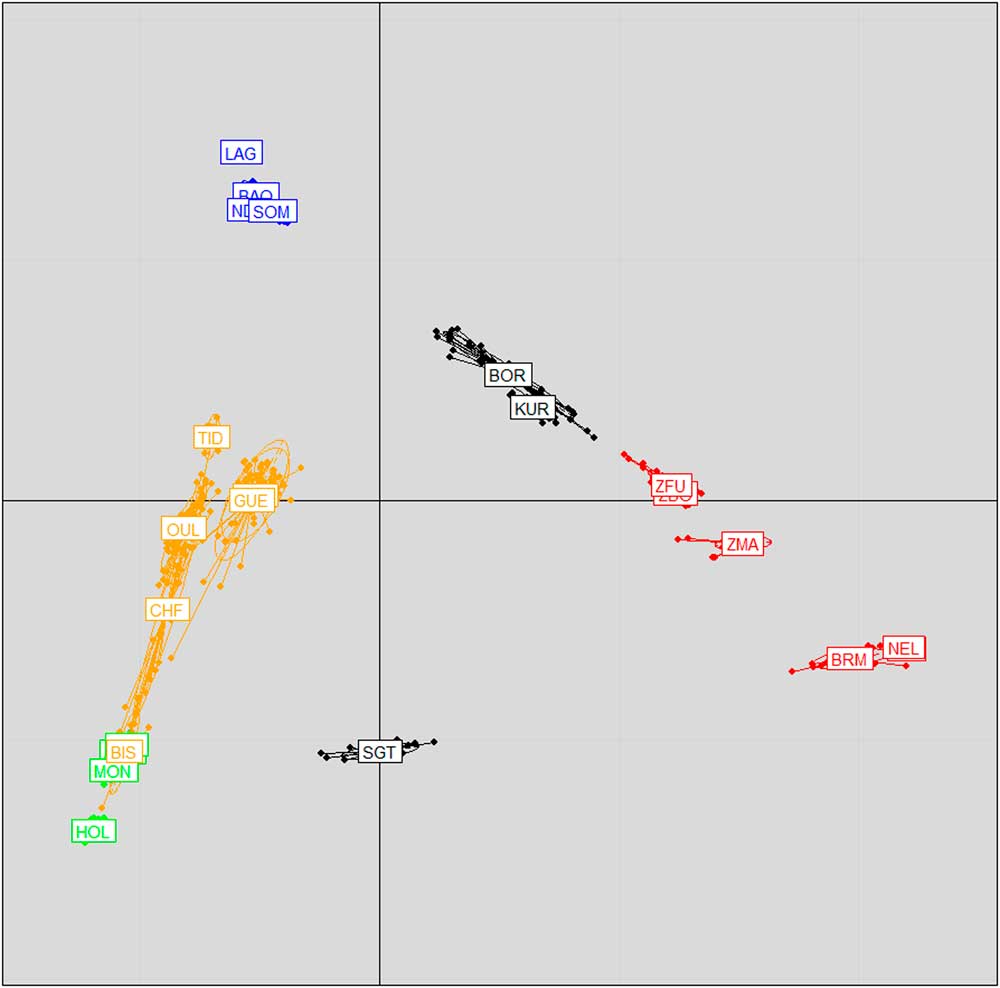
We carried out an individual-based PCA (Figure 1). The first two axes accounted for 11.6% and 7.2% of the total variation. A clear separation of EUT, WAT breeds and zebu (ZEB) was obtained. This global cattle genetic diversity can be described as a triangle with apexes represented by WAT, EUT and ZEB. The first axis aligned populations according to an indicine/taurine gradient, while the second one aligned them according to an African/European gradient. As expected, Algerian and Moroccan populations were positioned close to European breeds along the second axis, but the CHE and GUE populations slightly tilted toward the zebu. The CHF breed had a central position within this triangle with a large dispersion of CHF individuals within its ellipses and the presence of outliers, which came from different farms in the same region, indicating a heterogeneous origin of this population. The Algerian population BIS was very close to the European breeds and thus more distant from the other Maghrebin populations. Moreover, in agreement with the structure analysis, it can be seen that the BIS population has to be considered as a purely European breed.
Principal component analysis obtained from 732 individuals and 41 183 single nucleotide polymorphism. Individuals are plotted according to their coordinates on the first two components. Ellipses characterize the dispersion of each breed around its center of gravity. European taurine (green): ABO, HOL, TAR, MON; Algerian cattle (orange): BIS, CHE, CHF and GUE, Moroccan Cattle (orange): OUL and TID; West African taurine (blue): LAG, BAO, NDA and SOM; Hybrid between African taurine and zebu (Black): SGT; West African hybrids (Black): BOR and KUR; West African zebu (red): ZBO, ZFU and ZMA; zebu from Indian and Brazilian Origin (red): BRM, GIR and NEL. ABO=Abondance; HOL=Holstein; TAR=Tarine; MON=Montbéliard; BIS=Biskra; CHE=Cheurfa; CHF=Chelifienne; GUE=Guelmoise; OUL=Oulmès-Zaër; TID=Tidili; LAG=Lagune; BAO=Baoulé; NDA=N’Dama; SOM=Somba; SGT=Santa Gertrudis; BOR=Borgou; KUR=Kuri; ZBO=Bororo Zebu; ZFU=Fulani Zebu; ZMA=Zebu from Madagascar; BRM=Brahman; GIR=Gir; NEL=Nelore.

Analysis of population structure by ADMIXTURE software
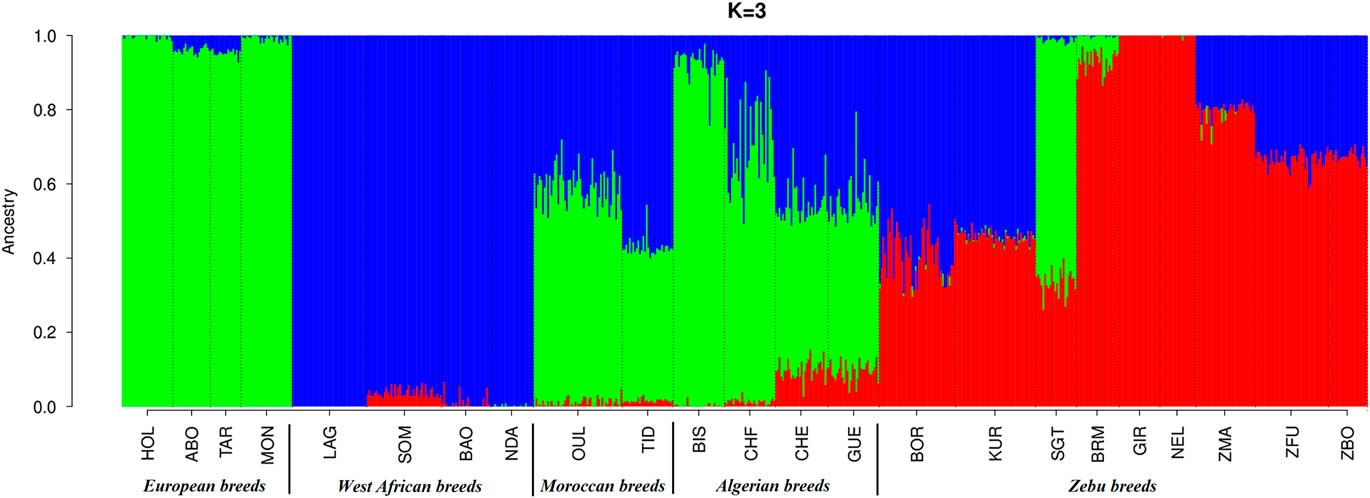
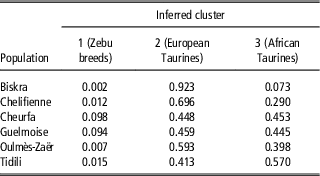
In agreement with the PCA, in this result, the ADMIXTURE analysis distinguished three groups (Figure 2) which might be representative of the EUT (cluster 1 in green), WAT (cluster 2 in blue) and ZEB cluster (cluster 3 in red). The four Algerian populations BIS, CHE, CHF and GUE and the two Moroccan breeds TID and OUL are characterized by the existence of several genetic origins. All individuals were heterogeneous and presented a significant proportion of EUT and AFT ancestry and possessed little percentage of ZEB ancestry. The BIS, CHF, OUL and TID individuals had on average 92%, 70%, 59% and 41% of EUT ancestry, respectively, as summarized in Table 2. Moreover, 9% of ZEB ancestry was detected on average in CHE and GUE individuals.
Unsupervised hierarchical clustering results on 732 individuals genotyped for 41 183 single nucleotide polymorphism with an inferred number of clusters K=3 for each individual, the proportions of European Taurines (EUT) (green), West African Taurines (WAT) (blue) and Zebu (ZEB) (red) ancestries are shown (y-axis). HOL=Holstein; ABO=Abondance; TAR=Tarine; MON=Montbéliard; LAG=Lagune; SOM=Somba; BAO=Baoulé; NDA=N’Dama; OUL=Oulmès-Zaër; TID=Tidili; BIS=Biskra, CHE=Cheurfa; CHF=Chelifienne; GUE=Guelmoise; BOR=Borgou; KUR=Kuri; SGT=Santa Gertrudis; BRM=Brahman; GIR=Gir; NEL=Nelore; ZMA=Zebu from Madagascar; ZFU=Fulani Zebu; ZBO=Bororo Zebu.

Different ratios of ADMIXTURE for each cattle population analyzed for K=3

Genetic differentiation
The genetic relationships, as measured by the F ST , ranged from 0.008 to 0.043 (Table 3). The CHE and GUE populations from eastern Algeria showed the lowest F ST values (F ST =0.008) while the BIS population from the Sub-Saharan of Algeria and TID from southern Morocco showed the highest F ST values (F ST =0.043).
Genetic distances (F ST ) values between the six cattle population

Phylogenetic analysis
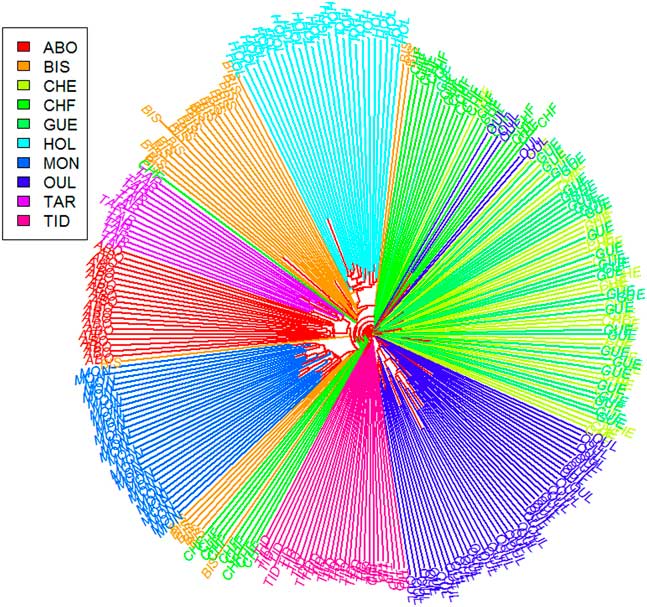
To provide additional insight into the origin and history of Algerian and Moroccan populations, we constructed a NJ tree based on allele sharing distance (Figure 3). Most of the Algerian animals from the two populations CHE and GUE were indistinguishable suggesting that each of these populations might be considered as a single population. Individuals from the CHF populations were separated. The BIS individuals were instead mostly grouped and they branched within the European populations, as previously shown with PCA analysis. Tidili and OUL individuals were separated according to their population of origin and they branched within the Maghrebin cluster. The French cattle breeds ABO, HOL, MON and TAR were grouped into four distinct clusters.
Neighbor-joining tree constructed among animals representing 10 cattle breeds. The tree was constructed using allele sharing distances based on 41 183SNP. Each branch represents a single animal and the breeds are distinguished by different colors. ABO=Abondance; BIS= Biskra; CHE=Cheurfa; CHF=Chelifienne; GUE=Guelmoise; HOL= Holstein; MON= Montbéliard; OUL=Oulmès-Zaër; TAR=Tarine; TID=Tidili.

Discussion
Genetic diversity within and between populations
The diversity in the Maghebin populations, measured by heterozygosity, was quite similar to that of European breeds (Gautier et al., Reference Gautier, Flori, Riebler, Jaffrézic, Laloë, Gut, Moazami-Goudarzi and Foulley2009). The value of F IS was slightly positive, suggesting inbreeding between related animals, which can be due to uncontrolled mating practices. Several factors can cause a deficit of heterozygotes. One reason could be inbreeding between related calves in which the gap affects the whole or most of the loci in a similar manner. Another factor could be the presence of subpopulation structure at the heard level that may cause distortion of the Hardy–Weinberg proportions because of the Wahlund effect (Jordana et al., Reference Jordana, Alexandrino, Beja-Pereira, Bessa, Canon, Carretero, Dunner, Laloë, Moazami-Goudarzi, Sanchez and Ferrand2003).
The differentiation (F ST ) level was low between CHE and GUE (F ST =0.008) and high between BIS and TID (F ST =0.043) cattle. A value of 0.068 was found in 18 south European beef cattle breeds (Jordana et al., Reference Jordana, Alexandrino, Beja-Pereira, Bessa, Canon, Carretero, Dunner, Laloë, Moazami-Goudarzi, Sanchez and Ferrand2003). In another study, the levels of differentiation were ranged from 0.008 to 0.043 within 28 European breeds (Gautier et al., Reference Gautier, Laloë and Moazami-Goudarzi2010). The low level of differentiation between CHE and GUE populations could be attributed to their common historical origin. This result seems to be a consequence of management practices that promote a certain gene flow among these two populations. This gene flow may be made easy by the low level of organization of these Algerian populations, particularly by the absence of herd books.
Overall, the different analyses performed suggest that BIS was the most EUT introgressed breed at a point that it should be considered, genetically speaking, as a pure European breed rather than a Maghrebin one. This might be due to the introduction of the French MON breed since the 1960s into Algeria to fill the deficit in dairy products (Bedrani and Bouaita, Reference Bedrani and Bouaita1998). The intermediate position of the CHF population between Maghrebin populations and French breeds could be interpreted as the result of crossbreeding between the animals of the local populations and imported breeds, which began during the French colonization and is still going on. This indicated that the CHF population is very heterogeneous. The Algerian population BIS was very close to the European breeds and thus more distant from the other Maghrebin populations. Moreover, in agreement with the structure analysis, it can be seen that the BIS population has to be considered as a purely European breed. The OUL, TID, CHE and GUE populations were found at an intermediary position between European and African breeds. In addition, the two later populations displayed a low level of zebu ancestry. This was consistent with historical records that showed that CHE population was crossed with the zebu (Association pour le Développement du Pastoralisme (ADP), Reference Alexander, Novembre and Lange1961). Muzzolini (Reference Muzzolini1982) stated that the first African humped cattle had a similar shape as the zebu in the central Sahara during the first millennium BC. His idea was largely based on the rock painting found in Maghreb (Libya), Hoggar and Tassili in the Sahara. It is thought that there was a wide hybridization between the zebu and the local cattle breed of Algeria for centuries, as Algeria has borders with sub-Saharan countries where the zebu is found. In addition, the biochemical studies showed that the B allele of the hemoglobin gene that was found in zebu cattle was present in Algerian cattle, but absent in Moroccan cattle (Epstein, Reference Epstein1971).
Finally, purebred stock is now scarce, at least in Algeria, as the populations have been crossed with imported French breeds (Payne and Hodges, Reference Payne and Hodges1997). The high gene flow between populations has guaranteed a gene exchanges among populations, which led to high within-population levels of diversity. The short-term effect of this flow for reproductive purposes may be through the advantages of additive effects and heterosis. Introgression of highly productive French breeds may have short-term advantages in term of productivity. However, this introgression may negatively impact the adaptability of these populations to a harsh environment, especially in the context of climate change (Hoffmann, Reference Hoffmann2010).
Conclusion
In this study, we used a medium-density 54K Illumina BovineHD BeadChip to examine genetic diversity and population structure in four Algerian and two Moroccan cattle populations. All the analyses (PCA, population structure and phylogenetic tree) support a clear differentiation of cattle populations according to their historical origins. CHE, GUE, OUL and TID populations share a common origin, while the BIS population was characterized by a strong genetic relationship with the European breeds. Similarly, if crossbreeding with imported European breeds continues, the CHF population will as well become a European breed. The results of this study show the wide range of the genetic status of the Maghrebin populations: while some can be considered as pure local breeds, some other have a very high level of introgression with European breeds. These genetic resources are threatened as they are at risk of becoming genetically uniform in the future and hence less adapted to future unpredictable environments. As outlined by Leroy et al. (Reference Leroy, Baumung, Boettcher, Scherf and Hoffmann2016), crossbreeding between local and improved resources may allow, in a favorable environment, an improvement of performance of production traits. However, fitness traits of crossbred animals are usually deteriorated in comparison with local individuals. This unfortunate situation can be avoided by effective management programs for their preservation. A first step toward achieving this could be to geographically delimit populations while allowing the normal management of traditional systems through a joint program encompassing farmers, veterinarians, national governments and geneticists.
Acknowledgments
The completion of this work has benefited from the participation and collaboration of many partners. The authors would like to thank the Algerian breeders and the Officials of the Departments of Agricultural Services of different wilayas (Departments) and Veterinarians who have contributed to the collection of samples for the 121 animals of Algeria. The authors thank the IAV Hassan II, Rabat, Morocco for providing 82 DNA of OUL and TID breeds, and the Moroccan farmers whose cattle were blood sampled. They also thank the LABOGENA staff for their laboratory assistance. Genotyping of samples was funded by the INRA ACCAF (Metaprogramme 2012-2014) grant (GALIMED project). This article was prepared during a leave granted by laboratory LGMC, University USTO ‘Mohamed Boudiaf,’ Oran, Algeria.
Declaration of interest
The authors declare that they have no competing interests.
Ethics statement
Blood samples from the animals were collected under routinary work upon breeder’s approval. No experiment was performed on the animals. This material has not been published in whole or in part elsewhere. The manuscript is not currently being considered for publication in another journal. All authors have been personally and actively involved in substantive work leading to the manuscript, and will hold themselves jointly and individually responsible for its content.
Software and data repository resources
Deposited in Portail Data InraDataverse (doi:10.15454/HCFRWQ) with an Open Access CC BY-NC license.