Introduction
Notoacmea scapha (Patellogastropoda: Lottiidae) is a small marine limpet that is extremely abundant in the intertidal zone of Otago Harbour, South Island, New Zealand. This species is distinguished from several closely related, morphologically similar limpets inhabiting New Zealand by its choice of substrate (Nakano & Spencer, Reference Nakano and Spencer2007; Nakano et al., Reference Nakano, Marshall, Kennedy and Spencer2009). Typically, this limpet grazes microalgae growing on the shells of the topshell snail, Diloma subrostrata, and the New Zealand cockle, Austrovenus stutchburyi (Morton & Miller, Reference Morton and Miller1968). The Otago Harbour mud flats support a rich diversity of trematode parasites (Leung et al., Reference Leung, Donald, Keeney, Koehler, Peoples and Poulin2009); however, it is unknown whether N. scapha plays any role in their life cycles. Indeed, several parasite life cycles from this area are incompletely resolved. Examining previously overlooked organisms for infections can serve to fill gaps in these partially understood life cycles.
The limpet N. scapha lives at the water–sediment interface, and is therefore exposed to a range of trematode cercariae targeting benthic organisms. On the one hand, the limpet may serve as an alternative second-intermediate host. On the other hand, it may also act as a sink in which cercariae may encyst as metacercariae and survive, but without ever being transferred to a definitive host by predation. For instance, echinostome metacercariae accumulate in both a deep-burrowing bivalve, Macomona liliana, and a shallow-burrowing one, A. stutchburyi (Leung & Poulin, Reference Leung and Poulin2008); however, the feeding behaviour of bird definitive hosts means that metacercariae in M. liliana, although viable, will never complete their life cycle.
Therefore, the purpose of this study was to determine whether N. scapha is infected by larval trematodes in Otago Harbour. We then discuss whether the limpets are more likely to act as intermediate hosts or as a sink in trematode transmission. We used molecular tools to identify metacercariae retrieved from limpets in the field, and ecological information to determine what role, if any, limpets play in the life cycles of these parasites.
Materials and methods
Field collections and dissections
Sixty N. scapha were collected from a mud flat at Lower Portobello Bay, Otago Harbour, South Island, in March 2010. Of these, 30 were removed from the shells of topshell snails, and 30 were removed from the shells of cockles. Prior to dissection, the limpets were housed in containers (170 mm long × 170 mm wide × 80 mm high) with fresh sea water and aerated with an air stone. The shell length of each limpet was measured to the nearest 0.1 mm with vernier callipers before dissection. The limpets were removed from their shells with forceps and firmly pressed between two glass plates to flatten the tissue. Metacercariae were clearly visible through the transparent tissue. All metacercariae were counted, and a subset of each morphotype was stored in 95% ethanol for identification.
Molecular identification of metacercariae
Gene sequences were obtained from a subset of metacercariae for comparisons with DNA barcodes available for Otago Harbour trematodes (Leung et al., Reference Leung, Donald, Keeney, Koehler, Peoples and Poulin2009). These metacercariae were placed individually into a 1.5 ml Eppendorf tube for DNA extraction. DNA was extracted in 200 μl of 5% chelex containing 0.2 mg/ml proteinase K, incubated at 60°C overnight and boiled at 100°C for 8 min. The CO1 gene of each individual was amplified using JB3 (5′-TTTTTTGGGCATCCTGAGGTTTAT-3′) of Bowles et al. (Reference Bowles, Hope, Tiu, Xushian and McManus1993) as the forward primer. The reverse primer used was trem.cox1.rrnl (5′-AATCATGATGCAAAAGGTA-3′) of Králová-Hromadová et al. (Reference Králová-Hromadová, Špakulová, Horáčková, Turčeková, Novobilský, Beck, Koudela, Marinculić, Rajský and Pybus2001). All polymerase chain reactions (PCRs) were run in 30 μl reaction mixtures. Cycling parameters were as described in Leung et al. (Reference Leung, Donald, Keeney, Koehler, Peoples and Poulin2009). The PCR products were purified using Purelink™ PCR Purification kits (Invitrogen, Carlsbad, California, USA) and sequenced as described in Leung et al. (Reference Leung, Donald, Keeney, Koehler, Peoples and Poulin2009). Sequences were aligned using ClustalW in MEGA version 3.1 genetic analysis program (Kumar et al., Reference Kumar, Tamura and Nei2004). Pairwise comparisons of sequences were conducted using Kimura's two-parameter model (Kimura, Reference Kimura1980) also in MEGA.
Results
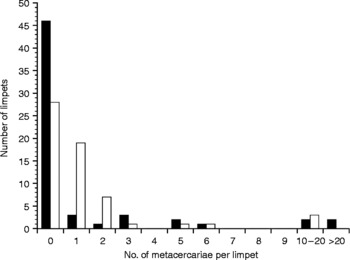
The 60 limpets collected had a mean ( ± SD) shell length of 5.7 ± 1.6 mm, with the longest reaching 9 mm. Three species of metacercariae were identified from the limpets; the sequences obtained were found to be identical to those of opecoelid sp. A, Acanthoparyphium sp. A and Curtuteria australis (see Leung et al., Reference Leung, Donald, Keeney, Koehler, Peoples and Poulin2009). All metacercariae were alive, with worms seen moving inside the cysts. An overall prevalence of 23% was observed for opecoelid sp. A, and there was no correlation between limpet shell length and abundance of these metacercariae (P = 0.08). Most infected limpets harboured very few metacercariae of this species, while over two-thirds of metacercariae recovered came from just four limpets hosting between 10 and 24 cysts (fig. 1). Two species of echinostome metacercariae were identified as Acanthoparyphium sp. A and C. australis; however, these two ecologically similar species were difficult to differentiate morphologically, and since only a few were identified using molecular data, they were subsequently grouped for analysis (table 1). The overall prevalence of echinostome metacercariae was 53%; the metacercariae showed an aggregated distribution among their hosts (fig. 1), and there was no correlation between limpet shell length and abundance of echinostomes (P = 0.13). Fisher's exact test revealed no difference in the prevalence of either species between limpets taken from Diloma shells and those from cockle shells (both P>0.05). Similarly, Wilcoxon signed-rank tests revealed no differences in abundance of either metacercariae between host/substrates (table 1). However, the overall prevalence of echinostome metacercariae was significantly higher than that of opecoelid sp. A metacercariae (Fisher's exact test, P = 0.001).
Frequency distribution of numbers of metacercariae per limpet for two trematode taxa among 60 limpets, Notoacmea scapha. Data are shown separately for opecoelid sp. A (black bars) and echinostomes (open bars).

Prevalence and mean abundance (±one standard deviation) of trematode metacercariae encysted within limpets (Notoacmea scapha) removed from the shells of cockles and topshells.

Discussion
Limpets can serve as first-intermediate hosts of trematodes (Martin, Reference Martin1982; Prinz et al., Reference Prinz, Kelly, O'Riordan and Culloty2010), and are also commonly reported to be infected by trematode metacercariae (e.g. Martorelli & Morriconi, Reference Martorelli and Morriconi1998; Oliva & Huaquin, Reference Oliva and Huaquin2000). Here, we show that although the limpet N. scapha is physiologically compatible for the survival of metacercariae of three different trematode species, we argue that it serves as a sink in their transmission dynamics, as it is unlikely to be consumed by suitable definitive hosts.
While it is apparent that N. scapha is readily susceptible to penetration by cercariae of the echinostomes Acanthoparyphium sp. A and C. australis, the limpet is most probably not the intended host for either of these trematodes. The definitive hosts of Acanthoparyphium sp. A and C. australis are wading birds such as the pied oystercatcher Haematopus ostralegus (Allison, Reference Allison1979), which acquire metacercariae of Acanthoparyphium sp. A or C. australis after feeding on infected cockles. These birds feed on bivalves by either hammering a hole in the shell or by prying the shell open using their bill (Nagarajan et al., Reference Nagarajan, Lea and Goss-Custard2002). Oystercatchers do not ingest the shell of their prey, and are unlikely to consume N. scapha attached to the shell of bivalves. Oystercatchers can occasionally feed on limpets, but in such cases the targeted limpet species are several times larger than the very small N. scapha (e.g. Frank, Reference Frank1982). Therefore, Acanthoparyphium sp. A and C. australis metacercariae encysted within the limpet, like those found in the deep-burrowing bivalve Macomona liliana (Leung & Poulin, Reference Leung and Poulin2008), are most likely lost from the life cycle.
The first-intermediate host for opecoelid sp. A is the topshell snail Diloma subrostrata (Donald et al., Reference Donald, Kennedy, Poulin and Spencer2004), and although the downstream hosts for this trematode have not been confirmed, they are thought to include a crustacean second-intermediate host and a fish definitive host (Leung et al., Reference Leung, Donald, Keeney, Koehler, Peoples and Poulin2009). While metacercariae of opecoelid sp. A persist within the limpet, they are unlikely to be consumed by the appropriate downstream fish host. As with metacercariae of Acanthoparyphium sp. A and C. australis, opecoelid sp. A metacercariae are most likely lost from the system when encysted in the limpet N. scapha. There are no known predators of this limpet, although it is highly likely that whelks, Cominella glandiformis, are the only organisms feeding on them (H. Spencer, pers. comm.). Metacercariae in limpets may survive consumption by whelks and passage through their gut, like metacercariae from other whelk victims (Latham et al., Reference Latham, Fredensborg, McFarland and Poulin2003; McFarland et al., Reference McFarland, Mouritsen and Poulin2003), but this still would not lead to transmission to suitable definitive hosts for either opecoelid sp. A or the echinostomes.
From a physiological perspective, it appears that N. scapha is a suitable alternative host for the encystment of some species of cercariae, with the metacercariae remaining viable. However, because N. scapha is unlikely to be consumed by the downstream hosts for these trematodes, the limpets most likely act as decoys, ‘distracting’ the free-living stages from their target hosts (Thieltges et al., Reference Thieltges, Jensen and Poulin2008). Once the metacercariae are formed within N. scapha, they are effectively removed from the system within their dead-end host, as if they had failed to encyst at all. Given that the prevalence of the different trematodes was statistically similar among limpets removed from cockles versus those removed from topshells, individual limpets may alternate between substrates, thereby exposing themselves to whichever parasites are near. The importance of limpets as parasite population sinks is probably limited, however. Indeed, for echinostomes, abundance of metacercariae in the limpets is quite low, and in spite of generally high limpet densities, only a small fraction of the parasite population ends up in limpets instead of cockles, their normal second-intermediate host. Using conservative estimates of at least 50 limpets and 100 cockles per m2 (unpublished data), and abundances of 1.32 metacercariae per limpet (see table 1) and over 300 per cockle (Leung & Poulin, Reference Leung and Poulin2008), the difference between parasites reaching the right host and those getting lost in limpets is over 400-fold. Similarly, Leung & Poulin (Reference Leung and Poulin2008) estimated that no more than 3% of echinostome metacercariae are lost in the deep-burrowing bivalve M. liliana. Therefore, N. scapha and M. liliana, although they are acting as sinks for the cercariae that fail to locate an appropriate second-intermediate host, are probably not major forces in the population dynamics of these trematodes.