Introduction
Ageism is frequently identified as an important form of discrimination touching multiple facets of seniors’ lives such as employment (Loretto, Duncan and White Reference Loretto, Duncan and White2000) and encounters with health and social services (Davidson Reference Davidson2012). While there are many complex cultural, socio-economic, institutional and political factors behind the prevalence of ageism (Palmore Reference Palmore1999), the media represents a major constructor and diffuser of ageing stereotypes (Rozanova, Northcott and McDaniel Reference Rozanova, Northcott and McDaniel2006; Vasil and Wass Reference Vasil and Wass1993). Inspired by the polarised ageism framework (Cole Reference Cole1992; McHugh Reference McHugh2003; Rozanova, Northcott and McDaniel Reference Rozanova, Northcott and McDaniel2006), we perform a comparative content analysis of three forms of ageism (intergenerational, compassionate and new ageism) in two American (The New York Times and The Washington Times) and two Canadian newspapers (Toronto Star and National Post). The justification for this comparison stems primarily from commonalities in both countries’ media systems, specifically independence from political parties with journalists aiming to write from a neutral point of view (Hallin and Mancini Reference Hallin and Mancini2004).
There are two main objectives for this comparison. First, we aim to assess whether substantial differences in coverage exist between news outlets in Canada and the United States of America (USA). We suspect that US newspapers contain more articles with intergenerational ageism in line with previous comparative studies (Cook et al. Reference Cook, Marshall, Marshall, Kaufman, Marmor, Smeeding and Greene1994; Gusmano and Allin Reference Gusmano and Allin2014) and that compassionate ageism prevails in Canada. Second, we analyse whether the political orientation of newspapers influences how ageing is portrayed. Building upon arguments on the importance of political orientation in forming different portrayals of older adults (Arber and Ginn Reference Arber and Ginn1991; Binstock Reference Binstock2010) and on contributions analysing policy biases in media (Kim, Carvalho and Davis Reference Kim, Carvalho and Davis2010; Larcinese, Puglisi and Snyder Reference Larcinese, Puglisi and Snyder2011), we expect intergenerational ageism to be prevalent in conservative newspapers (The Washington Times and National Post) and compassionate ageism in liberal ones (The New York Times and Toronto Star).
The research reveals four key findings. First, a disproportionate amount of articles in our sample (76%) contain negative portrayals of ageism, adding support to earlier contributions finding that the media continues to convey mostly negative messages when it comes to ageing. Second, the USA continues to feature more intergenerational articles than Canada, while Canada exhibits a high number of articles featuring compassionate ageism. Third, the political orientation of newspapers plays a role in shaping the types of ageism depicted, with a majority of conservative articles depicting intergenerational ageism while liberal articles feature mostly compassionate ageism. Finally, we found very few articles portraying a more holistic or complex understanding of ageing.
This contribution features five sections. First, it explores why media portrayals matter, with a special emphasis on the under-representation of older adults and their negative depictions. This section also introduces the three forms of ageism under analysis. The second section summarises the literature concerning the political orientation of the media, including the country of origin, and how it can impact the portrayals of older adults. The third and fourth sections present the methodology employed and the empirical analysis. The conclusion summarises the findings and propose avenues for further research.
Media portrayals of older adults
The media functions as ‘a resource for learning’ because it primarily acts as a means of diffusing general information (Lyons Reference Lyons2009: 32). Within democratic regimes, the media aims to equip citizens with a ‘coherent sense of the broader social forces that affect the conditions of their everyday lives’ (Gamson et al. Reference Gamson, Croteau, Hoynes and Sasson1992: 373). While fulfilling this purpose, the media also generates information about specific social groups (Lyons Reference Lyons2009), which has important societal and policy consequences. For example, the media creates an exemplar of a particular societal group, which shapes how the rest of society views this group (Lee, Carpenter and Meyers Reference Lee, Carpenter and Meyers2007) and citizens use ‘media-generated images’ to attach particular value to different ideas and, importantly, to different societal groups (Gamson et al. Reference Gamson, Croteau, Hoynes and Sasson1992: 374). More specifically to public policy, the media plays an important role in shaping the social construction of target populations, which in turn determines if a social group is deemed ‘undeserving’ or ‘deserving’ and the type of policy instruments preferred by governments (Schneider and Ingram Reference Schneider and Ingram1993: 335). Complementing the policy literature, Williams, Ylänne and Wadleigh (Reference Williams, Ylänne and Wadleigh2007) stress that these social constructions are particularly important when younger generations are lacking contact with older members of society.
Lastly, one of the most severe implications of media portrayals, and the object of this study, is their role in perpetuating detrimental stereotypes and ageism in society (Gilbert and Ricketts Reference Gilbert and Ricketts2008). Prior studies of newspapers denote the prevalence of ageism (Fealy et al. Reference Fealy, Mcnamara, Treacy and Lyons2012; Gusmano and Allin Reference Gusmano and Allin2014; Martin, Williams and O'Neill Reference Martin, Williams and O'Neill2009; Rozanova Reference Rozanova2010; Rozanova, Northcott and McDaniel Reference Rozanova, Northcott and McDaniel2006).
The portrayal of older adults in the media
Scholarly research on the aged in the media features two main themes: the under-representation and the negative portrayal of older adults (Lyons Reference Lyons2009: 33; Rozanova, Northcott and McDaniel Reference Rozanova, Northcott and McDaniel2006: 374; Vasil and Wass Reference Vasil and Wass1993: 80). First, in a comprehensive literature review on the portrayal of older adults, Vasil and Wass (Reference Vasil and Wass1993) find that more than 90 per cent of the studies (20 of 22) mention that older adults were notably absent in the media. More recent studies of the representation of older adults point in the same direction. Healey and Ross (Reference Healey and Ross2002) interviewed seniors on media content and found that even seniors acknowledged that they saw a clear bias of television content towards youthful cohorts. Studies conducted by Harwood and Anderson (Reference Harwood and Anderson2002), as well as Robinson and Anderson (Reference Robinson and Anderson2006), on television content share these conclusions.
Second, and contrary to the literature cited above, there is an ongoing debate concerning the portrayals of older adults in the media. Most of the literature claims that the media paints a negative image of older adults, and that this applies to all media (Aronoff Reference Aronoff1974; Harris and Feinberg Reference Harris and Feinberg1977; Lyons Reference Lyons2009; Vasil and Wass Reference Vasil and Wass1993). For example, Cohen's (Reference Cohen2002) focus group study critiques the depictions of ageing older women in the television show The Golden Girls. An Irish study on the portrayal of older adults in the print media emphasises that seniors are almost exclusively associated with the concepts of ‘dependency and otherness’, often in relation to the ‘alarmist tone of population ageing’ (Fealy et al. Reference Fealy, Mcnamara, Treacy and Lyons2012: 99). Also worth mentioning is a study on the consequences of an ageing population as depicted in The Economist. Relying on a random sample of articles from 1997 to 2008, 168 of the 256 articles analysed constructed the older population ‘as a burden’ (Martin, Williams and O'Neill Reference Martin, Williams and O'Neill2009: 1).
Despite these trends, positive media depictions of older adults can also be found in many studies (Roy and Harwood Reference Roy and Harwood1997), such as Featherstone and Hepworth's (Reference Featherstone, Hepworth, Featherstone and Wernick1995) study of a magazine and Harwood and Roy's (Reference Harwood and Roy1999) study of print advertisements in widely read American and Indian magazines. In a study of print media, Williams, Ylänne and Wadleigh (Reference Williams, Ylänne and Wadleigh2007: 19) go further by arguing that negative portrayals of older adults have been surpassed by more positive and ‘adventurous images’ of seniors. The authors cite numerous media depictions of seniors as ‘healthy, fit, active, modern and even sexual older people’, and conclude that these new depictions can provide positive ‘role models’ for older adults (Williams, Ylänne and Wadleigh (Reference Williams, Ylänne and Wadleigh2007: 18–19).
Research findings such as these have triggered an ongoing debate on the actual content of media depictions of adults (Roy and Harwood Reference Roy and Harwood1997) and on what constitutes a positive or negative portrayal. For example, Rozanova, Northcott and McDaniel (Reference Rozanova, Northcott and McDaniel2006) perform an examination of both opposing types of portrayals with the polarised ageism framework in their study of Canadian newspaper articles. The first type of ageism highlights the contrast between older members of society and younger members in a particularly unfavourable light. The authors refer to these media depictions as intergenerational. The second type of ageism is rooted in the favourable portrayals of older adults, often conceptualised as ‘successful ageing’ in gerontology (Rozanova, Northcott and McDaniel Reference Rozanova, Northcott and McDaniel2006). They found evidence of polarised forms of ageism in 30 articles of the Canadian newspaper Globe and Mail. We expect similar findings in the Canadian (Toronto Star and the National Post) and US newspapers (The New York Times and The Washington Times) under study for this article.
Conceptualising three forms of ageism for media analysis
Three popular forms of ageism are studied in this contribution: compassionate ageism, intergenerational ageism, and new ageism. Drawing from Rozanova, Northcott and McDaniel's (Reference Rozanova, Northcott and McDaniel2006) study on polarised ageism, we expect the media to present both negative (compassionate and intergenerational ageism) and positive (new ageism) portrayals of ageing. A key distinction between their study and ours is the classification of compassionate ageism as a distinctive negative form of ageism.
First, prior to the 1970s, older adults were traditionally regarded in a negative, yet sympathetic manner (Arber and Ginn Reference Arber and Ginn1991; Binstock Reference Binstock2010). Seniors were painted as victims who were mentally and physically incapable of taking care of themselves, which Binstock (Reference Binstock2010) identifies as compassionate ageism. Compassionate ageism considers older adults as ‘deserving poor’ (Binstock Reference Binstock1983: 136; Schneider and Ingram Reference Schneider and Ingram1993) and it is rooted in the social liberal ideology, which assumes that it is the role of the government to ensure the wellbeing of older adults (Arber and Ginn Reference Arber and Ginn1991: 51; Binstock Reference Binstock2010: 575). It represents a form of ageism due to its depiction of older individuals as passive, frail and dependent, with governmental authorities cementing these stereotypes through policies that limit their participation in the labour market (Macnicol Reference Macnicol2006) and practices that exclude them from meaningful aspects of political life (Walker and Naegele Reference Walker and Naegele1999).
Second, intergenerational ageism has become far more prevalent since the 1970s, with older adults being depicted as a strong, one-dimensional, over-indulgent societal faction (Arber and Ginn Reference Arber and Ginn1991; Binstock Reference Binstock2010). This type of ageism is connected to the conservative movement in that it champions individual instead of governmental responsibilities (Binstock Reference Binstock2010; Quadagno Reference Quadagno1989). Intergenerational ageism depicts an age war where older adults are portrayed as ‘greedy geezers’ who benefit unfairly from programmes such as Social Security and Medicare (Binstock Reference Binstock2010; Quadagno Reference Quadagno1989). As such, older adults are associated with being societies’ takers rather than givers (Rozanova, Northcott and McDaniel Reference Rozanova, Northcott and McDaniel2006) and they are even being held responsible for causing an impending ‘generational storm’ (Kotlikoff and Burns Reference Kotlikoff and Burns2005). A similar shift towards intergenerational ageism rooted in conservative values has also been identified in Canada (Foot and Venne Reference Foot and Venne2005).
The third form of ageism analysed in this contribution is new ageism. It builds upon the omnipresence of successful ageing in gerontology (Dillaway and Byrnes Reference Dillaway and Byrnes2009) that co-exists alongside complementary concepts such as healthy ageing, productive ageing and active ageing (Boudiny Reference Boudiny2013). New ageism, as defined by Angus and Reeve (Reference Angus and Reeve2006), reflects the overtly positive ideals behind these concepts, which are difficult, not to say impossible, to reach for many older adults (Dillaway and Byrnes Reference Dillaway and Byrnes2009; Rozanova Reference Rozanova2010; Rozanova, Northcott and McDaniel Reference Rozanova, Northcott and McDaniel2006). Older adults have in fact multiple understandings of what constitutes successful ageing, and these do not necessarily match the messages promulgated in the media and policy documents (Ferri, James and Pruchno Reference Ferri, James and Pruchno2009). As with intergenerational ageism, new ageism also has political roots dating back to the conservative shift of the 1980s (Dillaway and Byrnes Reference Dillaway and Byrnes2009; Moody Reference Moody, Wykle, Whitehouse and Morris2005), but also as part of the turn towards the social determinants of health in psycho-social (Baltes and Baltes Reference Baltes and Baltes1993) and biomedical research (Bowling and Dieppe Reference Bowling and Dieppe2005). Ageing is depicted as a policy issue that is personal in nature where the state plays a very limited role (Rozanova Reference Rozanova2010). The agency of an individual is prized as the means of confronting the hardships of life, rather than dependence on a governmental body (Binstock Reference Binstock2010). New ageism requires the continued efficiency of adults as valuable contributors in a capitalistic society (Liang and Luo Reference Liang and Luo2012). Individual responsibilities are also promulgated in the psycho-social and biomedical versions of successful ageing since they aim at highlighting increased levels of both physical and mental activity (Dillaway and Byrnes Reference Dillaway and Byrnes2009; Rozanova, Northcott and McDaniel Reference Rozanova, Northcott and McDaniel2006: 376) and lifestyle choices (Baltes and Baltes Reference Baltes and Baltes1993; Franklin and Tate Reference Franklin and Tate2009).
The political orientation of the media and its impact on the portrayal of older adults
This contribution seeks to move beyond identifying the prevalence of polarised ageism in the media by analysing whether the political orientation of a newspaper and its country of origin differently influence both the frequency of ageist articles and the types of ageism portrayed in newspapers. This section aims to discuss the importance of the mediatisation of politics, the political orientation of the media, and the value of comparing ageism in Canada and the USA. Each section concludes by elaborating clear theoretical expectations for the three forms of ageism elaborated in the previous section for the subsequent empirical analysis.
The mediatisation of politics and the political orientation of media
There is an increasing mediatisation of politics where debates and public institutions are influenced, and even shaped by mass media (Mazzoleni and Schulz Reference Mazzoleni and Schulz1999), and the media is frequently identified as a major source of influence in policy research (Baumgartner, Green-Pedersen and Jones Reference Baumgartner, Green-Pedersen and Jones2006). The political orientation of a particular media outlet influences the type of coverage a particular issue receives. Several studies demonstrate notable policy differences in the conservative and liberal-leaning media coverage of economic news (Larcinese, Puglisi and Snyder Reference Larcinese, Puglisi and Snyder2011), poverty (Kim, Carvalho and Davis Reference Kim, Carvalho and Davis2010), same-sex marriage legislation (Pan, Meng and Zhou Reference Pan, Meng and Zhou2010), refugees (Greenberg Reference Greenberg2000) and climate change (Feldman et al. Reference Feldman, Maibach, Roser-Renouf and Leiserowitz2012).
To identify how the political orientation of newspapers influences the type of ageist discourse deployed, it is important to state clearly what we would expect in terms of differences based on the political tendencies of newspapers. Importantly, social gerontologists have been quick to emphasise that ageism is not only a theme for conservative media. For example, Davidson (Reference Davidson2012: 29–30) reports instances of intergenerational ageism in the liberal print media in both the United Kingdom and the USA. In Canada, Gee (Reference Gee, Gee and Gutman2000) also employs examples from multiple sources to argue that ‘apocalyptic demography’ is ubiquitous in the media.
To the best of our knowledge, there are no contributions systematically analysing the importance of the political orientation of the media and how they portray ageism. With multiple mentions of ageism being present across the media political spectrum, we expect to find all forms of ageism in all four newspapers under study. Moreover, we expect the prevalence of ageism will differ based on both the political orientation of the media and its country of origin. With many analyses linking the rise of intergenerational arguments with right-wing interest groups dedicated to retrenching the welfare state (Arber and Ginn Reference Arber and Ginn1991; Binstock Reference Binstock2010; Gee Reference Gee, Gee and Gutman2000, Quadagno Reference Quadagno1989), we expect to find more intergenerational ageism in conservative newspapers.
Secondly, with left-wing parties more likely to endorse propositions that assume governmental intervention will improve the lives of the most vulnerable populations, even during times of retrenchment (Korpi and Palme Reference Korpi and Palme2003), we expect liberal newspapers to feature more compassionate ageism within their content. Finally, with a strong focus on individual responsibilities and minimal state intervention, we would also assume that new ageism will be more evident in conservative newspapers, while liberal newspapers would be more likely to present a deeper analysis of multiple social causes and conditions in ageing, consistent with a previous study on poverty (Kim, Carvalho and Davis Reference Kim, Carvalho and Davis2010).
Ageism in Canada and the USA
US society is primarily known for its prizing of individual agency, with US citizens more interested in preserving their own individual freedoms than promoting a responsibility to ensure the wellbeing of other citizens (Gusmano and Allin Reference Gusmano and Allin2014). In fact, Sabin (Reference Sabin2012) argues that the US constitutional framework highlights freedoms and agency, with government imposition or ‘external control’ of citizens seen as the great enemy in US cultural thinking. Conversely, authors have written that Canada is thought to exemplify co-operation amongst citizens. For example, McDaniel (Reference McDaniel, Gee and Gutman2000: 130) points to the generosity of the Canadian welfare state, which symbolises this co-operation, and the relative weaknesses of US social policies. Clark (Reference Clark, Hendricks and Rosenthal1993) uses foundational documents from both the USA and Canada as a means of highlighting the differences between the two national political ideologies. In the Canadian case, the British North American Act states ‘peace, order, and good government’ whereas the equivalent US document, the Declaration of Independence, mentions ‘life, liberty and the pursuit of happiness’ (Clark Reference Clark, Hendricks and Rosenthal1993: 13).
There are very few contributions comparing Canadian and US media with regard to issues relevant to our three concepts of ageism (Cook et al. Reference Cook, Marshall, Marshall, Kaufman, Marmor, Smeeding and Greene1994; Gusmano and Allin Reference Gusmano and Allin2014). A study comparing the prevalence of intergenerational equity debates in the academic, media and political arenas in Canada and the USA (1980–1993) stresses that this debate was virtually absent in Canada (Cook et al. Reference Cook, Marshall, Marshall, Kaufman, Marmor, Smeeding and Greene1994). Given these findings and the theoretical arguments discussed earlier (Arber and Ginn Reference Arber and Ginn1991: 53; Rozanova Reference Rozanova2010: 220), we would expect to see more portrayals of intergenerational ageism and new ageism in the US newspapers than in the Canadian ones. Conversely, we would expect to see more compassionate ageism in the Canadian newspapers to reflect the more prevalent belief that governments should provide a safety net to take care of older adults.
Empirical analysis
The polarised ageism framework is a valuable heuristic tool because it assumes that ageism takes different shapes and it develops a methodology to identify them. To study the impact of the political orientation of newspapers and their country of origins on the prevalence of three forms of ageism, we perform a comparative analysis focusing on four major newspapers: The New York Times, The Washington Times, Toronto Star and National Post. The following methodological choices were made. First, the articles read in this study were from 2013 and 2014; these years were chosen to present a contemporary picture of older adults in newspaper content. Second, these particular newspapers represent the different liberal and conservative ideologies present in the US and Canadian contexts.
Newspaper selection
Many elements facilitate the comparison of US and Canadian newspapers. According to Hallin and Mancini (Reference Hallin and Mancini2004), who developed a typology of media systems, both countries belong to the Liberal model. North American countries embrace ‘an informational style of journalism’ and newspapers remain independent from political parties (Hallin and Mancini Reference Hallin and Mancini2004: 198). Also, US and Canadian journalists aim generally to write from a neutral perspective, but differences in political orientation can be seen, most particularly in the television sector (Hallin and Mancini Reference Hallin and Mancini2004: 208).
To our knowledge there is no definitive study which compares the polarisation of individual newspapers in Canada and the USA owing to political orientation. However, there is a plethora of research on the polarisation of newspapers within these countries, with one of the most cited studies published by Groseclose and Milyo (Reference Groseclose and Milyo2005). The authors develop a measure of ideology based on the frequency with which newspapers use information from certain think tanks. These newspaper citations were then observed in light of the citations used by politicians to classify different media as conservative or liberal. Their study found that The Washington Times and The New York Times were positioned on the right and left side of the political spectrum, respectively (Groseclose and Milyo Reference Groseclose and Milyo2005: 1211).
Gentzkow and Shapiro's (Reference Gentzkow and Shapiro2010, 36) study adds support to our selection which tracked the rate at which different newspapers utilise ‘politically charged phrases’. The Washington Times and The New York Times are classified as conservative and liberal counterparts by not only academic research but also internet users (Gentzkow and Shapiro Reference Gentzkow and Shapiro2010: 47–8). These two newspapers have also been used to compare the coverage of the 2004 American Presidential race, finding evidence to suggest that The New York Times and The Washington Times were publishing ideological liberal and conservative content (Cummings Reference Cummings2006). These noticeable differences in political orientation are far from coincidental since The Washington Times was created to provide a conservative counterpoint to both the local Washington Post and national New York Times (Edwards Reference Edwards2002: 50, 60).
There is also evidence to justify a comparison of the Toronto Star and the National Post as polar opposites on the political spectrum. A comparative analysis of Canadian newspapers reveals that the Toronto Star is a liberal-leaning newspaper while the National Post is identified as the conservative counterpoint (Greenberg Reference Greenberg2000). Since its creation in 1892, the Toronto Star has targeted Toronto's working class (Toronto Star 2012). The newspaper was geared early on towards social welfare policies like ‘mothers’ allowances, unemployment, insurance, old-age pensions, and the first phases of [Canada's] national health plan’ (Toronto Star 2012). The National Post was created in 1998 as an offshoot of the Financial Post (Potter Reference Potter2014). The Financial Post was initially created to supply Toronto's financial stakeholders with trustworthy financial advice (Mcgillivray Reference Mcgillivray2013). As such, the National Post is conservative in its ideological leaning, and is known to craft its content to the more affluent political and business community (Greenberg Reference Greenberg2000).
Research method
This contribution follows closely the methodology used by Rozanova, Northcott and McDaniel (Reference Rozanova, Northcott and McDaniel2006) in their study of ageism in 30 articles of the Globe and Mail. We employ a content analysis on a random sample of articles chosen throughout the 2013 and 2014 calendar year. In this study, six random weeks were chosen by selecting one year at random and then selecting every fourth week which preceded and followed the selected week. This ensures the randomness of the sample (Rozanova, Northcott and McDaniel Reference Rozanova, Northcott and McDaniel2006: 377). The six weeks chosen only consisted of a five-day week given that The Washington Times only runs from Monday to Friday. Therefore, no Saturday or Sunday articles were chosen from the Toronto Star, The New York Times and National Post. The following weeks were chosen for 2013: 4–8 February, 1–5 April, 27–31 May, 22–26 July, 16–20 September and 11–15 November. The identical methodology was replicated for 2014. The following weeks were chosen for 2014: 10–14 February, 31 March–4 April, 26–30 May, 21–25 July, 15–19 September and 10–14 November.
After the six five-day weeks were chosen, a keyword search was run on each week individually. Each article from the six weeks was searched for the words ‘seniors’, ‘65 and older’, ‘retirement’, ‘the elderly’ and ‘older adult’, replicating the criteria used by Rozanova, Northcott and McDaniel (Reference Rozanova, Northcott and McDaniel2006). This was done to ensure that the words represented an unbiased picture of older adults in both countries. After having removed non-relevant articles and duplicates, The New York Times search produced samples of 69 and 51 articles and The Washington Times search produced samples of 30 and 25 articles, for 2013 and 2014, respectively. The Toronto Star produced samples of 36 and 29 articles and the National Post produced samples of 22 and 32 articles, for 2013 and 2014, respectively. In total, the sample consists of 294 articles.
Rozanova, Northcott and McDaniel (Reference Robinson and Anderson2006, 377) recommend a sample of 30 articles since this ‘seemed sufficient to provide saturation’. Contrary to them, however, our sample size of articles also included editorials, letters to the editor and open-editorials. This choice is supported by studies related to the political orientation of newspapers which find that ideological positions are most present in editorials (Groseclose and Milyo Reference Groseclose and Milyo2005). Each article was then read carefully and analysed to identify five major components in the content analysis: ‘social characteristics, social roles, contexts, issues, themes’ (for further details, see Rozanova, Northcott and McDaniel Reference Rozanova, Northcott and McDaniel2006: 377).
Results
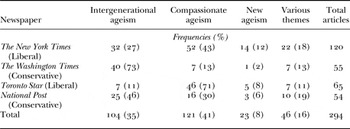
To facilitate the evaluation of theoretical expectations with our content analysis, we tackle each theoretical proposition by restating briefly the argument, presenting summary statistics (Table 1) and including excerpts to illustrate differences. As expected, there were negligible differences between 2013 and 2014 and we opted to present our figures by newspaper rather than by newspaper per year. The New York Times (120) had more than twice the number of articles as the National Post (54) and The Washington Times (55) and nearly twice that of the Toronto Star (65). Thus, to ensure comparability we included weighted figures with a base of 100 for each newspaper, which we obtained by calculating percentages instead of raw numbers for each category. For example, the weighted number for the presence of intergenerational ageism in the USA calculated the percentage for The New York Times (27%) and The Washington Times (73%) divided by 2, which attributes equal importance to both newspapers. Both non-weighted and weighted numbers are reported in the tables.
Keyword search results by theme and newspapers (2013 and 2014 data combined)

With regards to the content analysis, it should be noted that this study is less concerned with refuting ageist stories and facts presented in the newspaper articles. Rather, this study focuses on the frequency at which various ageist themes were present in the different newspapers and how these newspaper stories collectively and uniformly portrayed ageing and older adults. As Rozanova, Northcott and McDaniel (Reference Robinson and Anderson2006: 374) argue, ageing is not a universal experience; yet, newspaper articles clearly depict it as so.
Polarised ageism in Canadian and US newspapers?
Confirming results from the Globe and Mail study of Rozanova, Northcott and McDaniel (Reference Rozanova, Northcott and McDaniel2006), our results demonstrate a high degree of polarisation with multiple forms of ageism being present across all four newspapers. A high proportion of articles fall within the intergenerational ageism and compassionate ageism categories (76%). These results also add support to the studies cited earlier finding negative portrayals of older adults. Surprisingly, only 8 per cent of the articles involved content related to new ageism. Although further research is needed, this would suggest that the ubiquitous presence of this concept in gerontology has not yet reached the media. Only 16 per cent of all articles presented a collection of various and unrelated themes regarding ageing.
As expected, however, new ageism portrayals focus primarily on the physical aspects of ageing. One representative example from The New York Times highlights the findings of a scientific study stating that ‘regular exercise including walking significantly reduces the chance that a frail older person will become physically disabled’ (‘Exercise for older adults helps reduce their risk of disability, study says’, The New York Times, 27 May 2014). The article praises the experience of Mildred Johnston who is 89 years old and walks once a week. Johnston is quoted about the benefits of her physical activity, stating:
Exercising has changed my whole aspect on what aging means, she said, it's not about how much help you need from other people now. It's more about what I can do for myself. (‘Exercise for older adults helps reduce their risk of disability, study says’, The New York Times, 27 May 2014)
Johnston's quote reinforces the main crux of new ageism, wherein physical activity is equated with ‘ageing well’, which results in another vehicle of ageism for citizens who are less physically active (Rozanova, Northcott and McDaniel Reference Rozanova, Northcott and McDaniel2006).
Political orientation of newspapers
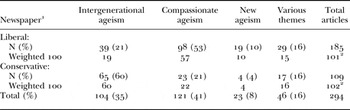
There is strong evidence to suggest that the political orientation of newspapers matters when it comes to ageism (Table 2). Sixty per cent of our articles in conservative newspapers feature intergenerational ageism portrayals. Most notably, The Washington Times presents a substantial amount of intergenerational ageism (73%). For example, a Washington Times article explains that lobby groups within the USA, such as the AARP, are urging President Obama to ‘keep his hands off of entitlement programs’ (Seth McLaughlin, ‘Obama's budget worries social security defenders fear ‘chain’ Consumers Price Index would reduce benefits’, The Washington Times, 5 April 2013). This article suggests that older adults are working to ensure generous benefits while the rest of the USA is faced with economic hardship. It highlights two key components of intergenerational ageism: (a) the capacity of senior groups and their influence in policy making and (b) the efforts of both Democrat and Republicans to ‘balance the budget’ and reduce government spending, which assume cuts to social programmes benefiting primarily older adults. Another article from the same newspaper paints a vivid case of intergenerational ageism:
Seniors often live a quarter-century or longer after a mostly white-collar retirement, drawing subsidies from those least able to pay for them. Seniors are not like today's strapped youth, scrimping for a down payment on a house. Most are not struggling to find even part-time work. None is paying off crushing student loans. In a calcified economy, why would an affluent couple in their early 60s earn a senior discount at a movie, while the struggling young couple with three children in the same line does not? (‘The death of the ossified 60's, Ivy League technocrats have simply replaced old biases with new ones’, The Washington Times, 31 May 2013)
Types of ageism by political orientation (2013 and 2014 data combined)

Notes: 1. Liberal newspapers: Toronto Star and The New York Times; conservative newspapers: The Washington Times and National Post. 2. Due to rounding.
In Canada, a National Post article states simply, ‘Canadian taxpayers can no longer afford the bill for richer plans than most of them enjoy, the world has changed since those plans were approved’ (‘Facing a harsh pension reality’, National Post, 31 May 2013). This comes after a description of the shrinking workforce due to increased population retirement, and importantly the article states: ‘fewer people are paying more money to support retirees’.
While intergenerational ageism portrayals are common within conservative newspapers, liberal newspapers include articles with compassionate ageism as a dominant theme. The weighted score for compassionate ageism was 57 for liberal newspapers versus 22 for conservative counterparts. The Canadian Toronto Star presented 71 per cent of its articles with compassionate ageism, a percentage that is noticeably higher than The New York Times (43%).
The left-leaning newspapers express compassionate ageism by emphasising the vulnerability of seniors. A steady stream of articles reminds readers of the chronic conditions and diseases that accompany old age, including Alzheimer's, dementia, osteoporosis and involuntary diarrhoea (‘The day my son went missing’, The New York Times, 13 November 2013; ‘Does extra weight protect from osteoporosis’, Toronto Star, 2 April 2013; ‘Taking an antibiotic? Don't forget the good bugs’, Toronto Star, 22 July 2013). This is evident in a 2014 New York Times piece, which outlines the results of a study centred on cancer and hysterectomies (‘Study adds to worries over use of hysterectomy procedure that may spread cancer’, The New York Times, 23 July 2013). The article states directly, ‘the researchers found that age was the biggest risk factor for the uterine cancers, with cases increasing steeply from 50-year-old women to those 65 and older’.
They also stressed the issue of movability. For example, an article on automobile regulation quotes US Transportation Secretary Anthony Foxx: ‘we are committed to protecting the most vulnerable victims of back over accidents—our children and seniors’ (‘Rearview cameras by 2018 for cars and light trucks’, The New York Times, 1 April 2014). Another example of this limited movability issue was found in a 2013 Toronto Star article. The article explained the role of a ‘red cap porter’ stating: ‘red cap porters [are those] who help the elderly and the mobility challenged’ (‘Via Rail eliminates porters as it cuts 56 jobs’, Toronto Star, 24 July 2013).
Compassionate ageism is, lastly reinforced, in the depiction of older adults as victims of crime, fraud and abuse (‘Digest’, Toronto Star, 14 February 2014; ‘Seeking serenity in a patch of land’, The New York Times, 30 May 2013; ‘3 people killed in car crashes’, The New York Times, 12 November 2013; ‘Most victims are once bitten, twice shy, expect when it comes to fraud’, The New York Times, 23 July 2014; ‘U.S. warns of frauds tied to health care law’, The New York Times, 19 September 2013; ‘Illegal retirement home still operating’, Toronto Star, 10 November 2014).
A New York Times article explains frankly that:
The primary target for investment frauds is a male in his 50s or 60s with high financial literacy, Professor Pratkanis said. Con artists flatter and bond with targets who consider themselves to be savvy investors, he said. They say ‘You are an investor, you know what's going on.’ (Most victims are once bitten, twice shy, expect when it comes to fraud’, The New York Times, 23 July 2014)
Similarly, a 2013 New York Times article describes a scheme which extracted sensitive information from Medicare recipients, stating clearly: ‘advocates for older Americans said that many were confused and wrongly believed that they needed to apply for coverage through the exchanges, scheduled to open Oct. 1’ (‘U.S. warns of frauds tied to health care law’, The New York Times, 19 September 2013). Articles also insinuate that older adults are more likely to be victims of physical beatings and car accidents (‘Seeking serenity in a patch of land’, The New York Times, 30 May 2013; ‘3 people killed in car crashes’, The New York Times, 12 November 2013). This insinuation is largely seen in the constant depiction of seniors as victims of crime, for example, a 2014 Toronto Star article described the stabbing of a 65-year-old man in Newmarket, Ontario (‘Digest’, Toronto Star, 14 February 2014). This can also be seen in this New York Times article describing violence in Turkey:
The man in the ski mask struck in the twilight of late afternoon, strangling the elderly woman from behind, beating her senseless and leaving her for dead. He ran off with 50 Turkish lira, about $30, and her engagement ring, a last memory of her long-dead husband. ‘He just beat me, over and over again,’ said the woman, Turfanda Asik, 88, who spent two weeks in an intensive care unit. ‘He hit my back, my skinny back. What have I done to him? What did he want?’ Ms. Asik was left bruised and blinded in one eye. (‘Attacks on elderly Armenian women in Turkey awaken fears’, The New York Times, 4 April 2013)
Lastly, a Toronto Star article outlines in great detail the abuse suffered by senior citizens in a retirement home:
An 82-year old resident who fell off a chair onto a tiled floor was left unattended for 20 minutes as the only staffer on duty was busy elsewhere looking after some of the other 17 residents, many of whom suffered from severe physical and mental impairments. (‘Illegal retirement home still operating’, Toronto Star, 10 November 2014)
These articles support the compassionate ageism argument that left-leaning newspapers depict seniors as vulnerable.
Does ageism take a different form in Canada and the USA?
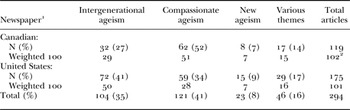
As expected, intergenerational ageism is more prevalent in the US newspapers than in Canadian newspapers (Table 3), with a weighted score of 50 for US newspapers versus 29 for Canadian newspapers. However, results do not support the view that Canadian newspapers are less ageist, but rather they portray a different kind of ageism with a weighted score of 51 versus 28 for the US newspapers. This difference is apparent in the phraseology present in the US newspapers in comparison with Canadian newspapers. The US conservative newspapers refer to older adults as constantly ‘double-dipping’ into national expenditures (‘The death of the ossified 60's, Ivy League technocrats have simply replaced old biases with new ones’, The Washington Times, 31 May 2013). Furthermore, senior citizens are described as riding a ‘gravy train’ of entitlements. This ‘gravy train’ is even compared to the financial plight of millennials:
Today's 65-year-old expects to net more than $280,000 and is adding to the fiscal gap. The unfortunate millennials and generations yet unborn are the ones who will have to redeem these obligations. Today's 30-year-old will net $12,000, while the average 25-year-old will pay out almost $26,000. The net tax bill for future generations is an eye-popping $420,000. This kind of transfer from a generation that is expected to have both lower income and wealth to a generation that is richer is morally indefensible. (‘The sucker generation: young Americans are getting stuck with the tab for today's pricey entitlements’, The Washington Times, 31 March 2014)
Types of ageism by country of origin (2013 and 2014 data combined)

Notes: 1. Canadian newspapers: Toronto Star and National Post; US newspapers: The New York Times and The Washington Times. 2. Due to rounding.
Similarly, the liberal US newspaper uses a highly negative image of the ageing process in a citation from an ageing rock group who asks:
‘Can we do it anymore? If we're ever going to, we should do it whilst we're not too decrepit and fragile,’ Mr. Cocker said. ‘Rock music itself is middle-aged now. If you think of 1955 as Year Zero, then it's coming up to 60. That's almost getting too old, isn't it? But you can rekindle that spark gained from ideas when you were younger.’ (‘Taking a fan's eye view of a much-loved band’, The New York Times, 13 November 2014)
Canadian newspapers are remarkably less openly derogatory in their intergenerational descriptions of older adults, even in the conservative newspaper (National Post). There are no comparable examples from those cited above. The intergenerational ageism demonstrated in the Canadian newspapers was presented in a more factual fashion. A typical example of intergenerational ageism in the Canadian newspapers can be found in this 2013 National Post article, which discusses Alberta's reform to the pension plan of its civil servants:
Alberta's pension has un-funded liabilities of $7.4-billion which, while affordable now, won't be as the ranks of retirees grows and people collect benefits over longer lives. The number of active workers to retirees has already shrunk dramatically, so fewer people are paying more money to support retirees over a longer period. There's a limit to how often pension plans can boost payments by active workers or ask taxpayers to foot a larger government contribution, and the market struggles of the past decade demonstrated how uncertain investment growth can be. (‘Facing a harsh pension reality’, National Post, 18 September 2013)
In a similar example, a 2014 National Post article published a Statistics Canada report on future Canadian demographic shifts. The articles cites:
In 2013, there were just under 7,000 Canadians who had reached age 100. By 2063, with aging boomers and medical advances, this number will swell to more than 62,000 under a medium growth scenario. The population aged 80 and over is projected to hit nearly 5 million by 2063, up from 1.4 million in 2013. Workers wanted. (‘More of us, and older; 10 things to know’, National Post, 18 September 2014)
These two examples demonstrate that while intergenerational ageism was present in the Canadian newspapers, it lacked the pejorative and openly conflictual wording found in the US newspapers.
Conclusion
The comparative analysis of three forms of ageism (intergenerational, compassionate and new) in Canadian and US newspapers reveals at least four interesting findings. First, in line with the findings of Rozanova, Northcott and McDaniel (Reference Rozanova, Northcott and McDaniel2006), newspapers present various forms of ageism, but negative portrayals dominate, as they represent 76 per cent of all articles in the sample. Very few articles presented positive forms of ageism, as evidenced by the limited number of new ageism portrayals. Thus, the key research question on the portrayal of ageism in newspapers is what kind as opposed to how much ageism appears. Second, only 16 per cent of the articles in the sample presented what we would consider a more complex – and complete – representation of the ageing experience. These findings coincide with various studies on the dominance of negative forms of ageism in the media of various countries such as Ireland (Fealy et al. Reference Fealy, Mcnamara, Treacy and Lyons2012) and India (Harwood and Roy Reference Harwood and Roy1999).
Third, the political orientation of newspapers plays an important role in the transmission of ageism. Conservative newspapers are more prone to display intergenerational ageism, where older adults are construed as selfishly seeking benefits while placing the burden of these costs on to younger generations. Liberal newspapers more often feature compassionate ageism portrayals, where older adults are portrayed as needy or fragile, and thus in need of stronger governmental protection. Fourth, there is also a noticeable difference between US and Canadian newspapers with regards to ageism. US newspapers report more portrayals of intergenerational ageism and less compassionate ageism, but the key difference lies in the language employed to convey similar messages. For example, US newspapers are far more forthcoming and explicit in their depiction of intergenerational ageism, employing words such as ‘geezers’ and ‘double dipping’ which are nowhere to be found in Canadian newspapers. It remains to be seen whether portrayals of new ageism will increase resulting from the prevalence of successful ageing, and its multiple iterations, within the gerontology literature.
Finally, in line with a study on climate change (Feldman et al. Reference Feldman, Maibach, Roser-Renouf and Leiserowitz2012), our comparative analysis suggests that researchers ought to pay closer attention to the tone employed by different news institutions. The contrast between US and Canadian newspapers is striking, with US newspapers employing more pejorative and sensational language to portray older adults, while Canadian media is far less derogatory. This indicates that phraseology and tone are important elements deserving closer scrutiny and further analysis in ageing studies.
There are multiple avenues for further research. The word search for articles could be expanded and altered to gather different types of articles and to analyse other forms of ageism. Our study targets the presence of ‘usual’ types of ageism. Further testing should be conducted in other societies, such as China, which have a different understanding of ageing (see Liang and Luo Reference Liang and Luo2012). In addition, although Canada is a bilingual country, our sample referred to English newspapers only. A comparison between English and French newspapers could unearth differences in ageism along linguistic lines.
Beyond Canada and the USA, an analysis with news media in European countries that have historically been linked to political parties could enhance our understanding of the relationship between political orientation and the forms of ageism portrayed. For example, the comparative welfare state literature indicates that social democratic parties favour the deployment of public services to address social needs, while Christian democratic parties typically promote the role of the family (Esping-Andersen Reference Esping-Andersen1999). Thus, should we expect distinctive forms of compassionate ageism emphasising the lack of governmental services in social democratic newspapers, and a lack of attention from family members in Christian democratic newspapers? Or are these mitigated by the welfare regime predominant in the country of analysis irrespective of the partisan orientation of newspapers?
Another avenue would be to compare the extent to which media representations of ageism coincide with the age-orientation of social policies (Lynch Reference Lynch2001). The USA is considered to have a policy bias towards older adults, due in large part to the policy structure of Medicare, while Canada features no such age bias. Can this be one of the reasons behind the strong presence of intergenerational ageism in US media? Comparison with additional countries featuring various levels of age-orientation in their policy mix would help elucidate this research question.