I. Introduction
WESTERN countries have engaged with China for the more than four decades since Deng Xiaoping launched economic reform and opening policies in 1979. These countries had hoped that integrating China into the world economy and maintaining extensive contacts with the Chinese people would shape China’s developmental trajectory into a more open and free society. But since 2013, under Xi Jinping’s rule, Chinese politics has turned more authoritarian, which Western analysts take as evidence of engagement-policy failure.Footnote 1 And thus, Western scholars have debated why engagement policy did not succeed in transforming China into a democratic country.Footnote 2
But a more fruitful discussion begins with asking why China positively engaged with Western democracy promoters in the first place. After the end of the Cold War, Western countries increased resources and funds to further spread democracy across the globe with the triumphant belief that democracy would continue to prevail over other forms of government.Footnote 3 Western nongovernmental organizations (ngos), partly funded by their governments, offered various programs for China to develop its legal, electoral, and administrative systems, as well as Chinese civil society. Interestingly, the Chinese authorities welcomed the Western offer of democratic assistance, sometimes reaching out first, between the mid-1990s and mid-2010s.
China’s openness to Western democracy-promotion programs is puzzling in many aspects. China, as a non-democracy, is expected to resist any Western pressure to be democratized. Indeed, the Chinese Communist Party (ccp) has shown zero interest in transforming China’s political system into a Western-style liberal democracy. Why, then, was China distinctly open to the Western democracy-assistance programs compared to other authoritarian countries? Despite concerns about a legitimacy crisis, why did the ccp actively seek rather than repel Western influence in the sphere of political reform?
I argue that the ccp selectively accepted the Western democracy- assistance programs not to democratize China, but rather to strengthen its regime legitimacy. The ccp launched a series of governance reform programs throughout the 1990s, and Chinese leaders found that Western democracy-assistance programs largely overlapped with their own initiatives. They thought that if carefully controlled, Western assistance could make valuable contributions toward facilitating the ccp’s own governance-reform programs, which were designed to strengthen the Party’s legitimacy, because citizens would appreciate the democratic progress made in the governance style and policy behavior of the Chinese state.
The objective of this article is to develop a theory that explains authoritarian regimes’ political openness to Western democracy-assistance programs. It identifies authoritarian leaders’ strategic motivation and traces the causal process of policy development and implementation. In so doing, it attempts to fill the gap in democracy-promotion scholarship as a research topic intersecting international relations and comparative politics. The extant literature focuses on explaining why and how Western countries should promote democracy abroad, mainly from the perspective of supply-side democracy promotion. Turning to the domestic politics of target countries, I develop a demand-side theory of democracy promotion, addressing the questions of why and how authoritarian countries would want to engage with Western democracy- promotion programs. What this article does not address are the effects of authoritarian regimes’ opening policies, that is, whether—and if so, how much—they achieve their intended outcomes, which is also an important question. But measuring causal effects requires a good understanding of the causal mechanisms for why and how authoritarian regimes make such policies in the first place. In section VII, I address the question about effects as a subject for future research.
To trace the process of the Chinese government’s engagement with Western organizations, I present case studies of collaboration in four sectors: (1) rule of law, (2) elections, (3) good governance, and (4) civil society. Western donors typically sort democracy-assistance programs into these four groups.Footnote 4 The period of investigation is between the 1990s and the early 2010s, during which time the Chinese government selectively accepted Western democracy-assistance programs. In addition to positive cases, I also investigate the Xi regime’s reversal of China’s opening policies with the passage of the so-called foreign ngo law in 2016. By tracing the causes of the policy change, I present the Xi regime as a negative case to verify the same causal mechanism that explains the positive cases of openness. Footnote 5 The case studies draw on primary and secondary sources in Chinese and English, including public statements, personal interviews, and scholarly analyses.
The theory of authoritarian openness contributes to the literature on authoritarian legitimation in two ways. First, investigating the “golden years” of China’s political engagement with the West deepens our understanding of the ccp’s survival strategy.Footnote 6 China is widely regarded as a role model for authoritarian revival.Footnote 7 To explain China’s resilient authoritarianism, scholars have focused on the state’s coercive measures and manipulation of information through propaganda systems. They find that the ccp adopted some liberalization policies (albeit limited) and governance reform policies before Xi reversed them. This article supplements these studies by exploring how China creatively coped with external pressure for liberal democracy. Second, I put the theory of authoritarian legitimation in dialogue with the theory of democratic transition. Inspired by modernization theory, Western democracy promoters envision that sowing seeds of democratic change within authoritarian countries is important for the eventual democratization of those political systems. My work highlights that authoritarian regimes believe they can benefit from limited democratic reform, using it to strengthen popular support. Western donors’ and authoritarian regimes’ different thinking about the effects of democratic reform suggests that analysts need to consider the time-horizon element when they evaluate the validity of modernization theory. That is, democracy-assistance programs may be beneficial for authoritarian rulers’ regime legitimacy in the short and medium terms, but may threaten its long-term survival.
In this article, I first show how China, compared with other authoritarian countries, was distinctively open to Western democracy-promotion programs from the mid-1990s to the mid-2010s.Footnote 8 After laying out the research puzzle, I introduce a theory of authoritarian openness to Western democracy-promotion programs. I subsequently examine the practices of Western democracy-promotion providers in China, followed by a discussion of how and why the Xi regime reversed the opening policies. I next address alternative explanations and compare them with my argument. I then discuss the theoretical implications of the findings and conclude with avenues for future research.
II. The Puzzle: Why Accept Western Democracy-Promotion Programs?
Since the end of the Cold War, Western countries, especially the United States, significantly increased resources and budgets to promote democracy abroad.Footnote 9 Interestingly, the Chinese government also increased its interactions with Western organizations that offered democracy aid programs to China.
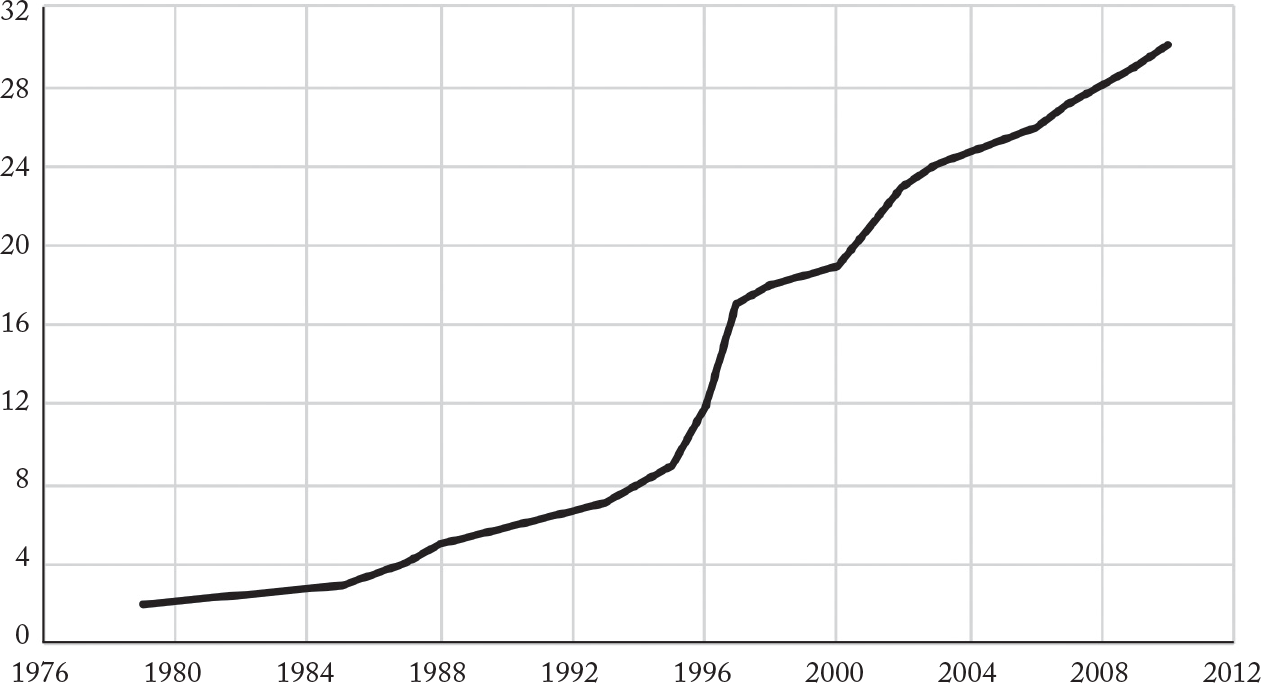
To measure the level of China’s openness to Western democracy- assistance programs, I refer to the database compiled by the China Development Brief (cdb), a Chinese ngo that provides information on foreign NGOs in China.Footnote 10 By sorting international NGOs by sectors of programs, we can extract information about foreign NGOs that work on democracy-related themes like rule of law, elections, good governance, and civil society. Figure 1 shows that the number of Western NGOs in those democracy-related sectors steadily increased between the mid- 1990s and the mid-2010s.Footnote 11
The Number of Western Democracy-Assistance Organizations in China
Source: NGO directory compiled by the China Development Brief, at http://chinadevelopmentbrief.cn/directory/.
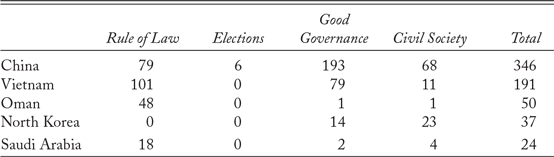
For a cross-national analysis, I compare the five most durable authoritarian states as identified from Polity 5 data: Saudi Arabia, North Korea, China, Vietnam, and Oman. Footnote 12 Using the US Agency for International Development (USAID)’s foreign-aid database, I identify the number of US democracy-related projects offered to these states and funded by the US Department of State and USAID as a proxy indicator for Western democracy-assistance programs. In the database, the categories, “Legal and judicial development,” “Elections,” “Public sector policy and administrative management,” and “Democratic participation and civil society,” correspond to the four subsectors mentioned above that Western organizations typically sort their democracy-related projects into: rule of law, elections, good governance, and civil society.Footnote 13
Table 1 shows that China is an outstanding destination for the democracy-assistance projects supported by US agencies. Closer examination suggests that the high number of projects there is not only due to the country’s sheer size, but is also due to its receptive environment. By comparison, in the case of North Korea, funding goes first to US-based foundations, such as the National Endowment for Democracy (ned), which then redistribute it to South Korean ngos or other US-based ngos that support North Korean refugees. In the China case, budgets are directly allocated to Western organizations that operate inside China, such as the International Republican Institute (iri), the National Democratic Institute (ndi), the American Bar Association (aba), and the Asia Foundation. The operation of these organizations on Chinese soil would not be possible without the Chinese government’s consent. In addition, between the mid-1990s and mid-2010s, China did not show signs of outright resistance to US engagement, unlike Saudi Arabia, for example, which has a low number of democracy-promotion projects. In the latter case, in the wake of the 9/11 terrorist attacks, the Bush Administration pressed Saudi Arabia hard to hold free and fair elections. In 2002, this pressure provoked Saudi Arabia and Egypt to form an Arab anti-democracy alliance to counter the US pro-democracy drive.Footnote 14 In the end, due to security concerns regarding Iraq and Iran, as well as economic concerns regarding oil prices, the US softened its stance vis-à-vis Saudi Arabia.Footnote 15 If the small number of democracy-related projects in Saudi Arabia represents its government’s noncooperative attitude, the large number in China’s case indicates its government’s positive attitude for cooperation beyond merely reflecting the country’s vast territory and population.
Number of Projects in the Four Subsectors of Democracy-Assistance Programs Funded by the US State Department and USAID from 1991-2016a

a Data from the Polity 5 Project and USAID’s Foreign Aid Data. For more details about the method of data compilation, see Appendix 2 in the supplementary material; Cho Reference Cho2021b. The two original data sets used for this table are available in the replication files for this article; Cho Reference Cho2021a.
China’s openness to Western endeavors to democratize the country is puzzling. Many China experts agree that the ccp had (and has) zero interest in adopting a Western-style democratic system.Footnote 16 The ccp views Western efforts to democratize China as a threat to its survival: Chinese leaders have claimed that the West tries to delegitimize China’s political system in the name of democracy promotion.Footnote 17 Therefore, one would expect that China should strongly resist any Western attempt to promote democracy in China. Given China’s own past policies of closing off and the country’s deeply rooted suspicion of Western intent, why did the ccp engage with the Western democracy- promotion programs?
International relations theory and comparative politics scholarship provide little explanation for authoritarian regimes’ deliberate openness to Western endeavors to democratize them. In ir theory, scholars explore the strategies, effects, and limits of democracy-promotion programs, but they also tend to assume that autocrats would invariably resist Western efforts to democratize their countries.Footnote 18 The assumption overlooks the possibility that authoritarian regimes may voluntarily engage with Western democracy-promotion programs. In the field of comparative politics, there is a growing body of literature on the various subtypes of authoritarian regimes and their policies of openness in the sphere of domestic politics.Footnote 19 Comparative scholars find that authoritarian regimes do not rely merely on repressive measures to maintain their rulings, they are also creative in adopting liberal policies and democratic institutions to draw popular support. But this finding in the arena of domestic politics does not explain authoritarian regimes’ openness in the international space. Although scholars have investigated the international dimension of democratization processes, they have not paid much attention to the casual mechanism of authoritarian regimes’ counterstrategy against external pressure, especially when regimes choose to engage rather than to fight.Footnote 20
In short, there is a gap at the intersection of authoritarian openness and the international dimension of democratization. The gap has not received much scholarly attention because the issues of democracy promotion have been studied largely from the perspective of supply- side democracy promoters. Looking the other way, one may well assume that authoritarian regimes, positioned on the recipient-side of democracy promotion, also make efforts not to be influenced by the democracy-promotion suppliers. But even with this assumption, why authoritarian regimes may respond with opening policies, as China did, rather than resisting by closing down any contacts with Western democracy-promotion organizations remains puzzling.
III. Authoritarian Openness to Democracy-Promotion Programs from Outside
According to Thomas Carothers, democracy assistance is defined as “aid specifically designed to foster a democratic opening in a nondemocratic country or to further a democratic transition in a country that has experienced a democratic opening.”Footnote 21 For the goal of democracy promotion, international organizations, state governments, and civil societies (Western NGOs that promote democracy abroad) have operated various programs to nurture the development of institutions and capacities to practice the norms of democratic society in targeted countries. Why would nondemocratic regimes be interested in accepting democracy aid programs as a host government?
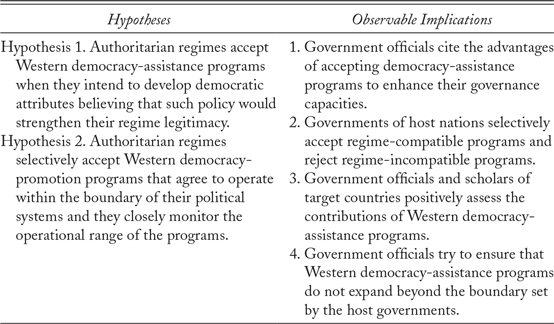
To answer this question, I start with deductive reasoning on the basic assumption that nondemocratic regimes, by definition, would not want to be democratized by external forces. Flipping this logic, one can draw the first proposition: authoritarian rulers would accept Western democracy-promotion programs only when they believe such openness would help them to stay in power longer than they would otherwise. As noted above, democracy-assistance programs are typically designed to develop the four sectors of target states: rule of law, elections, good governance, and civil society. One can then assume that authoritarian regimes would be willing to accept democracy-assistance programs only when they already have a plan to develop those four sectors. Combining these two inferences, I draw the first hypothesis to explain authoritarian openness:
—H1. An authoritarian regime accepts Western democracy-assistance programs when it intends to develop democratic attributes with the belief that such policy would strengthen its regime legitimacy.
The literature on authoritarian legitimation supports the plausibility of hypothesis 1. Scholars have identified autocrats’ tools for maintaining legitimacy, including reigns of terror, cults of personality, the promotion of nationalism, propaganda, censorship for information manipulation, and so on.Footnote 22 Recent studies pay attention to a new direction in the authoritarian strategy of legitimation: adopting democratic institutions. For example, Steven Levitsky and Lucan Way find that authoritarian governments can adopt competitive elections, a key institution that defines liberal democracy, as a way of justifying their rule without truly changing their illiberal domestic politics.Footnote 23 In her analysis of why dictators develop seemingly democratic institutions, Jennifer Gandhi claims that authoritarian rulers attempt to encapsulate the potential opposition and trade concessions for broadened political support.Footnote 24 In addition to this function of cooptation, Andrew Nathan argues that authoritarian regimes establish “input institutions” for political participation and appeal, which can strengthen regime legitimacy among the general public.Footnote 25 For authoritarian rulers, such democratic institutions can serve to gather feedback from the public so that they can improve the quality of public policy, which in turn contributes to shaping more positive support from that public. Adopting democratic institutions, if controlled well, can be an optimal strategy for authoritarian rulers to enhance regime legitimacy.
And if that’s the case, there then emerges room for authoritarian regimes to use Western democracy aids to their advantage. Regimes can benefit from the West’s financial and technical assistances to improve state capacities to meet society’s demands for better public services. But at the same time, authoritarian regimes must be careful not to allow Western programs to instigate a democratization movement against their authority. Therefore, they need to be selective when determining which programs to accept.
In this regard, Sarah Bush’s categorization of regime-compatible and regime-incompatible programs is useful for further investigation. In her analysis of the incentive structure for democracy promoters, Bush defines regime-compatible programs as those that are unlikely to threaten the imminent political survival of an incumbent regime in target state.Footnote 26 Regime-incompatible programs are the ones that foster open competition and free exchange of political information within target countries.Footnote 27 In other words, with regime-compatible programs, democracy promoters aim to make changes within the boundary of a nondemocratic system, whereas regime-incompatible programs attempt to make changes against a nondemocratic system itself. Therefore, authoritarian regimes may consider accepting the former but clearly reject the latter. Even after accepting the regime-compatible programs, they need to ensure that Western assistance does not empower the civil society to challenge the state too much. In so doing, authoritarian regimes attempt to maximize the benefits of Western support—facilitating their own governance programs—while minimizing the danger of a democratization movement against their power. Thus, the second hypothesis:
—H2. An authoritarian regime selectively accepts the Western democracy-promotion programs that agree to operate within the boundary of the regime’s political system and it closely monitors the operational range of the programs.
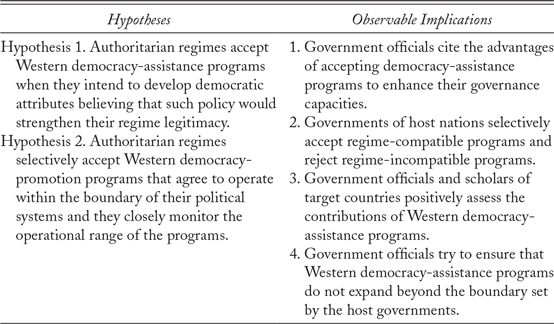
I draw observable implications from the two hypotheses to guide the empirical investigation. If hypothesis 1 is correct, the evidence should show that the more actively an authoritarian regime implements democratic reform programs, the more it would be willing to accept Western assistance. Footnote 28 Government officials’ public statements about wanting to cooperate with Westerners for governance reform will prove the intentional aspect of authoritarian openness. In addition, officials’ and scholars’ ex post assessments regarding the benefits of Western aid strengthen the hypothesis of ex ante expectation of such benefits. According to hypothesis 2, authoritarian regimes should be selective when accepting democracy-assistance programs. The evidence should show that the accepted Western programs do not directly pursue institutional change of nondemocratic political systems but instead seek to improve the policies within them. If we find evidence that an authoritarian re-gime closely monitors Western programs and prevents them from expanding their operational ranges, it will indirectly prove that the regime has no intention of making a transition to Western liberal democracy. Table 2 summarizes the hypotheses and observation implications.
Summary of Hypotheses and Observable Implications
To probe the plausibility of the theory of authoritarian openness, this article uses a single case study of China. As illustrated in Table 1, in the period of study, China was distinctively open to Western democracy-promotion programs compared to other authoritarian states. This makes China, with its remarkable resilience of authoritarianism, a deviant but important case. Additionally, China meets the conditions of a most-likely case study model. Given the ccp’s long-standing suspicion that the West attempts to delegitimize it in the name of democracy promotion, one would expect that China should close itself off against this external influence even more tightly than other authoritarian states.Footnote 29 But China did not act in such a way. The gap between the expectation of closing off and the actual policies of openness makes China a hard but interesting case to probe.
Further, employing the logic of within-case analysis, this study compares the status of Western democracy-assistance programs in China across the periods of pre-1990s, 1990s–2014, and 2014–present, as the phases of preopening, opening, and after opening, respectively. One caveat: I do not distribute equal weights of analysis to the three periods because the goal of this research is not to test existing theory, but to develop a theory to explain the opening period as a deviant case in particular. Therefore, the empirical investigation provides a much deeper analysis on the opening period than on the pre- and post-opening periods. The variation of China’s policies before and after the opening period are examined not to measure the causal effects between variables, but to verify the casual mechanism by presenting both positive and negative cases.Footnote 30
IV. China’s Selective Openness to Western Democracy-Promotion Programs
In the 1980s, the Chinese government was not interested in cooperating with Western countries on a political agenda because Deng Xiaoping’s political reform programs were not designed to enhance China’s democratic governance. Deng’s political reform focused on either supporting economic reform programs or stabilizing inner-party politics. He introduced various institutions, such as term and age limits, to ensure generational change of the party leadership and to curtail favoritism and the abuse of power within the party.Footnote 31 Deng also laid the foundation for collective leadership by decentralizing the decision-making power within the top echelon of the party.Footnote 32 But these measures were essentially a top-down approach to reform elite politics. Gathering bottom- up feedback from the general public was not a priority. On the contrary, Deng wanted to maintain the party’s control over the society by launching the Anti-Spiritual Pollution Campaign (1982–1983) and the Anti-Bourgeois Liberalization Campaign (1986–1987). Therefore, he was not particularly interested in the idea of inviting Westerners to assist in his political reform programs. Using his own network, billionaire investor and philanthropist George Soros managed to set up a foundation in 1986 with the goal of advancing democratic norms and values in China, but it quickly became the target of infighting between pro- and antireform factions within the CCP and was forced to close in 1989, before the students protest at Tiananmen Square.Footnote 33
Reflecting on the collapse of the Soviet Union and the Tiananmen Square protests, the Chinese leaders realized that they could not simply rely on repressive policies to stay in power; they needed to draw genuine and voluntary support from the people.Footnote 34 After all, as Nathan argues, the Chinese leaders shared the belief with many in the West that democratic governance has functional benefits in regulating conflict, making government more legitimate, and improving the quality of government.Footnote 35 As a result, the ccp launched a broad range of democratic reform programs in the early 1990s and began to develop various institutions to gather and incorporate input from the general public for the policy-making process. It encouraged local governments to respond to people’s demands for better public services. The ccp was determined to transform the mentality of bureaucrats from gatekeepers to service providers.Footnote 36
Specifically, first, the Chinese government implemented a series of policies for legal reform. The work report of the 15th Party Congress in 1997 emphasized the party’s goal of “governing country through the law.” Chinese leaders made numerous remarks to stress that the ccp should protect the legal rights of Chinese citizens from the abuse of state power.Footnote 37 Second, the ccp expanded village elections that were initially introduced to fill the institutional gap created by the retreat of state power in the 1980s.Footnote 38 The government encouraged all villages to conduct elections in the 1990s so that villagers could participate in the policy-making process at the local level.Footnote 39 Third, the ccp tried to institutionalize consultation processes for policy planning and budget execution. For example, it introduced public hearings and town hall meetings with local residents to boost government transparency.Footnote 40 Fourth, the ccp fostered Chinese ngos onto which it could offload some of the administrative burdens of service provision. The ccp expected these ngos to provide various opportunities for volunteer activities that the society increasingly desired and which the government alone could not handle.Footnote 41
It is no coincidence that the four areas of China’s democratic reform overlap with the four subsectors of democracy assistance as defined by USAID. As noted above, many nondemocratic rulers have adopted democratic institutions, such as legislatures and elections, not only to refine their image as a reformer or to distribute patronage, but also to gather society’s inputs for better governance by the state.Footnote 42 Although the ccp had no intention of transforming China into a Western-style liberal democracy, its efforts to make China’s political system fairer and more inclusive received positive assessments domestically and internationally in the mid-1990s. The problem was that Chinese administrators did not fully understand the details of how to conduct legal reform, free and fair village elections, public hearings or town hall meetings, or ngo development. They lacked experience and expertise, which caused confusion and inefficiency in the initial phase of governance reform.
As a result, Chinese leaders emphasized the need to learn from the West. In his remarks at the Central Party School on June 9, 1992, then- President Jiang Zemin stressed that the Chinese people should acknowledge the advanced civilizations that capitalist countries achieved and be bold about learning anything useful from them for China’s development.Footnote 43 While clarifying that China should oppose the introduction of a Western-style representative system, Jiang emphasized that the country should learn scientific methods of social management from the West. Former Premier Wen Jiabao was even more explicit on the need for China to learn from foreign countries. In an interview with a French journalist in 2007, Wen said, “China lacks experiences in the construction of socialist democracy … we need to learn from all the great achievements of the world and adjust them to our conditions, so that we can go on the road of Chinese-style democracy.”Footnote 44 Encouraged by such remarks from top leaders, Chinese scholars’ comments on the need in the political domain to learn from the West passed the censors and proliferated in publications.Footnote 45 It was under this mood that Chinese authorities reached out to Western countries to seek assistance for their governance reform programs.
The Rule of Law
During President Bill Clinton’s visit to China in 1998, the two governments agreed to cooperate to enhance the rule of law regime in China. Based upon the agreement, a number of Western organizations, including the American Bar Assocation (aba), the International Republican Institute (iri), the Ford Foundation, and the Asia Foundation, launched programs to support China’s legal reform. Of these, the aba and the Asia Foundation deserve close examination for their long-standing commitments and broad range of activities in China.
The aba’s programs in China from the mid-1990s to mid-2010s were largely divided into five thematic areas: (1) legal profession reform, (2) criminal law reform and anti-human trafficking, (3) women’s rights, (4) environmental governance, and (5) access to justice and human rights. As for the method of engagement, the aba focused on providing educational opportunities for Chinese legal scholars, judges, and lawyers. For instance, in June 2000, the aba and the Chinese Ministry of Justice held the seminar, “Comparative Study of US-China Legal Aid Institutions,” in Beijing, where seventy participants gathered, including then-Associate Justice of the United States Supreme Court Anthony Kennedy.Footnote 46 The aba also hosted an international roundtable on domestic violence legislation for Chinese policymakers, who crafted the Anti-Domestic Violence Law in 2014. Moreover, the aba organized numerous study tours for Chinese legal professionals to visit the US. During the tours, Chinese participants had opportunities to observe America’s court system and to discuss China’s legal system with American legal experts.Footnote 47
While the aba focused on educating Chinese legal professionals, the Asia Foundation supported the general populace on legal rights. The Chinese Ministry of Justice established legal aid centers across the provinces to help ordinary citizens to learn how to use laws to protect their rights. In 1999, the foundation started the project, Improving Grassroots Legal Aid Capabilities, in support of legal aid centers in Guizhou, Shanxi, Yunnan, and Inner Mongolia. It also implemented the four-year project, Justice under the Rule of Law in Society, which aimed to decrease barriers for Chinese citizens to access China’s judicial system. Chinese scholars assess the Asia Foundation’s activities as a great success: it not only improved the legal aid center’s quality of service but also contributed to developing Chinese citizens’ legal awareness.Footnote 48 The pattern of cooperation between these Western ngos and their Chinese counterparts can be summarized as knowledge development at the central level and as implementation of legal reform at the local level.
Despite two decades of cooperation, however, the Western ngos could not expand their programs as broadly as they desired. The constraints stemmed from the ccp’s own dilemma in effecting legal reform: certainly, the ccp was willing to strengthen the judiciary, but not to the extent that it could challenge the party’s authority.Footnote 49 Accordingly, Western ngos were welcome to support China’s legal reform, but only so far as not to touch upon the sensitive issues. The highest positions of the court system at every level in China are mostly filled with party members. Western assistance would not be sought if the courts deemed a case to be “politically sensitive.”Footnote 50 For example, public security law was seen too sensitive to involve Westerners in its reform process.Footnote 51 If state agents, such as police officers, were involved in litigation by ordinary citizens, Western ngos were advised not to get involved in such “political” and “important” cases.Footnote 52 Likewise, there is no record of Western ngos having been invited to discuss reforming China’s press laws.
Human rights is another sensitive issue area that Chinese authorities did not allow Western ngos to engage with. In their mission statements, the aba and the Asia Foundation publicly declared that addressing human rights was one of their goals in China. But a closer look reveals that they addressed economic and legal dimensions of human rights, not political ones. For example, the aba paid special attention to the welfare of rural migrant workers in urban areas and their legal rights. The Asia Foundation particularly cared about women’s rights.Footnote 53 Chinese authorities appreciated Western support for these disadvantaged groups as long as the ngos refrained from organizing to challenge state authority. Providing legal aid for the human rights of individual rural migrant workers or female workers was in line with China’s legal reform.
In short, the Chinese government cooperated with Western ngos to benefit from their technical and educational assistance for legal reform. As long as the Western ngos did not jeopardize China’s plan to implement “legal reform without democratization,” the ccp could benefit from Western assistance in making China’s legal system function more effectively and somewhat more fairly than before in the eyes of the Chinese populace.Footnote 54
Elections
The Chinese government introduced free elections at the village level in an effort to solve the crisis in village authority after Deng Xiaoping disbanded People’s Communes in the 1980s.Footnote 55 Western scholars and policymakers paid close attention to these developments while supporting China’s experiment with direct elections. Interestingly, the Chinese government was equally eager to reach out to Western ngos for assistance. The Chinese Ministry of Civil Affairs (mca) formally extended invitations to several Western ngos to observe village elections in China. In May 1994, for the first time as an international agency, the iri sponsored a four-member delegation to observe the local village elections in Fujian province.Footnote 56
During the trip, the iri delegation observed three elections, attended two representative assembly meetings, and organized seminars with Chinese officials from the village, county, and national governments. The delegates identified several problems associated with the electoral process and provided concrete proposals for future elections. For example, they suggested that voters be provided with practical opportunities to exercise their rights with secret ballots and that all candidates—party and nonparty members—should be treated equally. In 1997, the iri delegation made a second trip to the same counties in Fujian province. The team could verify significant improvements in the mandatory use of private voting booths, the abolishment of proxy voting, and the standardized training of election workers. The delegation concluded that local Chinese officials effectively implemented their specific recommendations from the 1994 trip.Footnote 57 The iri team was again invited to observe elections in the same two counties in 2000 and 2003, which provided a unique opportunity to observe four consecutive rounds of village elections in a single Chinese province.Footnote 58
The Carter Center also closely cooperated with Chinese authorities to improve village elections. In July 1997, former President Jimmy Carter visited China and discussed village elections with Jiang. The Carter Center was invited to observe village elections multiple times and helped local officials conduct a nationwide survey on villagers’ selfgovernance. Overall, the pattern of Carter Center support of village elections was similar to the iri’s: the team observed village elections, made recommendations for improvement, and wrote after-observation reports to share with its Chinese counterparts.
But the Carter Center took one step further in an effort to change the institutional settings for village elections.Footnote 59 The Carter Center and the mca held a conference on the procedural law of village elections in 2000, at which the Carter Center proposed establishing independent election committees at the county level. It argued that only a permanent and relatively independent extra-governmental agency could effectively handle problems stemming from the arbitration of elections.Footnote 60 In addition, the Carter Center suggested building a nationwide data-collection system to standardize village election procedures.Footnote 61 This project began in 1998 and statistical data from village elections (162 counties of Fujian and Jilin provinces) was first collected in 2000 and 2001.Footnote 62
Chinese officials and scholars recognize the contributions of these Western ngos in the four areas of electoral reform. First, the Western ngos disseminated the norms and rules of democratic elections, such as secret balloting and campaigning, among the local cadres who virtually had no experience in managing electoral systems.Footnote 63Second, the Western ngos contributed to revising the Electoral Law of Village Committees at the central level. Third, they organized several study tours for Chinese officials to observe the US elections, thereby stimulating Chinese people’s own study of electoral systems.Footnote 64 Fourth, and perhaps most important, the regular experience of voting contributed to reinforcing villagers’ belief in democratic values.Footnote 65 Chinese scholars credit Western ngos for raising villagers’ awareness of political rights and participation.Footnote 66
Nonetheless, Western ngos also had limits on their influence. Although they could engage in the procedural dimension of democratic elections, the Western ngos could not influence the exercise of power after the election.Footnote 67 Even if elected through democratic means, the heads of the village committees were (are) still under the shadow of the more influential party branch. And the autonomy of village leadership is still significantly constrained by its county or township government. Therefore, a village committee’s primary function remains its ability to efficiently carry out directives from state authorities over its ability to convey villagers’ voices to the higher levels of bureaucracy.Footnote 68 The democratic procedure of elections does not guarantee the democratic exercise of power. Western organizations could help with the former, but not the latter.
Similarly, Western ngos could help to consolidate village electoral systems nationwide horizontally, but could not help to expand them vertically. In January 1999, China’s National People’s Congress (npc) invited the Carter Center to observe direct elections for Township People’s Congress deputies as well as indirect elections for township government officials in Chongqing municipality.Footnote 69 This event was significant because unlike a village committee, which is defined as an autonomous unit of self-government by the Chinese constitution, a township is a building block of the formal Chinese government structure.Footnote 70 During the trip, the Carter Center delegation noticed problems similar to those it found earlier in village elections, such as a lack of secret ballots, a careless vote-counting manner, and loose procedures of voter identification.Footnote 71 It was the first time that a Western agency had been invited to observe township elections. There was no second invitation.
In the end, the effect of Western programs in rural areas was marginal in respect to challenging the fundamentals of the Chinese political system. If there had been any sign of such an effect, the Chinese government could simply stop inviting Western ngo participation. Knowing this limit well, Western ngos tended to focus on providing technical assistance for the existing electoral system at the village level, and avoided raising the idea of adopting a competitive, multiparty elections at the national level.Footnote 72
Good Governance
The Chinese government has, since the early 1990s, launched a series of administrative reform programs. The goals were to provide better administrative services and to gradually allow Chinese citizens to participate in the policy-making process. In March 2000, the npc passed the so-called Law on Legislation to allow law drafters to gather public input on proposed legislation. In May 2008, the Chinese government issued Open Government Information (ogi) regulations for a nationwide government-information disclosure system.Footnote 73 To support these initiatives, the ndi, the Asia Foundation, and the Ford Foundation operated various programs in China.
The ndi particularly invested resources in assisting Chinese efforts to introduce legislative hearings. It sponsored conferences to assess hearings’ effectiveness on legislation and the cost-benefit analysis of holding hearings. For example, in 2000, the ndi co-organized three national seminars with Peking University’s Center for People’s Congress and Foreign Legislature Studies to discuss citizen participation in the legislative process. At the third seminar, the ndi assisted Chinese participants in drafting procedural guidelines for conducting legislative hearings. The ndi also worked with the mca to develop a training program for local community officials on increasing citizen participation. In addition to organizing events to encourage dialog among Chinese citizens, the ndi also held events that featured Western experts on public hearings. In 2004, the ndi hosted the seminar, “Dissemination and Improvement of Local Legislative Hearings,” in Gansu province, where fifty Chinese officials and scholars gathered from Ningxia, Qinghai, and Shanxi provinces; Inner Mongolia; and the Xinjiang Uighur Autonomous Regions.Footnote 74 For this event, the ndi invited Alexander Longolius, a former speaker of the Berlin Parliament, and Jackie Dingfelder, a member of Oregon’s legislative assembly. The two Western experts presented the practices, benefits, and costs of public hearings in Germany and the US, respectively. During these meetings, Chinese participants asked questions about the details of public hearings and discussed their applicability to administrative settings in China. On the second day of the program, participants observed Gansu province’s first public legislative hearing. Longolius and Dingfelder commented that the hearing was well-organized and noted that Chinese media had an impressive degree of access.Footnote 75
The Asia Foundation also ran programs to foster government transparency and accountability in China.Footnote 76 It focused on developing the ogi performance-evaluation system and the official income and asset reporting system.Footnote 77 In 2011, the Asia Foundation supported an international study tour to the US for Chinese participants drawn from Peking University, the Hunan Provincial and Legislative Affairs Office, and the Administrative Law Research Association. During the trip, participants had opportunities to meet with American officials to learn about ogi policies in the US. The Ford Foundation also supported China’s development of ogi. What distinguishes the Ford Foundation from the ndi and the Asia Foundation is that it indirectly provided financial support to the relevant Chinese ngos instead of directly engaging with Chinese officials and/or experts. For example, the Ford Foundation funded research at Peking University’s Center for Public Participation Studies and Supports on whether government agencies comply with ogi regulations. The institute published, “The China Government Transparency Watch Report 2009,” which revealed that over half of provincial-level governments that year fell short of meeting the government’s standards for information openness.Footnote 78
Many Chinese participants in the Western NGO-organized events agreed that the practices of public hearings and ogi regulations should be further disseminated across China.Footnote 79 During the ndi event, the executive director of the China Center for Comparative Politics and Economics, a Beijing-based institute associated with the ccp, commented that public hearings reduced local government’s protectionism and increased legislative capacity by incorporating talented citizens’ expertise from outside the administrative system. Another Chinese participant commented that because most legislators in China were neither elected nor accountable to the public, they had little incentive to administer public hearings eagerly. Still, he asserted, public hearings were good ways to collect useful information for developing more effective public policy.Footnote 80
The Chinese authorities welcomed this kind of reflection from Chinese participants because it served to achieve the government’s goal of good governance. Pursuit of efficient governance is not unique to China, but is a global trend; many other countries have tried to fight wasteful spending, to standardize administrative procedure, and to reduce bureaucratic hurdles. In this regard, China shares more similarities than differences with Western countries.Footnote 81 Because the norm of administrative reform itself has been diffused from the outside, it is not surprising that Chinese leaders were willing to learn from the West and welcomed Western offers to educate Chinese practitioners on the good practices for public hearings and ogi regulations.Footnote 82
Civil Society
The number of Chinese ngos has grown dramatically, from fewer than one hundred in 1990 to more than five hundred thousand in 2014.Footnote 83 In that same period, Western organizations launched various programs to empower Chinese ngos. The Ford Foundation is one of the leading supporters of Chinese ngos. In its mission statement, the foundation makes explicit that it aims “to strengthen China’s civil society in an effort to promote more democratic and accountable governance.”Footnote 84 As of 2016, the foundation has distributed over $275 million in grants to Chinese ngos.Footnote 85 The foundation also provides professional development to social entrepreneurs and produced a manual of good practices to guide partnerships between government and the nonprofit sector in China.
Europeans also have been active in supporting the growth of civil society in China. For example, the European Union delegation to China (a de facto EU embassy in Beijing) provided €535,360 in 2016 for the project, “China ngo Connect: Building Communications Capacity among the Chinese Civil Society.” It also organized an EU-China Civil Society Dialogue Project event, which aimed to support the consolidation of a structured dialogue between European and Chinese civil societies, with funding of €1 million.Footnote 86 Among European countries, Germany has been particularly active in engaging China. In 1979, the Hanns Seidel Foundation became the first German political foundation to work in China and since then it has supported, in cooperation with China’s State Education Commission, the development of China’s educational sector. The Heinrich Böll Foundation, associated with the German Green Party, has operated in China since 2006 to promote green energy and to address environmental issues by supporting China’s environmental ngos through the foundation’s branch office in Beijing.
These Western organizations have prudently restricted themselves to non-experimental and nonpolitical areas. Although they directly provide funds and assistance to Chinese ngos, they have not been invited to discuss the revision of redundantly restrictive laws and regula-tions over Chinese ngos, such as the requirement for dual registrations and the prohibition of regional branches.Footnote 87 Above all, Western organizations are prohibited from supporting Chinese civil organizations that could oppose the ccp’s authority, such as labor unions, as well human rights lawyers and potential dissidents.Footnote 88
V. Xi Jinping’s Reversal of Opening Polices
Since taking office in 2013, Xi recentralized decision-making power from state organs to the party and from local to the central government, reversing the direction of his predecessors’ reform policies.Footnote 89 China’s engagement with Western democracy-assistance programs is no exception.
In 2017, the Administrative Law on Activities of Overseas Nongovernment Organizations within the Territory of the People’s Republic of China (jingwai feizhengfu zuzhi jingnei huodong guanlifa), also known as the foreign ngo law, entered into effect in China. This law requires foreign ngos to obtain consent from a professional supervisory unit (psu)—presumably a government agency or government-approved organization in the foreign ngo field. After receiving sponsorship, international ngos must register with the Ministry of Public Security (mps), allowing the Chinese police to scrutinize all aspects of their operations, including finance.Footnote 90 Foreign ngos are allowed to operate in the areas of economy, education, health, environment, and so forth. They cannot engage in activities that would “endanger China’s national unity, security, or ethnic unity,” or “harm China’s national interests and societal public interest.” But the definitions of endanger and harm are notably absent, creating ambiguity on the law’s interpretation.Footnote 91
The foreign ngo law has effectively shrunk the Western ngos’ programs in general. According to data released by the mps, only 49 representative offices of foreign ngos formally registered in 2020, down from 291 in 2017, 127 in 2018, and 82 in 2019.Footnote 92 Not only has their num-ber decreased, but also their activities have been limited to nonpolitical areas: industry associations, trade groups, and education-related projects comprised more than 70 percent of all registered foreign ngos’ programs in 2020.Footnote 93
The foreign ngo law had negative consequences for Western democracy programs. The aba stopped registering its programs in China and moved the branch office from Beijing to Hong Kong in 2017, scaling back its operation to promote the rule of law regime in China.Footnote 94 Both the ndi and the iri withdrew staff from Hong Kong—entirely closing branch offices in China—after the Chinese government sanctioned the leaders of both organizations for their criticisms of the Hong Kong National Security Law.Footnote 95 Both organizations opened offices in Taiwan in 2020.Footnote 96 As of 2021, the Ford Foundation remains registered in China, but it has shifted its focus to supporting China’s “going-out” programs, such as Chinese ngos’ engagement with African countries.Footnote 97 Likewise, many Western organizations have pivoted from working inside China to partnering with Chinese actors to promote development abroad.Footnote 98 The various Western programs that once contributed to expanding the democratic channels of communication between the government and the general populace (thereby making China a more open and democratic society) came to a full stop under Xi’s watch.
Why did Xi reverse the previous opening policies toward Western democracy-assistance programs in China? I argue that it is because Xi stopped the previous policies of democratic reform in China and replaced them with those of illiberal politics. Under Xi’s rule, the ccp eroded the autonomy of political entities outside the party, such as legal professionals, village committees, executive branches, and ngos.Footnote 99 It is true that to maintain political stability, the Xi government continues to modernize its governance system.Footnote 100 It boasts the development of e-governance systems, claiming that Chinese citizens now have broader access to government services through technological innova- tion.Footnote 101 Yet China watchers report that such developments carry a coercive function: innovative technologies like facial recognition, artificial intelligence, and big data are used to monitor and track the country’s 1.4 billion inhabitants.Footnote 102 With an estimated two hundred million surveillance cameras, which is four times as many as the US had as of2020, the Xi regime has been building a national surveillance system of unprecedented scale.Footnote 103 Such efforts represent the reversal of previous policies to increase bureaucratic accountability, to limit the abuse of state’s power, and to expand the autonomous space of civil society.Footnote 104 Therefore, the Xi government has fewer reasons to seek assistance from Western organizations for democratic reforms in China.
Rather, Xi has repeatedly accused Western democracy programs of being sinister plots to delegitimize the ccp. The public learned how Xi reemphasized the party’s guard against the influence of Western ideology, norms, and values when an internal document, “The Briefing on the Current Situation in the Ideological Realm,” (also known as Document 9), was leaked to media in 2013.Footnote 105 That same year, Silent Contest, a documentary allegedly produced by the Chinese National Defense University, claimed that some foreign ngos flocked to China to target young Chinese and draw them over to the West, specifically citing the Ford Foundation, ndi, iri, the Carter Center, and the Asia Foundation.Footnote 106 The Xi regime views Western democracy organizations as national security threats.Footnote 107
In short, the Xi administration suspended China’s engagement with Western democracy-assistance programs for three reasons: (1) to reverse democratic reform policies, (2) to reduce the need for technical support from the West, and (3) to reinforce the leadership’s antiWestern worldview. Flipping the logic of this negative case, one can draw the causal mechanism for the positive case: authoritarian regimes can have multiple motivations when they choose to engage with the West on political agendas, including (1) learning new ideas and practices for democratic reform, (2) acquiring technical and materialistic benefits, and (3) maintaining friendly relationships with Western countries.
In the next section, I discuss which motivation among these three might have been the most important reasons behind the ccp’s engagement with Western democracy promoters.
VI. Alternative Explanations: The Pretense of Democratic Cooperation for Other Benefits
Regarding the argument that the Chinese government selectively accepted Western democracy assistance to facilitate its own governance- reform programs, critics might contend that it merely pretended to cooperate for other purposes. First, as noted above, Western organizations provided material support for China’s governance reform, such as funding international conferences and study tours for Chinese scholars and officials. From the perspective of local governments, as long as the central government approved, there was no reason to decline Western offers of additional funding for their governance-reform policies.Footnote 108 Second, China’s positive engagement with the Western organizations might have been Beijing’s costly signal to maintain friendly relationships with Western countries.Footnote 109 This especially might have been the case when China needed to lift sanctions imposed by Western countries in the wake of the 1989 protests at Tiananmen Square. China also needed to re-attract foreign investments in the early 1990s. These two alternative explanations constitute a counterargument that China’s selective openness was only an adaptation strategy to cope with external pressure for democratization, without serious interest in learning new ideas and practices from Western liberal democracy.Footnote 110
Against the first alternative explanation, there is circumstantial evidence indicating that the Chinese government was genuinely interested in learning from the West. If Chinese officials simply sought financial and material benefits, it should have been the local governments that actively called on the central government for broader cooperation with Western organizations. But instead of a bottom-up process, there was a top-down approach, with the central state taking initiative. As noted above, Jiang Zemin, Hu Jintao, and Wen Jiabao had emphasized the need to “boldly learn” anything useful from the West for the construction of Chinese-style democracy. Jiang agreed with Clinton in 1998 to cooperate on China’s legal reform, and it was the MCA that first invited the Carter Center to observe village elections in China. The fact that the policy initiatives were taken from the central level indirectly proves that the strategic decision to engage with the West was seen as an opportunity to learn, rather than as an opportunity to seek money from the West for provincial interests.
Concerning the second alternative explanation, it should be noted that China’s selective openness expanded consistently through the 1990s and 2000s, regardless of the fluctuation in China’s relationship with the West. If the goal of China’s selective openness was only friendly relations with the West, then the Chinese government should have expanded the Western democracy-related programs—and done so more visibly than usual—when its relationship with the West soured. More important, it should have decreased, if not fully stopped, Western democracy programs when its relationship with the West improved. The evidence is mixed. The Chinese government actively reached out to Western ngos between 1999 and 2001 while anti-America protests broke out in China for the accidental US bombing of the Chinese embassy in Yugoslavia and the midair collision between Chinese and US military aircraft.Footnote 111 And Chinese engagement with Western organizations did not scale down when the Sino-American relationship improved after Beijing supported the US war against terrorism in 2001 and there was less need for Beijing to keep sending costly signals for friendly relations with Washington.Footnote 112 This observation implies that there was a more important motivation for China’s enduring engagement with the West than management of the Sino-West relationship.
Above all, Chinese officials have directly stated that their primary motivation to cooperate with Westerners was to deepen their own study of the best practices and techniques for China’s democratic governance.Footnote 113 In my interview with a former high-ranking official of the mca who was in charge of the collaboration with Western ngos in China, he confirmed that learning from Western practices of democratic governance was a priority.Footnote 114 A senior program officer at the cdb, a Chinese ngo that researches and advises on the operations of domestic and foreign ngos, also agreed that the desire to learn from the West was the main driver of China’s selective openness.Footnote 115 The case studies above present similar comments and sentiments from the Chinese officials and scholars who emphasize learning as a major motivation.
Of course, one should not take these comments at face value. It is right to question to what extent these comments are lip service praising Western support for other purposes. But combined with the circumstantial evidence above, the Chinese officials’ testimonies allow us to conclude with a high level of confidence that learning new ideas and practices from the West was the main motivation. It is true that provincial governments benefited from Western funding and that Western donors praised China’s cooperative attitudes, but from the Chinese government’s perspective, these were secondary considerations or accidental benefits.Footnote 116 In this context, the presence of democratic reform programs can be framed as the independent variable for the authoritarian regime’s acceptance of Western democracy-assistance programs while the material benefits or reputational effects are intervening variables.
In short, the Jiang and Hu administrations engaged with the Western democracy programs because they had already implemented democratic reforms in the sectors of rule of law, village elections, good governance, and civil society. Additional benefits, such as funding or diplomatic recognition, created positive feedback for sustaining Western democracy aid programs in China. The Xi regime suspended the collaboration not merely because its relationship with the US had deteriorated or because material benefits had been reduced, but fundamentally because it reversed the previous reform programs and retightened the party’s control over society.Footnote 117
VII. Theoretical Implications: Modernization Theory and Authoritarian Legitimation
The two main players investigated in this article are Western democracy- assistance organizations and Chinese authorities. The former ultimately hopes to change China’s political system to a liberal democracy while the latter strives to prevent such a change. What theories of political change or non-change can explain the dynamics between these two actors and their conflicting goals? What new insights does the case study of China suggest? These questions require putting modernization theory and authoritarian legitimation theory in dialogue.
Scholarship finds that modernization theory provides theoretical support for the policies of democracy promotion.Footnote 118 Modernization theory argues that there is a positive relationship between wealth and democracy: a higher level of economic development gives rise to a larger middle class and a more highly educated public, which forms favorable conditions for the spread of democratic norms and values within society.Footnote 119 There is no denying that this kind of “all good things go together” argument has been a subject of heated debate among political scientists.Footnote 120 But putting aside the scholarly debate, there is little dispute that the theory has enduring inspiration for Western countries’ engagement with nondemocratic countries.Footnote 121 Democracy promoters may not always be conscious of the casual process of modernization theory, but their activities make practical contributions to the casual link between economic development and political democratization—the spread of democratic norms and practices within a target country or region.Footnote 122 Democracy promoters aim to modernize rule of law, electoral systems, good governance, and civil society in an effort to spread democratic norms and practices and thereby create favorable conditions for democratization. If successfully conducted, such efforts can facilitate opportunities for political participation and the political awakening of civil rights within authoritarian countries. In other words, although Western democracy-related organizations do not aim to change the political system per se, they can contribute to expediting the causal process of political change by empowering civil society to enact grassroots movement toward democratization.
Ironically, authoritarian regimes also can be motivated to implement democratic reforms precisely to prevent the type of political changes that modernization theory predicts. Authoritarian leaders need to continue economic development to look legitimate in the eyes of the general populace and to bribe their winning coalitions. They are well aware that economic development will naturally make society more vibrant and give rise to more educated people who will be more critical of their nondemocratic governments. When such a “crisis of success” unfolds, authoritarian rulers surely can rely on the old tactics of repression and propaganda to coerce the obedience of the ruled.Footnote 123 Yet when in place for a long time, such negative policies are costly, especially when, as the economy grows, society becomes pluralistic, vigorous, and connected with the outside world. Therefore, it is rational for authoritarian states to preemptively conduct governance-reform programs to meet with society’s increasing expectations of public service and an open society to the degree that society is satisfied and does not challenge the central authority. This causal mechanism can explain why Chinese authorities once tolerated lively debate among Chinese intellectuals about the meaning of democracy in China and implemented democratic reforms through the 1990s to 2000s.Footnote 124
As noted in section II, scholars have identified such a strategy of authoritarian legitimation through limited democratic reform. China’s case especially has inspired many analysts to conceptualize the legitimation strategy, examples of which include adaptive authoritarianism by David Shambaugh, resilient authoritarianism by Andrew Nathan, responsive authoritarianism by Daniela Stockmann, consultative authoritarianism by Jessica Teets, fragmented authoritarianism by Andrew Mertha, benevolent authoritarianism by Francis Fukuyama, and popular authoritarianism by Anne-Marie Brady.Footnote 125 Although these scholars use different adjectives, the core idea is consistent: authoritarian rulers attempt to strengthen their regime legitimacy by increasing the channels of political communication between state and society, thereby reflecting the perspectives of the mass public in the policymaking process or at least by creating such a perception.Footnote 126
My research contributes to this literature by shedding new light on the authoritarian regime’s distinct definition of democracy and its effects on the policy-making process. The authoritarian regime in China, for example, defines democracy in terms of government performance in representing the best interests of the vast majority of the people.Footnote 127 By this definition, Chinese leaders believe that the level of democracy should be measured not by the level of political contestation but by the level of policy effectiveness. Certainly, one can claim that such narratives on democracy are merely designed to disguise the nondemocratic nature of authoritarian regimes. But such an assessment should not lead one to quickly conclude that we do not need to take seriously authoritarian rulers’ talk about democratic reforms. From authoritarian regimes’ perspectives, democratic reform does not require a radical change of the political system; what is more important is to ensure a gradual change of policies to maximize people’s satisfaction within the boundary of an authoritarian system. Therefore, there is no conceptual inconsistency for authoritarian regimes when they choose to selectively engage with Western democracy-related programs.
In short, this article draws scholars’ attention to the perception gap between (1) authoritarian regimes that believe they can accommodate democratic features like the rule of law, elections, good governance, and civil society within the authoritarian system, and (2) Western democracy promoters who believe that such democratic features will eventually lead to institutional changes toward multiparty systems, national elections, and the separation of power.Footnote 128 The perceptional gap explains how Chinese officials and Western democracy promoters could cooperate, as if they were in the “same bed, but having different dreams.”Footnote 129 It also highlights the diverse strategies that authoritarian regimes adopt to cope with internal and external pressures for democratic transition.
VIII. Conclusion
The Chinese government selectively accepted Western democracy- promotion programs from the mid-1990s to the mid-2010s. The authoritarian regime intended to use Western aid to facilitate its own governance reform programs, which were designed to strengthen the CCp’s regime legitimacy in the eyes of the Chinese people. Existing scholarship finds that authoritarian regimes can adopt the features of democratic governance, albeit limited, for the purpose of enhancing both the efficiency and legitimacy of their rulings. This article shows that when authoritarian regimes have a desire to implement democratic reform, they may be quite willing to welcome Western democracy- assistance programs. They are motivated to learn from Western practices of democratic governance with the belief that if carefully controlled, Western support can help them stay in power longer than they would otherwise. But this causal mechanism also implies that authoritarian regimes may suspend the engagement if they change domestic policies and move in a less democratic and less liberal direction.
The theory of authoritarian openness can be further tested with other cases, such as Vietnam, Russia, and the Middle East. For example, given that Vietnam shares many similarities with China as a communist country situated in the sphere of Chinese civilization, it is not surprising that Vietnam’s modernization process resembles the Chinese experience.Footnote 130 If the theory of authoritarian openness is valid, one should find evidence that the Vietnamese government also selectively accepted Western democracy-assistance programs. Russia’s case can be investigated similarly. It is noteworthy that in the early 2000s, the Arab world also saw a growing level of political competition and increased attention to electoral reform.Footnote 131 Steven Heydemann’s research illustrates how authoritarian countries like Egypt and Tunisia adopted democratic reform policies and how they also took advantage of Western democracy-aid programs.Footnote 132 The theory of authoritarian openness can explain the causal link between the presence of governance reform in nondemocracies and the nondemocratic regime’s selective acceptance of democracy-assistance programs in these countries.
There are two avenues for future research on the effects and future direction of democracy-promotion policy. First, this article identifies authoritarian regimes’ strategic intention behind selective engagement with the West. But could authoritarian rulers really achieve their intended outcome this way? What are the effects of authoritarian openness and how can they be measured? As noted above, Chinese citizens are generally satisfied with their government’s performance, perceiving that China has been democratized over time.Footnote 133 In this regard, one can say that the ccp’s democratic reforms between the 1990s to the early 2010s were successful and Western democracy programs contributed to that success. But Xi reversed the previous policies of democratic reform because the ruling elite in China shared his concern about the increase of liberal tendencies within Chinese society. From these contradicting observations, one can establish a hypothesis that the Xi regime benefited from the dividends of his predecessors’ democratic reform programs in the short term, but simultaneously worried about the possibility of political movement against the ccp in the long term. Testing this hypothesis would require measuring the general effects of democratic reform on the level of popular support and then discerning the unique impact of Western aid programs’ effects within them. Authoritarian rulers’ level of confidence in democratic reform also needs to be taken into account. Given the complexity of interactions among these multiple variables, measuring the effects of democracy-promotion programs would require a new research project to follow up this article.
Second, questions about these effects also beg a question about the future of democracy-promotion policy. If donors have to worry about whether their programs legitimize the authoritarian regime, should they continue these programs? If the answer is yes, what needs to be changed from the old ways of promoting democracy abroad? I suggest that there is uncertainty about how long it will take democracy-assistance programs to bear the fruits of democratic transition at the structural level. At the policy level, this means that democracy promoters need to have more patience about the pace of structural changes in their target countries.Footnote 134 Western democracy promoters should be aware that their efforts may generate only modest and incremental gains for the short and medium term, which doesn’t mean that they should stop pressing authoritarian rulers to emulate the policies of democratic reform. Recent ir studies find that political rhetoric and commitment—if made repeatedly—can generate the coercive power to change policies.Footnote 135 In this context, my work implies that pressing autocrats on the practices and habits of democratic reform is still useful for an eventual transformation of political systems in the long term.Footnote 136 But the hypothesis still needs to be empirically tested.
This article enhances our understanding of authoritarian regimes’ survival strategies. Western countries attempt to facilitate the spread of democratic norms and values within authoritarian countries. Authoritarian rulers try to make use of Western engagement to their advantage. Western democracy-assistance programs appear to strengthen authoritarian resilience in the short term, but they might eventually bring democratic transition in the long run. In this context, this article partly explains the resurrection of authoritarianism in the 2010s and highlights the authoritarian regime’s dilemma to survive “the (political) crisis of (economic) success.”Footnote 137 The case study of China, currently the most successful and resilient authoritarian country, illustrates authoritarian regimes’ dilemma and their diverse strategies to maintain regime legitimacy.
Supplementary Material
Supplementary material for this article can be found at https://doi.org/10.1017/S0043887121000137.
Data
Replication files for this article can be found at https://doi.org/10.7910/DVN/4G5BSV.
Acknowledgements
I wish to thank Yoonseo Kim, Jinyoung Suh, Dani Nadal, Madison Schramm, Dongjoon Park, Oriana Skylar Mastro, James Raymond Vreeland, Kier Lieber, Andrew Bennett, Daniel Nexon, Matthew Kroenig, Sarah Bush, Eleni Ekmek- tsioglou, Yoshikazu Kato, and three anonymous reviewers for their feedback and support. I appreciate my friends and teachers in China for sharing their thoughts to help me better understand Chinese politics. I am also grateful to Victor Cha, who first taught me how to formulate a research question, and to Marc Howard, whose comments encouraged me to finish this piece. Kristen Looney advised me on the study of Chinese politics before and beyond this project. The views expressed in this article are mine alone and do not reflect the official position of the DKI APCSS or the United States government.
Funding
This research was supported by the Smith Richardson Foundation.
Authors
Sungmin Cho is a professor at the Daniel K. Inouye Asia Pacific Center for Security Studies (DKI APCSS), an academic institute of the US Department of Defense. He specializes in the international relations of East Asia, with focus on the politics of China and North Korea. He can be reached at sungmin80@gmail.com.