Dairy farmers commonly feed milk replacer (MR) to dairy calves diluted at 12·5% DM and fed at 10% of calf body weight (BW) in two feedings. But some studies (Diaz et al. Reference Diaz, Van Amburgh, Smith, Kelsey and Hutten2001; Jasper & Weary, Reference Jasper and Weary2002) reported that calf growth and gain to feed ratio could be improved by feeding more milk or MR. Greater growth rates in early stages of life might be profitable because increases in relative BW and wither height are most rapid and cost-effective during the first 6 months of life (Kertz et al. Reference Kertz, Barton and Reutzel1998). However, feed cost per kg of BW gain are greater for calves fed more MR than for those fed conventionally (Quigley et al. Reference Quigley, Wolfe and Elsasser2006) but similar in calves fed restrictively to grow at 0·4 kg/d and in those fed MR at 2% of BW and starter ad libitum (Brown et al. Reference Brown, VandeHaar, Daniels, Liesman, Chapin, Keisler and Weber Nielsen2005b). However, increasing the liquid feeding rate of dairy calves increased fat deposition (Diaz et al. Reference Diaz, Van Amburgh, Smith, Kelsey and Hutten2001; Bartlett et al. Reference Bartlett, McKeith, VandeHaar, Dahl and Drackley2006) and impaired mammary gland development (Silva et al. Reference Silva, VandeHaar, Whitlock, Radcliff and Tucker2002). Mammary parenchymal mass can be increased without altering intraparenchymal fat content when both protein and energy intake are increased during the preweaning period (Brown et al. Reference Brown, VandeHaar, Daniels, Liesman, Chapin, Akers, Pearson and Weber Nielsen2005a). Thus, MR with a high content of crude protein (CP) is recommended when feeding high amounts of MR to dairy calves.
On the other hand, reducing age at first calving (AFC), between 23 and 25 months of age, may reduce rearing costs of replacement heifers (Tozer & Heinrichs, Reference Tozer and Heinrichs2001). However, it may also reduce BW at calving (Abeni et al. Reference Abeni, Calamari, Stefanini and Pirlo2000) and consequently milk yield at first lactation (Abeni et al. Reference Abeni, Calamari, Stefanini and Pirlo2000; Ettema & Santos, Reference Ettema and Santos2004). BW at first lactation is more correlated to milk yield during first lactation than AFC (Hoffman & Funk, Reference Hoffman and Funk1992). Thus, to reduce heifer replacement costs, AFC can be targeted about 22 months of age (Van Amburgh et al. Reference Van Amburgh, Galton, Bauman, Everett, Fox, Chase and Erb1998) and freshening BW at calving about 544–567 kg to maximize milk yield at first lactation (Keown & Everett, Reference Keown and Everett1986). Although most of the studies based on reducing AFC without impairing BW at calving focused on the effect of nutrition on growth before and after puberty (Pirlo et al. Reference Pirlo, Capelletti and Marchetto1997; Lammers & Heinrichs, Reference Lammers and Heinrichs2000; Zanton & Heinrichs, Reference Zanton and Heinrichs2005), AFC may be also affected by nutritional, health, and environmental factors during the first 4 months of life (Heinrichs et al. Reference Heinrichs, Heinrichs, Harel, Rogers and Place2005). For instance, a decrease of age at puberty onset and an increase of fat-corrected milk yield at first lactation were observed in calves fed milk ad libitum (Shamay et al. Reference Shamay, Werner, Moallem, Barash and Bruckental2005).
The objectives of this study were to compare growth performance during the preweaning period, reproductive performance at breeding, and milk yield at first breeding of heifers fed conventionally or following an enhanced-growth feeding programme during the preweaning period.
Materials and Methods
Animals and treatments
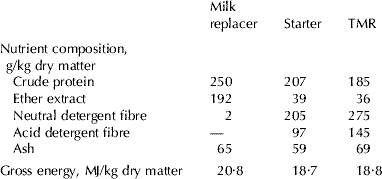
Sixty female Holstein calves (BW 43·2±0·58 kg and 9·8±0·61 d old) arrived from different farms to a commercial contract-heifer operation (Rancho Las Nieves, Mallén, Spain) under the approval and supervision of the Animal Care Committee of IRTA. Upon arrival, they were weighed and housed in individual hutches (1·07×1·60 m) bedded with straw. Then, calves were randomly distributed according to BW in two groups: 31 calves were assigned to a conventional feeding programme (CF) and 29 calves to an enhanced-growth feeding programme (EF). The first week of study was an adaptation period, during which calves in CF treatment received 4 l/d of MR at 12% DM dilution rate, and EF calves received during the first 3 d of the adaptation week 4 l/d at 12% DM dilution rate, and during the last 4 d of the adaptation week 4 l/d at 15% DM dilution rate. After the adaptation period, CF calves were fed 4 l/d of MR at 12% DM dilution rate from days 1 to 27, and 2 l/d offered in the afternoon feeding from day 28 to weaning at day 34 (50 d of age). EF calves were offered MR at 18% DM dilution rate according to the following schedule: 4 l/d from days 1 to 6, 6 l/d from days 7 to 13, 7 l/d from days 14 to 20, 6 l/d from days 21 to 27 and 3 l/d offered in afternoon feed from days 28 to 34 of study. All groups received the same MR (Sprayfo Excellent 60, Sloten BV, Holland) offered in feeding bottles twice daily at 7.00 and 17.00, and the same calf starter until 1 week after weaning (Table 1). Water was available ad libitum throughout the study. Calves were housed individually until 1 week after weaning. Then, they were moved to groups of six calves and were fed a TMR (Table 1) until day 56 of study (72 d of age). Heifers were kept within the same groups until they reached the target BW of 116 kg. Then, these pens were combined in groups of four, independently of their treatment, and transferred to other pens forming groups of 24 heifers and were fed a TMR containing 181 g CP/kg and 11·21 MJ ME/kg (DM basis) until they reached 160 d of age and a target BW of 164 kg. These pens were later grouped again to form single groups of approximately 70 heifers and fed a TMR containing 174 g CP/kg and 9·67 MJ ME/kg (DM basis) until they were 215 d old and reached a target BW of 213 kg. Later, these pens were further combined into single groups of approximately 130 heifers (combining heifers that pertained to the study with others that did not) and were fed a TMR containing 168 g CP/kg and 9·41 MJ ME/kg (DM basis), and the animals did not leave this pen until they reached a target BW of 261 kg at an age of 270 d. In these pens, heifers were fed a TMR containing 162 g CP/kg and 9·20 MJ ME/kg (DM basis), then at the age of 330 d all the animals weighing >310 kg were moved into other pens forming groups of approximately 120 heifers and fed a TMR containing 153 g CP/kg CP and 9·00 MJ ME/kg (DM basis). Finally, at the age of 400 d heifers weighing >380 kg were moved to a breeding pen and were fed a TMR containing 141 g CP/kg and 8·83 MJ ME/kg (DM basis). Once heifers were in the breeding pen, oestruses were checked three times a day, and heifers were inseminated 12 h after oestrus was detected. When a heifer did not reach the target BW at each specific age she was kept in the same pen, but her cohorts moved up to the following pen, and a new group of younger heifers moved in. Thus, the animals that were delayed (did not reach the target BW at a specific age) were regrouped with a new set of younger heifers. Animals that were delayed were weighed every 15 d until they reached the target BW and were then moved up one group. One month before calving, heifers returned to their original farm and they were fed and milked according to the management of each farm.
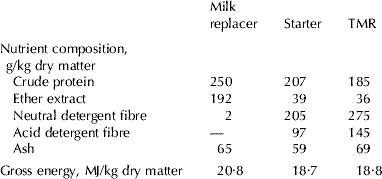
Chemical composition of milk replacer, starter, and first total mixed ration (TMR)
During the preweaning period, animals were vaccinated against Clostridium spp. with Miloxan (Merial, Lyon, France) and bovine respiratory syncytial virus (BRSV), Parainfluenza-3 virus, Pasteurella haemolytica with Bovipast RSP (Intervet, Boxmeer, Holland) at 23 d of age, and revaccinated 3 weeks later.
Measurements
MR and starter intakes were measured daily from the beginning of the study to day 42 of study. Afterwards, from days 42 to 56 of the study, pen TMR intake was recorded daily. BW was measured once weekly from the beginning to day 56 of the study, and before every pen change (days 94, 149, 200, 387). Diarrhoea scores were recorded daily during the preweaning period following the scale (1=firm; not hard; 2=soft; 3=runny; and 4=watery) proposed by Larson et al. (Reference Larson, Owen, Albright, Appleman, Lamb and Muller1977). Medical treatments, if needed, were recorded throughout the study. During the preweaning period, 10 ml blood was collected from each calf by venipuncture of the jugular vein into a collection tube under vaccum at 1, 3, 5, 6 and 8 weeks of study, 2–4 h after the morning offer of MR. Blood was kept cold in ice and centrifuged at 1500 g for 15 min to obtain serum. Serum samples were stored at −20°C until subsequent determination of serum urea, non-esterified fatty acids (NEFA) and insulin. Additionally, a 5-ml blood sample harvested with sodium fluoride and potassium oxalate was also obtained to determine plasma glucose.
Breeding data (number of artificial insemination, BW and age at breeding and at pregnancy) of all heifers in the study and milk yield at 305 DIM of 28 primiparous cows from three different farms were recorded. These 28 cows were distributed in three different farms that recorded individual daily milk yields. The remaining cows were discarded because they returned to herds where milk yield was not recorded daily or because they left the contract heifer operation before the expected date (and thus underwent different management, nutrition, etc.). Initially, the study had been planned to include all cows in each treatment, but only 14 cows per treatment could be used at the end. Initial power analysis indicated that assuming a variation of ±1000 kg of milk production in the first lactation and a power of 80%, in order to detect significant differences of about 1000 kg with a 95% CI a minimum number of 17 animals per treatment was necessary. Therefore, owing to the inability to track all heifers initially included in the study, using only 14 cows per treatment is likely to result in insufficient statistical power to detect differences.
Chemical analyses
Samples of MR and starter were analysed for DM (24 h at 103°C) with an electronic oven (P-Selecta model 297D, Germany), ash (4 h at 550°C) with an electronic muffle (Lenton, England), N using the AOAC (1990) method (988.05) adapted for an automatic distiller Kjeldhal (Kjeltec Auto 1030 Analyser, Tecator, Sweden) and using CuSO4/Se as a catalyst instead of CuSO4/TiO2, ether extract using the AOAC method (920.39) using petroleum ether for distillation instead of diethyl ether (AOAC, 1990), neutral detergent fibre, with sodium sulphite and heat-stable alpha-amylase, acid detergent fibre (van Soest et al. Reference Van Soest, Robertson and Lewis1991), and gross energy with an adiabatic calorimeter (IKA-calorimeter C 4000, Heitersheim, Germany).
Enzymic determination of plasma glucose, serum urea and NEFA were conducted following the HK/G-6-PDH method (Burrin & Price, Reference Burrin and Price1985), the urease-GLDH method (Gutmann & Bergmeyer, Reference Gutmann and Bergmeyer1974) and the ACS-ACOD method (Wako, Osaka, Japan), respectively. Serum insulin was determined using an ELISA kit (Mercodia, Uppsala, Sweden).
Statistical analyses
ANOVA with repeated measures was used to study the changes in BW, gain to feed ratio, MR and starter intakes and blood parameters during the preweaning period. The statistical model included calf as a random effect, feeding programme, sampling time, and the interactions between the two main factors as fixed effects. Time entered the model as a repeated measure.
Performance during days 42 to 56 of study was analysed considering calf within pen as random effect, and feeding programme, sampling time, and the interaction between these two fixed factors as fixed effects. Total intake of TMR was analysed considering pen as experimental unit. Time also entered the model as a repeated measure.
For each analysed variable, calf nested within feeding programme was subjected to three variance-covariance structures: compound symmetry, autoregressive order one, and spatial power. The variance-covariance structure that yielded the smallest Schwarz's Bayesian criterion was considered the most desirable matrix. Comparisons with P⩽0·05 were considered significant, whereas comparisons with P⩽0·10 were presented as tendencies. Differences between treatment means across time were assessed with a multiple test comparison using Tukey's test.
Performance from day 56 to the end of the study was analysed with the same model as data from the preweaning period, but time entered the model as a repeated measure only using the spatial power variance-covariance structure.
Owing to the lack of normality, serum NEFA and insulin, and insulin to glucose ratio were analysed after a ln-transformation. Least square means for these parameters presented herein correspond to non-transformed data, and sem and P-values correspond to the ANOVA analysis using ln-transformed data, respectively.
No incidences of medical and oral rehydratant treatments and loose faeces occurred after the second week of the study. Thus, only data from the first 2 weeks of the study were used for the statistical analysis. Faecal scores were grouped in two categories: scores 1 and 2 were considered a single category illustrating absence of loose faeces, and scores 3 and 4 were grouped into a second category representing presence of loose faeces. Then, data were split into two categories for every calf and week: absence of loose faeces within a week (0) or presence of loose faeces at least once within a week (1). Then, a logistic regression with calf as a random effect, and week and feeding programme as fixed effects was performed. Medical and oral rehydratant treatments were analysed similarly to the presence of loose faeces within a week. Therefore, data were split into two categories: no medical treatments or any medical treatment within a week. After that, a logistic regression was performed including calf as random effect, and week, feeding programme and their interaction as fixed effects.
Delays due to insufficient BW were analysed as the number of delays throughout the study. Then, data were analysed as a Poisson regression model including feeding programme as a fixed effect.
Reproductive performance parameters analysed included: age of heifers at the entrance to the breeding pen, age at first breeding, age at pregnancy and fertility at first breeding. These parameters were analysed with ANOVA including feeding programme as a fixed effect. Pregnancy rate at first breeding was analysed by a logistic regression including feeding programme as a fixed effect.
Finally, milk yield was analysed with ANOVA including feeding programme as fixed effect and original farm as random effect.
Results
Performance
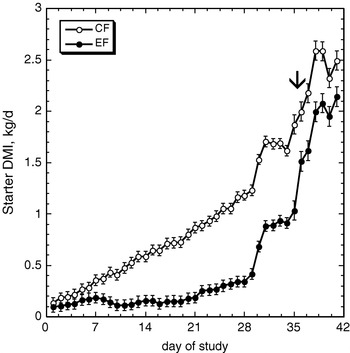
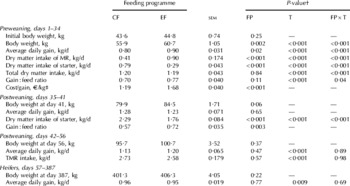
Starter DM intake (DMI) was lower (P<0·001) in EF than with CF calves during the preweaning period and the week after weaning (Table 2). Furthermore, starter DMI evolved differently (P<0·001) during the preweaning period. Starter DMI of CF calves increased linearly from the day 7 of the study and throughout the preweaning period, whereas EF calves presented a slight linear increase of starter DMI from day 22 d (Fig. 1). Although total DMI was similar in both treatments during the preweaning period, it evolved differently (P<0·001) throughout the preweaning period as indicated by the interaction between feeding programme and time (Table 2). During the first 20 d of the study, EF calves had greater total DMI than CF calves, because of greater MR consumption. Thereafter, as CF calves increased starter consumption, total DMI was similar between treatments, and from days 25 to 34 of the preweaning period, CF calves had greater total DMI than EF calves. After mixing calves within feeding programme in groups of six, similar DMI were observed in both treatments (Table 2).
Starter dry matter intake (DMI) of calves following a conventional (CF, ○) or an enhanced-growth (EF, •) feeding programme. The arrow points to the weaning day.

Least squares means of performance and intake of calves following a conventional (CF) or an enhanced-growth (EF) feeding programme

† FP=effect of feeding programme; T=time; FP×T=interaction between feeding programme and time
‡ Cost of MR 1·59 €/kg, cost of starter 0·31 €/kg
Calves in the EF treatment had greater (P<0·05) average daily gain (ADG) than CF calves during the preweaning period. However, ADG was similar for both treatments the week after weaning, and for the first 2 weeks after grouping calves (Table 2). Moreover, the interaction between feeding programme and time indicated that during the first 3 weeks of study ADG was greater (P<0·001) for EF compared with CF, but it was similar for both treatments during week 4 of study, and it was lower in EF than in CF treatment the week before weaning when MR was reduced to one meal per day. Nevertheless, after mixing calves in groups, ADG evolved similarly for both treatments. All calves decreased ADG the first week after mixing, but calves recovered the ADG observed the week after weaning during the second week following mixing of groups. After that, heifers presented similar ADG throughout their growing period (Table 2). Overall, differences in BW tended to be greater (P=0·06) for EF than for CF calves until 41 d. After that, both treatments presented similar BW (Table 2). There were no differences (P=0·22) in delays due to insufficient BW at target age between EF and CF calves. Gain to feed ratio was numerically greater (P=0·11) in EF than in CF calves during the preweaning period. Furthermore, the interaction of feeding programme with time (P<0·05) showed that EF calves presented greater gain to feed ratio up to 13 d of the study compared with CF calves, but it was similar afterwards in both treatments throughout the preweaning period. Surprisingly, the gain to feed ratio improved (P<0·01) in EF calves the week after weaning (Table 2), because EF calves presented lower starter DMI the week after weaning than CF calves, and ADG was similar in both treatments during that week. Although EF calves grew more and were more efficient than CF calves during the preweaning period, the feeding costs per kg of BW gain were greater (P<0·001) for EF than for CF calves (Table 2).
The incidence of health problems was very low in both treatments and there were no differences in the occurrence of loose faeces between CF and EF during the first 2 weeks of the study. Similarly, there were no differences in the incidence of medical and oral rehydratant treatments between CF and EF calves throughout the first 2 weeks of the study (data not shown).
Blood parameters
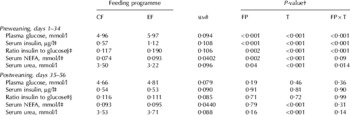
Plasma glucose and serum insulin concentrations were greater (P<0·001) in EF compared with CF calves during the preweaning period (Table 3). Furthermore, both plasma glucose and serum insulin showed the same evolution throughout the preweaning period. Calves in EF treatment showed greater (P<0·001) plasma glucose and serum insulin concentration from days 7 to 21 of study than CF calves, and similar concentrations were observed in both treatments at day 34. However, after weaning, there were no differences between treatments either in serum insulin or in plasma glucose. Insulin to glucose ratio was greater (P<0·05) in EF than CF calves during the preweaning period, and similar in both treatments 2 weeks after weaning. This indicates that greater insulin release was needed to avoid an increase of plasma glucose during the preweaning period.
Least squares means of blood parameters of calves following a conventional (CF) or an enhanced-growth (EF) feeding programme

† FP=effect of feeding programme; T=time; FP×T=interaction between feeding programme and time
‡ Least squares means for NEFA and insulin concentrations and the ratio glucose to insulin blood concentrations presented herein correspond to non-transformed data, and sem and P-values correspond to the ANOVA analysis using ln-transformed data, respectively
§ Ratio insulin to glucose expressed as pg/mmol
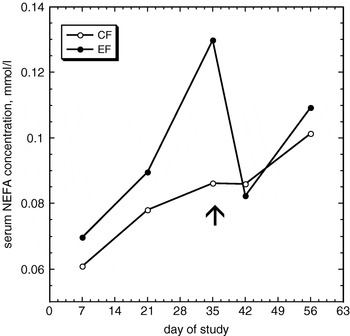
During the preweaning period, serum NEFA concentration was greater (P<0·01) in EF compared with CF calves. However, it tended (P=0·09) to be different between treatments across time during this period (Table 3). Calves on EF treatment showed an increase of serum NEFA from day 21 to day 35 of the study, which was not observed in CF calves (Fig. 2). However, during the 2 weeks after weaning, there were no differences in serum NEFA between treatments.
Serum non-esterified fatty acid (NEFA) concentration of calves following a conventional (CF, ○) or an enhanced-growth (EF, •) feeding programme. The arrow points to the weaning day.

Serum urea concentrations were greater (P<0·05) in CF than in EF calves during the preweaning period (Table 3), and evolved differently (P<0·001) during this period. Serum urea decreased from day 1 to day 21 of study in calves on the CF treatment, but serum urea increased from day 21 to day 34 in both treatments. However, during the 2 weeks after weaning there were no differences between treatments.
Reproductive performance and milk yield
There were no differences between treatments in age of entrance to the breeding pen, age at first artificial insemination, age at pregnancy and 305-DIM milk yield (Table 4). Similarly, fertility at first breeding (53·3 v. 64·3% in CF and EF calves, respectively) and the odds of becoming pregnant at first insemination were not different between treatments (P=0·40).
Reproductive performance and milk yield at 305 days in milk of calves following a conventional (CF) or an enhanced-growth (EF) feeding programme

† FP=effect of feeding program
‡ n=14 from three different farms
Discussion
Growth performance
Growth rate of EF calves during the preweaning period was similar to that observed by Shamay et al. (Reference Shamay, Werner, Moallem, Barash and Bruckental2005) when feeding high amounts of milk, but greater than the rates reported by others (Brown et al. Reference Brown, VandeHaar, Daniels, Liesman, Chapin, Keisler and Weber Nielsen2005b; Quigley et al. Reference Quigley, Wolfe and Elsasser2006). Age, gender and origin of calves, and the presence of an adaptation week before the start of the study may explain these differences in ADG. The decrease in ADG observed the week before weaning in EF calves has also been reported before (Bar-Peled et al. Reference Bar-Peled, Robinzon, Maltz, Tagari, Folman, Bruckental, Voet, Gacitua and Lehrer1997; Jasper & Weary, Reference Jasper and Weary2002). It may be explained by the decrease of energy and protein intake of EF calves (6·4% less gross energy, GE, and 9·2% less CP intake than the week before) when MR was reduced to one feeding per day. Contrary to CF calves, that continued to increase GE and CP intake the week before weaning (19·4% more GE and 17·3% more CP intake than the week before). To avoid the reduction in ADG and encourage starter intake around weaning, a more gradual weaning process should be used (Brown et al. Reference Brown, VandeHaar, Daniels, Liesman, Chapin, Keisler and Weber Nielsen2005b). Recently Khan et al. (Reference Khan, Lee, Lee, Kim, Kim, Ki, Ha, Lee and Choi2007) successfully weaned calves following a step-down programme; this consisted of feeding milk at 20% BW for the first 25 d of age, milk at 10% BW from 26 to 45 d, and finally weaning calves gradually by diluting milk with water from 46 to 50 d.
The improved feed efficiency during the first 2 weeks of study in EF compared with CF calves was probably a result of the high degree of digestion of milk-based diets (Davis & Drackley, Reference Davis and Drackley1998). However, the decrease of gain to feed ratio in EF calves from day 14 to weaning day may be attributed to the low capacity of EF calves to digest starter. Terré et al. (Reference Terré, Devant and Bach2007) observed that apparent nutrient digestibility was lower in enhanced-fed calves than in those fed conventionally one week after weaning. However, the improvement in feed efficiency after weaning in EF calves might be due to greater gut fill in EF than in CF calves, because of the potentially lesser rumen development and DM turnover in EF than in CF calves (Hartnell & Satter, Reference Hartnell and Satter1979). In spite of the improved growth during the preweaning period, feeding calves on an enhanced-growth feeding programme is not economic unless future benefits are obtained to compensate for the costs of feeding high levels of MR during the preweaning period. Similarly to the present study, raising calves on an intensified feeding programme was more expensive (Quigley et al. Reference Quigley, Wolfe and Elsasser2006; Raeth-Knight et al. Reference Raeth-Knight, Chester-Jones, Hayes, Linn, Larson, Ziegler, Ziegler and Broadwater2009).
Similarly to Jasper & Weary (Reference Jasper and Weary2002), we found no differences in health afflictions or faecal score. However, other studies feeding additional MR report an increase in health problems (Quigley et al. Reference Quigley, Wolfe and Elsasser2006), higher faecal scores (Diaz et al. Reference Diaz, Van Amburgh, Smith, Kelsey and Hutten2001; Raeth-Knight et al. Reference Raeth-Knight, Chester-Jones, Hayes, Linn, Larson, Ziegler, Ziegler and Broadwater2009) and higher medicated days (Cowles et al. Reference Cowles, White, Whitehouse and Erickson2006) compared with conventionally fed calves.
Blood parameters
Quigley et al. (Reference Quigley, Wolfe and Elsasser2006) also report greater plasma glucose concentrations when calves are fed additional amounts of MR. This can be explained by the greater amounts of lactose fed to EF compared with CF calves, since serum glucose and insulin increase with lactose and total sugar intake (Hugi et al. Reference Hugi, Bruckmaier and Blum1997).
The increase of serum insulin from days 7 to 21 in EF calves was probably a response to the high amount of ingested energy during the first 3 weeks of study (Hammon et al. Reference Hammon, Schiessier, Nussbaum and Blum2002). The increase in serum NEFA concentration from days 21 to 35 of the study in EF calves, but not in CF calves, occurred when MR was reduced to one daily feeding the week before weaning, and it may suggest mobilization of energy reserves due to the decrease of energy consumption during that week, as it occurs in transported calves during their journey (Knowles et al. Reference Knowles, Brown, Edwards, Phillips and Warriss1999).
Lower serum urea in EF compared with CF calves during the preweaning period may indicate that although EF calves tended to consume more CP during this period than CF calves (data not shown), they utilized dietary N more efficiently. Similarly, Cowles et al. Reference Cowles, White, Whitehouse and Erickson2006 report lower blood urea N when feeding calves on an enhanced-growth feeding programme compared with conventional feeding. These results are surprising as literature usually describes a positive relationship between dietary CP and serum urea concentrations (Blome et al. Reference Blome, Drackley, McKeith, Hutjens and McCoy2003; Quigley et al. Reference Quigley, Wolfe and Elsasser2006). However, other studies (Smith et al. Reference Smith, Van Amburgh, Diaz, Lucy and Bauman2002; Terré et al. Reference Terré, Devant and Bach2006) did not find differences in plasma urea when comparing high and low levels of MR or milk consumption.
Reproductive performance and milk yield
Although reproductive performance and milk yield were similar in the present study, the long-term effects on calves fed high amounts of milk or MR are varied. Calves allowed to suckle their dam calved 31 d earlier and weighed 37 kg more at calving than calves fed bottle-fed 3 l of MR once daily (Bar-Peled et al. Reference Bar-Peled, Robinzon, Maltz, Tagari, Folman, Bruckental, Voet, Gacitua and Lehrer1997). Moreover, calves fed MR at 2·1% of BW during the preweaning period calved 17 d earlier and with a similar BW to calves fed MR at 1·2% BW during the preweaning period (Davis-Rincker et al. Reference Davis-Rincker, VandeHaar, Wolf, Liesman, Chapin and Weber Nielsen2006). Nevertheless, no differences in age at first calving were found in calves fed milk ad libitum or 0·45 kg/d of MR (Shamay et al. Reference Shamay, Werner, Moallem, Barash and Bruckental2005). Others report a significant increment of milk yield (12·6%) when young calves were fed an intensified feeding programme (Drackley et al. Reference Drackley, Pollard, Dann and Stamey2007). However, similarly to the present study, increments in milk yield of enhanced-fed calves of 5·25% (Raeth-Knight et al. Reference Raeth-Knight, Chester-Jones, Hayes, Linn, Larson, Ziegler, Ziegler and Broadwater2009) or 4·71% (Bar-Peled et al. Reference Bar-Peled, Robinzon, Maltz, Tagari, Folman, Bruckental, Voet, Gacitua and Lehrer1997) did not reach statistical significance. However, the numerical differences observed in the current study are relatively large and they might have reached significance if a larger sample size had been used (n was 14, although initially planned to be 30). Nevertheless, the present results may be an important contribution for posterior literature reviews and meta-analysis.
Conclusions
Enhanced-growth feeding programmes improve calf ADG but impair starter consumption during the preweaning period. However, the same DMI is achieved one week after weaning on both feeding programmes. In spite of the improvement in growth during the preweaning period, there were no statistically significant differences in age at first breeding, age at first pregnancy or milk yield; a greater sample size, however, might have resulted in significant differences.
We thank Rancho Las Nieves for allowing the development of this study in their facilities. We owe special thanks to Fernando, Bernat, Pepe y José Luís from Rancho Las Nieves, and INIA (Instituto Nacional de Investigación y Tecnología Agraria y Alimentaria) for the fellowship that supported the work of Marta Terré.