Over the years, autonomic dysfunctions associated with psychiatric disorders have attracted increasing interest (Lehofer et al., Reference Lehofer, Moser, Hoehn-Saric, McLeod, Liebmann, Dmovsek and Zapotoczky1997). Heart rate variability (HRV), one of the most promising markers for the measurement of autonomic function (Task Force, 1996), refers to beat-to-beat fluctuations in heart rate. Used to assess cardiac autonomic function, HRV is related to outcomes following cardiac events (Kleiger, Miller, Bigger, & Moss, Reference Kleiger, Miller, Bigger and Moss1987; La Rovere, Bigger, Marcus, Mortara, & Schwartz, Reference La Rovere, Bigger, Marcus, Mortara and Schwartz1998). Changes in HRV pattern can be an indicator of compromised health (Pumprla, Howorka, Groves, Chester, & Nolan, Reference Pumprla, Howorka, Groves, Chester and Nolan2002). High HRV indicates good adaptability, implying a healthy individual with well-functioning autonomic control (Pumprla et al., Reference Pumprla, Howorka, Groves, Chester and Nolan2002). Low HRV reflects excessive sympathetic and/or inadequate parasympathetic tone (Task Force, 1996) and an abnormal and insufficient adaptability of the autonomic nervous system (Pumprla et al., Reference Pumprla, Howorka, Groves, Chester and Nolan2002).
HRV can be evaluated using two approaches: time domain or frequency domain. Time domain methods use simple statistical analyses (means and variance) to measure the amount of variability present in a prespecified time period in a continuous electrocardiogram, whereas frequency domain methods analyse the presence of underlying rhythms (Task Force, 1996). In the frequency approach, periodic oscillations of heart rate at various frequencies are measured in order to determine the overall variance in heart rate (Task Force, 1996).
Increased cardiac morbidity and mortality have been associated with depression among persons with and without cardiac risk factors (Penninx et al., Reference Penninx, Beekman, Honig, Deeg, Schoevers, van Eijk and van Tilburg2001), and this relationship is, in part, mediated by reductions in HRV (Carney et al., Reference Carney, Blumenthal, Freedland, Stein, Howells, Berkman and Jaffe2005; Grippo & Johnson, Reference Grippo and Johnson2002; Thayer & Lane, Reference Thayer and Lane2007). Investigation of the relationship between HRV and depression has generally been conducted in cardiac patient samples (Carney et al., Reference Carney, Blumenthal, Freedland, Stein, Howells, Berkman and Jaffe2005; Carney et al., Reference Carney, Saunders, Freedland, Stein, Rich and Jaffe1995; Drago et al., Reference Drago, Bergerone, Anselmino, Varalda, Cascio, Palumbo, Angelini and Trevi2007); however, there is some evidence that depressed patients exhibit decreased HRV (Agelink, Boz, Ullrich, & Andrich, Reference Agelink, Boz, Ullrich and Andrich2002; Nahshoni et al., Reference Nahshoni, Aravot, Aizenberg, Sigler, Zalsman, Strasberg and Weizman2004; Udupa et al., Reference Udupa, Sathyaprabha, Thirthalli, Kishore, Lavekar, Raju and Gangadhar2007).
Mindfulness-based cognitive therapy (MBCT), a relatively new therapy initially designed for the treatment of relapse in depression, has also been applied to the treatment of active depression and anxiety (Evans et al., Reference Evans, Ferrando, Findler, Stowell, Smart and Haglin2008; Kenny & Williams, Reference Kenny and Williams2007; Teasdale et al., Reference Teasdale, Segal, Williams, Ridgeway, Soulsby and Lau2000; van Aalderen et al., Reference Van Aalderen, Donders, Giommi, Spinhoven, Barendregt and Speckens2012). MBCT is designed to improve awareness and non-reactive acceptance of negative thoughts and feelings (Teasdale et al., Reference Teasdale, Segal, Williams, Ridgeway, Soulsby and Lau2000): teaching participants to disengage from habitual and repetitive negative thinking patterns (e.g., rumination and worry) that are thought to increase vulnerability to depression (Teasdale et al., Reference Teasdale, Segal, Williams, Ridgeway, Soulsby and Lau2000), and instead purposefully attend to the present moment with friendly interest and in a non-judgmental manner (Baer, Reference Baer2003; Kabat-Zinn, Reference Kabat-Zinn1990). It is hypothesised that this reduces rumination and promotes more adaptive responding.
Most evaluations of MBCT have focused on mental health symptoms, and whether they decrease following MBCT programs. MBCT is demonstrably efficacious in reducing depressive symptoms in people with current and recurrent depression (Barnhofer et al., Reference Barnhofer, Crane, Hargus, Amarasinghe, Winder and Williams2009; Finucane & Mercer, Reference Finucane and Mercer2006; Kenny & Williams, Reference Kenny and Williams2007; Kingston, Dooley, Bates, Lawlor, & Malone, Reference Kingston, Dooley, Bates, Lawlor and Malone2007; van Aalderen et al., Reference Van Aalderen, Donders, Giommi, Spinhoven, Barendregt and Speckens2012) and in preventing relapses (Godfrin & van Herringen, Reference Godfrin and van Herringen2010; Kuyken et al., Reference Kuyken, Byford, Taylor, Watkins, Holden, White and Teasdale2008; Ma & Teasdale, Reference Ma and Teasdale2004; Teasdale et al., Reference Teasdale, Segal, Williams, Ridgeway, Soulsby and Lau2000). Furthermore, MBCT improves quality of life (QoL) in both depressed clinical (Godfrin & van Herringen, Reference Godfrin and van Herringen2010; Kuyken et al., Reference Kuyken, Byford, Taylor, Watkins, Holden, White and Teasdale2008), non-clinical (Kaviani, Hatami, & Shafiabadi, Reference Kaviani, Hatami and Shafiabadi2009; Kaviani, Javaheri, & Hatami, Reference Kaviani, Javaheri and Hatami2011), and subclinical populations (Kaviani, Hatami, & Javaheri, Reference Kaviani, Hatami and Javaheri2012) and among patients with both medical and mental health problems (Roth & Robbins, Reference Roth and Robbins2004).
Although several types of meditation have been shown to be associated with HRV improvements (Phongsuphap, Pongsupap, Chandanamattha, & Lursinsap, Reference Phongsuphap, Pongsupap, Chandanamattha and Lursinsap2008; Telles, Mohapatra, & Naveen, Reference Telles, Mohapatra and Naveen2005; Telles et al., Reference Telles, Raghavendra, Naveen, Manjunath, Kumar and Subramanya2013; Wu & Lo, Reference Wu and Lo2008), few researchers have explored relationships between MBCT and HRV (Delizonna, Williams, & Langer, Reference Delizonna, Williams and Langer2009; Ditto, Eclache, & Goldman, Reference Ditto, Eclache and Goldman2006; Peressutti, Martin-Gonzalez, & Garcia-Manso, Reference Peressutti, Martin-Gonzalez and Garcia-Manso2012; Peressutti, Martin-Gonzalez, Garcia-Manso, & Mesa, Reference Peressutti, Martin-Gonzalez, Garcia-Manso and Mesa2010). These studies emphasised concentrative techniques and involved intensive practice, suggesting that the HRV changes resulting from MBCT-associated practices supports the premise that mindfulness may improve the effectiveness of self-regulatory mechanisms such as attention and emotion processing (Peressutti et al., Reference Peressutti, Martin-Gonzalez and Garcia-Manso2012), and control over heart rate (Delizonna et al., Reference Delizonna, Williams and Langer2009). Peressutti and colleagues (2010) found that the HRV changes were coherent with years of practice from novice to experienced meditators, and inferred that changes in breathing pattern were associated with the quality and focus of attention. Similarly, Ditto and colleagues (Reference Ditto, Eclache and Goldman2006) analysed the breathing cycle in body scan meditation (a technique used in MBCT) and demonstrated that respiratory sinus arrhythmia (an index of parasympathetic control) increased among meditating participants.
The present study aimed to pilot a method for examining the relationship between depression and HRV in mental health outpatients undergoing MBCT. Specifically, the study examined whether MBCT treatment over an 8-week period was associated with objective changes in (a) time and frequency domain HRV, and (b) depressive symptoms and quality of life.
Method
Design
Adults referred for MBCT with a current DSM-IV Axis I diagnosis and a previous history of anxiety and/or depression, were recruited between May 2010 and August 2012 at the Centre for Treatment of Anxiety and Depression (CTAD), a public mental health outpatient clinic in Adelaide, an Australian city. Participants underwent physical measurements, psychometric questionnaires, and electrocardiographic monitoring to determine HRV. The assessment was repeated twice before the commencement of the mindfulness program, and once after, with 8 weeks between each appointment. The three testing sessions occurred at a similar time of day for each participant, to avoid diurnal variations. The project received approval from the Central Northern Adelaide Health Service and the University of Adelaide Human Research Ethics Committees.
Electrocardiographic Monitoring
Participants rested for 5 minutes in a quiet room to stabilise heart rate (and exclude potential stress effects) prior to 20 minutes of electrocardiographic testing in the supine position. Following administration of the Stroop Color and Word Test (used as a stressor; Golden & Freshwater, Reference Golden and Freshwater1998), participants undertook a second 20-minutes of ECG recording (including the 5 minutes of rest) to analyse any stress effect.
Participants
Participants were referred to CTAD for MBCT by their treating psychologist, psychiatrist or general practitioner, and were accepted into the study once a CTAD psychiatrist confirmed a primary diagnosis adhering to DSM-IV Axis I criteria (APA, 1994) and satisfying the inclusion and exclusion criteria. Excluded from the study were people with cardiac, respiratory or neurological diagnoses, or an inability to complete psychometric measures (due to language difficulties or colour blindness). Pregnant or lactating women and substance abusers were also excluded. Finally, people were excluded if their psychiatric diagnosis rendered them ineligible for the MBCT program. Throughout the study, any reported changes in participants’ medication, caffeine, alcohol or substance use were discussed with the CTAD psychiatrist and a cardiologist, in light of the exclusion criteria.
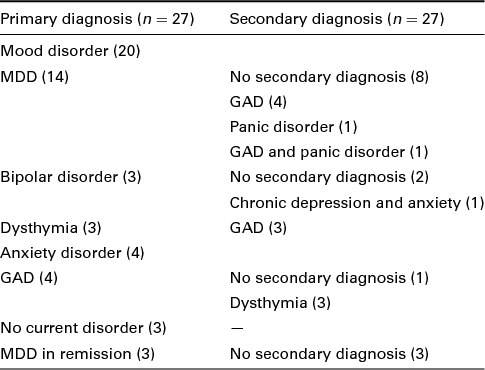
Participants were 27 volunteers (M age = 47, SD = 13, 63% female), with a primary diagnosis of either a mood (current or in remission) or anxiety disorder, and a range of comorbid conditions (Table 1). Participants gave written consent to participate in the study with full knowledge of the experimental nature of the research, and were instructed to abstain from alcohol, illicit substances, caffeine and nicotine for a minimum of 4 hours prior to testing.
DSM-IV Diagnoses of Mental Health Outpatients

Note: Expressed as diagnosis (number). GAD, generalised anxiety disorder; MDD, major depressive disorder.
Measures
Variables measured in this study included (a) patient demographics (age and gender), (b) physical measurements (weight, height, waist circumference and HRV) and (c) cardiac risk factors (body mass index, cigarette smoking status, alcohol and illicit substance usage, hypertension, hypercholesterolemia, diabetes mellitus, cardiac condition and prescription medication). Psychometric measures included the Short Form-36 version 1 (SF-36; Tucker, Adams, & Wilson, Reference Tucker, Adams and Wilson2010; Ware & Sherbourne, Reference Ware and Sherbourne1992), Stroop Color and Word Test (Golden & Freshwater, Reference Golden and Freshwater1998) and Center for Epidemiologic Studies Depression scale (CES-D; Radloff, Reference Radloff1977). Participants were classified according to standard CES-D threshold scores (Ensel, Reference Ensel, Lin, Dean and Ensel1986; Zich, Attkisson, & Greenfield, Reference Zich, Attkisson and Greenfield1990) as not depressed <16; mildly depressed 16–26 (indicative of minor depression); or moderately to severely depressed ≥27 (indicative of major depression; Cheok, Schrader, Banham, Marker, & Hordacre, Reference Cheok, Schrader, Banham, Marker and Hordacre2003).
To determine HRV, power spectral analysis of the beat-to-beat time series of R-R (commonly called normal-to-normal; NN) intervals was performed using the Holter LX Analysis program (NorthEast Monitoring, 2009). Three time domain measures were analysed: SDNN (standard deviation of NN intervals) as a marker of the overall magnitude of variability; RMSSD (square root of the mean squared difference of successive NNs), an estimate of short-term components of HRV; and HRV triangular index (the number of NN intervals divided by the maximum of the density distribution), an estimate of overall HRV. Two frequency bands associated with different physiological rhythms were analysed: low frequency band (LF: 0.04–0.15Hz), which is determined by both parasympathetic and sympathetic activity; and high frequency band (HF: 0.15–0.4Hz), reflecting mainly respiratory sinus arrhythmia as an index of cardiac vagal control. The time points of LF and HF were averaged to obtain the raw frequency domain score.
Statistical Analyses
Statistical analyses were performed using SPSS statistical software version 17 (SPSS, 2008) and Stata version 12 (StataCorp, 2011). In the univariate analyses, descriptive statistics were reported as means and standard deviations for continuous data and as percentages for categorical data. The primary endpoint (treatment effect) for HRV parameters and SF-36 physical summary score was analysed as panel data utilising a repeated measures model. The Hausman test indicated whether a fixed or random effects model was preferred. Depression was analysed as a dichotomous variable (CES-D depressed/not depressed). The percentage of participants in each CES-D depression category remained the same at test times 1 and 2, providing only two outcomes for this variable. Therefore, a population-averaged estimate of the treatment effect was produced and analysed using logistic regression. Probabilities of p < .05 were considered significant. Effect sizes were calculated using Cohen's d, where a d value of 0.2 indicates a small effect, 0.5 a medium effect, and 0.8 a large effect (Cohen, Reference Cohen1988).
Power analysis using GPower software indicated that for an effect size of 0.25, p value of .05 and 80% power, this pilot study required a total sample size of 28. Importantly, this power analysis examined the chance of detecting an overall time effect in the repeated measures/logistic regression tests. However, this study was also testing for a treatment effect over and above the linear trend with time. Based on the collected data (with test times 1 and 2 averaged), this study had an effect size of 0.34 and 97% power to detect a time effect for the CES-D score, but at most, a 0.07 effect size and 11% power to detect a time effect for the HRV parameters in the analysis.
Results
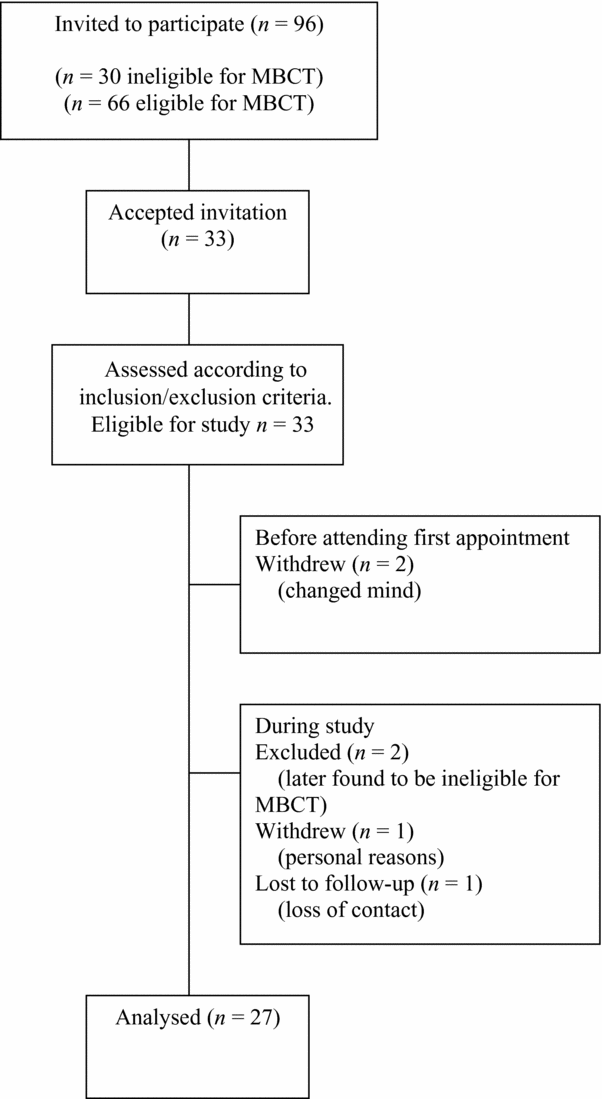
Of the 96 people invited into the study, 33 accepted. Two participants withdrew before their first appointment, and during the course of the study another four were excluded, withdrawn or lost to follow-up, resulting in a final sample size of 27 (Figure 1).
Recruitment flow diagram.
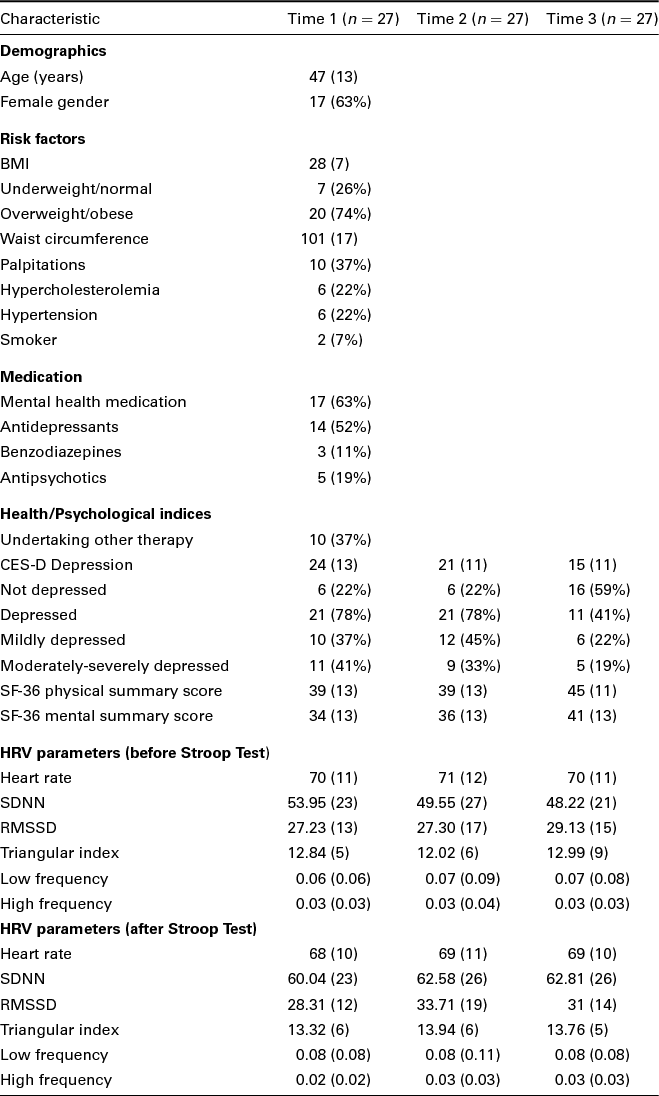
The clinical and psychometric characteristics of study participants are summarised in Table 2. With CES-D scores of 16 or higher, the majority of participants were classified as depressed at baseline, but scores decreased over the three testing periods. The SF-36 mental and physical summary scores both increased from test time 1 to test time 3, suggesting improved QoL. More than half of the sample was taking prescription medication for their mental health disorders.
Characteristics of Mental Health Outpatients for the Three Test Times
Note: Values expressed as number (per cent) or mean (SD). CES-D = Center for Epidemiologic Studies Depression, RMSSD = root mean square of successive RR intervals, SF-36 = Short Form-36, SDNN = standard deviation of normal to normal RR interval. SDNN, RMSSD in ms; LF, HF in sec2/Hz.
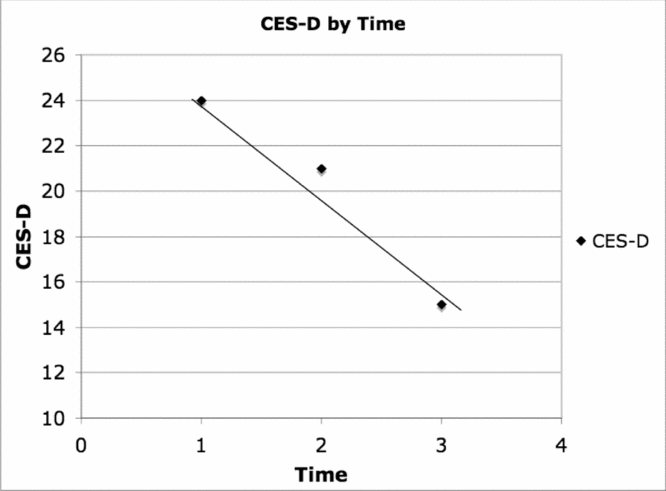
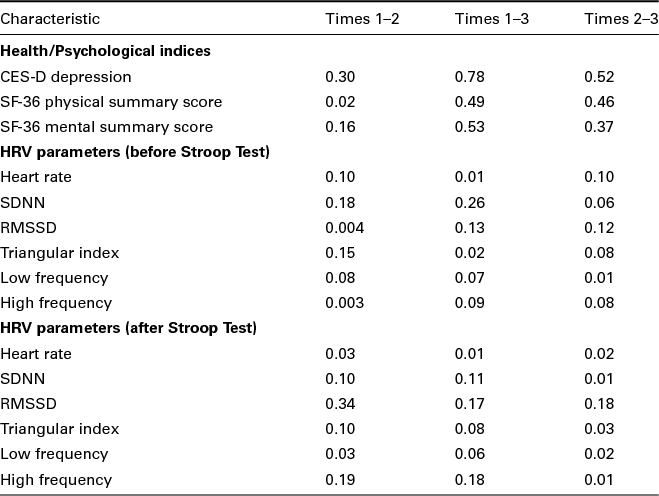
Multivariate analyses revealed significant treatment effects for SF-36 physical summary score (5.35, 95% CI 1.40–9.31, p = .008) and for depression as a dichotomous variable (0.20, 95% CI 0.05–0.74, p = .016). A linear effect (rather than treatment effect) was detected for depression as a continuous variable (Figure 2). Subgroup analyses were considered (those classified as moderately to severely depressed at baseline, and those primarily diagnosed with generalised anxiety disorder), but these groups were too small for meaningful analyses. No significant change was observed for any time or frequency domain parameter with or without the stressor test. Effect sizes for each parameter are shown in Table 3.
CES-D (as a continuous variable) by time. Mean CES-D scores are shown for each test occasion. There was a linear time effect on depression scores.
Effect Sizes (Cohen's d)
Note: CES-D = Center for Epidemiologic Studies Depression, RMSSD = root mean square of successive RR intervals, SF-36 = Short Form-36, SDNN = standard deviation of normal to normal RR interval.
Discussion
This pilot study primarily aimed to examine whether group-based MBCT influenced HRV in mental health outpatients. Results showed no change in heart rate or in time and frequency HRV parameters with or without administration of the stressor (Stroop Color and Word Test). Nevertheless, MBCT was found to promote a significant improvement in health-related QoL as measured by the SF-36 physical summary score, and a reduction in self-reported depressive symptoms. Although underpowered to detect any difference in HRV, this exploratory pilot study provides a basis for future investigation into the relationship between HRV and MBCT.
When CES-D was analysed as a continuous variable, no treatment effect was evident. The majority of variation in the data was explained by a linear time effect (Figure 2). Depression scores decreased linearly from the first baseline test occasion to the post-treatment test occasion. However, when CES-D was analysed as a dichotomous variable, a large difference in variation was found between the depressed and not depressed categories, resulting in a significant treatment effect. Given that the percentage of depressed patients (as classified by the CES-D) was stable across the 8 weeks for test times 1 and 2, and decreased by half after MBCT, CES-D as a categorical variable provided a clinically meaningful method of analysis. It is notable that during the course of this study some of the participants were receiving additional long-term psychotherapy (psychologist and/or psychiatrist). It is unlikely that this influenced the above findings, because participants were referred to the MBCT course due to a lack of or only partial response to their current therapy.
Validity of Study Findings
Consistent with the established literature (Barnhofer et al., Reference Barnhofer, Crane, Hargus, Amarasinghe, Winder and Williams2009; Godfrin & van Herringen, Reference Godfrin and van Herringen2010; Kenny & Williams, Reference Kenny and Williams2007; Roth & Robbins, Reference Roth and Robbins2004; van Aalderen et al., Reference Van Aalderen, Donders, Giommi, Spinhoven, Barendregt and Speckens2012), our findings provide further evidence for the effectiveness of MBCT for depressive symptoms and QoL. Furthermore, our study showed benefits for a heterogeneous sample of mental health outpatients, similar to those referred to many community mental health providers, treated in mixed rather than diagnosis-specific group sessions. However, given the study's limitations, results must be interpreted with caution. The design was quasi-experimental and did not include a control group, comparison therapy, or any form of randomisation.
Previous Studies of Depression and HRV
This study is believed to be one of the first to investigate the effect of MBCT on HRV. As we noted in the introduction, previous studies examining mindfulness and HRV differed from the MBCT program undertaken in this study in the emphasis of concentrative techniques or intensiveness of practice (Delizonna et al., Reference Delizonna, Williams and Langer2009; Peressutti et al., Reference Peressutti, Martin-Gonzalez and Garcia-Manso2012; Peressutti et al., Reference Peressutti, Martin-Gonzalez, Garcia-Manso and Mesa2010). Results are therefore not easily comparable. However, Ditto and colleagues (Reference Ditto, Eclache and Goldman2006) examined the short-term autonomic and cardiovascular effects of one MBCT technique, body scan meditation. They reported an increase in respiratory sinus arrhythmia (an index of parasympathetic control) among meditating participants.
We did not find a significant change in either time or frequency domain HRV parameters with or without administration of the stressor test, but our findings have a number of potential explanations. First, in terms of final sample size, the study was underpowered to detect either a time or treatment effect in HRV. Second, Agelink and colleagues (Reference Agelink, Boz, Ullrich and Andrich2002) found that only severely depressed patients showed reduced HRV and significantly lower modulation of cardiac vagal activity compared to non-depressed controls. In our study, 41% of participants were moderately to severely depressed at baseline and statistically this subgroup was too small for meaningful analyses. In addition, we attempted to compare the HRV parameters in our study with those in other studies (Udupa et al., Reference Udupa, Sathyaprabha, Thirthalli, Kishore, Lavekar, Raju and Gangadhar2007; Udupa et al., Reference Udupa, Thirthalli, Sathyaprabha, Kishore, Raju and Gangadhar2011), but the large variability in scores between studies prevented meaningful interpretation. Third, some studies analysing depression and HRV selectively recruited drug-naïve participants (Chang et al., Reference Chang, Chang, Chen, Kuo, Lu and Huang2012; Lehofer et al., Reference Lehofer, Moser, Hoehn-Saric, McLeod, Liebmann, Dmovsek and Zapotoczky1997; Moser et al., Reference Moser, Lehofer, Hoehn-Saric, McLeod, Hilderbrandt, Steinbrenner and Zapotoczky1998; Udupa et al., Reference Udupa, Sathyaprabha, Thirthalli, Kishore, Lavekar, Raju and Gangadhar2007), whereas 63% of our participants were using psychiatric medications. Although consistent with treatment as usual, this may have influenced findings. Selective serotonin reuptake inhibitors (SSRIs) have been reported to either increase (Tucker et al., Reference Tucker, Adamson, Miranda, Scarborough, Williams, Groff and McLean1997) or decrease (Bar et al., Reference Bar, Greiner, Jochum, Friedrich, Wagner and Sauer2004; Volkers et al., Reference Volkers, Tulen, van den Broek, Bruyn, Passchier and Pepplinkhuizen2004) HRV, and seratonergic and noradrenaline reuptake inhibitors (SNRIs; Licht, de Geus, van Dyck, & Penninx, Reference Licht, de Geus, van Dyck and Penninx2010) and mood stabilisers (Henry, Minassian, Paulus, Geyer, & Perry, Reference Henry, Minassian, Paulus, Geyer and Perry2010) also influence HRV. Moreover, short duration cardiac recordings have shown a small increase in HRV, while longer recordings contradicted this result (van Zyl, Hasegawa, & Nagata, Reference Van Zyl, Hasegawa and Nagata2008). Finally, several studies of depression and HRV recruited only patients with major depressive disorder (Chang et al., Reference Chang, Chang, Chen, Kuo, Lu and Huang2012; Udupa et al., Reference Udupa, Sathyaprabha, Thirthalli, Kishore, Lavekar, Raju and Gangadhar2007). Our study was naturalistic and our sample more heterogeneous. Anxiety is known to affect HRV (Friedman, Reference Friedman2007; Gorman & Sloan, Reference Gorman and Sloan2000); indeed, Watkins and colleagues (Reference Watkins, Grossman, Krishnan and Blumenthal1999) argued for stronger links between anxiety and HRV than depression and HRV. Comorbid anxiety may, therefore, have been a significant confound in our exploration of HRV in mental health outpatients.
It has been suggested that mindfulness is not a self-relaxation technique (Baer, Reference Baer2003), but rather a form of mental training that facilitates more adaptive responses to stress (Bishop, Reference Bishop2002). Accordingly, it is possible that meditation emphasising concentrative techniques may have a greater impact on HRV. However, it is also possible that the absence of an HRV effect in our study reflects the need for longer-term mindfulness practice and experience, as found in studies of experienced meditators (Peressutti et al., Reference Peressutti, Martin-Gonzalez and Garcia-Manso2012; Phongsuphap et al., Reference Phongsuphap, Pongsupap, Chandanamattha and Lursinsap2008). Although our participants’ mood, attitudes and QoL may have changed during the 8-week MBCT program, longer-term follow-up studies of MBCT are essential to document any physiological changes. It should also be noted that HRV was not analysed using non-linear techniques, which may be more sensitive to depression effects (Kemp et al., Reference Kemp, Quintana, Gray, Felmingham, Brown and Gatt2010).
Conclusion
This pilot establishes the feasibility of the study design and highlights the psychological and health-related QoL benefits of MBCT in a naturalistic outpatient sample. Despite the absence of measurable improvements in HRV, the study represents an important extension to knowledge of the population and methodology required in order to examine this relationship. Future studies may, by eliminating confounders, permit more reliable quantification of the contributions of autonomic function to the causal network surrounding depression. To increase sample size, studies could include multicentre sites for recruitment and implement randomised controlled trials. Our study highlights the immediate psychological and QoL value of mindfulness training, and support larger and longer-term studies of its potential physiological benefits on cardiac health.
Acknowledgments
The authors wish to thank the ECG technicians at The Queen Elizabeth Hospital, the CTAD staff and all participants who volunteered for the study.