Introduction
Individuals with post-traumatic stress disorder (PTSD) experience a wide range of symptoms following a trauma that can be grouped into several clusters, which include: re-experiencing, avoidance, hyper-arousal, and numbing. This varied symptomatology, ranging from intrusive recollections and vivid dreams to difficulty sleeping and anger, is often targeted for pharmacologic management (American Psychiatric Association, 2000). Although the syndrome only develops in a fraction of individuals exposed to trauma, it is relatively common, especially in combat Veterans. Recent studies have found that between 7 and 13% of the approximately 1 million individuals who deployed to the conflicts in Iraq and Afghanistan have developed PTSD (Hoge et al. Reference Hoge, Castro, Messer, McGurk, Cotting and Koffman2004; Kok et al. Reference Kok, Herrell, Thomas and Hoge2012). In 2010, the US Veterans Health Administration (VHA) treated almost 500 000 individuals with PTSD in specialty mental health clinics (Hermes et al. Reference Hermes, Rosenheck, Desai and Fontana2012).
The multi-dimensional symptoms of PTSD are mirrored by the multitude of pharmacologic and psychotherapeutic treatments associated with the disorder. In 2010, the VHA published practice guidelines, updated from 2004, for the treatment of PTSD (Management of Post-Traumatic Stress Working Group, 2010a). These recommendations provide an assessment of over 15 pharmacologic treatments and found good evidence for selective serotonin reuptake inhibitors (SSRIs) and serotonin norepinephrine reuptake inhibitors (SNRIs). For second generation antipsychotics (SGAs), the recommendation for their use in PTSD was upgraded from ‘No Evidence’ in 2004 to ‘Fair Evidence’ as an augmentation strategy in 2010, and then to ‘contraindicated’ in the case of risperidone and ‘insufficient evidence’ for other SGAs after a further update in 2011 (Management of Post-Traumatic Stress Working Group, 2010b; Krystal et al. Reference Krystal, Rosenheck, Cramer, Vessicchio, Jones, Vertrees and Stock2011). VHA guidelines are comparable with those of the National Institute for Health and Care Excellence (NICE), which recommend SGAs, specifically olanzapine, only as a second or third line treatment in augmentation to antidepressants (National Collaborating Centre for Mental Health, 2005).
Off-label use of SGAs is now more common than the use for FDA approved indications such as schizophrenia, bipolar disorder, and treatment resistant depression. The most common psychiatric diagnosis in patients prescribed SGAs off-label in the VHA is PTSD (Leslie et al. Reference Leslie, Mohamed and Rosenheck2009). An estimated 13% of Veterans with PTSD were treated with SGAs in 2009, a proportion that has gradually decreased from a high of almost 18% in 2002, for unclear reasons (Bernardy et al. Reference Bernardy, Lund, Alexander and Friedman2012). An earlier study of national VHA prescription data found that the prescription of antipsychotics to individuals with PTSD was related most strongly to the presence of a comorbid psychotic, bipolar or cognitive disorders and recent psychiatric hospitalization (Mohamed & Rosenheck, Reference Mohamed and Rosenheck2008).
Prior studies of antipsychotic use in individuals with PTSD are limited by administrative data where information on why providers choose particular medications is not available. In the case of SGAs, this information is important as the agents can cause significant medium and long-term side-effects such as weight gain, disturbances in glucose homoeostasis, hyperlipidemia and neurological side effects (Allison et al. Reference Allison, Mentore, Heo, Chandler, Cappelleri, Infante and Weiden1999). To better understand the reasons providers select SGAs for individuals with PTSD in contrast to other conditions, the current study used data from a survey of providers at the time they started an SGA. Three groups receiving SGAs were compared: veterans with PTSD as their sole mental health diagnosis, veterans with PTSD as one of multiple diagnoses, and veterans without a PTSD diagnosis. It further sought to identify the reasons and clinical correlates of SGA use in those with PTSD, which might expand the understanding of this practice.
Methods
Procedure
Data were gathered as part of an intervention consisting of non-commercial educational outreach to providers, termed academic detailing, performed by VHA psychiatrists and aimed at educating providers on the latest effectiveness and side-effect data for SGAs in addition to a required provider decision-making survey. These strategies were employed in an effort to reduce the rate of new prescriptions for costly on-patent SGAs at a single VHA medical center between October 2007 and May 2009. The intervention was implemented throughout the VA Connecticut Healthcare System which provided outpatient and inpatient treatment to approximately 10 000 veterans with mental illness annually during this time period (Greenberg & Rosenheck, Reference Greenberg and Rosenheck2007). The survey involved all antipsychotic prescribers (psychiatric physicians, advance practice registered nurses, and physician assistants) and was completed at the time any on-patent SGA (olanzapine, long-acting injectable risperidone, oral risperidone, aripiprazole, ziprasidone, or quetiapine) was ordered as a new, non-refill prescription for an outpatient. The survey was electronically delivered as part of the medication ordering system at the time any new SGA prescription was submitted. Completion was required before the prescription could be electronically sent to the pharmacy. Therefore, 100% of providers writing SGA prescriptions were assumed to have been surveyed regarding 100% of patients receiving SGAs over this period. The institutional review boards of the Yale University School of Medicine and the VA Connecticut Healthcare System approved the study.
Sample
The sample draws from a total of 2643 surveys completed over the 20-month study period. Surveys in which information on the SGA prescribed was missing (n = 30) were excluded.
Survey
The survey consisted of 20 questions completed by the provider, which documented patient demographics, the proposed medication, the primary psychiatric diagnoses under treatment, important comorbid medical diagnoses, and prior antipsychotics attempted as well as other patient health characteristics such as the patient's current Global Assessment of Functioning (GAF) and body mass index (BMI). A list of forced choice selections and write-in answers were given for each question. Providers were asked ‘Is the proposed medication for the treatment of…’ and could make multiple selections from among five diagnostic categories: schizophrenia, bipolar disorder, other affective disorders, PTSD and ‘other.’ In addition, providers selected from among ten reasons for using the SGA: ‘intolerance to current drug,’ ‘efficacy,’ ‘less extra-pyramidal symptoms,’ ‘less tardive dyskinesia risk,’ ‘less akathisia,’ ‘less sedation,’ ‘increased sleep/sedation,’ ‘treatment of tardive dyskinesia,’ ‘patient preference,’ and ‘other.’
Analysis
Chi-square tests and analysis of variance (ANOVA) were used to compare responses to survey questions among three mutually exclusive categories based on the clinician documented diagnosis: prescriptions for individuals with a diagnosis of PTSD only, for those with PTSD and an additional psychiatric diagnosis (schizophrenia, bipolar disorder, other affective disorder and ‘other’) and for those with a psychiatric diagnosis other than PTSD.
Results
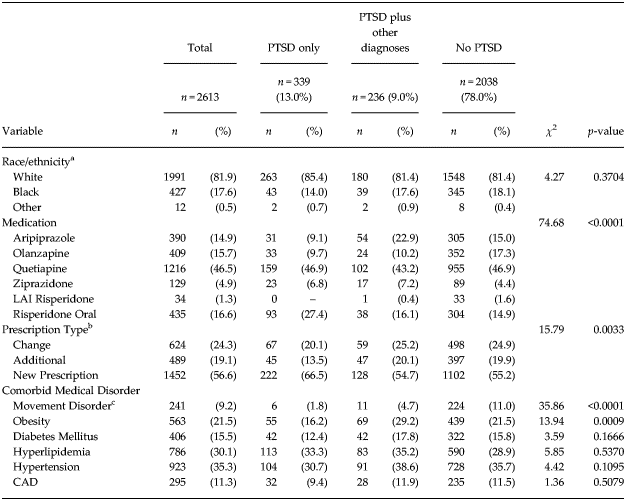
Of the 2613 surveys analysed, the proportion of SGA prescriptions written for PTSD as the sole diagnosis was 13% (n = 339), the proportion where PTSD was one among other diagnoses was 9% (n = 236), while the proportion without a PTSD diagnosis was 78% (n = 2038) (Table 1). The mean age for individuals with PTSD either as the sole diagnosis [50.7 years (s.d. = 13.8)] or among other diagnoses [50.4 years (s.d. = 13.1)] was significantly but only modestly younger compared with those without PTSD [55.7 years (s.d. = 14.9); F = 27.60, p < 0.001]. The mean GAF score of those with PTSD only [47.2 (s.d. = 14.1)] was significantly but modestly higher than those without PTSD or with PTSD in combination with other diagnoses [44.3 (s.d. = 13.5) and 43.9 (11.0), respectively; F = 6.71, p = 0.0012].
Characteristics and bivariate analysis by usage for PTSD categories for responses to a survey associated with the prescription of atypical antipsychotics

PTSD, post-traumatic stress disorder; LIA, long acting injectable; CAD, coronary artery disease.
a183 observations missing in the race/ethnicity category.
b48 observations missing in the prescription type category.
cMovement disorder includes tardive dyskinesia, extra-pyramidal symptoms, and akithesia.
When comorbid medical disorders associated with the prescription of SGAs for PTSD were evaluated, the proportion of those with movement disorders (tardive dyskinesia, extra-pyramidal symptoms or akathisia) and obesity were lower in those with PTSD only (1.8 and 16.2%, respectively) compared with those without PTSD (11.0 and 21.5%, respectively) (χ 2 = 35.86, p < 0.0001 for movement disorders; X 2 = 13.94, p < 0.0009 for obesity) (Table 1).
The most frequently prescribed SGAs in the entire sample were quetiapine (46.5% of prescriptions), oral risperidone (16.6%), and olanzapine (15.7%). There was a statistically significant association between the specific SGA prescribed and PTSD diagnostic categories (χ 2 = 74.68, p < 0.0001) (Table 1). Oral risperidone was used in a notably higher proportion in those with PTSD only (27.4%) compared with those with PTSD in combination with other diagnoses (16.1%), and those without PTSD (14.9%). Olanzapine, in contrast, was prescribed to a lower proportion of those with PTSD only (9.7%) compared with those with PTSD in addition to another disorder (10.2%) and those without PTSD (17.3%). Aripiprazole displayed the largest difference in use among PTSD categories. It was the second most commonly used SGA in those with PTSD in combination with other disorders (22.9%), while it was used in only 15.0% of veterans with disorders exclusive of PTSD and only 9.1% of veterans with only PTSD.
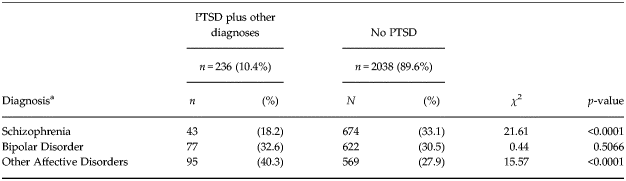
In this sample receiving SGA prescriptions, n = 717 (27.4%) had schizophrenia, n = 699 (26.8%) had bipolar disorder and n = 664 (25.4%) had other affective disorders, while n = 575 (22%) were diagnosed with PTSD. When evaluating those with multiple psychiatric disorders, the proportion with affective disorders other than bipolar disorder was higher among those with PTSD (40.3%) compared with those without PTSD (27.9%) (χ 2 = 15.57, p < 0.0001); whereas the proportion with bipolar disorder was similar between the two categories (Table 2). The proportion of individuals with schizophrenia was significantly lower among those with PTSD and a comorbid psychiatric disorder (18.2%) compared with those without PTSD (33.1%) (χ 2 = 21.61, p < 0.0001).
The distribution of other psychiatric diagnoses among those receiving SGAs with the diagnosis of PTSD
PTSD, post-traumatic stress disorder.
a339 representing PTSD only were removed.
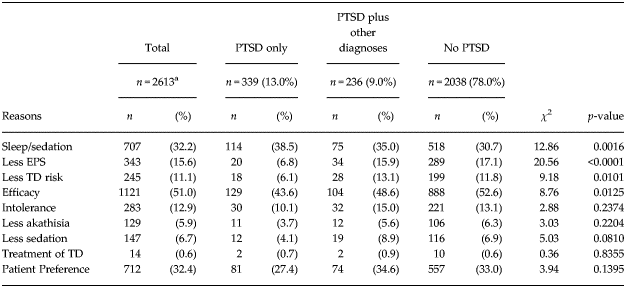
To further explore SGA prescribing practices among PTSD categories, the reasons given for the prescription of SGAs were evaluated (Table 3). The most common reasons selected for the entire sample were ‘efficacy’ n = 1121 (51%), ‘patient preference’ n = 712 (32.4%), and ‘sleep/sedation’ n = 707 (32.2%). Among those with PTSD, the most common reasons were ‘efficacy’ n = 233 (45.7%) and ‘sleep/sedation’ n = 189 (37.1%). However, ‘efficacy’ was selected in a relatively lower proportion in those with PTSD only (43.6%) compared with those with PTSD in combination with other disorders (48.6%) and those without PTSD (52.6%) (χ 2 = 8.78, p < 0.0125). The only reason that was significantly more frequently selected in those with PTSD was ‘sleep/sedation,’ selected in 38.5% of individuals with PTSD only and in 35.0% with PTSD in combination with another disorder, compared with 30.7% without PTSD (χ 2 = 12.86, p < 0.0016). The proportion of providers identifying ‘less extra-pyramidal symptoms’ and ‘less risk of tardive dyskinesia’ was significantly lower in patients with only PTSD (6.8 and 6.1%, respectively) compared with patients without PTSD (17 and 11.9%, respectively) (χ 2 = 20.56, p < 0.0001 for less extra-pyramidal symptoms; χ 2 = 9.18, p < 0.0101 for less risk of tardive dyskinesia).
Bivariate analysis of reasons given for the prescribed SGA by usage for PTSD categories
PTSD; post-traumatic stress disorder; EPS, extra-pyramidal symptoms; TD, tardive dyskinesia.
a415 where no reason was selected were removed for the calculation of individual proportions.
Discussion
Using a provider survey completed at the time any SGA was prescribed over a 20-month period, this analysis identified the provider selected clinical correlates of and reasons for SGA use among Veterans with PTSD compared with those with other psychiatric disorders. Overall, SGAs were most likely to be given for ‘efficacy,’ and specifically with the goal of ‘sleep/sedation’ in individuals with PTSD compared with those without PTSD. These are plausible reasons for choosing SGAs, but ones for which the evidence was limited at the time and safer agents were available. Those prescribed SGAs who had PTSD were generally younger, with slightly superior functioning, and less evidence of neurological side effects compared with their counterparts with other mental health disorders. The drugs were less likely to be given to avoid side-effects traditionally related to first generation antipsychotics, and most likely as a new prescription for quetiapine. These results expand the understanding of how individuals with PTSD are treated with pharmacologic agents within VHA, will allow more precise consideration of the risk–benefit profiles of these medications in the treatment of PTSD, and will help direct further pharmacoepidemiologic efforts as well as efforts to bring prescribing practices more in line with guideline recommendations.
A recent evaluation of prescription patterns for PTSD across the entire VHA by Lund et al. (Reference Lund, Bernardy, Alexander and Friedman2012) and Bernardy et al. (Reference Bernardy, Lund, Alexander and Friedman2012) found an overall decrease in the proportion of benzodiazepines and SGAs prescribed to veterans with PTSD over time. However, the Lund et al. study specifically evaluated a sample with PTSD; whereas, a 2009 study by Leslie et al. evaluated the off label use of all antipsychotics, nationally within VHA, finding that 42% of individuals prescribed antipsychotics had a diagnosis of PTSD, higher than the 22% observed in this study. A key methodological limitation of these studies is their reliance on administrative data, which does not allow for an understanding of the rationale and strategies used to make medication management decisions (Bernardy et al. Reference Bernardy, Lund, Alexander and Friedman2012). The current study used a provider survey linked to each SGA prescription to expand the understanding of why these agents are prescribed. The fact that providers selected the specific diagnoses treated is a methodological improvement, providing more information on provider decision making than the administrative data used in other studies.
While ‘efficacy’ was the most frequent reason selected by providers in all diagnostic groups including PTSD, ‘sleep/sedation’ was more frequently selected in those with PTSD alone compared with those with PTSD and another psychiatric disorder and those without PTSD. In addition, quetiapine was the most frequently prescribed SGA in all diagnostic categories. These results mirror that of Bernardy et al. (Reference Bernardy, Lund, Alexander and Friedman2012) which found a 10% increase in the use of low-dose quetiapine and a 13% increase in the use of non-benzodiazepine hypnotics for PTSD between 1999 and 2009. The use of quetiapine especially at low dose for the purpose of sleep or sedation has been implicated in other studies (Robert et al. Reference Robert, Hamner, Kose, Ulmer, Deitsch and Lorberbaum2005; Hartung et al. Reference Hartung, Wisdom, Pollack, Hamer, Haxby, Middleton and Mcfarland2008; Philip et al. Reference Philip, Mello, Carpenter, Tyrka and Price2008). In addition, this finding is further supported by a recent large randomized controlled trial of risperidone as an adjunct to SSRIs for treatment resistant PTSD. Risperidone significantly increased sedation and improved the symptom clusters of hyper-arousal and re-experiencing, but did not show improved efficacy over SSRIs alone (Krystal et al. Reference Krystal, Rosenheck, Cramer, Vessicchio, Jones, Vertrees and Stock2011).
The selection of ‘efficacy’ as the most frequent reason given for using SGAs among individuals with PTSD and the relative increased use of risperidone as the second most frequently used SGA among those with PTSD, must be put into context with the relevant VHA treatment guidelines and literature at the time of the survey. In 2004, VHA guidelines on the pharmacologic treatment of PTSD found no evidence for the use of SGAs in PTSD (Management of Post-Traumatic Stress Working Group, 2004). In the period between 2004 and 2010, during the time of the survey, ten small controlled studies, most evaluating risperidone, were published suggesting that SGAs might be helpful in the treatment of PTSD. Their results lead to recommendations in the 2010 VA/DoD treatment guidelines to include ‘Fair Evidence’ for the use of SGAs as an augmentation strategy (Management of Post-Traumatic Stress Working Group, 2010a). Krystal et al. (Reference Krystal, Rosenheck, Cramer, Vessicchio, Jones, Vertrees and Stock2011) published findings from a large multicenter trial of risperidone as an augmentation to fluoxetine in veterans with chronic PTSD (Krystal et al. Reference Krystal, Rosenheck, Cramer, Vessicchio, Jones, Vertrees and Stock2011). On the whole, this trial was negative for risperidone, leading to a revised recommendation in 2011 that risperidone is contraindicated as an adjunct to SSRIs and that there is insufficient information for a recommendation regarding the use of other SGAs (Management of Post-Traumatic Stress Working Group, 2010b). Providers may have interpreted the larger number of trials with risperidone between 2004 and 2010 and their results as evidence that SGAs were efficacious in the treatment of PTSD and that risperidone was superior to other agents.
Additional trends in the reasons for the prescription of SGAs in PTSD were noted. ‘Less extra-pyramidal symptoms’ and ‘Less tardive dyskinesia risk’ were selected in a reduced proportion of individuals with PTSD compared with those without PTSD. This finding is most likely related to the infrequent use of first generation antipsychotics in PTSD as compared with other disorders (Mohamed & Rosenheck, Reference Mohamed and Rosenheck2008; Bernardy et al. Reference Bernardy, Lund, Alexander and Friedman2012). In disorders where antipsychotics hold FDA indications, providers most likely view antipsychotics as a valid treatment choice and the avoidance of extra-pyramidal symptoms and tardive dyskinesia more of a priority in these disorders as compared with PTSD in which lower doses are often used, especially in the case of quetiapine (Hartung et al. Reference Hartung, Wisdom, Pollack, Hamer, Haxby, Middleton and Mcfarland2008). However, it must be noted that SGAs, even at low doses, are not without neurologic side effects (Miller et al. Reference Miller, Caroff, Davis, Rosenheck, McEvoy, Saltz and Keefe2008), especially extra-pyramidal symptoms and akathisia (Kane et al. Reference Kane, Fleischhacker, Hansen, Perlis, Pikalov and Assunção-Talbott2009). The existence of akathisia, especially, as a side effect among SGAs may be apparent in the finding that ‘less akathisia’ was not less frequently selected in those with PTSD in this study.
Several limitations of this analysis must be addressed. Compared with other studies that have evaluated the breadth of pharmacologic treatment for those with PTSD, this study only evaluated the use of SGAs that may limit its scope, but nevertheless addresses an important prescribing issue in itself. An important treatment option recommended by recent VHA treatment guidelines is the use of SGAs as augmenting agents to other medications such as SSRIs and SNRIs. This study, along with similar studies, was unable to determine the proportion of SGAs used as an augmentation to other pharmacologic or psychotherapeutic treatments. In addition, although VHA is the single largest integrated healthcare system within the US, this study evaluated only VHA service users and its generalization to other health systems and other countries may be limited. The original study's objectives did not involve the analysis of decision making with regard to the specific use of SGAs for PTSD, thus the interpretations of reasons such as ‘efficacy’ was left to the provider and the clinical context in which the prescription was made. Information regarding the severity of symptoms or the refractory nature of prior treatments in those treated with SGAs compared with other medications was not available, and the reasons available for selection on the survey did not include aggression, arousal, impulsivity, paranoia or other reasons, the selection of which might be expected in those with PTSD. In addition, the dose and length of prescriptions were not recorded, which is especially important given the relative prominence of ‘sleep/sedation’ as a reason, as quetiapine is commonly used at low dose for this purpose.
This work provides a more complete picture of the reasons individuals with PTSD are prescribed certain agents within a drug class. Results indicate that among individuals with PTSD treated with SGAs, the reasons ‘efficacy’ and ‘sleep/sedation’ are most commonly given and quetiapine is most frequently used. PTSD is often difficult to treat with relatively low remission rates even with the most efficacious treatments, and there is a paucity of evidence for the relative efficacy of individual SGAs. In this context, providers appear to have interpreted what evidence there is as supporting indications for efficacy and sleep or sedation and made practice decisions according to this evidence. As new psychotropic agents become available for the treatment of PTSD and our understanding of the current pharmacotherapeutic options deepen, pharmacoepidemologic efforts in concert with traditional efficacy trials will be needed to evaluate provider use of these agents. Such studies will better inform clinicians, researchers, administrators, and policy makers on how prescribing decisions are made and better focus efforts on evaluating risk–benefit ratios, and bringing prescribing behaviour in line with guideline recommendations. In addition, peer-driven educational efforts among providers such as academic detailing aimed at psychopharmacologic decision making may improve guideline adherence and lower the risk SGA exposure for some patients.
Acknowledgements
The authors would also like to thank Elina Stefanovics, PhD, VA Connecticut Healthcare System, for her help in data management and analysis. Dr Stefanovics declares no conflicts of interest in relation to this research. The funding source had no role in the design, analysis or interpretation of data or in the preparation of the report or decision to publish.
Financial Support
This analysis was supported by the New England Mental Illness Research, Education, and Clinical Center. The funding source had no role in the design, analysis or interpretation of data or in the preparation of the report or decision to publish.
Conflict of Interest
Dr Hermes reports no financial relationships with commercial interests. Dr Sernyak has received honoraria from Pfizer. Dr Rosenheck has received research support from Janssen Pharmaceutica Products and Wyeth Pharmaceuticals within the last year in addition to AstraZeneca pharmaceuticals LP, Bristol-Myers Squibb, and Eli Lilly and Co in the past. He has received consulting fees from Bristol-Myers Squibb, Eli Lilly and Co., Roche Pharmaceuticals and Janssen Pharmaceutica Products. He has testified as an expert in Jones ex rel. the State of Texas v. Janssen Pharmaceutica Products. This analysis was supported by the New England Mental Illness Research and Education Center. The funding source had no role in the design, analysis or interpretation of data or in the preparation of the report or decision to publish.