The Aliso Canyon natural gas storage facility was the site of the largest natural gas leak in United States history. Between October 23, 2015, and February 18, 2016, a ruptured well released 97 100 tons of natural gas consisting of methane, ethane, and sulfur odorantsReference Conley, Franco and Faloona 1 near Porter Ranch (PR) in the San Fernando Valley (SFV) area of Los Angeles County. Exposure to high concentrations of methane and ethane is known to cause headaches and nausea, while exposure to sulfur-containing compounds is associated with respiratory tract irritations, loss of smell, and headaches.Reference Conley, Franco and Faloona 1 Studies have previously reported a link between health symptoms and natural gas exposure in communities located near shale and other nonconventional gas sites.Reference Adgate, Goldstein and McKenzie 2 - Reference McKenzie, Witter and Newman 5
During the 16-week period of the leak, Los Angeles County Department of Public Health (LADPH) received over 700 health complaints regarding symptoms potentially related to the gas leak, including headaches, nausea/vomiting, diarrhea, nosebleeds, breathing problems, chest tightness, cough, and dizziness. 6 Health concerns prompted the temporary relocation of residents living in PR and surrounding neighborhoods. 6
Even after the leak was sealed and air quality had returned to background levels, some residents reported a recurrence of symptoms upon returning to their homes, 7 although an investigation by LADPH did not reveal elevated levels of natural gas and odorants in the air of homes in affected areas. However, a “characteristic fingerprint” of metals, indicating that they originated from the Alison Canyon storage facility, was reported in samples from residents’ homes. 7 The investigation concluded that the compounds could be associated with the symptoms. 7
In March 2016, LADPH conducted a Community Assessment of Public Health Emergency Response (CASPER) among households within 3 miles of the leak. In that survey, 81% of households reported medical symptoms believed to be associated with the leak, with 63% reporting symptoms after it was sealed. Furthermore, 61% of those reporting symptoms sought medical care for those symptoms even after the well was sealed, with 90% seeking medical care at family practitioners or urgent care centers, 29% seeking care by specialists, and 17% seeking care at emergency departments. 8 Additionally, 13% of residents who reported health symptoms during the leak indicated seeking medical care prior to reporting. 6
Per the United States Census, approximately 60 000 US military veterans live in the SFV, including about 9000 in the PR neighborhood, which is the closest to the gas leak. About 2600 veterans in PR and 17 500 in SFV receive medical care from the US Department of Veterans Affairs (VA). The VA patient record system includes patients’ outpatient visits and diagnoses at any VA health care facility; these data provided a unique opportunity to examine the potential impacts of the gas leak on veterans residing near the leak site. Unlike the CASPER assessment, which was based on self-reported symptoms, this analysis was based on actual health care utilization and diagnosis data for VA users.
We hypothesized that VA patients living in the impacted areas would have had higher exposure to natural gas than those living in surrounding areas and thus would have a higher percentage of visits with diagnoses for respiratory conditions related to the exposure during the time of gas leak.
METHODS
Cohort Description
We conducted a retrospective cohort study using VA administrative and clinical data. The cohort included patients receiving health care from the VA between October 2014 and September 2017 who resided in the San Fernando Valley area of Los Angeles County. Also included in the cohort were residents of Simi Valley and Thousand Oaks, located in neighboring Ventura County, who lived within 15 miles of the Aliso Canyon facility. Patients enrolled with VA for care after February 29, 2016 were excluded because we were unable to verify that they were residing in the area during the incident. Missing or “undeliverable” addresses were also excluded. The study cohort consisted of 17 180 patients. This study was approved by the US Department of Veterans Affairs (VA) Greater Los Angeles Healthcare System Institutional Review Board (IRB).
Study Groups
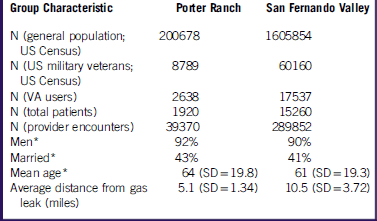
VA users with zip codes corresponding to Porter Ranch and adjacent neighborhoods (Northridge, Chatsworth, Granada Hills, and Mission Hills) were assigned to the PR group. Those neighborhoods were eligible for temporary relocation according to Southern California Gas records 9 and appeared as hot spots on LADPH density maps of reported symptoms during the gas leak. 6 VA users with zip codes corresponding to the rest of San Fernando Valley, Simi Valley, and Thousand Oaks were assigned to the SFV group for comparison. The PR group included 1 920 patients and the SFV group included 15 260 patients. Average distances from the facility were calculated for each group using geo-coded patient addresses.
Health Care Encounter Assessment
We examined outpatient encounters at all VA facilities in Los Angeles and Ventura Counties. We assessed respiratory conditions, the most common group of symptoms reported by affected residents, 6 , 8 including acute and chronic diagnoses, and cough, respiratory abnormalities, epistaxis, throat pain, and postnasal drip, by using ICD-9-CM codes (460-519, 784.1, 784.7, 786.09, 786.2) and ICD-10-CM codes (J00-J99, R04-R06, R07.0).
Data Analysis
We examined trends in respiratory-related visits to VA primary care physicians, pulmonologists, and otolaryngologists as a percentage of total visits to VA providers. Visits were assessed in 6-month blocks to account for potential seasonal variations. Time periods included: period 1 (7-12 months before the leak), period 2 (1-6 months before the leak), period 3 (during the gas leak, ie October 2015 to March 2016), period 4 (7-12 months after the leak), period 5 (13-18 months after the leak), and period 6 (19-24 months after the leak). We conducted between-group comparisons (PR vs SFV) for all periods and within-group comparisons for period 3 vs period 5 and period 4 vs period 6. For within-group comparisons, we did not compare results from periods 1 and 2 to the respective periods because changes in ICD (International Classification of Diseases) codes that occurred in October 2015 rendered these time periods noncomparable. We used Chi-square tests to assess statistical significance of the changes within and between the study groups. All analyses were performed using SAS 9.4 software (SAS Institute, Cary, NC).
RESULTS
Comparisons of demographic parameters between the PR and SFV groups were not statistically significant, indicating that proximity and potential exposure to the gas leak site were the only differences. Average distance from the incident site was 5.1 and 10.5 miles for the PR and SFV groups, respectively (Figure 1, Table 1).
Study Area of Aliso Canyon Gas Leak by Study Group, October 2014 to September 2017 (N = 17 180)

Patient Population by Study Group of US Department of Veterans Affairs (VA) Users Residing in Areas Impacted by the Porter Ranch Gas Leak, October 2014 to September 2017 (N=17 180)

* p>.05
Between-Group Comparisons
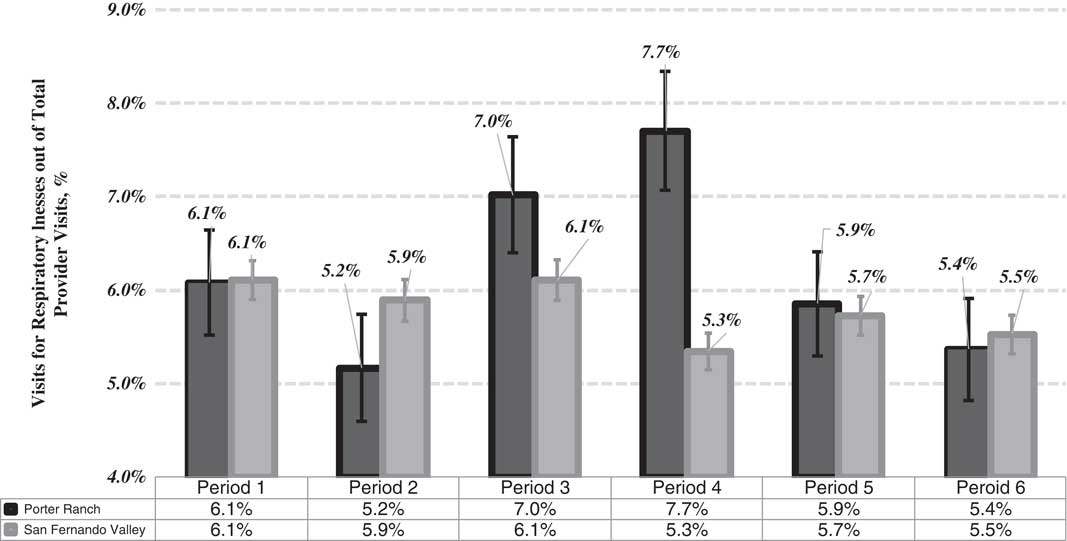
Figure 2 shows changes in the proportion of respiratory-related visits. Between October 2014 and September 2017, there were 39 370 total visits to VA providers for PR, 2450 of which had respiratory diagnoses (6.2%; 95% CL: 6.0%-6.5%), while there were 289 852 total visits by the SFV group with 16 716 respiratory diagnoses (5.8 %; 95% CL: 5.7%-5.9%). The difference between the two groups was statistically significant (P<0.001).
Percent of Respiratory-Related Diagnoses Out of Total Visits to US Department of Veterans Affairs (VA) Providers by VA Users From Oct 2014 to September 2017 (N = 17 180; Period 1: October 2014-March 2015, Period 2: April 2015-September 2015, Period 3: October 2015-March 2016; Period 4: April 2016-September 2016, Period 5: October 2016-March 2017; Period 6: April 2017-September 2017)

For period 1, there were no differences between PR and SFV: 424 respiratory-related visits for PR (6.1%; 95% CL: 5.5%-6.6%) and 3105 visits for SFV (6.1%; 95% CL:5.9%-6.3%) with P >0.05 between PR and SFV. For period 2, there was a significant difference (P<0.05) between PR and SFV: 299 respiratory-related visits to VA providers for PR (5.2%; 95% CL: 4.6%-5.7%) and 2527 visits for SFV (5.9%; 95% CL: 5.7%-6.1%). Comparing the proportion of respiratory-related visits between PR and SFV groups during the gas leak (period 3) showed a significant difference between the groups (P<0.01), with 456 respiratory-related visits for PR (7.0%; 95% CL: 6.4%-7.6%) vs 2885 respiratory-related visits for SFV (6.1%; 95% CL: 5.9%-6.3%). The largest difference in the proportion of respiratory diagnoses was observed immediately following the gas leak (period 4): 524 visits for PR (7.7%; 95% CL: 7.1%-8.3%) compared to 2670 for SFV (5.3%; 95% CL: 5.1%-5.5%) (P<0.0001). One year after the gas leak (period 5), there were no significant differences between the two groups (P>0.05), with 396 respiratory-related visits to VA providers for PR (5.9%; 95% CL: 5.3%-6.4%) and 2867 respiratory-related visits for SFV (5.7%; 95% CL: 5.5%-5.9%). This was followed by period 6, where again no significant difference in the proportions of the respiratory-related visits was observed, with 351 respiratory-related visits for PR (5.4%; 95% CL: 4.8%-5.9%) and 2662 respiratory-related visits for SFV (5.5%; 95% CL: 5.3%-5.7%).
Within-Group Comparisons
For PR, there was a statically significant difference in the proportions of respiratory-related diagnoses between periods 3 and 5 (7.0% vs 5.9%; P=0.03) and between periods 4 and 6 (7.7% vs 5.4%; P<0.0001). For SFV, there was a significant difference in the proportion of respiratory-related diagnoses between periods 3 and 5 (6.1% vs 5.7%; P<0.05); however, there was not a significant difference between periods 4 and 6 (5.3% vs 5.5%; P>0.05).
DISCUSSION
Because exposure to natural gas is associated with respiratory symptoms, it is not surprising that breathing problems, coughing, sore throat, congestion, sinus pressure, and nosebleeds were most commonly reported by residents participating in CASPER. 6 , 8 Our study supports these findings; we found an increase in respiratory diagnoses during outpatient visits by VA patients living near the leak.
While we observed an increase in the percentage of outpatient visits for respiratory symptoms in the PR group during the gas leak, the biggest increase was observed in period 4. This increase was atypical for the April-September season, as respiratory-related diagnoses are expected to decrease during those months. In contrast to the PR group, there was a decrease in the percentage of visits for respiratory diagnoses for the SFV group, which followed a predicted pattern with a slight increase in the proportion of respiratory-related diagnoses during winter and a decrease during summer. The difference in the proportions of respiratory-related diagnoses between the two groups during period 4 may have several contributing factors. It may indicate that the PR group experienced longer-term health effects, possibly due to prolonged exposure to natural gas. The mean age for the PR group was 64, and older residents were less likely to relocate during the gas leak. According to the report, a significant proportion of households that did not relocate had at least 1 household member who was 65 years or older. 8 It may also indicate that veterans were re-exposed to the metal compounds found in the surface dust of their homes upon their return after the leak was sealed, as was suggested in the LADPH report. 7 During period 2, we observed an increase in respiratory diagnoses in the SFV group, which was most likely attributed to the unusual excess of cases of influenza and/or bacterial pneumonia; after excluding such diagnoses (results not shown), the differences were no longer statistically significant. For period 3, however, even after excluding seasonal diagnoses, the differences between the two groups remained significant.
This study has limitations. We used VA data; health care visits to non-VA providers were excluded. Thus, our study may underreport total healthcare utilization. Additionally, we did not have information about how many veterans relocated during the leak. However, it should be noted that relocations did not start until late December 2015; therefore, residents likely were exposed to the natural gas for at least 2 months. 10 This factor also leads us to believe that our results likely underestimate the effects of the PR leak on the health of veterans residing near it. Furthermore, we could not assess the severity of the reported condition or whether the diagnosis was for a new visit or a follow-up.
The change from ICD-9-CM to ICD-10-CM in October 2015 made those periods non-comparable, and we did not perform statistical analysis comparing changes before and after the switch. However, we do not believe that the increase in the proportion of respiratory diagnoses in PR group in periods 3 and 4 was because of changes to the ICD system, because we also observed a decrease in respiratory visits among the SFV group during the corresponding periods. Changes in the ICD system did not affect the between-group comparisons.
CONCLUSION
Our study found that VA users living near the gas leak likely experienced prolonged negative health effects from higher levels of exposure to natural gas as indicated by an increase in the proportion of respiratory-related visits to VA health care providers during the gas leak and up to 6 months after the gas leak was sealed. Our results suggest that early relocation following gas leaks may mitigate respiratory exacerbations and decrease unnecessary health care utilization related to prolonged exposure. Further research is needed to examine potential long-term health effects, if any, of the natural gas leak.
Acknowledgements
This material is based upon work supported by the US Department of Veterans Affairs, Veterans Health Administration, Office of Patient Care Services. The views expressed in this manuscript are those of the authors and do not necessarily reflect the position or policy of the Department of Veterans Affairs or the US government.