Introduction
The worldwide increase in life expectancy is associated with a marked rise in the number of older people with cognitive impairment and dementia (Ferri et al., Reference Ferri2005; Kalaria et al., Reference Kalaria2008). It is estimated that more than 24 million people have dementia, and this figure is expected to double every 20 years, with greater rates of increase in developing countries. Dementia prevalence increases with age, ranging from 5% of those aged 71–79 years to 37.4% of those aged 90 and older in the U.S.A. (Plassman et al., Reference Plassman2007). While this age-related increase in prevalence seems to plateau after age 90 in men, it continues to rise in women, reaching close to 50% at age 95 years (Corrada et al., Reference Corrada, Brookmeyer, Berlau, Paganini-Hill and Kawas2008).
Dementia places an increasing burden on caregivers and health care services (Thompson and Spilsbury, Reference Thompson and Spilsbury2000). The diagnosis of dementia is often delayed, with physicians adopting a “watchful waiting process” for people with suspicious symptoms (Iliffe et al., Reference Iliffe2009). Most people with dementia seem to prefer an early disclosure of the diagnosis (Jha et al., Reference Jha, Tabet and Orrell2001) in order to end uncertainty, confirm suspicions, obtain better understanding of problems, and facilitate planning and access to support and interventions (Bamford et al., Reference Bamford, Lamont, Eccles, Robinson, May and Bond2004). It is thus important to increase awareness and develop reliable diagnostic tools for assessing cognitive decline in older patients (Dwolatzky and Clarfield, Reference Dwolatzky and Clarfield2004).
The diagnosis of dementia is based on clinical criteria and neuropsychological findings (Knopman et al., Reference Knopman2001). While cognitive screening instruments are readily available and widely used, the diagnosis of dementia often requires more comprehensive and accurate neuropsychological testing batteries, usually administered in specialist settings at significant expense. Over the past decade, computerized cognitive assessment tools have been developed in order to provide cognitive assessments in clinical settings, and these have been validated in many conditions (Partridge et al., Reference Partridge, Shapiro, Micalone, Jenouri, Woolard and Gifford1999; Wilken et al., Reference Wilken2003; Doniger et al., Reference Doniger2005; Reference Doniger, Simon and Zivotofsky2006b; Ritsner et al., Reference Ritsner, Blumenkrantz, Dubinsky and Dwolatzky2006; Crooks et al., Reference Crooks, Parsons and Buckwalter2007; Leitner et al., Reference Leitner, Doniger, Barak, Simon and Hausdorff2007; Schweiger et al., Reference Schweiger, Abramovitch, Doniger and Simon2007; Fillit et al., Reference Fillit, Simon, Doniger and Cummings2008). Mindstreams (NeuroTrax Corp., NY) is one such tool, with batteries for mild impairment validated in normal aging, mild cognitive impairment and early dementia (Dwolatzky et al., Reference Dwolatzky2003; Doniger et al., Reference Doniger2005). However, these batteries are not suitable for patients with more advanced cognitive impairment. Thus, a user-friendly computerized battery was designed specifically for patients with dementia. The Mindstreams battery for moderate impairment is a 15-minute instrument assessing orientation to time and place, memory, executive function, visual spatial skills, and verbal function. We present the results of a study designed to evaluate the discriminant validity of this battery for assessing patients with moderate cognitive impairment.
Methods
Participants and procedure
A total of 170 men and women older than 60 years of age undergoing cognitive assessment either at a tertiary memory clinic, or at assisted living facilities or nursing homes, performed the Mindstreams battery for moderate impairment in addition to standard clinical evaluation. After complete description of the study, written informed consent was obtained from each participant or an authorized surrogate. All procedures were approved by the Helsinki Committee of the Soroka Medical Center.
Clinical evaluation
Standard evaluation included demographic details, medical history, physical examination, laboratory testing, and imaging when indicated. Subjective cognitive complaints were determined according to a five-item cognitive symptoms questionnaire (CSQ) completed by the caregiver. In completing the CSQ, respondents reported whether the participant had memory loss, word-finding difficulty, reduced ability to manage financial affairs, difficulty in managing medications independently, and a noticeable decline in cognitive function over the past six months. Cognitive screening included administration of the Mini-mental State Examination (MMSE; Folstein et al., Reference Folstein, Folstein and McHugh1975), 5-minute delayed recall of the MMSE memory items (Tabert et al., Reference Tabert2002), and a 13-point Clock Drawing test (Freedman et al., Reference Freedman, Leach, Kaplan, Delis, Shulman and Winocur1994). Functional assessment was based on the Lawton-Brody Instrumental Activities of Daily Living (IADL) Scale (Lawton and Brody, Reference Lawton and Brody1969). Screening for depression was with the 15-item Geriatric Depression Scale (GDS; Sheikh and Yesavage, Reference Sheikh and Yesavage1986). Staging was according to the Clinical Dementia Rating (CDR) scale (Hughes et al., Reference Hughes, Berg, Danziger, Coben and Martin1982; Morris, Reference Morris1993) on the basis of clinical data but independent of computerized cognitive testing results. Thus, this staging served as the gold standard for evaluating the discriminant validity of the computerized measures.
Computerized battery
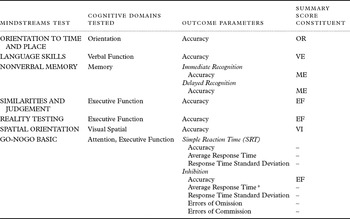
All participants completed the Mindstreams® battery for moderate impairment (NeuroTrax Corp., NY), a 15-minute computerized battery designed as a clinical tool for the cognitive assessment of older adults with significant impairment. As described previously (Dwolatzky et al., Reference Dwolatzky2003; Schweiger et al., Reference Schweiger, Abramovitch, Doniger and Simon2007), Mindstreams consists of custom software installed on a standard computer that serves as a platform for cognitive tests producing accuracy and/or response time (RT; millisecond timescale) data. Once tests are run on the local computer, the data are uploaded to a central server, where calculation of outcome parameters from raw single-trial data and report generation immediately occur. The Mindstreams battery for moderate impairment consists of six technician-administered tests and one patient-administered interactive test sampling the cognitive domains of orientation, memory, executive function, visual spatial processing, and verbal function (Table 1).
Mindstreams battery for moderate impairment: tests administered, cognitive domains tested, and outcome parameters recorded. Summary score constituents are indicated.

OR = Orientation Summary Score; ME = Memory Summary Score (Immediate Recognition weighted twice Delayed Recognition); EF = Executive Function Summary Score; VI = Visual Spatial Summary Score; VE = Verbal Function Summary Score.
a computed for correct responses only.
The tests can be briefly described as follows:
• Orientation to time and place: the participant is asked three basic questions regarding orientation to time and place. Accuracy is weighted such that partial credit is awarded for responses that are almost correct.
• Language skills: the participant is asked to comply with simple verbal commands and to name pictures of common objects; partial credit is awarded for responses that are nearly correct.
• Nonverbal memory: the participant is presented with pictures of common objects followed by an immediate recognition test; a delayed recognition test for the same objects is administered after 5 minutes.
• Similarities and judgement: a multiple-choice test in which the participant is asked simple questions relating to similarities and differences of common objects, as well as basic knowledge and praxis.
• Reality testing: the participant is presented with a series of pictures in which a particular aspect of the scene is either incomplete or inconsistent with context; following the presentation of each picture, the participant is asked to determine which aspect is aberrant; if he/she is unable to identify the aberrant aspect, multiple choices for the correct answer are provided and partial credit is awarded if a correct response is made.
• Spatial orientation: computer-generated scenes containing a red pillar are presented; the participant is asked to select the view of the scene from the vantage point of the red pillar.
• Go-NoGo Basic: a timed, patient-administered test consisting of two parts; in the simple reaction time (SRT) portion, large green squares are presented at pseudo-random intervals, and the participant is required to press the mouse button as quickly as possible whenever a square appears; in the inhibition stage, either a red circle or a white square is presented, and the participant responds only to a white square but not to a red circle.
For the technician-administered tests, a test supervisor reads the instructions and verbal test stimuli to the participant and enters the participant's response according to instructions given in small italicized text at the bottom of the screen. Only accuracy outcome parameters (scale: 0–100%) are recorded for these tests. For the patient-administered Go-NoGo Basic test, the patient enters his/her own responses, and RT and standard deviation of RT outcome parameters are recorded in addition to accuracy. Tests are always administered in the same fixed order.
Summary scores reflecting accuracy in each cognitive domain are computed as in Table 1; summary scores comprising multiple outcome parameters are computed as their average, and this approach has been described previously (Hausdorff et al., Reference Hausdorff, Doniger, Springer, Yogev, Simon and Giladi2006). For the Memory summary score, a weighted average is computed, with immediate recognition accuracy weighted twice that of delayed recognition accuracy. A Global Score (GS) is computed as a weighted average of all summary scores and serves as a measure of overall battery performance. As memory and executive function play a more prominent role in determining overall cognitive status in the elderly, the summary scores reflecting these domains are weighted more than the others in computing the GS.
Statistical analyses
Given the small number of participants staged as CDR 0 or 3, these groups were excluded from between-groups analyses. For continuous measures, comparison across CDR 0.5, 1 and 2 groups was by univariate analysis of variance (ANOVA); the non-parametric Kruskall-Wallis test was used for ordinal variables and in cases of heterogeneity of variance (Levene's test, p < 0.05). To enhance statistical validity, an interaction term was included in the ANOVA when significant at p < 0.10. The χ2 test was used for between-groups analysis of categorical demographic variables. For Mindstreams measures, pairwise comparisons were run (non-parametric Mann-Whitney U test for ordinal variables and when variances were heterogeneous) as well as analysis of covariance (ANCOVA) to adjust for years of education, computer usage, and depressive symptoms. Computer usage was rated as follows: never, once or twice, monthly, weekly, every few days, or daily. Depressive symptoms were measured by the 15-item GDS. Given the presence of heterogeneity of variance for numerous Mindstreams measures, a weighted least squares procedure was employed whereby the weights were the estimated error variances in linear regression analyses of the Mindstreams measure on the covariate run separately for each group (Doniger et al., Reference Doniger2006a). Effect sizes (Cohen's d; Cohen, Reference Cohen1988) were computed for each pairwise comparison, separately for the unadjusted and adjusted means and standard deviations. To facilitate comparison across categories, Lawton IADL ratings for each category (aside from those deemed irrelevant) were scaled from 0 to 1 so that 1 always reflects maximum dependence; a total score was computed as the average scaled score across categories. Pearson bivariate correlations were computed between Mindstreams GS and each of the following: MMSE, Lawton IADL total, Clock-13, and CDR sum of boxes (CDR-SB; sum of CDR domain ratings) scores. Correlations were also computed between performance on Mindstreams Nonverbal Memory: Immediate Recognition and MMSE Memory Items (Immediate) as well as between Mindstreams Nonverbal Memory: Delayed Recognition and MMSE Delayed Memory Items. p < 0.05 (2-tailed) was considered significant.
Results
Participant characteristics
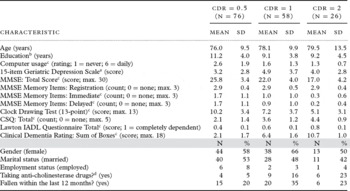
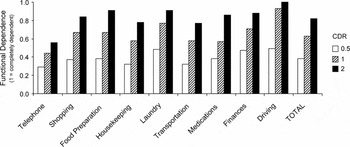
Of the 170 study participants, seven received a global CDR score of 0 (no impairment), 76 were staged as CDR 0.5 (questionable impairment), 58 as CDR 1 (mild impairment), 26 as CDR 2 (moderate impairment), and 3 as CDR 3 (severe impairment). As mentioned previously, given the small number of participants staged as either CDR 0 or 3, these groups were excluded from between-groups analyses. Demographic and clinical characteristics for participants staged as CDR 0.5, 1 and 2 are shown in Table 2. Groups did not differ with respect to age, gender, marital status, employment status or fall status. However, groups were significantly different in years of education, computer usage and depressive symptoms. Given that these differences may have influenced cognitive performance, each variable was entered as a covariate in the between-groups analyses of Mindstreams measures (see Methods). Significant differences were also found in the proportion of participants taking anti-cholinesterase drugs across groups. As anticipated, groups differed on total MMSE and Clock-13 scores as well as on immediate and 5-minute delayed recall of the three MMSE memory items; however, groups did not differ on initial rehearsal of the memory items (i.e. “registration”). On the CSQ, caregivers reported more cognitive symptoms for CDR scores of greater severity. Significant between-group differences were found for all individual Lawton IADL categories as well as for the total score (Figure 1). Finally, groups differed on the CDR-SB, as expected given its relationship to the global CDR score used for staging. Regarding the diagnosis of dementia, 30% of participants staged as CDR 0.5, 95% of those staged as CDR 1, and 100% of those staged as CDR 2 were diagnosed with dementia.
Demographic and clinical characteristic for participants staged with the global CDR score as Very Mild (CDR = 0.5), Mild (CDR = 1), or Moderate (CDR = 2) impairment.

CSQ: Cognitive Symptoms Questionnaire; IADL: Instrumental Activities of Daily Living; MMSE: Mini-mental State Examination.
a Significant difference between groups (p < 0.05, analysis of variance [ANOVA]).
b Significant difference between groups (p < 0.01, ANOVA).
c Significant difference between groups (p < 0.001, ANOVA).
d Significant difference between groups (p < 0.05, Chi-square test).
Lawton Instrumental Activities of Daily Living (IADL) questionnaire ratings by Clinical Dementia Rating (CDR) stage. significant (p < 0.001) differences across CDR 0.5, 1, and 2 groups were found for all Lawton IADL categories.

Between-group differences on Mindstreams summary measures
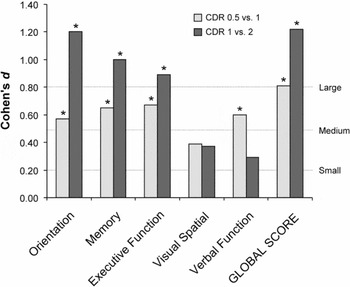
Mindstreams Global Score (GS) performance was significantly different across CDR groups (F[2,157] = 44.74, p < 0.001), reflecting poorer overall battery performance for CDR stages consistent with greater impairment. All pairwise comparisons were significant (p < 0.001), with a larger effect size for CDR 1 vs. 2 (d = 1.22) than for CDR 0.5 vs.1 (d = 0.81; Figure 2). Differences persisted with adjustment for education, computer usage, and depressive symptoms (p < 0.001), with similar effect sizes (CDR 0.5 vs. 1: 0.59 < d < 0.90; CDR 1 vs. 2: 1.11 < d < 1.20).
Mindstreams summary measures: profile of effect sizes for discriminating among pairs of Clinical Dementia Rating (CDR) stages. Cohen's conventions for small, medium and large effect sizes are indicated (Cohen, Reference Cohen1988). *p < 0.05.

The Orientation summary score was significantly different across CDR groups (Kruskall-Wallis ANOVA: H[2] = 50.95, p < 0.001), reflecting poorer performance for CDR stages consistent with greater impairment. All pairwise comparisons were significant (CDR 0.5 vs. 1: p = 0.003; CDR 1 vs. 2: p < 0.001; CDR 0.5 vs. 2; p < 0.001), with a larger effect size for CDR 1 vs. 2 (d = 1.20) than for CDR 0.5 vs.1 (d = 0.57; Figure 2). Differences persisted with adjustment for education, computer usage, and depressive symptoms (p < 0.001), with similar effect sizes (CDR 0.5 vs. 1: 0.46 < d < 0.64; CDR 1 vs. 2: 1.12 < d < 1.21).
The Memory summary score was significantly different across CDR groups (Kruskall-Wallis ANOVA: H[2] = 38.12, p < 0.001), reflecting poorer performance for CDR stages consistent with greater impairment. All pairwise comparisons were significant (p < 0.001), with a larger effect size for CDR 1 vs. 2 (d = 1.00) than for CDR 0.5 vs. 1 (d = 0.65; Figure 2). Differences persisted with adjustment for education, computer usage, and depressive symptoms (p < 0.001), with similar effect sizes (CDR 0.5 vs. 1: 0.51 < d < 0.66; CDR 1 vs. 2: 0.95 < d < 0.98).
The Executive Function summary score was significantly different across CDR groups (F[2,157] = 25.24, p < 0.001), reflecting poorer performance for CDR stages consistent with greater impairment. All pairwise comparisons were significant (p < 0.001), with a larger effect size for CDR 1 vs. 2 (d = 0.89) than for CDR 0.5 vs. 1 (d = 0.67; Figure 2). Differences persisted with adjustment for education, computer usage, and depressive symptoms (p < 0.001), with similar effect sizes (CDR 0.5 vs. 1: 0.43 < d < 0.75; CDR 1 vs. 2: 0.77 < d < 0.90).
The Visual Spatial summary score was significantly different across CDR groups (F[2,149] = 5.62, p = 0.004), reflecting poorer performance for CDR stages consistent with greater impairment. The CDR 0.5 vs. 1 (p = 0.072) and CDR 1 vs. 2 (p = 0.329) pairwise comparisons failed to reach significance (Figure 2); the CDR 0.5 vs. 2 pairwise comparison was significant (p = 0.006). Differences persisted with adjustment for education and depressive symptoms (p < 0.03), and the CDR 0.5 vs. 1 comparison reached significance with adjustment for depressive symptoms (p = 0.022; d = 0.41). With adjustment for computer usage, the difference across CDR groups failed to reach significance (p = 0.167).
The Verbal Function summary score was significantly different across CDR groups (F[2,157] = 11.42, p < 0.001), reflecting poorer performance for CDR stages consistent with greater impairment. The CDR 0.5 vs. 1 pairwise comparison was significant (p = 0.001) with an effect size of d = 0.60, but the CDR 1 vs. 2 comparison failed to reach significance (p = 0.400; Figure 2); the CDR 0.5 vs. 2 pairwise comparisons was significant (p < 0.001). Differences persisted with adjustment for education, computer usage, and depressive symptoms (p < 0.03), with similar effect sizes for CDR 0.5 vs. 1 (0.42 < d < 0.64).
In summary, Executive Function (d = 0.67) and Memory (d = 0.65) summary scores distinguished best between CDR 0.5 and 1, while Orientation best differentiated among CDR 1 and 2 (d = 1.20; Figure 2). Verbal Function differed from other domains in that the effect size for CDR 0.5 vs. 1 was larger relative to CDR 1 vs. 2.
Between-group differences on Mindstreams outcome parameters
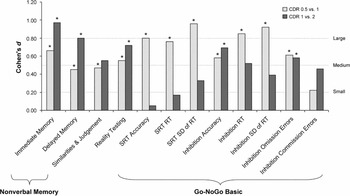
Outcome parameter results from Orientation to Time and Place, Language Skills, and Spatial Orientation tests are equivalent to the results for the Orientation, Verbal Function, and Visual Spatial summary scores presented above (see Table 1). The profile of effect sizes for discriminating among pairs of CDR stages for the remaining Mindstreams outcome parameters is presented in Figure 3.
Mindstreams outcome parameters: profile of effect sizes for discriminating among pairs of Clinical Dementia Rating (CDR) stages. Cohen's conventions for small, medium and large effect sizes are indicated (Cohen, Reference Cohen1988). *p < 0.05. SRT = Simple reaction time; RT = Response time; SD = Standard deviation.

For Immediate and Delayed portions of the Nonverbal Memory test, Reality Testing, and the Inhibition portion of the Go-NoGo Basic test, significant differences in accuracy were obtained for both CDR 0.5 vs. 1 and CDR 1 vs. 2 comparisons, with larger effect sizes for CDR 1 vs. 2. For (accuracy on) the Similarities and Judgement test as well as accuracy, response time (RT), and response time standard deviation (SD of RT) on the Simple Reaction Time (SRT) portion of the Go-NoGo Basic test and RT and SD of RT on the Inhibition portion of the Go-NoGo Basic test, significant differences were obtained for CDR 0.5 vs. 1 but not for CDR 1 vs. 2; CDR 0.5 vs. 1 effect sizes were much larger for the Go-NoGo Basic outcome parameters. Significant differences in omission errors but not commission errors on the Inhibition portion of the Go-NoGo Basic test were found for both CDR 0.5 vs. 1 and CDR 1 vs. 2. Significant differences persisted after adjustment for years of education and depressive symptoms; after adjustment for computer usage, differences persisted for all but the following for CDR 0.5 vs. 1: Delayed (Nonverbal) Memory, Similarities & Judgement, and Reality Testing (accuracy). For CDR 1 vs. 2, a significant difference emerged for Similarities and Judgement following adjustment for years of education, computer usage, and depressive symptoms.
In sum, for memory outcome parameters (Table 1), Immediate Memory distinguished better than Delayed Memory (Figure 3); among executive function outcome parameters (Table 1), Reality Testing distinguished better than Similarities and Judgement (Figure 3). Outcome parameters from the SRT portion of the Go-NoGo Basic test (Table 1) exhibited excellent discriminant validity for CDR 0.5 vs. 1 but poor ability to distinguish between CDR 1 and 2 (Figure 3). On the Inhibition portion of the Go-NoGo Basic test, outcome parameters measuring response time and response time variability but not accuracy (Table 1) discriminated well between CDR 0.5 and 0.1 (relative to CDR 1 vs. 2; Figure 3).
Correlations between Mindstreams and paper-based measures
The Mindstreams Global Score (GS) was highly correlated with MMSE (r = 0.77, p < 0.001), Lawton IADL total (r = ˗0.61; p < 0.001), Clock-13 (r = 0.64; p < 0.001), and CDR-SB (r = ˗0.72; p < 0.001) for the study cohort. Mindstreams Nonverbal Memory: Immediate recognition was correlated with MMSE Memory Items (Immediate; r = 0.44; p < 0.001), and Mindstreams Nonverbal Memory: Delayed Recognition was correlated with MMSE Delayed Memory (r = 0.35; p < 0.001).
Discussion
The Mindstreams battery for moderate impairment has good discriminant validity in differentiating between varying degrees of cognitive impairment in older adults, providing detailed and distinct cognitive profiles. This user-friendly computerized cognitive assessment battery is thus valuable in the evaluation of the older patient with marked cognitive symptoms and is useful in the assessment of patients with dementia.
The clinical diagnosis of dementia is based on subjective cognitive complaints, impaired cognitive function on objective testing, and functional decline. While the most commonly used tool for cognitive screening is the MMSE (Folstein et al., Reference Folstein, Folstein and McHugh1975), there are many other screening instruments available (Iliffe et al., Reference Iliffe2009). There is a need to develop diagnostic tools that are both psychometrically robust and appropriate for use in both primary care (Milne et al., Reference Milne, Culverwell, Guss, Tuppen and Whelton2008) and specialist clinics. Computerized cognitive tests are being developed in order to provide physicians with reliable, reproducible cognitive assessments that are readily available in the clinical setting in many disease conditions (Dwolatzky et al., Reference Dwolatzky2003; Doniger et al., Reference Doniger2005; Reference Doniger2006a; Ritsner et al., Reference Ritsner, Blumenkrantz, Dubinsky and Dwolatzky2006; Schweiger et al., Reference Schweiger, Abramovitch, Doniger and Simon2007; Fillit et al., Reference Fillit, Simon, Doniger and Cummings2008; Gualtieri and Johnson, Reference Gualtieri and Johnson2008).
The Mindstreams battery for moderate impairment was developed as a simple-to-use 15-minute cognitive assessment battery designed specifically for patients with moderate cognitive impairment. In validating this instrument we found that the Mindstreams Global Score was particularly useful in differentiating between mild to moderate dementia, as well as between the milder forms of cognitive impairment. The summary measures that distinguished best between those with very mild impairment and mild impairment were Executive Function and Memory, while the Orientation measure best differentiated between mild and moderate impairment. While reaction time and verbal function measures distinguished well between very mild and mild impairment, they were not useful in discriminating between mild and moderate impairment. In the memory domain, Immediate Memory distinguished better than Delayed Memory. In the executive function domain, Reality Testing distinguished better than Similarities and Judgement. It is important to note that discriminant validity remained intact after adjustment for years of education, computer experience, and depressive symptoms.
Though several computerized cognitive assessment tools have been validated for early detection of mild cognitive impairment and mild dementia (Doniger et al., Reference Doniger2005; Crooks et al., Reference Crooks, Parsons and Buckwalter2007; Fillit et al., Reference Fillit, Simon, Doniger and Cummings2008), this study describes the use of a computerized cognitive assessment battery designed primarily for the evaluation of patients with moderate cognitive impairment and dementia. These patients have short attention spans and poor comprehension and are thus not usually able to manage more complex testing. The strengths of the Mindstreams battery for moderate impairment are that it is of short duration, requires no previous experience using a computer, and is administered anywhere (even at the patient's home on a laptop computer) by a technician who requires minimal training. The commands are clear and simple, and the stimuli are large. Thus patients with visual impairment (but not blindness) or with lower education are able to perform this battery. Moreover, the battery incorporates adaptive test designs to reduce patient frustration, precise response time measurement (as in the Go-NoGo Basic test), and immediate scoring and reporting with longitudinal graphs suitable for tracking change over time. Indeed another potential use of the battery is for the long-term follow-up of patients with significant cognitive impairment, both for staging and profiling performance in multiple cognitive domains affected by the neurodegenerative process and for measuring the response to therapeutic interventions.
Our study was limited due to the small number of subjects who were severely impaired. Thus the validity of the battery in evaluating patients with severe dementia must await future studies. Though cognitive impairment in such patients is usually apparent, more comprehensive cognitive assessment should help to determine which functions are more impaired. This may enable researchers to develop non-pharmacological interventions, such as cognitive training, that are tailored to benefit specific cognitive domains.
Further evaluation of the Mindstreams battery for moderate impairment is necessary to determine whether this computerized cognitive assessment battery has other clinical and research applications in caring for the growing number of patients with dementia.
Conflict of interest declaration
Dr Doniger and Dr Simon are employees of NeuroTrax Corporation.
Description of authors' roles
Tzvi Dwolatzky designed the study, recruited subjects, provided clinical data and wrote the paper. Luba Dimant administered the computerized battery and assisted in the collection of data. Ely Simon designed the study, developed the computerized battery and assisted in the data analysis and writing of the paper. Glen Doniger designed the study, performed the statistical analysis, assisted in the development of the computerized battery and wrote the paper.
Acknowledgments
The authors thank Shimon Amit for outstanding technical support.