Introduction
Coins are the most common foreign body ingested in children. They are mainly benign and, in the absence of complications, do not represent a surgical emergency.Reference Little, Shah, St Peter, Calkins, Morrow and Murphy 1 They have a similar appearance on plain X-ray to disc batteries, which in contrast pose significant risks and must be managed as an emergency due to an array of potentially devastating sequelae.
The increasing prevalence of lithium ion disc battery ingestion, as recorded by US registries, has led to the drafting of a proposed ‘Button Cell Battery Safety Act of 2011’ by the US Senate. 2 Recognition of the immediate and longer-term concerns following lithium ion disc battery ingestion are essential to address an emerging trend, representing a 6.7-fold increase in incidence, and the associated morbidity.Reference Litovitz, Whitaker, Clark, White and Marsolek 3
Case report
A three-year-old girl presented following the unwitnessed ingestion of a foreign body with subsequent odynophagia and dysphagia. Her four-year-old brother claimed to have seen her swallow a one pound coin.
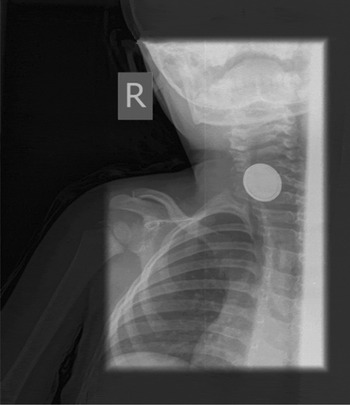
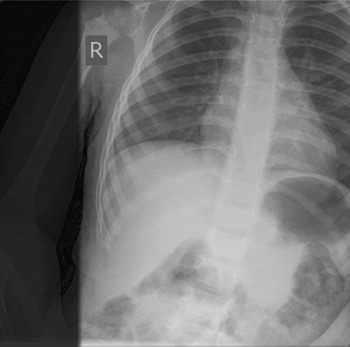
Two hours following the incident, the patient presented to a peripheral hospital with no signs of immediate airway compromise and underwent an anteroposterior chest radiograph (Figures 1 and 2). This confirmed a pharyngo-oesophageal circular foreign body lodged in a coronal plane at the level of the C7 vertebra and no distal foreign bodies. Six hours following foreign body ingestion, the patient was transferred for urgent ENT assessment and definitive management. She remained afebrile and systemically well, having refused oral intake since the event. Examination revealed a full range of neck movement with no surgical emphysema. She was placed nil by mouth and consent was obtained for oesophagoscopy and foreign body removal.
Anteroposterior X-ray of an ingested circular, radiopaque foreign body. R = right

Anteroposterior X-ray confirming no foreign bodies present in the distal alimentary tract. R = right

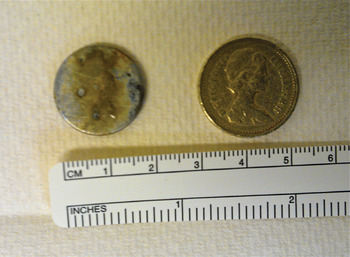
Within 2 hours of presentation to the ENT on-call team, a 20-mm lithium ion disc battery was removed from the level of the cricopharyngeal muscle, 11 cm from the incisors (Figure 3). The battery had extensive areas of corrosion. The area that had been in contact with the negative electrode had a circumferential mucosal burn injury and residue. The pharynx was thoroughly irrigated and a nasogastric tube inserted.
Photograph of a lithium ion disc battery (20 mm) with areas of corrosion, alongside a UK one pound coin (22.5 mm).

The patient was started on intravenous co-amoxiclav and an oral proton pump inhibitor, and was monitored for symptoms and signs of perforation. Following 2 days of nasogastric feeding, oral feeding was trialled. The nasogastric tube was removed 7 days following its insertion, and the patient was referred for serial endoscopy follow up under the regional paediatric surgeons.
Discussion
Difficulties in distinguishing between coins and disc batteries on plain films are well recognised. The larger, and increasingly common, lithium ion disc batteries mimic the size of UK coins; both are spherical and fully attenuate on anteroposterior plain films. The double shadow, or ‘halo’ effect, is a reported feature of disc batteries of all sizes on an anteroposterior view, although its absence does not preclude the presence of a battery.
True lateral X-rays are necessary to demonstrate the greater depth and asymmetric bevelled edge of such batteries, corresponding with the negative electrode, although this may be incorrectly mistaken for obliquity.Reference Maves, Lloyd and Carithers 4 A study involving both radiologists and otolaryngologists reported the combined sensitivity of anteroposterior and lateral plain films in identifying disc batteries to be 80.4 per cent.Reference Lee, Ebert, Fordham and Rose 5 Underpenetrated films prevented visualisation of a double shadow and significantly reduced the correct identification of batteries. As some battery designs generated ambiguity amongst reporting clinicians, the study posed an additional question: ‘based on available imaging, should endoscopic removal be expedited?’ In this situation, in patients with ambiguous X-ray features and if the clinician was forced to decide if the foreign body should be considered a disc battery until proven otherwise (at urgent endoscopy rather than postponed to the next available list), the effective sensitivity of plain films to identify foreign bodies as disc batteries increased to 94.4 per cent.
Unless reliably witnessed, circular, radiopaque foreign bodies must always be considered corrosive batteries until proven otherwise at endoscopy. The main risk in unwitnessed foreign body ingestion stems from not considering it in the differential diagnosis and thus not performing any imaging.
Litovitz et al. performed a review of 65 246 battery ingestions based on several US registries between 1985 and 2009.Reference Litovitz, Whitaker, Clark, White and Marsolek 3 The authors identified a trend, which has influenced a change in management guidelines and, most significantly, in recently proposed US legislation. 2 The study reported a 6.7-fold increase in major outcomes occurring between the first and final 3 years of the reviewed period. Lithium ion battery ingestion increased from 1.3 to 24 per cent, and the ingestion of batteries 20–25 mm in diameter increased from 1 to 18 per cent, reflecting their increased use in home electronic devices. It was identified that 93.9 per cent of major or fatal outcomes involved disc batteries greater than or equal to 20 mm in diameter.
In a symptomatic patient with no ingestion history, a foreign body must still be considered if they present with any acute airway, swallowing or choking symptoms. Ninety-two per cent of fatalities and 56 per cent of major outcomes resulted from unwitnessed battery ingestion in non-verbal children.Reference Litovitz, Whitaker, Clark, White and Marsolek 3 Failure to recognise and therefore manage these cases as an emergency, demonstrated by delays in ENT or other specialist referral as observed in our case, or leaving a known battery to the next available routine list, may be considered medically negligent.Reference Hawthorne and Gleeson 6
Local caustic effects are observed following the ingestion of several commercially available batteries. Zinc-carbon and alkaline (zinc-manganese dioxide) cells cause liquefaction necrosis and mucosal ulceration from local leakage of corrosive electrolytes.Reference Marom, Golfarb, Russo and Roth 7 The mercury-oxide battery causes both local caustic damage and systemic toxicity, which has led to its withdrawal from sale in many countries.
Twenty-millimetre lithium ion batteries are associated with a proportionally greater number of significant outcomes than other battery chemistries.Reference Litovitz, Whitaker, Clark, White and Marsolek 3 Firstly, they tend to be larger and are consequently more likely to impact in the pharyngo-oesophagus. Secondly, of greater significance, they generate a higher voltage (3.6 volt vs 1.2–1.6 volt), which causes a chemical burn even when in a discharged state, with the electrolytic current generated at the negative electrode. Significant cytotoxicity and tissue injury involving 3 volt lithium manganese dioxide cells can be caused by combinations of thermic, caustic and toxic phenomena. This damage has been demonstrated to reach its maximal effect within 2 hours, and is associated with a pH that rises to 12.2.Reference Chevin, Attik, Dika, Duval, Bottin and Raspiller 8 In descending order of severity, the immediate concerns of lithium ion disc battery ingestion are: generation of an electrolytic current; leakage of the corrosive alkaline electrode resulting in hydrolysis of tissue fluids and mucosal erosion; direct pressure necrosis of adjacent tissues; and systemic toxicity from the absorption of electrolytes, although this is uncommon and of least significance.Reference Mallon, White and Thompson 9
In the US, the Consumer Product Safety Commission issued a warning in March 2011 10 summarising the evidence presented in the 2010 review by Litovitz et al.,Reference Litovitz, Whitaker, Clark, White and Marsolek 3 and submitting industry and public recommendations in order to prevent unintentional battery ingestion. This recognition has driven legislative change in the US following the drafting of a proposed ‘Button Cell Battery Safety Act of 2011’, 2 which necessitates the placement of warning labels and more secure battery compartments. This legislation proposed the regulation of all consumer products sold in the US that contained lithium or button cell batteries, stating that button cell compartments are to be ‘secured, to the greatest extent practicable, in a manner that reduces access to button cell batteries by children that are three years of age or younger’.
Current UK legislation limits the percentage content of mercury, cadmium and lead in batteries unless clearly marked, but places no emphasis on either lithium or button cell batteries, nor does it recognise their increasing prevalence and greater risks. In one report, 37.3 per cent of ingested 20-mm lithium ion disc batteries (the type of battery involved in this case) were intended for use in remote controls.Reference Litovitz, Whitaker and Clark 11
The case reported here, in which an unwitnessed foreign body ingestion was inadequately investigated, leading to delays in management, demonstrates a common scenario. The recognised thermic, caustic and toxic effects can occur very rapidly. The American Academy of Pediatrics has recommended an algorithm based upon systematic review, which shows that the window of opportunity for injury-free removal of an oesophageal battery is less than 2 hours.Reference Litovitz, Whitaker, Clark, White and Marsolek 3 All patients under 13 years, or those with an ingested battery that is more than 12 mm in diameter, must undergo anteroposterior and lateral imaging, and the battery must be removed within 2 hours. If a battery of any size is ingested, becomes symptomatic and is located within the stomach, it must be removed endoscopically.
Several reported complications associated with battery ingestion must be anticipated. These may occur following the initial injury or may occasionally occur at a later stage, following successful removal. The complications include oesophageal stricture and perforation, mediastinitis, trachea-oesophageal fistula, aorto-oesophageal fistula complicated by massive haemorrhage, vocal fold palsies, and death.Reference Yardeni, Yardeni, Coran and Golladay 12 – 15
-
• Lithium ion disc battery ingestion has escalated with their increased use in household devices
-
• Twenty-millimetre lithium ion disc battery ingestion can have severe outcomes and is an emerging concern
-
• Lithium batteries generate a relatively high voltage, causing rapid local injury, even in a discharged state
-
• The window of opportunity for injury-free removal of an oesophageal battery is less than 2 hours
-
• A high level of suspicion, with adequate imaging, is essential for efficient management of unwitnessed foreign body ingestions
A correlation between potential injuries and the negative electrode allows anticipation of potential complications. No standard of care exists for post-operative follow up; however, a water-soluble contrast is recommended prior to the initiation of oral feeding in order to rule out perforation. Oesophageal stenting, either by nasogastric tube insertion or Silastic® stents, is controversial but may reduce stricture rates.Reference Berkovits, Bos, Wijburg and Holzki 16 Proposed medical management options include steroids, antibiotics and anti-reflux therapy, each of which is supported by low levels of evidence.Reference Kay and Wyllie 17
Conclusions
Lithium battery ingestion has escalated with their increased use in household electronic devices. This has led to an increase in preventable morbidity in an otherwise healthy paediatric cohort. This trend deserves greater recognition across emergency, paediatric, general surgical and ENT specialties.
The experience in our case highlights the root causes and consequences of suboptimal assessment and management. These include the effective use of imaging to investigate suspected battery ingestion, and the early recognition of potential immediate and longer-term complications. Unless reliably witnessed, circular, radiopaque foreign bodies must be treated with a high degree of suspicion and considered corrosive batteries until proven otherwise at endoscopy.
The American Academy of Pediatrics Guidelines may guide the approach to managing battery ingestions, and a review of the impact of recent US legislative changes may invite opportunities to introduce similar preventative public health policies in the UK.