The Veterans Health Administration has 4 health care missions, the first 3 of which are related to medical care for veterans, provider training, and research. The fourth mission concerns disaster and emergency response for veterans and the general population, and states that the Veterans Administration (VA) will provide support to communities following domestic terrorist incidents and other major disasters.Reference Bascetta1 Consistent with this mission, emergency management professionals have begun to consider how the knowledge and expertise of veterans could contribute to civilian disaster mitigation, preparedness, response, and recovery through volunteer or paid employment with public health agencies.Reference Steeves2 Given that veterans are more likely than nonveterans to engage in volunteering,Reference Nesbit and Reingold3 veterans could be a valuable emergency management resource for local health departments and other agencies.
Because emergency management plans are coordinated at the local level, confidence in the integrity of local health departments is critical to obtaining the support and commitment of veterans to collaborative, community-based emergency management. During the past 10 years, however, the failure of some government agencies to respond adequately to several major disasters and emergencies has had a disproportionate impact on racial/ethnic minority groups-particularly African Americans-that are well represented in the veteran population.4 In the wake of the 2001 anthrax attacks, testing and treatment of the predominantly African American US Postal Service workers began nearly 1 week later than it did for Senate staffers on Capitol Hill, even though both groups were at risk of exposure.Reference Washington5 News reports and articles at the time described the government's response to the anthrax attacks as an example of discrimination against African Americans.Reference Adams, O'Brien and Nelson6-Reference Vedantam and Flaherty9 Peer-reviewed research also suggests that race and class disparities have decreased the US public's confidence in the fairness of the government's response to health emergencies. For example, in the months immediately following the 2001 anthrax attacks, a survey of the US population suggested that approximately 70% of respondents believed that if there were a shortage of vaccine in the event of a smallpox outbreak, wealthy and influential people would be vaccinated first.Reference Blendon, Buhr and Cassidy10 The Los Angeles County Health Department contended with similar concerns among racial/ethnic minority groups during the 2009 H1N1 vaccination effort.Reference Plough, Bristow, Fielding, Caldwell and Khan11 In Los Angeles County, California, a survey of the general population suggested that African Americans had lower adjusted odds than did Whites of trusting that their local public health department would respond fairly to their needs in the event of a disaster.Reference Eisenman, Wold and Setodji12
The aim of this study is to assess whether this perceived lack of fairness extends to the veteran population, particularly those who belong to racial/ethnic minority or disadvantaged groups. In addition to the issue of equity, the confidence of veterans in a local public health system's response to disasters is also critical to ensure the health and safety of veterans, as many veterans have combat-related injuries and other health problems that leave them particularly vulnerable to disaster-related harms; those with disabilities may have an especially difficult time in the event of evacuation. Veterans who do not trust their local health departments may dismiss important disaster preparedness communications or, in the event of an emergency, fail to give proper consideration to recommended countermeasures such as evacuation or vaccinations. The identification of subgroups of veterans who are not confident in the fairness of their local public health systems’ disaster response may help determine whether more tailored disaster preparedness and response efforts are needed for this population.
This study includes an analysis of data on veterans from a probability sample of households in California to examine differences in perceived fairness of county disaster response, across groups defined by race and ethnicity, income, education, and other demographic and socioeconomic variables. The study hypothesis is that there are lower levels of confidence in public health systems among veterans who are racial/ethnic minorities (compared with Whites), people with less than a college degree (compared with those with a college degree), and people in low-income groups (compared with those with higher incomes).
Methods
Data
Data were obtained from the 2009 California Health Interview Survey (CHIS), a biennial cross-sectional telephone survey of a representative sample of households (adults, adolescents, and children) randomly drawn from stratified areas in California. One adult in each eligible household was randomly selected for interview. The adult response rate was 19.5%. Weights were constructed to adjust for nonresponse and for differences across households in the probability of sampling adults. Full details of the CHIS methods are available elsewhere.13 These analyses were exempted from review by the institutional review board at the Department of Veterans Affairs Greater Los Angeles Healthcare System.
Analytic Sample
The sample size for these analyses is 5955. Because the target population is veterans, analyses were restricted to respondents who had ever served on active duty in the US Armed Forces. There were 6058 respondents who were veterans in the 2009 CHIS-12.7% of the total sample of 47 614. Of those, 103 veterans older than age 65 years who were too ill or frail to participate in the survey completed a reduced version of the CHIS questionnaire through a proxy respondent. The reduced questionnaire did not include the items on emergency preparedness, thus reducing the analytic sample size to 5955. When the analytic weights were applied to the data,14 the 5955 veterans who participated in these interviews represented an estimated 2 256 500 veterans who were living in California in 2009. This estimate of the size of the veteran population in California is similar to those reported by the US Census BureauReference Richardson and Waldrop15 and the American Community Survey.16
Dependent Variable
Respondents were asked, “How confident are you that the county's public health system will respond fairly to your health needs, regardless of your race, ethnicity, income or other personal characteristics – very confident, somewhat confident, not too confident, or not at all confident?” Similar questions have been used in previous work on racial/ethnic variations in perceived fairness of public health departments.Reference Eisenman, Wold and Setodji12, Reference Meredith, Eisenman, Rhodes, Ryan and Long17 Responses to this question were used to create a dichotomous variable of confident (“very confident” or “somewhat confident”) versus not confident (“not too confident” or “not at all confident”).
Independent Variables
Data on race and ethnicity were collected in 3 steps by CHIS interviewers. First, respondents indicated whether they were Latino or Hispanic. Respondents then asked to chose 1 or more of the following races: White, Black or African American, Asian, American Indian, or Alaska Native, Pacific Islander, or Native Hawaiian. They could also report verbatim another race. Respondents who identified as American Indian or Alaska Native were asked if they were enrolled members of a federally or state-recognized tribe. Respondents choosing more than 1 race were asked: “Do you identify with any one race in particular?” If the respondent answered “no,” he or she was recorded as “Other.”
Respondents who were Latino and also Black/African American, Multiracial, White, or “Other” were categorized as “Latino.” To maximize the size of the American Indian or Alaska Native group, respondents who indicated that they were registered in a federally or state-recognized tribe were grouped as American Indian or Alaska Native, regardless of race and Latino ethnicity.Reference Mays, Ponce, Washington and Cochran18 Because of small sample sizes, one group was created for Asian and Pacific Islander respondents. In summary, each respondent was categorized as African American, Alaskan Native, or American Indian (AIAN), Asian or Pacific Islander (API), Latino, White, or “Other.”
Because socioeconomic integration may be generally related to confidence in government, the analysis included several variables on income, education, housing, and other respondent characteristics. A 5-category ordinal variable on annual household income was included in the analyses, ranging from “less than $20 000” to “more than $80 000.” Education has been associated with trust in government in previous work,Reference Perrin and Smolek19 so the analysis included a corresponding variable categorized as high school or less, some college, and a bachelor's degree or higher. Because homeownership would increase a respondent's investment in their community, the analysis included a 3-category variable to indicate whether the respondent was a homeowner, a renter, or neither (ie, had an “other” housing arrangement). A nominal variable was used to indicate whether respondents were married, unmarried but living with an intimate partner, widowed, or never married. The analysis also included a 4-category ordinal variable to reflect respondents’ perceptions of the safety of their neighborhoods, ranging from “never” to “always” safe, because previous work has reported that perceived safety was associated with respondents’ confidence in their local public health systems’ fairness.Reference Eisenman, Wold and Setodji12
Veterans with disabilities are at increased risk of disaster-related harms; for this reason, the analysis included a dichotomous variable indicating whether the respondent reported having any physical, emotional, or psychological disability. The analysis included a dichotomous variable on gender. To account for the impact of age-and, to some degree, the impact of military cohort-a 7-category ordinal variable on age was included that grouped into 19 to 29, 30 to 39, 40 to 49, 50 to 59, 60 to 69, 70 to 79, and 80 years and older. In a previous analysis of telephone survey data,Reference Eisenman, Wold and Setodji12 respondents who participated in non-English interviews had lower odds of believing that their counties would respond fairly to disasters. The prevalence of non-English interviews in this veterans sample was too rare (0.5%) to include; for this reason, the analysis accounted for the potential impact of acculturation/nationality on confidence in county public health systems with a 5-category nominal variable indicating whether respondents were born in the United States or in Latin-American, Asian, European, or other countries.
Data Analysis
Univariate statistics were calculated to describe the distribution of the dependent variable on confidence and other population characteristics. Multivariate logistic regression was used to test the hypothesis that less confidence in county public health systems exists among veterans who are racial or ethnic minorities (compared with Whites), people with less than a college degree (compared with those with a college degree), and people in low-income groups (compared with higher-income groups). To facilitate interpretation, adjusted odds ratios were transformed into adjusted percentages with 95% confidence intervals. Computer software (Stata 11.0) was used to weight prevalence estimates to the California population.20
Results
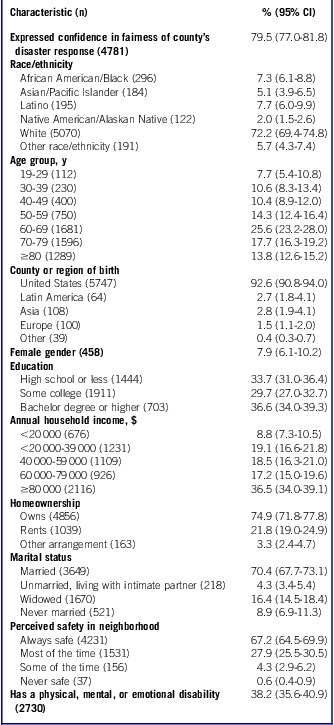
As shown in Table 1, 79.5% of the sample was confident that their county's public health system would respond fairly to their health needs in the event of a disaster, regardless of race and ethnicity, income, or other characteristics. Most of the veteran population was White (72.2%), followed by Latino (7.7%), API (7.3%), “other” race/ethnicity (5.7%), African American/Black (5.1%), and AIAN (2.0%). Nearly 8% of the sample consisted of women, and the modal age group was 60 to 69 years old (25.6%).
Characteristics of US Veterans in California, 2009 (n = 5955).

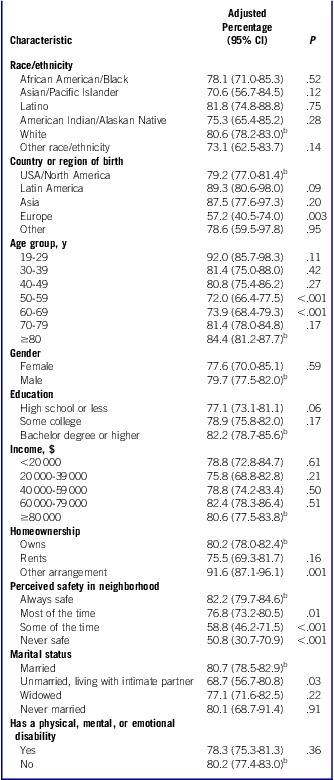
Table 2 presents the adjusted percentages of participants who were confident in the fairness of their county's disaster response. Contrary to the hypothesis, there were no differences among groups for the variables on race/ethnicity, education, or income; there were also no significant differences between men and women, or between respondents with and without disabilities. However, a lower percentage of participants born in European countries were confident in the fairness of their local public health systems’ disaster response, compared with those born in the United States (57.2% vs 79.2%; P = .003), net of other factors. Compared with participants aged 80 and older, a lower adjusted percentage of those in the 50-to 59-year-old group (84.4% vs 72.0%, P < .001), as well as the 60-to 69-year-old group (84.4% vs 73.9%, P < .001), were confident in their county public health systems. A higher adjusted percentage of participants who neither owned nor rented their homes (ie, were in “other” types of housing arrangements) were confident in their counties’ disaster response than were those who owned their homes (91.6% vs 80.2%; P = .001). Participants who were unmarried but lived with their partners had lower confidence in their local health departments than did the married participants (68.7% vs 80.7%; P = .03), net of other factors. There was a dose-response or monotonic trend in the adjusted association of perceived neighborhood safety and confidence in local public health systems: compared with the level of confidence among those who perceived their neighbors as “always safe” (82.2%), confidence in public health systems steadily decreased among those who perceived their neighborhoods as safe “most of the time” (76.8%, P = .01), “some of the time” (58.8%, P < .001), and “never” (50.8%, P < .001).
Veterans’ Confidence in the Fairness of County's Disaster Response, 2009: Results From Multiple Logistic Regression ModelFootnote a

a To facilitate interpretation, adjusted odds ratios were transformed into adjusted percentages with 95% CIs.
b Indicates that this group was used as the comparison group in the logistic regression model and calculation of P values.
Comment
Both research articles and news coverage have highlighted stark disparities in the impact of disasters on the US population, with racial/ethnic minorities and people in poverty suffering more than other groups.Reference Adams, O'Brien and Nelson6-Reference Blendon, Buhr and Cassidy10, Reference Wenger21 Thus, it is not surprising that these populations have reported lower levels of confidence in public agencies that are charged with emergency management.Reference Eisenman, Wold and Setodji12, Reference Meredith, Eisenman, Rhodes, Ryan and Long17 However, in this sample of nearly 6000 veterans in California, there were no statistically significant differences by race/ethnicity, income, and educational background in the percentages who reported confidence that county public health systems would respond fairly to their needs in the event of a disaster. This result among veterans is a sharp contrast with a previous study of the Los Angeles County general population, which showed that African Americans were less confident than Whites in the fairness of local disaster response.Reference Eisenman, Wold and Setodji12
Large-scale threats to a nation such as terrorist incidents have been shown to increase citizens’ trust and support of their government, and previous work suggests that this surge of support is larger among veterans than it is among nonveterans.Reference Perrin and Smolek19 Veterans may have generally greater confidence in the fairness of local health departments’ disaster response-regardless of race/ethnicity, education, or other characteristics-because military service may reinforce an already strong sense of loyalty to government and its agencies. Military culture is traditionally characterized as quintessentially hierarchical; military units were historically segregated by race, with African Americans cordoned to separate living facilities during World War II. However, such official racial divides have long since been eliminated from military policy.Reference MacGregor22 In a 1967 speech opposing the war in Vietnam, Martin Luther King Jr noted the great irony that young Black and White men who “would never live on the same block in Detroit” were fighting together side-by-side in Southeast Asia.Reference King23 Although stark power differentials exist between officers and enlisted service members, living and working conditions have reportedly become more uniform for enlisted members from a wide range of cultural and socioeconomic backgrounds (oral communication, V. Denise Martin, MBPA). For many veterans, the relationships formed during their service may leave them with an impression that military culture is more egalitarian than is US civilian society, and this belief may affect their attitudes toward other divisions and levels of government, including local health departments charged with emergency management. The lower levels of trust observed among the 50-to 59-and 60-to 69-year-old age groups may reflect the fact that these veterans came of age during and immediately after the Vietnam War. Vietnam veterans reportedly have, on average, substantial levels of ambivalence toward government and civic engagement, compared with other military cohorts.Reference Teigen24, Reference Pollack25
The result that confidence was lower among veterans who lived in neighborhoods perceived as less safe is consistent with previous work.Reference Eisenman, Wold and Setodji12 Residents who perceive local neighborhood conditions as unsafe may have lower feelings of collective efficacy.Reference Sampson, Raudenbush and Earls26 Much like the victims of residential toxic exposure,Reference Edelstein27 residents of unsafe neighborhoods may feel “stressed, stigmatized, and fearful,” leading to a feeling of neglect by local government. This is a concern in light of the damage caused by Hurricane Katrina, which underscored the notion that residents of such neighborhoods are particularly vulnerable to the impact of disasters. Respondents may also have experienced disparities in local community services (policing, fire, and public schools) in their neighborhoods, further contributing to perceived disparities in the “quality and responsiveness” of local public health departments.Reference Eisenman, Wold and Setodji12
The result on marital status suggests a connection between “life-stability” and trust in local government. Marriage implies a public commitment (financial or otherwise) to a particular partner and home life. The marriage and family literature suggests that with shifting social norms during the past several decades, marriage has become a symbol of achieving stability in one's economic and relationship situation.Reference Gibson-Davis28-Reference Gibson-Davis, Edin and McLanahan30 Research suggests that intimate partners often perceive cohabitation as a transitional stage to marriage, although the majority of cohabiting couples do not end up marrying.Reference Stevenson and Wolfers31 The finding that veterans in cohabiting relationships with partners have less confidence in government than do married individuals suggests a possible connection between the absence of a legal commitment to one's partner and an associated lack of ties to local institutions in one's community. European-born veterans had lower levels of confidence than did those born in the United States, which may reflect a preference for alternatives to dominant US cultural beliefs; however, the results do not suggest that trust was lower among respondents born in Asia or Latin America. Europeans have historically held to a more interventionist and communitarian role of the state than residents of the United States; in addition, the United States tends to be publicly characterized as racially fragmented and conflictive,Reference Favell32 an image that was likely underscored in the context of Hurricane Katrina. World-views, beliefs, and perceptions associated with a European up-bringing may be associated with a suspicion toward mainstream US norms and a mistrust of the government that military service may not mitigate. Finally, the result that veterans who neither rent nor own a home have a higher level of confidence in local health departments than do homeowners is unexpected and somewhat counterintuitive; an explanation for this finding would perhaps be better addressed in more qualitative types of research in the future.
Limitations
This study has several limitations that should be acknowledged. The results may not generalize to veterans in states other than California. The 19.5% response rate raises concerns about non-response bias; however, a methodologic study of the representativeness of the CHIS sample showed that those who responded to the telephone interview were quite similar to those who did not respond, supporting the representativeness of the sample.33 Further, veterans in the CHIS sample are comparable on several sociodemographic characteristics (eg, age, gender, homeownership) to veterans who participated in the US Census and the American Community Survey.Reference Richardson and Waldrop15, 16, 34 Women are approximately 8% of the US veteran population.35 In the current analytic sample, 7.9% of participants are women, supporting the generalizability of the results to veterans in general.35 Although our set of control variables is similar to those used in previous work on racial/ethnic minority groups’ confidence in the equity of government disaster response,Reference Eisenman, Wold and Setodji12 there is still the potential for omitted variables bias in the multivariable model, particularly for the result on perceived neighborhood safety: Respondent characteristics for which there were no data may have driven the association of perceived safety and confidence in public health systems. A variable indicating whether participants were drafted or volunteered to join the military was not available in the CHIS data set, and this could be strongly associated with confidence in local health systems and race/ethnicity, income, and educational background. Data from survey items on political attitudes would have been preferable to the interpretations of the variables on marriage and continent of birth; the speculative nature of that part of the discussion should be acknowledged.
Further research is needed to understand how political beliefs and perceptions among veterans are related to confidence in the fairness of local public health departments. In addition, research should investigate whether confidence in local health departments has any impact on veterans’ acceptance of disaster preparedness or response communications, or on their willingness to participate in emergency management activities; confidence in local government does not necessarily mean that people will accept such communications or participate in these activities.
Conclusions
Confidence in the fairness of county public health departments is likely to be critical in obtaining the support of veterans for local community-based disaster preparedness planning and response. If confidence does indeed affect veterans’ willingness to accept disaster preparedness communications or to give proper consideration to recommended emergency countermeasures, then the results of the current study suggest that local health departments that issue such information to veterans are not likely to encounter barriers by race/ethnicity, income, education, disability status, or gender. We found some subgroups with less confidence; however, these groups-Vietnam-generation veterans (ie, those between ages 50 and 69 years), those who perceived their neighborhoods as increasingly unsafe, those who were unmarried but living with a partner, and those born in Europe-may have lower confidence due to norms, beliefs, and perceptions rather than a shared demographic such as race, socioeconomic status, gender, or disability. For these groups, lack of trust toward local public health departments may be due to mutable beliefs and attitudes rather than to more stable social positions. Local health departments may be able to influence such beliefs by providing the public with evidence that they can indeed be trusted to respond fairly in disasters. In previous work, African American focus-group respondents expressed greater trust in health departments if those agencies worked in ways that evidenced the principles of honesty, consistency, and competency.Reference Thompson8 Local health departments can work to ensure that their emergency management policies and risk communication strategies are consistent with these trust-building values. The current study findings are promising, as they show that veterans’ confidence in local health departments does not vary by race/ethnicity, education, and other important demographic and socioeconomic characteristics.
About the Authors
Veterans Emergency Management Evaluation Center, Veterans Health Administration, Sepulveda, California (Drs Heslin, Gin, and Dobalian; Mr Ordunez; and Mss Riopelle and Naranjo).
Funding and Support
Department of Veterans Affairs, Veterans Health Administration, Office of Public Health.
Published online: November 27, 2012. doi:10.1001/dmp.2012.61