What are historical recordings, especially those produced in colonial contexts, good for? This is a pressing question for European sound archives, emphasised by ongoing discussions about how to deal with colonial objects and human remains in museum collections. As scholars in music and sound studies have established, it is not only the content of sound recordings that are non-neutral as historical sources, framed by the “colonial ear” of those who created them; rather, coloniality further permeates the vocabularies and categories that we use to describe, categorise, and access them (Garcia Reference García, Ziegler, Åkesson, Lechleitner and Sardo2017; Ajotikar & Van Straaten Reference Ajotikar and van Straaten2021; Hoffmann Reference Hoffmann2023). Given this, what should institutions do with collections of colonial sound recordings now?
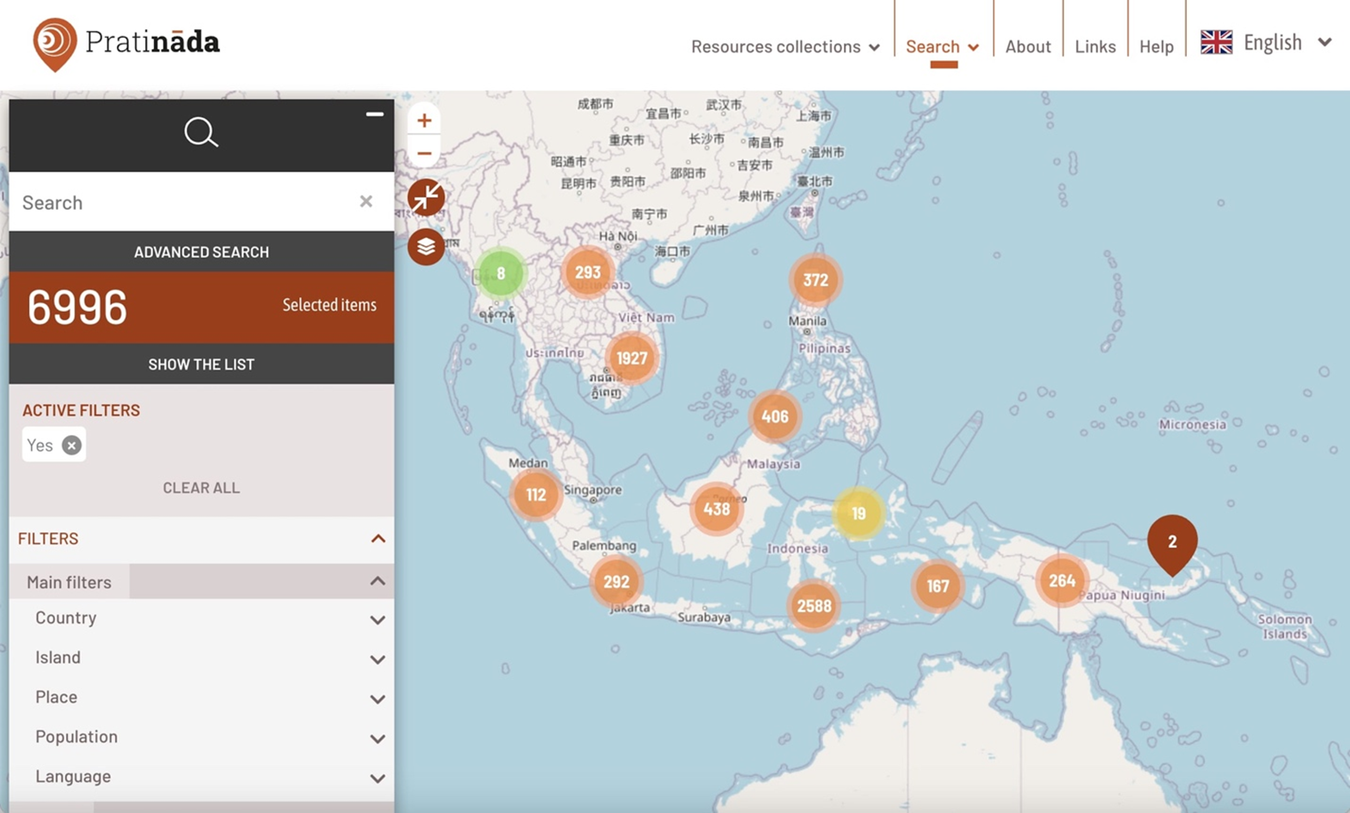
The Pratinada platform (https://pratinada.net), which debuted in 2024, proposes open-ended responses to these provocations on several levels (Figure 1). Alongside two other websites, a forthcoming edited volume, and a number of outreach initiatives such as residencies and fellowships, Pratinada is an outcome of a 3-year project called Decolonising Southeast Asian Sounds (DeCoSEAS), which ran from 2021 to 2024 with funding from the European Joint Programming Initiative on Cultural Heritage (JPI-CH). Led by meLê yamomo, Assistant Professor of New Dramaturgies, Media Cultures, Artistic Research, and Decoloniality at the University of Amsterdam, and Barbara Titus, Associate Professor of Cultural Musicology at the same institution, the project was groundbreaking in terms of using a European funding structure to create and support a collaborative transnational network of institutions, scholars, activists, and artists not only in the Netherlands, France, and the United Kingdom, but also in Southeast Asia, including the Philippines, Indonesia, Malaysia, and Laos.
Screenshot of Pratinada’s homepage. Accessed 20 August 2024 by the author.

The DeCoSEAS project took as its aim the “decolonisation” of collections of sound recordings that documented Southeast Asian music- and sound-making practices held in European institutions, as discussed in further detail in publications by yamomo and Titus (Reference yamomo and Titus2021, Reference yamomo, Titus and van Bijnen2024). The project arose out of yamomo’s prior experiences trying to use these archives for research into Southeast Asian sonic history, which brought to light the multiple kinds of physical, political, and epistemological barriers to access for non-European users. Despite holding scholarly credentials, institutional affiliations and a prestigious grant from within Europe, yamomo recounts that his Southeast Asian identity led to unanswered emails and unopened doors of archival vaults (yamomo and Bayer Reference yamomo, Bayer, Grüny and Farnsworth2024). In response to these hard-won insights, the DeCoSEAS collaboration proposed a three-pronged approach to decolonising historical sound recording collections based on the principles of access, agency, and dialogue. These principles are evident in the features of the Pratinada platform in ways that distinguish it from many other online archives and that make it useful both for providing access to specific collections and as a site for thinking decolonial approaches to historical sound archives more broadly.
In terms of providing access, Pratinada aggregates over 7,000 sound recordings from European collections that document the music-making and sounding practices of Southeast Asian individuals and communities. At present, the recordings come from the collections of three participating institutions: the Jaap Kunst Collection at the University of Amsterdam; the French National Centre for Scientific Research (CNRS)/Musée de l’Homme in Paris; and the BBC Empire Service broadcast recording collection at the British Library in London. Together, the recordings cover 14 countries and 152 ethno-linguistic groups, and include published musical works as well as original field recordings created by 39 collectors (including ethnologists, linguists, musicologists, filmmakers, and missionaries) spanning almost a century. On its homepage, Pratinada offers visitors the option to explore the recordings on a map, to browse through various filters, or to search the collections’ aggregated metadata.
By providing access to these recordings—including previously inaccessible recordings that were digitised through the DeCoSEAS project—the Pratinada platform offers the possibility of linking the collections with listeners who may be able to provide new context, meaning, and modes of listening to the Southeast Asian sounds they capture. Global digital access (including smartphone compatibility) makes it possible for listening encounters to take place outside of the walls of European institutions, and thus potentially outside of the colonial epistemological frameworks of the collectors who initially created the recordings (or, to put it differently, who collected or “took” them; see Clark Reference Clark2024; yamomo and Titus Reference yamomo, Titus and van Bijnen2024:112). Instead, scholars, musicians, artists, cultural activists, and other users in Southeast Asia and beyond can access the recordings for their own purposes—which is underlined by Pratinada’s use of a Creative Commons license (CC BY-NC-ND), enabling (non-commercial) reuse of the data. To further facilitate wider use, the platform’s interface is translated into seven Southeast Asian languages—Thai, Lao, Indonesian, Vietnamese, Khmer, Filipino, and Tetum, the national language of East Timor—in addition to English and French.
Pratinada is thus a potentially useful resource for anyone conducting research on Southeast Asian musical practices, or on colonial European collecting. In particular, the collections provide strong coverage of musical practices in Indonesia, Vietnam, and Timor, and of the collecting practices of particular historical figures such as the Dutch musicologist Jaap Kunst. The site also demonstrates the entanglement of colonial epistemologies with the practices of field recording and music archiving throughout the 20th century. Since the site aggregates already-existing historical collections, much of the metadata still represents colonial perspectives and could thus be inaccurate due to changes in terminology in the intervening time, or due to the lack of knowledge of the original creators and cataloguers of the recordings (as would be the case in any historical archive). Such inaccuracies could lead to challenges searching the collection; they certainly highlight the difficulty of using the historical objects as objective records documenting the musical past. On the other hand, we could also see such inaccuracies as useful in terms of investigating colonial collecting and knowledge-making practices, as they serve to highlight the mishearings, assumptions, and gaps in knowledge that characterise the historical European ear listening to its Others.
While Pratinada makes strides forward in modelling widespread, open digital access for transnational users, access is not the only answer that the platform offers to the question of decolonising colonial collections. yamomo and Titus write, “[P]roviding access is only the first and most basic step [to the project of decolonisation], and the work does not stop there. Even more pertinent is the transfer of agency over the curation of the sonic heritage. And this intertwines with a more pertinent concern: Who gets to create the discourse about these materials?” (Reference yamomo, Titus and van Bijnen2024:118). The concerns with agency and discourse are also evident in Pratinada’s features. The DeCoSEAS project invited direct engagement with the collections via fellowships, residencies, and guest curatorships, extended to scholars and artists from Southeast Asia and elsewhere, that provide critical insights into the collections. Unfortunately, these are currently not directly incorporated into Pratinada, but can be accessed through the platform’s links to other related websites; for example, one can find fellowship reports via the DeCoSEAS project site (https://www.decoseas.org/) and a guest-curated digital exhibition of recordings by Jaap Kunst on the Kunst Collection’s own website (https://jaapkunst.org/the-map-and-the-sound-archive/). Moreover, Pratinada’s Omeka backend and metadata schema are intended to provide wide compatibility so that sub-collections can potentially be curated via other web interfaces; this has already been done for the Jaap Kunst Collection (https://jaapkunst.org) and the BBC Empire Service Southeast Asia recordings (https://omekas.seasia-hearing.org/s/bbc-sea/).
Through its concerns with agency and dialogue around historical Southeast Asian sound recording collections, Pratinada does more than just providing digital access to previously inaccessible collections; rather, it does this through initiating a meta-conversation about the principles and power of archiving colonial collections. This is accomplished in part by making its own archival practices transparent and explicit. On the “Help” page of the website, users can see all metadata fields listed with a brief explanation: for example, individual items are catalogued with both original (colonial) and “decolonised” titles, “Creator” refers to the performers, composers, or knowledge keepers documented in the recordings rather than the European collectors (who, in many collections, are non-critically listed as the recordings’ creators), and musical instruments can be catalogued both by the names listed on the original recordings by the collectors—names that may or not be accurate—as well as crowd-contributed terminologies that may be more accurate, current, or inclusive. These may seem like small details, but these decisions represent shifts in authority and agency and were made through dialogue with a large network of participants with different positionalities in relation to the historical material, a dialogue that—like the project of decolonisation—is open and ongoing.
Thus, while Pratinada offers access to many unique, previously inaccessible historical recordings, it also offers much more, contributing to a broader discussion about decolonisation as an academic and societal question. One of the meta-questions it poses now is about the ongoing viability and future of a digital archive platform that is the output of a multi-year, multi-country project with limited funding. These days, many projects generate websites as an output—many of which are left to languish unmaintained after the project ends and the funding dries up. How can the Pratinada platform continue to dynamically provide access and opportunities for rethinking archival agency, and to promote the ongoing, never finished dialogue that decolonisation entails? Can it continue to do this after its project-based funding has ended? This may require rethinking the funding structures for such projects and shifting from a focus on outputs as the endpoints of projects toward strategies for continued maintenance of newly created web resources like Pratinada. Here is yet another open-ended provocation that the Pratinada platform and the DeCoSEAS collaboration offer to rethinking colonial sound recording collections and to the project of decolonising archives and academia.