Deliberative democrats argue that the basis of any vibrant democracy is the existence of frequent, inclusive and reasoned political discussions, because citizens come to understand different viewpoints, and to accommodate their differences by talking to each other (Dryzek, 2000). This means that a deliberative democracy feeds on a diversity of opinions. Thompson (Reference Thompson2008: 205) even argues that ‘[i]f the participants are mostly like-minded or hold the same views before they enter into the discussion, they are not situated in the circumstances of deliberation’.
Disagreement thus propels deliberation (Gutmann and Thompson, Reference Gutmann and Thompson1996), and deliberation is claimed to be able to overcome these political conflicts and promote tolerance, even in the face of strong adversity (Dryzek, Reference Dryzek2005; but see: Kuklinski et al., Reference Kuklinski, Riggle, Ottati, Schwarz and Wyer1991; Mutz, Reference Mutz2006: 135). However, there is inevitably a threshold beyond which conflicts become too deep to allow any deliberation. The claim that deliberation is the best and most desirable way of handling political conflict is thus a matter of degree, and scholars have remained hesitant to test the theoretical premises under rather more adverse circumstances (O’Flynn, Reference O’Flynn2006).
This article, in contrast, tries to push deliberative scholarship to its edges by focusing on citizen deliberation in deeply divided societies. This focus is not without risk, because it is often argued that ‘deliberation is not possible in segmented societies’ (Thompson, Reference Thompson2008: 511), and that citizen activism would only exacerbate political conflict (McGarry and O’Leary, Reference McGarry and O’Leary2009: 82). As such, the quest for political solutions is often left to elites who are more likely to display the ‘spirit of accommodation’ (Lijphart, Reference Lijphart1975) that these societies require, whereas citizen involvement is expected to intensify the political struggle.
Democratic stability in divided societies is thus considered to be at risk whenever the demos plays too prominent a role. This is an interesting paradox, one that contradicts the core beliefs of deliberative democrats. Inevitably, the question rises when and under which conditions political discussion between members of diametrically opposed groups could live up to the deliberative ideal type. Our first research question is therefore: can deliberation among citizens of deeply divided societies live up to the standards of the ideal speech situation? Or rather, does confrontation with members of the outgroup undermine the quality of deliberation?
Whether or not deliberation is possible is closely linked to the question how we can counter the potentially disastrous consequences of an intergroup setting. Previous research has found that strong decision-making rules are an important lever for deliberation, even for deep conflicts (Steiner et al., Reference Steiner, Bächtiger, Spörndli and Steenbergen2004; Mendelberg and Karpowitz, Reference Mendelberg and Karpowitz2006; Landwehr, Reference Landwehr2009 ). Demanding a decision under a supermajority rule might therefore turn around the downward spiral of intergroup deliberation. This is why we ask what would happen if we put ordinary citizens from both sides of the divide together to deliberate under very demanding decision-making rules. Put differently: could stringent decision-making rules neutralize the potentially disastrous dynamics of deliberation in an intergroup setting?
This article thus treats two intrinsically related questions: (1) whether deep conflicts undermine citizen deliberation, and (2) whether strong decision-making incentives could neutralize the negative effects of these conflicts. In this contribution, we argue – counter-intuitively – that ordinary citizens faced with members of ‘the other side’ behave more deliberatively than citizens talking only to their ingroup members, and that supermajority rules yield a more positive quality of deliberation than simple majority rule.
In order to substantiate these claims, we analyze a deliberative experiment organized in 2010 among Belgian citizens from both sides of the linguistic cleavage. Belgium is a particularly interesting case for testing the viability of democratic deliberation for two reasons. First, it is obviously a divided society. Since its founding in 1830, the language issue was considered a source of political unease, and in the past 50 years, Belgian politics has been trapped in a profound political struggle between the two language groups. This divide is, however, not only about language or the internal boundaries between the language groups. The two parts of the country also return different election results, with a more leftist oriented French-speaking south (Wallonia) and a more right-wing Dutch-speaking north (Flanders). Feelings of identity are stronger in Flanders, which also voices demands for further devolution and more fiscal autonomy. Both parts of the country thus have fundamentally different views on policy choices and on the institutional choices for the future of Belgium. Each language group furthermore has its own party system, and a fully split media landscape (Deschouwer, Reference Deschouwer2012).
The second reason is that Belgium has a long-standing tradition of pacifying its conflicts on an elitist consociational basis (Lijphart, Reference Lijphart1981), but finding solutions has become increasingly hard in recent years due to the steady rise of regionalist parties (Sinardet, Reference Sinardet2008). The combination of decreasing contact between the groups, and the surge of nationalist discourse within the groups has placed serious pressure on traditional conflict management techniques, and it is claimed that the Belgian system has reached its limits. Testing the potential of a deliberative model of democracy in Belgium, could thus offer interesting perspectives for the future of ethno-linguistic conflict regulation.
We will detail the effects group division and decision-making rules could theoretically have on the quality of deliberation in the first two sections of this article. The third and fourth sections deal with the experimental design and its validity, followed by a discussion of data analysis. The final section turns to the empirical analysis of how group composition and decision-making rules affect the quality of deliberation.
Deliberating across divides
Most deliberative scholars agree on the idea that contact between citizens of conflicting social and political groups could be a key ingredient for peaceful conflict resolution (Dryzek, Reference Dryzek2005; O’Flynn, Reference O’Flynn2006; Steiner, Reference Steiner2012). Deliberation on issues of common concern could propel a trend towards conflict reduction because equal consideration is given to all perspectives, and the open-mindedness towards the arguments of others that deliberation requires, is conducive to higher levels of mutual understanding. As such, democratic deliberation could transform strong antagonism into a constructive element of democratic sustainability (O’Flynn, Reference O’Flynn2006), but this assumption has not hitherto been submitted to rigorous empirical testing (but see Luskin et al., Reference Luskin, O'Flynn, Fishkin and Russell2012).
This lack of empirical evidence is why we borrow insights from social psychology and studies of ethnic conflict management. For instance, Morrell approaches intergroup deliberation from the social psychological idea of empathy, and argues that ‘without the process of empathy, it is highly unlikely that citizens will demonstrate the toleration, mutual respect, reciprocity, and openness toward others vital for a deliberative democracy’ (Morrell, Reference Morrell2010: 114). At the same time, he reckons, however, that empathy may be rare in divided societies: empathy requires the capacity to move oneself into the position of others, and to be sensitive to others’ feelings, but divided societies have divided public spheres, their citizens grew up in different realities, and group identities are determined by the need to be different from the other side in some way. In this sense, he agrees with Mutz that ‘the threat of a violent outcome is particularly great when those who have been living in segregated settings are first exposed to those of differing views’ (Mutz, Reference Mutz2006: 89). Under such adverse circumstances, citizens will have a hard time empathizing with those they oppose, or it will at least require an unimaginable amount of ‘deliberative restraint’ (Hindess, Reference Hindess2000; McGraw, Reference McGraw2010) because discussion across divides will induce the defensive attitudes likely to undermine deliberation, with participants standing firm on their initial stance.
Not accepting the other side’s viewpoints should not even be a conscious process, as social validation theory teaches us (Lopes et al., Reference Lopes, Vala and Garcia-Marques2007). Acceptance or refusal of arguments depends in no small measure on the credibility of their source rather than their intrinsic epistemic value. ‘When deliberation deals with an issue that has long generated deep conflict’, Mendelberg (Reference Mendelberg2002: 161) argues, ‘it is unlikely that many novel arguments will be aired. And if novel and valid arguments are aired, they are not likely to persuade many people’. Social validation mechanisms turn social identities into discursive weapons by imposing an automatic refutation of opposing arguments.
When sitting together and talking does little more than heighten mutual linguistic armament, citizens could be tempted to avoid contact altogether. Opting out of the deliberation could be an alternative when deliberants feel threatened, and the perception of a threat is easily aroused when a group has to face its political adversaries. After all, groups know that giving in to better arguments means compromising their identities and betraying their own group.
Despite the rather grim picture sketched about the viability of democratic deliberation, there are some theoretical and empirical indications that a divided group composition may not necessarily lead to lower deliberative quality. The influential ‘contact hypothesis’ is of particular interest in this respect. Based on experiments in racially segregated neighborhoods, Allport (Reference Allport1954) found that stereotypes and prejudices form the basis of intergroup conflict, but also that contact between groups could reduce conflict. Working together towards a common goal, under conditions of equality has been shown to lead to a strong reduction in intergroup biases and to conflict mitigation. According to these premises, intergroup deliberation could foster tolerance rather than open conflict (Pettigrew, Reference Pettigrew1998; Dovidio et al., Reference Dovidio, Gaertner and Kawakami2003).
These social–psychological claims find some support in a Deliberative Poll in Northern Ireland, which gathered Catholics and Protestants on issues of education. The results of the experiment showed that the participants rated the trustworthiness of the outgroup significantly higher after the deliberation (Luskin et al., Reference Luskin, O'Flynn, Fishkin and Russell2012). Contact and a search for common solutions to the problems faced by the groups thus led to a positive deliberative dynamic.
Similar benefits from facing an outgroup were also pointed out in Sunstein’s work on enclave deliberation (Sunstein, Reference Sunstein2007). Contrary to common assumptions, deliberation within one’s own group has some important negative consequences. In deliberative enclaves, the noses of the participants are all pointing in the same direction, and everyone involved is aware of that orientation. The participants are familiar with most of the arguments and will tend to interpret new information brought before them as confirming their prior beliefs (Mendelberg, Reference Mendelberg2002; Ryfe, Reference Ryfe2005). Moreover, the sense of commonality might lower the burden of justification. Because the participants share an identity and the same perspectives, they assume that everyone in the group knows what they are talking about. This could lead to poor justifications because the participants feel that it is useless to make explicit what is thought to be commonly known. The result is an increase of cognitive errors, or even ideological amplification (Sunstein, Reference Sunstein2007). Confrontation with the radically different perspectives from the outgroup might actually be an important buffer against the use of group heuristics and cognitive shortcuts. Between-group deliberation could thus lead to higher quality arguments.
However, most theories do not fully take into account that the linguistic diversity that characterizes the Belgian case could be a disincentive for deliberation because, as O‘Leary (Reference O‘Leary2005: 10) argues, ‘deliberation takes place in languages, dialects, accents, and ethnically toned voices [so] that it is not possible to create “ideal speech situations”’. Multilingual deliberation in divided societies is bound to suffer from misunderstandings, and even if multilingualism might incite more attentive listening and information processing (Keysar et al., Reference Keysar, Hayakawa and An2012), the language differences in a divided society function as an important signifier for the underlying political conflict (Longman, Reference Longman2007: 89). As such, the least bit of misunderstanding will be interpreted as a show of distrust and contempt. This argument is reminiscent of Mill, who contends that ‘[a]mong a people without fellow-feeling, especially if they read and speak different languages, the united public opinion, necessary to the working of representative government, cannot exist’ (Mill, 1865/1991: 428).
Despite the theoretical ambiguity on the potential effect of confronting adversarial groups, we hypothesize that the quality of deliberation in divided settings will be lower because of social, psychological and linguistic barriers. Competing interests and conflicting identities are thus expected to reduce the possibility of genuine citizen deliberation in divided societies.
Deliberation and decision-making rules
Despite the rather worrying expectations that a divided group composition might undermine deliberation, submitting groups to strong decision-making incentives could counter the perpetuation of conflict in intergroup communication. If citizens participating in deliberative groups are asked not only to talk, but also to reach a joint decision, the decision-making rules could force participants to cooperate despite the deep conflicts that divide them. It is often argued that unanimity rule could be a good lever for high quality deliberation (Hastie et al., Reference Hastie, Penrod and Pennington1983; Guarnaschelli et al., Reference Guarnaschelli, McKelvey and Palfrey2000). Unanimity enhances justificatory and respectful discourse because it requires that all participants in the deliberation approve of the decision. It thus fosters a thoroughly deliberative process where arguments pro and con are exchanged. Rather than stimulating bullying behavior, it creates open-mindedness towards the arguments of others (Delli Carpini et al., Reference Delli Carpini, Cook and Jacobs2004). As such, unanimity rule files off the sharp edges of more extreme positions, and instigates accommodation (Nemeth, Reference Nemeth1977: 46). It installs a group norm emphasizing the fact that the group should behave as one, whereas majority rule symbolizes the fact that disagreement within the group is acceptable (Mendelberg and Karpowitz, Reference Mendelberg and Karpowitz2006).
Despite the generally positive appreciation of unanimity rule, Gastil (Reference Gastil1993: 54) argues that unanimity can have negative effects on deliberation. Unanimity rule can improve inclusiveness, but it can also hinder deliberation because it gives minority members veto rights. It could thus induce a stalemate when issues are discussed on which no side is willing to change its initial position. Under such circumstances, majority rule might be more desirable. After all, no one can threaten to deadlock the discussion, which leaves the power of argumentation as the only viable strategy for minorities (Foss, Reference Foss1981: 1061).
However, the assumption that deliberation can be of superior quality under majority rule is heavily contested. A simple majority, it is argued, will reduce deliberative quality because only a limited number of people need convincing (Meirowitz, Reference Meirowitz2007). The demands for inclusion are lower so that deliberants only selectively provide arguments to convince just enough people to reach the quorum (Hastie et al., Reference Hastie, Penrod and Pennington1983). Certain of victory, the majority will also put less effort into formulating persuasive arguments, and more into discrediting the minority opinion.
The effect of other types of supermajorities is hidden behind a cloud of ambiguity. Hastie et al. (Reference Hastie, Penrod and Pennington1983) found that interactions under two-thirds majority were more inclusive than under majority rule because the threshold for a decision was raised, but the respect accorded to others and the justification of positions might be less compared with unanimity rule. Other research has shown, however, that ‘a simple majority decision scheme was very nearly as accurate for juries assigned a two-thirds majority rule’ (Davis, et al., Reference Davis, Kerr, Atkin, Holt and Meek1975: 11), and that majority and supermajority rules generate equivalent deliberative outcomes (Gerardi and Yariv, Reference Gerardi and Yariv2007).
In summary, our hypothesis is that supermajority rules foster argumentative, rather than power-based interactions, whereas majority rule leads to exclusion and disrespect (Diamond et al., Reference Diamond, Rose and Murphy2005). More stringent decision-making rules therefore lead to higher quality deliberation demanding respect, inclusion, and the willingness to yield to better arguments.
Research design
Testing these hypotheses requires the observation of communicative interactions between citizens from both sides of the linguistic divide. Due to their highly segmented nature, however, political discussions take place within the confines of one’s own subgroup. Divided societies are thus characterized by a limited number of contacts across divides.
This absence of ‘naturalistic’ locations explains why we opted for an experimental research design. In 2010, we organized a mini-public with Belgian citizens from both sides of the linguistic cleavage. The question we presented them was as simple as it was controversial: ‘how do you see the future of Belgium?’ At a moment when negotiations on state reform had stalled and early elections were in sight, this mini-public dealt with the core issues of the Belgian political deadlock, such as the future state reform, the electoral district of Brussels–Halle–Vilvoorde (over which the government resigned), and the organization of elections in a country without statewide parties.
In total, nine deliberative experiments took place in a 3×3 factorial design, and for each experiment we invited 10 citizens.Footnote 1 On the one hand, we varied the group composition. The homogeneous Dutch or French-speaking groups were the control condition, whereas a divided group composition constituted the treatment condition. On the other hand, the decision-making rule also varied across experiments. There, the simple majority rule functioned as the control condition, whereas the two-thirds majority and unanimity rules were treatment conditions to determine the effect of supermajorities.
Whereas the group division was simply implemented by manipulating the group composition, an adequate implementation of the decision-making rules was somewhat more difficult because we needed the participants to feel the pressure of the decision-making rule during the entire deliberation. We therefore emphasized strongly in the introduction to the experiments that we expected a decision following a predetermined rule immediately after the discussion. Only in this way could we ensure that what we measured was the effect of the rule.
An additional problem with implementing the rules was that we did not have a genuine default option. Besides taking away their lunch, there was no real means of pushing the participants to a final decision, which could undermine the effect of the rules. However, we were primarily interested in talk, that is, in the process leading to the decision. So, even when no final agreement could be reached, the non-agreement was still preceded by extensive discussions. The process, which interests us, could therefore still be analyzed even if no decision was reached.
Besides varying these experimental conditions, we also kept some potential confounders constant. We first chose a neutral location, and in the divided groups simultaneous translation was foreseen. Also the number of participants per experiment was kept constant. We sampled small groups of 10 persons to ensure that exclusionary tendencies were not built into the design because large groups risk domination by those with the best communicative capacities (Young, Reference Young2000). We also ensured that the socio-demographic composition of the different groups was comparable to avoid group composition effects (see e.g. Mendelberg and Karpowitz, Reference Mendelberg and Karpowitz2006; Karpowitz et al., Reference Karpowitz, Mendelberg and Shaker2012).
Each group discussed in two rounds of one and a half hours. The first round was opened with the general question ‘how do you see the future of Belgium?’ In this first round, the participants could introduce issues themselves. The second round was more focused on specific institutional issues in Belgian politics, which were hotly debated at the time the experiments took place.
It is commonplace in deliberative events that the moderators urge participants to be respectful or to present good arguments. This means that the moderators actively try to improve the quality of the deliberation. By keeping the facilitators in our experiment passive, we did not artificially boost the discourse quality index (DQI)-scores of the experiments, thereby guaranteeing that the analyses reflect the true dynamics of the deliberative process (Myers, Reference Myers2007). The moderators’ role was therefore limited to introducing the experiment, letting the discussion begin, and closing it afterwards. In the second round, the moderator also introduced the specific institutional issues under discussion.
The participants were recruited by drawing a random but disproportionately stratified sample to ensure the equal presence of both Dutch and French-speakers in the pool. Due to time and financial restrictions, however, these samples were drawn from an existing panel with over 110,000 individuals rather than official census lists. This panel resembles the socio-demographic composition of the Belgian population quite well, and was managed by a social research bureau specialized in organizing opinion polls. From this panel, we randomly drew two samples of 1000 respondents, one for each linguistic group.Footnote 2
When assigning the participants to the groups, we had to avoid generating internally homogeneous groups, since this was desirable neither from a theoretical point of view (Thompson, Reference Thompson2008), nor in light of our research question. It would have been useless to see whether division undermines deliberation if all participants in the divided groups shared the same views on the future of Belgium. This is why participants were assigned to the groups using block randomization. This means that we divided our sample of 2000 respondents into several blocks based on a combination of their language, sex, age, preferences for the future of Belgium, and outgroup feelings. From each of these blocks, we randomly assigned the 90 participants to one of the nine groups in our experiment.
Issues of validity
Our procedure of selecting and assigning participants admittedly raises important questions on the external validity of our experiments. Like many other deliberative events, we only had a limited number of participants, which were moreover not fully randomly assigned, so that the generalizability of our findings might be compromised.
However, we did everything possible to make claims of external validity possible. Even though we were unable to draw a random population sample, the socio-demographic composition of the participant sample corresponds accurately to that of the entire population with regard to sex and age but, as is common in these kinds of experiments, the share of higher educated among the effective participants was larger than their share in the population. This limits the potential for generalizability somewhat.
The second issue regards the lack of realism of the experimental setting, which might dilute the effects of our two treatments. The context of the experiment may potentially have a large impact on the validity of our findings. If the participants perceived the setting to be ‘cold’ (Fung, Reference Fung2003), that is, if they felt that there was little at stake, they might simply have changed their behavior and opinions to get the experiment over with, and to go to lunch. This might undermine the robustness of our findings.
It is impossible to avoid this problem entirely in an artificial experimental setting, but we did everything in our power to ensure that the participants felt like there was something at stake in the discussions. First of all, the experiments were not organized on a university campus, but in a building at just a few minutes walk from the Belgian and European parliaments to create a more ‘serious’ setting. Second, the participants were informed beforehand that the results of their discussions would be sent out in a press release, and that the detailed analyses of the deliberations would be presented to the competent parliamentary committees. The impression of the participants was thus that there would be real consequences to their efforts, making the experiment less like a social science game and more like a formal deliberative setting.
Moreover, we are convinced that at least the potential for very deep conflicts was present in all of the groups. As we mentioned before, the groups were composed in such a way as to include diametrically opposing opinions on the future of Belgium. This diversity of opinions offered serious potential for heated discussions, especially because the public opinion at the time of the experiments was extremely polarized. Moreover, due to additional recruitment efforts, we experienced very little dropout in the divided groups. This means that the divided groups were the groups with the strongest polarization of opinions. The chances for intergroup conflict exacerbation and a low deliberative quality were thus the highest in the divided groups, so that our positive results (as we will see later on) are very likely to reflect the true dynamics of intergroup deliberation in Belgium.
Finally, even though experimental designs have their obvious flaws in terms of mundane realism, one of their strengths is their ability to create settings that are not readily available in real life. In this case, large-scale and recurrent discussions between French and Dutch speakers in Belgium would certainly constitute a much better and realistic setting for guaranteeing a strong external validity, but the very absence of these discussions necessitated a different approach. Experiments in the form of mini-publics in a carefully controlled environment can uncover thus far unknown dynamics, and possibly pave the way for a more large-scale replication in Belgium or other divided societies.
Analyzing deliberation: the DQI
After the experiments took place, the discussions were transcribed word-for-word, and subsequently subdivided into individual speech acts, that is, every time a speaker formulates a demand or an opinion, this was considered a speech act. Each of these speech acts was coded using the DQI, previously used to determine the deliberative quality of parliamentary discourse (Steiner et al., Reference Steiner, Bächtiger, Spörndli and Steenbergen2004; Bächtiger, Reference Bächtiger2005). This index has widely acclaimed content validity, and even Jürgen Habermas ‘admires the inventive introduction of a DQI for capturing essential features of proper deliberation’ (Habermas, Reference Habermas2005: 389).
One critical remark should be made about the DQI. First of all, we should keep in mind that the index was developed for measuring parliamentary discussion. Such discourse is structured by formal rules that limit, for instance, speaking time and order. These limitations are not characteristic of citizen discourse. We therefore needed to adapt the DQI to the specificities of the current setting. This is in line, however, with the way in which Steenbergen and his colleagues (Reference Steenbergen, Bächtiger, Spörndli and Steiner2003) see their index, namely as a flexible instrument that needs to be adapted to specific research designs. Because of this, we added new coding categories that are particularly relevant in citizen deliberation, such as the use of respectful language.
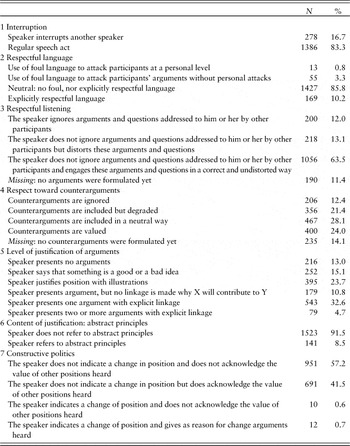
Table 1 lists the items that were included in the coding. Interruptions, respect for counterarguments, the level of justification and constructive politics all capture an essential dimension of deliberation, and they were all part of the original DQI. To this we added, the use of respectful language and respectful listening, two dimensions that are crucially part of citizen deliberation. We also coded respect towards the ingroup and outgroup, and references to the common good, but these items showed less than 5% variation, so that we had to exclude them from further analyses.
DQI items

DQI=discourse quality index.
The next step was to determine whether these individual items construed a genuine index for deliberation. After all, Steenbergen and his colleagues (Reference Steenbergen, Bächtiger, Spörndli and Steiner2003: 30) ‘expect the coding categories to hang together reasonably well that a subset (or perhaps all) of [the DQI dimensions] can be combined to form a scale that can serve as an overall measure of discourse quality’. If we failed to check this unidimensionality, and if each single item would turn out to measure something entirely different, the index would lack construct validity.
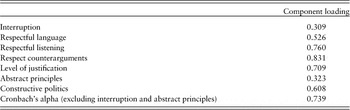
In order to move from the items to the index, we used a factor analysis. The Table 2 reports that that there is only one factor on which five out of seven DQI items load well. Respect for counterarguments, respectful listening and the level of justification are the three strongest items, but they are completed by the use of respectful language and constructive politics, which have slightly lower factor loadings. All of these items refer to a way of presenting one’s arguments, and defending one’s position. The way in which speakers listen to others and react to them, and the respect they accord to their arguments, reflects the same underlying structure as the efforts speakers put into defending their own ideas and their openness towards better arguments.
Principal component analysis of the DQI items

DQI=discourse quality index.
Given the positive results of the factor analysis, we created an additive scale. After we excluded interruption and abstract principles, the scale has a good internal consistency and reliability (Cronbach’s alpha of 0.739). Since each of the DQI items behaves empirically as we theoretically projected in a reliable manner, the index has high construct validity.
Deliberating across divides: empirical perspectives
As we discussed in the theoretical framework, citizens involved in intergroup deliberation are expected to behave in one of two ways: they can either avoid interacting with the other side or become discursively violent. Hereafter we test both possibilities. First of all we figure out whether the citizens in our groups chose the exit option and engaged in mere ‘enclave deliberation’ with members of their own group. Afterwards, we analyze the deliberative quality of the interactions to see whether the participants in our mini-publics use discourse as a weapon.
Finding an exit: integrative vs. enclave deliberation
The assumption that putting citizens of opposing groups together suffices to get them to talk together is not unproblematic because participants may simply look for an exit strategy. After all, deliberation takes citizens ‘out of their comfort zone’ (Ryfe, Reference Ryfe2005: 57) and citizens are increasingly found to avoid participating in politics in general (Eliasoph, Reference Eliasoph1998; Ulbig and Funk, Reference Ulbig and Funk1999) and political discussions in particular (Conover et al., Reference Conover, Searing and Crewe2002) because of the conflicts these entail. Conflict avoidance could thus be detrimental to intergroup deliberation because participants may turn inwards, talking only to their own ingroup members. If the participants were indeed found to engage in mere enclave deliberation, there would be very little use in looking at deliberative quality, so we needed to measure the discursive integration of both groups in the discussion. We therefore coded so-called intergroup interactivity. This is a dummy variable where ‘0’ signifies that a speech act is a reaction to a speech act uttered by the ingroup, whereas ‘1’ indicates an integrative speech act, in which the participant reacts to a member of the outgroup.
Table 3 shows that there is a fair amount of discursive integration within the divided groups. There is practically no gap between the number of reactions to the ingroup and the outgroup, suggesting not only a high level of discursive integration, but also that the participants did not resort to so called ‘enclave deliberation’. This table fails to tell the whole story, however, because the intergroup interactivity was lower during the first 10 minutes or so of the discussion. This is due to the fact that the participants were put in a highly unusual situation and it probably took a while to get used to the translation.
Frequency table of intergroup interactivity

a Since we only look at the groups in which intergroup interactivity plays a role, that is, the divided groups, the missings include: all of the speech acts in the homogeneous groups and the speech acts in the divided groups that did not form a reaction to a previous statement.
It is also interesting to look at a number of determinants for engaging in intergroup interactivity. Engaging in multilingual discussion could after all be easier for those who are actively bilingual, as previous research on multilingual deliberation at the European level indicates. In an interesting article on multilingual deliberation in the European Social Forum meetings, Doerr (Reference Doerr2012) argues that there is an increased risk of misunderstandings and enclave deliberation in multilingual settings, but she also shows convincingly that translators were an important resource in facilitating the discussion and in promoting the inclusion of minority languages.
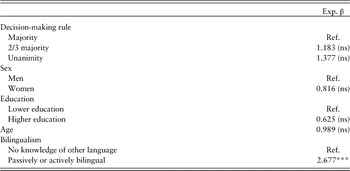
Moreover, we included the participants’ sex and education in the models because deliberating in an intergroup setting is highly antagonistic, something with which women and lower educated groups feel less comfortable (Caluwaerts, Reference Caluwaerts2012). Finally, Table 4 also fails to tell us whether the integrative speech acts are more prevalent in the groups discussing under the supermajority rule. After all, the more agreement is required, the more important it is to talk across group boundaries.
We tested which factors are positively or negatively related to intergroup interactivity in Table 4. We kept the model relatively simple and limited because of the small n, and this explains the low R 2. Nevertheless, the table convincingly shows that neither the usual socio-demographic suspects nor the decision-making rules are significantly related to intergroup interactivity. The only variable that does play a crucial role is knowledge of the outgroup’s language, which was to be expected. If a participant has at least passive knowledge of the other language,Footnote 3 the odds of uttering a reaction to the outgroup increases by more than 2.5 times. Intergroup deliberation thus depends more on skill than on willingness, and bilingualism is an important asset when discussing issues across linguistic divides. The fact that the effect of bilingualism is relatively strong indicates that simultaneous translation did not fully succeed in extending the deliberative potential to all participants. This is in line with the findings of Fiket and her colleagues (Reference Fiket, Olsen and Trenz2011: 25) that ‘problems of understanding related to the use of plural languages in heterogeneous group settings can thus be partly overcome, even though there remain restrictions in how the principle of political equality can be approached’.
Binomial logistic regression predicting discursive integration

N=379; Nagelkerke, R 2=5.7%.
Turning (discursively) violent
Since the participants did not choose exit, it is useful to focus on the deliberative quality of the interaction. Before turning to the results, several technical remarks should be made. First of all, the analyses were initially run with the distinction between Dutch and French-speaking groups added as an independent variable. While testing whether the assumptions for OLS regressions were met, however, Levene’s test for the homogeneity of variances showed that the model suffered from heteroscedasticity.Footnote 4 Even though Allison contends that ‘heteroscedasticity […] has to be pretty severe before it leads to serious bias in the standard errors’ (Allison, Reference Allison1999: 128), we did follow the commonly suggested solution of model respecification by transforming the variables. We therefore dropped the distinction between the Dutch and French speaking homogeneous groups, and dichotomized group composition into divided or not. This meant that we lost some of the richness of our data, but it did provide us with a more robust model, with the additional advantage that the effect of our treatment condition, that is, a divided group composition, was much more easily interpretable.
Second, we should justify which potential confounders we controlled for in the analyses. The first set of variables contains the socio-demographic characteristics of those who utter the speech act. Gender was taken up in because deliberation is stratified along the lines of gender (Sanders, Reference Sanders1997). The speakers’ educational attainment was also included in the model. After all, the higher educated possess many more resources for deliberation in terms of political knowledge and verbal skills to formulate high quality rational arguments (Hooghe, Reference Hooghe1999). As is usual in these kinds of deliberative events, only a limited number of lower educated participants turned up to our experiments, so that the data are skewed. We therefore turned the educational level into a dummy and distinguished between those who are higher educated (code ‘1’) and those who received secondary education at most (code ‘0’). The age of the speaker was also considered relevant because older generations were socialized in the turbulent post-war years in which the relations between the linguistic groups were very uneasy. Moreover, those who grew up in the 1970s experienced severe political instability due to the heated tensions between the north and the south of the country, whereas younger generations grew up in times of relative peace.
Besides socio-demographic variables, we also included self-reported outgroup feelings. Based on an 11-point scale in the pre-test questionnaire, ranging from 0 to 10, we asked the respondents how positive or negative they were with regard to the other linguistic group. In discussions dealing with issues of identities and interests, people with negative feelings towards the outgroup could easily be expected to behave less deliberatively. Finally, issue polarization was added to the statistical models. Controversial topics heat the spirits of those discussing, and give rise to passionate pleas instead of rational arguments. Issue polarization was coded at the level of the speech acts. This means that a code ‘1’ was assigned to the speech act if it dealt with issues that were situated on the cleavage between French and Dutch speaking, and ‘0’ if it did not.
Stepwise regression analysis
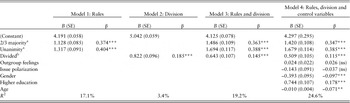
These specifications being made, we can now turn to the results of our stepwise regression analysis in Table 5, and the most interesting model to start from is the third one. Its relatively high explained variance of 19.2% means that the two experimental treatments under scrutiny are powerful predictors of deliberative quality. When compared with the first two models, however, it is obvious that decision-making rules account for most of this variation with an R 2 of 17.1%, whereas the explanatory power of the group division is a much more modest 3.4%. This indicates that a divided group composition does not have the overwhelmingly powerful effect we expected based on our literature review.
Stepwise OLS regression models predicting DQI score

OLS=ordinary least squares; DQI=discourse quality index.
OLS regression; N=1412.
Significance: *P<0.05; ***P<0.001.
a Dummy variable, majority rule was omitted because it was the reference category.
b Dummy variable, the homogeneous group was omitted because it was the reference category.
This gap in explanatory power does not necessarily mean that group composition makes no difference. After all, a closer look at the fourth model reveals that both rules and composition are significantly related to deliberative quality, even after controlling for potentially confounding variables. Deliberative quality is therefore clearly linked to the way in which groups are composed and required to make a decision.
The next question, then, relates to the strength and direction of these effects. The decision-making rules follow the hypotheses nicely: more stringent rules lead to significantly higher DQI scores. Whereas the mean under a majority rule is 4.297 out of 10, this rises to 5.717 under a two-thirds majority rule, and to 5.976 under a unanimity rule. Both supermajorities thus have a strong and positive impact on DQI, as testified by β-coefficients of 0.326 and 0.375 under two-thirds majority, respectively unanimity.
The effect of group composition is more ambiguous. We hypothesized that a divided group composition would undermine deliberative quality because citizens would activate prejudices and stereotypes, rather than engage in a respectful and inclusive process of arguing back-and-forth. This argument is disconfirmed by our data. Even though the effect is relatively weak, divided groups lead to significantly higher quality deliberation than homogeneous groups.Footnote 5
These surprising results suggest that deliberation in the face of deep adversarialism might act as a self-denying prophecy: instead of giving in to prejudices and exploiting misunderstandings, the participants seem to understand what is at stake and search for common ground (Rosenberg, Reference Rosenberg2005). As such, confronting citizens with the outgroup might take them ‘out of their comfort zones [and] instigate more considered judgment’ (Ryfe, Reference Ryfe2005: 57): because the only way of coming to a conclusion is by moving past stereotypes in a respectful way, division could even prove an incentive for deliberation.
Besides the effects of the experimental conditions, Table 5 also displays some rather unexpected results for issue polarization and outgroup feelings. There is no significant difference in DQI scores between polarized and non-polarized issues. This is probably due to the fact that the entire discussion was framed in a polarized way. After all, the opening question ‘how do you see the future of Belgium?’ already indicated that the entire discussion would deal with highly contentious issues, even if parts of the discussion were not polarized per se.
ANCOVA predicting DQI scores

ANCOVA=analysis of covariance; DQI=discourse quality index.
ANCOVA; N=1412.
Significance: ***P<0.001.
Both models controlled for gender, education, age, outgroup feelings of the speaker and issue polarization.
The fact that outgroup feelings did not play a significant role is partly due to sampling biases. The dropout rate in the days before the experiments was inevitably higher among those holding strongly negative outgroup feelings, even though participants with negative outgroup feelings were represented in each group. As such, those who had doubts about the trustworthiness of the outgroup were somewhat outnumbered by those who felt more positively.Footnote 6 Group pressure was therefore higher and they might have yielded more easily to ‘the civilizing force of hypocrisy’ (Elster, Reference Elster1998).
Interaction effects
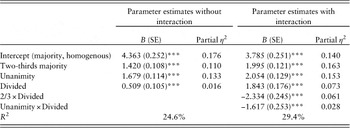
Even though the regression analysis clearly brings out the direct effects of both rules and composition on deliberative quality, we should also take a look at possible interaction effects. The conditional interdependence between rules and group composition has received little attention in the literature so far, but we should at least look at interaction effects to get the full picture. We therefore performed an ANCOVA with and without interaction effects. The interesting results of this analysis are reported in Table 6.
The parameter estimates reveal that all the interaction effects between decision-making rules and group composition are significant. More specifically, these results indicate that the effects of decision-making rules are much weaker in the divided groups than in the homogeneous groups. As such, a divided group composition overrules, or at least strongly reduces the effect of decision-making rules.
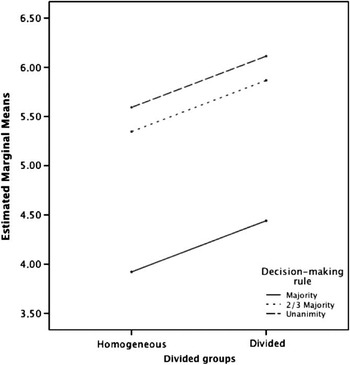
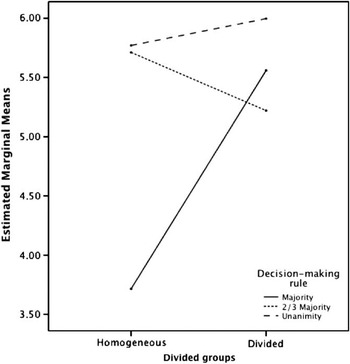
Figures 1 and 2 show this in a very convincing way: as soon as we take into account the interaction with group composition (Figure 2), the effects of the decision-making rules change dramatically. In the divided groups, decision-making rules barely exert any influence. The mean deliberative quality of the discussions is between five and six out of 10, regardless of the decision-making rule. In the homogeneous groups, on the contrary, there is a clear discrepancy in decision-making dynamics depending on whether the decision has to be made under a simple majority or a supermajority.
Estimated marginal DQI means by rule and composition without interaction effects. DQI=discourse quality index.

Estimated marginal DQI means by rule and compositions with interaction effects. DQI=discourse quality index.

In these groups, interaction under majority rule is characterized by a lower deliberative quality than under any other rule, as we hypothesized. The fact that only the bare minimum of people in the group need to be convinced about the value of a position means that much less discursive effort has to be put into convincing others. Deliberation under two-thirds majority and unanimity, on the other hand, forms a separate cluster with much higher DQI scores. The need for a consensus requires a lot more argumentative effort and a more receptive attitude towards the arguments of others. The data thus suggest that the best way of convincing others of the value of a position is by treating them with respect, and by reciprocating the open-mindedness that the participants expect from others.
Conclusion
This paper started from the generally held belief that democracy in divided societies can only be stable as long as the citizens remain passive. This idea, that contact between conflicting groups at the citizen level will only exacerbate political conflict, figured prominently in the literatures on ethnic conflict and deliberation. Deliberative democrats are after all highly skeptical about the potential for interbloc deliberation, because the favorable conditions for deliberation, such as intergroup empathy and mutual trust, are missing in divided societies.
Despite these grim perspectives, another line of research offered interesting perspectives for reversing the hypothesized negative relationship between group composition and deliberation. The implementation of supermajority decision-making rules, this literature argued, could yield more positive deliberative dynamics. Demanding a consensus requirement implied the inclusion of all participants and their arguments. As such, supermajority rules would create opportunities for thorough argumentation in a context of mutual respect and sincerity.
Even though the theory appeared relatively straightforward, the results from our Belgian experiments had a mind of their own, with three important conclusions standing out. First of all, citizens do not turn their backs on the other side, but actively engage in intergroup deliberation. However, as we have seen, knowledge of the other group’s language is an asset in multilingual deliberation. Simultaneous translation can to some extent mediate the effect of plurilingualism, but it cannot abolish the fact that those with knowledge of the other language did talk more frequently to members of the other group.
Second, decision-making rules were found to be important predictors of deliberative quality, but their effect was limited to the homogeneous groups. In these homogeneous groups, majority rule and supermajorities induce separate deliberative dynamics, and the need for consensus triggers the need for inclusive, respectful and rational discourse. In the divided groups, the effect of the rules largely vanishes: a divided group composition was found to make the pressure for consensus obsolete, because the DQI scores in the divided groups tended to flock together no matter what the decision-making rule.
The third and probably most interesting finding is that group division did have an effect, but facing the outgroup led to higher rather than lower deliberative quality. Citizens who differed fundamentally on highly contentious issues in Belgian politics were still able to act deliberatively, and even to generate a higher deliberative score than citizens in homogeneous groups. Confrontation with diverging perspectives avoided the argumentative inbreeding that accompanies enclave deliberation, and rather than undermining rational and inclusive decision making, division created a fundamental openness and willingness to argue back-and-forth with people of radically different views.
This finding was unexpected in light of social identity theory, as well as theories of ethnic conflict management. However, it lends some support to Allport’s (Reference Allport1954) contact hypothesis, which states that intergroup contact in which the groups have equal status and are required to constructively look for solutions to common problems (as was the case in our experiment) fosters a more respectful and reciprocal, that is, a more deliberative attitude. Moreover, Belgium is so segmented that contact between the groups is rare. We can therefore assume that deliberation in the divided groups created a very unusual and maybe even threatening situation. Such situations activate attentiveness and social learning (Ryfe, Reference Ryfe2005; Mackuen et al., Reference Mackuen, Marcus, Neuman and Keele2007), two characteristics that are conducive to high quality deliberation.
These results cannot be generalized without caution. Even though we raised the stakes by telling the participants that their inputs would be shared with the media and the political elites, the experiments still took place in a relatively cold deliberative setting. Under such circumstances, the threshold for giving in to demands from the outgroup is lower. In a hot setting where decisions actually affect everyday lives in the divided polity, the dynamics of deliberation could potentially turn out to be less positive.
Despite all the precautions we carefully built into the design, the external validity of our small-scale experiment is contestable. The best way for research on deliberation in divided societies to move forward and to increase external validity is through replication (Morton and Williams, Reference Morton and Williams2010). Our suggestion would therefore be to corroborate our results by repeating this experiment in a more hostile and hotter setting.
Despite its limitations, this paper offers a very first glimpse at deliberation under very adverse circumstances, and the results raise high hopes for deliberation between diametrically opposed groups. Citizen activism on highly contentious issues, it appears, does not necessarily undermine democratic stability, and citizen involvement in intergroup contact could even be a trigger for conflict mitigation, contrary to what theories of ethnic conflict management claim. Putting citizens from both sides together opens up minds and instigates a more considered judgment. This possibility of grassroots involvement is often missing in theories based on elitist premises. Of course we cannot generalize beyond the specific Belgian case, which has not known any physically violent outbursts in the past 40 years, but a good way forward in research on ethnic conflicts might be to focus on a more active role for citizens in processes of conflict accommodation, albeit under demanding institutional constraints.
These findings show that ordinary citizens in divided societies are able and willing to take up their role in establishing a dialogue. If this contribution can provoke the same kind of dialogue among scholars, as those that took place among the citizens in our experiments, it can consider its mission accomplished.
Acknowledgments
The authors thank Jürg Steiner, Juan Ugarriza and Min Reuchamps for their much valued comments. This research was made possible by the Research Foundation – Flanders (FWO) and the Belgian Science Policy (Belspo).