The term ‘capability’ is a familiar one in educational circles, usually in reference to ability or potential of a learner. Delving into dictionary sources for the word ‘capability’ provided the following meanings and interpretations:
1. The power or ability to generate an outcome.
2. The sum of expertise and capacity.
3. The knowledge, skill, ability, or characteristic associated with desirable performance on a job, such as problem solving, analytical thinking, or leadership.
4. Some definitions of capability include motives, beliefs, and values.
5. Building capability starts with the individual and is compounded or increases exponentially as it spreads to work groups, teams and finally organisations through a network effect (Fowler & Fowler, Reference Fowler, Fowler and McIntosh1964; Morris, Reference Morris1976).
In short, we can initially define capability as ‘the ability of an individual or a group to generate an outcome’.
We may also recognise that a task or a set of tasks or a job can range from the very simple to the very complex, so that in general, the degree of difficulty is factored in when thinking about capability. For performance contexts that are complex, high levels of capability require knowledge, insight, skill, and the capacity to solve problems through excellent planning, organisation and action systems (Williams, Reference Williams2006).
As noted in point 5 above, these knowledge-to-action processes involve individuals as well as groups. For individuals, evaluations can be from the self, from significant others and from organisations that have appraisal and performance measuring systems such as the Performance Based Research Funding system (PBRF) used by tertiary institutions in New Zealand. For institutions or organisations, there are techniques for analysing the internal capabilities with respect to strategic plans, objectives and performance outcomes. In considering the capability approach therefore, it is helpful to be clear about the overall context with respect to the continua of complexity and social organisation.
Some Theoretical Foundations of the Capability Approach
There is a vast literature on how humans think and how they learn to function with respect to the realities they face. As Bernstein (Reference Bernstein1967) points out, the life process is one of continuous transformation that is embedded in the flow of time. It seeks to fulfil the developmental and self-preservational program of the genus. It is a process of directional development that is regulated by the chromosomes and by the brain. It is, in a broad sense, capability development.
The function of the brain is not merely to register variations in the internal and external environments, but it is also to model the future requirements of the individual. That is, to model that which has not yet occurred but which will be. As Welford (Reference Welford1968, Reference Welford and Legge1970) explained, the model resembles an interpolation between the current moment in time and the state of affairs at some future time. Fulfilment of the life process therefore can be characterised as the continuous development of capability and capacity that is manifested by planning, organisational and action processes. That fulfilment requires capability development — which is indeed, a learning process (Bernstein, Reference Bernstein1967; Grossberg, Reference Grossberg, Rosen and Snell1978; Kahneman, Reference Kahneman1973; Reed, Reference Reed1982; Warren, Reference Warren1984; Welford, Reference Welford and Legge1970).
As noted by Maslow (Reference Maslow1970), humans have a hierarchy of needs that are fundamental to life. They include basic physiological and physical needs like safety, shelter and survival, with higher levels of love, esteem and self-actualisation. The components of self-actualisation are physical, emotional, mental and spiritual health. As these needs are satisfied people pursue fulfilment through professional, philanthropic, educational and artistic avenues.
While the work of Maslow (Reference Maslow1970), Bernstein (Reference Bernstein1967) and others illustrate the higher order meaning of the term ‘capability development’ it should be noted that the work of philosophers such as Polanyi and Prosch (Reference Polanyi and Prosch1975) also contributes to our understanding of how the mind develops the cognitive capabilities that contribute to knowing and understanding the meaning of phenomena — and thereby are foundational in any theory of capability development. In operational terms, therefore, we suggest the following definition:
Capability, at its most fundamental level, is being able to respond to the challenges that are encountered in life. The term ‘capability building’ refers to developing the potential and ability to succeed in recognising, planning and producing solutions to problems. It is a matter of continuous transformation, which is an inherent feature of the life process that also contributes to a sense of self-efficacy, self-actualisation and wellbeing.
Research Capability
Capability is also fundamental to research and to the advancement of knowledge. In the model of knowledge generation presented in Figure 1, knowledge is placed at the centre, with an upward arrow to ‘generation’. That arrow represents the primary path involving research capability, capacity and activity, which lead to knowledge generation.
A model of knowledge generation.

The peak of the triangle (Figure 1) represents the edge of knowledge — the boundary between the known and the unknown. This edge is an exciting place to be for trained researchers because it is where new key questions are formed and new models and theories emerge — and where new knowledge is created.
The bottom corners of the triangle represent the foundational support of both management and communication systems. With respect to management, there are many models and different styles. For example, within a large research organisation there may be several tiers. Typically, they include director, executive, managerial, coordinative and clerical levels. There may also be different roles in smaller functional groups, such as project or program teams. At its most fundamental level, however, there are the capacities and capabilities of each individual — plus the degree to which their own self-management contributes to the program. While it is beyond the scope of this article to go deeply into management and communication models, it is clear that to produce worthwhile research, organisations require the support of an able and well-coordinated management and communications base that permeates all levels, including the individual one.
Given that the core purpose of research activity is to produce new knowledge and (at least for non-commercial research) to share it in various ways, the communication system may be seen as having two emergent parts. One is research output via publication and the other is information for stakeholders and the public. The outputs are comprised of research findings arising directly from research projects and others are derived from research-related activities (symposia, conferences, wānanga, seminars and workshops). As noted previously, for university-based research entities in particular, these outputs are recognised and evaluated by the PBRF funding model. The information for stakeholders and the public is essentially a crafted sub-set of the research activities and outputs.
The Capability Building Program at Ngā Pae o te Māramatanga
As noted previously, the model of research generation is a function of capability, which permeates the whole process. Moreover, the capabilities for successful research activity generally need to be acquired through study and practice. The aim of this section is to describe the progress of the development of the Capability Building (CB) program of Ngā Pae o te Māramatanga, provide an update of recent progress and to outline future directions.
After some preliminary development in late 2002, the CB program began in 2003 and in the following year we presented and published a paper outlining the early development of the Māori and indigenous (MAI) doctoral support program (Williams et al., Reference Williams, Smith, Kidman, Wilkie, Phillips and McKinley2004). This part of the CB program specified two main objectives, which were: to intervene through doctoral-level training to increase the numbers of highly-trained researchers and to facilitate the development of future leaders and policy-makers. A central part of the strategy was to build a coordinated network of MAI sites that were based in our major tertiary institutions (eight universities and one Maori tertiary institute Te Whare Wānanga o Awanuiārangi). At that stage we had established four sites, and the paper described the developmental features and challenges that each faced (Williams et al., Reference Williams, Smith, Kidman, Wilkie, Phillips and McKinley2004). A primary objective was to continue such development to establish a national MAI structure.
As the MAI program expanded, we continued to refine and to share its development both nationally and internationally. The focus was firmly on developing research capability and leadership among Māori and indigenous doctoral students (Williams Keelan, & Puketapu, Reference Williams, Keelan and Puketapu2006; Williams, Smith, McKinley, & Smith, Reference Williams, Smith, McKinley and Smith2006).
By the end of 2006, we had established another two sites at universities, which brought the total to six. As we were steadily approaching a nationally distributed network, it was time to set up a dedicated website, and so ‘Te Kupenga o MAI’ (the net of MAI) was formed (http://www.mai.ac.nz/about). This website became the hub of the MAI program, enhancing communication and providing an online centre for the network.
During this period, the conceptual basis of the capability building program was articulated further in terms of its vision of cultural transformation, its system of grants and fellowships, its mentoring components, and a framework for a potential networked curriculum (Williams, Reference Williams2007). This article also took the position that this developmental activity for the capability building program was itself an example of ‘action’ or applied research.
One of the main conclusions of the ‘transformative model’ was that our multi-level networked operation brought strength because it allowed ‘a high order of coalition, a convergence of purpose’ (Williams, Reference Williams2007, p. 5). It is pleasing therefore that over the past 3 years we have extended this convergence by forming valuable alliances with the Allan Wilson Centre for Molecular Ecology and Evolution, with Crown Research Institutes Scion and Landcare Research, with the Manu Ao Academy and with Fulbright New Zealand. These relationships, along with those embedded in the full network of Ngā Pae o te Māramatanga's participating entities clearly support the drive for social and economic transformation through an indigenous ontology.
An aspect of this transformative movement is embedded in the new strategic plan for Ngā Pae o te Māramatanga vision, which focuses on the creative potential of Māori to bring about positive transformation in the world. We suggest that a working definition for creative potential is infixed in the creative nature of research, and in a previous paper we suggest that ‘While research is a critically systematic process, it is also fundamentally a creative one that seeks answers to questions and solutions to problems’ (Williams & Ormond, Reference Williams and Ormond2010, p. 2). From this perspective, the CB program facilitates creative potential through the production of new knowledge that enhances the quality of life for Māori.
In the section on connecting and sharing information (Williams & Ormond, Reference Williams and Ormond2010, p. 4) two new initiatives relating to communication systems were introduced. One was the MAI Review online journal (http://www.review.mai.ac.nz). This journal was created because as we engaged in the MAI program, along with other capability building initiatives such as seminars, workshops, writing retreats and conferences, it became apparent that a great deal of unique research activity was taking place and that there was a need for a suitable vehicle for communication through publication. The journal's first issue was in November, 2006, and its 14th issue (April, 2011) brought the total number of published articles to 243. The journal provides opportunities for a variety of papers including keynote articles that focus on topical issues relevant to indigenous scholarship, commentaries, research articles, creative work including poetry, research notes, research intern reports, and workshop pieces on issues relevant to postgraduate research with ‘how to’ approaches to conference organisation, doctoral supervision, writing, use of online tools and more. Two special editions have been published so far. One is devoted to Pacific research in education (2010, issue 1) and the other focuses on Indigenous community research (2010, issue 3). Both offer collective scholarly contributions. MAI Review is well known among the MAI Te Kupenga network and the indigenous community and it continues to attract a great deal of national and international interest.
The second initiative was about connecting the increasing critical mass of research scholars through what was initially called a ‘National Database of Māori Scholars’ (Williams & Ormond, Reference Williams and Ormond2010, p.4). The first stage of the proposal was to form a central registry of Māori researchers and research students so that they could become acquainted and communicate easily (Williams, Reference Williams2005). With strong support from the Ministry of Education and the Tertiary Education Commission, we formed a steering committee that consulted with universities, MAI Te Kupenga and other students, research groups, Iwi and other key stakeholders to work through the planning process.
A major requirement in the planning process for the scholar directory was to ensure the protection of privacy — by law and by function. In addition to the protection of the Privacy Act of 1993, each registrant has precise control over access to their information. We were pleased to launch the website at Ngā Pae o Te Māramatanga's 4th International Traditional Knowledge Conference in June, 2010. The site is entitled ‘Pukenga Tukutuku: Directory of indigenous research capability’ (http://scholar.mai.ac.nz/). A major feature of this scholar directory is that it is not restricted to Māori — it is a research directory for anyone who is engaged in indigenous research. While the initial impetus of creating a national directory is retained, we warmly invite all scholars of indigenous knowledge to register, share and connect. The major need for the present phase is for scholars from anywhere in the world to register so that we build a substantial directory of scholars and continue to foster and support the development of research capability and the generation of new knowledge.
In addition to the journal and the scholar directory developments, Te Kupenga o MAI has now grown to 10 sites, with all the major tertiary institutions forming the structured network that has at least 400 people closely involved. As outlined in our previous papers, each site runs regular research seminars, workshops and writing retreats throughout the academic year and takes part in national events like the MAI doctoral student conference, and the national writing retreat. For example, the 7th annual Doctoral Writing Retreat, run over nine days in January 2010 at the Tainui College at Hopuhopu, was another success. There were over 30 participants from the disciplines of Science, Health, Education, Social science, law, Māori studies, Social Work and Computer Science. It is notable that since these retreats began, 44 of the retreat participants have completed PhDs. Every year a national highlight is the annual MAI Doctoral Conference. The eighth one was hosted over 3 days in October 2010 by MAI ki Pōneke in Wellington. It was very well attended with 101 participants and 33 presentations. The entire program was characterised by an outstanding level of scholarship and research activity over a wide range of disciplines and research topics. Another feature was a three-way video conference with students and staff at the University of Alaska and Te Whare Wānanga o Awanuiārangi.
These national events are important for bringing the members of the network closer together to share research interests, build scholarly alliances and strengthen the research culture. MAI can be characterised as a whānau (extended family) with relationships enriched through participation in the MAI site at the institution and through national activities. Many refer to the programme as a memorable part of their doctoral journey.
In addition to the growth of the network, its communications and national events, there are a number of other features which have advanced markedly over the past few years. For example, in 2007, we initiated the research project entitled ‘Teaching and learning in the supervision of Māori Doctoral Students’. The team was led by Dr Barbara Grant and Associate Professor Elizabeth McKinley, and the project was completed in 2009. Since then we have been disseminating its findings through published articles, conference papers and workshops nationally and internationally. The project has added significantly to understanding supervision practice in Māori and indigenous academic contexts (e.g., McKinley, Grant, Middleton, Irwin, & Williams, Reference McKinley, Grant, Middleton, Irwin and Williams2009, Reference McKinley, Grant, Middleton, Irwin and Williams2011).
The grants and fellowships scheme for capability building has continued to be very successful in extending support for scholars. Since 2003, we have awarded 146 research internships to promising senior undergraduate students for supervised projects over the summer period. The majority of these scholars have entered graduate study; and this year, two students from the first cohort of interns, gained the PhD degree. Since 2004, we have awarded 130 doctoral scholarships, which were throughout the MAI network of sites and with several placed overseas. The research areas continue to range across a broad spectrum of disciplines. Of these, 31 have completed the PhD and several others are under examination. The doctoral bridging grants began in 2005 with the purpose of supporting newly graduated doctorate holders to write and publish and so far we have awarded 25. Except for two currently under examination, all have either published or are working on research outputs for books and/or international journals. A highlight in 2010 was establishing a joint system with Fulbright New Zealand for senior scholar, graduate and travel awards in indigenous research and development (see Te Kupenga o MAI website, http://www.mai.ac.nz/grants-and-fellowships).
It is useful to consider our program’ activities and outcomes in the light of national trends for Māori PhD enrolments and completions since the Capability Building program began in late in 2002. Figure 2 is constructed from the latest data available from the Ministry of Education. It shows the trends for both enrolments and completions for the PhD degree from 1994 to the end of 2010. For enrolments (left Y-axis) the numbers increase linearly from 77 in 1994 to 450 at the end of 2010. There is a slightly sharper slope over the later years, and over the 2002–2010 period, the gain of 215 represents a 91% increase in enrolments.
Patterns of enrolment and completion for Māori PhDs in New Zealand universities from 1994 to 2010 (from data supplied by the New Zealand Ministry of Education).
The figures for completions (right Y-axis) provide a total of 358 from 1994 to the end of 2010. For the 1994–2001 period, the numbers range from a low of 3 to a high of 20, and this trend continues until 2006 when we see acceleration to the present peak of 47 for the year 2010. Over the 2002–2010 period, 268 Māori completed the PhD degree in New Zealand. This represents a gain of 198% over this period. When we add the seven students we supported in doctoral programs overseas (Australia, Canada, United Kingdom, United States of America) the respective completion figures become 275, with a gain of 206%.
While many factors contribute to these trends for enrolments and completions, there is compelling evidence that the Capability Building doctoral support and mentoring program of MAI Te Kupenga has made a significant impact on the increasingly positive trends over the past 7 years. This initial impact has been carried further through these successful scholars, who are making increasingly substantive contributions in teaching, research, leadership and community research engagement.
The progress made through the Capability Building and MAI program also means that we can now make a stronger case for the inclusion of a more advanced and distinctive curriculum for indigenous education and research within our institutions of higher learning. Such a curriculum would meet academic criteria in a way that embraces unique aspects of Māori and indigenous knowledge, values and visions. It would also help ensure that the emergent research would make use of the most appropriate epistemology, methodology and remain deeply connected with indigenous communities while enabling positive transformation.
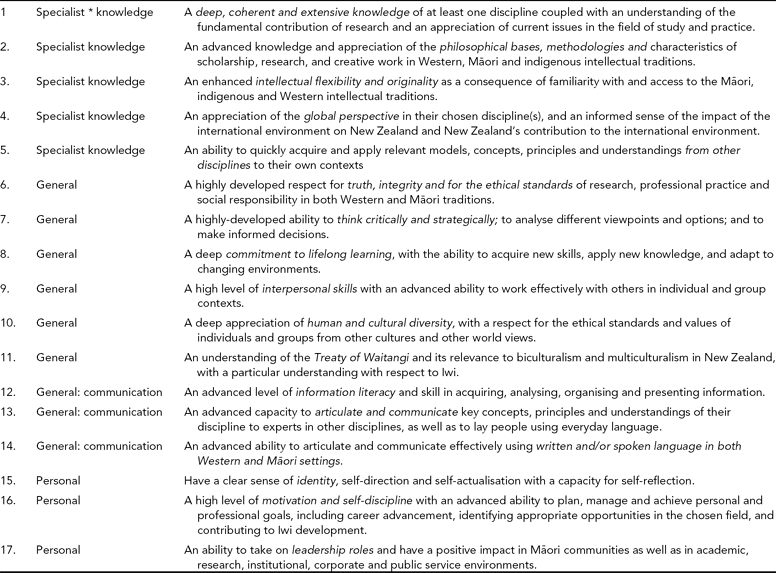
We began developing a curriculum framework by reviewing universities’ lists of the competencies they expected doctoral graduates to have. It was clear that apart from occasional reference to the Treaty of Waitangi, there was a need for a more specific list of fundamental competencies that were applicable to Māori or indigenous doctoral graduates. Therefore we drafted such a list and refined it in the light of feedback from many quarters.
The present list is given in Table 1, which groups the desired attributes according to specialist, general, communication and personal competencies. While there is a natural emphasis on the Māori dimension, it is noted that the principles of such a model may be generalised to other indigenous settings. It is also notable that such a list would have relevance for non-indigenous researchers working in Māori and indigenous fields. The list has also helped us draft a curriculum framework that has five main components. These are: research skills, communication skills, professional development, personal development and institutional knowledge (Williams & Ormond, Reference Williams and Ormond2009).
Attributes of a Māori Doctoral Graduate
Note: *The term ‘specialist knowledge’ relates specifically to the academic and professional disciplines associated with the primary field of study. The term ‘general’ denotes knowledge, skills and attributes that are very much wider in scope.
Each component has a subset of topics that can be developed into course material for a unique program of learning and training for indigenous research capability. We are presently treating the research skills component as a priority and are working on developing course content. We contend that the uniqueness of indigenous ways of teaching, learning, conducting and communicating research can enrich aspects of doctoral education through further curriculum development and we will continue to seek further support from our universities to adopt this unique pursuit of academic excellence.
Summary and Conclusions
A review of the progress of the activities, new initiatives and outcomes of the Capability Building programme of Ngā Pae o te Māramatanga has confirmed that this multi-level and networked program has met success in building research capability. For the future, the aim is to continue strengthening our research culture and capabilities in the following way. A research capability program that embraces the principles of both the academic discipline, with its focus on basic research, and the applied discipline, with its focus on the application of knowledge for the benefit of humankind, will ensure continued success.
Progress will be further supported by distributing the program through all levels of the Ngā Pae o Te Māramatanga research program. This will assist in the facilitation of the creative potential of Māori and indigenous people and will increase the production of new knowledge and uplift Māori participation in research and scholarly excellence. Further development includes the fostering of a distinctive research capability curriculum in tertiary centres of learning and research through MAI Te Kupenga. The outcomes from the research and capability programs will be shared through effective networking, communications and publications. Collaboration with relevant stakeholders will also be sought for the advancement of research capability and capacity.
We recognise the need to increase the supply of future knowledge-makers in the multi-disciplinary arena of indigenous development; and we seek therefore to enhance the development of future scholars through well-defined pathways to research excellence. If we can successfully continue to nurture, foster and support the emergence of the creative and intellectual potential, distinctive human capital will indeed be realised locally, nationally and internationally.
About the Authors
Dr Adreanne Ormond is Maori and her iwi are Rongomaiwahine, Ngati Kahungnu and Tuwharetoa. Her research involves indigenous youth and exploring the experience of indigenous students studying at the tertiary level. With colleagues, she has organised and facilitated national and institutional Maori and Indigenous support programs for postgraduate students, including organising writing retreats and national conferences for over a decade. She is currently a Senior Lecturer at Victoria University Faculty of Education in the School of Maori Education.
Emeritus Professor Les Williams (Rongowhakaata, Ngāti Maru) grew up in Gisborne, New Zealand. He completed a PhD in educational and experimental psychology at the University of California, Berkeley (1970) then became the first Māori to hold a full-time lectureship at the University of Otago. In 1985, he was awarded a personal professorship and later became Dean of the School of Physical Education. His research focused on human learning and action systems and he has published widely. He has held several international fellowships and been engaged in research, teaching and administrative activities in Europe, Australia, Canada, the United Kingdom, and the United States. In 2001, he moved to Auckland and worked with Māori scholars and students and led the Capability Building program of Ngā Pae o te Māramatanga. He is now works as a research consultant.