1 Introduction
It is claimed in van Kemenade (Reference Kemenade, Pintzuk, Tsoulas and Warner2000) that clause-initial negatives are a context for subject–verb inversion throughout the history of English. It is certainly easy to find examples of such inversion. (1) and (2) illustrate the two types that existed in early English. The first type involves a marker of clausal negation in initial position, as in the Early Middle English example (1). The second type involves other negative words, such as the conjunction nor in the Early Modern English example (2).
(1)

(2) Nor did he use those obligations ill, that love had done him
(seventeenth century; BEHN-E3-H,156.13)

The patterns in (1) and (2) each have distinct histories. Ingham (Reference Ingham2005) discusses the history of the pattern in (1). This article discusses the emergence of the pattern in (2). Corpus data show that the pattern in (2) arises during the Middle English period (1150–1500). Unlike other accounts (Nevalainen Reference Nevalainen1997; Ingham Reference Ingham2007), I will propose an analysis that extends to negative inversion in both Middle English (1150–1500) and Early Modern English (1500–1700). Under the analysis to be proposed, changes to negative inversion follow from more general changes to the scope properties of negative items. Specifically, I propose to account for changes in negative inversion using the Minimalist distinction between LF-interpretable and LF-uninterpretable features of lexical items. As I will show, this account unifies changes to negative inversion with the account of Jespersen's Cycle proposed by Wallage (Reference Wallage2008).
The data for this article come from a series of diachronic corpora. For the Early Modern English data I have used the Penn–Helsinki Parsed Corpus of Early Modern English (Kroch, Santorini & Delfs Reference Kroch, Santorini and Delfs2004) and the Parsed Corpus of Early English Correspondence (Taylor et al. Reference Taylor, Nurmi, Warner, Pintzuk and Nevalainen2006). The Middle English data come from the prose texts in the Penn–Helsinki Parsed Corpus of Middle English (2nd edition) (Kroch & Taylor Reference Kroch and Taylor2000). The Old English data are taken from the York Corpus of Old English Prose (Taylor et al. Reference Taylor, Warner, Pintzuk and Beths2002). These corpora are all tagged for parts of speech and syntactically parsed at the clause level, allowing syntactic constructions to be searched for electronically using CorpusSearch (Randall Reference Randall2000). All examples cited and quantitative data given come from exhaustive searches of the prose texts in these corpora.
In section 2, I present corpus data showing the emergence of new patterns of negative inversion in Middle English (1150–1500) and Early Modern English (1500–1700). Section 3 turns to syntactic accounts of negative inversion in earlier English (Nevalainen Reference Nevalainen1997; Ingham Reference Ingham2007) and Present-day English (Haegeman Reference Haegeman, Horn and Kato2001). Nevalainen (Reference Nevalainen1997) and Ingham (Reference Ingham2007) link the rise of new patterns of negative inversion in earlier English to the loss of negative concord. However, in section 4, I present corpus data showing that the new patterns of negative inversion do not correlate with the loss of negative concord. Instead, I propose that they result from changes in the way sentential scope for negation is marked in negative concord constructions. Sections 5 and 6 formalise this idea using the distinction between LF-interpretable and LF-uninterpretable features available in Minimalist frameworks such as Chomsky (Reference Chomsky, Martin, Michaels and Urigereka2000). Section 7 discusses some implications of this proposal for the syntax of negative concord and the syntax of negative markers.
2 Negative inversion in early English
2.1 Distinguishing negative inversion from other types of inversion in the history of English
Since Old and Middle English had various types of inversion, it is necessary to focus the analysis on those cases in which the inversion is triggered not just by the presence of a clause-initial element, but by the presence of an initial negative element. The two distinct types of inversion that existed in Old and Middle English are: (i) inversion of a finite verb with a full nominal subject, as in (3); (ii) inversion of the finite verb with a pronominal subject, as in (4). The subjects are in bold in (3) and (4).
(3)
(4)
To explain the difference, Haeberli (Reference Haeberli and Lightfoot2002a, Reference Haeberli, Zwart and Abrahamb) argues that subject pronouns and full nominal subjects occupy different positions in the clause: subject pronouns appear in spec,AgrP, while full nominals appear in a lower position, i.e. spec,TP. (5) shows the structure of the negative inversion example (4), with ic ‘I’ in spec,AgrP.
(5)
Negative inversion, as in (4), inverts a finite verb and a subject pronoun. Haeberli (Reference Haeberli and Lightfoot2002a) and Pintzuk (Reference Pintzuk1999) analyse cases like this as having the finite verb in C0, where it precedes the subject pronoun, as shown in (5). In contrast, verb movement in affirmative main clauses, like (3), is typically to Agr0. Such V-to-Agr movement does not invert a finite verb and pronominal subject, but it does invert a finite verb and a full nominal subject in spec, TP. Footnote 3 Therefore, in Old English and also in much of Middle English, we can only distinguish negative inversion (V-to-C movement) from V-to-Agr movement in clauses with pronominal subjects. Hence this article examines only clauses with pronominal subjects.
2.2 Two patterns of negative inversion in early English
It has been claimed that there have been two broad changes to inversion during the history of English: the loss of inversion with ne in the thirteenth century (Ingham Reference Ingham2005) and the emergence of inversion with other negatives, which Nevalainen (Reference Nevalainen1997) dates to the sixteenth century.
The first pattern, found in Old English and Middle English, involves the negative marker ne in clause-initial position, as in (4) and (6).
(6)
Until the twelfth century, ne is the typical marker of sentential scope negation and often negates a clause on its own. Structurally, we can analyse ne as a head affixed or cliticised to the finite verb. It virtually always appears immediately preceding the finite verb, irrespective of the latter's position within the clause. When ne appears in clause-initial position, the finite verb prefixed by ne moves to C0 because of its negative force.
During the thirteenth century, not becomes grammaticalised as a negative marker, before ne is lost in the fourteenth and fifteenth centuries. Ingham (Reference Ingham2005) links the loss of the inversion pattern in (4) and (6) to the grammaticalisation of not as a sentential negative marker in the thirteenth century. This fits with an analysis which links negative inversion to negative force. Ingham proposes that until the thirteenth century, ne is sufficient to mark negative force on its own. During the thirteenth century, not is grammaticalised as a negative force marker. He argues that this causes ne to lose its negative force, so it can no longer move to C0. In what follows, I adopt this analysis for the loss of (4)/(6).
The second pattern of negative inversion follows other clause-initial negative items, such as negative adverbs in (7a), negative NPs in (7b) and negative conjunctions in (7c).
(7)
This is the antecedent of the Present-day English pattern. Nevalainen (Reference Nevalainen1997) and Ingham (Reference Ingham2007) date its emergence to the sixtenth century. However, data from the PPCME2 provide evidence of this pattern as early as the thirteenth century. An example is given in (8). This pattern is discussed in detail in section 3.
(8)
2.3 The diachrony of negative inversion in early English
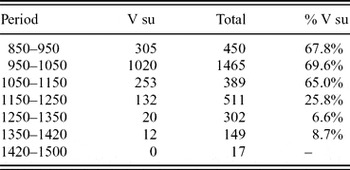
In order to obtain full data on the frequency of the various types of negative inversion in main clauses from the twelfth to the seventeenth century, I carried out an exhaustive search of the corpora described in section 1. Table 1 examines the position of the negative marker ne in relation to the subject in main clauses with pronominal subjects. When ne precedes the subject pronoun, as in (9), the finite verb to which ne is procliticised always moves to a position preceding the subject pronoun, C0, resulting in subject–verb inversion.
(9)
The table confirms Ingham's (Reference Ingham2005) finding that the frequency of subject–verb inversion involving the negative marker ne declines steeply during the twelfth and thirteenth centuries. After the twelfth century, ne is most often found in a position following the subject, indicating that the position of ne plus finite verb is lower, Agr0 in terms of Haeberli (Reference Haeberli and Lightfoot2002a, Reference Haeberli, Zwart and Abrahamb).
The frequency of the negative marker ne preceding a subject pronounFootnote 4

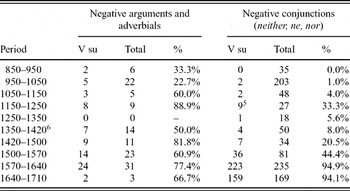
However, ne is not the only negative which may appear with subject–verb inversion in early English. Table 2 gives the frequency of inversion of a finite verb and a subject pronoun in two more environments: following a clause-initial negative argument or adverbial, as shown in (10); and following a clause-initial negative conjunction, as in (11).
(10)
(11) nor are they of any religion at all
(seventeenth century; VERTE-E2-P2,47.191)
The frequency of inversion following different clause-initial negative items (excluding clear cases of constituent negation)

Table 2 shows that inversion following negative arguments and negative adverbials appears considerably earlier than the sixteenth century, which is the period to which Nevalainen (Reference Nevalainen1997) dated their emergence. There are some examples in Old English and their number increases during Middle English. Despite a certain amount of variation in their frequency in different texts and at different periods, negative inversion following negative arguments and negative adverbials seems to become established during the twelfth and thirteenth centuries. However, inversion following the negative conjunctions ne and nor does not become the norm until the late sixteenth or even seventeenth century. It is possible that a predominance of clauses with negative conjunctions in the Early Modern English data used by Nevalainen (Reference Nevalainen1997) led her to propose that negative inversion of the Present-day English type emerges in the sixteenth and seventeenth centuries. Table 2 shows that the development of negative inversion involves a process of diffusion. It is established much earlier with negative arguments and negative adverbials than with negative conjunctions. Thus, the frequency of inversion at any particular date is determined by the category of the clause-initial negative item.
3 The relationship between negative inversion and negative concord
3.1 Nevalainen (Reference Nevalainen1997)
Nevalainen (Reference Nevalainen1997) observes that the rise of negative inversion, as in (12a), is at odds with a more general decline in inversion following clause-initial adverbs such as yet in affirmative declarative clauses, as in (12b).
- (12)
(a) Nor never longed I since I came hether to set my fote in mine owne howse.
‘Nor never longed I since I came here to set my foot in my own house’
(CEEC, THOMAS MORE 543, Nevalainen (Reference Nevalainen1997, 206, ex.11))
(b) yet will I forbear till it shall please god in mearcy to scease it
‘yet will I forbear till it shall please God in his mercy to make it cease’
(CEEC, KATHERINE PASTON 84, Nevalainen (Reference Nevalainen1997, 206, ex. 6))
Nevalainen (Reference Nevalainen1997: 212) claims that the establishment of the pattern in (12a) is a consequence of the loss of negative concord. Until the sixteenth century, English is a negative concord language: a clause has a sentential negative reading irrespective of how many negative words it contains, as shown in example (13).
(13)
(13) contains two negative words: not and no, but until the sixteenth century such a clause would have negative force as a whole. In contrast, a Present-day standard English interpretation of the clause would be that we will make a sale in Christmas week (‘it is not possible that we will not’), where the force of each negative word cancels out the other to give an affirmative reading. According to Nevalainen (Reference Nevalainen, Fisiak and Krygier1996), the loss of negative concord largely took place in the sixteenth century. Nevalainen (Reference Nevalainen1997: 212) capitalises on this fact by proposing that negative concord and negative inversion are mutually exclusive ways to mark sentential scope for negation in the sixteenth-century data. This would mean that the loss of negative concord allowed negative inversion to establish itself.
3.2 Ingham (Reference Ingham2007)
Ingham (Reference Ingham2007: 380) makes a similar observation, that negative inversion and negative concord are incompatible. He accounts for this incompatibility by adopting Zeijlstra's (Reference Zeijlstra2004) idea that negative concord requires the functional projection NegP. Specifically, Ingham (Reference Ingham2007) proposes that negative concord between not in spec,NegP and a negative item within VP blocks movement of the negative item to spec,CP across spec,NegP not. In earlier periods, we find negative concord between a negative item and the negative head ne, as in (14).
(14)
In such clauses Ingham (Reference Ingham2007: 380) claims that spec,NegP is occupied by a null negative operator which licenses ne in Neg0 and marks sentential scope for negation. Just as in clauses with the negative operator not, the null negative operator in spec,NegP blocks the movement of a negative item to spec,CP, as shown in (15).
(15)
Ingham (Reference Ingham2007) therefore predicts that negative inversion will be absent from all stages of English which have negative concord. However, this prediction is not correct: data from Middle English show that negative inversion and negative concord are not always in complementary distribution.
3.3 Negative inversion and negative concord in corpus data
Both Nevalainen (Reference Nevalainen1997) and Ingham (Reference Ingham2007) propose that the loss of negative concord is a prerequisite for the establishment of negative inversion. However, negative inversion following negative arguments and negative adverbials becomes established during the twelfth and thirteenth centuries while negative concord is still productive and frequent. Figures for the period 1250–1350 show that in 90 per cent (n = 127/141) of clauses involving a negative argument in this period, the negative argument is in negative concord with ne. One example from among many is given in (16).
(16)
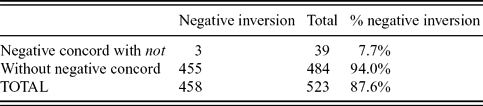
More careful analysis shows that there are two different kinds of negative concord in English. One of these co-occurs with negative inversion from the thirteenth century onwards, but the other does not. First, I present data from the Early Modern English period. Table 3 takes all main clauses with initial negative constituents (conjunctions, arguments and adverbials). It compares the frequency of negative inversion in clauses which have negative concord involving not, such as (17), against clauses without negative concord, like (18).
- (17)
(a) No more we shan't indeed
‘No more shall we indeed’
(seventeenth century; VANBR-E3-H,62.623)
(b) Nor it were not best for themselves
‘Nor were it best for themselves’
(sixteenth century; LATIMER-E1-H,37L.340)
(18) nor can I by any means say against it
‘nor can I by any means speak against it’
(seventeenth century; BOETHPR-E3-H, 135.108)
Frequency of inversion and negative concord in clauses with an initial negative element in Early Modern English (1500–1710)Footnote 7
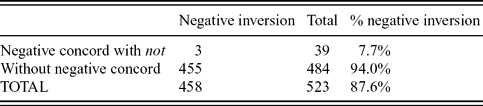
These data show a clear opposition between negative inversion and negative concord: they co-occur in only three instances, one of which is given in (19), accounting for 7.7 per cent of all clauses with negative concord.
(19) no more would not I if I was your wife
‘no more would I if I was your wife’
(seventeenth century; PENNY-E3-H,267.501)
Thus, where the clause-initial negative enters into negative concord with not, inversion typically does not occur, as shown in (17). In clauses without negative concord, on the other hand, inversion is frequent, as in (18).
While we find that negative concord is largely incompatible with negative inversion in Early Modern English, the same is not true in Middle English clauses with initial negative arguments or adverbials. In this period, inversion following these negatives typically occurs whether or not the clause also exhibits negative concord, as shown in (20), without negative concord, and (21), with negative concord.
(20)
(21)
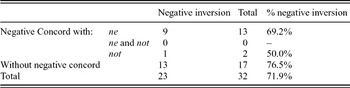
In this period, there is a high frequency of inversion following a clause-initial negative argument such as nothing or a negative adverbial such as never, irrespective of the presence or absence of negative concord with a negative marker like ne or not. Full figures are given in table 4.
Inversion following a clause-initial negative argument or adverbial in the prose texts in the PPCME2 corpus (Middle English, 1150–1500)

In Middle English, negative concord typically involves the negative marker ne. Table 5 shows that in all but one of the Middle English main clauses in which inversion and negative concord co-occur, the negative concord is between a clause-initial negative item and the word ne, as illustrated by all three examples in (21). The only example in which negative inversion co-occurs with not is given in (22).
(22)
Negative inversion with different types of negative concord in Middle English (1150–1500)

In Old English, whenever we have a clause-initial negative argument or adverbial, it always appears in multiple negation with ne. However, Old English ne and Middle English ne differ with respect to inversion. While negative inversion may follow initial negative items which are in concord with Old English ne, as in (23), it is only found in 30.3 per cent (n = 10/33) of all cases. Hence non-inversion, as in (24), is more typical.
(23)
(24)
This section has shown that there are two types of negative concord in early English. When negative concord involves the Middle English and Early Modern English negative marker not, there is typically no inversion following a clause-initial negative. The Old English negative marker ne behaves in a way similar to not with respect to negative inversion. However, when negative concord involves the negative marker ne in Middle English, a clause-initial negative typically triggers subject–verb inversion. In section 5, I will argue that these differences correspond to changes in the scope properties of negative items at successive stages of Jespersen's Cycle. But before turning to this, it is first necessary to present some of the formal devices that have been argued to play a role in negative inversion in general.
4 Negative inversion and scope
A very influential analysis of negative inversion in Present-day English was proposed in Haegeman (Reference Haegeman1995). She presents a formal analysis of inversion facts and, importantly, also points out that initial negatives do not always trigger inversion. She links this to differences in the scope of the initial negative item. After discussing some of the details of her analysis, I will argue that the presence or absence of negative inversion in earlier English provides a useful clue to the nature of negative elements in the relevant periods.
4.1 Negative inversion and scope in Present-day English
A central component of Haegeman's (Reference Haegeman1995) analysis is the Neg-criterion, given in (25). Basically, it states that a negative operator in a specifier position requires a negative element in the associated head position and vice versa.
(25) The Neg-criterion (Haegeman Reference Haegeman1995: 106)
(a) A NEG-operator must be in a Spec-Head configuration with an X-[NEG].
(b) An X-[NEG] must be in a Spec-Head configuration with a NEG-operator.
As negative operators, negatives in spec,CP are subject to the Neg-criterion. This means that an X-[NEG] must appear in C0. According to Haegeman (Reference Haegeman1995: 180–1), this is the reason why the verb has to move to C0 when there is a clause-initial negative operator. However, it is clear that in Present-day English not all clause-initial negative constituents trigger inversion. Haegeman (Reference Haegeman1995, Reference Haegeman, Horn and Kato2001) links the ability of initial negatives to trigger subject–verb inversion to their scope. Negatives whose negation takes sentential scope trigger subject–verb inversion, as in (26a), but those whose negation takes constituent scope, as in (26b), do not.
- (26)
(a) With no job would Mary be happy
( = Mary wouldn't be happy with any job)
(Haegeman Reference Haegeman, Horn and Kato2001: 21, ex. 1a)
(b) With no job, Mary would be happy
( = Mary would be happy without a job)
(Haegeman Reference Haegeman, Horn and Kato2001: 21, ex. 1b)
Haegeman (Reference Haegeman, Horn and Kato2001: 31–2) shows that the examples in (26) contrast in other ways which indicate differences in the scope of their negation (sentential scope in (26a), constituent scope in (26b)). Thus, sentential negative clauses take positive tags, while clauses with constituent negation take negative tags, as (27) shows. Furthermore, sentential scope negation licenses the polarity items ever, any, but constituent scope negation does not, as shown in (28).
- (27)
(a) Mary would be happy with no job, would she?
(b) With no job, Mary would be happy, wouldn't she?
- (28)
(a) With no job would she ever be happy
(Haegeman Reference Haegeman, Horn and Kato2001: 32, ex. 35b)
(b) *With no job, she would ever be happy
(Haegeman Reference Haegeman, Horn and Kato2001: 32, ex. 35b)
Haegeman (Reference Haegeman, Horn and Kato2001: 21) proposes that clause-initial sentential scope negatives are focus-operators while clause-initial constituent scope negatives are topics. She adopts a split CP structure: topicalisation is movement to spec,TopicP and focalisation movement to spec,FocusP. The clause-initial negative is subject to the Focus-criterion when it is a focus operator, but not when it is a topic. Haegeman claims that the finite verb is an X-[focus], and therefore the focus criterion, (29), results in subject–verb inversion since the finite verb moves to the head of FocusP, a position higher than the subject, which occupies spec,TP. In contrast, topicalisation does not trigger movement of T0 to Topic0.
(29) The focus-criterion (Haegeman Reference Haegeman, Horn and Kato2001: 23)
(a) A FOCUS-operator must be in a spec-head configuration with an X-[FOCUS]
(b) An X-[FOCUS] must be in a spec-head configuration with a focus operator.
Clearly, we need to maintain a distinction between the behaviour of negatives with and without sentential scope. However, it is difficult to express this in terms of topic/focus, since clause-initial negatives behave differently from other clause-initial focalised constituents. In English, a clause-initial negative is followed by subject–verb inversion, as in (26a), but other clause-initial focalised constituents like Your book in (30a) are not. The focalised constituent Your book in (30a) is only distinguished from the topic Your book in (30b) by intonation, not the position of the verb.Footnote 8
- (30)
(a) YOUR BOOKi you should give ti to Paul, (not mine)
(Haegeman Reference Haegeman, Horn and Kato2001: 33, ex. 41a)
(b) Your booki, you should give ti to Paul, (not to Bill)
(Haegeman Reference Haegeman, Horn and Kato2001: 33, ex. 41b)
In addition, Ingham (Reference Ingham2007) points out that the movement of sentential scope negative phrases to spec,CP is not likely to involve focalisation since contrastive focus in English ‘falls towards the end of the clause’ (Ingham Reference Ingham2007: 380). Hence, he concludes that clause-initial negatives are not focus operators in English. Instead, he proposes that clause-initial sentential scope negatives move to spec,CP to check a force feature on C0. This force feature is optionally available to mark strongly emphatic negative force.
4.2 Negative inversion and the scope properties of negative markers in earlier English
If Haegeman (Reference Haegeman, Horn and Kato2001) is right in proposing that negative inversion only follows an initial negative item when it marks sentential scope negation, then negative inversion can be used as a diagnostic for the nature of negative elements. In particular, an inversion-inducing initial negative has sentential scope, hence any further negative elements in the clause are concordant negatives rather than negative scope-markers themselves. For Middle English and Early Modern English, this means that the occurrence of negative inversion can tell us something about the words ne and not. For example, since (31) has negative inversion, the clause-initial negative constituent naure ‘never’ must mark sentential scope for negation. The fact that ne appears in negative concord with it indicates that ne lacks negative force of its own.
(31)
In (32), on the other hand, the clause-initial negative item does not mark sentential scope negation, hence the lack of negative inversion following it. Instead, it is the negative marker not that endows the clause with negative force.
(32) nor I do not care
‘nor do I care’
(seventeenth century; LISLE-E3-H,IV,123C1.502)
In this way, the presence or absence of negative inversion can be used to argue that ne and not do not have the same status in Middle English. There is in fact other evidence to distinguish ne and not in Middle English in terms of negative force. This can be found in the Middle English change in sentential negation known as Jespersen's Cycle (Jespersen Reference Jespersen1917), in which the negator ne comes to be supplemented by not in early Middle English, as in (33), before ne is lost. Wallage (Reference Wallage2008) interprets the existence of sentences like (33) as evidence that ne often lacks negative force from the twelfth century onwards. Thus, Middle English ne is no longer sufficient to mark negative force at LF on its own, hence its co-occurrence with not.
(33)
Sections 5 and 6 account for the changes to negative inversion described in section 3 using the same mechanism of morphosyntactic feature change that Wallage (Reference Wallage2008) proposed to account for Jespersen's Cycle. Section 5 outlines the syntactic assumptions. Section 6 describes the hypothesis and its application to the early English negative inversion data.
5 Preliminaries to a syntactic hypothesis
5.1 Syntactic assumptions
I will argue that changes in negative inversion arise from differences in the scope properties of negative items in negative concord with ne and not. The changes will be formalised within a Minimalist syntactic framework. In this framework (Chomsky Reference Chomsky1999, Reference Chomsky, Martin, Michaels and Urigereka2000), lexical items are specified in the lexicon with morphosyntactic features, which drive syntactic operations. Features are either semantically interpretable [iF] or semantically uninterpretable [uF]. Interpretable features are semantically interpreted at LF and contribute meaning to the clause. Thus, at LF, an interpretable [iNeg] feature will mark the scope of negation.
Uninterpretable features [uF] have a purely formal role in triggering syntactic operations. They must be checked by External or Internal Merge, or by Agree and then must be deleted prior to LF. External merge takes a lexical item from the lexicon and adds it to the derivation. Internal merge and Agree establish relationships between a head with [uF] and an element already in the syntactic derivation with a matching [iF]. A feature [uF] on the head will be checked by a matching feature that it c-commands. Applying this to negation, a [uNeg] feature will probe for an [iNeg] feature within the already constructed derivation. In the case of internal merge, the item bearing the [iNeg] feature will move to become the specifier of the head which bears the [uNeg] feature. If C0 has an uninterpretable negative feature [uNeg] checked by internal merge, an item with an interpretable [iNeg] feature will move to spec,CP. In the case of Agree, the [uNeg] feature of the head will be checked without any movement.
5.2 Deriving negative concord and negative inversion
Zeijlstra (Reference Zeijlstra2004) and Wallage (Reference Wallage2005) derive negative concord using the mechanism of Multiple Agree proposed by Hiraiwa (Reference Hiraiwa2001). The uninterpretable formal features on negative items are valued by multiple agreement during the syntactic derivation by a negative marker which has a semantically interpretable negative feature. When a uninterpretable [uNeg] feature on a functional head such as Neg0 or C0 is checked against a semantically interpretable [iNeg], Multiple Agree will simultaneously check and delete all the matching uninterpretable [uNeg] features c-commanded by that head within the clause. An example can be seen in (35), which is part of the derivation for the sentence in (34). [uNeg] on the negative head Neg0 is the probe. Merge of not [iNeg] in spec,NegP checks and deletes all the [uNeg] features in the clause, on both Neg0 and on the DP no sayle. In (35) and all the derivations that follow, deleted features are distinguished by the use of strike-through.
(34)
(35)
In general terms, Zeijstra (Reference Zeijlstra2004: 243ff.) argues negative concord languages must have an uninterpetable [uNeg] feature on a functional head in order to establish Multiple Agreement. He proposes this head is Neg0. By extension, he argues that the presence of Neg0 distinguishes languages which allow negative concord from those which do not. I adopt this analysis here.
Turning now to the derivation of examples with negative inversion, (36) shows an example derivation of the Present-day English sentence given earlier as (26a). With no job starts out as a VP-adjoined adverbial and moves to spec,CP to check the [uNeg] feature on C0.
(36)
In a feature-driven syntax, we are required to say that overt movement of a negative phrase to spec,CP is triggered by the presence of the feature [uNeg] in C0. When there is a negative operator in spec,CP, there must be a finite verb in C0. Hence overt T-to-C movement takes place. In (36), I postulate the presence of a [uT] feature on C0 that will trigger this T-to-C movement.Footnote 9
6 Syntactic hypothesis: the relationship between inversion, negative concord and sentential negation
Adopting the analysis sketched above, I now turn to the relation between negative inversion and the morphosyntactic feature specification of negative items in the history of English. I propose that negative items undergo change in their specification during Middle English. This affects both their ability to co-occur with negative inversion and their ability to appear in negative concord with different negative markers. The difference between historical stages of English with and without negative inversion reduces to the semantic interface interpretability of the negative features on the clause-initial negative items. Only negative items with a semantically interpretable [iNeg] feature count as negative operators, so only these spec,CP negative operators require a finite verb to move to C0. Negative items with uninterpretable [uNeg] features I analyse as topics in spec,CP. This follows Haegeman's (Reference Haegeman, Horn and Kato2001: 34) analysis of non-inversion following clause-initial negatives in Present-day English. Negatives which have [uNeg] features can move to spec,CP but cannot check a [uNeg] feature on C0 because they lack inherent negative force.
Clause-initial concordant negatives may appear with another negative item which is itself the semantically interpretable marker of sentential scope negation within the clause. In these cases, the clause-initial negative item lacks negative force, and has an uninterpretable [uNeg] feature. As a consequence, such concordant negative items are not negative operators and will not trigger negative inversion. This analysis predicts different frequencies of negative inversion in clauses with and without negative concord. The frequency of negative inversion should be lower in negative clauses which have negative concord than it is elsewhere, since it is possible that the clause-initial negative item in negative concord constructions is not a marker of sentential scope negation. In the next subsection, I propose to refine this analysis by distinguishing two types of negative concord, one involving Middle English ne which co-occurs with negative inversion, the other involving Middle English and Early Modern English not which does not.
6.1 The relationship between negative inversion and changes in marking sentential scope negation
Wallage (Reference Wallage2008) argues for a change in the morphosyntactic features associated with negative markers in the Middle English period. Negative marking undergoes a three-stage development in Middle English, an example of Jespersen's Cycle. Wallage (Reference Wallage2008) characterises the syntax of the stages of Jespersen's Cycle as follows:
Stage 1: sentential negation is morphologically marked by a prefix ne on the finite verb, as in (37). The word ne is associated with a semantically interpretable negative feature [iNeg]
(37)
Stage 2: sentential negation is morphologically marked by two elements: a syntactic head ne with a semantically uninterpretable feature [uNeg], and a phrasal (specifier) element not which has a semantically interpretable feature [iNeg]. This feature checks the [uNeg] feature of the negative head. An example is given in (38).
(38)
Stage 3: sentential negation is morphologically marked on the phrasal element not, which has a semantically interpretable [iNeg], as in example (39).
(39) I know nat the cause
‘I do not know the cause’
(fifteenth century; MALORY,627.3549)
The element which marks the scope of negation at LF changes in the transition from stage 1 to stage 2. At stage 1, ne has the [iNeg] feature necessary to mark sentential scope. At stage 2 it does not, but has a [uNeg] feature. At stages 2 and 3, not has an [iNeg] feature and is the marker of sentential scope negation at LF.
For negative inversion to occur, sentential scope must be marked on the clause-initial negative item, i.e. the clause-initial negative item must have an [iNeg] feature. Since a negative clause can contain only one [iNeg] feature, Old English ne at stage 1 and Middle English not at stages 2 and 3, which both have an [iNeg] feature, cannot appear in clauses with negative inversion unless the negative marker is itself in clause-initial position. However, at stage 2 of Jespersen's Cycle, it is possible for ne to appear in clauses where negative inversion follows some other clause-initial negative item because stage 2 ne has an uninterpretable [uNeg] feature. Hence examples like (40) are found.
(40)
Next, I show how clauses with initial negative items are syntactically derived at each stage of Jespersen's Cycle, starting with stage 3 and working back through stages 2 and 1.
6.2 Clause-initial negatives in negative concord with Middle English and Early Modern English not
When the negative marker not has an [iNeg] feature, all other negative items in the clause are concordant elements bearing [uNeg] features which agree with not. In such clauses, like (41), any clause-initial negative is in negative concord with not, and not itself a marker of sentential scope negation.
(41)
At the point before C0 is merged, the structure is as in (42). I assume V-to-Agr movement for early English following Haeberli (Reference Haeberli and Lightfoot2002a).Footnote 10 The negative marker not [iNeg] is merged in spec,NegP and checks [uNeg] features on Neg0 and on by no meanes by multiple agreement. After being checked against the [iNeg] feature on not, the [uNeg] features on Neg0 and on by no meanes are deleted.
(42)
(43) shows the complete CP for the sentence in (41). By no meanes has moved to spec,CP, but this movement is independent of the need to check [uNeg] features on the phrase by no meanes or on C0. By no meanes does not have the semantically interpretable [iNeg] feature associated with negative force, so does not check a [uNeg] feature on C0. Since it lacks semantically interpretable negative features, by no meanes also does not trigger negative inversion under the Neg-criterion. By no meanes may be a topic or focus in spec,CP.
(43)
6.3 Clause-initial negatives in negative concord with Middle English ne
At stage 2 of Jespersen's Cycle, the negative marker ne has a semantically uninterpretable [uNeg] feature, so it can co-occur with a clause-initial negative which has an [iNeg] feature. As a result, ne at stage 2 is compatible with negative inversion. The derivation for an example like (21b), repeated here as (44), is shown in three stages, (45)–(47).
(44)
(45) shows the first stage in the derivation of (44). Ne is a clitic prefixed to the finite verb in V. The [uNeg] feature on the negative head Neg0 probes for a matching interpretable feature and is checked by agreement with the [iNeg] on nouther hwit ne blac. Under Multiple Agree, this operation also checks the [uNeg] feature on the finite verb ne nemmet.
(45)
At the point before C0 is merged, the structure looks like (46), with the subject in spec,AgrP and movement of the finite verb to Agr0.
(46)
The complete CP is given in (47). C0 has a [uNeg] feature checked by agreement with the [iNeg] feature on the NP nouther hwit ne blac, which moves to spec,CP. Since nouther hwit ne blac has an [iNeg] feature, it is a negative operator. Where there is an operator in spec,CP the finite verb moves to C0. So I postulate that when C0 has a [uNeg] feature, it also has a [uT] feature which ensures overt movement takes place. Alternatively, we could adopt a modified Neg-criterion analysis in which only negative items with [iNeg] features count as negative operators, but see note 9 for some problems with this approach.
(47)
6.4 Clause-initial negatives in negative concord with Old English ne
At stage 1 of Jespersen's Cycle, i.e. Old English, ne has an interpretable [iNeg] feature, and so marks sentential scope negation. Any negative items which co-occur with it will be concordant items, without negative force. Hence at stage 1, there will be no negative inversion when the clause-initial negative is in negative concord with ne. (24a) gives an example of this type, repeated here as (48).
(48)
(49) shows the structure at the point where the negative head Neg0 is merged. Negative ne is prefixed on the finite verb in V0 and has an interpretable [iNeg] feature. Nan þing, the noun phrase in object position, has a [uNeg] feature. The [uNeg] feature on Neg0 agrees with all matching features within the derivation under Multiple Agree. As a result, the [uNeg] features on Neg0 and on nan þing are checked by multiple agreement with the [iNeg] feature on the verb ne answarode. This means that the [uNeg] feature on nan þing is deleted at this point in the derivation.
(49)
The complete CP looks like (50) when spelled out. Since nan þing does not have an [iNeg] feature, it cannot check [uNeg] features on C0. Instead, its movement to spec,CP is independent of any need to check neg-features.
(50)
6.5 Summary
The co-occurrence of negative inversion and negative concord is a consequence of the morphosyntactic features of the negative marker in the negative concord construction. Variation in negative inversion can be explained using the same syntactic mechanism that Wallage (Reference Wallage2008) argues operates within Jespersen's Cycle. Change in the interpretability of the negative feature on ne is implicated in the grammaticalisation of not, and in the development of negative arguments and adverbials as negative operators with the feature [iNeg], which leads to new patterns of negative inversion. For negative inversion to take place, the clause-initial negative item must have an [iNeg] feature. Only one [iNeg] feature is allowed per negative clause, so clause-initial negatives with [iNeg] are incompatible with negative markers which also have [iNeg] features, i.e. incompatible with ne at stage 1of Jespersen's Cycle and not at stages 2 and 3. At stage 2 of Jespersen's Cycle, however, ne has a [uNeg] feature so is compatible with negative inversion.
7 Implications
7.1 The semantic representation of negative concord
The account sketched above has implications for the question of how negative concord is to be represented. Zeijlstra (Reference Zeijlstra2004: 243ff.) adopts an operator-variable binding approach to the semantics of negative concord. His account requires that the negative operator [iNeg] c-commands and therefore binds all the concordant [uNeg] items. Zeijlstra (Reference Zeijlstra2004: 243ff.) argues that this binding requirement operates at S-structure. However, this analysis predicts that examples like (41) with Early Modern English not, repeated here as (51), should not occur.
(51) but by no meanes she would not confesse the same
‘but by no means would she confess the same’
(sixteenth century; ORIGIN2,287.030.461, PCEEC)
It is generally accepted that Early Modern English not is fully grammaticalised as a marker of negative force (with an [iNeg] feature), yet the concordant negative by no meanes in (51) precedes not. Also in cases of negative concord involving a negative subject, like (52), the concordant negative subject precedes the negative marker not.
(52) but no Cristen man ys not suffered for to come ny it
‘but no Christian man is permitted to come near it’
(sixteenth century; TORKINGT-E1-H,30.117)
If we are to maintain the distinction between negative concord with ne and negative concord with not proposed on the basis of changes to negative inversion, then an account of negative concord as operator-variable binding at S-structure cannot be maintained. Instead we have to say either that the negative operator not raises to the left-periphery at LF, from where it c-commands all concordant negative items, or that the negative concord relation is based on syntactic licensing via morphosyntactic feature checking rather than a particular configuration at LF.
7.2 The loss of negative concord in the fourteenth and fifteenth centuries
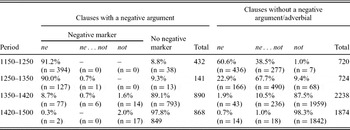
The analysis I propose provides a plausible link between Jespersen's Cycle and the loss of certain kinds of negative concord in the fourteenth and fifteenth centuries. Frisch (Reference Frisch1997: 33) claims that clauses with negative arguments – subjects or objects involving the negative quantifier no or negative pronouns like nothing – or negative adverbials like never, by no means, in no way should be excluded from accounts of the Middle English Jespersen Cycle because the distribution of ne, ne. . .not and not in these clauses differs from their distribution elsewhere. However, the analysis proposed in section 6 points to an explanation for the anomalous behaviour of these cases. Examination of all the negative arguments in the PPCME2 corpus shows that negative arguments usually appear in negative concord with the negative marker ne until the fourteenth century. This is shown by the fact that sentences like (53a) are frequent. However, Jack (Reference Jack1978) finds that the negative markers ne. . .not or not rarely appear in negative concord with a negative argument or a negative adverbial even in the fourteenth and fifteenth centuries, when not is firmly established as the default negative marker elsewhere. This means that the patterns in (53b) and (53c) are rare. Instead, negative arguments tend not to enter into negative concord with either the negative markers ne or not in the fourteenth or fifteenth centuries, but are the only negative word in their clause, as shown in (53d).
(53)
Table 6 presents figures for all clauses that contain a negative argument, distinguished according to whether the clause, in addition, contains the negative marker ne, ne. . .not, not or no negative marker at all. For comparison, it also gives the frequencies of clauses with ne, ne. . .not and not but without negative arguments or negative adverbials – that is, clauses in which the only negative words are either ne, not or both ne and not. In these clauses, ne. . .not or not are the most frequent ways of marking negation even as early as the thirteenth and fourteenth centuries. (54) is an early example.
(54)
The frequency of ne, ne. . .not and not in clauses with and without negative arguments in Middle English (1150–1500)

Table 6 shows that as the frequency of negative concord with ne declines, there is no corresponding increase in the frequency of negative concord with not. Instead, the loss of ne leads to an overall decline in negative concord involving a negative marker (ne, ne. . .not or not). This means that if a clause has a negative argument, it is increasingly often the sole negative item in the clause, as in (53d).
In section 6, I argued that there could be negative inversion in Middle English following a clause-initial negative argument because negative arguments at that point were markers of sentential scope negation, bearing [iNeg] features. I proposed that the incompatibility of not and negative inversion follows because there cannot be two [iNeg] features in a negative clause. Put differently, not is not required to introduce an [iNeg] feature to the clause when [iNeg] has already been introduced by the negative argument. In fact, since a negative clause can contain only one [iNeg] feature, it follows that not is not allowed in these cases. Extending this analysis to negative arguments in non-clause-initial positions derives the more general incompatibility between not and negative arguments seen in table 6. In contrast, ne is able to appear in negative concord with negative arguments in Middle English because it has an uninterpretable [uNeg] feature.
There is one further infrequent pattern to note. Negative arguments and adverbials sometimes enter into negative concord with each other in clauses without the negative markers ne or not (55) (n = 6 in the PPCME2).
(55)
A possible analysis of such clauses is that one negative argument has an [iNeg] feature, and the others have [uNeg] features. The negative argument with the [iNeg] feature licenses the negative arguments which have [uNeg] features by agreement. This would mean that the loss of negative concord from Standard English involves the loss of negative arguments or negative adverbials with [uNeg] features. Once every negative item has an [iNeg] feature, there can only be one negative word in each negative clause.
7.3 Inversion facts as evidence for dating the grammaticalisation of not
The analysis of negative inversion presented here makes predictions about the grammaticalisation of not in Middle English. Once not is grammaticalised as a marker of negative force with an [iNeg] feature, I predict that when it appears in negative concord with a clause-initial negative item there will be no negative inversion. Indeed, in later Middle English and Early Modern English (1350–1700), not rarely appears in clauses with negative inversion. Within this extended period, only 9.7 per cent (n = 3/31) of clauses with negative inversion also have not. One of these three examples is (19), repeated here as (56).
(56) no more would not I if I was your wife
‘no more would I if I were your wife’
(seventeenth century; PENNY-E3-H,267.501)
However, in Early Middle English (1150–1250), 76.5 per cent (n = 13/17) of clauses with negative inversion have not. Two examples can be seen in (57).
(57)
Negative inversion following ne, as in these examples, requires that ne has an [iNeg] feature, so in order to co-occur with initial ne in these clauses, not must have a [uNeg] feature.Footnote 11 These differences between the ability of not to co-occur with inversion at different periods allow us to date the grammaticalisation of not as an LF-interpretable marker of negation with an [iNeg] feature to the thirteenth century. After this date, examples like (57) are no longer found. This corresponds with the date Haeberli & Ingham (Reference Haeberli and Ingham2007) propose on the basis of positional facts.
In clauses which have non-initial ne and not, it is possible to analyse the co-occurrence of ne and not in two ways, with sentential scope negation being marked either by ne, as in (60a), or by not, as in (60b). However, only the first option (60a) is available in clauses which have initial ne and negative inversion, since ne must have an [iNeg] feature in order to move to C0. Hence, once not begins to grammaticalise as a negative marker, its frequency should be lower in clauses with initial ne.
- (60)
(a) ne [iNeg]. . ..not [uNeg] (older pattern, not is in negative concord with ne)
(b) ne [uNeg]. . .not [iNeg] (newer pattern, not is a negative marker; ne is in negative concord with not)
Early Middle English data from the period 1150–1250 bear out this prediction: not is more common in clauses with non-initial ne (91.3 per cent, n = 21/23) than in clauses with initial ne (76.5 per cent, n = 13/17). The almost categorical use of not in clauses where ne appears non-initially indicates its incipient grammaticalisation in these clauses.
8 Conclusion
In this article, I have argued that changing patterns of subject–verb inversion following clause-initial negatives are linked to changes in the scope associated with negative items.Footnote 12 As I have shown, the history of negative inversion, changes to negative concord and the grammaticalisation of new sentential negative markers receive a unified explanation, which follows from changes in the scope properties of negative items during the Middle English period. The availability of negative inversion in negative concord constructions follows a cycle which is linked to changes in the way sentential negation is marked at the various stages of Jespersen's Cycle. The data presented here provide further support for the analysis of Jespersen's Cycle in Wallage (Reference Wallage2008), which distinguished ne [iNeg] at stage 1 of Jespersen's Cycle from ne [uNeg] at stage 2 of Jespersen's Cycle in terms of LF-interpretability of negative features.
The replacement of ne [iNeg] by ne [uNeg] in the twelfth to thirteenth century co-occurs with a reanalysis of clause-initial negative items as negative operators with [iNeg] features of their own. The two structural analyses of clause-initial negative items given in (61) were only distinguished by the non-occurrence of negative inversion in (61a) and its occurrence in (61b).
- (61)
(a) Negative argument [uNeg] . . . ne V [iNeg]
(no negative inversion)
(b) Negative argument [iNeg] . . . ne V [uNeg]
(negative inversion)
Once language learners learned that ne had [uNeg] features, clauses with initial negative items would have the structure (61b) instead of (61a). It is this change that gave rise to new patterns of negative inversion.