Introduction
The ageing of populations in countries of the global North, coupled with economic pressures on pension systems, has led many of these countries to focus on so-called dependency ratios and the presumed economic burden of so many elders, and to re-examine their pension policies (Walker Reference Walker2009; Wilson Reference Wilson2000).
In Europe, ‘active ageing’ is one response (e.g. Moulaert and Léonard Reference Moulaert and Léonard2011; Walker Reference Walker2009), the goal being to counter a demeaning discourse of elders’ dependence by demonstrating their productivity. Policies encourage and enable workers to stay in the labour force longer by providing incentives to continue employment and reducing ageism in the labour market (Walker and Maltby Reference Walker and Maltby2012). Pressuring workers to stay in the labour force longer by changing the age of retirement eligibility is another response; some scholars worry that retirement itself, as an institution, is at risk, especially for those from lower social classes (e.g. Phillipson Reference Phillipson1998). In most of these discussions, whether by scholars or by policy makers, gender differences in paid and unpaid work, and sources and types of dependence, go undiscussed. Concerns about changes in retirement as a life-stage have tended to be gender-neutral, assuming that this time of life is the same for men and women because neither would engage in paid labour. Although some research has found that retirees experience this time of life as a kind of freedom (e.g. Gestin Reference Gestin2003; Repetti Reference Repetti2015a), few have explored whether women and men experience that freedom in the same ways. To the extent that any such variations might be structured by gender inequalities, policies that do not take these into account may reinforce those disparities while simultaneously creating new ones in retirement. How these gender dimensions might be further shaped by class has been even less frequently considered.
In these regards, Switzerland presents an interesting case to study. Following the political path of the European Union, the Helvetic federal authorities are working to reform old-age insurance policies to provide incentives to seniors to remain in the labour market as long as possible (Repetti Reference Repetti2015a). Debates concerning these reforms do not consider unequal divisions of unpaid domestic work performed outside the labour market. They do not attend to the fact that Swiss women maintain primary responsibility for this unpaid work over their lifecourses while men engage in their paid professional activities (Levy, Gauthier and Widmer Reference Levy, Gauthier and Widmer2007), a situation that also serves to limit women's wages. Such inattention results in an unquestioned acceptance of the suggestion to raise women's retirement age from 64 to 65 so as to ensure ‘equality’ between men and women.
The unpaid domestic work that retirees perform also goes unrecognised, which is apparent in proposed reforms that never question their potential effects. For example, there is no discussion of who will do the domestic work that retirees perform if they remain in the labour market. Also given working women's share of responsibility for domestic labour, one might argue that they will be especially disadvantaged as they would be asked to continue two types of labour for longer.
Because they are based on people's relationships to paid work only, such retirement policies ignore differences between men and women in terms of employment, the role of paid work in their lives and their relationships to unpaid labour that may be rooted in systemic inequalities (Calasanti and Slevin Reference Calasanti and Slevin2001). For instance, many scholars cite both the fact that women's employment is often more discontinuous than men's, and that women's paid labour is influenced more by family responsibilities (Barnes and Parry Reference Barnes and Parry2004; Everingham, Warner-Smith and Byles Reference Everingham, Warner-Smith and Byles2007). But few explain these differences in terms of gender relations.
In debates over policies meant to ameliorate the effects of inequality (age, in the case of retirement policy), we argue that scholars must consider the extent that differences observed within retired populations result from intersecting inequities such as gender and class. This is especially important in examining arguments about dependence in later life, and changes in retirement policies that encourage continued labour force participation or other forms of ‘productive’ labour.
In this paper, we explore the gendered experiences of retirement among a small group of presently or previously married Swiss men and women. We find that both men and women see retirement as a time of freedom from work, an observation that dovetails with other studies (e.g. Fontaine and Gendron Reference Fontaine and Gendron2012; Gestin Reference Gestin2003; Repetti Reference Repetti2015a). But we also find that gender and class intersect to shape what this freedom means, across the lifecourse, with implications for active ageing mandates in later life.
Feminist gerontology
We draw on feminist gerontology (Calasanti Reference Calasanti, Bengtson, Silverstein, Putney and Gans2009), a critical approach to gender inequality in later life that explores the ways that gender relations might influence the retirement experiences of both women and men in Switzerland. The concept of gender relations conveys both that gender serves as a dynamic, social organising principle, and that women's and men's identities and power are gained in relation to one another. That is, gender is embedded in social relationships at all levels, from individual interactions and identities to institutional processes. People orient their behaviours to collectively decided ideals of manhood and womanhood, influencing life chances in the process. Societies organise on the basis of gender such that what people take to be masculine and feminine influences and reflects gendered divisions of labour (paid and unpaid, and occupations within each of these); and people evaluate and reward performance of such labour differentially, with women's work generally devalued relative to men's. Thus, the gender identities that emerge in social interaction also serve to privilege men – give them unearned advantages – while they usually disadvantage women, even as people reshape seemingly ‘natural’ gender differences and meanings.
The gendered organisation of societies means that gender relations are embedded in taken-for-granted patterns of behavior that comprise the normal workings of such social institutions as family or paid work. The gendered division of labour, wherein men are seen to be more suited to paid work in the public sphere, and women are fit to provide care within the home without pay, is thus naturalised; it is ‘the way things are supposed to be’. This holds true even if marital partners are both employed; one – the man – is seen to be the primary breadwinner and, thus, the other – the woman – often must sacrifice wage-earning, either by working part-time or not being able to devote as much time to a full-time job. State pensions are then based on men's experiences; they assume careers, and that someone else takes care of reproductive labour, and calculate benefits on that basis. This also assumes a context of heterosexuality; indeed, the naturalised bases of these gender relations often underlies heterosexuals’ concerns about non-heterosexual relationships, as these are seen to be ‘going against nature’. Such is the strength of these heteronormative gender ideals that one need not be married in order to enact them, and to believe them to be natural. Finally, because men's privileges are intimately tied to women's disadvantages, the situation of one group cannot be understood without at least implicit reference to the position of the other.
The impact of gender relations in later life can be seen in relation to this division of paid and unpaid labour. For example, in countries in the global North, and despite some increase in men's participation, women who work for pay still bear more responsibility for reproductive labour, regardless of the number of hours they are employed (e.g. Coltrane and Adams Reference Coltrane and Adams2008); they face a ‘second shift’, an unpaid job, when they finish their paid labour (Hochschild and Machung Reference Hochschild and Machung1989). In Switzerland, national data on housework from 1997 to 2010 show that three-quarters of women in couple households with children still have primary responsibility for housework, despite some movement towards sharing responsibility for some tasks (Federal Statistical Office 2013). Even among dual-earner couples, especially those with children, men's paid labour takes priority over women's, and women, whether employed full-time or part-time, continue to take primary responsibility for housework and child care. Men and women in similar family situations (in terms of marital status and number and ages of children) work comparable hours, more than 60 per week; but men's time is spent more in paid work while women's is spent in unpaid labour (Federal Statistical Office 2013). Men rely upon that reproductive labour, which enables them to pursue their roles as breadwinners with greater ease. This division of labour shapes men's and women's experiences over their lifecourses, and into retirement.
Gender, class and retirement
The taken-for-granted nature of the gender division of labour has long influenced research such that studies of women's retirement remained rare until the 1980s. Scholars and policy makers had assumed that paid labour was not central to their identities. Research that included women often still focused on the male, breadwinner model in analyses (Calasanti Reference Calasanti1996; Everingham, Warner-Smith and Byles Reference Everingham, Warner-Smith and Byles2007). Later research employed separate approaches for men and women, emphasising paid work for the former and family as central to the latter. Rarely have studies examined both work and family realms for both men and women. For instance, research on the extent to which care work influences men's retirement decisions remains rare (Barnes and Parry Reference Barnes and Parry2004). Also, even though some women report that they structure their paid work around their reproductive labour, many still express strong paid work attachment (Everingham, Warner-Smith and Byles Reference Everingham, Warner-Smith and Byles2007; Price Reference Price2002). Thus, what we know about gender differences and the effect of inequality remains limited.
One noteworthy exception is Barnes and Parry's (Reference Barnes and Parry2004) qualitative study of male and female retirees in the United Kingdom (UK). While they do not tie their findings to gender inequality per se, they examine how gender influences the resources available to men and women in retirement, and asked respondents about both work and family realms. For instance, although they find work identities to be central to men more frequently than for women, the situation is complex. Given norms that family is to be of greater importance to women, claiming paid work to be important is easier for men (Barnes and Parry Reference Barnes and Parry2004); it is itself a gendered activity. Thus, they found it equally the case for men and women that strong occupational identities could lead to problems in retirement, especially when labour-force withdrawal was not voluntary (see also Petit Reference Petit2016). There is also some evidence from research in France that men will take on domestic duties when they retire ahead of their wives; however, they see this as temporary. Indeed, some wives will delay retirement in order to keep from having to assume domestic labour (Guichard-Claudic et al. Reference Guichard-Claudic, Le Borgne-Uguen, Pennec and Thomsin2001; Pennec Reference Pennec and Legrand2001).
Gender relations shape the opportunities and constraints that men and women possess over the lifecourse and in later life, as well as the meaning of retirement itself. For instance, as noted above, men's experiences formed the bases for pensions, as these were instituted to reward people's histories of paid labour; their ability to rely upon women's reproductive labour thus benefits them in retirement. Swiss national data reveal a large percentage of women experiencing part-time jobs, intermittent work histories and low earnings, factors that all decrease social insurance amounts (Federal Statistical Office 2013). Thus, despite the recent push for gender equality in Swiss pension laws, gender inequalities in retirement income remain, rooted in the gender division of labour and labour market disparities. Old-age policies reproduce these gender inequalities over the lifecourse such that women face greater financial insecurity and a higher risk of marginalisation in old age than do men (Le Feuvre et al. Reference Le Feuvre, Kuehni, Rosende and Schoeni2014; Pilgram and Seifert Reference Pilgram and Seifert2009; Rosende and Schoeni Reference Rosende and Schoeni2012; Tabin Reference Tabin2011).
Gender relations can structure other aspects of retirement as well. As has been documented in other countries of the global North, where women are often called upon to continue their care work into old age, surveys of Swiss elders find that retired women are more likely to care for their relatives than are their male counterparts (Federal Statistical Office 2014a). While such care work can certainly constrain their experiences, it also points to the ways that the gender division of labour over the lifecourse might provide older women different resources from men. Specifically, women's engagement in domestic labour, including kin keeping, may garner them social supports and networks that older men lack, particularly those men who are no longer married (Calasanti Reference Calasanti, Bengtson, Silverstein, Putney and Gans2009; Davidson, Daly and Arber Reference Davidson, Daly, Arber, Arber, Davidson and Ginn2003). Such networks stand in contrast to men's, which are often companionships formed in a context of shared interests and activities (Barnes and Parry Reference Barnes and Parry2004: 230).
While focused on gender, feminist gerontologists also consider how intersecting inequalities can shape gendered experiences of ageing, including retirement (Calasanti Reference Calasanti, Bengtson, Silverstein, Putney and Gans2009). In this regard, scholars have demonstrated that class location earlier in life has a cumulative impact over the lifecourse, through such avenues as schooling and social opportunities, influencing not only resources but also health in retirement (Dannefer Reference Dannefer2003). Likewise, Swiss policies reproduce childhood social class over the lifecourse; their retirement policies reinforce this connection by basing benefits on earnings and savings (Rainer et al. Reference Rainer, Oris, Studer and Beariswyl2015; Tabin Reference Tabin2011). Such advantages and disadvantages are further shaped by the gender division of labour. For instance, the income inequalities between men and women over their working lives means that women are particularly vulnerable to low income and poverty in retirement (Federal Statistical Office 2014b). The scant research on this suggests that for women who have been working-class members throughout their lives, retirement income loss did not significantly influence their satisfaction. Their income did not lower appreciably; and they had learned previously to engage in cost-free activities (Barnes and Parry Reference Barnes and Parry2004).
In addition to financial capital, social class is associated with social and cultural capital that retirees bring to bear in achieving a ‘productive’ old age (Kojola and Moen Reference Kojola and Moen2016). Those of higher classes enjoy the social relationships, education and experiences that improve participation and status even though they no longer occupy recognised places in the labour market. Those in a higher social class may experience retirement as an opportunity to invest in economic, social and familial activities. For instance, the middle-class men and women in Barnes and Parry's (Reference Barnes and Parry2004) study had friendships in different parts of the UK (in part because of occupational mobility); their class positions allowed them to pay for necessary travel to see them in retirement. By contrast, those who were working class were limited to social networks closer to home, and socialised with friends at pubs or on local outings. Lower-class retirees face greater risk of social exclusion and stigma. Possession of less social, financial and cultural capital, and poorer health, makes it especially difficult for them to pursue active ageing. Retirement in such circumstances might present more constraints than opportunities (Bourdieu Reference Bourdieu2003; Guichard-Claudic et al. Reference Guichard-Claudic, Le Borgne-Uguen, Pennec and Thomsin2001; Repetti Reference Repetti2015a).
Gender inequalities can lead to differences as well; men are more likely to participate in economic and social activities in the public realm that convey higher status and visibility. Looking at studies on Australian and British men, Russell (Reference Russell2007: 182) finds that men prefer activities that followed traditionally masculine pursuits, such as sports, that either reflect the kinds of male camaraderie of previous years, or struck them as task-oriented ‘projects’ with outcomes they could relish as ‘achievements’. Women invest in less-recognised social and familial fields (Guillemard Reference Guillemard2002; Petit Reference Petit2016). Thus, Barnes and Parry (Reference Barnes and Parry2004: 222) found that the class differences in their study were less pronounced for women in that their friendships tended not to be in the public sphere as often as men's, and they argue that, while the financial resources and social capital attendant upon class shape retirement transitions, gender identities also play important roles.
Freedom in retirement
Active ageing policies assume that retirement is a stage in which people enjoy free time, and that they spend it in ways recognised as productive social contributions. Indeed, such assumptions are backed by studies that focus on what retirees are not doing (i.e. working for pay; Sargent et al. Reference Sargent, Lee, Martin and Zikic2012), or their talk about anticipated or newfound freedoms (e.g. Barnes and Parry Reference Barnes and Parry2004; Loretto and Vickerstaff Reference Loretto and Vickerstaff2012; Petit Reference Petit2016; Repetti Reference Repetti2015a), and the ways they deal with the transition (e.g. Fontaine and Gendron Reference Fontaine and Gendron2012). Time becomes a theme, and retirees remark on their desire to control their time (Barnes and Parry Reference Barnes and Parry2004; Everingham, Warner-Smith and Byles Reference Everingham, Warner-Smith and Byles2007).
Although such studies seldom focus on freedom, those that do find gender differences, even if they do not theorise them in terms of inequality. For instance, research on women in Australia finds that some view retirement as a chance to balance their work and family obligations (Everingham, Warner-Smith and Byles Reference Everingham, Warner-Smith and Byles2007). Likewise, studies in the UK and the United States of America (USA) find that men are relatively more likely to view retirement as an earned right, with permission to pursue hobbies and leisure activities, whereas women focus on domestic labour and their relief at no longer having to juggle the competing obligations of paid and unpaid work (Calasanti Reference Calasanti1993; Loretto and Vickerstaff Reference Loretto and Vickerstaff2012).
Previous findings also suggest how intersections of gender with class shape feelings about retirement. The depiction of ‘freedom’ put forward by the professional women in August's (Reference August2011) study saw this as an opportunity to reprioritise and grow, and engage in hobbies and travel, pursuits that match their material and social resources. A more telling and suggestive finding, based on a study of men and women of middle and lower classes in the UK, is that the retirement transition was easiest for middle-class men with good incomes and for whom a range of activities were available (Barnes and Parry Reference Barnes and Parry2004). While middle-class women might have similar incomes, gender intersections can be gleaned from one respondent's quote, a single woman, who expressed feeling free – because of her distance from paid work and from domestic labour – from demands on the overall use of her time. She enjoyed not having to answer to anyone, even at home. One might surmise, then, that the gender division of labour that follows middle-class men into retirement not only gives them material resources but also the time to pursue activities more freely than their female middle-class counterparts can generally do.
The present study
Questions about potential inequalities in retirement experiences are perhaps all the more relevant to Switzerland, given recent policies that seek to ensure gender equality, as well as larger attempts in Switzerland (Federal Department of Home Affairs 2013) and throughout the global North (European Commission 2010) both to postpone the timing of retirement and to push retirees to be active and productive.
In this paper, we adopt a critical, feminist approach to the retirement experiences of a small group of pensioners in Switzerland, focusing on the ways that gender influences how they make sense of their retirement. In so doing, we address the extent to which gender differences among pensioners in other countries also might be found in Switzerland. Further, we theorise the gender differences that we observe in terms of inequalities rooted in gender divisions of labour, and consider how social class may intersect with gender in these retirement experiences. Dovetailing with findings in other countries in the global North, we demonstrate that men and women both see retirement as a time of freedom; we argue that what this means for each of them differs in ways that are linked to their lifecourses rooted in gender inequalities. We suggest that these variations are further shaped by the resources and constraints presented by class location. Finally, we argue that these differences have implications for both retirement research and old-age policies in Switzerland and the global North.
Methods
Our paper uses data derived from a recent qualitative study on retirement and active ageing in Switzerland (Repetti Reference Repetti2015a). The first author conducted semi-structured interviews among 30 pensioners in 2010 and 2011 in order to understand the extent to which they incorporated the active ageing discourse into their identities. All resided in the French-speaking part of Switzerland, and received benefits from Old Age Insurance. The interviews were conducted in French, lasted between one and two hours, and were digitally recorded and then transcribed. They took place in a location chosen by the respondents, usually in their homes, but sometimes in a public place they selected.
Given the aim of the original research, respondents were asked open-ended questions concerning how they would describe themselves, as well as more directed questions concerning, for example, how they saw themselves and their roles as retirees, and how they felt others perceived them. Interview topics also included respondents’ reactions to current political debates concerning the future of retirement policies in Switzerland. Interviewees themselves sometimes addressed these themes, but when this was not the case, they were asked about them.
In talking about their everyday lives, respondents usually integrated their discourses into a large time-frame. That is, they often referred to the near or distant past to give sense to the explanation that they were giving. For example, when they were talking about the freedom they felt they now had, they compared their current situation to their past circumstances in order to clarify the present. Thus, these narratives reflected interviewees’ daily lives in terms of the past and present. As Bertaux (Reference Bertaux2003) emphasises, such life stories are a kind of discourse that undergoes adaptation and reconstruction with time. Thus, we were not interested in the veracity of respondents’ answers so much as in uncovering the meanings and experiences that they brought to bear in order to talk about themselves.
Sample
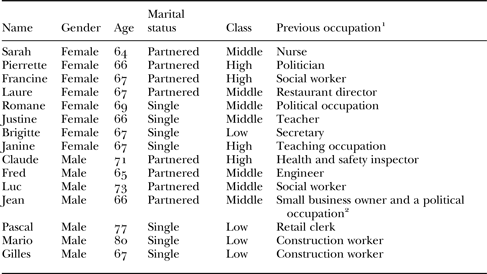
The present analysis focuses on 15 men and women from the original 30 interviewees. We focus on this sub-set in order to compare men and women who had all worked for pay and thus received pensions based on their own labour-force activity, and who had been in heterosexual marriages and had families during the majority of time they were employed. As shown in the Table 1, of our 15 respondents (all names are pseudonyms), seven are men and eight are women. Four men and four women were still in heterosexual couples at the time of the interviews, whereas the remainder (three men and four women) were unpartnered either due to widowhood (three women and one man) or divorce/separation (one woman and two men), and lived alone. Respondents ranged in age from 64 to 80 years old, and all were able to perform their activities of daily living without help. In this sense, they represent a group engaged in healthy ageing – ageing without incapacities (Schmid Botkine and Rausa-de Luca Reference Schmid Botkine and Rausa-de Luca2007). Finally, we assessed class based on the occupation of the respondent and (former) spouse, levels of education and receipt of social assistance. The resulting class status of the sample was varied: four were higher class (three women and one man); seven were middle class (four women and three men); and four were lower class (one woman and three men). Not surprisingly, given the association between income and living alone, all those in the lower class were presently single.
Sample demographics

Notes: 1. We are referring here to the main occupation from which respondents retired. 2. His main occupation was as a small business owner, but he also worked in politics.
Analysis
In order to analyse the content of the discourses (Bardin Reference Bardin1977) of the interviewees, we used the approach that L'Ecuyer (cited in Dépelteau Reference Dépelteau2000: 295) describes as a method of classification or codification of the elements of the interview transcripts so as to understand better its exact and precise meaning. Through this ‘logic of the discovery’ (De Bruyne, Herman and Schoutheete Reference De Bruyne, Herman and De Schoutheete1974: 27) and using an inductive approach, our aim was to explore the sense that retirees made of the idea of freedom.
Analytically, we engaged in a latent content analysis of respondents’ discourses (Henry and Moscovici Reference Henry and Moscovici1968). We identified the relevant items and fragments in which our interviewees talked about freedom such as, for example: ‘It is a quite extraordinary thing, when I look on my calendar and I see that I don't have anything planned for the coming week. This is freedom.’ Then we ordered and classified the corresponding themes in tables based on criteria of exclusivity and homogeneity such as, for example, ‘not having a time schedule based on labour market time and having the possibility of organising time freely’, ‘having the opportunity to devote time to one's relatives’ or ‘having the opportunity to devote time to one's hobbies’. This process involved understanding the internal logic of each discourse but also comparing them in order to find common structuring logics. In particular, we noted that gender and class played a significant role in the way that our interviewees gave sense to the idea of freedom, which we elaborate more clearly below.
Findings
Retirement: leaving paid labour only
The idea that retirement meant freedom for these pensioners emerged spontaneously in the interviews (Repetti Reference Repetti2015a). When they withdraw from labour-force activity and receive pensions, men and women said they felt liberated from the constraints of the labour market. This replicates findings of research in other countries noted above. Our respondents felt freed from the pressures of the labour process itself and valued this new feeling. They spoke of a right to ‘choose their lives’ (‘choisir sa vie’, Ehrenberg Reference Ehrenberg2000: 15), that is, to use their time according to their own routines and interests more than they had in the labour market.
Men and women describe this sensation of freedom in some similar ways. Both express relief that the organisation of their everyday life is no longer constrained by paid work rhythms, as Sarah and Claude make clear:
There is not this stress anymore because you need to be at work no matter how you are feeling and how your last night was, and no matter what your mood is … This feeling [of stress], I don't have it anymore. And this is much better so … It is a big relief. It is much [more] freedom of action and much less stress. (Sarah, 64)
What makes me feel like I am retired is that I have kind of jumped ship. And that was a relief, no stress anymore from the entire hierarchy that weighs on you, etc. Now, I take it easy and [am] relaxed … Before, you had a boss who would come and tell you what needed to be done … I have more freedom [now]. (Claude, 71)
Still, men and women's responses also differed in ways that reflect the gender division of labour, wherein men of this cohort took breadwinning to be their primary role while women, even when employed for pay, were primarily responsible for domestic labour. These gendered activities and identities that characterised their lifecourses continued into retirement, even when paid work has ceased. Below, we discuss these disparate meanings that men and women give to the freedom they feel in retirement.
Gendered time and activities: hobbies and domestic work
Men focused significant portions of their narratives on their hobbies, speaking of free time open to possibilities. These vary according to their interests and opportunities, as we can see in Fred's (65) comments:
I wanted to paint again. I have a gift for painting, drawing. But I also take pictures. On my PC [personal computer], I make small video clips, [do] video editing, photos … But I also love movies. We go to the cinema a lot. I look for good films that are on television too. And in fact, I have a file on my PC where I write what I have seen, I go on the Web, on Wikipedia to look at the movie poster, I look at links to the movie director, the one who makes the music, etc. … I have always loved to do that. Now I can spend time on that … And I have 18 book volumes on the Second World War. I have already read the first two. I'm fascinated with this period. So, no problem … I don't have any spare time, if you will.
Luc (73) also mentions his new freedom and the time he can now spend on his hobbies:
There are a lot of things to do when you are retired. I read. I read a lot. I devour books. And I do a lot of physical activities, always. Mountain treks. And swimming, currently [I swim] twice a week.
Finally, Claude's (71) description of his hobbies demonstrates a feeling of unfettered freedom:
I feel freedom in terms of my time and of what I want to do. If I want to read, I don't know, a book about … public transportation! I have a whole library on public transportation especially. If I want to look at something, a chapter on the development of public transportation in the USA … And another day, I read a book on the history of a town I am interested in or of a region, a country, because I am very interested in history and geography … And other things too! If I want to do this or that, I do it! That's it! I don't have constraints anymore, thinking that ‘I should do that later’.
The men also discuss spending their time in other activities, such as volunteering for non-profit organisations. Regardless of the activities, most accounts centred on organising daily lives however they please, as they could never do when employed. Further, because of the many years of paid work that they performed, they feel entitled to leisure now:
When I retired, I felt that it was totally right because I had worked enough. And I had other organised activities. Leisure activities. This means that I was not lost when I retired. (Luc, 73)
By contrast, women speak of newfound ability to organise domestic work more flexibly than when they were accountable to paid work schedules. For instance, Pierrette (66) describes herself as spontaneous, and likes to avoid routine. But when she was employed, her spontaneity was more constrained; now she is more able to act on the spur of the moment:
Since I retired, I can take things as they come. For example, the laundry … [N]ow, I can suddenly think ‘now, I have washing to do, I'm going to do it’ … When I have a moment of freedom, I do what needs to be done [around the house].
For these women, as for the men, to feel free means having time for themselves (Everingham, Warner-Smith and Byles Reference Everingham, Warner-Smith and Byles2007; Guichard-Claudic et al. Reference Guichard-Claudic, Le Borgne-Uguen, Pennec and Thomsin2001): to read, to relax, to rest. For them, this is new and gives them the sense that their life has really changed. Pierrette takes ‘a rest every day since’ she retired. And ‘from time to time’, she likes ‘to knit or watch a detective series’ but only when she has time. For her, this makes life better than when she used to work for pay. Now, she feels like she can do what she ‘really wants to do’.
What differs from the stories of the men, however, is that women's moments depend not only on their own wishes but also on the constraints presented by the domestic work that they must still do:
In the morning, if I only have this to do, I care for our home. I am in charge of everything in the house. And sometimes, yes, I take moments for myself, for meditation, but not every day, really not. And I prepare the meal. (Francine, 67)
Laure (67), who helps her son with his new restaurant, does not find enough time for ‘herself’ she says, by which she means having enough time to accomplish her domestic work:
Sometimes, I would like to have more time to do things in my home. Cleaning. I like to clean and tidy up. Having a little more time for myself. And I would like to paint. But I have no time. Or accomplish some maintenance in the house.
For Sarah (64), and similar to the findings of Guichard-Claudic et al. (Reference Guichard-Claudic, Le Borgne-Uguen, Pennec and Thomsin2001), retiring meant recovering her responsibility for domestic work. During her last years in employment, her husband was retired already, and ‘he took charge of a lot of things in the house’:
So I let him take over the house, automatically. That was welcome because in my head, I was not available. But since I retired, I have taken my place in the house again, the cooking and everything. I have kind of taken my place again in the area.
All four of these married women considered that having a home that is well-cared for is important, and that it is their duty to provide that care.
The four single women in our sample also mention their responsibility for domestic labour. In contrast to the married women, their descriptions of freedom are more linked to having time for oneself and the right ‘not to do anything’, as Romane (69), Justine (66) and Brigitte (67) say, or ‘stay quiet at home’ (Janine, 67). Similar to reports from previous research, they feel that they now deserve to ‘do for themselves’ and not only ‘for the others’ anymore (Guichard-Claudic et al. Reference Guichard-Claudic, Le Borgne-Uguen, Pennec and Thomsin2001: 102). This results not merely from liberation from dictates of the labour market, but also from the decrease in pressure to perform unpaid domestic work on a particular schedule. These women no longer live with men, because they are widowed, separated or divorced. Contrary to the married women, they have been able to reduce their unpaid work as well. They still feel that, as women, they are expected to ensure that their home is clean. Nevertheless, they feel freer to delay their domestic labour because nobody depends on them for their everyday life at home:
I don't have a schedule anymore … Sometimes, you have a messy home but you don't want to do anything. You sit in front of the TV and then, you don't move anymore … Take a book or sit in front of the TV or do crosswords. Because you are doing your crossword and your home is messy or, I don't know, dead leaves are in the garden but you don't want to go and scoop them up, so you do crosswords. (Romane, 69)
For Janine (67), having the right to relax, to take a break, instead of performing domestic labour is novel, and stands in stark contrast with her time while in the labour market:
I feel like I am totally free because when you need to work five days a week, as a woman, you need to spend your weekends by doing the cleaning – even if I was lucky to have a maid – doing the washing, the ironing, everything that has to be done. You cannot organise so many events on the weekends. The grandchildren come too on the weekends … While now, if today I don't want to go shopping, I will go tomorrow. Whereas before everything was well settled and programmed or you were not able to do everything that was to be done.
Brigitte (67) expresses the same idea, and stresses the relief accompanying this new-found freedom when compared to all the work that she needed to do before:
Now I think ‘all that I had to do [when I used to work]!’ And now, I still do these [tasks], but slowly. Because I say to myself, ‘I am not in a hurry, what I don't do today, I can do tomorrow’. So sometimes, I postpone things too. And sometimes, I do anything! … I remain sitting, reading … Reading, going for a walk, this is all leisure.
This last excerpt highlights the different ways that men and women consider their freedom and activity in retirement. Men see their freedom as linked to the possibility of devoting time to leisure, such as reading books or engaging in sports or physical activities (such as walking), and they describe these as new activities in which they can now invest. By contrast, women, especially single women, see freedom not only in terms of leisure possibilities, which they describe as ‘not doing anything’, but also in terms of having more flexibility in the way they organise their domestic work. In this sense, they may consider that ‘doing something’ means accomplishing work that is linked to their domestic labour.
Married women did not express similar sentiments about postponement of domestic work. Thus, the fact of living with men seemed to influence the extent to which these women feel more or less free to take time for themselves and delay domestic tasks.
In contrast to the women, married men never mentioned domestic work. As the previous quotes have shown, the men speak of free time for hobbies and having earned this freedom with paid work. This does not mean that the men never perform domestic work. Indeed, according to Swiss Statistics, in 2013, old men (aged 64–74) reported that they spent an average of 19.1 hours a week engaging in domestic labour (Federal Statistical Office 2015). But such unpaid labour makes no appearance in their stories. This is especially notable given that the interviews did not focus on pre-specified activities of the retirees but allowed them the opportunity to describe this time in their lives as they saw fit. This gender difference in discussing domestic labour thus suggests that even if men engage in such unpaid work, it is not a central part of their experience or identities. Bolstering this point, Laure and Francine both say that their husbands are not concerned about domestic work in the way they are. This observation surprises them but they do not consider it to be a big problem:
When I and my husband retired, I expected … I thought ‘my husband is retired, some husbands give a hand to their wives’. But now, he is very involved and useful in outside activities, where he can use his abilities, well! … And now, it's fine like this. And I like to cook. Maybe, if he had time, he would like it too, but cooking is one of the few things that he does not know and that I [don't mind doing]. (Francine, 67)
I always have something in my mind [about domestic tasks]. I think: ‘I should do this and we have not finished that!’ My husband, he can relax sometimes. He can read the newspapers, you know? I can't! But he puts all the news in his head and then he can talk about a lot of things, you know? So he reads a lot. In the meanwhile, he does his crosswords in the newspaper. But I can't! I have always something in my head that needs to be done. (Laure, 67)
This difference between men and women's preoccupation with domestic work is consistent with feminist gerontology and previous studies that show that, in contrast to women, the responsibility for domestic work is not part of men's identity (Solimeo Reference Solimeo2008). Thus, on average, retired men continue to engage in less than do women, and when they do, it is more of an option – a choice that they can make – than based on a felt social or moral obligation. This point is evident in Francine's assertion that her husband might have liked to cook if he had had time and if he had known how to.
Gender, class and freedom: an intersectional analysis
We have shown that gender influenced retired men's and women's experiences of free time, such as the extent to which they feel accountable for domestic labour. This gender difference is perhaps most evident when we look at the men and women who are single. The heteronormative bases for gender relations do not disappear for those who are no longer married. Instead, singlehood clarifies gender relations by disrupting divisions of labour with the removal of a partner. In respondents’ accounts, it seems to constitute the deviant case that inspires them to articulate the norm. The four single women we discussed above, regardless of class, all spoke of feeling less pressured to perform domestic labour. They did not stop doing it; they merely felt less constrained by a schedule or the need to perform it at a particular time as they do it only for themselves.
By contrast, all three of the single men, each of whom were members of the lower class, complained of retirements constrained by the fact they had no one to whom they could shift responsibility for domestic labour. Closer examination of these men suggest ways that class might intersect with gender in shaping these retirement experiences. First, like the single women in our sample, these men had been part of a heterosexual couple during the majority of the time in which they were actively employed. But unlike the married men in our study, all three single men mention the domestic work that they needed to accomplish now that they no longer live with companions. Second, they all have low pensions and receive supplementary monies provided by the canton to help older people whose incomes are deemed insufficient. Therefore, they cannot afford to hire others to perform domestic work; and yet, two of the three stated that they received some help from cleaning women who are either paid by social services for few hours a month, or have found a way to pay for a few, cheap tasks to help them out. But for the most part, they must perform the majority of domestic labour themselves. This can be an occasion for them to showcase their abilities, and receive kudos for doing work that, when performed by women, tends to be invisible (Calasanti and King Reference Calasanti and King2007).
Pascal's comments exemplify many of these points. He spoke proudly about his domestic abilities:
Yesterday was an example of giving 100 per cent [of effort], because I began at 7 am. I cleaned all the windows, I had not done them for a long time and I had to do them because it is spring, etc. So I'm very busy. And cooking, I spend a minimum of three hours a day in the kitchen! (Pascal, 77)
Although doing domestic work is a source of pride, it can also involve unpleasant tasks, which he tries to delegate:
I do everything in the apartment, from A to Z. I do the cleaning, etc., but [not] shirts. I have found a lady, I wash the shirts and she irons them. For just two francs you see, so that's OK. I don't like to iron, I do iron, but I don't like it.
For some men like Pascal, performing domestic labour may show their competence and independence in caring for their homes. However, this work can also be experienced as unfair and wrong, as Mario (80) makes clear:
I do everything myself. Seriously. Now the windows are dirty because of the construction site. There is too much dust. But they were clean. I do everything myself you know? And I could almost say, if there were a woman here now, she would be on holiday. She would not have anything to do. But nowadays, women have another point of view! The couple, it is over! Soon we will make love alone.
Mario's feeling of injustice stems from his perception that women are no longer content to follow the gender division of labour. For him, the idea that he has to perform what should be woman's work within the normative, heterosexual couple ideal is wrong. One gets the feeling that this not only makes him feels betrayed, in the sense that the patriarchal bargain has been violated, but also abandoned. He continues:
I have to remain here all day, in the mess. So sometimes, I wonder why should I be in the mess like that, and why should I clean? Let's say apart from the kitchen. Now I have finished eating. I clean the dining room a little. I sleep. I clean the bathroom. Seriously, it needs to be done! And then I remain like this [he shows the untidy space around him]. And sometimes, [the social worker] responds: ‘We can send you a woman.’ But what can she do? She only comes once a week.
Mario performs domestic labour, and nowhere in his discussion does the idea of freedom emerge.
These lower-class men's comments stand in contrast to the single women we have discussed, including Brigitte (64), the only lower-class woman in our sample. As with the other women living alone, she now feels she can organise her everyday life according to her own rhythms. She neither complained about her domestic labour nor sought someone else to do it.
For these single men of the lower class, having to perform domestic work does not lead them to reconsider gender roles; instead it represents an imposition that they endure more or less philosophically. What is apparent in their comments are the gender relations that continue to structure their lives and influence their retirement experiences, and also how social class intersects with gender. While it is certainly the case that their being single men brings domestic labour to the fore, their class status makes it problematic and a constraint in retirement. Not having financial resources means that they will need to do the work themselves, and they can either resent or take pride in it. Even with limited resources, they may manage to pay women to take on some of it. Class thus shapes their responses to being left with unpaid labour obligations. Further, the kinds of freedom in retirement expressed by the men of higher classes did not emerge in the same way in lower-class men's interviews either.
Retirees of the middle and high class are especially free to engage with the broader community, with diverse forms of capital, including money, education and friendships, that connect them to others. But for those who are lower class, freedom takes a different meaning. Even if they value the right to decide how to organise their everyday lives (Repetti Reference Repetti2015a), their lower levels of social and financial capital can restrict the range of their social participation (Guillemard Reference Guillemard1972, Reference Guillemard2002), as Gilles (67), a lower-class man, explains:
You know, when I first retired, I used to leave home early in the morning. But now I go out later because going out is also an opportunity to spend money, go and drink coffee, you know. So now I go later, at about 8:30 or 9. And I go down to the street and then I think: ‘Where do I want to go?’ And I decide to go to [a small town] or [another small town] or anywhere else that is in the region and that I can reach by walking.
Both men and women of the lower class face higher barriers to their freedom than those of their higher-class counterparts, and they experience these in gendered ways. While middle- and higher-class men spoke of their relief in not having to organise their lives in relation to paid labour, lower-class men do not talk this way. Their lack of financial and social capital kept them from considering their new-found freedom to be as full of opportunities as their middle-class and higher counterparts find. Similar to men from the middle and high classes, their narratives focused on hobbies; but lower class men engaged in these activities at home (reading, writing, cooking and the like). When they did go out, as noted above, they needed to be careful not to spend money: ‘I spend a lot of time in the shopping centre, looking; and that is enough for me’ (Pascal, 77). They also did not stray far from home, which would also imply financial outlays. By contrast, when men of the middle and high classes talked about their hobbies, they mentioned many activities that can be costly: travelling, hiking, swimming, playing tennis, or spending time in a house in the countryside or in a chalet that they possess. For example, Fred (65) talked about the house he owns in the south of France: ‘I look forward to going there as soon as we can. I am doing a lot of repairs on the house at the moment. I love to go there.’
We have discussed how the gender division of labour can constrain women retirees’ freedom. But women also typically have greater access to social relations in later life than do men, given their lifecourse investment in kin and other social networks. However, class can shape the extent to which they can take advantage of these supports (Barnes and Perry Reference Barnes and Parry2004; Fontaine and Gendron Reference Fontaine and Gendron2012). Low financial capital can influence social capital, and we found Brigitte (64) felt lonely and disappointed not to have more social relations, especially within her family:
Some people of my age take care of their grandchildren and so on. But this is not my case anymore because my grandchildren don't need me anymore, they are 20 and 15 years old.
But it is not merely age to blame; she also mentioned her wish to live nearer to her daughter, so that she could see her and her family more often. The cost of travel is beyond her means. As she noted, ‘Pension [will not make me rich], you know, I also need to be careful with my money!’
By contrast, Janine (67), who is also single but middle class, has the financial ability to maintain relations with her family. Every Friday, she drives to her daughter's house, about 20 minutes away, in order to help her daughter with her domestic work. ‘I go and visit her. I do some ironing for her. We chat, we prepare the lunch for the children who come back from school at midday. It is really a pleasure to spend this time with her.’ Note that it is not the case that middle-class men do not spend time with family, but they do so very differently, in ways that they feel maintains their freedom and separation from reproductive labour obligations:
I am fortunate to be able to share moments with my grandchildren. But I don't do it under pressure. I have refused a mission to look after them according to a fixed rhythm. My daughter-in-law has tried to ask for some help from me but I have not accepted. I don't do that. I am a free man and I want to remain so. I want to see my grandchildren for my pleasure. (Fred, 65)
Despite her financial situation, Brigitte still maintained social activities and in ways that differentiated her from the lower-class men. When she talked about her everyday life, she also mentioned free activities that she does at home (reading, knitting, etc.). But she also participated with a senior association through which she engaged in such social activities as drinking coffee and chatting, playing cards, watching films and delivering services to other seniors.
Thus, our findings suggest that for women as well men, class influenced the way retired people talk about their freedom, in terms of the extent to which they can take advantage of the gendered possibilities available to them. Lower-class men lack the economic and social capital to engage in the leisure pursuits and social networks that their middle-class counterparts enjoy; their time must be given to domestic labour, and their financial positions keep them from evading this work as well as engaging in more costly hobbies. Brigitte, a lower-class woman, also finds it difficult to benefit from the opportunities to maintain social relations established over the lifecourse through her domestic labour. Still, she manages these constraints differently from her male counterparts; despite her financial situation, she has found low-cost ways to socialise.
Discussion and conclusions
Previous qualitative research in the USA (see e.g. Calasanti and Slevin Reference Calasanti and Slevin2001), the UK (e.g. Barnes and Parry Reference Barnes and Parry2004) and Australia (e.g. Everingham, Warner-Smith and Byles Reference Everingham, Warner-Smith and Byles2007) shows that, in these countries, gender shapes retirement experiences of freedom. Here, we examine the narratives of 15 Swiss pensioners to assess whether gender differences obtain in Switzerland as well. Using a feminist gerontological approach, we view gender and class relations as intersecting sets of resources and constraints that mutually constitute retirement experiences. We thus theorise the gender differences that we observe in terms of inequalities rooted in gender divisions of labour that influence opportunities for and barriers to freedom among Swiss retirees in later life, and examine ways that class might further shape these. Given our sample size, this latter analysis is suggestive only, pointing to directions for future research.
Swiss pension reform proposals assume gender parity, already accomplished, such that government should treat men and women in the same manner. We find no such equality among contemporary Swiss retirees. Women and men alike say that they feel a new freedom now that they are no longer engaged in the labour market; but the meaning of this freedom is gendered, reflecting inequities across the lifecourse. Men associate it with choosing to do whatever they want, to focus on hobbies and leisure, as a right that they earned with employment over the courses of their lives. This entitlement corresponds to the moral foundation of the Swiss Old Age Insurance, which posits retirement as a recognition of years of employment (Repetti Reference Repetti2015b). What goes unnoticed, however, is the extent to which retired men's freedom to choose activities rests on women's performance of reproductive or domestic labour in two respects: both prior to retirement, as he is able to focus on paid labour and gaining a higher income; and in retirement, as men's array of choices rests upon the domestic labour of wives.
This situation – and the reality that domestic labour is work – is further bolstered by our findings on single, lower-class men. They cannot count on wives to perform domestic labour, and also cannot afford to hire others to do this work. They thus find their leisure in retirement constrained both by the need to perform this work, and their inability to engage in hobbies that are costly.
The gender inequalities unrecognised by Swiss pension reform proposals appear in women's contrasting experiences of freedom in retirement, which they define as having the opportunity for greater flexibility in organising the domestic work that they must accomplish. This feeling is amplified for those women no longer living with a man; they take even greater liberties with delaying domestic labour. Like men, women engaged in hobbies, but their retirement narratives are organised around the theme of domestic work, demonstrating the importance of this activity for structuring their everyday life; they do not see themselves as entitled to do whatever they wanted, as men did. These observations are particularly striking in comparison to married men, who scarcely mention domestic work. Only single men spoke of their domestic labour, and not in relation to their feelings of freedom.
Our limited data also suggest that class shapes the way retired men and women experience their gendered freedom. While retirement represents an opportunity for those of middle and higher classes to ‘choose their lives’, retirees of the lower class find that their relative lack of economic and social capital constrains them from using their freedom to take on new social roles and activities in retirement. Class intersects with gender by enhancing or restricting gendered opportunities in later life. Men and women of higher classes are able to engage in a wide range of activities; such men are especially advantaged in this regard given that they see their time as totally their own. Because of the social connections they typically forge over their lifecourses, women may enter retirement with particular kinds of opportunities for social interaction. However, our results suggest that women in lower classes may not be able to take advantage of such things as intergenerational relationships if to do so involves financial costs.
Our findings point to the importance of gender and class inequalities in shaping retirement experiences and the need to consider these in fashioning social policies. Both paid and unpaid labour play a role in retirement, and typical notions of retirement that consider labour-force withdrawal only are inadequate for understanding this time of life – for either men or women. The men and the women we studied all worked for pay; but women's reproductive labour had a significant impact on both men's and women's experiences of freedom in retirement.
Finally, the gender differences uncovered here also point to a male-centred bias in the push for retirees to engage in active ageing. That is, the efforts to encourage older workers to stay in the paid labour market, or to engage in other, unpaid activities for the larger community, ignores the work that retired women are already performing, and is thus a form of exploitation. They not only perform domestic work still, but as this study and other research finds, they also engage in care work for grandchildren and older relatives – including their spouses. A gender-neutral depiction of retirees as persons with a lot of leisure time, who should be contributing more to society, ignores – indeed, hides – the unpaid work of all retirees, but especially women.
Acknowledgements
The first author would like to thank Prof. René Knüsel (University of Lausanne) and Prof. Jean-Pierre Tabin (University of Applied Sciences and Arts of Western Switzerland) for providing intellectual direction leading to this work. We also thank associate editor Sally Keeling, whose keen eye improved our manuscript, substantively and stylistically; and the anonymous reviewers, who pushed us to hone our ideas while providing clear suggestions for guidance. Ethical approval was given by the supervising faculty; no additional approval was required.