IntroductionFootnote 1
While it is possible to know a great deal about women in the Ur III state due to the large amount of documentation, comparatively little has been written on the topic.Footnote 2 Any increase in the amount of information available is therefore extremely precious. This article focuses on the publication of seven tablets from the Iraq National Museum that form part of a dossier of texts which may have belonged to an archive of a princess Šāt-Eštar. They are dated from the fifth year of Šū-Su'en (2046–2028 BC) to the third year of Ibbi-Su'en (2028–2004 BC). In 2009 the Iraq National Museum received 1500 tablets which had been confiscated from smugglers and come from the region of Umma (modern Tell Jokha). The texts deal with various topics and are being studied by scholars from Baghdad and Mosul. Among them are now thirty-four tablets which have been identified thus far as belonging to a dossier associated with a princess Šāt-Eštar. Ten of these tablets were initially treated in the author's unpublished MA thesis,Footnote 3 while a further seven have since been identified and are presented here. The rest of the Šāt-Eštar tablets are being studied by other scholars. It is currently unclear what the relationship was between these thirty-four Šāt-Eštar tablets and the rest of the 1500 confiscated tablets from Umma, although it is hoped that this will become apparent through further research.
The evidence of these texts supports views of the role of female members of the royal family in the Ur III state as mediators between the court and non-royal agents, as well as having considerable independence and authority over their own spheres of activity. Female royal family members such as Abī-simtī, queen of Amar-Su'en and mother of Šū-Su'en, had significant power within the state having considerable economic reserves as well as related cultic obligations throughout the territories.Footnote 4 It is clear that some Ur III princesses were married abroad for diplomatic reasons, and that foreign princesses were married into the royal family of Ur, such as Tarām-uram from Mari and Šulgi-simtī, who was most likely from Ešnunna, and most likely Abī-simtī herself who may have come from Mari.Footnote 5 They brought with them family members who themselves came to occupy positions of great political and economic power in the Ur III state, such as Babati, brother of Abī-simtī.
Such methods of forging alliances on the international level through dynastic marriage are not unusual as a means of securing peace. It is also quite apparent, however, that Ur III princesses married into the families of important officials as a means of securing loyalty but also very likely of mobilising local social and economic capital resources in the interests of the state. Examples are Arad-Nanna, whose family held the post of sukkal-mah, governing eastern and north-eastern territories over four generations, or the generals Hašib-atal, Šarrum-bani and Lugal-magurre, who were all married to princesses.Footnote 6 By multiplying family relationships with connections to the centre, the patrimonial Ur III state was able to reproduce and expand its somewhat fragmentary power-base, which relied in the extreme on local families and power-structures to implement its administrative reach.Footnote 7 To an extent it could be said that the princesses were inserted into such structures as an attempt to consolidate central state executive power through having a presence in the main families which supported it. As will be seen, they were able to do this with great independence and autonomy.
The texts presented here throw a light on the way in which spheres of influence over economic activity could intersect and reinforce each other in the Ur III patrimonial state. The princess Šāt-Eštar is married to an important official called Šarakam, who is a scribe. She appears to be based in Umma, as is her husband, but has interests in Irisaĝrig where she may have her own representatives and economic resources. She is also able to mobilise the contacts and resources that are associated with her husband's own spheres of influence, particularly in her relationships with a fuller from his entourage, and she demonstrates an involvement in various economic areas, such as textiles and sheep, dates and barley. Just as with Abī-simtī, the queen and later dowager queen, her involvement with textiles is doubtless related to wool-production and sheep-herding, thus significant capital interests.Footnote 8 And as with other royal women of the Ur III period, she also appears to have had cultic responsibilities.
Background
The Third Dynasty of Ur ruled much of Southern Mesopotamia, or Sumer and Akkad, from 2112–2004 BC. This was a period of revival and renaissance for Sumerian culture in all its aspects during the reigns of its five kings Ur-Namma (2112–2095), Šulgi (2094–2047), Amar-Su'en (2046–2038), Šū-Su'en (2037–2029) and Ibbi-Su'en (2028–2004). Thousands of cuneiform tablets and administrative documents have been divided among museums and private collections around the world, in most cases having been illicitly excavated from cities in the south of Iraq such as Ur (Tell al-Muqayyar), Lagaš (al-Hiba), Nippur (Nuffar), and especially the three main sites of Ĝirsu (Telloh), Umma (Tell Jokha) and Puzriš-Dagan (Drehem). According to the estimate of Manuel Molina (Reference Molina2016) there are nearly 120,000 tablets in the world's cuneiform collections that date to this period, providing us with invaluable evidence concerning economy and daily life. Additionally there is a large number of texts housed in the Iraq Museum, and there are likely to be hundreds if not thousands also in private collections around the world that are as yet undocumented.
The fact that the vast majority of Ur III tablets does not come from regular excavations means that their archival contexts have to be reconstructed on the basis of their content, particularly the month-names which are particular to specific ancient cities, as well as information concerning the histories of their accessions to the various collections in which they are found today. In the following an attempt is made to collect the already published information about princess Šāt-Eštar, which is supplemented by the texts published herewith.
Ur III texts concerning Šāt-Eštar
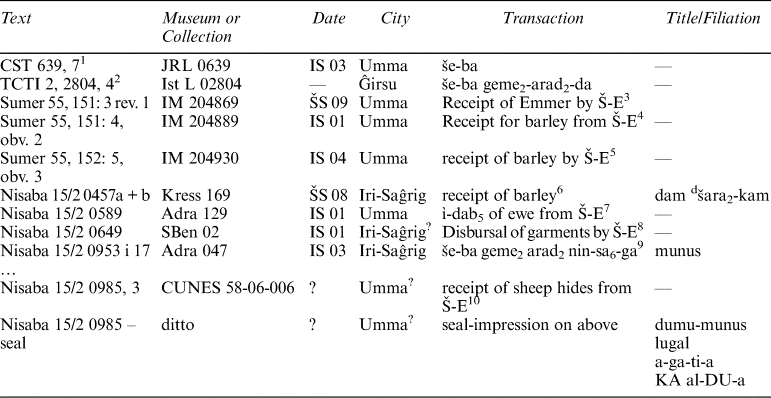
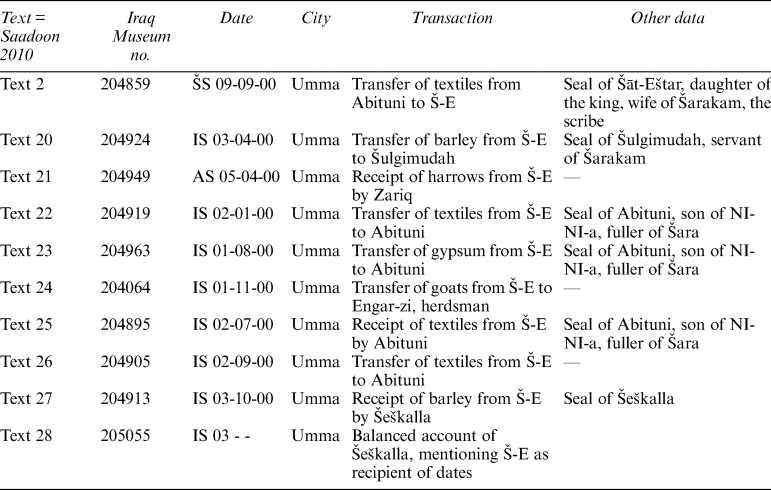
Before the accession of the new tablets from Umma to the Iraq Museum only a few tablets were known which mentioned this name, and even less which specifically mentioned the individual who seems to have been a princess with this name. Most of the tablets belong to the collection that seems to have come from Irisaĝrig/Āl-Šarrākī and was published by D.I. Owen.Footnote 9 Prior to this only two tablets (from Umma and Ĝirsu) had been published that referred to a Šāt-Eštar of the Ur III period,Footnote 10 almost certainly not the same Šāt-Eštar as the princess in question here. Table 1 presents the already published attestations of the name Šāt-Eštar in Ur III documents in their order of publication.Footnote 11 The tablets that were treated in the author's unpublished MA dissertation are summarised in Table 2.
Previously published Ur III tablets mentioning Šāt-Eštar.

1 Fish Reference Fish1932. Rectangular tablet.
2 Lafont and Yıldız Reference Lafont and Yildiz1996. Square tablet.
3 Salah Reference Salah2010: 151, emmer of the arable land of the god Nin-ildum received from Ur-Mamit by Šāt-Eštar.
4 Salah Reference Salah2010: 151, receipt of barley by Urani from Šāt-Eštar.
5 Salah Reference Salah2010: 152, small square tablet with pinched corners.
6 Owen Reference Owen2013b: 230. Square tablet with envelope. The barley of Šāt-Eštar, wife of Šarakam, is received ([šu ba-a]n-ti) by an individual whose name is broken ([x-x-]ni-rum) under the seal of one Bēlī-kasip (for later –kašip) from one Abu-ṭāb.
7 Owen Reference Owen2013b: 272–273; Small square tablet with two pinched corners and seal-impression. Scribe: lu2-diğir-ra. Owen (loc. cit. 272 fn. 270) thinks this tablet may have belonged to the Iri-Sağrig archive, even though it comes from Umma.
8 Owen Reference Owen2013b: 290–291; rectangular sealed tablet, disbursal by Šāt-Eštar under the seal of Abintuni, with seal of a-bu-tu 9-ni son of NE-NE-a, azlag7-lugal? (royal? fuller) on the tablet, according to Owen's reading of the title (loc. cit.). This title will need to be revised in light of new attestations below. The BDTNS database currently reads a-bu-DIB-NI on the seal (revised text by M. Molina from 2013, accessed 1.11.2017). It is suggested here that the writing is a-bu-tu9-ni, using the same sign tu9 = TÚG in the writing of the name as is used in the writing of the profession lúazlag (= LÚ.TÚG). The value tu9 for TÚG is contained in Proto-Ea (Borger, MZL 2004, 206 no. 809).
9 Owen Reference Owen2013b: 415–420. This large multi-columned tablet contains disbursals of grain to families of different types of dependent workers, and contains the name Šāt-Eštar five times: i 17 (munus); ii 2 (munus); ii 14 (munus dumu-ni, i.e. the daughter of Ahubaqar, who exercises the profession bar-tab); v 11 (munus); rev. i 11 (munus); rev. i 34 (no title). Clearly these are not Šāt-Eštar the princess. A list of the filiations of these women is given at Owen Reference Owen2013a: 523, with the caveat that the title munus saĝ-rig7 listed there is not correct: it is solely munus “woman”, with saĝ-rig7-me being the heading of the next paragraph.
10 Owen Reference Owen2013b: 430. Received (šu ba-t[i]) by Agatia.
Provisional summary of texts mentioning Šāt-Eštar edited in Saadoon Reference Saadoon2010.

The New Texts Concerning Šāt-Eštar
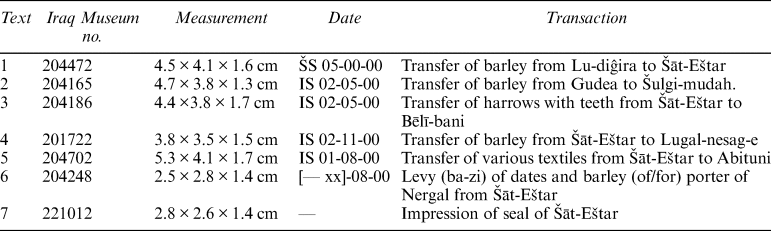
Table 3 details the registration numbers, dates and contents of the new tablets from Umma concerning Šāt-Eštar that are presented below.
The New Tablets Concerning Šāt-Eštar.


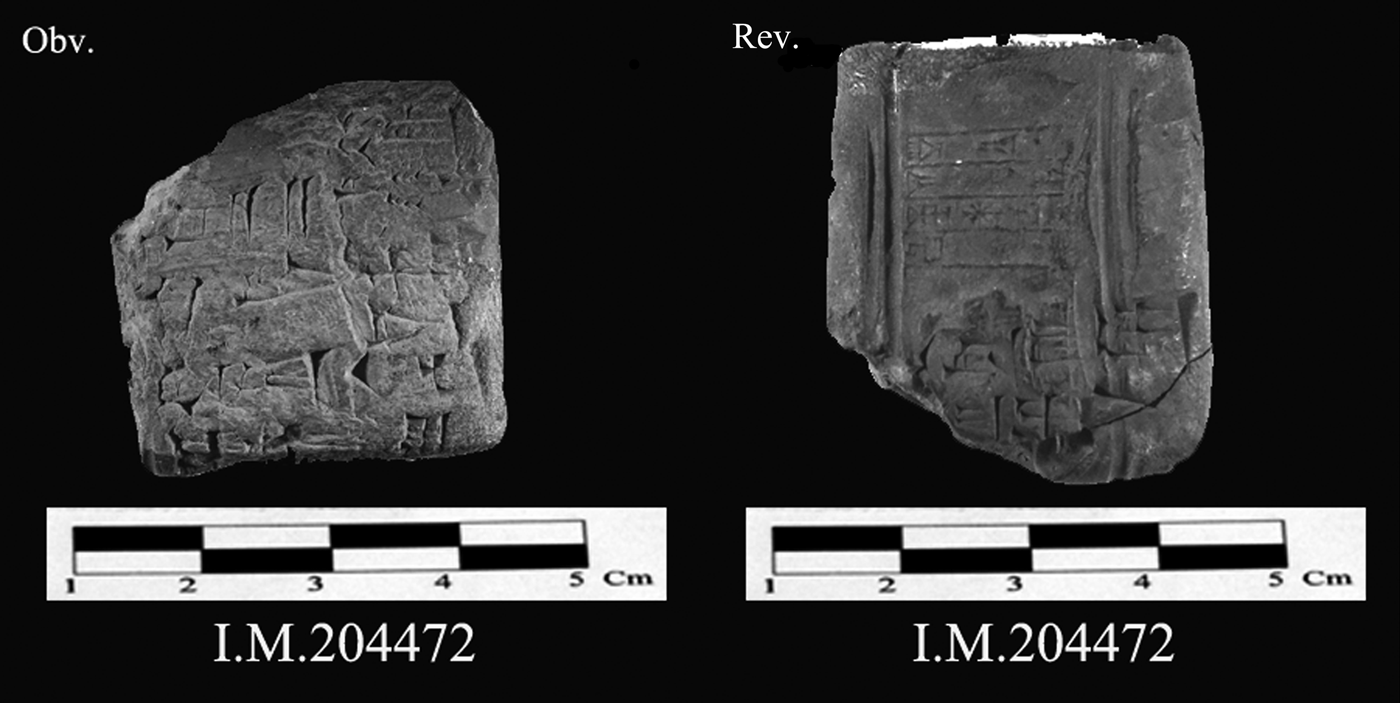
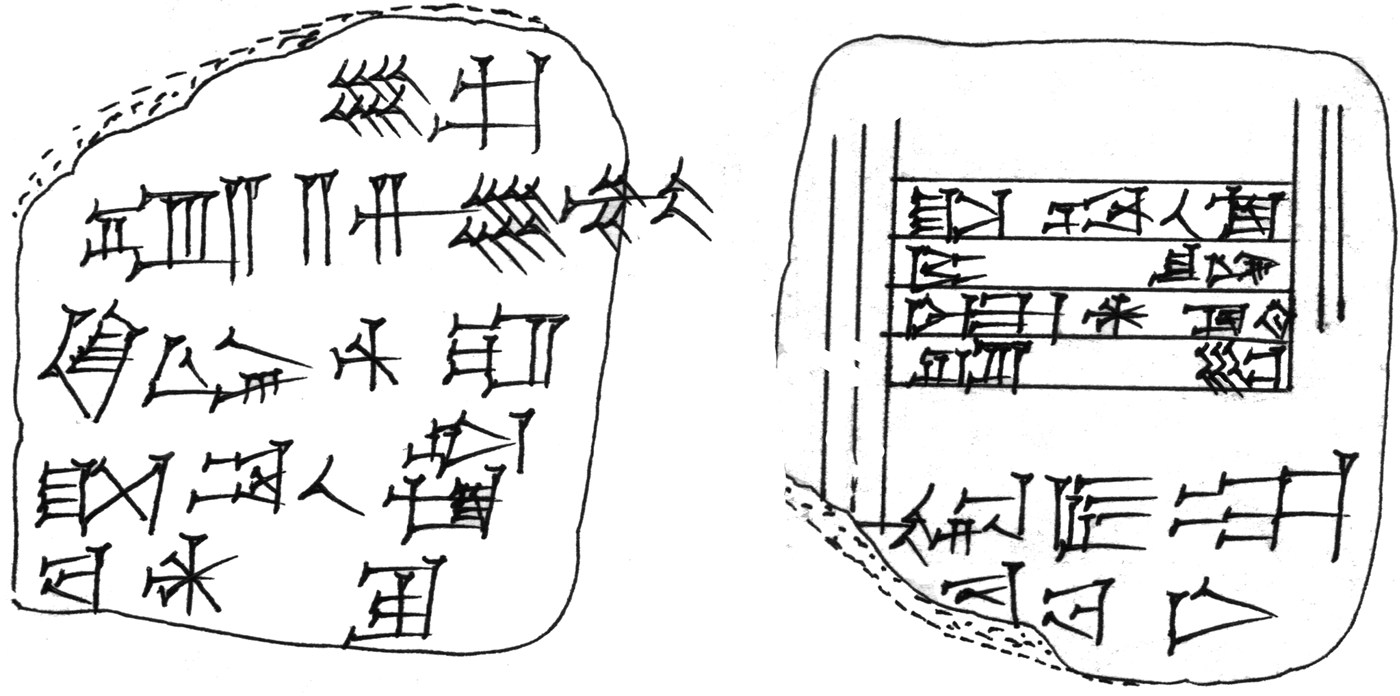
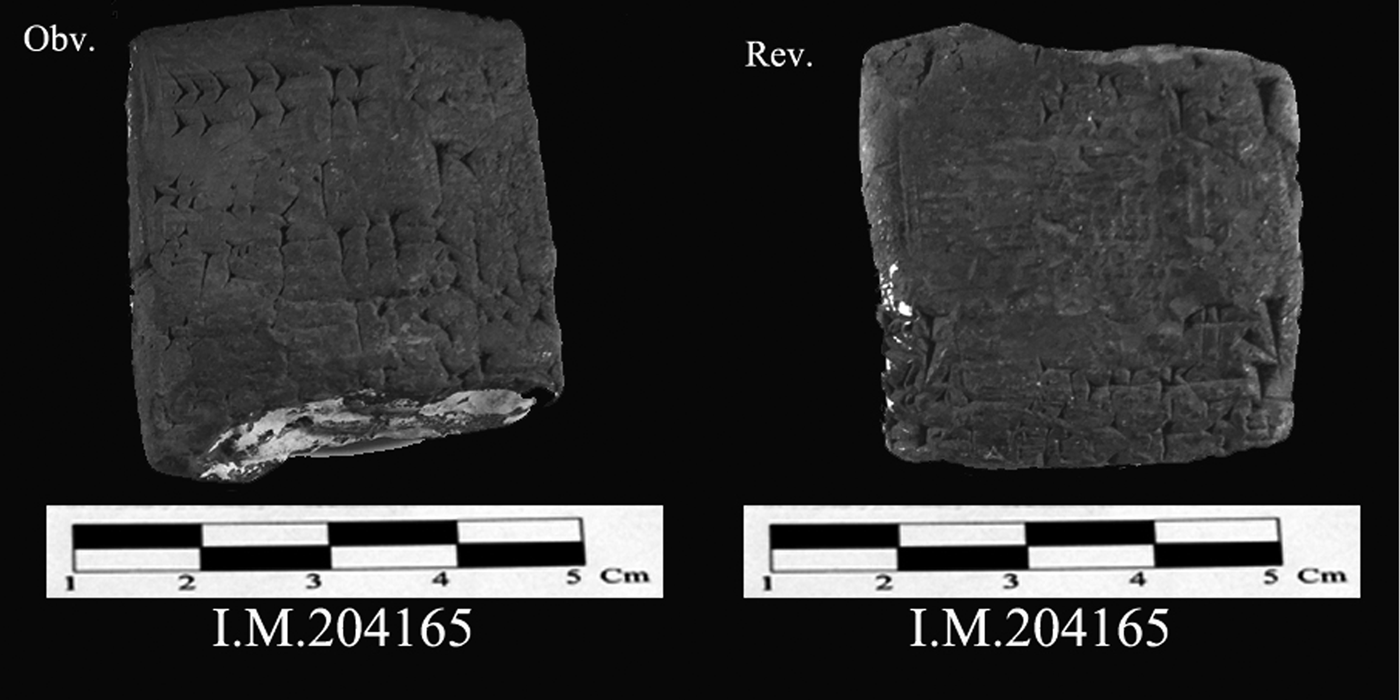
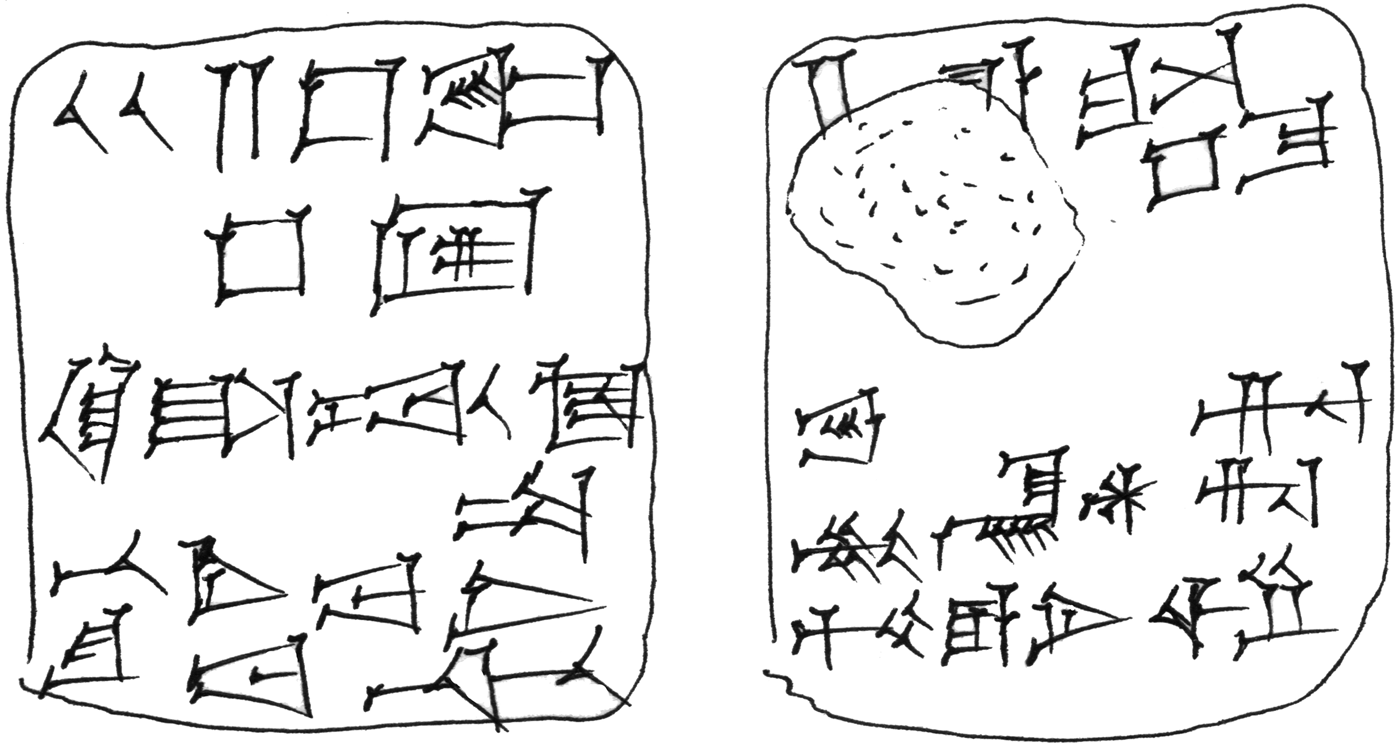
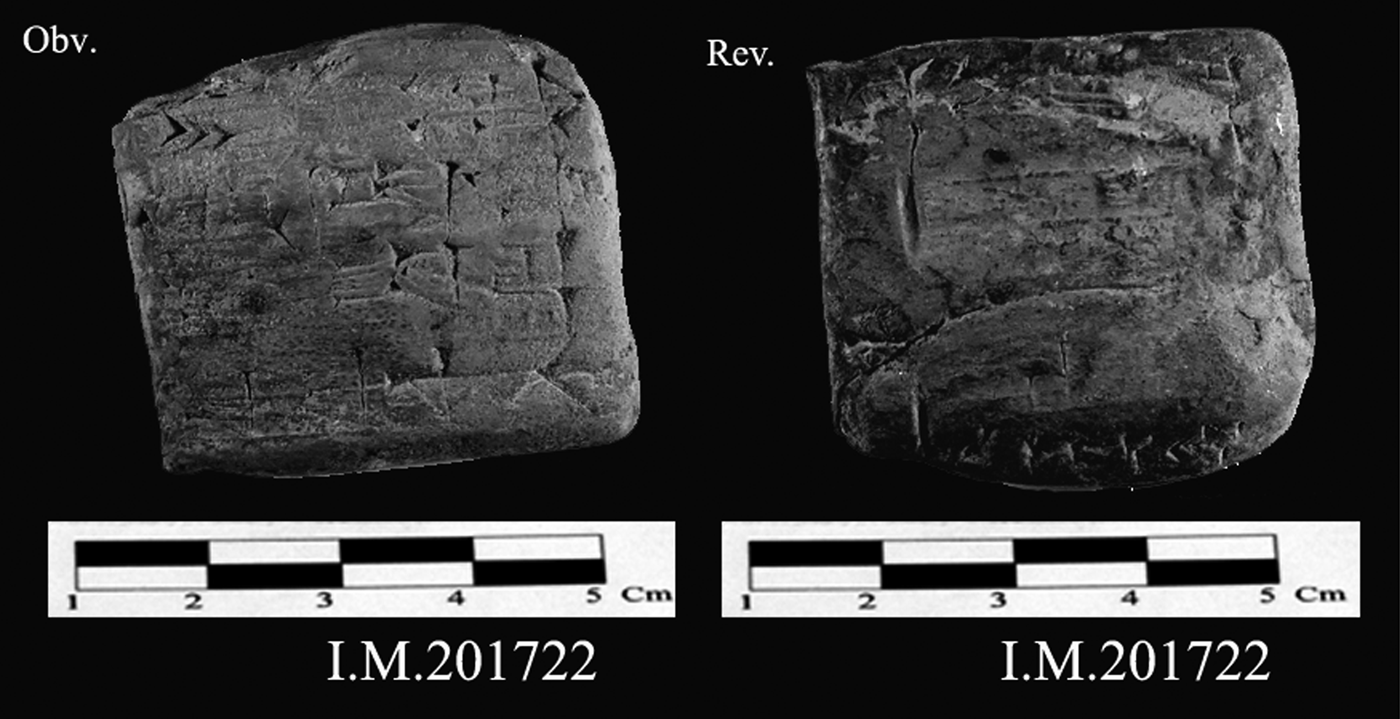
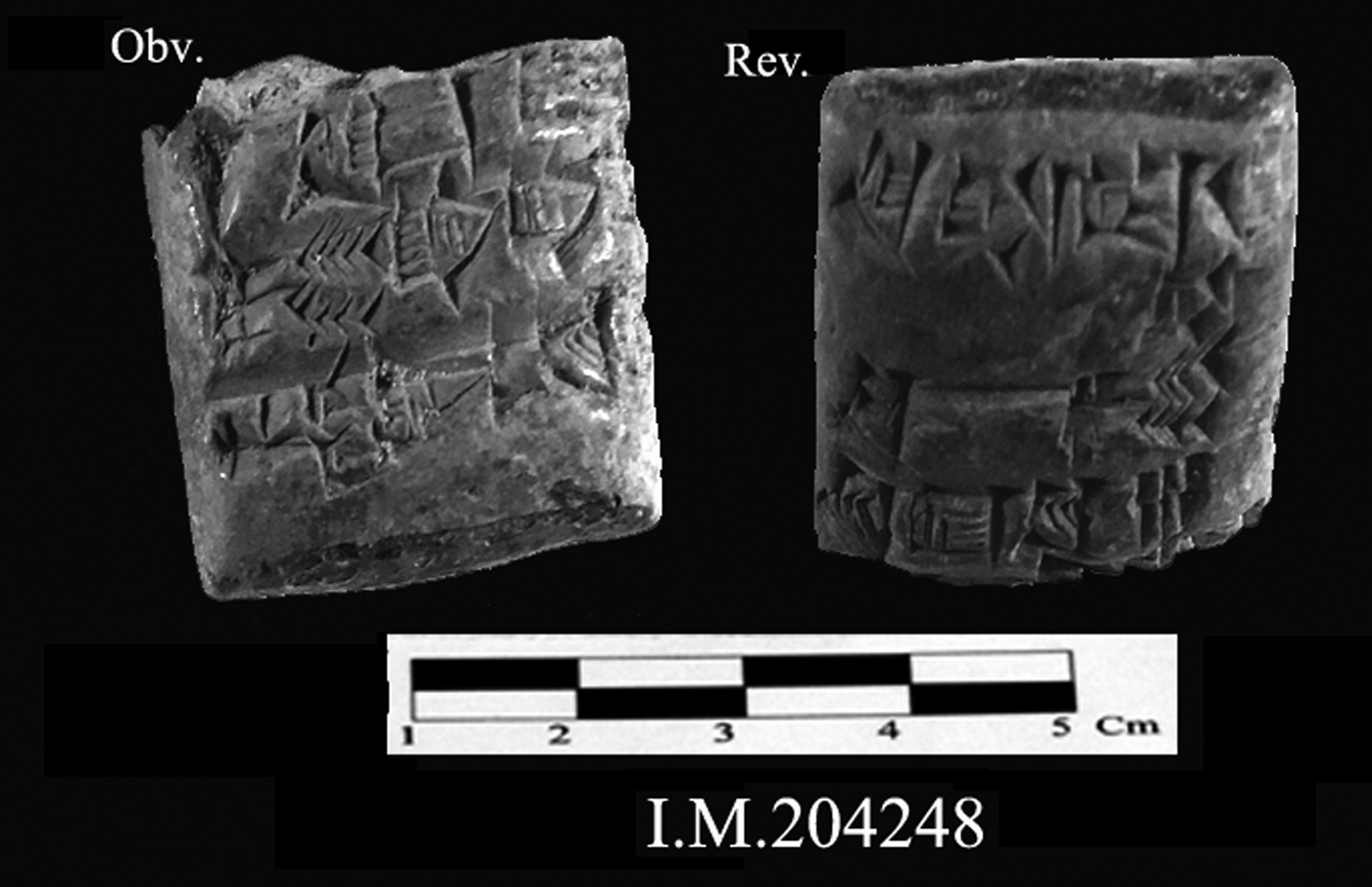
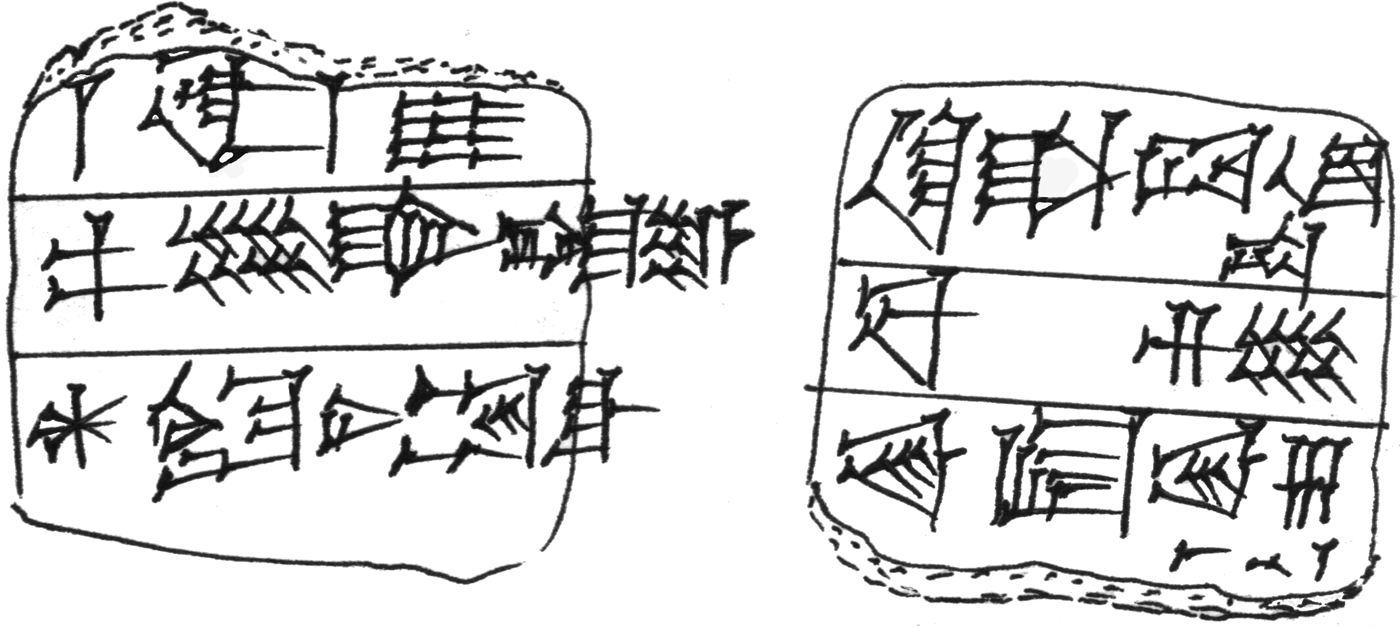
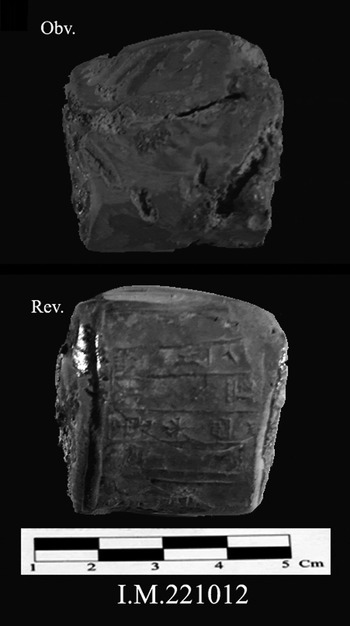
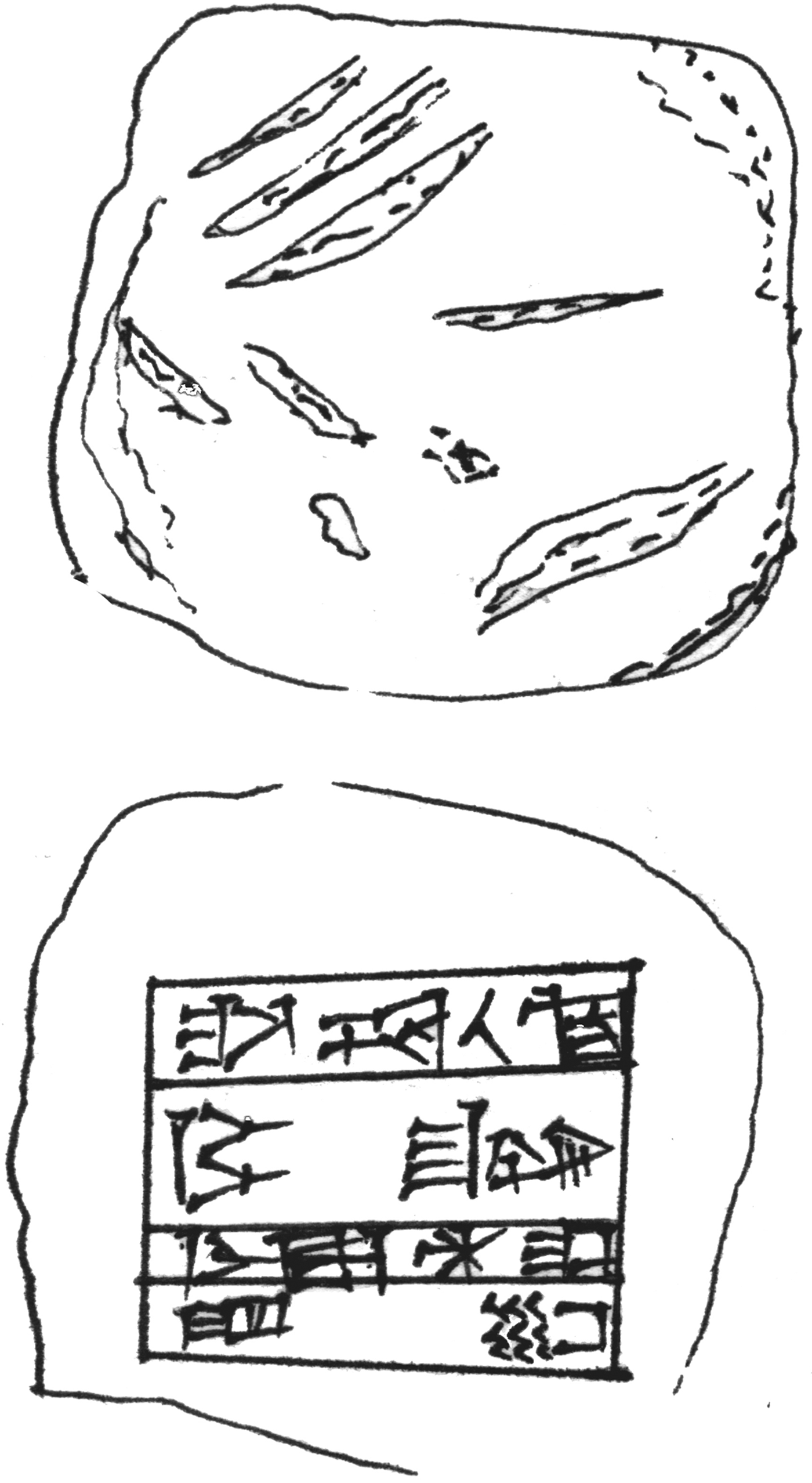
Translation: (Obv. 1) (concerning) [x] gur of barley (2) received by Aya-zimu (3–4) Šāt-Eštar transferred from Lu-diĝira. (Rev. Seal Impression) Šāt-Eštar, daughter of the king, wife of Šarakam the scribe (Rev. 1–2) (Date): ŠS 05.
photos of Text 1 obv. and rev.

copy of Text 1 obv. and rev.

Commentary
(1) The verb dib means “to transfer”, “cause to pass”, presumably from one office to another. (2) The phrase kišib3 a-a-zi-mu is attested at Umma in UTI 6, 3741 rev. 4; 3749 rev. 2. A person called Aya-zimu (“Aya is my life”) is further attested at Umma in SAT 2, 0816 obv. 4, and the name also occurs at Lagaš, Ĝirsu, Umma and Irisaĝrig (3) Lu-diĝira is a commonly attested name at Umma.

Translation: (Obv. 1–5) Šulgimudah received 2940 litres of grain ration in gur from Gudea on behalf of Šāt-Eštar. (Rev. 1) In the house …. (Seal Impression): Šarakam, scribe, Šulgi-mudah (is) his servant. (Date): IS 02-05-00.
photos of Text 2 obv and rev.

copy of Text 2 obv and rev.

Commentary
Šulgimudah seems to be acting on behalf of Šāt-Eštar in receiving grain from Gudea. The name Šulgi-mu-dah (or Šulgi-mu-du8) is attested in three tablets from Umma or Umma region: AAICAB 1/4, Bod. S 355 rev. 9; BIN 5, 001, 18; Sigrist and Gabbay Reference Sigrist, Gabbay and Csabai2014: 295 no. 5), while the name Gudea is quite frequent there (202 attestations according to BDTNS). The seal-impression makes it clear that this Šulgimudah is in some sense dependent on Šarakam, another indication of the high social status of this personage. (Obv. 1) The phrase še-ba gur is apparently only attested in Umma. (Rev. 2): the verb-form al-šu(-) is unclear. Seal-impression 4: the use of the sibilant –su rather than –zu is unexpected in Ur III Akkadian with arad, while arad-zu is attested on Saadoon Reference Saadoon2010: 52 no. 21, seal 3. An alternative interpretation would read the noun-phrase in Sumerian: “Šulgimudah (is) your! servant”.

Translation: (Obv. 1–4) Bēlī-bāni received 24 harrow-teeth from Šāt-Eštar (Rev. 1) From the house of tools. IS 02-05-00.
photos of Text 3 obv and rev.

copy of Text 3 obv. and rev.

Commentary
Obv. 1: ĝešur3 has the meaning “roof-beam”, Akkadian gušūrum, but is also used in the sense of Akkadian šakākum “to harrow”, and is attested frequently in Ur III texts with this meaning (Civil Reference Civil1994: 77). Harrow-teeth, referring to the blades of the harrow, are thus far only otherwise attested in UTI 6, 3781, 5 (Yıldız and Ozaki Reference Yildiz and Ozaki2001), a letter-order from Umma containing also “hoe-teeth”. Obv. 3: Bēlī-bāni “my lord is the creator”, the name is well attested, including in 7 texts from Umma dating from AS 07 to ŠS 09, where the year-dating is preserved.Footnote 12 The reading of rev. 1 as ki e2 ša ĝeštukul “house of tools” is highly speculative and the traces are difficult to read. A receipt of harrows from a Šāt-Eštar is also involved in Saadoon Reference Saadoon2010 Text 21, which is dated to AS 05.

Translation: Obv. 1–4: Lugal-nesaĝ-e received 900 litres of barley from Šāt-Eštar, IS 02.11.00, Seal-impression: Lugal-nesaĝ-e son of Ahuwaqar.
photos of Text 4 obv. and rev.

copy of Text 4 obv. and rev.

Commentary
Lugal-nesaĝ-e receives barley from (the estate of) Šāt-Eštar. This personal name is frequently attested at Umma and in Ur III texts more generally. The personal name Ahu-waqar, on the other hand, is only found in two Umma texts dated to Š 36 and ŠS 09.Footnote 13 It is frequently attested in texts from Garšana and Puzriš-Dagan, as well as being attested at Ur, Nippur, Susa and other places. Two tablets (although not from Umma) attest children of someone called Ahuwaqar, but none called Lugal-nesaĝ-e.Footnote 14

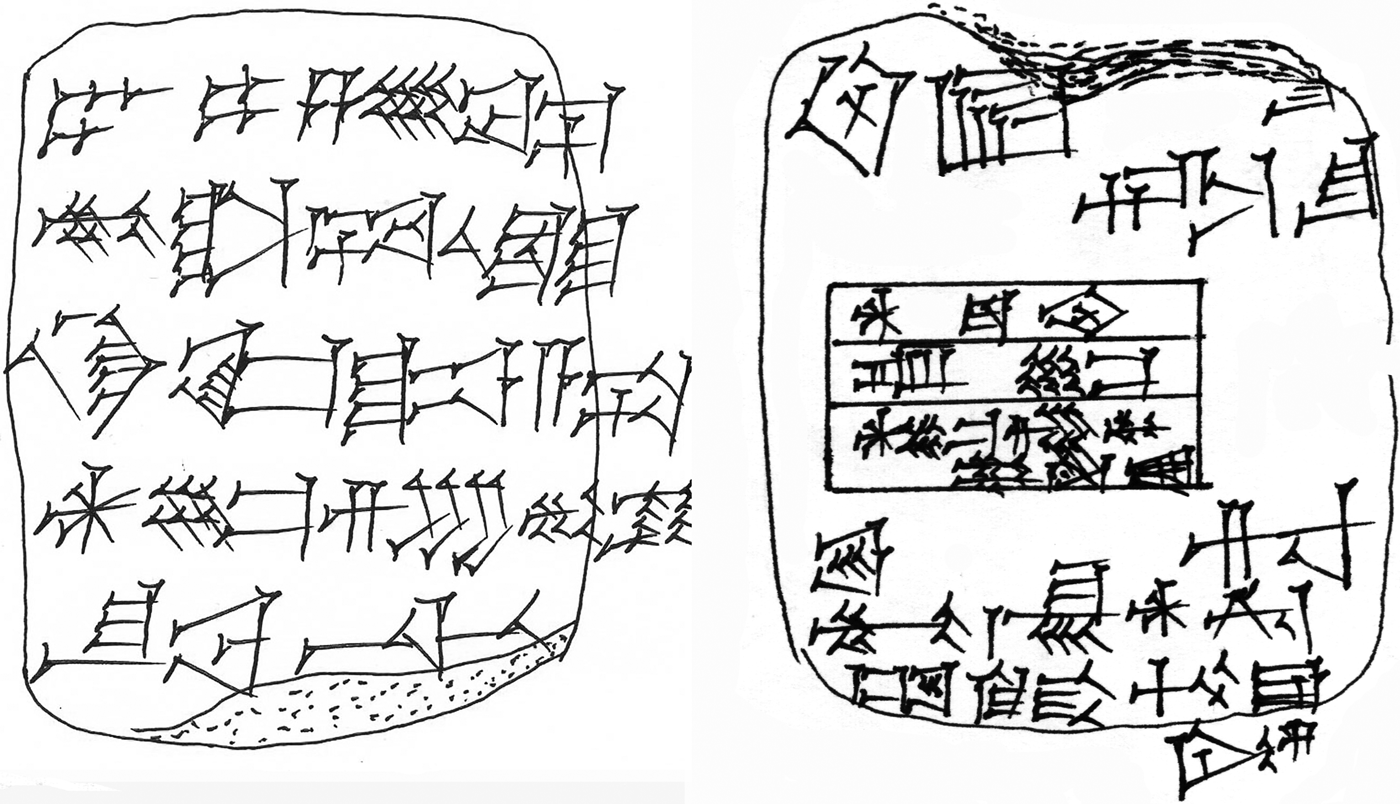
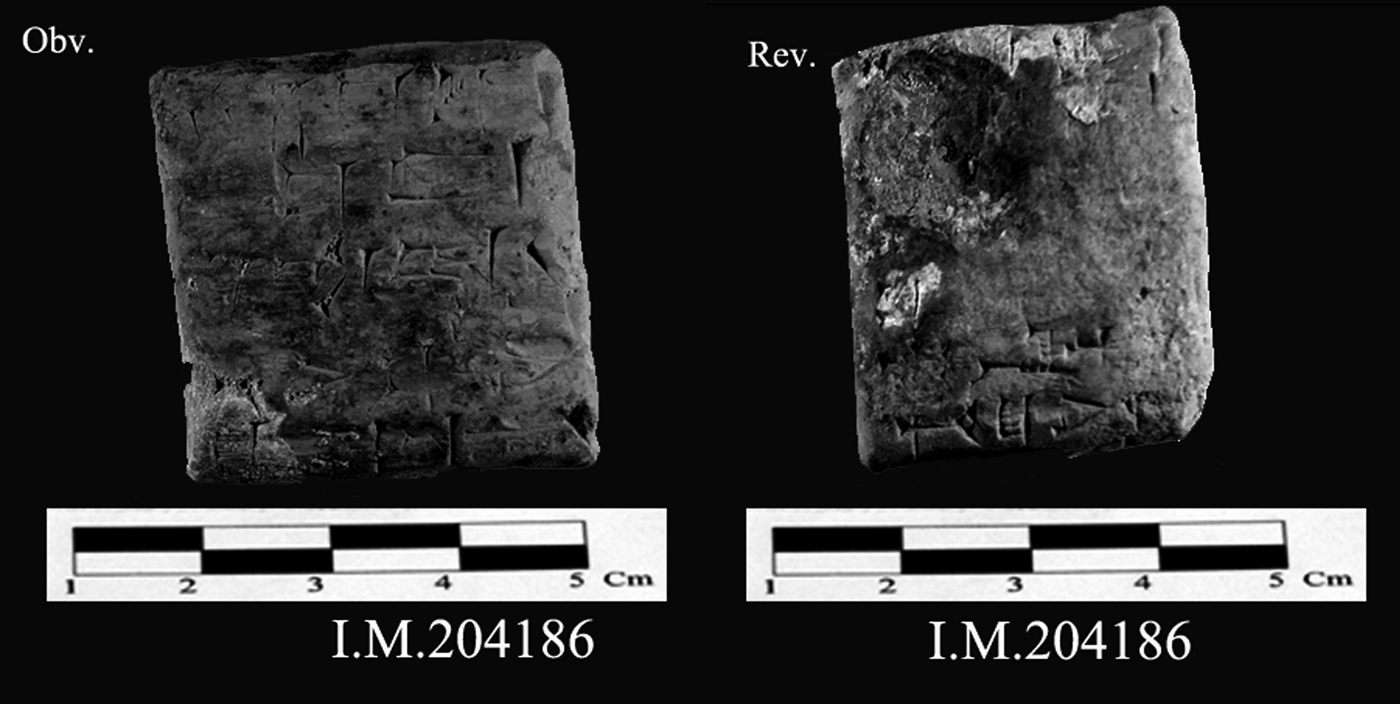
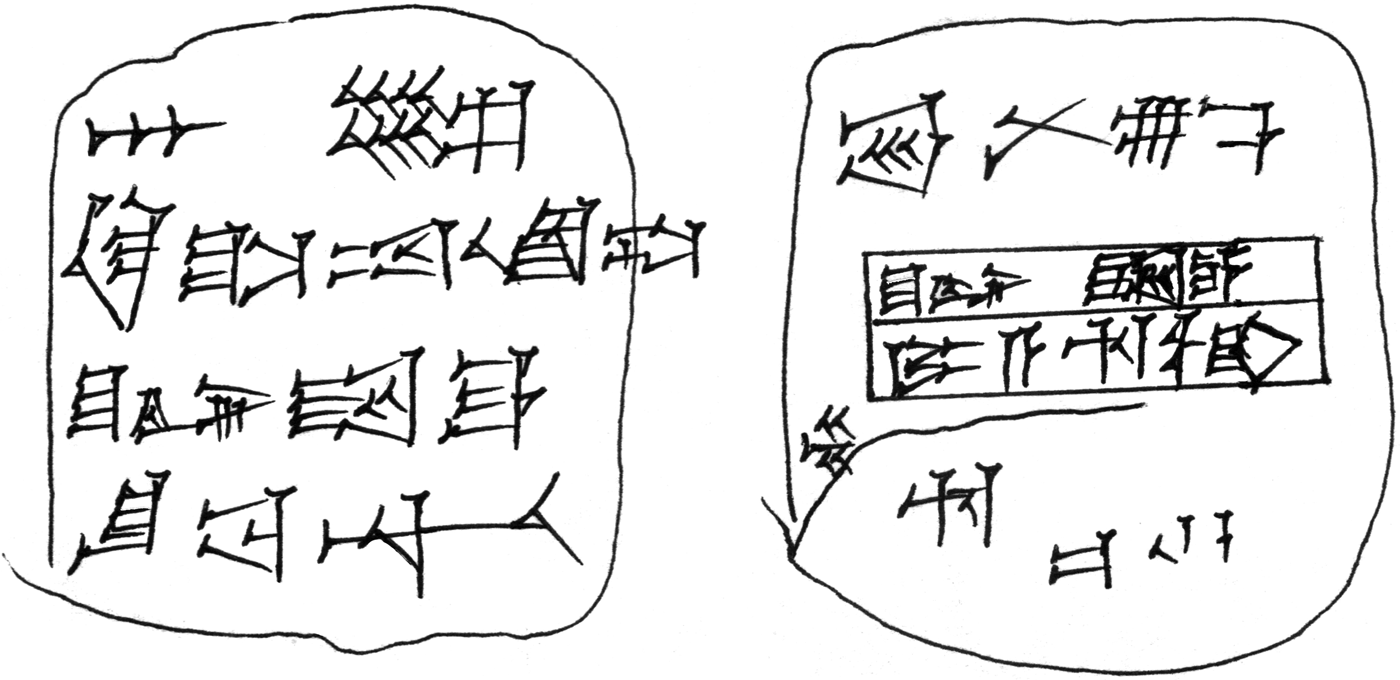
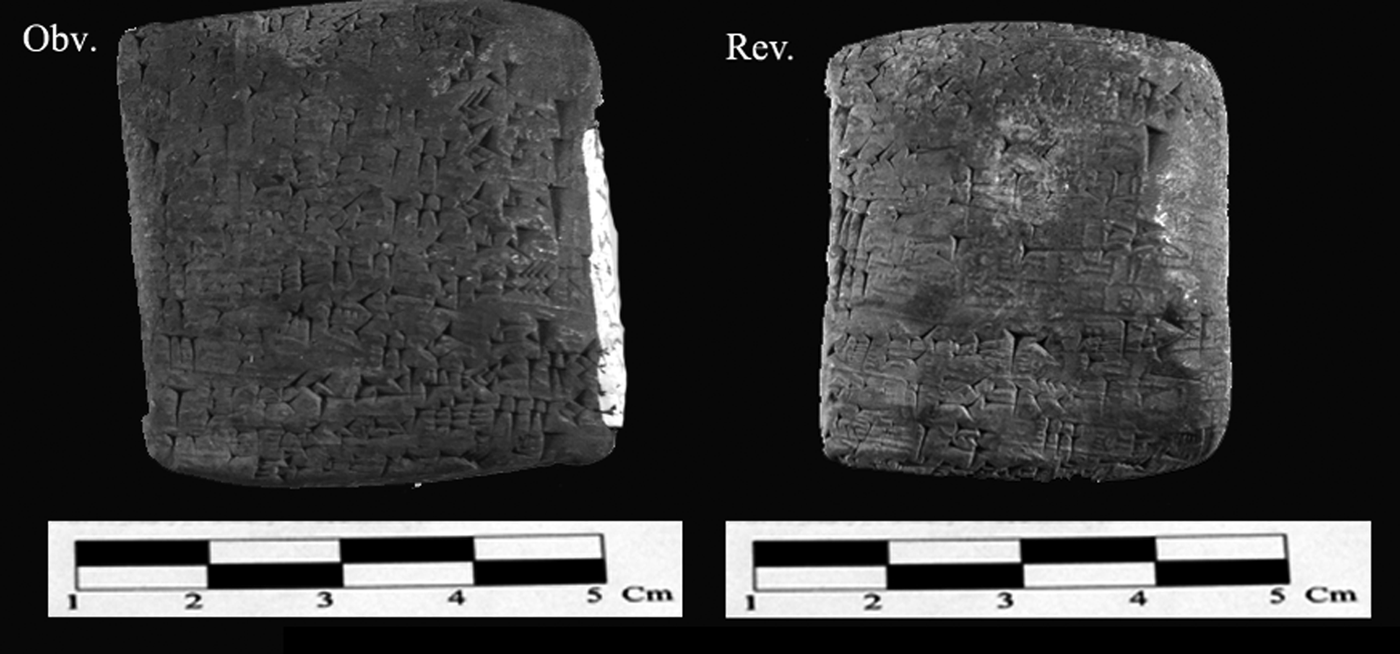
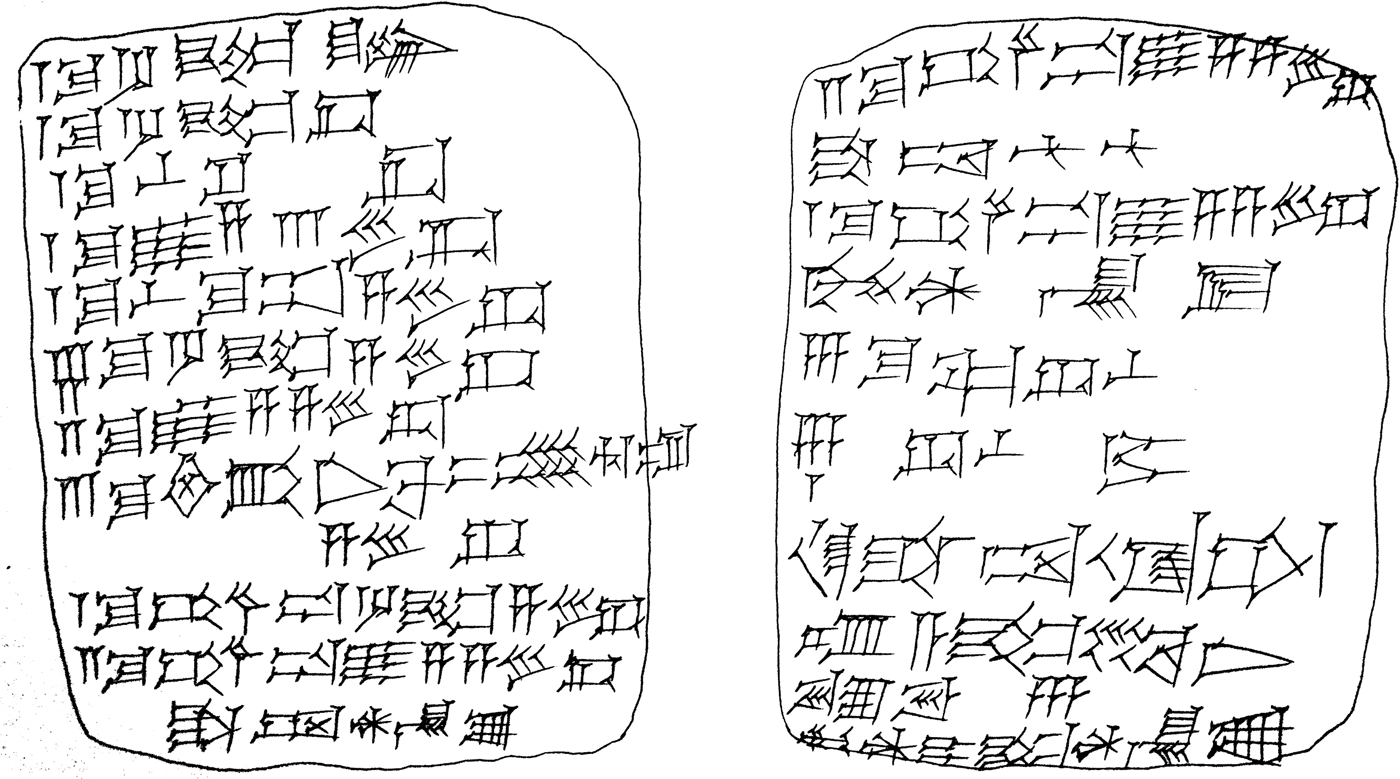
Translation: Obv. 1–11: 1 royal ceremonial garment, 1 ceremonial garment second quality, 2 headbands second quality, 1 tufted textile third quality, 1 over-garment fourth quality, 5 ceremonial garments fourth quality, 2 tufted textiles fourth quality, 3 šagadu-garments of the batabduhhûm variety, 1 ceremonial nahlaptum-garments fourth quality, 2 tufted nahlaptum-garments: Šāt-Su'en. Rev. 1–2: 2 tufted nahlaptum-garments third quality: Šāt-Nūnu. Rev. 3–4: 1 tufted nahlaptum-garment fourth quality: Geme-Enlil. Rev. 5–8: 6 top quality weaver's textiles, 7 small weaver's <textiles>, from (the estate of) Šāt-Eštar. Received by Abituni. Seal-impression: Abituni, son of NE-NE-a, fuller of Šarakam. IS 01-08-00.
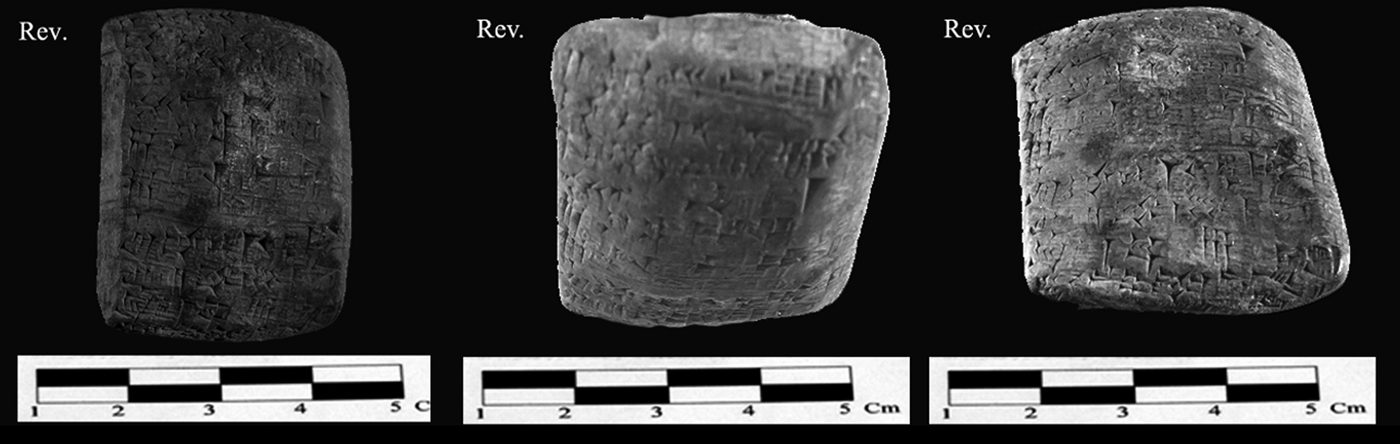
photos of Text 5 obv. and rev.

photos of Text 5 rev. from angles.

copy of Text 5 obv. and rev.

Commentary
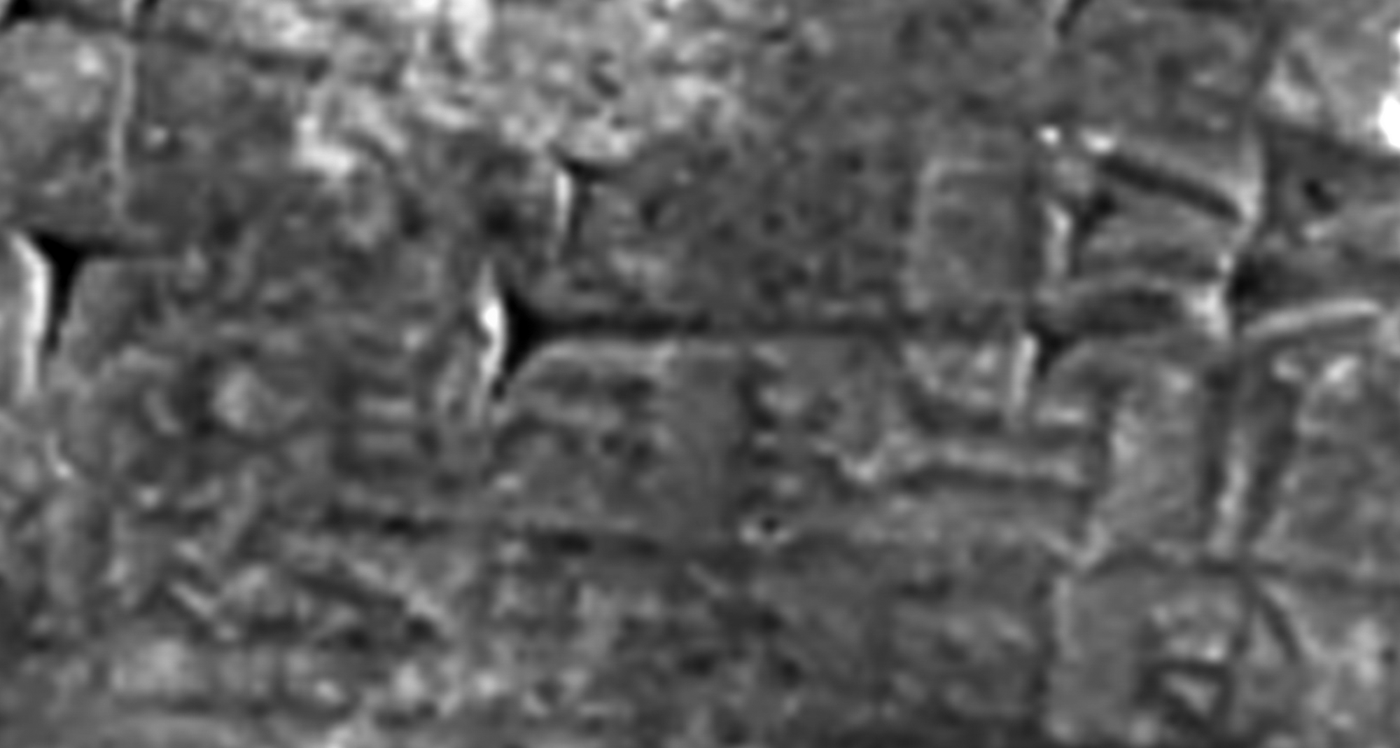
This is apparently a laundry list for various high-status women, sealed by Abituni, the “fuller of Šarakam”. Šāt-Eštar is the wife of Šarakam, as we learn from the seal in Text 1 and she is the only woman's name with ki … –ta “from (the estate of)” in the text, while the others are simply placed in apposition to lists of garments. Her access to or relationship with Abituni thus seems to be highlighted. Interestingly a Šāt-Su'en is attested at Irisaĝrig in a text from around the same time as this one.Footnote 15 A Šāt-Su'en “daughter of the king” is also attested there in a document from ŠS 03.Footnote 16 There is also a Šāt-Su'en dumu-munus lugal in tablets from Puzriš-Dagan from the time of the end of the reign of Šulgi.Footnote 17 The fact that Šāt-Su'en is associated with more garments than any other in our document may be significant. The name Šāt-nūnu is attested in a document from Irisaĝrig dated to IS 01-00-00, where she seems to be one of a group of female millers, so unlikely to be identical with this one.Footnote 18 The name Geme-Enlila is attested in a number of documents from Umma, one of which has an association with “tufted” textiles.Footnote 19 There is also queen Geme-Enlila, spouse of Ibbi-Su'en, a princess of the same name from the same period and a lukur-woman of Ninurta.Footnote 20 For Abituni and his seal see Nisaba 15/2 0645 and 0649, where the name on the seal is clearly spelled differently to the way it is spelled here on the tablet (rev. 8): a-bu ?-tu 9-ni. This spelling may be reflected in the seal on Text 5, however (fig. 12), although it is dificult to see. The spelling of his name and that of his father also appears to be different on the seals edited in Saadoon Reference Saadoon2010 Texts 22, 23 and 25: a-bi2-tu-ni, where the cuneiform copies also indicate that he is son of NI-NI-a, rather than NE-NE-a. The garments listed are high quality items which would have taken a long time to produce.Footnote 21 As fuller to Šarakam Abituni would have occupied an important position. It is unclear why he is also taking responsibility for the clothes belonging to the other women mentioned in this document and why only Šāt-Eštar's clothes are designated as “from (the estate of) PN”, but these details may indicate that she is the primary agent in the transaction.
detail of seal of Abi/utuni, fuller of Šarakam


Translation: (Obv. 1′–3′) […] 160 (litres of) dates, 20 (litres of) barley for the porter of Nergal (Rev. 1.–2) booked from (the estate of) Šāt-Eštar. Date: xx.08.xx
photos of Text 6 obv. and rev.

copy of Text 6 obv. and rev.

Commentary
Tablet attesting a levy of dates and barley (as well as other materials lost in the break) from (the estate of) Šāt-Eštar for the “porter of Nergal”. Porters of deities are attested: Inana (ITT 4, 07311 ii 12, Ĝirsu); Šara of Umma (BPOA 1, 1624 obv. 2, Umma); and Lamma-Šū-Su'en (BPOA 1, 1409 obv. 3, Umma). A temple of Nergal is not yet attested at Umma, but there appears to have been one at Irisaĝrig.Footnote 22 One document from Umma mentions temples of Nergal at Garšana and at Niĝsuda, a place-name which is apparently only mentioned on Umma tablets during the Ur III period.Footnote 23

Translation: Šāt-Eštar, daughter of the king, wife of Šarakam, the scribe.
photos of Text 7 obv. and rev.

copy of Text 7 obv. and rev.

Commentary
A square-shaped rectangular nodule with traces of attachment to something else on both sides, impressed with a seal of Šāt-Eštar, which is identical to the seal-impression on Text 1.
Discussion
There are two main divisions among the texts that are currently available. On the one hand we have the documents from Irisaĝrig, and on the other we have documents from Umma. Šāt-Eštar was obviously a popular name in Irisaĝrig, as the attestation of various daughters of dependent workers attests in the large document Nisaba 15/2 0953 demonstrates. A further document with envelope from Irisaĝrig (Nisaba 15/2 0457a+b) records a receipt by someone of barley (belonging to) a Šāt-Eštar wife of Šarakam. This was presumably a socially higher individual than the women mentioned in Nisaba 15/2 0953. The new texts published herewith in fact confirm that this is the same person as the one who is mentioned on the tablets from Umma whose seal tells us she is a princess.
This means that there must have been a close connection between Irisaĝrig and Umma as far as Šāt-Eštar's affairs were concerned. According to M. Molina it took four days to tow a boat upstream from Umma to Irisaĝrig, a distance which he calculates on the basis of the evidence presented by Nisaba 15/2 1036 at around 62 km.Footnote 24 Nisaba 15/2 0985 contains a receipt for sheep hides from the estate of Šāt-Eštar, taken in receipt by Agatia. According to what is preserved of the month-name, it could either be an Umma tablet or one from Irisaĝrig. The seal calls Šāt-Eštar a dumu-munus lugal, and also mentions Agatia, with a further epithet or predicate that is not easy to decipher: KA al-DU-a. D.I. Owen excludes this document from the Irisağrig archive due to the fact that it mentions the princess Šāt-Eštar on the seal, and due to the presence of Agatia, who also appears in Saadoon Reference Saadoon2010 Text 3, and is connected with the receiver Abituni in Saadoon Reference Saadoon2010 Text 2, which also mentions the princess Šāt-Eštar.Footnote 25 However, given the clear connection between Šāt-Eštar the wife of Šarakam who is attested in Irisaĝrig (Nisaba 15/2 0457a+b) and the Šāt-Eštar wife of Šarakam attested at Umma, the fact that Agatia is associated with Abituni, also known from Umma, should not exclude that she is also active in Irisaĝrig.
Agatia could be used as a female name, as a tablet from Irisaĝrig informs us.Footnote 26 Possibly Agatia is acting as a representative of the princess Šāt-Eštar and this is the signification of the epithet or predicate KA al-DU-a (“carrying the word for”?) given to Agatia as preserved on the seal of Šāt-Eštar on Nisaba 15/2 0985. This would mean that the seal on Nisaba 15/2 0985 is actually the seal of Agatia. The other character who appears in connection with the princess Šāt-Eštar at Umma is Abi(n)tuni, whose seal on Nisaba 15/2 0649 tells us he is the son of NE-NE-a, and by profession a (“royal?” according to Owen's interpretation) fuller. There was also some doubt about the provenance of this tablet, whether it was from Irisaĝrig or not, as the month name is a common one.Footnote 27 The similar content with regard to a transfer of specific textiles again involving Abituni in text no. 5 presented above now makes it very likely that Nisaba 15/2 0649 is in fact from Umma. Text 5 (above) also clarifies the fact that Abituni is the fuller of Šarakam, rather than being a fuller of the king.Footnote 28 Abituni is thus far attested only in texts from Umma, but the name Agatia is attested in texts from Umma and Irisaĝrig without any assurance that this is the same person, and Šāt-Eštar wife of Šarakam is attested in texts from both Umma and Irisağrig. It thus does not seem possible to decide on the basis of the currently available data which of the towns Umma or Irisaĝrig the document Nisaba 15/2 0985 comes from, although the close economic and political relationship between the two seems to be well established. The princess Šāt-Eštar, at least according to the data provided by the new documents, seems to have been based in Umma, a central province with royal estates, but clearly had economic interests in Irisaĝrig, a slightly more peripheral city from the perspective of the dynastic centre of the Ur III state.
Princess Šāt-Eštar's husband Šarakam is attested on seal-impressions on Text 1, Text 2, Text 5 and Text 7, i.e. from ŠS 5 to IS 2. Šarakam (“the one of Šara”) was a popular name at Umma, due to the temple (e2-mah) of Šara which was located there. The BDTNS database currently contains 994 instances of this name in Umma texts attested from Šulgi year 22 as far as Ibbi-Su'en year 3. On the basis of patronymic data, at least 22 separate individuals with this name can be identified at Umma. There are attestations of a name and profession dšara2-kam dub-sar on 21 tablets, five of which come from Umma and partially overlap in time with the mentions of Šarakam on seal-impressions on the documents published here.Footnote 29 Additionally a Šarakam, scribe and son of Nūr-Su'en, appears on two seals found on a group of homogeneous looking documents from Garšana dated from ŠS 09–11 to IS 03–07, thus overlapping with our documents chronologically.Footnote 30 There is also a reference to a Šarakam, governor of Ĝirsu in a document from Garšana, dated to AS 5.Footnote 31 Attempts by Steinkeller to locate Garšana have most recently put it to the southeast of the Umma region bordering Ĝirsu, although it is also positioned by others to the north(west) of Umma.Footnote 32 There is a Šarakam who is director of operations at Puzriš-Dagan during the period of Amar-Su'en,Footnote 33 and there is a further Šarakam “scribe” in a number of documents from Irisaĝrig from the very end of Amar-Su′en and beginning of Šū-Su'en's reigns.Footnote 34
Šarakam the governor of Ĝirsu under Amar-Su'en is tentatively identified by F. Weiershäuser with the Šarakam son of Inim-Šara, whose family (in particular his wife) is closely associated with the business of the estate of queen Šulgi-simtī in the years Š 40–46.Footnote 35 This could be an earlier Šarakam to Šarakam husband of Šāt-Eštar. However, there is no substantive reason to disassociate Šarakam the scribe who is the husband of princess Šāt-Eštar from Šarakam governor of Ĝirsu in the reign of Amar-Su'en. If Šarakam the scribe is attested at Umma in Amar-Suen year 6, it is perfectly possible (although not necessary), for the same person to have carried the title ensi2 at Ĝirsu at the same time.Footnote 36 See for comparison the career of Šū-Kabta, general and doctor, also married to a princess, Simat-Ištaran, as illustrated by the Garšana-archives.Footnote 37
On the other hand it is possible that Šarakam the scribe in our texts is identical with Šarakam the director of operations at Puzriš-Dagan during part of the reign of Amar-Suen, especially if this Šarakam can in turn be identified with Šarakam the scribe who appears as an “officer” (maškim) on a later tablet from Puzriš-Dagan.Footnote 38 Here Šarakam the scribe appears in the role of maškim along with Babati, who was the uncle of king Šū-Su'en himself.Footnote 39 It would thus appear that Šarakam the scribe of this document could appear in the same context and role as the highest of Ur III officialdom with close relations to the throne. It does not have to be thought unlikely that an official as important as Šarakam appears to have been at Puzriš-Dagan during the middle years of Amar-Su'en should now be called “Šarakam the scribe” at the beginning of the reign of Šū-Suen. Multiple posts could be held at the same time, and his qualification as scribe is not necessarily indicative of a demotion nor is it an indication of rank in the same fashion as the office of maškim might indicate, however temporarily.
As a methodological principle, however, one should strive to keep these different names in different places provisionally separate, even when they have the same title, until incontrovertible evidence, such as patronymic and other prosopographical data are found. However, if Šarakam the scribe and husband of princess Šāt-Eštar was a sufficiently important person, it is perfectly possible that he was operating in more than one of these geographically close locations. A very similar mobility (Nippur, Puzriš-Dagan, Irisaĝrig, Zabalam, Garšana and Ĝirsu) is also attested for the comparable couple Šū-Kabta and princess Simat-Ištaran.Footnote 40 Unfortunately there does not appear at the current stage of research to be a significant prosopographical overlap in the present documentation between any of these identifiable individuals named Šarakam the scribe and the group of names associated with Šāt-Eštar, wife of Šarakam the scribe, apart from that of the fuller Abituni. A more in depth investigation than can be the subject of this publication may yet bring such results.
As stated, the princess Šāt-Eštar would appear to have been based in Umma, as the majority of texts mentioning her thus far seem to come from there. According to an analysis advocated among others by P. Michalowski, the Ur III kings married their daughters to high officials or their sons in order to secure their loyalty while they were in post.Footnote 41 The business of her estate included dealing with textiles and sheep, dates, barley and probably agricultural implements. As mentioned earlier, this hints at access to considerable capital reserves, which may have derived either from her husband's estate or from royal holdings, if the distinction can in fact be said to make any difference. She may have been represented in Irisaĝrig by a woman called Agatia, if Nisaba 15/2 0985 in fact comes from there, and the epithet applied to Agatia can be interpreted as indicating that she is Šāt-Eštar's advocate. Such a connection, although tentative, allows an insight into the way in which a member of the royal family with estates in a central province (Umma) could utilise connections in order to extend her economic activity and thus that of the royal family into areas that were slightly further away from the dynastic seat. Unless a connection is attested between Agatia and the sphere of Šarakam, it appears that this is independent activity of Šāt-Eštar that is being conducted here, in a similar manner to the way it is attested for Simat-Ištaran in Garšana, who continues in economic activity independently from her husband Šū-Kabta after his death.Footnote 42
Connections between the estate of Šū-Kabta and princess Simat-Ištaran in Garšana also appear to be upheld with the city of Irisaĝrig, as these figures appear in the texts from there. References are made in Garšana texts to an a-ga-ti, who is the sister of Šū-Kabta.Footnote 43 It cannot be assumed that this is the same person as a-ga-ti-a who is the “representative” of Šāt-Eštar, especially given that another person called a-ga-ti-a is mentioned in the same text (dumu-munus ul-luh-uri5ki).Footnote 44 However, it also cannot be excluded that they are the same, and a sister of Šū-Kabta, also married to a princess and thus likely a relative of Šāt-Eštar, would make an excellent contact for her. Further research into the prosopographical relationships between Garšana, Irisaĝrig and the circles of Šū-Kabta and Simat-Ištaran, Šarakam and Šāt-Eštar would be promising.
Šāt-Eštar seems to have collaborated closely in textile conservation or cleaning with Abituni, the fuller of Šarakam, her husband, and this occasionally - as per Text 5 - on behalf of other women of Umma, although the precise relationship between the participants is not clear. Two of the women share names with princesses: Šāt-Su'en and Geme-Enlila, the latter also being the name of Ibbi-Su′en′s queen. If these identities in name correspond to personal identities, then Text 5 throws an interesting light on the organisation of everyday life among the female members of the royal household. Šāt-Eštar has connections to a fuller via her husband's circle of dependents. This is not to say that the other princesses did not have such access, but possibly hints at an occasion where Šāt-Eštar needs to intervene on their behalf in procuring a fuller's services.
Furthermore, Šāt-Eštar also conducted dealings using other intermediaries who were servants of her husband, as shown by the intercession of Šulgi-mudah in the transaction recorded in Text 2. These relationships demonstrate the way in which the infrastructure of the Ur III state was supported by networked structures belonging to semi-independent hierarchies outside of the royal family's direct chain of command. Šarakam had his own dependents or servants, and Šāt-Eštar, a member of the royal family, is able to mobilise these in addition to her own dependents, such as Agatia.
Women of the Ur III royal family typically had cultic responsibilities. The recent book of T.M. Sharlach has focussed on the role played by Šulgi-simtī, queen of king Šulgi, in sponsoring religious institutions and a similar role was clearly filled by Abī-simtī.Footnote 45 Text 6 may indicate support on the part of Šāt-Eštar's estate for the institution of the porter of Nergal, although it is unclear whether there was a Nergal temple in the city of Umma during the Ur III period. Nevertheless, this would be a pattern of behaviour comparable with that observed for royal women throughout the Ur III state. If the transaction in Text 6 in fact refers to the temple of Nergal at Irisaĝrig or indeed at Garšana (a district of Umma), then this further underscores the close connection between Šāt-Eštar and either of these places, which has been remarked on previously in this discussion.
Who was Šāt-Eštar?
The question of how we divide up the different attestations of the name Šarakam, especially with the professional designation “scribe”, has an effect on how we imagine Šāt-Eštar might have been related to the royal family. There may be some grounds for thinking her a daughter of Šulgi, possibly supported by her connection to a Šāt-Su'en who may be identical with the Šāt-Su'en who is attested as a princess at the end of the reign of Šulgi. On the other hand she is also associated in the same document with Geme-Enlila, the name for two royal women of the time of Ibbi-Su'en, and there is a Šāt-Su'en from the time of Šū-Su'en as well at Irisaĝrig. One might also consider that Šulgi had a son called Šū-Eštar, the masculine counterpart to Šāt-Eštar. However, such an early date for Šāt-Eštar and Šarakam is prosopographically difficult.
If we associate, for example, our Šarakam with the son of Inim-Šara whose family was involved in business with the estate of queen Šulgi-simtī at the end of the reign of king Šulgi, then he would have been in a fairly advanced middle age by the time of our documents, which start in ŠS 05. He would also have to have become separated from or lost his wife of the Šulgi period and married Šāt-Eštar. In the mean time he might have filled a very senior post at Puzriš-Dagan during the reign of Amar-Su'en, while also being ensi at Ĝirsu (unless this is a different person), and then started calling himself dub-sar during the reign of Šū-Su'en. However, this may not be the most convincing biography and it does not account for the fact that none of the documents mentioning Šāt-Eštar as a princess are attested before ŠS 05.Footnote 46
Given that it is obvious that there were many people of the name Šarakam living at around the same time, and quite possibly more than one calling themselves Šarakam dub-sar, we should perhaps exploit the fact that Šāt-Eštar is first attested as a “daughter of the king” in the reign of Šū-Su'en and suppose that said king might be her father. Šū-Su'en's primary wife or queen was Kubātum.Footnote 47 Daughters of the king are mentioned during Šū-Su'en's reign, but also specifically a “daughter of Kubātum”, whom W. Sallaberger has identified with Geme-Enlila, the queen of Ibbi-Su'en.Footnote 48 Note that we saw a connection between Šāt-Eštar and a Geme-Enlil in Text 5 presented here. Šū-Su'en also had three further secondary wives that we know the names of, one of whose “water-drinking place” receives a posthumous offering in ŠS 06: Takūn-mātum (lukur lugal).Footnote 49 Unless she died young, this may indicate that she was at that time at the very least of a reasonably advanced age and she may also have been dead for some time. So Šāt-Eštar may have herself at least have been grown up by the time of her death. Whoever her mother was, and there are doubtless many women in the royal household who have thus far not been identified in the documentation, Šāt-Eštar would have needed to be of marriageable age at least by the time of ŠS 05.
It is also possible that Šāt-Eštar is a daughter of Amar-Su'en by Abī-simtī, for example. She has connections with a woman called Agati(a), who may appear in a document from Garšana in which Abī-simtī also occurs.Footnote 50 Furthermore, many of Šāt-Eštar's activities in Umma and further abroad appear to mirror those of the better attested Simat-Ištaran in the Garšana archive and elsewhere, who was herself perhaps a daughter of Amar-Su'en.Footnote 51 This is of course no probative argument, but it is quite possible that two princesses acting in similar ways over the same time period in neighbouring areas might themselves be related, both having been married into important local families at around the same time as part of a concerted imperial strategy to gain more traction in the significant families of the administration on whom the state was itself all too dependent.
Conclusion
The tablets published herewith do not yet provide us with enough information to identify precisely how the princess Šāt-Eštar was related to the royal family of Ur. She would appear to have been married to a high-status official of the Ur III state, although it is difficult to work out precisely which attestations of the name Šarakam correspond to which historical individuals. Šarakam the scribe, the husband of Šāt-Eštar, may have shared roles with individuals close to the king, such as the uncle of Šū-Su'en, even if a broader biography is not yet definitely visible. He had a personal fuller in his wider household or retinue, with whom Šāt-Eštar had some dealings which may have been further connected to other female members of the royal family. Šāt-Eštar also conducted her own business, using both her husband's and her own resources and intermediaries, and may have been involved in the support of specific religious institutions in a similar fashion to other Ur III royal women. The documents of the Šāt-Eštar dossier that are currently available provide invaluable detail on the relationship between the local authority of officials and that of the royal family. They are especially useful as regards the prospects they offer for studying the relations between Umma as a central provincial city with royal estates and the not too distant cities of Irisaĝrig, where Šāt-Eštar appears to have had contacts, and Garšana (part of the district of Umma), where the somewhat comparable figures of princess Simat-Ištaran and Šū-Kabta had an estate. Like Simat-Ištaran, who conducted affairs in Nippur, Zabalam and Garšana, she may well have had estates outside of the city of Umma. The documents also extend our knowledge concerning royal women in the Ur III period considerably, by throwing light on a figure who until very recently was not represented or identified in the documentation at all.
Acknowledgements
I would like to express my thanks to the Director General of Iraqi Museums, Mr Oais Huseen Rashed for allowing me to study these texts. I would also like to thank the manager of the cuneiform department in the Iraq Museum, Ms Elham Shaker Jawad and all members of her team. The author would also like to acknowledge a debt of gratitude to Dr Mark Weeden, SOAS University of London, and to Prof. Steven J. Garfinkle of Western Washington University, for valuable insights, and to Prof. Manuel Molina, Centre of Humanities and Social Studies (CSIC) in Madrid for suggesting the topic in the first place.