Introduction
Weight excess disorders, affecting all ages and racial/ethnic groups, are a serious public health problem worldwide. The prevalence of obesity has continued to rise, while the age of onset has dropped.Reference Shaw, Sicree and Zimmet 1 In China, the prevalence of obesity and diabetes in children have been increasing.Reference Yu, Han and Chu 2 It is now realized that an adverse intrauterine environment increases the susceptibility to chronic disease such as obesity, hypertension, diabetes and cardiovascular diseases in the offspring, extending well into adulthood.Reference Spencer 3 In particular, the exposure to maternal gestational diabetes mellitus (GDM) increases the risk of offspring obesity and subsequent diabetes,Reference Malcolm 4 a worldwide observation involving different racial groups such as the Pima Indians, Caucasians and Asians.Reference Kim, England, Sharma and Njoroge 5 Little is known, however, about the magnitude of risk for obesity in offspring that is attributable to maternal diabetes in utero in mainland Chinese population. We have noted that exclusive breast feeding may reduce the risk of offspring overweight at the age of 2–8 years in the offspring of GDM mothers.Reference Zhao, Ma, Huang, Liang and Ding 6 To clarify the independent effects of GDM, maternal obesity on childhood overweight and obesity, we examined a cohort of children at age 1–10 years in a mainland Chinese population to examine these issues. We also examined the impact of breast feeding on the effect of maternal GDM on childhood overweight and obesity.
Methods
Our hospital is a tertiary referral center for high-risk pregnancies in Yunnan province, China, with an average of 3200 deliveries annually.Reference Ma, Lao and Sun 7 All women with risk factors for GDM underwent a 75-g oral glucose tolerance test (OGTT) at ⩽12 weeks gestation; if the initial results were normal, the OGTT was repeated at 28–32 weeks gestation,Reference Ma, Lao and Ma 8 , Reference Du, Ma and Lao 9 preferably at 28 weeks. All women at low-risk for GDM underwent an OGTT at 28–32 weeks gestation. No preliminary challenge test was used. We have applied the 1999 WHO diagnostic criteria for GDM since January 1, 2003.Reference Kousta, Lawrence and Penny 10 On the basis of the 75-g OGTT results, the mothers were classified as follows: normal glucose tolerance (NGT); impaired glucose tolerance (IGT; fasting blood glucose <7.0 mmol/l and 2-h postprandial blood glucose ⩾7.8–11.0 mmol/l); and diabetes mellitus (DM) (fasting blood glucose ⩾7.0 mmol/l or 2-h postprandial blood glucose ⩾11.1 mmol/l) groups, and the category of GDM includes both gestational IGT and DM. Women diagnosed with GDM are instructed to monitor their blood glucose values and received dietary advice. If the fasting blood glucose was ⩾5.3 mmol/l and the 2-h postprandial blood glucose was ⩾7.0 mmol/l, insulin therapy was initiated. Since 2003, maternal data, including ethnicity, age, height, educational level, occupation, marital status, smoking status, parity, pre-pregnancy weight, pre-pregnancy body mass index (BMI), blood pressure, OGTT results, the family telephone number and paternal data, including weight, height, blood pressure and a family history of DM, were obtained at the first antenatal visit and entered into the maternal database. Maternal obesity was defined as BMI⩾27 kg/m2. Birth data, including date of birth, gestational age, mode of delivery, birth weight, length, gender, Apgar scores, congenital birth defects, neonatal hypoglycemia, hyperbilirubinemia and perinatal death, were captured in the neonatal database and clinical records of the neonatal intensive care unit.
In mainland China, regular physical examination and monitoring of growth pattern for children are performed four times during the infancy, twice annually up to 2 years of age, and annually from the age of 3 years, as per government policy (Law of the People’s Republic of China on Maternal and Infant Health Care). Weight and height measurements were taken using calibrated instruments according to standard protocols by trained healthcare professionals, and recorded in parental reports, which include also the current weight and height of the parents. For this study, the subjects were children who were born in our hospital between January 1, 2003 and December 31, 2011. Data for this study, including the mode of feeding during the 1st year of life, was collected by trained pediatricians via telephone interview of parents who extracted these measurements from the parental reports during the period March 2012 to February 2013, after obtaining informed consent from the parents. Birth size was categorized as large-for-gestational age (LGA, birth weight ⩾90th percentile), appropriate-for-gestational age (AGA, birth weight ⩾10th and <90th percentile) and small-for-gestational age (SGA, birth weight <10th percentile) according to our own sex-specify birth charts.Reference Zhang, Ma and Wang 11 Using the BMI growth curves for Chinese children and adolescents at 0–18 years of age,Reference Li, Ji, Zong and Zhang 12 overweight in boys was defined as BMI⩾82nd percentile for age, and obesity was BMI⩾96.3 percentile for age, while in girls overweight was BMI⩾87.4 percentile for age and obesity was a BMI⩾98th percentile for age.
For each eligible case, the inclusion criteria included: (1) the mother had received regular antenatal care at our hospital during the index pregnancy; (2) singleton pregnancy; (3) delivery at gestational age ⩾37 weeks; (4) the mother was living in Kunming during pregnancy and after birth; and was a member of the Kunming urban population; (5) the mother had no known type 1 or type 2 diabetes before pregnancy. The study was approved by the Health Administrative Departments of Yunnan Province, and the Medical Ethics Committee of the university.
Statistical analysis
All data were expressed in means±s.d., or proportion (%). The prevalence of overweight and obese offspring at 1–2, 2–5 and 5–10 years of age between the groups was analyzed using χ2 test. Univariate analysis was used to examine the incidence of and factors associated with overweight and obesity in the children born to mothers with and without GDM. Multiple logistic regression analysis was used to examine the independent roles of the factors identified in the univariate analysis. The confounding factors adjusted for included maternal age, educational level, occupation, marital status, smoking status, parity, maternal glucose concentrations at the OGTT, gestational age at delivery, weight gain, mode of delivery (cesarean section) and parental current weight, height and BMI. A P value<0.05 for two-tailed statistical tests was taken to indicate significance. All statistical analyses were performed using SPSS17.0 statistical software.
Results
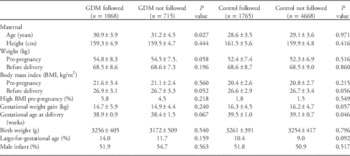
There were 8216 children with available data that satisfied our study inclusion criteria. Of the 8216 children with available data and who were eligible for inclusion in the study, the parents of 3536 (43.0%) children could not be contacted, and the parents of 1816 (22.1%) children declined to participate. Excluded were 12 children with childhood medical conditions that would interfere with growth, 15 children had moved away with their families after birth and another four died. The final study group therefore consisted of 2833 (34.5%) children with parental consent for the study. Comparison was made between those included and not included in the study for both the GDM and control pregnancies (Table 1). In the GDM pregnancies, those included in the study had only a slightly but significantly younger maternal age, but no difference in infant outcome, compared with those not included. In the control pregnancies, those included had a slightly but significantly longer gestational age, and no other differences, compared with those not included. Among these 2833 children, 1068 (38%) were born to mothers with GDM (554 males and 514 females), and included 149 LGA cases, 771 AGA cases and 148 SGA cases. The other 1765 (62%) children were born to mothers with NGT (control group, with 915 males and 850 females), including 184 LGA cases, 1401 AGA cases and 180 SGA cases. The age at study ranged from 1 to 10 years.
Comparison of gestational diabetes mellitus (GDM) and control group by follow-up status

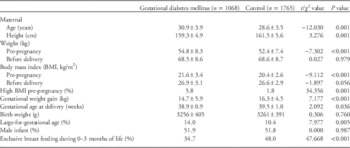
Comparison of maternal and newborn characteristics between the GDM and control groups
The GDM mothers were significantly older (30.9±3.9 v. 28.6±3.5 years, P=0.001), shorter (159.3±4.9 v. 161.5±5.6 cm, P=0.001), heavier before pregnancy (54.8±8.3 v. 52.4±7.4 kg, P<0.001) and had higher pre-pregnancy BMI (21.6±3.4 v. 20.4±2.6 kg/m2, P<0.001). Prevalence of pre-pregnant obesity was also higher among the GDM mothers (5.8 v. 1.8%, P=0.001). Gestational weight gain was greater in the control group (14.7±5.9 v. 16.3±4.5 kg, P<0.001). While the gestational age at delivery was shorter in the GDM group (38.9±0.9 v. 39.5±1.0 weeks, P=0.036), there was no difference in birth weight (3256±405 v. 3261±391 g, P=0.760) or incidence of male infants (51.9 v. 51.8%, P=0.987). However, the incidence of LGA infants was higher (14.0 v. 10.4%, P=0.005), while that for exclusive breast feeding for the first 3 months of life was lower (34.7 v. 48.0%, P<0.001) in the GDM group compared with control group (Table 2).
Maternal and infant characteristics in the study and control groups

Comparison of the prevalence of offspring overweight and obesity between the GDM and control groups at different ages
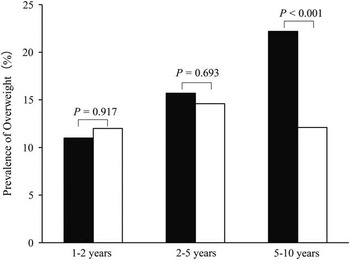
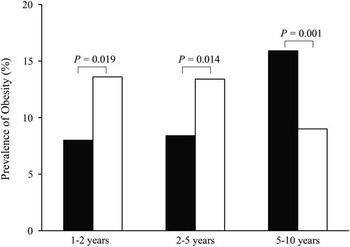
There were 178 overweight (16.6%) and 115 obese (10.7%) children in the GDM group, and 222 overweight (12.6%) and 212 obese (12.0%) children in the control group. Before 5 years of age, there was no difference in the prevalence of overweight between the GDM and control groups (1–2 years: 11.0 v. 12.0%, P=0.917; 2–5 years: 15.7 v. 14.6%, P=0.693, Fig. 1). However, the prevalence of obesity in the GDM group was significantly lower (1–2 years: 8.0 v. 13.6%, P=0.019; 2–5 years: 8.4 v. 13.4%, P=0.014, Fig. 2). After 5 years of age, the offspring of mothers with GDM had significantly higher prevalence of overweight (22.2 v. 12.1%, P<0.001, Fig. 1); and obesity (15.9 v. 9.0%, P=0.001, Fig. 2).
Comparison of prevalence of offspring overweight between gestational diabetes mellitus (GDM) group (■) and control group (□) at different age. Before 5 years of age, there was no difference in the prevalence of overweight between the GDM and control groups (1–2 years: 11.0 v. 12.0%, P=0.917; 2–5 years: 15.7 v. 14.6%, P=0.693). After 5 years of age, the offspring of mothers with GDM had significantly higher prevalence of overweight (22.2 v. 12.1%, P<0.001).

Comparison of prevalence of offspring obesity between gestational diabetes mellitus (GDM) group (■) and control group (□) at different age. Before 5 years of age, the prevalence of obesity in the GDM group was significantly lower (1–2 years: 8.0 v. 13.6%, P=0.019; 2–5 years: 8.4 v. 13.4%, P=0.014). After 5 years of age, the offspring of mothers with GDM had significantly higher prevalence of obesity (15.9 v. 9.0%, P=0.001).

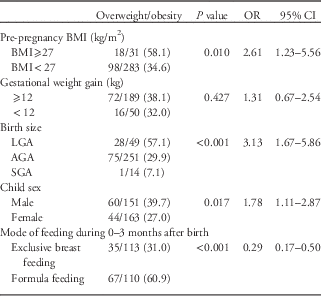
When the factors associated with offspring overweight and obesity at age 5–10 years in the GDM group were analyzed, the overall prevalence of overweight/obesity was 58.1% in children of GDM mothers with pre-pregnancy BMI⩾27 kg/m2 compared with 34.6% of children born to mothers with pre-pregnancy BMI<27 kg/m2 (P=0.01, Table 3). The LGA infants had increased prevalence of overweight and obesity than SGA offspring (57.1 v. 7.1%, P=0.001) and AGA offspring (57.1 v. 29.9%, P<0.001). Male children of GDM mothers had increased overweight/obesity (39.7 v. 27.0%, P=0.017). The incidence of overweight/obesity among children exclusively breast fed during the first 3 months of life was lower than children with formula feeding (31.0 v. 60.9%, P<0.001) (Table 3).
Incidence of overweight/obesity at age 5–10 years in offspring of women with gestational diabetes mellitus (n=314)

OR, odds ratio; 95% CI, 95% confidence interval; BMI, body mass index; LGA, large-for-gestational age; AGA, appropriate-for-gestational age; SGA, small-for-gestational age.
Results expressed in number (%).
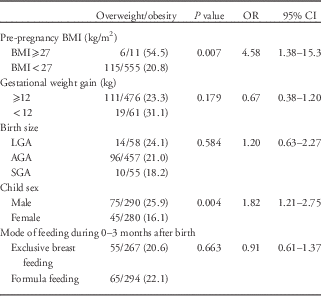
In the control group, children of mothers with pre-pregnancy BMI⩾27 kg/m2 had similarly increased prevalence of overweight/obesity than children of mothers with pre-pregnancy BMI<27 kg/m2 (54.5 v. 20.8%, P=0.007). Male children of control mothers had increased overweight/obesity than female children (25.9 v. 16.1%, P=0.004). There was no difference in incidence of overweight/obesity among the LGA, AGA and SGA offspring. The incidence of overweight/obesity among children exclusively breast fed during the first 3 months of life was similar to that of children with formula feeding (20.6 v. 22.1%, P=0.663) (Table 4).
Incidence of overweight/obesity at age 5–10 years in offspring of control mothers (n=570)

Results expressed in number (%).
OR, odds ratio; 95% CI, 95% confidence interval; BMI, body mass index; LGA, large-for-gestational age; AGA, appropriate-for-gestational age; SGA, small-for-gestational age.
Multiple logistic regression analysis was used to examine the independent role of GDM on the combined outcome of overweight/obesity in the offspring, adjusting for the effects of maternal pre-pregnancy obesity, children gender and age (Model 1). Maternal GDM was independently associated with children overweight/obesity with adjusted odds ratio (aOR 2.28), 95% confidence interval (CI) 1.61–3.22. This was not materially affected by the additional adjustment for birth size (Model 2, aOR 2.15; 95% CI 1.52–3.05) or exclusive breast feeding during 0–3 months of life (Model 3, aOR 1.85; 95% CI 1.29–2.67) (Table 5).
Multiple logistic regression analysis on the independent effect of gestational diabetes mellitus (GDM) on childhood overweight and obesity

aOR, adjusted odds ratio; 95% CI, 95% confidence interval.
Discussion
We found an increased prevalence of overweight and obesity at age 5–10 years in the offspring of mothers with GDM, which was independent of maternal obesity or birth size. Moreover, our study showed that after controlling for breast feeding during the first 3 months of life, GDM remained an independent determinant of offspring overweight and obesity.
Our study had an ideal control group defined with the same diagnostic criteria for GDM. Furthermore, mothers with GDM and the mothers in the control group were all insured in the same hospital and were urban residents who lived in Kunming city in China; thus, any differences in socioeconomic status and access to healthcare that could have influenced glucose control and nutritional intake in pregnancy, as well as the risk of obesity in offspring, were minimized. More than 90% of our study population was of Han ethnicity and fewer than 10% was minor ethnicity; this minimized the effects of ethnicity on GDM and the risk of obesity in children. Although not population based, the sample size of this study is, to the best of our knowledge, the largest on the children of mothers with GDM in the mainland Chinese population, who were all residing in one city and were delivered in one hospital.
A small number of studies have examined the impact of maternal diabetes on offspring overweight and obesity.Reference Gillman, Rifas-Shiman, Berkey, Field and Colditz 13 , Reference Lawlor, Fraser and Lindsay 14 , Reference Hillier, Pedula and Schmidt 15 The crude ORs for the relationship between GDM and childhood overweight or obesity ranged from 0.7 to 6.3. Among Chinese populations, Tam et al.Reference Tam, Ma and Yang 16 , Reference Tam, Ma and Yang 17 reported that maternal GDM increased the offspring’s cardiometabolic risk at 8 years of age and the risk of overweight at 15 years of age. In our study, we found that maternal GDM remained an independent determinant of offspring overweight/obesity (aOR 2.15, 95% CI 1.52–3.05) at age 5–10 years even after adjustment for maternal obesity and birth size. However, before 5 years of age, the prevalence of obesity was reduced in the offspring of mothers with GDM compared with the control group. The underlying explanation for this could be that after birth the growth rate in offspring of GDM mothers slowed down due to their removal from the enhanced in-utero growth stimulus, so that they reverted to their original genetically programmed growth rate. After the age of 5 years, the in-utero programming of GDM then kick-started growth acceleration, especially following exposure to the same diet as their parents, thus resulting in increased prevalence of overweight. Taylor et al.Reference Taylor, Grant, Goulding and Williams 18 found that obesity at the critical period of adiposity rebound between 5 and 7 years may increase the risk of adult obesity. Hence, it was of a great importance that a high percentage of the GDM children in their age group of >5 years in our study who were either overweight or obese compared with the controls. Therefore, such cases should probably be closely followed into their adulthood and managed accordingly. As our study was cross-sectional, a prospective observational study starting from birth is warranted to confirm our hypothesis.
The current literature regarding the impact of breast feeding on subsequent growth in the offspring of diabetes mothers is inconclusive.Reference Owen, Martin, Whincup, Smith and Cook 19 Plagemann et al.Reference Plagemann, Harder, Frank and Kolhoff 20 found that offspring of mothers with type 1 diabetes who consumed the highest tertile of breast milk during the 1st week of life were more likely to be overweight at 2 years of age compared with those who consumed banked milk. Crume et al.Reference Crume, Ogden and Maligie 21 found adequate (⩾6 breast milk-months) breast feeding protected against childhood adiposity and reduced the increased adiposity levels associated with exposure to diabetes in utero. However, our results showed that the effect of maternal GDM on offspring overweight/obesity remained significantly irrespective of breast feeding for 3 months after birth.
Our study had several limitations. We were unable to check the children’s dietary and physical activity, so we cannot examine the influence of these factors. The information to determine childhood BMI was obtained from parental reports, which could have resulted in some erroneous information, but owing to the social and logistical problems we could not conduct an actual physical examination on all these children. As the data of measurement was from established medical institutions performed by trained professionals, the risk of the parents over- or under-estimating the weight of their children would be eliminated. In our study, BMI was used as obesity index instead of the more refine subscapular and tricep skinfold thicknesses measurements due to the large numbers of children.
In summary, our study has provided independent evidence that the risk for overweight and obesity is increased in offspring of mothers with GDM in a mainland Chinese population, which was independent of maternal obesity, birth size and breast feeding. Therefore, every attempt should be made to prevent the growing number of pregnancies affected by GDM in the future.
Acknowledgment
None.
Financial Support
This project was financially supported by two research grants from the National Natural Science Funds (No. 81160082) and National Major Specialty Developmental Program (No. 2010508). Part of this study was presented in a mini-oral form and the presenter was supported for a travel grant in the value of S$2000 at the 8th World Congress on Developmental Origins of Health and Disease held in Singapore on November 17–20, 2013.
Conflicts of Interest
None.
Ethical Standards
The study was approved by the Health Administrative Departments of Yunnan Province, and the Medical Ethics Committee of the university.