INTRODUCTION
From the vast literature on recruitment we know that there are myriad possible reasons why individuals take up arms and fight in civil wars. Grievance and avarice are two of the most prominent explanations, although theorists have also pointed to the role of community pressures, emotional rewards, protection from indiscriminate violence, and coercion and/or force. Much of the recruitment literature, and particularly scholarship on the greed-grievance debate, tends to assume that one logic of participation accounts for mobilisation in civil war and that this initial, single motivation remains constant over the course of a conflict (Weinstein Reference Weinstein2007; Kalyvas Reference Kalyvas2008: 1063). Likewise much of the macro-level literature on civil war duration relies on the assumption that the strategic interaction between rival actors and the population has no impact on the evolution of a civil war, or on the reasons why civilians decide to join armed groups (Kalyvas Reference Kalyvas2008: 1063). As a result of these assumptions we know little about why armed groups with economic endowments (such as natural resources or support from a foreign patron) may eventually resort to forced recruitment rather than continuing to attract recruits through the prospect of pecuniary rewards (Weinstein Reference Weinstein2005, Reference Weinstein2007). Similarly the literature gives no indication of why groups with social endowments (such as shared identities and beliefs) may also resort to forcible recruitment tactics.
It is particularly difficult to address these questions given that the current academic and policy-based literature does not provide a clear conceptualisation of what constitutes forced, as opposed to coerced or purely voluntary recruitment. Instead, scholars have noted that: ‘notions of “voluntary” [recruitment] are problematic in a context of ongoing conflict … [when] young people are often left to choose the least worse of a series of bleak possibilities’ (Seymour Reference Seymour2011: 60; see also Wille Reference Wille, Florquin and Berman2005: 193). Authors discussing recruitment in Angola, Mozambique and Liberia have also had difficulties disentangling voluntary and coercive recruitment (see Honwana Reference Honwana, Honwana and Boeck2005: 41; Pugel Reference Pugel2007: 36; Boas & Hatloy Reference Boas and Hatloy2008: 37–8).
In what follows I conceptualise forced, coerced and voluntary recruitment and theorise the conditions under which non-state armed groups are likely to adopt each type of recruitment strategy. This theory is drawn inductively from a comparison of recruitment into non-state armed groups in the DRC between 1998 and 2010, including recruitment into local defence (‘Mai-Mai’) militias and into the rebel group Rassemblement Congolais pour la Démocratie (RCD), which later became known as RCD-Goma. These groups had very different initial endowments: while RCD had economic endowments (and few social endowments), local defence militias in the Kivu provinces had social (but initially few economic) endowments. In contrast to existing theories which assume that economic and social endowments remain constant (Weinstein Reference Weinstein2005, Reference Weinstein2007), I examine how recruitment strategies alter in response to changes in these endowments, and in particular, to changes in popular support, accountability and manpower deficits.
A BRIEF HISTORY OF CONFLICT IN THE DRC
Ceded by King Leopold II, the country later known as Zaire and then as the Democratic Republic of Congo (DRC) became a Belgian colony on 15 November 1908. The fertile soils of the Kivu highlands in eastern Congo soon attracted European settlers who were keen to profit from export-oriented plantation agriculture. To provide labour for the plantations, beginning in 1926 Belgian administrators began to import workers from neighbouring Rwanda. Rwandophones (known as ‘Banyarwanda’) were present in eastern Congo long before colonisation, however the arrival of this new wave of Hutu and Tutsi immigrants sparked tensions with native inhabitants (including the Nande, Hunde and Nyanga) who saw much of their customary land taken and settled by the new arrivals.Footnote 1
Tensions between natives and Rwandophones over land rights, citizenship and political representation became violent in late 1962 as the Banyarwanda rose up to fight Hunde and Nande communities in North Kivu (Mararo Reference Mararo1997: 521). Meanwhile in South Kivu, a Tutsi Banyarwanda community (later known as the ‘Banyamulenge’) found itself drawn into another conflict – the 1964 eastern (or ‘Simba’) rebellion. The Banyamulenge sided with the Armée Nationale Congolaise (ANC) and, after helping the government to defeat the Simba rebels, were rewarded with access to land when the former general of the ANC, Joseph Mobutu, became president in November 1965. In reaction, traditional authorities from native communities began calling into question the citizenship of the Banyamulenge. Banyarwanda in North Kivu also began purchasing large tracts of land as a result of new laws granting citizenship to the Banyarwanda (in 1972) and legalising private ownership (in 1973). As a result of these changes Banyarwanda acquired roughly 90 per cent of the former European plantations in Masisi and Rutshuru territories (North Kivu) and ‘native’ communities became a demographic minority increasingly resentful of the Rwandophones they perceived as ‘foreigner occupiers’ (Tsongo 1996 in Pottier Reference Pottier2002: 27).
On 29 June 1981, and in the spirit of a policy of authenticité, Mobutu repealed the 1972 citizenship law. This left both Banyarwanda and Banyamulenge potentially unable to vote and, with uncertain land tenure, faced with the prospect of being run off their land by native citizens. The campaign to exclude Rwandophones from political power continued throughout the 1980s and early 1990s with the systematic exclusion of these communities from local and legislative elections (Stearns Reference Stearns2012: 23–5). In North Kivu, tensions eventually erupted into violence between Banyarwanda and native communities during a period of electoral build-up in early 1993. During this communal violence, native communities formed local defence militias (known as ‘Mai-Mai’). These militias contained veterans of the earlier Simba rebellion and often used magic water (mai) and other potions (dawa) to protect their members from harm.
Matters became worse when, following the 1994 genocide in Rwanda, roughly 1·2 million Rwandan Hutus crossed into North and South Kivu (Ndikumana & Kisangani Reference Ndikumana, Kisangani, Collier and Sambanis2005: 75). Within this refugee movement were Hutu genocidaires and former Rwandan soldiers who went into refugee camps in areas traditionally home to the Congolese Tutsi Banyamulenge. Native ethnic groups subsequently colluded with the Hutu genocidaires in an attempt to settle their score with, and drive out, the Banyamulenge. In an attempt to gain support from these native communities, Mobutu's regime provided weapons to the Rwandan Hutu and, on 28 April 1995, stripped all Banyamulenge and Banyarwanda of their Zairian citizenship (Wright Reference Wright, Kotzé and Solomon2008: 90; Kisangani Reference Kisangani2012: 28). A little over a year later, the deputy governor of South Kivu ordered the Banyamulenge to leave Zaire. The Banyamulenge refused to leave, and turned to Rwanda for help.
At this time, Rwanda's Tutsi-led government was trying to deal with cross-border attacks launched by the Hutu genocidaires from refugee camps in Zaire. The coalescence of Banyamulenge and Rwandan interests prompted the latter to create the Alliance des Forces Démocratiques pour la Libération du Congo (AFDL). The AFDL rebel group ousted Mobutu with support from local Mai-Mai militias and installed Laurent Kabila as president of the newly renamed DRC. Relations between Kabila and his Rwandan backers soon began to deteriorate however, and the highly visible presence of Rwandans in the DRC's national army and government led Kabila to worry that he was perceived as a mere tool of Rwandan interests (Reyntjens Reference Reyntjens1999: 245). In an attempt to increase his internal legitimacy, Kabila ordered all Rwandan and other foreign military to leave the DRC on 26 July 1998.
In reaction, Rwanda supported a military effort to replace Kabila with someone who would better help to secure Rwanda's western border. Together Rwanda and Uganda formed a new armed group known as the Rassemblement Congolais pour la Démocratie (RCD) which announced its leadership on 16 August 1998 (Prunier Reference Prunier2008: 197). RCD aimed to remove President Laurent Kabila, who was accused of corruption and tribalism (Turner Reference Turner2007: 5).When RCD split in May 1999, the original RCD became known as RCD-Goma while its splinter group was referred to as Rassemblement Congolais pour la Démocratie-Kisangani-Mouvement de Liberation (RCD-K/ML). Local Mai-Mai militias fought on the side of the DRC government against RCD-Goma, which was widely perceived as either a Rwandan stooge or a ‘Tutsi dominated occupation’ (Tull Reference Tull2005: 131). While some members of the Banyarwanda Hutu community supported RCD-Goma, others formed a Mai-Mai militia known as Mai-Mai Mongol and fought on the same side as native local defence militias including Mai-Mai Simba, Mai-Mai Jackson, Mai-Mai Kifuafua, Mai-Mai Nyabiondo and Mai-Mai Kasikila (Stearns Reference Stearns2013: 15).
Although the RCD-Goma war eventually ended in 2002 a new rebel group emerged during the subsequent peace process. The Congrès National pour la Défense de la Peuple (CNDP) was led by Laurent Nkunda, backed by Rwanda, and fought for the protection of the Banyamulenge and the Banyarwanda Tutsi (ICG 2007: 7). Native militias soon re-emerged to counter what they perceived as yet another foreign threat. One of these armed groups, the Patriotes Résistants Congolais – Forces Armées Populaires (PARECO), was a coalition of Mai-Mai militias established on 3 March 2007. Although technically under the overall command of General Sikuli Lafontaine (a prominent Mai-Mai commander during the RCD war), PARECO combined disparate elements under the control of separate commanders. While Lafontaine controlled PARECO's Nande faction, PARECO's Hunde wing was led by General Janvier Karairi Bwingo, and PARECO's Hutu faction by General Hassan Mugabo.
Representatives from CNDP, PARECO and several other Mai-Mai militias attended the Goma Peace Conference in early 2008 and signed the Acts of Engagement. However, General Janvier's PARECO-Hunde faction refused to implement the agreement, arguing that the Congolese authorities could not guarantee the security of land tenure for the Hunde community (UN 2010, para. 45). This faction formed the new militia, Alliance des Patriotes pour un Congo Libre et Souverain (APCLS) in April 2008.
EXISTING THEORIES OF RECRUITMENT
There are many theories of recruitment in the literature on revolution, protest and civil war. In Table I, I summarise the seven main theories and then briefly discuss each in turn. Although much of this work has accounted for participation in rebel groups, recent work suggests that these explanations also account for participation in militia groups that fight in defence of the state (Humphreys & Weinstein Reference Humphreys and Weinstein2008; Peters Reference Peters2011: 32).
Theories explaining individual participation in armed conflict
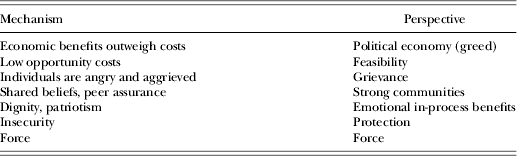
One of the most prominent explanations for recruitment into armed groups in recent years has been the idea that those who fight do so voluntarily because they are motivated by greed (Collier Reference Collier, Berdal and Malone2000; Collier & Hoeffler Reference Collier and Hoeffler1999, Reference Collier and Hoeffler2004). Taking a narrow version of the greed thesis suggests that individuals will enlist when the benefits of membership in an armed group exceed the costs. Consequently, when armed groups have access to economic endowments, such as natural resources or support from a foreign patron, it should be possible to attract new recruits with pecuniary rewards derived from these endowments (Weinstein Reference Weinstein2005, Reference Weinstein2007). The greed thesis has been the dominant narrative used to account for the onset and continuation of armed conflict in the DRC since the late 1990s (Autesserre Reference Autesserre2010). A series of reports produced at that time by European NGOs, Congolese research institutes and later by the United Nations Panel of Experts highlighted that rebel and militia groups in the DRC were financing their military activities through the illegal trade, taxing and looting of resources, including coltan and cassiterite (UN 2001; Global Witness 2004).
The dominant greed thesis has evolved over the years with proponents now less focused on greedy motivations than on the opportunity costs for potential recruits (Collier et al. Reference Collier, Hoeffler and Rohner2009). From this perspective, rebellion occurs where it is feasible, or more specifically, where it is possible to draw on a pool of recruits who have little to lose by joining, perhaps because they are without school or income. With the switch to opportunity cost arguments, the greed perspective begins to overlap with a large body of work in political science on grievances as a cause of rebellion (Gurr Reference Gurr1970). Individuals who are unable to go to school may willingly join a rebel group because they have low opportunity costs, but they may also voluntarily sign up because they are frustrated, angry, and aggrieved about their inability to receive an education. The same can also be said for individuals who are unemployed or who earn too little to make ends meet.
Traditionally, the grievance perspective has involved the study of a set of preconditions which lead to the build up of frustration over time and, eventually, to aggression against the established order. Some earlier work on recruitment in the DRC follows this approach, suggesting that a combination of pre-existing grievances, low opportunity costs and greedy motivations account for recruitment in the early 1990s (Van Acker & Vlassenroot Reference Van Acker and Vlassenroot2001; Jourdan Reference Jourdan2011). These accounts start by pointing to the aforementioned 1973 law that legalised private ownership and suppressed customary land rights. This legal change meant that land became concentrated in the hands of a new class of urban Congolese entrepreneurs and that an agricultural labour surplus emerged, consisting of young men aggrieved by their inability to access land, education, or alternative sources of work. By these accounts, recruitment provided a means of expressing frustration but was also an attempt to generate income in a situation in which there were few ‘alternatives to a situation of acute deprivation’ (Van Acker & Vlassenroot Reference Van Acker and Vlassenroot2001: 52).
The literature also points to a second, less noted mechanism in which new grievances are generated and/or opportunity costs are driven down, not by preconditions, but by ongoing war (Azam Reference Azam2002, Reference Azam2004). During times of war civilians are subject to pillage, rape, killings and other forms of mistreatment by armed groups which either occupy, or attempt to occupy, territory. Indeed civilians are more often victims of current civil wars than combatants (Azam Reference Azam2002: 131–2). Where this idea has been mentioned in the literature it has been associated with the observation that armed groups in the DRC have looted their civilian supporters in order to lower their opportunity costs to participation (Azam Reference Azam2004). Rather than suffer pillage, some civilians may then decide to join the pillagers. Conversely however, the literature on militias such as the Mai-Mai in the DRC and the Kamajors in Sierra Leone suggests that civilians who are looted or otherwise adversely affected by rebel groups may react by joining opposing local defence militias (Humphreys & Weinstein Reference Humphreys and Weinstein2008). This differs from traditional grievance theories in that civilians do not fight against the previously established order, but instead, for restoration of the status quo.
In addition to the aforementioned reasons of grievance, greed and opportunity costs, authors have also argued that recruitment in the DRC has been a way for marginalised individuals to ‘renegotiate and improve their social status' (Jourdan Reference Jourdan, Vlassenroot and Raeymaekers2004: 162). This argument is particularly prevalent with regard to participation in local Mai-Mai defence militias (rather than rebel groups): ‘With few prospects, association with Mai-Mai is seen by some young people as a means of enhancing their status within the community’ (CSUCS 2010: 8). Status has long been part of explanations accounting for collective action, particularly in the theoretical literature linking community ties to recruitment (Taylor Reference Taylor and Taylor1988; Petersen Reference Petersen2001). From this perspective, when communities are ‘strong’ (i.e. characterised by shared beliefs and values, generalised reciprocity, and direct and many-sided relationships between members) community members may feel pressured into participation because of a norm of fairness. The impact of this norm is likely to be particularly pronounced if community members interact with a high number of participants (Petersen Reference Petersen2001). These participants may also attempt to actively persuade those who opt to stay on the sidelines to ‘do their bit’. In this scenario, community members who fight are likely to be rewarded with social status but also to be reassured by the idea of safety in numbers. In contrast, the minority of remaining non-participants are likely to face social sanctions in the form of contempt from their peers.
The theoretical literature linking community dynamics to mobilisation also suggests that differences in the levels of emotions (such as the depth of resentment) felt by community members also explains why some community members participate (and do not participate) in armed conflict (Petersen Reference Petersen2001: 33). This argument aligns with the emotional in-process benefits perspective, which suggests that individuals sometimes fight because they take pleasure in asserting their dignity and defiance (Wood Reference Wood2003). This perspective has not received explicit mention in the literature on recruitment in the DRC but seems plausible given the clear link between grievances (both pre-existing and endogenous) and the emotional satisfaction that can be derived from attempts to remedy these grievances (Gurr Reference Gurr1970: 34).
An additional theory of recruitment turns attention away from emotional concerns to matters of protection (Kalyvas & Kocher Reference Kalyvas and Kocher2007). This theoretical argument suggests that states may unleash violence which targets segments of the population based on certain characteristics (age, sex, locale, ethnicity, etc.) rather than actual behaviour (for example, supporting the rebels versus not supporting the rebels). Consequently, individuals may join armed groups because recruitment provides protection from this kind of indiscriminate violence and, crucially, more protection than remaining a civilian. The protection argument has been advanced to explain recruitment in the DRC with authors asserting that ‘once the conflict has started the escalation of violence often forces young people to enrol en masse given that in a situation of widespread insecurity, enrolment is sometimes the only alternative to death’ (Jourdan Reference Jourdan2011: 97).
Finally, it should also be noted that while there is little theoretical literature on forced recruitment (an exception is Beber & Blattman Reference Beber and Blattman2013) there is much anecdotal evidence of the practice by rebel and militia groups in the DRC, often concerning abductions from villages, schools and marketplaces (see HRW 2001; CSUCS 2010).
VOLUNTARISM, COERCION AND FORCE
In this section I conceptualise voluntary, coerced and forced recruitment and propose a classification of the theories discussed above within these conceptual categories (Table II).
Theories of recruitment in terms of voluntarism, coercion and force
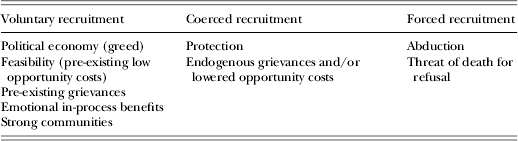
Drawing on existing work on coercion in the political theory literature, I argue that coerced recruitment occurs when one agent (Agent A) threatens another (Agent B) with a sanction if refusing to enlist. There are two necessary and jointly sufficient components to this definition (Bayles Reference Bayles, Pennock and Chapman2009: 17). First, the existence of an interpersonal threat, posed by Agent A, which pertains to recruitment – ‘join, or else I'll …’ – and second, the existence of a sanction which is applied if Agent B fails to comply with Agent A's demand. As I present it here, coercion can be associated only with harms and not with benefits in order to separate it from existing theories linking positive selective incentives to voluntary recruitment.
In the aforementioned definition, coercion involves the voluntary action of the person being coerced in that Agent B can choose to either comply with Agent A's demand or receive a sanction. Just as individuals have different pain thresholds, individuals will have different limits when it comes to coercion. What may be coercive for one civilian may be not so coercive for another. In the formulation I present here, if the potential sanction is so severe as to remove virtually all choice from the decision, this qualifies as forced recruitment. The implication is that coercion is a matter of degree, with force at the upper bound. A straightforward, yet somewhat extreme illustration of forced recruitment is when a combatant holds a gun to the head of a civilian and threatens ‘enlist or be killed’.
Threats are not always inter-personal (i.e. between Agent A and Agent B) but can also be posed by ‘the logic of the situation’ (Pennock Reference Pennock, Pennock and Chapman2009: 3). For example, the recruitment for protection mechanism described above is an example of a coercive recruitment mechanism because pervasive insecurity pushes individuals into armed groups. This type of recruitment is not forced at gunpoint, but neither is it entirely free of duress. The same can be said for recruitment that occurs because of the endogenous grievance mechanism mentioned above. It will be recalled that this mechanism captures the idea that when combatants loot, rape and kill civilians during ongoing war, new grievances are generated and/or opportunity costs are driven down. In this latter scenario, there is no inter-personal threat but the logic of the situation coerces recruitment, particularly if civilians believe that the only way to restore their normal lives is to either join the pillaging group or to fight back by enlisting in an opponent group.
In sum, if an individual is faced with an inter-personal threat of the type ‘join or I'll …’ and the sanction is severe enough to remove all choice in the matter, then this type of recruitment can be considered forced. If the sanction is relatively mild or posed by the logic of the situation, this type of recruitment can be considered at least partially coerced. Within a coercive setting, recruitment can be a mixture of both coercion and voluntarism, the balance of which is determined by the extent to which an individual emphasises his or her own agency (i.e. ‘it was my decision’) over the constraints of the environment (‘I had no choice’).
Finally, non-coercive or purely voluntary participation occurs in the absence of both an inter-personal threat and a coercive environment. As I see it, individuals who join up because of the peer pressure mechanism outlined in the ‘strong communities’ literature are not coerced unless this type of social pressure is coupled with a threat of harm for non-compliance. Additional forms of voluntary participation occur when civilians enlist because of greed and/or low opportunity costs, or because of a build-up of pre-existing grievances and resentment (i.e. for emotional in-process benefits).
RESEARCHING RECRUITMENT IN THE DRC: FIELD METHODS
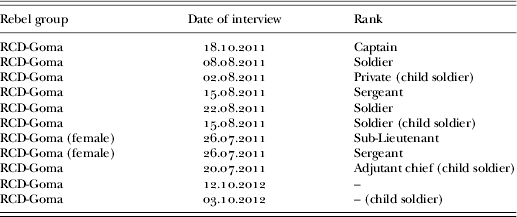
In 2011 and 2012, I conducted interviews with 111 ex-combatants in Goma and Sake in North Kivu Province. During these interviews I asked open-ended questions about how and why the respondents had joined armed groups. As many of these interviewees had fought in more than one group I restricted the current analysis to first-time recruitment and selected interviewees (52 in total) whose first armed group had been either RCD/RCD-Goma or a local defence (‘Mai-Mai’) militia. The decision to contrast the Mai-Mai movement and RCD was based on the fact that these actors had very different initial endowments, yet both eventually resorted to force. In total I used interview transcripts from 11 first-time RCD/RCD-Goma recruits and 41 first-time militia fighters: Mai-Mai Mongol (4), Mai-Mai Simba (5), Mai-Mai Jackson (2), Mai-Mai Kifuafua (7), PARECO-Lafontaine (12), APCLS (7), Mai-Mai Nyabiondo (2), Mai-Mai Kasikila (1) and an unnamed Mai-Mai group (1). A list of the interviewees is provided in Appendix 1.
To outside researchers, ex-combatants are what sociologists call a ‘hidden population’, in that they often lack characteristics that distinguish them from the general population (Salganik & Heckathorn, Reference Salganik and Heckathorn2004: 195). To overcome this, I relied on a chain-referral technique or, more simply put, introductions by individuals with insider knowledge. These ‘insiders’ oversaw the management of ex-combatant associations, training centres and reintegration projects. I was also sometimes provided access to former combatants who did not participate in such programmes by asking for direct referrals from interviewees.
Chain-referral generates a sample which is non-random and which may contain biases which are then compounded through each wave of referral. This may occur, for example, if respondents refer researchers to friends with backgrounds and experiences which are similar to their own (Cohen & Arieli Reference Cohen and Arieli2011: 428–9). To counteract this I attempted to speak to a wide variety of respondents in order to capture at least some of the variation in recruitment experiences (Nussio Reference Nussio2011: 585). I also attempted to diversify the experiences of the interviewees by asking for referrals from many different insiders. Although the resultant sample is not necessarily representative, it is also not obviously biased in terms of ethnicity, age, sex or former military rank. This is because I interviewed Rwandophones and ‘native’ citizens, former child and adult combatants, males and females, former rank and file combatants and former junior commanders (i.e. captains, sergeants and lieutenants). The respondents also cited a range of motivations, and while some argued that they were forced to join their armed groups, many others did not.
Ex-combatants are sometimes considered unreliable sources of information because their statements may be coloured by considerable trauma, they may change their stories to present themselves as victims rather than perpetrators (Utas Reference Utas2003), or they may present overly politicised accounts (Peters Reference Peters2011: 18). To address this I tried, as other researchers have, to build rapport with respondents through repeated visits, to ask probing questions, and to corroborate, where possible, with individuals who knew the respondent's background and with additional relevant literature.
To derive the conceptual framework distinguishing forced, coerced and voluntary recruitment I went back and forth between the interview transcripts, the existing recruitment literature and the literature on coercion in order to inductively ‘code’ the transcripts (Saldana Reference Saldana2009). Once this conceptual step was complete I then attempted to develop a theory, discussed below, of why armed groups resort to force. To do this I turned to the coded interview transcripts and the broader literature on the DRC to put together a history of recruitment practices for the Mai-Mai and RCD/RCD-Goma. I then compared these histories to look for variables explaining why some groups used voluntary, coercive and/or forced recruitment methods at different times.
UNDERSTANDING FORCED RECRUITMENT: A THEORETICAL FRAMEWORK
In this section I propose a theoretical framework explaining the resort to forced recruitment in terms of popular support, manpower deficits and accountability to local communities, government sponsors and/or the international community. Table III summarises this framework, indicating the primary recruitment mechanisms which should be observed when a non-state armed group experiences manpower deficits.
Primary types of recruitment in the face of manpower deficits
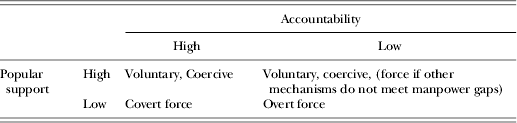
The theoretical argument presented here begins from the premise that fighting in civil wars requires a constant supply of recruits to replace deserters, the war-wounded and the deceased. More simply put, if a military rout is to be avoided, armed groups need to bring in new recruits to replace those lost. Initially, armed groups will try to attract voluntary recruits by using their economic and/or social endowments in order to appeal to individuals with greedy motives, low opportunity costs, grievances, community ties and emotional reasons for participation (these are the voluntary mechanisms in Table II). However, according to the theory I present here, popular support will affect the propensity of volunteers to enlist. Indeed, where popular support for an armed group is low, even economic endowments may not be sufficient to attract opportunist recruits to an armed group that is the source of much resentment. Economic endowments may also contribute to the generation of resentment if combatants are perceived merely as bandits and thieves or as tools of a foreign sponsor.
Ceteris paribus, armed groups with little popular support will have more trouble filling recruitment gaps with volunteers than will groups that enjoy popular support. However, when manpower needs arise, force is still likely to be employed by popular groups who have sources of logistic and financial support that do not emanate from local populations. This is because armed groups with access to natural resources and/or support from (foreign or domestic) government sponsors are likely to be less accountable to local communities, especially when these sponsors are unconcerned by the use of forcible recruitment practices (Beber & Blattman Reference Beber and Blattman2013). The absence of international pressure to halt forced recruitment may also lower accountability in a similar way.
In contrast, however, when armed groups are in fact accountable to local communities, the international community and/or governmental sponsors who condition support on the absence of forcible recruitment, then the use of force is likely to be contingent on popular support and manpower needs. As I discuss further below, for popular groups with high accountability, manpower needs may be met by recruits spurred by voluntary and coercive recruitment mechanisms, thus reducing the need to resort to force. However, if manpower needs arise when popular support is low and accountability is high, a lack of voluntary and coerced recruits means that non-state armed groups may have few other options than to use force, albeit in a covert manner.
As explained in the previous section, coercive recruitment can arise when an occupying armed group loots and threatens civilians under its control in order to lower their opportunity costs to participation and to create a desire for protection. However, coercive recruitment strategies are not always intended, and may simply be a by-product of the grievances and insecurities created by ongoing war. A coercive environment is likely to push civilians into the arms of groups with popular support rather than those without, meaning that unpopular groups with low accountability have greater incentives to resort to force. This follows partly because coercion may drive civilians into the arms of other (more popular) armed groups, but also because neither voluntary nor coercive recruitment mechanisms will be sufficient to fill manpower gaps. It should also be noted, however, that if an unpopular and unaccountable armed group is not faced with recruitment deficits, combatants may opt to kill (rather than forcibly recruit) members of communities that are perceived to be unsupportive.
LOCAL DEFENCE MILITIAS
In 1998, military commanders in local Mai-Mai defence militias and traditional chiefs in the Kivu provinces collaborated to mobilise volunteers to fight against RCD. The goals of Mai-Mai commanders and some traditional chiefs coalesced, as both sought to keep land and positions of traditional authority out of the hands of the Rwandan-backed rebellion which, as aforementioned, was often perceived as a ‘Tutsi dominated occupation’ (Tull Reference Tull2005: 131, 150).
Drawing on social endowments, and consistent with the ‘strong communities’ theory of recruitment, commanders and chiefs sometimes tried to persuade members of their communities to join the Mai-Mai. As an illustration, a former member of Mai-Mai Mongol explained that ‘It was the traditional chiefs that pushed us to enrol and fight for our tribe’ (Interview 13, 8.10.2012). Two former members of a Mai-Mai militia in Nyabiondo (Masisi territory, North Kivu) who were recruited at the beginning of the RCD rebellion also described how, ‘The superiors of the Mai-Mai addressed our chiefs who supported our movement, and the chiefs sensitised young candidates for recruitment. When the Tutsi started to attack the east of our country we enrolled in the Mai-Mai to combat RCD. This was after we were sensitised by our customary chiefs. We then decided freely to join the armed group’ (Interview 21, 15.8.2011).
Importantly however, former Mai-Mai combatants reported that they also knew people in their villages who opted not to join the fight against RCD, and who were not forced to do so. Just as some families supported and encouraged their children's participation in local defence militias, others actively tried to prevent their children's enrolment. As a former member of Mai-Mai Kifuafua reported, ‘I had a friend who was a blacksmith who stayed in civilian life. He was also troubled by the uneasy peace but his family prevented him from coming to fight with Kifuafua’ (Interview 9, 11.10.2012). A former corporal in the Mai-Mai Kasikila militia also explained that, ‘Each person who couldn't stand the presence of the Banyarwanda enrolled. The ones who did not want to stayed quietly in the village. I had some friends who stayed. They were afraid of combat and of being killed. I did not have fear, because I wanted to avenge the death of my brother’ (Interview 15, 6.10.2012).
Owing to the high level of popular support for the Mai-Mai, voluntary recruitment occurred and Mai-Mai militias did not initially resort to force. The coercive logic of the ongoing war also drove non-Tutsi civilians into the Mai-Mai for protection. As illustration, some former militia fighters reported that they joined up upon hearing that RCD-Goma was attempting to take control of their neighbourhood or village, and also because they heard rumours of forced recruitment drives. As a former member of Mai-Mai Jackson, recruited during the war against RCD-Goma, remembered: ‘At home [in Nyanzale, Rutshuru territory] there was the Mai-Mai which fought the Tutsi … I joined Mai-Mai Jackson when the Tutsi came to our villages. They said that the young men were Mai-Mai, and even if we weren't, they were going to kill us anyway’ (Interview 6, 8.8.2011). Another former Mai-Mai member provided a similar explanation: ‘[I joined] because of the massacres by the Tutsi in the villages. We saw the threats to our population and us, the youth, took the decision to take up arms and join the Mai-Mai. We found the one with the most dawa [magic] to protect us’ (Interview 12, 2.8.2011).
Endogenously created grievances and/or lowered opportunity costs also prompted coerced recruitment, and strong community mechanisms such as peer-pressure seem to have had particular resonance in such coercive environments. For example, a former lieutenant in Mai-Mai Mongol explained that he decided to fight against RCD-Goma because his work was disrupted and also because his chiefs asked community members to participate: ‘Our chiefs asked that each family with three children delegate at least one young male. It was necessary to combat our enemies. So, I decided to sacrifice myself in the name of my family, because I could no longer work in my field’ (Interview 16, 6.10.2012). Emotional in-process benefits of participation also combined with endogenous grievances and/or lowered opportunity costs, including for those who lived under the control of the unpopular RCD. Resentment against the ‘occupiers’ ran high and was bolstered by the fact that the rebels disrupted livelihoods in their zones by forcibly closing some local businesses and imposing taxes on others (UN 2001 para 64–8). As a former member of Mai-Mai Kifuafua explained, ‘The people were maltreated by the RCD soldiers. We had in mind the defence of our country because we were traumatised by the exactions of RCD. By pride we decided to defend ourselves’ (Interview 3, 22.8.2011). More generally, ‘Tunafia nchi yetu’ (‘we die for our country’) was the patriotic and emotive rallying cry of the Mai-Mai in the fight against RCD-Goma (IRIN 2006).
It should be noted that despite the prevalence of community and coercive recruitment mechanisms, greedy motivations were not entirely absent and served to encourage at least some voluntary recruitment into Mai-Mai groups (Van Acker & Vlassenroot Reference Van Acker and Vlassenroot2001: 71). In 1998, support from Kinshasa meant that Mai-Mai militias were able to switch from hit-and-run tactics to the occupation of territory, including territory rich in natural resources (Van Acker & Vlassenroot Reference Van Acker and Vlassenroot2001: 67). In these zones, local Mai-Mai militias taxed individuals working in resource extraction, such as coltan diggers in Masisi territory, in return for ‘protection’ (Global Witness 2004: 22). The introduction of economic endowments prompted at least some recruitment which was simultaneously opportunistic but also security-seeking. As a former corporal in Mai-Mai Simba explained, ‘I was unemployed and my parents were poor. There was no security [in Walikale] because of the militias and rebels of all origins who invaded and stayed in the area because of the minerals and mines. The difficulties of life pushed me to enrol. I thought I would have a part of the mines, the gold, the diamonds, but I had nothing at all’ (Interview 10, 4.10.2012).
Over time, the introduction of economic endowments helped to contribute to the growing perception among some civilians that Mai-Mai combatants were becoming simple bandits and thieves. Indeed, by 2004, six years after the onset of the RCD rebellion, the Mai-Mai movement had experienced a notable drop in public support (Jourdan Reference Jourdan, Vlassenroot and Raeymaekers2004: 172; CSUCS 2010: 4). Added to this, the perception of Mai-Mai invulnerability to bullets – and therefore the idea that these groups could provide protection – had also begun to wane. As one civilian remarked in December 2002, ‘once they did not die, but now they have started to die as all the others’ (Jourdan Reference Jourdan, Vlassenroot and Raeymaekers2004: 172).
Coupled with this drop in popular support throughout the RCD war, the Mai-Mai's access to natural resources, increased backing from the DRC government and the movement of Mai-Mai groups outside their communities of origin all contributed to a decline in accountability (IRIN 2006). While the recruitment of children (forced or otherwise) is prohibited by a number of national laws in the DRC, including the 2002 Labour Code and the 2004 Defence and Armed Forces Law No. 04/23, there has been a lack of political will to implement these laws and a lack of institutional capacity to enforce them (CSUCS 2010: 12). Furthermore, Mai-Mai commanders known to have forcibly recruited children have subsequently taken up positions within the national army, free from sanctions (CSUCS 2010: 12). This enabling environment where accountability to the DRC government, to local communities, and to the international community was low meant that over time, as manpower needs arose and as popular support declined, Mai-Mai militias resorted to force.
As illustration, large-scale forced recruitment by Mai-Mai groups was observed by the time that these groups re-emerged to fight RCD-Goma's successor group, CNDP, in 2006. As a former member of PARECO-Lafontaine (a coalition of Mai-Mai groups fighting CNDP) explained, ‘We recruited each day. We had a need for new soldiers, so we rounded up youth, first to make them porters who would then become combatants. We fought each day so there were many deaths and injuries, we needed to replace them’ (Interview 19, 15.8.2011). United Nations reports corroborate these assertions, reporting that recruitment drives by local Mai-Mai militias often coincided with periods of battle between the Mai-Mai and CNDP in 2007–8 (UN 2008; CSUCS 2010: 5). A former member of APCLS, a predominantly Hunde militia which emerged as a splinter from PARECO-Lafontaine provided a similar story: ‘In general, we did not force people, but as soon as the number of effectives diminished through combat we took the young by force’ (Interview 19, 18.10.2012). In a similar manner, forced recruitment seems to have occurred when extra numbers were needed prior to impending battles. A former member of PARECO-Lafontaine described how, ‘When we were going on mission, we picked up twenty people to carry our bags. The youngest of them we kept and gave them weapons. The eldest we sent home. We recruited especially during our military operations. We entered homes and took young people by force’ (Interview 11, 11.10.2012). A former officer from PARECO-Lafontaine, who was involved in recruitment, provided a similar explanation: ‘When we were going to the front we picked up youth who were going to school. This is how I was recruited’ (Interview 3, 10.10.2012).
THE RCD REBELLION
The Rassemblement Congolais pour la Démocratie (RCD) rebel group emerged two years after the 1996 Alliance des Forces Démocratiques pour la Libération du Congo (AFDL) rebellion. Not only did RCD lack popular support from non-Rwandophone communities but it also faced a hostile population tired of war (Tull Reference Tull2005: 131). What RCD lacked in popular support, however, it made up for in economic endowments. Initially, Rwandan, Ugandan, Burundian and/or Congolese soldiers within RCD drained stockpiles of minerals and agricultural and forest products from eastern DRC (UN 2001: para 32). Following the exhaustion of these stores, RCD turned to extraction and advertised coltan trading as soon as it assumed control over the areas previously controlled by AFDL (Montague Reference Montague2002: 112).
In common with the recruitment tactics used by the Mai-Mai, RCD-Goma attempted to encourage voluntary recruitment among the population under its control by embarking on sensitisation campaigns. Rebel representatives issued radio broadcasts encouraging parents to send their children to the regular RCD-Goma army or to RCD-Goma's auxiliary ‘Local Defence Forces.’ The Local Defence Forces were small bands of individuals who received minimal military training and who were tasked with protecting their community from Mai-Mai attacks (HRW 2001: 13). These groups were introduced by RCD to overcome the reluctance of the local population to join its ranks and also to increase the rebellion's internal legitimacy. Recruitment into the Local Defence Forces was often followed by transfer into the regular (or full-time) RCD-Goma army.
In contrast to the voluntary recruitment into the Mai-Mai militias, ‘strong community’ mechanisms of peer-pressure and peer-assurance did not yield large numbers of voluntary recruits for RCD. Instead, RCD's reliance on foreign governments and linkages to international markets contributed to local perceptions of the rebels as foreign occupiers uninterested in local communities (Mampilly Reference Mampilly2011: 188). Similarly, ready access to economic endowments meant that the rebels had little incentive to mobilise popular support through the provision of services, preferring instead to concentrate their resources on military engagements (Mampilly Reference Mampilly2011: 188).
In consequence, civilians within the Kivu provinces often did not volunteer, but instead, attempted to actively resist enrolment (Tull Reference Tull2005: 152). In December 2000, for example, a resident of Masisi territory in North Kivu province commented ‘They [RCD-Goma] say that everyone from 15 to 40 should be in the army. “Why?” we ask. We don't know the point of this war’ (HRW 2001: 6). Another Goma resident stated similarly, ‘We know that there is no-one who would go voluntarily. Now when they come to persuade us to let one of our sons go to the army, the first question the parents ask is where are the sons we already gave you? And who are you fighting against and why?’ (HRW 2001: 5).
This is not to say that no civilians or traditional chiefs enrolled for opportunistic reasons, although this type of voluntary recruitment does seem to have been relatively rare considering the abundance of RCD's economic endowments. Some former RCD combatants reported that they joined in order to support their families, and because of pre-existing grievances and low opportunity costs: ‘I am the eldest. My father is dead and so I am the head of the family, but I couldn't manage to look after my two younger brothers and sister. That's why I enrolled in RCD-Goma’ (AI 2006: 41). A former child soldier in RCD-Goma also reported that he enlisted owing to a peer-assurance mechanism: ‘I joined because there were many children already there’ (AI 2003: 17).
The dearth of voluntary recruits was also compounded by the fact that, as observed in the previous section on militia recruitment, coercive recruitment mechanisms (including protection but also endogenous grievances and/or lowered opportunity costs) tended to push many non-Tutsi civilians into the arms of popular Mai-Mai militias rather than the resented RCD. Some, however, did enlist in RCD-Goma in the hope of protecting themselves against accusations that they were Mai-Mai supporters. This was done in the knowledge that association with the enemy would bring forth punishment. As one female former RCD-Goma combatant explained,
I was living in my village with my mother and my brothers and sisters. One day, our village was attacked by the Mai-Mai. The Mai-Mai soldiers stole everything we had. A few days later, our village was attacked again by RCD-Goma, who accused us of collaboration with the Mai-Mai and of giving them food. I watched as soldiers killed many of my relatives in the village and raped my two sisters and my mother. I was hiding … I was scared, and I thought that if I joined the army, I would be protected. I wanted to defend myself. (AI 2003: 8–9)
Another more succinctly stated that she joined RCD-Goma because she ‘did not want to be mistaken for a Mai-Mai’ (Interview 1, 26.7.2011).Footnote 2
Unable to encourage large-scale voluntary recruitment and with little popular support to lose, RCD-Goma resorted to more coercive tactics and eventually, forcible conscription. As a former RCD-Goma combatant who initially resisted RCD's sensitisation campaigns explained,
The Rwandans came and said ‘you the Congolese work with us to chase our enemies [i.e. the Interahamwe, and ex-FAR] who are in the DRC and make them return to Rwanda’. At this time, I was 18 years old and I refused to join them but then they used their military orders and they took me by force. Those who tried to refuse were put in prison, or their families were harassed. (Interview 10, 8.8.2011)
A former RCD instructor also explained how, ‘I was sent to certain zones to recruit people for the RCD army. Because no-one would volunteer, the RCD forced people’ (HRW 2001: 11).
Forced recruitment was undertaken not only because of low levels of popular support and voluntary recruitment, but also because RCD increasingly needed new troops to fill manpower gaps. In particular, following the July 1999 Lusaka peace agreement, it was agreed that the Rwandan army troops, which made up a considerable portion of RCD-Goma's ground forces, were to withdraw from the DRC. As these withdrawals began, RCD-Goma found itself in a militarily vulnerable position, in part because of its previous reliance on Rwandan forces but also because of the large amount of territory over which it sought to maintain control, and which was actively contested by Mai-Mai groups (AI 2003: 14–15). As new Mai-Mai offensives commenced, RCD-Goma began a forced recruitment drive that aimed to remedy these new manpower deficits.
To illustrate, during a forced recruitment drive conducted by RCD-Goma in November 2000, one Goma resident described how ‘They didn't find enough youth to come forward voluntarily so they had to do it by force’ (HRW 2001: 5). Another stated in December 2000, ‘the war is not succeeding. They [RCD-Goma] need numbers at the front. They say it is being done voluntarily but if you refuse you are considered hostile to the RCD and are the enemy’ (HRW 2001: 5). Reports indicate that as RCD-Goma's forced recruitment campaign was underway in late 2000, young men in Goma were loaded into trucks and taken away to fight whereas others were picked up at Kituku market (HRW 2001: 7). Many of the former RCD-Goma soldiers whom I interviewed also recounted their experiences of individual and mass forced recruitment. As one recalled,
I joined in the era when they [RCD-Goma] took youths in the street to enrol them. I was taken by force on the return from school. RCD sent soldiers who encircled and took the young in their neighbourhoods and in their villages and brought them into the forest. It was the epoch when Laurent Nkunda [then serving with RCD] took the young by force. We were rounded up and forced to work with RCD until we had an occasion to quit the group … We did not have a choice. (Interview 4, 3.10.2012)
Furthermore, just as Mai-Mai militias forcibly recruited on their way to combat in order to bolster numbers for battle, so too did RCD-Goma. Civilians were initially forced to carry the group's equipment and supplies before being forcibly enlisted. As a former member of RCD-Goma explained: ‘Before entering RCD, I was a baggage porter for the soldiers. We had no choice and we were threatened with beatings or torture if we refused’ (Interview 13, 2.8.2011).
Initially a combination of low popular support, a dearth of voluntary and/or coerced recruits, and large recruitment deficits prompted RCD-Goma's resort to forced recruitment. However, as condemnation of the group's forced recruitment drives grew, the rebel group changed tack slightly. RCD-Goma was concerned by international perceptions of the group and often tried to avoid perpetrating violence openly in urban areas under its control, where word was likely to get out (Mampilly Reference Mampilly2011: 198). Furthermore, owing to the presence of international agencies in the urban centres of Goma, Bukavu and Uvira, RCD-Goma curtailed forcible recruitment in these areas, focusing instead on outlying rural zones where force could be used in a more covert manner (AI 2003: 15). These rural zones included the less monitored areas of Shabunda, Mwenga, Fizi and Idjwi (all in South Kivu), Masisi, Walikale and Rutshuru (all in North Kivu), and finally, the Kindu and Punia territories of Maniema province (AI 2003: 15). Anecdotal evidence also suggests that, in an attempt to make up for the absence of forced recruits in urban areas, RCD-Goma switched to the alternative strategy of promising pecuniary incentives to urbanites in return for voluntary enlistment (HRW 2001: 18).
CONCLUSION
In this paper I have conceptualised forced, coerced and voluntary recruitment and provided a theoretical framework explaining the use of these different recruitment strategies in the DRC. The framework highlights that overt forced recruitment is most likely to occur when armed groups experience manpower deficits and when accountability is low. High popular support may reduce (although not necessarily eliminate) the use of force under these conditions because popular groups should be better able to plug manpower deficits with volunteers and coerced recruits than unpopular groups, ceteris paribus. These theoretical relationships are also potentially applicable outside of the DRC. For example, the RENAMO rebel group in Mozambique forcibly recruited in areas of popular support when extra combatants were needed and accountability was absent (Weinstein Reference Weinstein2007: 612). Ex-combatants from the rebel group Liberians United for Reconciliation and Democracy have also stated that forcible recruitment was used because ‘after Lofa Country came under [our] control we needed more people to do further advances’ (Wille Reference Wille, Florquin and Berman2005: 195).
Ultimately, if a non-state armed group finds itself low on numbers with its survival at stake, it seems unlikely that international pressure on armed groups and their sponsors will be able to increase accountability and halt forcible recruitment drives completely (Mack Reference Mack, Gates and Reich2010: 244). However, international pressure, attention and monitoring may be able to curtail the worst excesses by making overt and particularly rampant forcible recruitment drives more difficult to conduct. Furthermore, international restrictions on trade in natural resources from conflict zones and tougher measures against (foreign) governments backing non-state armed groups may also help to increase (or at least sustain) reliance on and accountability to local communities, thereby reducing the resort to force. It should be noted, however, that in order to fill manpower deficits, armed groups may then more actively pursue alternative avenues in order to increase their numbers of voluntary and coerced recruits.
APPENDIX 1: INTERVIEWEES