Over the past fifteen years, concerns related to immigration and the integration of immigrants have risen to the forefront of European politics (e.g., Givens and Luedtke Reference Givens and Luedtke2005; Guild, Groenendijk, and Carrera Reference Guild, Groenendijk and Carrera2009). As anti-immigrant nationalist parties have gained ground, European governments have closed borders and even deported immigrants en masse. At the same time, countries throughout the European Union (EU) have increasingly stressed the importance of the social, economic, and cultural integration of immigrants. As immigration has become increasingly politicized across Europe, many governments have restructured themselves. Some countries have created new cabinet ministries designed to focus on immigration and immigrant integration. Other countries have assigned new immigration-related tasks to existing political bodies. In the face of new or radically transformed governance structures, one important question emerges: To what extent do women serve in immigration ministry leadership?
Research suggests that the likelihood a woman will serve in a cabinet position is strongly influenced by portfolio. Historically, women in government have been more often tasked with portfolios considered to be “of special interest to women” (Duverger Reference Duverger1955, 124). These are ministries, such as health, education, and family welfare, that tend to have less policy influence and smaller budgets (Escobar-Lemmon and Taylor-Robinson Reference Escobar-Lemmon and Taylor-Robinson2005; Paxton and Hughes Reference Paxton, Hughes and O'Connor2010; Studlar and Moncrief Reference Studlar and Moncrief1999). While women are increasingly holding highly visible cabinet positions with traditionally masculine portfolios, such as security and finance, recent studies suggest that, at the global level, historical patterns endure (Krook and O'Brien Reference Krook and O'Brien2010; WEDO 2007). The continuing concentration of women in feminized and less prestigious jobs may reinforce, rather than challenge, ideas about the jobs women are fit to do (England Reference England2005). To date, however, research has not yet considered how leadership of immigration policy—an increasingly visible and important portfolio in many EU member states—maps onto these historically gendered patterns.
Focusing on a new policy area, particularly in the EU, may lead to different results. Gender equality is central to the EU's image, and facilitating it is an important part of EU-level policymaking (Elman Reference Elman2007). Women have made significant inroads into European ministries in recent years (Kantola Reference Kantola2009), and cabinet expansion and restructuring may fuel greater inclusion of women (Paxton and Hughes Reference Paxton and Hughes2007). This policy area, in particular, with its recent changes in governance structures may provide new spaces for greater descriptive representation. On the other hand, an extensive body of literature documents how immigration experiences and politics are highly gendered (Elman Reference Elman2001; Kofman Reference Kofman1999; Piper Reference Piper2006; Schain Reference Schain2008). Furthermore, immigration policy issues span areas of governance traditionally typed as feminine and areas traditionally typed as masculine. Thus, the extent to which women lead immigration-related ministries may vary by the particular immigration focus of the ministry.
Despite both EU rhetoric about gender equality and recent advances for women in politics, we suggest that immigration governance in the European Union follows a gendered division of labor. We make the case that immigrant integration, in large part, involves “care work,” which continues to be dominated by women (Duffy Reference Duffy2005; England Reference England2005), so we expect integration to be more likely to be led by women. By contrast, immigration control—combating illegal immigration and residence, and regulating the number and nature of labor migrants—is increasingly linked to the traditionally masculine domain of domestic security and, thus, may be more likely led by men.
In this article, we present the first analysis of the sex of immigration-related ministers in the 27 member states of the European Union, the worldwide leader in global migration flows (European Commission 2009). We use descriptive statistics and logistic regression to evaluate whether women are more likely to serve as integration ministers and less likely to serve as immigration control ministers in April 2010. We control for key factors such as position prestige, women's representation in the national legislature, and length of EU membership. We also test for whether gendered patterns are mediated by cabinet ideology, more expansive integration policies, and recent changes in the immigrant population. Following the quantitative analyses, we briefly investigate, through the cases of Germany and Belgium, how subcabinet positions in the immigration arena may also be gendered.
GENDER AND IMMIGRATION MINISTRY LEADERSHIP
Although women remain underrepresented in politics, they have been appointed to an increasing share of executive cabinet positions in recent years (Krook and O'Brien Reference Krook and O'Brien2010; WEDO 2007). Women's political leadership may have broad effects on women's power and status (e.g., Escobar-Lemmon and Taylor-Robinson Reference Escobar-Lemmon and Taylor-Robinson2005). For example, political theorists argue that women's presence in highly visible political positions may transform attitudes regarding their capacity to lead (e.g., Mansbridge Reference Mansbridge1999). This may be particularly so in Europe because of the importance of cabinet positions in coalition bargaining (Bäck, Debus, and Dumont Reference Bäck, Debus and Dumont2011, Strøm, Müller, and Bergman Reference Strøm, Müller and Bergman2008). Women's presence in executive cabinets may also influence policymaking processes and decisions more directly (Annesley and Gains Reference Annesley and Gains2010; Atchison and Down Reference Atchison and Down2009). Women often have distinct policy priorities (e.g., Lovenduski and Norris Reference Lovenduski and Norris2003), see social problems differently (e.g., Kathlene Reference Kathlene1995), and allocate resources differently than men (e.g., Chattopadhyay and Duflo Reference Chattopadhyay and Duflo2004).
Women are not, however, entering all types of ministries at equal rates (Borrelli Reference Borrelli2002; Davis Reference Davis1997; Reynolds Reference Reynolds1999). Although some women have been appointed to traditionally masculine posts, men still generally dominate posts in finance, defense, justice, and foreign affairs, even in more gender-balanced parliaments (Paxton and Hughes Reference Paxton, Hughes and O'Connor2010). Cabinet members with these masculine portfolios tend to be core advisors to prime ministers and presidents (Borelli 2002; Davis Reference Davis1997). Women, on the other hand, are more likely to be appointed to what are seen as “softer” ministries, that is, those that focus on culture, education, environment, family, health, or women's affairs (Krook and O'Brien Reference Krook and O'Brien2010; Reynolds Reference Reynolds1999). In the EU specifically, at least one-half of female ministers typically deal with sociocultural matters (Kantola Reference Kantola2009). These tend to be lower prestige positions with less policy control, smaller budgets, and limited direct access to presidents and prime ministers (e.g., Escobar-Lemmon and Taylor-Robinson Reference Escobar-Lemmon and Taylor-Robinson2005; Studlar and Moncrief Reference Studlar and Moncrief1999). Because leaders of these more feminized ministries are generally less likely to be core advisors, they have less impact on policy development and implementation (e.g., Paxton and Hughes Reference Paxton, Hughes and O'Connor2010).
We argue that the traditional gendered division of jobs in government is consistent with ideologies that assign “care work” to women. As conceived by feminists, care work “provid[es] a service to people that helps develop their capabilities” through unpaid and paid labor (England Reference England2005, 383). Care work is performed predominantly by women, both in the home and in professions such as education, health care, social work, and therapy (Duffy Reference Duffy2005; van der Lippe and van Dijk Reference van der Lippe and van Dijk2002). Many of the ministries women are more likely to lead—education, health, family, etc.—are devoted to these kinds of services. Because feminized portfolios tend to be less visible and have fewer resources, the gendering of cabinet positions reproduces the broader trend of women performing work that is devalued relative to male-dominated activities (England Reference England2005).
We expect immigration policy leadership to be divided in similarly gendered ways. Broadly, immigration policy is oriented around two political problems: (1) how to integrate immigrants living in the EU and (2) how to control further migration and manage illegal migrants. We suggest that the first of these problems, immigrant integration, is viewed as a feminine policy area because it is, in many ways, centered around care work. Integration is most centrally about immigrants developing capabilities to participate fully in mainstream society. Trying to keep immigrant children in school, facilitating immigrants' understanding of how civic organizations work, and providing language training are a few examples of care-oriented integration policies and programs (Heckmann and Schnapper Reference Heckmann and Schnapper2003). Indeed, like care work in general, integration has implications for both paid and unpaid labor, and it involves aspects of public life, such as education, and aspects of what are often considered to be about private life, such as personal language use.
Because care work is central to integration, women may be seen as better able to lead new positions to oversee immigrant integration. Or, if countries assign integration responsibilities to existing ministries, then they may be more likely to assign them to care-oriented ministries such as culture, labor, or social affairs, where women are already likely to serve. Thus, our first hypothesis:
H1: Ministers with responsibility for immigrant integration are more likely to be women than the average minister.
The second political problem related to immigration, what we call immigration control, involves managing economic migrants, border security, and illegal immigrants (Cornelius et al. Reference Cornelius, Tsuda, Hollifield and Martin2004). Over the last decade, immigration politics have undergone a process of “securitization.” In the minds of many Europeans today, immigration is a security issue (Faist Reference Faist2004). Among other things, inadequate control of immigration flows is often thought to increase vulnerabilities to terrorism (Freeman, Givens, and Leal Reference Freeman, Givens and Leal2008). Because men are often stereotyped as better equipped to manage security (Paxton and Hughes Reference Paxton and Hughes2007), the increasing links between immigration and national security may mean that men are more often tasked with immigration control leadership. In addition, the securitization of immigration may mean that responsibilities for immigration control are more likely to be placed in Ministries of Justice or the Interior, areas typically dominated by men (Davis Reference Davis1997; WEDO 2007). Based on this, we have our second hypothesis:
H2: Ministers with responsibility for immigration control are more likely to be men than the average minister.
Patterns of gendered governance may be mediated by the national context in which ministries operate. Government and party ideology may affect women's chances of being appointed to lead immigration ministries. In general, governments controlled by rightist parties are less likely to appoint women (Davis Reference Davis1997; Escobar-Lemmon and Taylor-Robinson Reference Escobar-Lemmon and Taylor-Robinson2005; Moon and Fountain Reference Moon and Fountain1997; Reynolds Reference Reynolds1999; Siaroff Reference Siaroff2000). We suggest that right-leaning governments are more likely to assign men to head immigration governance in particular. Rightist political ideology more consistently frames immigration as a security issue (Citrin and Sides Reference Citrin, Sides, Parsons and Smeeding2006). This framing raises the likelihood that integration and control will be assigned to male-dominated ministries. Take the Netherlands, for example, where anti-immigrant sentiments have been on the rise in recent years, a trend encouraged and used by far-right politicians (Entzinger Reference Entzinger, Joppke and Morawska2003). As government ideology has shifted, the sex of integration ministers has also changed; since 2008, more ministers with both integration and control responsibility have been men. Drawing from cases like the Netherlands, we suggest our third hypothesis:
H3: More conservative governments are more likely to appoint men to lead both control and integration ministries.
Immigration policy is shaped by more than partisan preferences (Schain Reference Schain2008), so we also look at overall approaches to immigrant integration. Governments with generally weaker commitments to facilitating integration may be less likely to appoint female immigration ministers. In the UK, for instance, integration is a controversial issue that is closely associated with immigration control. In a 2011 speech, British Prime Minister David Cameron argued against a multicultural approach, which “tolerated these segregated communities behaving in ways that run counter to our values,” instead backing an “unambiguous and hard-nosed… defence of our liberty” (Prime Minister's Office 2011). The Home Office recently suggested that the key to successful integration is actually immigration control, in a statement titled “Reforming family migration to promote better integration” (UK Border Agency 2011). This approach is reflected in the governance structure: There is no minister or other high-level official tasked with integration. Instead, integration is handled by the Immigration Minister, whose primary responsibility is immigration control and who is housed in the Home Office. We propose that countries less committed to fostering immigrant integration are less likely to create ministers devoted to integration and are also more likely to see integration as falling within the purview of security-oriented ministries rather than care-oriented female-led ministries:
H4: In governments with more expansive integration policies, women will be more likely to head integration ministries.
Finally, the rate of recent immigration from outside of the EU may also mediate typical patterns of gendered governance. Across Europe, policies about immigrants become more politically salient when immigration rates are high (Golder Reference Golder2003). Consequently, as immigration rates increase, ministers overseeing immigration policy have more central roles. Because men are more likely to hold powerful cabinet positions, men may be more likely to head immigration policy in countries that consider these issues to be more important. Countries with higher rates of immigration from outside the EU may also be more likely to see immigration as a potential security threat. Therefore, we offer our fifth hypothesis:
H5: In countries with higher rates of immigration from outside the EU, men will be more likely to oversee both immigration control and immigrant integration.
Women's leadership of control and integration ministries is also likely to be influenced by factors that promote or limit women's political inclusion more broadly, so we control for these factors in our analyses. Women more commonly hold cabinet positions in countries where they are also better represented in national legislatures (e.g., Davis Reference Davis1997; Escobar-Lemmon and Taylor-Robinson Reference Escobar-Lemmon and Taylor-Robinson2005; Krook and O'Brien Reference Krook and O'Brien2010; Reynolds Reference Reynolds1999). Proportional representation (PR) electoral systems are also sometimes found to increase women's presence in ministerial positions, though findings vary regionally (Siaroff Reference Siaroff2000; Whitford, Wilkins, and Ball Reference Whitford, Wilkins and Ball2007). Finally, although women are generally better represented in EU cabinets than in other regions, within the EU, women's inclusion in cabinets is uneven. Specifically, many of the newer EU member states have had fewer female ministers. For instance, in 2002, before joining the EU, Cyprus and the Czech Republic had no female ministers whatsoever, and, even after joining, Estonia, Slovakia, and Slovenia have had less than 10% female ministers (Kantola Reference Kantola2009).
IMMIGRATION AND IMMIGRATION INTEGRATION IN THE EU
Since the end of World War II, millions of immigrants from developing countries have settled in Western Europe. Many European countries stopped importing labor during the economic slowdown of the 1970s, but, in recent years, immigration has again been increasing (Moch Reference Moch2003). Estimates indicate that in 2007 alone, net immigration increased the population of the EU by more than 2 million people, more than four times the growth from the native population change (European Commission 2009). Thus, although the United States still has the largest immigration population in the world, the EU has surpassed the United States as the worldwide leader in global migration flows (Eurostat 2011; International Organization for Migration 2012; United States Census Bureau 2012). How to approach non-nationals is seen as a significant problem in the EU, in part due to the sheer size of this population.
Concerns related to immigration and the integration of settlers go beyond population dynamics, however. Conflicts involving immigrants as both aggressors and victims have fueled rising concerns about border control, domestic security, and discrimination against resident immigrant populations (Goodman Reference Goodman2010). The 2004 murder of Dutch filmmaker Theo van Gogh, the 2005 London bombings, and the 2011 mass shooting in Norway are only some of the most visible manifestations of the turbulent context surrounding immigrants in Europe in recent decades.
In response to such incidents and broader concerns about security threats posed by immigrants, anti-immigrant nationalist parties have gained ground in many EU member states (Bale Reference Bale2008, 315ff). Though it may be rare for anti-immigrant parties to receive more than one-fourth of the vote, they are increasingly included in governing coalitions (Bale Reference Bale2008). Further, they do not need a large number of seats to influence public discourse about immigration or to change the positions and rhetoric of larger parties (Schain Reference Schain2006; Simmons Reference Simmons1996). Overall, immigrant control occupies a significant place in the security and justice agenda in the EU (Bogusz Reference Bogusz2004). European governments have increased attention and resources to immigration control, resulting in the closing of borders and new programs for deporting immigrants (Cornelius et al. Reference Cornelius, Tsuda, Hollifield and Martin2004). States with restrictive approaches have EU-wide impacts: While EU treaties govern some border control policies, ongoing efforts to harmonize immigration and integration policies have been slowed by some states' efforts to protect their restrictive policies (Guild, Groenendijk and Carrera Reference Guild, Groenendijk and Carrera2009; Luedtke Reference Luedtke2009).
Over the last few decades, a very different narrative has evolved in EU discourse about the importance of immigrant integration. Conceptualizations of “integration” have varied among EU member states and across time (Heckmann and Schnapper Reference Heckmann and Schnapper2003). Many member states have seen integration as a tool for developing minority rights as well as a path to the socioeconomic inclusion of immigrant populations (Geddes Reference Geddes2002). More recently, integration policies have taken a more “muscular” approach (Schain Reference Schain2009), emphasizing the need for immigrants to accept dominant cultural norms and beliefs.Footnote 1 For instance, German Chancellor Angela Merkel recently declared that multiculturalism is a failed (“dead”) policy. Her statements were soon echoed by French President Nicholas Sarkozy and British Prime Minister David Cameron. At the same time, all three leaders have been quick to call for a stronger commitment to integration, even as they challenge the culturally inclusive bases of their countries' policies (BBC 2010).
In response to both control and integration concerns, many EU member states have restructured their governments. Some European countries, such as Denmark and France, have established ministries devoted to a range of immigrant-related issues, although even these countries have several ministries involved in immigration policy. Other countries, like Ireland, have developed new Ministries of Integration to handle integration policy, leaving control concerns to Ministries of Justice and other such bodies. Still other countries in the EU have no single body with authority over immigrant integration. For example, the Austrian Ministries of Employment and Interior deal with different facets of the political issue, whereas in Ireland, no ministry oversees integration. Below, we consider how changes in government structures for responding to border control and immigration integration, or making the decision not to restructure at all, has affected the gendering of jobs in European cabinets.
DATA AND METHODS
To evaluate the sex of immigration and integration cabinet ministers, we compiled data about all cabinet-level positions in the 27 European Union member states as of April 2010. We proceeded in two stages. First, we collected a list of cabinet members using the CIA World Leaders online database (CIA 2010) and categorized them by sex. Our dataset includes 478 ministers, of which 123 (25.7%) were women. Our analysis focuses on institutional positions rather than individuals per se. For that reason, people who hold two positions appear in the dataset twice. Second, we gathered data on the institutional configuration of state-level positions related to immigrant integration and immigration control. Our two major data sources are a partial list of immigration ministries on the European Web Site on Integration (European Commission 2010) and annual country reports from the European Migration Network (EMN 2010). We supplemented these data using other governmental and EU reports, ministry websites, reports from nongovernmental organizations, and relevant scholarship.
To determine whether a minister was involved with immigrant integration and/or immigration control, we developed coding rules. Ministries serving any aspect of integration—from the facilitation of labor market participation and educational opportunities to combating discrimination—are coded as regulating integration. Ministries responsible for the entry or exit of legal and/or illegal immigrants are coded as immigration control. We do not code the following as regulating either integration or control: (1) research ministries that only compile or analyze statistics; (2) ministries that deal only with temporary residents, including college students, asylum seekers, and seasonal laborers; (3) ministries that deal solely with resident national minorities; and (4) ministries that influence immigration flows indirectly, such as by trying to improve conditions in potential source countries. Some coding rules were specific to certain ministry types. For example, for labor ministries that deal with immigrant work permits, we considered the relationships between labor and residency. If work permits determine residency status, then the ministry is coded as regulating both integration and control. If the residency is determined independently of work status and is regulated elsewhere, then the labor ministry is coded as addressing integration only.
Finally, we coded ministers by whether they had “overall” or “supporting” responsibilities for integration and/or control. Ministers could have overall or supporting responsibilities for one or both areas, or they could lead one policy area and have a supporting role in the other. For instance, we code Ireland's Minister for Justice, Equality, and Law Reform as having overall control responsibility because of his authority over the Irish Naturalisation and Immigration Service (INIS) (Quinn Reference Quinn2009). INIS provides a “one-stop shop” to deal with asylum, immigration, citizenship, and visa issues (INIS 2012). The Minister of Enterprise, Trade, and Employment is coded as having a supporting role for immigrant control because it develops and implements policy related to economic migration (Quinn Reference Quinn2009). These data are available as the European Union Ministries with Immigration Governance Responsibilities (EU-MIGR), 2010 Dataset (Crage, Hughes, and Mohanty Reference Crage, Hughes and Mohanty2012).
We begin the analysis by using descriptive techniques to investigate the gendered patterns of institutional leadership of immigration policy in the EU. We then use logistic regression to predict the sex of ministers. All analyses are performed using R, 64 bit version 2.14.0. Our main independent variables are integration and control responsibility. Our main analyses consider all cabinet-level positions with any immigration-related responsibilities; we also discuss any differences that stem from analyzing overall and supporting ministers separately (full results available upon request).
We then test whether government ideology, immigration rates, or integration policies condition the relationships between immigration responsibility and minister sex. For immigration rates, we calculate the average rates of immigration from outside the EU from 2004–2009 (Eurostat 2011). Cabinet and party ideology is scored on a ten-point scale, where 10 corresponds to left-wing ideology (Döring and Manow Reference Döring and Manow2011). We measure integration policy with the 2007 Migrant Integration Policy Index (MIPEX). Created by the British Council and the Migration Policy Group, with input from numerous other scholarly and nongovernmental bodies, MIPEX uses 148 policy indicators to capture the breadth of immigrant integration policy.
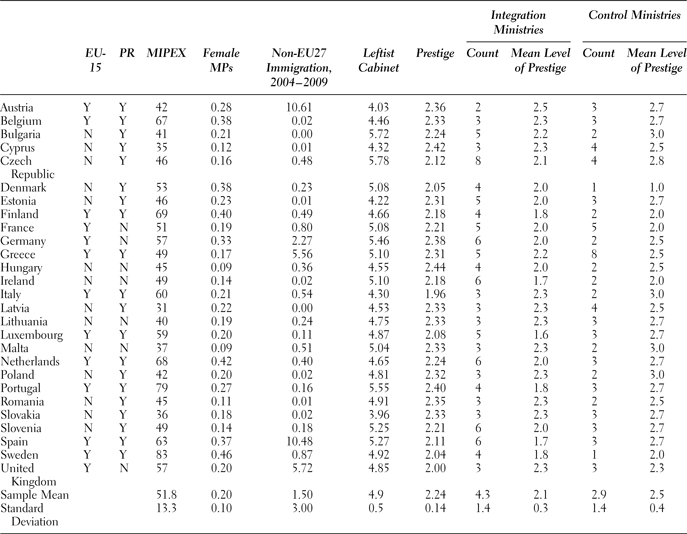
When predicting the sex of government ministers, we include several controls common in the literature on women in executive cabinets. We include the share of women in the lower or single house of the national legislature (IPU 2011). We control for whether a country was one of the original 15 EU member states (see Appendix). We include a dummy variable for a party-list PR system (IDEA 2012). Using measures designed by Krook and O'Brien (Reference Krook and O'Brien2010), we also control for the prestige of particular ministries. Prestige is an ordinal measure with high (3), medium (2), and low (1) categories, although substituting a set of dummy variables for prestige does not change the reported results. The ordinal measure is coded using ministry portfolios. High prestige ministries generally have high visibility and significant control over policy (for example, ministries of defense, finance, foreign affairs, and interior). A medium prestige ministry still has significant financial resources despite lesser status and visibility (for example, ministries of agriculture, education, planning, and transportation). Low prestige ministries have a general lack of resources.Footnote 2 The Appendix provides a country-level breakdown of the variables used in our models and correlations between exogenous variables.
Auxiliary analyses also suggest our results are robust. For example, substituting for prestige measures of the gendering of ministry portfolios (i.e., feminine, neutral, masculine) (again, consistent with Krook and O'Brien Reference Krook and O'Brien2010) does not alter our findings.Footnote 3 Including measures of regime type (parliamentary verses semipresidential or presidential) also has no impact on our substantive results.Footnote 4
In addition to the log-likelihood, we present two measures of absolute fit to assess the ability of our models to explain observations (Tjur's Pseudo-R2 and Receiver Operating Characteristic [ROC] Area Under Curve) and a measure of relative fit to facilitate model comparison (Akaike Information Criteria [AIC]).Footnote 5 For ROC and Pseudo-R2 measures, higher scores indicate better fit; the AIC is constructed such that lower scores indicate better fit (Wagenmakers and Farrell Reference Wagenmakers and Farrell2004).
We compare our results with alternative statistical approaches to address concerns that clustering may affect results. We use two alternative techniques that are common but considered suboptimal for our sample size: (1) adding dummy variables for each country and (2) Generalized Estimating Equations (GEE).Footnote 6 Including country dummy variables does not change the substantive results reported. No country estimate is statistically significant, and the AIC test statistic indicates that including country controls does not increase explanatory value. Parameter estimates obtained using GEE are also substantively similar to the logit estimates presented below.Footnote 7
RESULTS
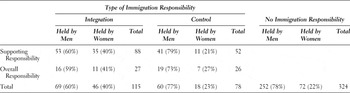
We begin with descriptive analyses of the ministry data. Table 1 summarizes the number of institutions with overall and supporting responsibilities by sex for each set of institutions. These data provide preliminary but clear evidence that women play a significant role in integration leadership in the EU. One hundred and fifteen ministers have responsibilities over integration, of which 46 (40%) are women. By contrast, women hold only 23% of cabinet positions with control responsibilities. That share is almost identical to the share of women heading institutions with no immigration responsibilities. This tendency of women to serve in integration ministries relative to other ministries is statistically significant at conventional levels.
Descriptive: Ministers by sex and immigration responsibility

Table 1 also suggests few differences between ministries with overall versus supporting responsibilities. For example, 41% of ministers with overall integration responsibilities are women, compared to 40% of ministers with only supporting integration responsibilities. A slightly larger difference exists among control ministries, where women are more likely to have overall responsibilities (27%) than supporting responsibilities (21%), but the difference is not statistically significant.
Immigration Policy and Gender
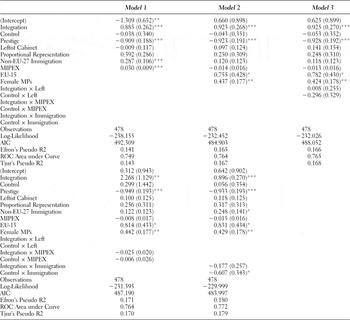
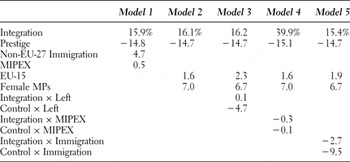
We present results from our logistic regression models predicting minister sex in Table 2 (logit estimates and standard errors) and Table 3 (marginal effects of statistically significant variables and interactions).Footnote 8 All models include the two central independent variables of interest: any integration responsibilities and any control responsibilities. The models in Table 2 improve in fit from left to right. Of all models, Model 5 does the best job of reproducing the data, fitting best in absolute terms (highest log likelihood, Tjur's Pseudo-R2, and ROC); Model 5 is also the most parsimonious (lowest AIC).
Maximum likelihood estimates from logistic regression equations predicting women ministers in European Union member states

Notes: Standard errors in parentheses. *** p < .001; ** p < .05; * p < .10 (based on two-sided Z-test).
Marginal effects of interactions and statistically significant variables

Notes: Computed using “Observed Values Approach” (Hanmer and Kalkan Reference Hanmer and Ozan2012). Immigration and proportion of female MPs in standard deviation form.
Model 1 includes a basic set of controls, including ministry prestige, original EU membership (EU15), and PR electoral system. Cabinet ideology, recent immigration from non-EU countries, and integration policy are also included as main effects. In this model, ministers with integration responsibility are more likely to be women than are other ministers in the EU, supporting Hypothesis 1. Indeed, a ministry having integration responsibility increases the predicted probability that the typical minister will be a woman by 15.9%. By contrast, we find no support for Hypothesis 2: Ministers with control responsibilities are similar to other ministers.
Of the control variables in Model 1, prestige has significant effects on minister sex in the expected direction: Women more commonly serve in cabinet positions with lower prestige levels. Interestingly, the negative marginal effect of prestige is similar in size to the positive marginal effect of integration responsibilities: A one-unit increase in prestige decreases the predicted probability that the typical minister will be a woman by 14.8%. In this model, neither cabinet ideology nor proportional representation has a statistically significant effect on the sex of the appointee. Model 1 also provides evidence that countries experiencing high levels of immigration are more likely to appoint women to cabinets (with a marginal effect of 4.7%). Countries with more expansive integration policies are also more likely to appoint women, though the marginal effect is small (0.5%).
Model 2 introduces women's share of seats in the national legislature, which is statistically and substantively significant in all remaining models. The marginal effect indicates that a one standard deviation increase in women's representation is associated with a 7.0% increase in the chance a woman will be appointed to a cabinet position. Original EU membership (EU-15) is also statistically significant, although the marginal effect is quite small (1.2%). Having more women legislators and original EU membership are associated with higher levels of immigration from outside the EU (ρ = 0.204, 0.439). They are also strongly correlated with more expansive integration policies (ρ = 0.719, 0.746). Thus, introducing women's legislative representation and original EU membership causes both non-EU immigration and integration policy to drop from significance. Still, in Model 2 our main substantive findings remain consistent: Women continue to be more likely to serve in ministries with integration responsibilities, but not in ministries that address control.
Government Ideology, Integration Policy, and Rates of Immigration
In Models 3, 4, and 5, we explore whether the gendered pattern of control and integration ministries is affected by government ideology, integration policy, and recent rates of immigration from outside of the EU (testing Hypotheses 3–5). Of the three, only immigration flows significantly mediate the relationship between immigration responsibilities and minister sex (supporting Hypothesis 5). Yet, statistical significance is neither necessary nor sufficient for demonstrating the existence of a particular interaction in logit models (Berry, DeMeritt, and Esarey Reference Berry, DeMeritt and Esarey2010). Therefore, we must also consider marginal effects when evaluating interactions and then perform likelihood-ratio tests to confirm the relevance of marginal effects that appear substantively meaningful. In Model 3, the interaction between cabinet ideology and integration ministry leadership is negligible; the marginal effect is 0.12%. Cabinet ideology appears to have a stronger effect on control ministries; the marginal effect is 4.7%. The LR test, however, shows that including the interaction does not significantly improve the model. Thus, cabinet ideology does not mediate the relationships between minister sex and integration or control responsibilities; Hypothesis 3 is not supported. We also find no support for Hypothesis 4: The marginal effects of integration policy interactions in Model 4 are both negligible, so an LR test is not necessary to confirm a lack of effects.
We do find support for Hypothesis 5. All else equal, countries with higher non-EU immigration rates are significantly less likely to have women heading control ministries than countries with lower immigration rates. The marginal effect of −9.5 percent also appears substantively meaningful and is confirmed by the LR test (p = 0.086, χ 2 = 4.906, df = 2). This provides further evidence that accounting for the interaction between immigration flows and control ministry leadership improves the explanatory power of the model. On the other hand, higher immigration rates do not influence women's odds of heading integration ministries.Footnote 9 Note that we find similar results if we substitute the size of a country's foreign-born population for recent rates of non-EU immigation. Substituting the size of the Muslim population or population share does not produce similar results; Muslim population differences are not associated with women's ministry in general or in the immigration arena.Footnote 10
Gendering of Subcabinet Positions: Germany and Belgium
By focusing solely on cabinet-level positions, our findings may underestimate the extent to which immigration regulation is gendered. Countries often have subcabinet level organizations with clear responsibility for immigration. These include special departments under prime ministers, offices that operate with some independence but are not part of the cabinet, and organizations within ministries. Preliminary investigation suggests that examining officials at these levels—those who have direct responsibility for immigration control or integration but are not in the cabinet—would support or strengthen the patterns observed so far. We briefly discuss two cases, Germany and Belgium, with different governance structures to illustrate a broader gendering of immigration policy regulation.
Germany is a clear example of the gendering of migration policies beyond ministry leadership. In 1978, West Germany founded the Commissioner for the Advancement of the Integration of Foreign Workers and their Dependents, an advisory position that reported to the Chancellor (Beauftragte der Bundesregierung für Migration, Flüchtlinge und Integration 2008). Since 1980, all of the commissioners have been women. The Federal Office for Migration and Refugees was founded in 1953 to handle asylum applications; its responsibilities have since expanded to include other immigration control tasks (Bundesamt für Migration und Flüchtlinge 2011). All four commissioners have been men.
Belgian immigration governance is more complicated. Overall, it shows the expected gendered patterns. The federal government is responsible for immigration control (Foblets and Yanasmaya Reference Foblets, Yanasmayan, van Oers, Ersbøll and Kostakopoulou2010). Responsibilities for migration and asylum policy have been spread out across multiple subcabinet positions, coordinated by the prime minister's office. They are assigned in ways that are consistent with gendered expectations. The State Secretary for Migration and Asylum Policies, a man oversees the handling of asylum applications and sets policies for the Aliens Office, which manages entry, border control, visas, and illegal immigration; the Aliens Office is also directed by a man (EMN 2009). Regional and Community governments are in charge of integration.Footnote 11 Wallonia, one of the major Belgian communities, illustrates the typical gendering of integration responsibilities. In 2004, responsibility for integration in Wallonia (and the French community) was added to the Ministry for Health and Social Action. So far, both ministers of the newly created Ministry of Health, Social Action, and Equal Opportunities have been women. Flanders, on the other hand, has not assigned immigrant integration to women. Since 2003, a Ministry of Civic Integration has existed but has been bundled with various other ministerial portfolios held by men (Foblets and Yanasmaya 2010). Overall, however, cases like Germany and Belgium demonstrate that a gendered division of leadership in the integration arena is likely not limited to the cabinet level.
CONCLUSION
In recent decades, EU members states have responded to increasing migration by dramatically altering policies related to the immigration and integration of foreign-born individuals and by restructuring governance accordingly. We argue that immigrant integration is associated with care work and immigration control with security issues, so we expected to find that women were more likely to lead integration ministries and that men were more likely to be responsible for control. Indeed, we found strong evidence of a gendered division of labor. Ministers overseeing immigrant integration are more likely than other ministers in the EU to be women. Even controlling for common predictors of minister sex, immigrant integration is more likely to be female-headed than the average portfolio. On the other hand, ministries that regulate immigration control continue to be male-dominated domains. Further, we found that men are even more likely to be responsible for immigration control in countries with high levels of immigration from outside of the EU.
Our results also point to a broad association between higher levels of women's political representation and immigrant-friendly integration policy. For example, women's share of national legislative seats and the breadth of integration policy correlate at more than 0.7. The cross-sectional nature of our data does not allow us to disentangle the causal relationships at play. On one hand, women in legislatures and ministries may help produce integration policies that are more immigrant-friendly. On the other hand, our findings may reflect a synchronicity of attitudes—that societies more favorable toward female politicians are also more committed to immigrant integration. As longitudinal data on integration policy in the EU becomes available, scholars should investigate these associations empirically.
One follow-up question to ask is whether the overall gendered patterns documented here are specific to the EU or, instead, would generalize to other advanced industrialized democracies. A cursory look suggests the pattern we find could be unique to Europe. In the United States, for example, border security is currently headed up by a woman. And in Canada and Australia, immigration ministers tasked with integration-type responsibilities are both male. More in-depth investigations of such differences could consider the influence of factors that are consistent across the EU. For instance, EU-level organizations actively promote the inclusion of women in member state leadership positions (e.g., European Commission 2011), which may have affected the patterns we observed. Broader comparative analysis is needed to determine which cultural or structural factors might lead to differences or similarities between EU member states and other countries.
Another notable result from our study is that cabinet ideology ultimately did not factor prominently into the analysis. Cabinet ideology did not exert an impact on the likelihood of appointing a female minister. This result mirrors recent research finding no effect of party ideology on women's inclusion in democratic cabinets (Krook and O'Brien Reference Krook and O'Brien2010) and a broader trend of late that shows declining importance of political ideology as parties on the Right increasingly promote women to political leadership (e.g., Htun Reference Htun, Ballington and Karam2005). Also surprising is that the gendering of integration ministry positions is consistent across the political spectrum. We expected to observe left-right differences in the gendering of ministry leadership that we ultimately did not find.
Even though political ideology may not explain the gendering of immigration leadership, we suggest that a political calculus may still enter into the appointment process. One explanation for the patterns we observe is that leaders on both sides of the political spectrum may be sensitive to how their political appointees are perceived by the public. Research shows that female leaders are more highly scrutinized and are more often penalized for assuming leadership in male-typed settings where assertiveness and aggression are valued (Eagly and Johannesen-Schmidt Reference Eagly and Johannesen-Schmidt2001; Eagly, Makhijani, and Klonsky Reference Eagly, Makhijani and Klonsky1992; Ridgeway Reference Ridgeway2001). Appointing women to care-oriented integration ministry leadership positions may be a way of minimizing the perceived risk of including women in political leadership. On the flip side, if leaders want to “get tough” on border control, then they may avoid appointing a woman, who could be judged more harshly than a man for the same tough behavior. In sum, leaders seeking public approval could be aware of the importance of gender role congruence for leadership assessment.
Leaders on both the Left and the Right might also use gender to send subtle messages about their immigration policy orientation. Appointing a woman may signal a “softer” approach to policy, whereas appointing a man may signal a “harder” position. Thus, political leaders could be taking advantage of gender stereotypes to appear softer toward legal immigrants living within a country's borders and harder on the illegal migrants perceived as threats to national security. These signals can be sent irrespective of actual policy. Gendering immigration leadership may, therefore, be a low-cost way to communicate a particular stance on immigration control and integration—much easier than actually creating or altering policy. That men are more likely to lead control ministries in countries with higher immigration rates supports this idea of gendered signaling. Across Europe, people in countries with higher immigration rates are more likely to support restrictive—or tougher—immigration control policies (Ceobanu and Escandell Reference Ceobanu and Escandell2010; Meuleman, Davidov, and Billiet Reference Meuleman, Davidov and Billiet2009; Zick, Pettigrew, and Wagner, Reference Zick, Pettigrew and Wagner2008). Political leaders in countries with higher immigration rates may, therefore, use male appointees to appear tougher on immigration control.
Ultimately, our research cannot answer the question of why leaders choose women for certain types of positions. But these findings suggest future research should continue to try to unpack the gendered political calculus of political appointments. Regardless of why a gendered division of immigration leadership positions exists, it is also important to consider other potential implications of this observed pattern. For example, our results inform scholarly debates about the extent to which women's roles in executive leadership remain gendered. Historically, women have been more likely to lead policy domains such as health, education, and social affairs (e.g., Davis Reference Davis1997; Krook and O'Brien Reference Krook and O'Brien2010; Reynolds Reference Reynolds1999). But recent research has suggested the traditional typecasting of women may be on the decline (e.g., Escobar-Lemmon and Taylor-Robinson Reference Escobar-Lemmon and Taylor-Robinson2005; Paxton and Hughes Reference Paxton, Hughes and O'Connor2010). Our results suggest that even as governments reorganize to address new policy issues, a gendered breakdown of tasks continues. Women are appointed to manage social and care-oriented issues (integration), and men are appointed to handle security (immigration control).
The gendered division of executive leadership over immigration policy could have policy implications. Ministers have significant power to promote policies they support or to block policies they oppose (Atchison and Down Reference Atchison and Down2009). But because sex differences in attitudes toward immigrants or immigrant integration are often inconsistent (O'Rourke and Sinnott Reference O'Rourke and Sinnott2006), exactly how the gendering of policy leadership might affect the implementation of immigration policy is difficult to anticipate.
Moreover, even if men and women serve as leaders of immigration policy in the same fashion, gendered patterns of executive leadership have symbolic importance (Mätzke Reference Mätzke2010). Research increasingly shows that the inclusion of women and other minorities in visible positions of power sends powerful messages about “who is fit to rule” (Mansbridge Reference Mansbridge1999; Paxton Reference Paxton1997). We contend that the gendered pattern of leadership also sends powerful messages about what they are fit to rule. The attitude that care work is women's work and that women's work is care work supports continuing gender inequalities that affect all levels of society (England Reference England2005; Geist Reference Geist, Treas and Drobnič2010; Pascall and Lewis Reference Pascall and Lewis2004). The continued gendering of leadership at the highest levels of formal politics in EU member states serves to reinforce the gendered divisions of labor that further gender inequalities in many areas of social life.
APPENDIX
Overview of member states and correlation of exogenous predictors