



1. Introduction
Since a proper local homeomorphism  $f: M \to N$, M and N topological manifolds, is a covering map, it follows that if M is connected and N is simply connected, then f is a global homeomorphism because the degree of the covering is equal to the index
 $\left[\pi_1(N): f_{*}(\pi_1(M)) \right]=\left[\{0\}: f_{*}(\pi_1(M)) \right] = 1$. Since a global homeomorphism is clearly proper, we have a characterization of global homeomorphisms inside the class of local ones: this is largely known as Hadamard global invertibility criterion, see [Reference Plastock19, Reference Xavier20]. So the “size” of the set Sf of non-proper points of f, see the precise definition in 2.1, in some sense measures how far a non-global local homeomorphism is from a global one.
Indeed, at least when M and N are smooth and  $f: M \to N$ is a local diffeomorphism, if M is connected and N is simply connected, assuming that Sf is contained in a submanifold H of codimension greater than or equal to 3, it follows that
 $M\setminus f^{-1}(H)$ is connected and
 $N\setminus H$ is simply connected (see [Reference Godbillon10, Theorem 3.1 p. 22 and Theorem 2.3 p. 146]) and so, as above, it follows that the restriction
 $f|_{M\setminus f^{-1}(H)}: M \setminus f^{-1}(H) \to N \setminus H$ is a global diffeomorphism. Since H has empty interior and f is a local diffeomorphism, we get that
 $f: M \to f(M)$ is a global diffeomorphism.
Here it will also follow that  $f(M) = N \setminus S_f$, because Sf has empty interior, otherwise we must have points
 $y \notin S_f$ having more than one preimage (see at the beginning of
 $\S$ 2 a more general argument, that also provides a characterization of Sf in terms of the number of preimages of points). A completely analogous argument is valid when
 $f: \mathbb R^n\to \mathbb R^n$ is a semialgebraic local homeomorphism. Actually in this case the set Sf is semialgebraic and we can consider its codimension. And, when
 $\operatorname{{codim}} S_f \geq 3$, it is also true that
 $\mathbb R^n\setminus f^{-1}(S_f)$ is connected and
 $\mathbb R^n\setminus S_f$ is simply connected, by [Reference Jelonek14, Lemma 8.1]. So if
 $\operatorname{{codim}} S_f \geq 3$, we get that
 $f: \mathbb R^n \to f(\mathbb R^n)$ is a global homeomorphism with
 $f(\mathbb R^n) = \mathbb R^n \setminus S_f$. In this case, when f is polynomial, we further have that f is surjective, by [Reference Białynicki-Birula and Rosenlicht1], and then Sf is forced to be empty. But even in the semialgebraic smooth case with (with
 $M = N =\mathbb R^n$), this may not be the case: Sf can have codimension n − 1, as shows Example 4.2 below. When f, M and N are not smooth (respectively f is not semialgebraic), we cannot guarantee that
 $N\setminus H$ (respectively
 $\mathbb R^n \setminus S_f$) is simply connected, and the argument above does not apply.
On the other hand, there exist polynomial non-injective local diffeomorphisms  $f \colon \mathbb R^2 \to \mathbb R^2$ (see explicit examples in [Reference Braun and Fernandes4, Reference Fernandes8, Reference Fernandes and Jelonek9, Reference Pinchuk18], see also [Reference Campbell5]) such that
 $\mathrm{codim} S_f = 1$, thus providing examples in
 $\mathbb R^n$ where
 $\mathrm{codim} S_f = 1$.
So it remains to deal with the case where Sf is contained in a submanifold of codimension 2, or is semialgebraic of codimension 2 – where we can no longer use, at least not as above, simple covering arguments to conclude injectivity. Actually, this situation is very appealing, due to a known conjecture by Jelonek:
Conjecture 1.1 (Jelonek’s conjecture [Reference Jelonek14])
Let  $f\colon \mathbb R^n \to \mathbb R^n$ be a polynomial map with nowhere vanishing Jacobian determinant and such that
 $\operatorname{{codim}} S_f\geq 2$. Then f is a bijective map (and consequently
 $S_f=\emptyset$).
The importance of Conjecture 1.1 can be measured by the fact that its validity in dimension 2n implies the validity of the celebrated Jacobian conjecture in dimension n: “A polynomial map  $F: \mathbb C^n \to \mathbb C^n$ with Jacobian determinant equal to 1 is an automorphism”, see [Reference Jelonek14]. Since Conjecture 1.1 has been proved true for n = 2 in [Reference Jelonek14] (assuring only the trivial fact that Jacobian conjecture in dimension 1 is true), see also [Reference Braun, Dias and Venato-Santos2, Proposition 2.13] for a proof on the semialgebraic case, it remains to investigate the higher dimensional,
 $n\geq3$, cases.
One of the aims of this paper is to provide a partial answer in the  $\operatorname{{codim}} = 2$ case, as a consequence of the following result.
Theorem 1.2. Let M be a n-dimensional topological manifold and  $f: M \to \mathbb R^n$ be a local homeomorphism.
(i) If Sf is contained in an affine subspace
 $\mathcal{H}$ of
$\mathbb R^n$ of codimension 2 then Sf does not intersect f(M). Further, if
$\mathcal{H}$ intersects f(M), then f is injective.
(ii) If Sf is an affine subspace of
$\mathbb R^n$ of codimension 2, then
$\chi (M) = 0$.


We say that a subset  $A \subset \mathbb R^n$ is ambient homeomorphic to an affine subspace
 $\mathcal{H} \subset \mathbb R^n$ if there exists a homeomorphism
 $h \colon \mathbb R^n \to \mathbb R^n$ such that
 $h(A) = \mathcal{H}$. In particular, when
 $M = \mathbb R^n$, item (ii) implies that the set Sf cannot be ambient homeomorphic to an affine subspace of
 $\mathbb R^n$ of codimension 2 for a local homeomorphism
 $f \colon \mathbb R^n \to \mathbb R^n$. An open question remains whether Sf can be merely homeomorphic to a subspace of codimension 2.
In order to prove Theorem 1.2, in  $\S$ 3, we first prove that the preimage of a certain “cylinder” not intersecting Sf is connected, see Theorem 3.2. This is a general property of Sf.
In  $\S$ 2, we provide more general properties for local homeomorphisms
 $f: \mathbb R^n \to \mathbb R^n$, one of them dealing with the unboundedness of certain connected components of Sf, see Theorem 2.3.
We finish the paper in  $\S$ 4 with the proof of the following version of Jelonek’s conjecture, now assuming more regularity:
Theorem 1.3. Let  $f = (f_1, f_2, \ldots, f_n): \mathbb R^n \to \mathbb R^n$ be a semialgebraic local homeomorphism such that
 $\operatorname{{codim}} S_f \geq 2$. If there are distinct indices
 $i_1, i_2, \ldots, i_{n-2} \in \{1,2, \ldots, n\}$ such that
 $\left(f_{i_1}, \ldots, f_{i_{n-2}}\right)^{-1}(c)$ is simply connected for every c in a subset with nonempty interior in
 $\mathbb R^{n-2}$, then f is injective.
When one is seeking for conditions guaranteeing the global injectivity of local diffeomorphisms, Theorem 1.3 can be compared to the main result of [Reference Fernandes, Maquera and Venato-Santos7]:
Theorem 1.4 ([Reference Fernandes, Maquera and Venato-Santos7, Theorem 1.1])
Let  $f = (f_1, f_2, \ldots, f_n): \mathbb R^n \to \mathbb R^n$ be a semialgebraic local diffeomorphism such that
 $\operatorname{{codim}} S_f \geq 2$. Let
 $H_{i_1\ldots i_{n-2}}\subset \mathbb R^{n-2}$ be the set of values
 $c\in \mathbb R^{n-2}$ such that
 $\left(f_{i_1},\ldots, f_{i_{n-2}}\right)^{-1}(c)$ is not homeomorphic to a union of planes. If
 $H_{i_1\ldots i_{n-2}}=\emptyset$ for all increasing permutations
 $(i_1 \lt i_2 \lt \ldots \lt i_{n-2})$ of
 $\{1,2,\ldots,n\}$, then f is bijective.
We notice that in Theorem 1.4, the bijectivity of f implies the simply connectedness of all the sets  $\left(f_1, \ldots, f_{n-2}\right)^{-1}(c)$. This implies in particular the hypothesis of our Theorem 1.3. We present in Example 4.2 an injective map satisfying the assumptions of Theorem 1.3 but not of Theorem 1.4.
The research that led to this paper was inspired by the unpublished work [Reference Fernandes and Jelonek6].
2. Some properties of Sf
We denote by  $B_R \subset \mathbb R^n$ (respectively,
 $\mathbb{S}_R\subset\mathbb R^n$) the open ball (respectively, the sphere) of radius R centered at the origin of
 $\mathbb R^n$, and by
 $\| \cdot\|$ the Euclidean norm in
 $\mathbb R^n$. For a finite set A, we write
 $\# A$ for its cardinality.
Definition 2.1. Let  $M , N$ be topological manifolds and let
 $f: M \to N$ be a map. We say that f is proper at
 $y\in N$ if there exists a neighborhood V of y such that
 $f^{-1} \left(\overline{V}\right)$ is compact. We denote by Sf the set of points of N at which f is not proper. This is the non-properness set of f, sometimes termed Jelonek’s set of f.
It is clear that f is proper if and only if  $S_f = \emptyset$.
For a continuous map  $f: \mathbb R^m \to \mathbb R^n$ the set Sf is formed by the points
 $y\in\mathbb R^n$ such that
 $f(x_k) \to y$ for a sequence
 $\{x_k\}$ satisfying
 $\|x_k\|\to \infty$.
Moreover, when f is a local homeomorphism and  $N\setminus S_f$ is non-empty and connected, it follows that the restriction
 $f|_{M\setminus f^{-1}(S_f)}: M\setminus f^{-1}(S_f) \to N\setminus S_f$ is a d-covering map, for some
 $d\in \mathbb N$. Moreover, if Sf has empty interior, it follows that
 \begin{equation}
y \in N \setminus S_f \text{ if and only if } \#f^{-1}(y) = d.
\end{equation}
Clearly in this case  $y\in S_f$ if and only if
 $\#f^{-1}(y) \lt d$.
We begin with a general separation theorem. By a topological hypersurface of  $\mathbb R^n$ we mean an embedded topological manifold of dimension n − 1.
Theorem 2.2. Let A be a compact topological hypersurface of  $\mathbb R^n$. Assume that A has k connected components. The complement of A has k + 1 open connected components, with exactly one of them unbounded. If k = 1, set AI as the bounded and AO as the unbounded components. Then
 $\overline{A^I}$ is compact and A is the common boundary of AO and AI.
This is a consequence of Alexander duality, see [Reference Hatcher13, Theorem 3.44], as follows. We are indebted to our friend Prof. Marcio Colombo Fenille for explaining it to us. Up to one-point compactification we can assume  $A\subset \mathbb{S}^n$, so for the first part of the theorem it suffices to prove that
 $\mathbb{S}^n \setminus A$ has k + 1 components. By Alexander duality,
 $\widetilde{H}_0(\mathbb{S}^n\setminus A; \mathbb Z)\approx\widetilde{H}^{n-1}(A; \mathbb Z)$. Since A is a topological hypersurface, it is necessarily orientable. Hence
 $\widetilde{H}^{n-1}(A; \mathbb Z)\approx \oplus_{i = 1}^k \mathbb Z$ and so
 $H_0(\mathbb{S}^n \setminus A; \mathbb Z)\approx \oplus_{i = 1}^{k+1}\mathbb Z$, meaning that
 $\mathbb{S}^n \setminus A$ has k + 1 components, one of them containing the point at infinity. So back to
 $\mathbb R^n$, we will get our components as claimed. In case k = 1, we will be done once we prove that the components Y 1 and Y 2 of
 $\mathbb{S}^n \setminus A$ has A as common boundary. Since the set
 $Y_i\cup A$ is closed and the closure
 $\overline{Y_i}$ is the disjoint union
 $Y_i\cup\partial Y_i$, it follows that
 $\partial Y_i\subset A$, for
 $i = 1,2$. The reverse inclusion is more involved. Let
 $x\in A$ and let
 $U\subset \mathbb{S}^n$ be an open neighborhood of x. It is enough to prove that U intersects
 $\partial Y_i$. Since A is a topological hypersurface, there exists an embedded open
 $(n-1)$-ball
 $V\subset A$ such that
 $V\subset U\cap A$. The set
 $A\setminus V$ is compact and locally contractible. By Alexander duality
 $\widetilde{H}_0 \left(\mathbb{S}^n \setminus (A\setminus V);\mathbb Z\right)\approx\widetilde{H}^{n-1}(A \setminus V;\mathbb Z)$. Since
 $A \setminus V$ is homotopic to a punctured topological hypersurface, we have
 $\widetilde{H}^{n-1}(A \setminus V;\mathbb Z) = 0$ and so
 $H_0\left(\mathbb{S}^n \setminus (A \setminus V);\mathbb Z\right)\approx\mathbb Z$, implying that
 $\mathbb{S}^n \setminus (A \setminus V)$ is connected and hence path connected (as it is open and locally path connected). If
 $p_i\in Y_i$ there is a path α in
 $\mathbb{S}^n\setminus(A\setminus V)$ from p 1 to p 2. Since p 1 and p 2 are in different path components of
 $\mathbb{S}^n\setminus A$, α meets
 $\partial Y_i$, let us say in yi, and so
 $y_i\in A$. As α is contained in
 $\mathbb{S}^n\setminus(A\setminus V)$, we have
 $y_i\in V\subset U$ and U intersects
 $\partial Y_i$ as desired.
For a smooth version of this result see [Reference Guillemin and Pollack11].
From now on we will use the notation of Theorem 2.2.
Theorem 2.3. Let  $f: \mathbb R^n \to \mathbb R^n$ be a local homeomorphism and
 $H \subset \mathbb R^n$ be a compact connected topological hypersurface. If
 $H \cap f(\mathbb R^n) \neq \emptyset$ and
 $H \cap S_f = \emptyset$, then
 $\overline{H^I} \cap S_f = \emptyset$.
Proof. By the assumptions the preimage of H by f is not empty. Further, by using the facts that f is a local homeomorphism, H is compact and does not intersect Sf, it follows that  $f^{-1}(H)$ is a disjoint union of finitely many compact connected topological hypersurfaces
 $Z_1, \ldots, Z_k$. Also, the restriction
 $f|_{Z_i}: Z_i \to H$ is a local homeomorphism and then
 $f(Z_i)$ is open in H for each i. Since Zi is compact and f is continuous, the image
 $f(Z_i)$ is also compact and hence closed in H. As
 $f(Z_i)$ is nonempty, open, and closed in the connected set H, it follows that
 $f(Z_i) = H$ for each i.
For a fixed point  $p \in H$, the distance function
 $d: \mathbb R^n \to [0,\infty)$,
 $d(y) = \|y - p\|$, when restricted to
 $\overline{H^I}$, has a maximum point
 $y_0 \in H$, with value
 $d(y_0) = d_{0}$.
In particular, it follows that the set
 \begin{equation*}
T = \{p + t(y_0 - p) \mid t \gt 1\},
\end{equation*}
is entirely contained in HO, because its points have distance to p greater than d 0.
Also, since f is a local homeomorphism it follows that, for any i, a maximum point of the function  $d\circ f$ when restricted to
 $\overline{Z_i^I}$ must live in Zi. Since
 $f(Z_i) = H$, it follows that
 \begin{equation}
d \circ f(x) \lt d_{0},
\end{equation}
for any  $x\in Z_i^I$. In particular, no Zj intersects
 $Z_i^I$.
Let W be the unbounded connected component of  $\mathbb R^n \setminus \cup_{i = 1}^k Z_i$. Clearly W agrees with the complement of
 $\cup_{i=1}^k Z_i^I$.
Claim 1:  $f(W) \subset H^O$. Indeed, since f(W) is connected it is enough to show there exists
 $x\in W$ with
 $f(x) \in H^O$. Since f is a local homeomorphism, we can choose points
 $x \in \mathbb R^n \setminus \cup_{i=1}^k Z_i$ and
 $y \in T$ with
 $f(x) = y$. By (2) the point x must lie in W. Then
 $f(x) \in T \subset H^O$, as we wanted.
Claim 2:  $f(Z_i^I) \subset H^I$ for
 $i=1,\ldots, k$. As in Claim 1, it is enough to show the existence of
 $x\in Z_i^I$ such that
 $f(x) \in H^I$. Since f is a local homeomorphism, for any point
 $x_0 \in Z_i$, there exist neighborhoods U of x 0 and V of
 $f(x_0)$ such that the restriction
 $f: U \to V$ is a homeomorphism. By Theorem 2.2, we can take a point y in
 $V \cap H^I$. By Claim 1, this point is not the image of any point in
 $W\cap U$. Since Zj does not intersect
 $Z_i^I$,
 $i,j=1,\ldots, k$, it follows that there must exist
 $x\in Z_i^I$ mapped to y.
From claims 1 and 2 it follows that  $f^{-1}(\overline{H^I}) = \cup_{i=1}^k \overline{Z_i^I}$. Since this set is compact, we conclude that
 $H^I \cap S_f = \emptyset$.
Theorem 2.3 has several applications. We present the following illustrative consequences. First observe that for a local homeomorphism  $f: M \to N$, the definition of Sf ensures that
 \begin{equation}
\overline{f(M)} \setminus f(M) \subset S_f \subset \overline{f(M)}.
\end{equation}
In particular, we immediately obtain:
Remark 2.4. A local homeomorphism f is onto if and only if 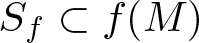 $S_f \subset f(M)$.
Corollary 2.5. Let  $f : \mathbb R^n \to \mathbb R^n$ be a local homeomorphism. Then
 $f(\mathbb R^n)$ is a bounded set if and only if Sf is a nonempty compact set.
Proof. If  $f(\mathbb R^n)$ is a bounded set then
 $\overline{f(\mathbb R^n)}$ is compact. Since Sf is closed it follows by the second inclusion in (3) that Sf is compact. Moreover, since
 $f(\mathbb R^n)$ is an open set, the first inclusion in (3) immediately implies that
 $S_f \neq \emptyset$.
Conversely, assume that Sf is a nonempty compact set and let  $r: = \max\{\|y\| \mid y\in S_f\}$. Then, for any ɛ > 0,
 \begin{equation}
S_f \subset \mathbb{S}_{r + \varepsilon}^I,
\end{equation}
which in particular implies  $\mathbb{S}_{r + \varepsilon} \cap S_f = \emptyset$. Therefore, Theorem 2.3 gives that
 $f(\mathbb R^n) \cap \mathbb{S}_{r + \varepsilon} = \emptyset$. By connectedness it then follows that
 $f(\mathbb R^n) \subset \mathbb{S}_{r + \varepsilon}^I$ or
 $f(\mathbb R^n) \subset \mathbb{S}_{r + \varepsilon}^O$. The latter case leads to a contradiction, as it would imply that
 $\overline{f(\mathbb R^n)} \subset \mathbb{S}_{r + \varepsilon}^O \cup \mathbb{S}_{r + \varepsilon}$, which contradicts (4) together with the second inclusion in (3). Thus, it must be
 $f(\mathbb R^n) \subset \mathbb{S}_{r + \varepsilon}^I$, ensuring that
 $f(\mathbb R^n)$ is bounded.
Remark 2.6. If  $f : \mathbb R^n \to \mathbb R^n$ is a local homeomorphism satisfying
 $S_f \subset f(\mathbb R^n)$, then Sf cannot be a nonempty bounded set. Indeed, otherwise Sf would be a nonempty compact set, and Corollary 2.5 would then apply to ensure that
 $f(\mathbb R^n)$ is bounded, which contradicts Remark 2.4.
Remark 2.7. If  $f : \mathbb R^n \to \mathbb R^n$ is a local homeomorphism such that Sf is a connected set, then
 $S_f\cap f(\mathbb R^n)$ cannot be a nonempty compact set. In fact, if
 $S_f \cap f(\mathbb R^n)$ were compact, it would be closed, and consequently closed in Sf. Moreover, since
 $f(\mathbb R^n)$ is open it follows that
 $S_f \cap f(\mathbb R^n)$ is also open in Sf. By connectedness,
 $S_f = S_f\cap f(\mathbb R^n)$. This leads to a contradiction with Remark 2.6, as Sf would then be compact and contained in
 $f(\mathbb R^n)$.
Remark 2.8. If  $f : \mathbb R^n \to \mathbb R^n$ is a local homeomorphism then Sf cannot have isolated points. Indeed, if
 $x \in S_f$ is isolated, there exists a sphere Sɛ centered at x with radius ɛ > 0 small enough such that
 $S_{\varepsilon}\cap S_f=\emptyset$. By the second inclusion in (3), we can choose such an ɛ so that
 $H = S_{\varepsilon}$ satisfies the conditions of Theorem 2.3. However, this would imply that
 $x\notin H^I$, which is a contradiction.
This generalizes [Reference Braun, Dias and Venato-Santos2, Proposition 2.3], where it was proven that for semialgebraic local diffeomorphisms of  $\mathbb R^2$,
 $S_f \neq \emptyset $ cannot have dimension 0. The above example, along with Hardt’s theorem [Reference Hardt12], demonstrates that for any semialgebraic local diffeomorphism of
 $\mathbb{R}^n$, the dimension of Sf satisfies
 $0 \lt \dim S_f \lt n$, provided that
 $S_f \neq \emptyset$.
Theorem 2.9. Let  $f : \mathbb R^n \to \mathbb R^n$ be a local homeomorphism. Suppose that for each connected compact component L of Sf, the set
 $S_f \setminus L$ is closed. Then the following are equivalent
(a)
$f(\mathbb R^n)$ is a bounded set.(b) Sf has a nonempty compact connected component.
(c) Sf is a nonempty compact connected set.
(d) Sf is a nonempty compact set.

Proof. Corollary 2.5 establishes the equivalence (a)  $\Leftrightarrow$ (d) and also that (a)
 $\Rightarrow$ (b). Since it is clear that (c)
 $\Rightarrow$ (d), it is enough to prove that (b)
 $\Rightarrow$ (c).
So we assume that Sf has a nonempty compact connected component L, and suppose by contradiction that there exists a nonempty connected component  $\tilde L$ of
 $S_f \setminus L$.
Let  $d(X,Y) = \inf \{\|x - y\|\ |\ x\in X, \ y\in Y\}$ denote the usual distance between
 $X, Y \subset \mathbb R^n$, and let
 $d_X: \mathbb R^n \to \mathbb R$ be the uniformly continuous function
 ${d}_X(y) = {d}(X, \{y\})$.
Clearly,  ${d}(X,Y) = \inf d_X(Y) = \inf d_Y(X)$, and
 $d_X(y) = 0$ if and only if
 $y \in \overline{X}$.
Set  $\delta= d(L, S_f\setminus L)$. Since
 $d_{S_f\setminus L}$ is continuous, L is compact and
 $S_f \setminus L$ is closed, it follows that δ > 0.
By the Whitney Approximation Theorem, see for instance [Reference Lee16, Theorem 6.21], there exists a  $C^{\infty}$ function
 $\lambda: \mathbb R^n \to \mathbb R$ such that
 \begin{equation}
|d_L(x) - \lambda(x)| \lt \frac{\delta}{8},
\end{equation}
for all  $x \in \mathbb R^n$.
Claim 1: The interval  $(\delta/8, 7\delta/8)$ is contained in
 $\lambda (f(\mathbb R^n))$. Indeed, since
 $S_f \subset \overline{f(\mathbb R^n)} $, there exists a sequence
 $\{z_k\} \subset f(\mathbb R^n)$ such that
 $\lim z_k \in L$. As
 $d_L(L) \subset \{0\}$, it follows by (5) that
 $\lim \lambda(z_k) \leq \delta/8$. On the other hand, our assumption guarantees the existence of a sequence
 $\{y_k\} \subset f(\mathbb R^n)$ such that
 $\lim y_k \in S_f \setminus L$. Then again by (5) and the definition of δ, we have
 $\lim \lambda(z_k) \geq 7\delta/8$. The connectedness of
 $\lambda \left( f(\mathbb R^n) \right)$ now gives the claim.
The Sard’s theorem, see for instance [Reference Lee16, Theorem 6.10], guarantees the existence of a regular value a of λ such that
 \begin{equation*}
a \in (3\delta/8, 5\delta/8).
\end{equation*}
Since L is compact, the fibers of dL are bounded (and so compact). From (5) we conclude that the fibers of λ are bounded as well and so compact. Hence  $\lambda^{-1}(a)$ is a compact hypersurface such that
 \begin{equation*}
\lambda^{-1}(a) \cap f(\mathbb R^n) \neq \emptyset,\quad \lambda^{-1}(a) \cap S_f = \emptyset.
\end{equation*}
Moreover, being a hypersurface,  $\lambda^{-1}(a)$ cannot have accumulation of connected components, and hence it has a finite number of connected components H 1, H 2,..., Hk.
Up to reordering, we can assume that there exists  $1\leq s \leq k$ such that
 $\overline{H_1^I}, \ldots, \overline{H_s^I}$ are pairwise disjoint and
 $\cup_{i=s+1}^k H_i \subset \cup_{j=1}^s\overline{H_j^I}$.
Claim 2: There exists  $l \in \{1, \ldots, s\}$ such that
 $ L \subset H_l^I$. Indeed, we have that
 $X:= \cup_{j=1}^s H_j$ is a compact manifold with s connected components. By Theorem 2.2,
 $\mathbb R^n \setminus X$ has s + 1 connected components. By the definition of s, these connected components are
 $H_1^I, \ldots, H_s^I$ and
 $\mathbb R^n \setminus \cup_{j=1}^s\overline{H_j^I}$. We have that λ restricted to
 $\mathbb R^n \setminus \cup_{j=1}^s\overline{H_j^I}$ is an unbounded function because L is compact and
 $\mathbb R^n \setminus \cup_{j=1}^s\overline{H_j^I}$ is unbounded, in particular
 $\lambda(x) \gt a$ for every
 $x \notin \cup_{j=1}^s\overline{H_j^I}$. Since
 $| \lambda (x) | \lt \delta/8$ in L, it follows that there exists
 $l \in \{1, \ldots, s\}$ such that
 $L \subset H_l^I$.
Claim 3: For any  $j\in \{1, \ldots, k\}$, it follows that
 $L \subset H_j^I$ if and only if
 $\tilde L \subset H^I_{j}$. In fact, assume that
 $ L \subset H_j^I$. Since
 $\tilde L$ is a connected set and
 $\tilde L \cap H_{j} = \emptyset$, we have either
 $\tilde L \subset H^O_{j}$ or
 $\tilde L \subset H^I_{j}$. If
 $\tilde L \subset H^O_{j}$, then
 $f(\mathbb R^n) \cap H^O_{j} \neq \emptyset$ and
 $f(\mathbb R^n) \cap H^I_{j} \neq \emptyset$ because
 $S_f \subset \overline{f(\mathbb R^n)}$. Thus
 $f(\mathbb R^n) \cap H_j \neq \emptyset$ by connectedness, contradicting Theorem 2.3. The same argument shows
 $\tilde L \subset H^I_{j} \Rightarrow L \subset H_j^I$.
Now, let m be such that  $L \subset H_m^I$ and there is no
 $H_i \subset H_m^I$ satisfying
 $L \subset H_i^I$. By Claim 3,
 $\tilde L$ shares this property with L.
Let  $\ell$ be the number of Hi’s contained in
 $H_m^I$. As before, there exists
 $1 \leq s_1 \leq \ell$ such that
 $\overline{H_{i_1}^I}, \ldots, \overline{H_{i_{s_1}}^I}$ are pairwise disjoint and
 $\cup_{j = s_1+1}^\ell H_{i_j} \subset \cup_{j = 1}^{s_1}\overline{H_{i_j}^I}$. Then, Theorem 2.2 says that
 $\mathbb R^n \setminus U_{j = 1}^{s_1} H_{i_j} \cup H_m$ has
 $s_1 + 2$ connected components:
 $H_m^O$,
 $H_{i_j}^I$, for
 $j = 1, \ldots, s_1$, and another one. This last component must be
 $H_m^I \setminus \cup_{j = 1}^{s_1} H_{i_j}^I$, and it will contain a path from L to
 $\tilde L$. Of course the function λ cannot attain the value a in this path. But this contradicts the definition of a.
For semialgebraic maps, since Sf has only finitely many connected components, the assumption on  $S_f \setminus L$ is unnecessary:
Corollary 2.10. Let  $f : \mathbb R^n \to \mathbb R^n$ be a semialgebraic local homeomorphism. The following conditions are equivalent:
(a)
$f(\mathbb R^n)$ is a bounded set.(b) Sf has a nonempty compact connected component.
(c) Sf is a nonempty compact connected set.
(d) Sf is a nonempty compact set.

A direct consequence of Corollary 2.10 (and the first inclusion in (3)) is the following:
Corollary 2.11. Let  $f : \mathbb R^n \to \mathbb R^n$ be a semialgebraic local homeomorphism, and let L be a nonempty compact connected component of Sf. Then
 $L \not\subset f(\mathbb R^n)$.
3. The influence of the shape of Sf
In the sequel, given a n-dimensional topological manifold N, by a locally flat topological hypersurface  $M \subset N$ we mean a hypersurface such that for any point of M there exists a local chart
 $(U,\phi)$ of N and R > 0 such that
 $\phi(U\cap M) = B_R\cap (\mathbb R^{n-1} \times \{0\})$. In the case when M and N are smooth, M is always locally flat.
Definition 3.1. Let N be a connected n-dimensional topological manifold, and let  $\mathcal{H}$ and
 $\mathcal{C}$ be subsets of N. The pair
 $(\mathcal{H}, \mathcal{C})$ is called a good separation in N if the following conditions hold:
(1)
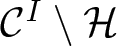
$\mathcal{C}$ is closed and is a connected locally flat topological hypersurface of N such that
$N \setminus \mathcal{C}$ consists of two nonempty connected components, denoted by
$\mathcal{C}^I$ and
$\mathcal{C}^O$, whose common boundary is
$\mathcal{C}$.(2)
$\mathcal{H} \subset \mathcal{C}^I$.(3)
$\mathcal{C}^I\setminus \mathcal{H}$ has finitely many connected components.(4)
$\mathcal{C}$ is a strong deformation retract of each of the sets
$(\mathcal{C}^I \setminus \mathcal{H} )\cup \mathcal{C}$ and
$(\mathcal{C}^O \cup \mathcal{C})$.




When  $\mathcal{C}$ is compact (respectively smooth) and
 $N = \mathbb R^n$, it follows from Theorem 2.2 (respectively [Reference Lima17, p. 41]) that
 $\mathbb R^n\setminus \mathcal{C}$ consists of two nonempty connected components whose common boundary is
 $\mathcal{C}$. The notation
 $\mathcal{C}^I$ and
 $\mathcal{C}^O$ are being borrowed from Theorem 2.2 and when
 $\mathcal{C}$ is compact and
 $N = \mathbb R^n$,
 $\mathcal{C}^I$ still stands for the compact connected component of the complement of
 $\mathcal{C}$. But it is clear that when
 $\mathcal{C}$ is not compact, both
 $\mathcal{C}^I$ and
 $\mathcal{C}^O$ are not compact. Even when
 $\mathcal{C}$ is compact but N is not
 $\mathbb R^n$, we can not guarantee one of the components of the complement of
 $\mathcal{C}$ is compact.
Theorem 3.2. Let M and N be connected n-dimensional topological manifolds. Let  $(\mathcal{H}, \mathcal{C})$ be a good separation in N and let
 $f: M \to N \setminus \mathcal{H}$ be a proper local homeomorphism. Then the preimage
 $f^{-1} ( \mathcal{C} )$ is connected.
Proof. Since f is a proper local homeomorphism, one may write  $f^{-1}(\mathcal{C}) = \cup_{i=1}^kZ_i$, where each Zi is a connected
 $(n-1)$-dimensional topological submanifold of M. The image
 $f(Z_i)$ is open in
 $\mathcal{C}$ because f is a local homeomorphism. It is also closed in
 $\mathcal{C}$ because Zi is closed in M and f is proper. Thus,
 $f(Z_i)$ is a nonempty open and closed subset of the connected space
 $\mathcal{C}$, and hence
 $f(Z_i) = \mathcal{C}$.
The objective of the proof is to conclude that k = 1.
We consider the decomposition of the complement:
 \begin{equation}
M \setminus \bigcup_{i=1}^k Z_i = \Big(\bigcup_{\substack{1\leq i\leq k\\ 1\leq j\leq r_i}}Z_{ij}^I \Big)\cup \Big( \bigcup_{\substack{1\leq i\leq k\\ 1\leq \ell\leq s_i}}Z_{i\ell}^O \Big),
\end{equation}
where for each  $i = 1, \ldots, k$, the sets
 $Z_{ij}^I$,
 $j = 1, \ldots, r_i$, and
 $Z_{i\ell}^O$,
 $\ell = 1, \ldots, s_i$, are the connected components of
 $M\setminus {\cup_{i = 1}^kZ_i}$. The superscript notations I and O will be explained in a while. First we justify the finiteness on the number of connected components by using the facts that f is a finite covering map and that
 $(N\setminus \mathcal{H}) \setminus \mathcal{C} = \mathcal{C}^O \cup (C^I\setminus \mathcal{H})$ has finitely many connected components.
For a given i, fix a point  $p\in Z_i$. Choose a neighborhood Up of p such that
 $f|_{U_p}\colon U_p \to V_q$ is a homeomorphism, where Vq is a suitable neighborhood of
 $q = f(p)$ so that
 $V_q \cap \mathcal{C}^I$ and
 $V_q \cap \mathcal{C}^O$ are connected, this is possible by (1) of Definition 3.1. Since Vq intersects both
 $\mathcal{C}^I$ and
 $\mathcal{C}^O$, it follows by connectedness and from the fact that Up is homeomorphically mapped onto Vq that Up intersects at least two distinct connected components
 $Z_{i j}^I$ and
 $Z_{i j}^O$ such that
 $f\left(Z_{i j}^I\right) \subset \mathcal{C}^I$, and
 $f\left(Z_{i j}^O\right) \subset \mathcal{C}^O$. Further, since
 $V_q \cap \mathcal{C}^I$ and
 $V_q \cap \mathcal{C}^O$ are connected,
 $Z_{ij}^I$ and
 $Z_{ij}^O$ are the only connected components with these properties. It makes sense then to define that the point p is associated to the connected components
 $Z_{i j}^I$ and
 $Z_{i j}^O$.
We say that  $p,p'\in Z_i$ are I-related if they are associated to the same component
 $ Z_{ij}^I$. By the definition of association, this is an equivalence relation in Zi whose equivalence classes are both open and closed in Zi. Thus, by the connectedness of Zi, every two points in Zi are I-related, so that all the components
 $Z_{ij}^I$,
 $j = 1,\ldots, r_i$, coincide. We denote this unique set by
 $Z_i^I$. An analogous argument shows that all the
 $Z_{i\ell}^O$ coincide, and we denote the resulting set by
 $Z_i^O$. Consequently, we may rewrite (6) as
 \begin{equation*}
M\setminus \displaystyle{\bigcup_{i=1}^k Z_i = \Big(\bigcup_{1\leq i\leq k}Z_{i}^I \Big) \cup \Big(\bigcup_{1\leq i\leq k}Z_{i}^O} \Big).
\end{equation*}
Claim: For any distinct indices  $i_1\neq i_2$, one has
 $Z_{i_1}^I \neq Z_{i_2}^I$ and
 $Z_{i_1}^O \neq Z_{i_2}^O$. Since clearly
 $Z_i^I \neq Z_j^O$, otherwise the connectedness of
 $f(Z_i^I)$ would imply that
 $\mathcal{C}^I \cap \mathcal{C}^O$ is not empty, this claim implies that
 \begin{equation*}
M = \bigcup_{i=1}^k\left(Z_i^I\cup Z_i\cup Z_i^O\right),
\end{equation*}
that is, M is expressed as the union of k open, pairwise disjoint sets. Then the connectedness of M forces that k = 1, as desired.
We now prove the claim for the  $Z_i^I$’s. Suppose by contradiction that
 $Z_{i_1}^I = Z_{i_2}^I$ for some
 $i_1\neq i_2$. Choose points
 $p_1\in Z_{i_1}$ and
 $p_2\in Z_{i_2}$ such that
 $f(p_1)=f(p_2)\in \mathcal{C}$. Let
 $V_{p_1}$ be a path connected neighborhood of p 1 and select a point
 $q\in V_{p_1} \cap Z_{i_1}^I$. Then there exists a path in
 $V_{p_1}$ connecting p 1 to q. Since
 $Z_{i_1}$ is closed and path connected, we may assume that this path is entirely in
 $Z_{i_1} \cup Z_{i_1}^I$. After repeating the argument for p 2, we can construct a path
 $\alpha\colon [0,1]\to Z_{i_1} \cup Z_{i_2} \cup Z_{i_1}^I$ connecting p 1 to p 2.
Define  $\beta(s) = f\left(\alpha(s)\right)$ and consider the continuous map
 $F\colon [0,1]\times [0,1]\to (\mathcal{C}^I \setminus \mathcal{H}) \cup \mathcal{C}$ given by
 \begin{equation*}
F(s,t) = \Phi(\beta(s), t),
\end{equation*}
where  $\Phi: \left(\mathcal{C}^I \setminus \mathcal{H} \right) \cup \mathcal{C} \times [0,1] \to \left(\mathcal{C}^I \setminus \mathcal{H} \right) \cup \mathcal{C}$ is the strong deformation retraction onto
 $\mathcal{C}$, i.e.,
 $\Phi(x,0) = x$,
 $\Phi(x,1) \in \mathcal{C}$ for all x, and
 $\Phi(x,t) = x$ for all
 $x \in \mathcal{C}$ and all
 $t\in[0,1]$. Then F is a homotopy between β and the curve
 $\gamma(s) = \Phi\left(\beta(s), 1\right)$ which is contained in
 $\mathcal{C}$. Since f is a covering map, there exists a unique lifting
 $\tilde{F}\colon [0,1]\times [0,1]\to M$ of
 $F(s,t)$ such that
 $\tilde{F}(s,0)=\alpha(s)$. The map
 $\tilde{F}(\cdot,1)$ is a lifting of γ, and its image must lie entirely on
 $Z_{i_1}$ or on
 $Z_{i_2}$. But
 $\tilde{F}(0,1)=p_1\in Z_{i_1}$ and
 $\tilde{F}(1,1) = p_2 \in Z_{i_2}$, a contradiction. Thus, the claim holds for the sets
 $Z_i^I$’s. An entirely analogous argument, now using the fact that
 $\mathcal{C}$ is a strong deformation retract of
 $\mathcal{C}^O \cap \mathcal{C}$, shows that
 $Z_{i_1}^O\neq Z_{i_2}^O$ for
 $i_1\neq i_2$.
We now proceed with the
Proof of Theorem 1.2
Up to an affine transformation, we may assume that
 \begin{equation*}
S_f \subset \mathcal{H} = \{(x_1,x_2, \ldots, x_n) \in \mathbb R^n \mid x_1 = x_2 = 0\}.
\end{equation*}
For each ɛ > 0 we define  $C_{\varepsilon}: = \{(x_1, \dots, x_n) \in \mathbb R^n \mid
x_1^2 + x_2^2 = \varepsilon^2 \}$. It is simple to conclude that, for every ɛ > 0, the pair
 $(\mathcal{H},C_{\varepsilon})$ forms a good separation in
 $\mathbb R^n$. Hence, by Theorem 3.2, the set
 \begin{equation*}
N_{\varepsilon} := f^{-1}(C_{\varepsilon})
\end{equation*}
is a connected  $(n-1)$-submanifold of M.
Given any point  $q = (q_1, \ldots, q_n) \in C_{\varepsilon}$, we set
 $Z_{q, \varepsilon}(j):= C_{\varepsilon} \cap \{(x_1, \ldots, x_n) \in \mathbb R^n\ |\ x_j = q_j\}$,
 $j = 3, \ldots, n$, and
 \begin{equation*}
Z_{q, \varepsilon}:= \bigcap_{j=3}^n Z_{q, \varepsilon}(j).
\end{equation*}
That is,
 \begin{equation*}
Z_{q, \varepsilon}= \{(x_1, \ldots, x_n) \in \mathbb R^n\ |\ x_1^2 + x_2^2 = \varepsilon,\ x_j=q_j, j=3, \ldots, n \}.
\end{equation*}
Since the restriction  $f: N_{\varepsilon} \to C_{\varepsilon}$ is a proper local homeomorphism and the pair
 $(\emptyset, Z_{q,\varepsilon}(3))$ is a good separation in Cɛ, it follows again by Theorem 3.2 that
 $f^{-1} (Z_{q, \varepsilon}(3))$ is connected and the restriction
 $f: f^{-1} (Z_{q, \varepsilon}(3)) \to Z_{q, \varepsilon}(3)$ is a proper local homeomorphism. Then by using that the pair
 $(\emptyset, Z_{q,\varepsilon}(3)\cap Z_{q,\varepsilon}(4))$ is a good separation in
 $Z_{q, \varepsilon}(3)$, we conclude that
 $f^{-1}(Z_{q,\varepsilon}(3) \cap Z_{q,\varepsilon}(4))$ is connected the restriction of f is proper. Repeating this process inductively for
 $k = 5, \ldots, n$, we conclude that
 $f^{-1}( Z_{q, \varepsilon})$ is connected.
Now we prove (i). If  $f(M) \cap \mathcal{H} = \emptyset$ we are done. If not, let
 $p\in M$ be such that
 $f(p) = \zeta = (0,0, \zeta_3\ldots, \zeta_n)$. It suffices to prove that
 $\zeta \notin S_f$. Choose neighborhoods U of p and V of ζ such that
 $f|_{U}\colon U\to V$ is a homeomorphism. Next, select ɛ > 0 sufficiently small so that the 2-disc
 $D = \{(x_1, \ldots, x_n) \ |\ x_1^2 + x_2^2 \leq \varepsilon^2, \ x_i = \zeta_i, i\geq 3\}$ is contained in V. The boundary
 $\partial D$ agrees with
 $Z_{q, \epsilon}$ for some
 $q \in C_\varepsilon$ with
 $q_j = \zeta_j$,
 $j \geq 3$. Since
 $f^{-1}(Z_{q,\varepsilon})$ is connected, it must be contained in U, and so for every
 $y\in \partial D$ we have
 $\#f^{-1}(y) = 1$. Consequently, the covering
 $f|_{M\setminus f^{-1}(S_f)}: M\setminus f^{-1}(S_f) \to \mathbb R^n \setminus S_f$ has degree d = 1, and so it is a global homeomorphism. Since Sf has empty interior, it follows that
 $f: M \to f(M)$ is a global homeomorphism and
 $S_f \cap f(M) = \emptyset$ as the argument in
 $\S$ 1.
To prove (ii), we assume that Sf coincides with the affine subspace given by  $x_1 = x_2 = 0$. By (i), the restriction
 $f: M \to \mathbb R^n\setminus S_f$ is a finite covering map of degree d. Thus, as in [Reference Braun, Dias and Venato-Santos3],
 \begin{equation*}
\chi (M) = d\, \chi(\mathbb R^n\setminus S_f),
\end{equation*}
where  $\chi(M)$ denotes the Euler characteristic of M. Since
 $\mathbb R^n\setminus S_f$ is homotopic equivalent to a circle,
 $\chi(\mathbb R^n\setminus S_f) = 0$, finishing the proof.
Example 4.2 below presents a map satisfying (i) with  $M = \mathbb R^n$.
Remark 3.3. Let M and N be connected 2-dimensional topological manifolds, with N simply connected and let  $f: M \to N$ be a local homeomorphism. If Sf is a singleton, then
 $S_f \cap f(M) = \emptyset$. This follows from (i) of Theorem 1.2 because N is diffeomorphic to
 $\mathbb R^2$.
As an application, let  $f: \mathbb R^n \to \mathbb R^n$ be a semialgebraic local homeomorphism such that
 $\operatorname{{codim}} S_f \geq 2$. If
 $M\subset \mathbb R^n$ is a simply connected bidimensional submanifold such that
 $f^{-1}(M)$ is connected and
 $M \cap S_f \cap f(\mathbb R^n) \neq \emptyset$, then
 $M \cap S_f$ contains at least 2 points.
Example 3.4. Define  $
{H}_R := \overline{B_R} \cup \{(x_1, \ldots, x_n) \in \mathbb R^n \mid x_1=x_2=0 \}$ and
 $C_{R, \varepsilon}:= D_{R, \varepsilon} \cup T_{R, \varepsilon}$, where
 $n\geq 3$ and
 \begin{equation*}
T_{R, \varepsilon}:= \left\{(x_1, \ldots, x_n) \in \mathbb R^n \mid x_1^2 + x_2^2 = R\varepsilon +\frac{3\varepsilon^2}{4} \right\} \cap \left(\mathbb R^n\setminus B_{R + \varepsilon}\right),
\end{equation*}
 \begin{equation*}
D_{R, \varepsilon}:= \left\{(x_1, \ldots, x_n) \in \mathbb{S}_{R+\varepsilon}^{n-1} \mid x_3^2+ \ldots +x_n^2 \leq \left(R+\frac{\varepsilon}{2}\right)^2 \right\}.
\end{equation*}
Then  $( H_R, C_{R, \varepsilon})$ is a good pair in
 $\mathbb R^n$.
Now, let M be a connected n-dimensional smooth manifold, with  $n\geq 3$, and
 $f: M \to \mathbb R^n$ be a local diffeomorphism. If
 $f^{-1}(\mathbb R^n \setminus \overline{B_R})$ is connected and
 $S_f\subset H_R$, then
 $S_f\cap ({H}_R\setminus \overline{B_R})\cap f (M) = \emptyset$.
Indeed, first observe that  $f^{-1}(H_R\setminus \overline{B_R})$ has codimension 2 in
 $M\setminus f^{-1}(\overline{B_R})$. So by [Reference Godbillon10, Theorem 3.1, p.22] it follows that
 $M \setminus f^{-1}(H_R) = \left(M\setminus f^{-1}(\overline{B_R})\right)\setminus f^{-1}(H_R\setminus \overline{B_R})$ is a connected manifold.
Then the restriction  $f|_{M \setminus f^{-1}({H}_R)}: M \setminus f^{-1}({H}_R) \to \mathbb R^n\setminus {H}_R$ is a proper local homeomorphism. Since
 $(H_R, C_{R,\varepsilon})$ is a good separation, it follows from Theorem 3.2 that
 $f^{-1}(C_{R,\varepsilon})$ is connected for every ɛ > 0.
Now acting as in the proof of item (i) of Theorem 1.2, if  $p\in M$ is such that
 $f(p) = \zeta = (0, 0, \zeta_3, \ldots, \zeta_n) \in {H}_R\setminus \overline{B_R}$, we may conclude that
 $\zeta \notin S_f$.
It is worth noting a conjecture by Jelonek [Reference Jelonek15], which states that the preimage of any sphere  $\mathbb S_R$, for sufficiently large R, under a local diffeomorphism
 $f: \mathbb R^n \to \mathbb R^n$, is connected. So
 $f^{-1}(\mathbb S_R)$, being a closed connected hypersurface of
 $\mathbb R^n$ will separate it into two distinct connected components, according to [Reference Lima17], one is
 $f^{-1}(B_R)$ and the other is
 $f^{-1}(R^n \setminus \overline{B_R})$. That is, if this conjecture is true, we would have a version of item (i) of our Theorem 1.2 by only assuming a well behavior of Sf away from a compact set.
4. Proof of Theorem 1.3
As we already mentioned, the set Sf of a semialgebraic local homeomorphism  $f: \mathbb R^n \to \mathbb R^n$ is semialgebraic and we can consider its codimension. In particular, when
 $\operatorname{{codim}} S_f \geq 2$ (the essential assumption in Jelonek’s conjecture), the complements
 $\mathbb R^n\setminus S_f$ and
 $\mathbb R^n\setminus f^{-1}(S_f)$ are connected, by [Reference Jelonek14, Lemma 8.1]. Consequently, the restriction
 $f|_{\mathbb R^n\setminus f^{-1}(S_f)}: \mathbb R^n\setminus f^{-1}(S_f) \to \mathbb R^n\setminus S_f$ is a covering map of degree d. From now on, we will refer to d as the degree of f. As we have noticed in
 $\S$ 1, since Sf has empty interior, if the degree of f is 1, then f is automatically injective.
Theorem 4.1. Let  $f = (f_1, f_2, \ldots, f_n): \mathbb R^n \to \mathbb R^n$ be a semialgebraic local homeomorphism and assume that
 $\operatorname{{codim}} S_f \geq 2$. Let
 $H\subset \mathbb R^{n-2}$ be the set of values
 $c\in \mathbb R^{n-2}$ such that
 $\left(f_1,\ldots, f_{n-2}\right)^{-1}(c)$ is not homeomorphic to a union of planes. Then there exists a semialgebraic set
 $W\subset \mathbb R^{n-2}$ with
 $\dim W \leq n-3$ such that:
(a)
$S_f \subset \left( H\cup W \right) \times \mathbb R^2$,(b) for every
$c\notin H\cup W$, the number of connected components of the set
$\left(f_1, \ldots, f_{n-2}\right)^{-1}(c)$ is the degree of f.(c) if
$c\notin H\cup W$ and L is a connected component of
$(f_1, \ldots, f_{n-2})^{-1}(c)$, then the restriction
$(f_{n-1}, f_{n}): L \to \mathbb R^2$ is a homeomorphism.


Proof. Assume that  $S_f\neq \emptyset$.
Consider the projection  $\pi: \mathbb R^n \to \mathbb R^{n-2}$,
 $\pi(x_1, x_2,\ldots, x_n) = (x_1, x_2,\ldots, x_{n-2})$, and denote by W the closure of the critical values of the map π restricted to Sf. By definition, the set W is semialgebraic, and, by Sard’s theorem, it has measure zero in
 $\mathbb R^{n-2}$. So
 $\dim W\le n-3$.
We begin by proving statement (c). Let  $c \in \mathbb R^{n-2}\setminus (H\cup W)$ and consider the bidimensional plane
 \begin{equation*}
P_c=\{(x_1, x_2,\ldots, x_{n-2}) = c\}\subset \mathbb R^n.
\end{equation*}
Since  $c\notin W$, the plane Pc is transversal to Sf, so that the intersection
 $S_f \cap P_c$ is finite. Actually, this intersection must be empty, otherwise the map
 $(f_{n-1}, f_n)$ restricted to a connected component L of
 $(f_1, \ldots, f_{n-2})^{-1}(c)$ (this map is the restriction of f from L to Pc), would be a local homeomorphism with non-properness set having isolated points. Since L is homeomorphic to
 $\mathbb R^2$, we would be contradicting Remark 2.8. Thus the map
 $(f_{n-1},f_n)|_L : L \to \mathbb R^2$ is a homeomorphism for every connected component L of
 $(f_1, \ldots, f_{n-2})^{-1}(c)$, proving statement (c).
This proof shows in particular that  $S_f\cap P_c = \emptyset$, for every
 $c\in \mathbb R^{n-2}\setminus (H\cup W)$, which proves statement (a). Moreover, for every
 $c\in \mathbb R^{n-2}\setminus (H\cup W)$ and
 $z\in \mathbb R^2$, the cardinality of
 $f^{-1}(c,z)$ is the degree of f and agrees with the number of connected components of
 $(f_1, \ldots, f_{n-2})^{-1}(c)$, proving statement (b).
Proof of Theorem 1.3
Up to reordering the coordinates of f, we can assume  $i_j = j$ for
 $j = 1, \ldots, n-2$. Since
 $\left(f_1, \ldots, f_{n-2}\right)^{-1}(c)$ is simply connected for every c in a subset with nonempty interior, by statement (b) of Theorem 4.1 we conclude that the degree of f is 1, that is, f is injective.
In the next example, injectivity follows from Theorem 1.3 but not from Theorem 1.4.
Example 4.2. Consider the semialgebraic map  $f = (f_1, f_2, \ldots, f_n) : \mathbb R^n \to \mathbb R^n$ given by
 \begin{equation*}
f(x) = \bigg(x_1 g(x_n), \ldots, x_{n-1} g(x_n), \Big(1 - \sum_{i = 1}^{n-1} x_i^2\Big) g(x_n) \bigg).
\end{equation*}
where  $g(x_n)=\sqrt{x_n^2+1}-x_n$. Denoting by Li the i-row of the Jacobian matrix of f, for
 $i = 1, \ldots, n$, it is simple to conclude, by performing the row operations
 $L_n \to L_n + 2 x_i L_i$, for
 $i=1, \ldots, n-1$, that the determinant of this matrix is
 \begin{equation*}
\begin{aligned}
g(x_n)^{n-1} g'(x_n) \left( 1 + \sum_{i = 1}^{n-1} x_i^2 \right),
\end{aligned}
\end{equation*}
which is nonzero for every  $x\in\mathbb R^n$.
Now let  $c \in \mathbb R^{n-2}$ and
 $i_1, \ldots, i_{n-2}$ be distinct indices in
 $\{1, \ldots, n\}$. We have two possibilities that are simple to compute:
• If
$i_j \neq n$ for all j then
$\left(f_{i_1}, \ldots, f_{i_{n-2}}\right)^{-1}(c)$ is simply connected.• If
$i_{j_0} = n$, then
$\left(f_{i_1}, \ldots, f_{i_{n-2}}\right)^{-1}(c)$ although being connected, is simply connected only if
$c_{i_0} \gt 0$.


So we can use any combinations of n − 2 different indices ij in  $\{1, \ldots, n$}, to conclude that f is injective by using Theorem 1.3. But we cannot use Theorem 1.4 for this.
Furthermore, for  $a\in \mathbb R^n$ with
 $(a_{1}, \ldots, a_{n-1}) \neq 0$, the equation
 $f(x) = a$ has only the solution
 $x = \left(a_1/w, \ldots, a_n/w, g^{-1}(w)\right)$ where
 $2 w = a_n + \sqrt{a_n^2 + 4 \sum_{i=1}^{n-1} a_i^2}$. On the other hand, the equation
 $f(x) = (0,\ldots, 0, a_n)$ has no solutions if
 $a_n \leq 0$, and the unique solution
 $x_i = 0$ for
 $i = 1,\ldots n-1$ and
 $x_{n}=g^{-1}(a_n)$ if
 $a_n \gt 0$.
So f is a global diffeomorphism onto  $\mathbb R^n \setminus \{(0,\ldots, 0, a_n)\ |\ a_n \leq 0\}$. In particular,
 $S_f = \{(0, \ldots, 0, a_n)\ |\ a_n \leq 0\}$, which is a semialgebraic set of codimension n − 1.
This example also illustrates that an injective semialgebraic local diffeomorphism need not be surjective, even when Sf is very “small”.
Funding
Support provided by the grants 2019/07316-0 and 2023/00376-2 of the São Paulo Research Foundation (FAPESP) and by the grant 308112/2023-7 of Conselho Nacional de Desenvolvimento Científico e Tecnológico (CNPq) of the Ministry of Science, Technology and Innovation of Brazil.
Support provided by the grants 301631/2022-0 and 175445/2023-0 of Conselho Nacional de Desenvolvimento Científico e Tecnológico (CNPq) of the Ministry of Science, Technology and Innovation of Brazil.
Support provided by the grant APQ-02056-21 of Fapemig-Brazil.
Support provided by the grant 403959/2023-3 of Conselho Nacional de Desenvolvimento Científico e Tecnológico (CNPq) of the Ministry of Science, Technology and Innovation of Brazil.


