INTRODUCTION
Many individuals with schizophrenia experience marked impairments in their social (i.e., interpersonal) functioning (Bellack, Morrison, Wixted, & Mueser, Reference Bellack, Morrison, Wixted and Mueser1990). These functional impairments are linked to deficits in patients’ ability or willingness to successfully perceive and interpret the intentions and behaviors of others (Couture, Penn, & Roberts, Reference Couture, Penn and Roberts2006; Fett et al., Reference Fett, Viechtbauer, Dominguez, Penn, van Os and Krabbendam2011), mental processes that are collectively referred to as social cognition (Green et al., Reference Green, Penn, Bentall, Carpenter, Gaebel, Gur and Heinssen2008). Social cognitive ability is typically inferred through performance on various tasks designed to assess one’s knowledge of and ability to perceive and process social cues (Pinkham et al., Reference Pinkham, Penn, Green, Buck, Healey and Harvey2014). As a group, people with schizophrenia demonstrate poorer performance on these tests compared to healthy participants (Savla, Vella, Armstrong, Penn, & Twamley, Reference Savla, Vella, Armstrong, Penn and Twamley2013).
Performance on tests of social cognition, and neurocognition, can potentially be influenced by a host of factors, including willingness to do well during standardized testing procedures. In schizophrenia, several studies have shown that effort and motivation are linked with performance on tests of neurocognition (Avery, Startup, & Calabria, Reference Avery, Startup and Calabria2009; Fervaha, Agid, Foussias, & Remington, Reference Fervaha, Agid, Foussias and Remington2014; Gorissen, Sanz, & Schmand, Reference Gorissen, Sanz and Schmand2005; Hunt, Root, & Bascetta, Reference Hunt, Root and Bascetta2014; Strauss, Morra, Sullivan, & Gold, Reference Strauss, Morra, Sullivan and Gold2015); however, less is known about the link between these variables and performance on tests of social cognition. One study reported a link between participants’ intrapsychic functioning, which encompasses motivation and hedonic experience, with performance on affect recognition tests (Poole, Tobias, & Vinogradov, Reference Poole, Tobias and Vinogradov2000), and this finding has been replicated with other social cognition tests (Lysaker et al., Reference Lysaker, Gumley, Luedtke, Buck, Ringer, Olesek and Dimaggio2013). Another study by the same group demonstrated that patients’ level of motivation in particular was significantly associated with social cognitive performance as assessed by a composite measure, which included tests of affect recognition (Gard, Fisher, Garrett, Genevsky, & Vinogradov, Reference Gard, Fisher, Garrett, Genevsky and Vinogradov2009). In another investigation, remitted patients with schizophrenia with higher levels of motivation performed better on tests of social cognition, including emotion processing, inferential ability and attribution (Mehta et al., Reference Mehta, Thirthalli, Bhagyavathi, Keshav Kumar, Subbakrishna, Gangadhar and Keshavan2014). A link between motivation and performance on tests of social cognition is further suggested by an earlier study in which patients’ performance on emotion processing tests was influenced by offering incentives (Penn & Combs, Reference Penn and Combs2000); specifically, patients who received payment based on performance on tests of social cognition improved their performance relative to baseline compared to patients who did not receive performance-contingent incentives. However, some contradictory evidence also exists. Specifically, one recent study using a performance validity measure to evaluate effort did not find that patients who failed the effort test (i.e., exerted suboptimal effort) had poorer performance on a social cognition measure compared to patients who passed the test (Strauss et al., Reference Strauss, Morra, Sullivan and Gold2015); however, it is unclear whether effort exertion is correlated with performance on social cognition tests, as this study did report a significant association between effort and neurocognitive test performance.
There is clearly an indication that patients with greater motivation tend to perform better on tests of social cognition. However, there are several confounds that need to be parsed before establishing such a relationship. One such confound is overall severity of illness. It could be possible that more ill patients are less motivated and concurrently perform worse on tests than less ill patients. Furthermore, although some previous studies have included several tests of social cognition they have been somewhat limited in other aspects, including having limited sample sizes and restricted ranges of patients with schizophrenia (e.g., outpatients, remitted, etc.). A study examining the relationship between motivation and social cognition in a large sample of patients with schizophrenia and specifically addressing the role of potentially confounding variables such as overall severity of illness is lacking.
We have previously reported on the relationship between motivation and neurocognitive test performance, finding a significant association between the two (Fervaha et al., Reference Fervaha, Agid, Foussias and Remington2014). The present study set out to similarly examine the relationship between motivation and performance on a social cognitive test in a large and heterogeneous sample of patients with schizophrenia. We hypothesized that level of intrinsic motivation would be significantly associated with performance on social cognitive tests; specifically, lower motivation would be associated with greater social cognitive deficits. We further hypothesized that motivation would influence social cognitive performance independent of clinical severity.
METHODS
Participants
Data were collected as a part of the Clinical Antipsychotic Trial of Intervention Effectiveness (CATIE) study for chronic schizophrenia. Details of the study design and rationale (Stroup et al., Reference Stroup, McEvoy, Swartz, Byerly, Glick, Canive and Lieberman2003), as well as primary findings (Lieberman et al., Reference Lieberman, Stroup, McEvoy, Swartz, Rosenheck, Perkins and Hsiao2005), have been presented elsewhere. The primary purpose of the CATIE study was to compare the effectiveness of atypical and conventional antipsychotic medications through a randomized controlled trial conducted between January 2001 and December 2004 at 57 sites in the United States (16 university clinics, 10 state mental health agencies, 7 Veterans Affairs medical centers, 6 private nonprofit agencies, 4 private-practice sites, and 14 mixed-system sites). Data reported in the present investigation are from the baseline visit, before the initiation of any study medications. At study initiation several participants reported not receiving any antipsychotic treatment for at least the preceding 2 weeks; however, the majority of patients were receiving antipsychotic medications (Table 1).
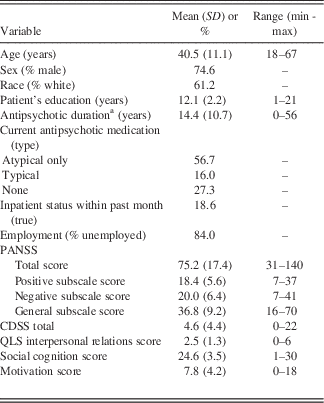
Sociodemographic and clinical characteristics of sample (N=1378)

a Duration since first antipsychotic prescription can be interpreted as a proxy measure for duration of illness.
CDSS=Calgary Depression Scale for Schizophrenia; PANSS=Positive and Negative Syndrome Scale; QLS=Heinrichs-Carpenter Quality of Life Scale; Min=minimum value; Max=maximum value.
The study inclusion criteria have been reported previously (Stroup et al., Reference Stroup, McEvoy, Swartz, Byerly, Glick, Canive and Lieberman2003). Briefly, participants were eligible if they were between the ages of 18 and 65 years and had a diagnosis of schizophrenia confirmed using the Structured Clinical Interview for DSM-IV Axis I Disorders (First, Reference First1997). Participants were excluded from the study if they had a diagnosis of schizoaffective disorder, mental retardation, pervasive developmental disorder, delirium, dementia, amnesia, or other cognitive disorders; had only one episode of schizophrenia; were pregnant or breast-feeding; or had a serious and acutely unstable medical condition.
The study was approved by the institutional ethics review board at each site, and written informed consent was obtained from the patients or their legal guardians. All participants demonstrated adequate decision-making capacity in regards to participating in the study as determined by the MacArthur Competence Assessment Tool (Appelbaum & Grisso, Reference Appelbaum and Grisso2001).
Instruments
Social cognition was evaluated using the Facial Emotion Discrimination Task (FEDT) (Keefe et al., Reference Keefe, Mohs, Bilder, Harvey, Green, Meltzer and Sano2003; Kerr & Neale, Reference Kerr and Neale1993). The FEDT is designed to evaluate emotional processing, which is considered a key component of social cognition (Green et al., Reference Green, Penn, Bentall, Carpenter, Gaebel, Gur and Heinssen2008). In this task, two same-sex human faces are presented adjacently and participants are required to determine whether the two faces are expressing the same or different emotions. Performance on this measure is taken as the sum of the number of correct responses across 30 trials (Keefe et al., Reference Keefe, Bilder, Harvey, Davis, Palmer, Gold and Lieberman2006). As a group, patients with schizophrenia perform significantly worse on this test compared to healthy volunteers (Kerr & Neale, Reference Kerr and Neale1993; Mueser et al., Reference Mueser, Doonan, Penn, Blanchard, Bellack, Nishith and DeLeon1996; Penn et al., Reference Penn, Combs, Ritchie, Francis, Cassisi, Morris and Townsend2000; Salem, Kring, & Kerr, Reference Salem, Kring and Kerr1996).
Intrinsic motivation was evaluated using three items from intrapsychic foundations subscale of the Heinrichs-Carpenter Quality of Life Scale (QLS) (Heinrichs, Hanlon, & Carpenter, Reference Heinrichs, Hanlon and Carpenter1984): sense of purpose, motivation, and curiosity. These items tap into core constructs of self-determination theory, which defines intrinsic motivation as interest in, drive toward, and enjoyment of activities and goals for their own sake (Ryan & Deci, Reference Ryan and Deci2000). While there is no “gold standard” instrument for the assessment of intrinsic motivation in schizophrenia, this derived 3-item measure has been used in numerous empirical studies examining this construct in patients with schizophrenia (Davis & Brekke, Reference Davis and Brekke2013; Fervaha, Zakzanis, et al., Reference Fervaha, Zakzanis, Foussias, Graff-Guerrero, Agid and Remington2014; Gard et al., Reference Gard, Fisher, Garrett, Genevsky and Vinogradov2009; Nakagami, Xie, Hoe, & Brekke, Reference Nakagami, Xie, Hoe and Brekke2008; Saperstein, Fiszdon, & Bell, Reference Saperstein, Fiszdon and Bell2011; Vohs, Lysaker, & Nabors, Reference Vohs, Lysaker and Nabors2013; Yamada, Lee, Dinh, Barrio, & Brekke, Reference Yamada, Lee, Dinh, Barrio and Brekke2010). The measure demonstrated good internal consistency in the present sample (Cronbach’s alpha=0.78), and each individual item was highly correlated with the overall motivation score (correlation range=0.81–0.85, all ps<.001). Moreover, this measure of motivation was highly related to the overall intrapsychic foundations subdomain score (r=0.91; p<.001).
The Positive and Negative Syndrome Scale (PANSS) was used to assess psychopathology (Kay, Fiszbein, & Opler, Reference Kay, Fiszbein and Opler1987). The PANSS is a 30-item clinician-rated instrument which assesses positive (e.g., hallucinatory behavior and delusions), negative (e.g., passive apathetic withdrawal and blunted affect), and general psychiatric symptoms (e.g., anxiety and lack of insight into illness). The items are score on a scale from 1 to 7, with higher scores indicating greater symptom severity. The PANSS total score was used in the present study as an index of severity of overall psychopathology, a measure which has been shown to have high convergence with other global illness severity measures (Leucht et al., Reference Leucht, Kane, Kissling, Hamann, Etschel and Engel2005). The PANSS demonstrated good internal consistency in the present sample (Cronbach’s alpha=0.87).
Other measures of interest were the Calgary Depression Scale for Schizophrenia (CDSS) to assess depressive symptoms (Addington, Addington, & Schissel, Reference Addington, Addington and Schissel1990), and the interpersonal relations domain of the QLS to assess social functioning (Heinrichs et al., Reference Heinrichs, Hanlon and Carpenter1984). The CDSS was used specifically as a measure of depressive symptoms in schizophrenia separate from negative symptoms (Addington, Addington, & Maticka-Tyndale, Reference Addington, Addington and Maticka-Tyndale1994; Collins, Remington, Coulter, & Birkett, Reference Collins, Remington, Coulter and Birkett1996). Individuals with a score greater than 6 on this instrument were identified as having moderate–severe depression, and likely meeting criteria for a major depressive disorder (Addington, Addington, & Maticka-Tyndale, Reference Addington, Addington and Maticka-Tyndale1993). The CDSS demonstrated good internal consistency in the current sample (Cronbach’s alpha=0.82). The measure of social functioning includes 8 clinician-rated items based on a semi-structured interview; the specific items tap into various aspects of psychosocial functioning including intimate relationships, activity with acquaintances, and social initiative. Notably, the QLS is among the most widely used measures of real-world functioning in patients with schizophrenia (Leifker, Patterson, Heaton, & Harvey, Reference Leifker, Patterson, Heaton and Harvey2011). This measure demonstrated good internal consistency in the present sample of patients (Cronbach’s alpha=0.87).
Statistical Analyses
Bivariate relationships were examined using Spearman’s rank-order correlation coefficients. Bivariate relationships were examined in the total sample, as well as subsamples of participants delineated based on clinical presentation. Specifically, patients with prominent positive symptoms, prominent negative symptoms, as well as patients in symptomatic remission were examined separately. Patients with a score of 4 (moderate severity) or greater on at least three items on the positive subscale of the PANSS were defined as meeting criteria for prominent positive symptoms. Similarly, those patients with a score of 4 or greater on at least 3 items on the negative subscale of the PANSS were defined as meeting criteria for prominent negative symptoms (Lapierre et al., Reference Lapierre, Angus, Awad, Saxena, Jones, Williamson and Grafford1999). Patients were identified as being in symptomatic remission if they had score of 3 (mild severity) or less on each of the following items on the PANSS: delusions, unusual thought content, hallucinatory behavior, conceptual disorganization, mannerisms and posturing, blunted affect, passive–apathetic social withdrawal, and lack of spontaneity and flow of conversation (Andreasen et al., Reference Andreasen, Carpenter, Kane, Lasser, Marder and Weinberger2005).
Because the performance scores on the social cognition measure were highly skewed (Keefe et al., Reference Keefe, Bilder, Harvey, Davis, Palmer, Gold and Lieberman2006), scores were also divided into high and low using a median split. Predictors of high versus low scores on this measure were then examined using logistic regression models, adjusted for selected covariates such as age and severity of psychopathology. For this analysis, β-values with standard errors (SE), Wald’s χ2 statistic, and odds ratios (OR) along with 95% confidence intervals (CIs) are reported. To complement the categorical logistic regression results, Spearman’s partial rank-ordered correlation coefficients, controlling for selected variables, were also computed (Schemper, Reference Schemper1991). Statistical tests were considered significant at a p-value of less than.05 (two-tailed). All analyses were conducted in SPSS Statistics version 20 (IMB Corp., Armonk, NY).
RESULTS
Motivation and social cognition data were available for 1378 patients with chronic schizophrenia. Sociodemographic and clinical characteristics of the sample are presented in Table 1. Briefly, participants had a mean age of 40.5 years, were mostly male, white and unemployed. Participants had a mean PANSS total score of 75.2, which corresponds approximately to a moderately severe global impression of illness severity (Leucht et al., Reference Leucht, Kane, Kissling, Hamann, Etschel and Engel2005).
Motivation and Social Cognition
Level of intrinsic motivation was significantly and positively correlated with the social cognition performance score (r=0.15; p<.001). Each individual item within the motivation measure was also individually associated with FEDT scores: sense of purpose (r=0.12; p<.001), goal-directed motivation (r=0.12; p<.001), and curiosity (r=0.13; p<.001). The relationship between motivation and social cognition remained significant for subsamples of patients with prominent positive symptoms (N=514; r=0.15; p=.001), prominent negative symptoms (N=520; r=0.13; p=.004), and for patients in symptomatic remission (N=221; r=0.16; p=.02).
Relationship between Social Cognition and Other Variables
Higher FEDT scores were also associated with lower severity of psychopathology (r=0.13; p<.001), and younger age (r=0.12; p<.001). Notably, these relationships of age-related and psychopathology-related decline in cognitive performance have also been found with neurocognition (Keefe et al., Reference Keefe, Bilder, Harvey, Davis, Palmer, Gold and Lieberman2006).
Motivation and Social Cognition - Independent of other Variables
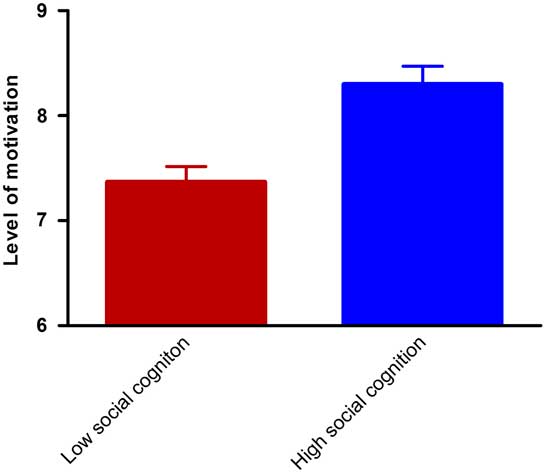
The median score on the FEDT was 25, and 635 participants (46.1% of the sample) scored above this. In the examination of high versus low scores categorically, motivation was a significant determinant of higher scores (β=0.05; SE=0.01; Wald’s χ2=16.77; OR=1.06; CI=[1.03,1.08]; p<.001; Figure 1). Motivation remained a significant predictor after adjusting for both age and severity of psychopathology (β=0.03; SE=0.01; Wald’s χ2=5.12; OR=1.03; CI=[1.004,1.06]; p=.02). Higher motivation was also associated with higher scores on the FEDT, after controlling for age and psychopathology (r=0.10; p<.001).
Level of motivation for patients with schizophrenia stratified by social cognition scores. Error bars represent standard error of the mean.

As depressive symptoms may confound the assessment of motivation, we repeated the above analyses in patients with a low level of depressive symptoms thought to be under the threshold for a major depressive episode. Nine hundred sixteen patients were identified with absent or mild depressive symptoms, and in these patients motivation also emerged as a significant predictor of test performance (β=0.07; SE=0.02; Wald’s χ2=20.27; OR=1.07; CI=[1.04,1.11]; p<.001), even after controlling for age and severity of psychopathology (β=0.05; SE=0.02; Wald’s χ2=6.56; OR=1.05; CI=[1.01,1.08]; p=0.01). In these patients with minimal depression, motivation was significantly linked to FEDT performance (r=0.18; p<.001), even after controlling for age and psychopathology (r=0.12; p<.001).
As antipsychotics might affect cognitive test performance, and therefore might confound any relationships between cognition and other variables, we repeated the analyses in antipsychotic-free patients. Three hundred seventy-seven patients reported not receiving any antipsychotic medication for at least 2 weeks, and even in these patients motivation was significantly linked to FEDT performance (r=0.15; p=0.003). After controlling for age and psychopathology, the pattern of association between motivation and social cognition remained similar, although the level of statistical significance only trended toward significance (r=0.09; p=0.08). Notably, the magnitude and direction of this relationship was similar for patients receiving antipsychotic medications (N=1001; r=0.15; p<.001), a finding that remained statistically significant after controlling for age and severity of psychopathology (r=0.10; p=0.002).
Previous work has suggested that two constructs may be related not because they are inherently linked, but rather because they both share variance with a distal outcome. This has been suggested as a possible explanation for the association between negative symptoms and cognition (Harvey, Koren, Reichenberg, & Bowie, Reference Harvey, Koren, Reichenberg and Bowie2006). As both motivation and social cognition were related to social functioning (r=0.53; p<.001 and r=0.10; p<.001, respectively), we re-examined the predictive value of motivation in determining social cognition scores after including social functioning as a covariate into the logistic regression model. Level of motivation continued to demonstrate significant predictive value for social cognition scores (β=0.05; SE=0.02; Wald’s χ2=11.39; OR=1.05; CI=[1.02,1.09]; p=0.001), even after additionally controlling for age and illness severity (β=0.04; SE=0.02; Wald’s χ2=5.53; OR=1.04; CI=[1.01,1.07]; p=0.02). Moreover, greater motivation was significantly associated with higher FEDT scores after controlling for social functioning (r=0.12; p<.001), and after additionally controlling for age and psychopathology (r=0.09; p=0.001).
Motivation as a Mediator Variable
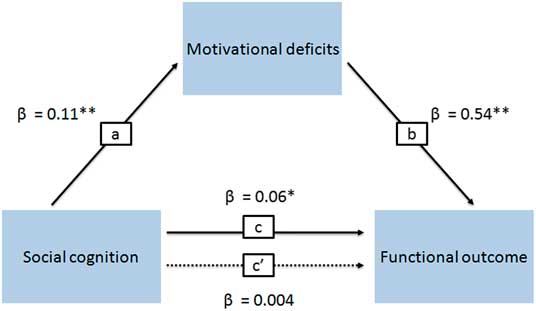
Given that both motivation and social cognition were related to social functioning, we were interested in whether motivational deficits mediated the relationship between social cognition and outcome. We tested this using mediation analysis (Baron & Kenny, Reference Baron and Kenny1986), with social cognition scores examined categorically. First, social cognition was significantly related to functional outcome (β=0.06; p=0.02). Second, social cognition was associated with motivation (β=0.11; p<.001). Motivation was also related to functioning scores (β=0.54; p<.001). Finally, when both motivational deficits and social cognition were used to predict functional outcome, motivation emerged as a significant predictor (β=0.54; p<.001) but social cognition did not (β=0.004; p=0.88). The Sobel’s test was significant (p<.001), demonstrating that motivation mediated the relationship between social cognition and functional outcome (Figure 2).
Mediation model, testing whether motivational deficits mediate the relationship between social cognitive performance and functional outcome (social functioning). The lines represent: (a) the direct effect of social cognition on motivation, (b) the direct effect of motivation on social functioning, (c) the direct effect of social cognition on functioning, and (c') the indirect effect of social cognition on functional outcome after parsing the contribution of motivation. **p<.001. *p<.05.

DISCUSSION
The present study examined the relationship between intrinsic motivation and performance on a social cognition test in individuals with schizophrenia. Our results reveal that poor motivation is significantly associated with worse performance on a selected test of social cognition, suggesting that impairments in social cognition in people with schizophrenia may partly be secondary to deficits in motivation. Importantly, this association between motivation and performance cannot be explained by severity of psychopathology, which itself was related to cognitive performance in the present study.
The amount of overlap between motivation and social cognitive performance was notably small. This may in part be related to the specific test or domain of social cognition assessed. There is some evidence that other facets of social cognition (e.g., theory of mind) are more strongly related to intrapsychic functioning, which encompasses motivation, compared to emotion processing as assessed in the present study (Tas et al., Reference Tas, Brown, Cubukcuoglu, Aydemir, Danaci and Brune2013). Nonetheless, the present study did discern a significant association that could not be accounted for by peripheral variables such as age or illness severity.
Social cognition and deficits therein have been receiving increasing attention in the context of schizophrenia research, in large part due to the impact these deficits have on functional outcome (Couture et al., Reference Couture, Penn and Roberts2006; Fett et al., Reference Fett, Viechtbauer, Dominguez, Penn, van Os and Krabbendam2011). Our results suggest that the magnitude of social cognition deficits is also related to level of motivation, and therefore assessing the impact of the former on functional outcome should be accompanied by consideration of the latter. To this end, one study has demonstrated that at least a portion of the relationship between social cognition and functioning is mediated through motivation (Gard et al., Reference Gard, Fisher, Garrett, Genevsky and Vinogradov2009). Consistent with this previous study, the present investigation also found that motivation mediates the relationship between social cognition and functional outcome.
The significant link between motivation and functioning in the final regression model of the mediation analysis highlights the importance of motivational deficits in the terms of their impact on functional outcomes. The present findings concur with previous studies that have found amotivation to be among the most robust predictors of outcome (Fervaha, Foussias, Agid, & Remington, Reference Fervaha, Foussias, Agid and Remington2013; Foussias et al., Reference Foussias, Mann, Zakzanis, van Reekum, Agid and Remington2011; Konstantakopoulos et al., Reference Konstantakopoulos, Ploumpidis, Oulis, Patrikelis, Soumani, Papadimitriou and Politis2011). Once motivational deficits were considered, other variables such as performance on neurocognitive tests offered little to no incremental predictive value. The present results extend this notion to include social cognition; once motivational deficits are accounted for, poor social cognition, at least as evaluated in the present study (i.e., emotion processing), has little to no predictive value for the determination of functioning. The findings are also consistent with previous work demonstrating a mediatory role of motivational deficits for the relationship between social cognition and outcome (Gard et al., Reference Gard, Fisher, Garrett, Genevsky and Vinogradov2009; Green, Hellemann, Horan, Lee, & Wynn, Reference Green, Hellemann, Horan, Lee and Wynn2012).
The present study has several limitations. First, only a single measure of social cognition was used in this study, tapping into only one (i.e., emotion processing) of several facets of social cognition (Green et al., Reference Green, Penn, Bentall, Carpenter, Gaebel, Gur and Heinssen2008). Similarly, motivation was also evaluated by a single measure. Future studies should examine the relationship between effort/motivation and performance on social cognition tests using multiple indicators of effort/motivation (e.g., performance validity tests) and multiple tests of social cognition that span the cognitive domains more comprehensively. Our study did not include a control group, so it remains unclear whether the relationships between motivation and social cognition observed here in schizophrenia patients would also be seen in other populations. Nonetheless, our findings do hold for patients with schizophrenia, who as a group demonstrate impairments in both of these domains. Finally, although we interpret the observed association between motivation and social cognition as intrinsic motivation impacting test performance, it remains possible that high social cognition ability promotes motivation. Another alternative possibility is that a yet to be discerned third variable is related to both motivation and social cognition, and that the relationship between the latter two variables simply reflects shared variance with this distal variable. One such potential variable is metacognition, which has been linked to motivational deficits (Tas, Brown, Esen-Danaci, Lysaker, & Brune, Reference Tas, Brown, Esen-Danaci, Lysaker and Brune2012; Vohs & Lysaker, Reference Vohs and Lysaker2014) and social cognition in patients with schizophrenia (Lysaker et al., Reference Lysaker, Leonhardt, Brune, Buck, James, Vohs and Dimaggio2014).
The present study set out to examine the relationship between performance on a test of social cognition and level of motivation in a large and heterogeneous sample of patients with schizophrenia. We found that motivational deficits were significantly, albeit weakly, associated with scores on the social cognition test, to an extent that could not be accounted for by potential confounds such as severity of illness. This suggests that motivation and social cognition are distinctly linked, and that future studies examining social cognitive performance should also consider effort and motivation. Furthermore, the importance of motivational deficits is underscored by its mediatory role in the observed relationship between social cognition social functioning.
Acknowledgments
This work was supported, in part, by a Vanier Canada Graduate Scholarship (to G.F.). This funding source had no further role in study design, statistical analysis or interpretation of findings; in writing of the manuscript; or in the decision to submit for publication. Data used in the preparation of this article were obtained from the limited access datasets (Version 1) distributed from the NIH-supported “Clinical Antipsychotic Trials of Intervention Effectiveness in Schizophrenia” (CATIE-Sz). This is a multisite, clinical trial of persons with schizophrenia comparing the effectiveness of randomly assigned medication treatment. The study was supported by NIMH Contract #N01MH90001 to the University of North Carolina at Chapel Hill. The ClinicalTrials.gov identifier is NCT00014001. This manuscript reflects the views of the authors and may not reflect the opinions or views of the CATIE-Sz Study Investigators or the NIH. Disclosures: Fervaha and Siddiqui have no conflicts to disclose. Foussias has been involved in research sponsored by Medicure Inc., and Neurocrine Bioscience, has received consultant fees from Roche, and has received speaker fees from Roche, Lundbeck, and Novartis. Agid has received research support from Pfizer Inc. and Janssen-Ortho, consultant fees from Janssen-Ortho, Eli Lilly Inc. US, Eli Lilly Canada, Sepreacor, Sunovion and Lundbeck, and speaker’s fees from Janssen-Ortho, Eli Lilly Inc. US, Eli Lilly Canada, Novartis, Sepracor and Sunovion. Remington has received research support from Novartis, Medicure and Neurocrine Bioscience, as a co-investigator he has received grant support from Pfizer Inc., consultant fees from LaboratoriosFarmacéuticos ROVI, Synchroneuron, Novartis, and Roche, and speaker’s fees from Novartis.